
Globally, approximately 90% of annual antibiotic consumption occurs in food-producing animal operations (Lutfiyati et al., 2024; Ngunguni et al., 2024), showing their widespread application in animal production systems (Ngunguni et al., 2024). Although this practice has boosted production efficiency and economic returns in animal farming, excessive antibiotic use has triggered significant challenges (Korver, 2023). For instance, antibiotic overuse leads to hazardous residue levels in animal-sourced food products, posing direct health risks to consumers. Long-term consumption of antibiotic-contaminated products may disrupt human gut microbiota balance, potentially leading to various health disorders. More worryingly, the abuse of antibiotics has driven the widespread emergence of antibiotic resistance (AR). AR not only reduces therapeutic efficacy but may also leave previously treatable infections untreatable or incurable.
AR, a subset of antimicrobial resistance, refers to the ability of certain microorganisms (especially pathogens) to tolerate antibiotics that were once effective against them. This means these microbes can survive and proliferate in the presence of antibiotics, diluting their capacity to treat infections (Mba and Nweze, 2022; Ranjbar and Alam, 2022). The World Health Organization (WHO) defines such pathogens as those with “the capacity to block antimicrobial activity”, and AR is now recognized as a major threat to global health, causing around 700,000 deaths annually from untreatable infections (World Health Organization, 2019). AR reduces the efficacy of traditional treatments, prolongs disease duration, increases mortality rates, and wastes healthcare resources. Recent years have seen a surge in multidrug-resistant pathogens with heightened virulence, exacerbating challenges in antimicrobial therapy (Ranjbar and Alam, 2022). The rise of AR is driven by factors such as excessive antibiotic use, target site modification, reduced antibiotic permeability, enhanced drug inactivation/efflux (Mulani et al., 2019). Antibiotic residues in animal-sourced products, such as chloramphenicol, beta-lactams, streptomycin, sulfonamides, tetracyclines, and quinolones in dairy, can trigger allergic responses and come into being resistant bacteria (Chiesa et al., 2020). In response, the WHO urged against using antibiotics as growth promoters in animal production, emphasizing concerns over residual contamination in animal-sourced foods (e.g., meat and dairy) (World Health Organization, 2019). These residues may accumulate in the environment and accelerate the spread of resistant strains. This stance addresses dual risks: environmental antibiotic accumulation and accelerated evolution of multidrug-resistant pathogens. Resistant strains compromise conventional treatments, significantly increasing infection management complexity and costs.
Thus, the development of antibiotic alternatives has become critical in modern animal production, with significance across multiple dimensions. (1) Curbing antibiotic overuse and resistance. Implementing alternatives reduces antibiotic overuse, thereby preserving antibiotic efficacy and curbing resistant pathogen transmission. (2) Ensuring food safety. Alternative strategies minimize drug residues in animal-sourced foods, lowering risks of allergic responses and chronic health impacts on consumers. (3) Enhancing animal welfare. Unlike broad-spectrum antibiotics that disrupt gut microbiota, targeted alternatives maintain microbial balance while preventing infections, improving animal health outcomes. (4) Meeting market demands for sustainable agriculture. Growing consumer preference for antibiotic-free products drives sustainable agriculture development. Alternatives enable producers to align with this trend while maintaining productivity.
Given the above, developing antibiotic alternatives addresses critical needs across multiple fronts: mitigating resistance transmission, reducing residue-related risks, enhancing animal welfare, and meeting market demands for safer food systems. Among emerging solutions, antimicrobial peptides (AMPs), naturally occurring host defense molecules in plants and animals, have garnered significant attention as antibiotic alternatives (Gani et al., 2025; Mba and Nweze, 2022).
Overview of AMPs
AMPs are a category of oligopeptides containing diverse numbers of amino acids, ranging from 10 to 50. Their unique amino acid sequences and cationic properties endow them with strong bactericidal properties. Not only are they highly effective against bacteria, but also exhibit biological activity against fungi, parasites, and viruses. Remarkably, some AMPs even have inhibitory effects on cancer cells. These peptides are widely distributed in plants, insects, and mammals. As key molecules in the innate immune system, AMPs possess remarkable antimicrobial and immunomodulatory activities (Valdez-Miramontes et al., 2021; Yu et al., 2025). AMPs concentrate at pathogen entry portals and immunologically active sites, including epithelial barriers (e.g., skin, respiratory/gastrointestinal tracts), mucosal surfaces (e.g., oral cavity, eyes, reproductive organs), and specialized immune tissues (e.g., bone marrow, thymic epithelium) (Linde et al., 2009). Their primary role is to neutralize pathogens by disrupting microbial membranes and modulating host immune responses, thereby protecting the host from pathogenic challenges.
The discovery of AMPs began in 1939 when researchers isolated an antimicrobial agent from soil bacterium Bacillus spp. that protected mice from Streptococcus pneumoniae infections (Dubos, 1939; Hotchkiss and Dubos, 1940). This compound was later named AMP. In 1941, Dubos and Hotchkiss (1941) purified the extract and identified a specific AMP called tyrothricin. Subsequently, another AMP, tyrocidine, was discovered and found effective against both Gram-negative and Gram-positive bacteria (Balls et al., 1942). Another AMP, named as purothionin (Wada and Buchanan, 1981), was isolated from the plant Triticum aestivum and found effective against fungi and certain pathogenic bacteria (Kang et al., 2019).
The diversity and widespread distribution of AMPs reflect their critical roles and multifunctional nature in biological systems. These peptides not only serve as frontline defenders against external pathogens but also play essential roles in maintaining internal homeostasis and regulating immune responses (Lai et al., 2022; Satchanska et al., 2024). With ongoing research, AMPs have emerged as promising candidates for novel antibiotic alternatives. Their potential applications could address the urgent challenge of antibiotic resistance by offering new solutions to combat pathogenic infections.
Structural characteristics of AMPs
Most AMPs contain cysteine residues, which confer them exceptional molecular stability (Nguyen et al., 2011). Despite this conserved feature, AMPs exhibit remarkable diversity in their primary sequences and secondary structural arrangements. This structural variability leads to unique functionalities, interactions, and biological activities (Wang, 2015; Wang et al., 2016 b). In biochemistry, secondary structure refers to the spatial organization of amino acid residues within a protein (Lai et al., 2022). The two most common elements are α-helices and β-sheets. An α-helix is a coiled conformation stabilized by hydrogen bonds between adjacent residues, forming a rigid spiral structure. β-sheets, in contrast, are planar structures formed by hydrogen-bonded β-strands arranged in parallel or antiparallel orientations, creating layered sheet-like conformations. AMPs are classified into four major types based on their dominant structural features. The first type is linear α-helical peptides, which are rich in α-helical structures and crucial for stability and interactions. For example, the cecropin, a typical AMP, has an α-helical structure. The combination of helix length, charge distribution, and hydrophobic residue orientation within these peptides explains their broad-spectrum antimicrobial activities (Graf et al., 2017; Porcelli et al., 2013; Staczek et al., 2024; Sugden et al., 2016). The second type is linear extended structures that lack common α-helical or β-sheet structures and are often composed of continuous sequences of specific amino acids (e.g., glycine, arginine, tryptophan, or proline). These AMPs may have other secondary structures or disordered structures. Although they lack obvious secondary structures, they are biologically active, such as human histatin and psoralen, which play important physiological roles in signal transduction, metabolic regulation, and defense against pathogens (Andersson et al., 2012; Kokryakov et al., 1993; Min et al., 2017). Furthermore, certain AMPs are characterized by abundant β-sheet structures, forming sheet-like conformations. β-sheets are common secondary structures in proteins, formed by hydrogen bonds between amino acid residues, and play a key role in protein stability and function. In proteins, β-sheets enhance stability and are essential for functional performance through parallel or antiparallel arrangements of peptide chains linked by hydrogen bonds (Min et al., 2017). This structural characteristic allows these AMPs to play key roles in various biological processes, including defense mechanisms against microbial infections and enhancement of molecular stability. Specific amino acid sequences can significantly influence the formation and stability of β-sheet structures. Interactions between certain amino acid residues, such as hydrophobic interactions and hydrogen bonds, contribute to stabilizing these β-sheets. These sequence characteristics are crucial for the correct folding and functional performance of proteins (Koehbach, 2017). Consequently, AMP molecules rich in β-sheets may possess unique stability and functional properties. A fourth class of AMPs combines α-helical and β-sheet structures, notably exemplified by defensins. These molecules are widely distributed across the biological kingdom and exhibit potent biological activities. Besides α-defensins, other categories of defensins exist that integrate both α-helices and β-sheets into their architecture (de Oliveira et al., 2025; Shafee et al., 2017). This structural diversity allows defensins to perform similar defensive roles across species, though their specific mechanisms and efficacy may vary with evolutionary adaptations. Notably, defensins are found not only in humans and other mammals but also in various invertebrates and plants (de Oliveira et al., 2025; Gil et al., 2024; Tietz et al., 2017). This broad distribution indicates that defensins have important conservation and functional diversity in the process of biological evolution. In different organisms, defensins may be involved in innate immunity, antibacterial, antiviral, and other biological processes, protecting the organism from external pathogens (Lorenzón et al., 2012; Tietz et al., 2017). Together, the four AMP types, including α-helical peptides, linear extended peptides, β-sheet-containing peptides, and α/β hybrid peptides, exhibit distinct structural and functional characteristics. These differences enable AMPs to engage in varied biological processes and signaling pathways, from membrane disruption to immune modulation, reflecting their adaptability in combating pathogens and maintaining host homeostasis.
Classification of AMPs
Generally, AMPs can be divided into four classes based on their target and mode of action, including antibacterial peptides, antiviral peptides, antifungal peptides, and antiparasitic peptides.
Antibacterial peptides
Antibacterial peptides are a class of bioactive molecules that primarily inhibit bacterial growth. Research on antibacterial peptides, especially cationic ones, is extensive, with a focus on their ability to disrupt bacterial cell membranes. At sufficient concentrations, these peptides can cause membrane disintegration and bacterial death (Xie et al., 2011). However, their mechanisms are not limited to membrane disruption. For example, buforin II can diffuse into bacterial cells and bind to DNA and RNA, inhibiting synthesis processes and causing bacterial death (Otvos et al., 2000). This intracellular action is more targeted than membrane disruption. Other antibacterial peptides, such as drosocin, pyrrhocoricin, and apidaecin, typically have 18–20 amino acid residues and specific intracellular binding sites (El-Kazzaz and Abou El-Khier, 2020; Kragol et al., 2001; Staczek et al., 2024). These sites enable them to interact with specific cellular components, achieving their antibacterial effects. Some antibacterial peptides can even kill antibiotic-resistant bacteria. For instance, nisin, like the antibiotic vancomycin, can block cell wall synthesis (Li et al., 2021). In summary, antibacterial peptides are diverse and versatile. They can kill bacteria by disrupting membranes or interfering with intracellular processes, making them potential antibiotic alternatives and offering new strategies for combating bacterial infections.
Antiviral peptides
Antiviral peptides (AVPs) are bioactive peptides that neutralize viruses through diverse mechanisms to protect host cells from infection. A common strategy involves integrating into viral envelopes or host cell membranes, destabilizing viral integrity and infectivity. Enveloped RNA and DNA viruses, whose lipid bilayer membranes resemble host cell membranes, are particularly susceptible to AVP targeting. By disrupting viral envelope structure, AVPs render viruses incapable of infecting host cells (Agamennone et al., 2022; Boas et al., 2019). Additionally, some AVPs bind viral surface glycoproteins to block viral attachment to host cells. For instance, defensins neutralize herpes simplex virus (HSV) by inhibiting glycoprotein-mediated binding, preventing viral entry and replication (Jenssen et al., 2004; Ohradanova-Repic et al., 2023; Sukmarini, 2022). This mechanism reduces both viral attachment and infectivity, exhibiting potent activity against enveloped viruses like HSV (Owliaee et al., 2025; Skalickova et al., 2015).
Beyond envelope disruption and receptor blocking, AVPs can also prevent viral entry by occupying specific host cell receptors critical for viral attachment. Heparan sulfate, for example, plays a key role in HSV particle binding to host cells (Papy-Garcia and Albanese, 2017). Another mechanism involves AVPs entering host cells to modulate gene expression, enhancing antiviral immunity or blocking viral gene expression (Mahajan et al., 2021). NP-1, a peptide derived from rabbit neutrophils, inhibits HSV-2 infection in Vero and CaSki cells without competing for cell surface receptors; instead, it prevents intercellular viral spread (Heydari et al., 2021). These multifaceted mechanisms, encompassing membrane disruption, receptor interference, and intracellular modulation, enable AVPs to combat viruses through diverse, synergistic pathways (Nayab et al., 2022; Wimley and Hristova, 2011).
Antifungal peptides
Antifungal peptides are bioactive molecules that target fungal cell walls or intracellular components to kill fungi, leveraging mechanisms that differ from antibacterial peptides due to structural disparities between bacterial membranes and fungal cell walls (Sharma et al., 2025; van der Weerden et al., 2013). Unlike bacterial targets, fungal cell walls contain chitin as a primary component, enabling certain antifungal peptides to bind specifically through sequences or domains that form stable complexes with chitin, destabilizing cell wall integrity and causing fungal cell lysis (Rautenbach et al., 2016). Others inhibit enzymes critical for chitin synthesis during cell wall biogenesis, blocking fungal growth by disrupting this key metabolic pathway (De Cesare et al., 2020; Ul Haq et al., 2024).
The relationship between antifungal peptide structure and their target specificity is multifaceted. While many contain polar and neutral amino acids (Sharma et al., 2025), structural diversity, including α-helical, extended, and β-sheet conformations, reflects their functional adaptability (Struyfs et al., 2021; Ul Haq et al., 2024). Their efficacy is determined not solely by structural features but by a combination of amino acid sequence, charge distribution, hydrophobicity, and physicochemical properties that collectively govern their interaction with fungal cells (Gamage and Pan, 2024; Pandidan and Mechler, 2025; Zasloff, 1987). This complexity underscores the versatility of antifungal peptides in targeting diverse fungal pathogens through mechanisms that transcend simple structural correlations.
Antiparasitic peptides
Antiparasitic peptides, though representing a smaller subset within the AMPs family, exhibit unique bioactivities and mechanisms of action. While research in this domain remains limited compared to antibacterial, anti-viral, or antifungal AMPs, significant advancements have emerged. Magainin (Zasloff, 1987), the first reported antiparasitic peptide, demonstrates potent activity against protozoans like Paramecium. Building on this, synthetic peptides targeting Leishmania parasites, causative agents of cutaneous leishmaniasis (black fever), have been engineered, offering novel therapeutic candidates (Alberola et al., 2004). Cathelicidins further exemplify this class, eliminating multicellular parasites such as Caenorhabditis elegans through pore-forming activity in cellular membranes (Schneider et al., 2016).
Notably, despite targeting multicellular organisms, antiparasitic peptides share mechanistic parallels with other AMPs, primarily relying on direct membrane interaction to disrupt cellular integrity. This conserved mode of action, combining rapid membrane destabilization with selective toxicity, positions antiparasitic peptides as versatile agents against diverse parasitic infections, with reduced resistance risks due to their physical disruption mechanisms.
The antimicrobial mechanism of AMPs
AMPs exert bactericidal effects through two primary mechanisms after binding to bacterial cell membranes (Khavani et al., 2024; Pirtskhalava et al., 2021). The first mechanism involves direct disruption of the membrane structure, leading to compromised integrity and leakage of cellular contents, which rapidly causes bacterial death (Wimley, 2010). The second mechanism involves AMPs penetrating into the bacterial cytoplasm, where they inhibit critical cellular processes such as DNA replication, transcription, and translation, disrupt cell wall synthesis, and suppress intracellular enzyme activities, ultimately leading to bacterial demise (Lan et al., 2010; Pirtskhalava et al., 2021). Notably, the membrane-disrupting mechanism is more rapid in action compared to the intracellular pathway (Benfield and Henriques, 2020; Lan et al., 2010; Nayab et al., 2022).
AMPs act on microbial cell membranes
AMPs exert antimicrobial activity through non-specific electrostatic interactions with microbial membrane phospholipids (Dawson and Liu, 2008; Nayab et al., 2022; Shai, 2002). The cationic charge of AMPs, derived from their alkaline amino acids, enables selective binding to negatively charged components on bacterial surfaces, lipoteichoic acids in Gram-positive bacteria and lipopolysaccharides in Gram-negative bacteria (Tong et al., 2021). Eukaryotic cell membranes have a positive charge, preventing AMP binding. This charge-based selectivity ensures AMPs target bacterial cells specifically (Ma et al., 2024). This charge-driven mechanism underlies AMPs’ broad-spectrum efficacy. Unlike receptor-targeted antibiotics, AMPs rely on electrostatic attraction to initiate membrane interaction, bypassing pathogen-specific resistance pathways (Priyadarshini et al., 2022). Hydrophobic residues in AMPs further mediate insertion into the lipid bilayer by binding to membrane hydrophobic tails. Concurrently, their hydrophilic residues disrupt the membrane’s hydrophobic core, inducing pore formation or structural collapse. This dual action triggers rapid osmotic imbalance, cytoplasmic leakage, and bacterial death (Hale and Hancock, 2007; Yoon et al., 2024). To date, the interaction mechanisms between AMPs and bacterial membranes are primarily explained by four dominant models, including barrel-stave model, carpet model, toroidal pore model, and aggregate model (Figure 1) (Khavani et al., 2024; Pálffy et al., 2009; Pouny et al., 1992). These models describe how AMPs disrupt membrane integrity to induce microbial cell death, depending on peptide concentration, membrane composition, and structural features of the AMPs.
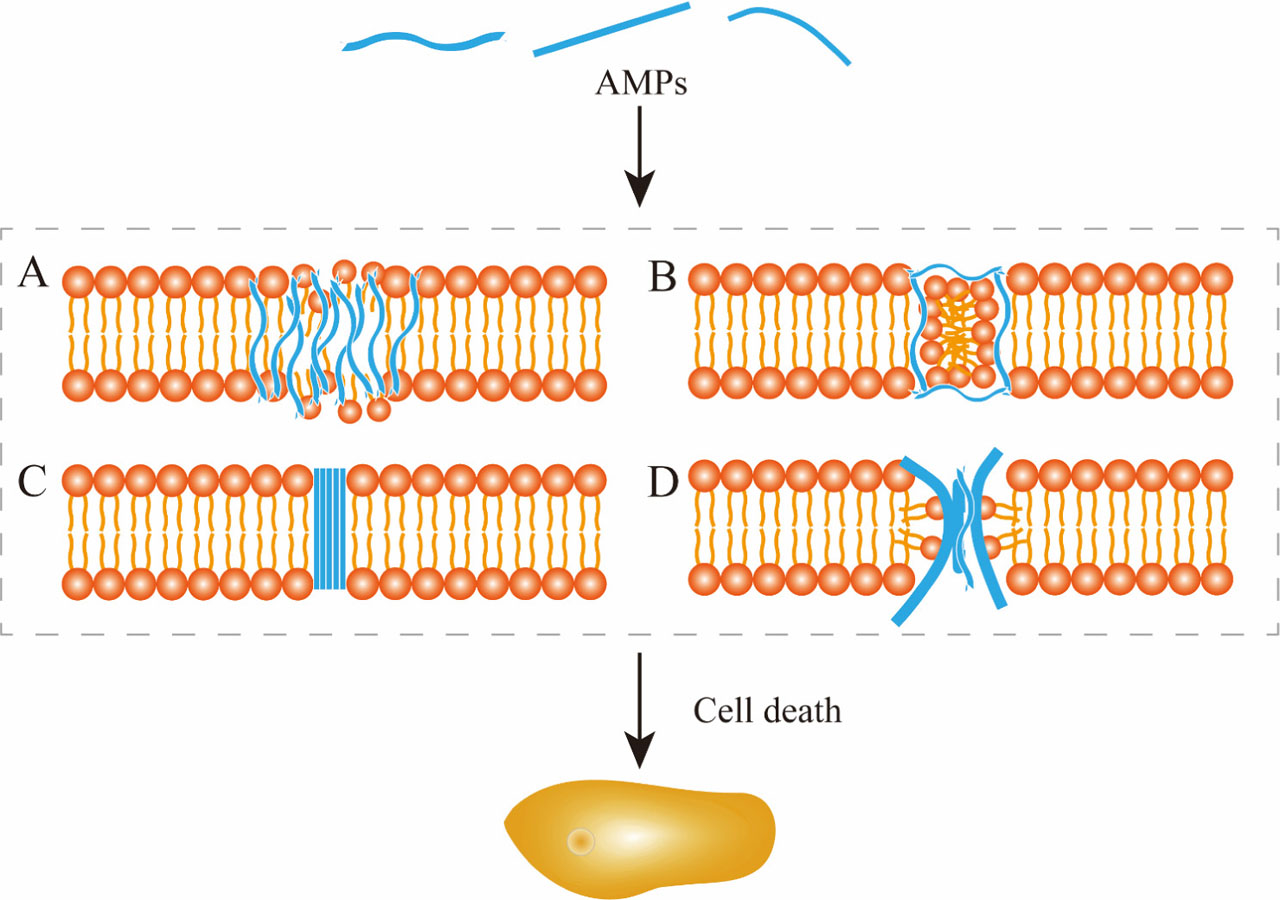
Figure 1.
Membrane permeabilization mechanism of AMPs. (A) Aggregate model. (B) Carpet model. (C) Barrel-stave model. (D) Toroidal pore model.
In 1991, it has been reported that the mechanism of pore formation employed by pardaxin and its analogues with lipid bilayers could be described by the “barrel-stave” model (Rapaport and Shai, 1991). In the barrel-stave model, AMPs insert their hydrophobic regions into the lipid bilayer, aligning parallel to the membrane plane. The hydrophobic regions of the AMPs interact with lipid tails, while their hydrophilic regions face the aqueous environment, creating a transmembrane pore. The peptides act as rigid “staves”, forming transmembrane channels that resemble the staves of a barrel. These channels allow ions and molecules to pass through the membrane, disrupting the cellular internal environment, leading to osmotic imbalance and cell death (Kumari and Booth, 2022). Typically observed in α-helical AMPs with a clear hydrophobic/hydrophilic charge separation (e.g., magainin). Moreover, AMPs preferentially affects Gram-negative bacteria due to their thinner peptidoglycan layer. For instance, alamethicin forms transmembrane channels by arranging itself in a barrel-like structure around an aqueous pore (Wimley, 2010). The hydrophobic regions of alamethicin interact with the membrane lipids, while the hydrophilic regions form the interior of the channel (Nagao et al., 2015; Wimley, 2010). Another example that forms barrel-stave channels is that gramicidin S creates pores that allow ions to pass through the membrane of Staphylococcus aureus, Enterococcus faecalis and E. faecium (Berditsch et al., 2019; Talapko et al., 2022).
The carpet model was first reported in 1992 (Pouny et al., 1992). Here, AMPs accumulate parallel to the membrane surface like a “carpet”, driven by electrostatic interactions with lipid headgroups. Upon reaching a critical concentration, they disrupt lipid packing through detergent-like effects, causing global membrane thinning and micellization. In this model, antimicrobial peptides induce global membrane thinning, rather than form specific pores. This action is very effective against membranes with high anionic lipid content. This non-pore-forming mechanism is characteristic of temporins and other short helical peptides. The indolicidin, a tryptophan-rich AMP, was observed to cover the model membranes by an in situ atomic force microscopy, following the carpet model (Shaw et al., 2006). These authors also found that the indolicidin-membrane association is influenced greatly by specific electrostatic interactions, lipid fluidity, and peptide concentration (Shaw et al., 2006). Aurein 1.2 exerts its bioactivity through aggregation-driven membrane permeation, inducing spontaneous curvature on the membrane by altering outer leaflet tension, ultimately leading to membrane destabilization and disintegration (Fernandez et al., 2012; Shahmiri et al., 2015). The carpet model for the membrane permeabilization mechanism also adapts to other AMPs, such as LFampin 265–284 (Bastos et al., 2011), copolyoxetane (Wang et al., 2016 a), melittin (Wimley, 2018), pepD2M (Chen et al., 2023), cecropin A (Tian et al., 2024), and so on.
Proposed and established in 1996 (Matsuzaki et al., 1996), this toroidal pore model has seen ongoing refinements over the years. AMPs form toroidal (doughnut-shaped) pores in the cell membrane. These pores create a pathway for the exchange of ions and molecules between the inside and outside of the cell, disrupting the cell’s homeostasis and causing death. There is emerging evidence that cryo-electron microscopy visualizes lipid headgroup reorientation around pores (Sui et al., 2018). The peptides are embedded at the hydrophilic and hydrophobic interface of the membrane, and the lipid head groups are arranged on the inner side of the pore. In the model, pores maintain continuity between membrane leaflets and are preferred by flexible peptides with proline hinges (e.g., protegrin), which resist pore closure due to lipid involvement. It has been reported that protegrin-1 forms toroidal pores in bacterial membranes (Langham et al., 2008). Moreover, extension of sticholysins N-terminal α-helix induces membrane lipid curvature, thereby facilitating the formation of toroidal pores (Schreier et al., 2025). This highlights the critical role of structural dynamics in AMPs and membrane interaction, as conformational changes directly modulate lipid organization and pore formation efficiency.
The aggregate model involves AMPs interacting with the membrane phospholipids and causing them to aggregate into large structures (Hale and Hancock, 2007). AMPs disrupts the normal structure and function of the cell membrane, leading to the loss of cellular contents and bacterial cell death. The aggregation of lipids and peptides results in the formation of non-bilayer structures that compromise the membrane’s integrity (Luo and Song, 2021). The aggregate model is primarily associated with peptides enriched in β-sheet structures stabilized by disulfide bonds, which induce non-specific membrane disruption rather than pore formation and remain effective at low peptide concentrations. Atomic force microscopy (AFM) evidence confirms that these peptides generate membrane ripples and aggregation-induced defects, destabilizing lipid bilayers through collective peptide-membrane interactions and ultimately leading to cell permeabilization (Alsteens et al., 2017; Swana et al., 2021). Magainin 2 interacts with the membrane phospholipids and causes them to aggregate into large structures (Salnikov and Bechinger, 2011). This aggregation disrupts the normal structure and function of the cell membrane, leading to the loss of cellular contents and bacterial cell death (Salnikov and Bechinger, 2011). Another peptide that follows the aggregate model, dermaseptin-PH forms peptide-lipid complexes that compromise the integrity of the cell membrane (Huang et al., 2017).
The choice of model often depends on the AMPs’ structural features and the target membrane’s physicochemical properties. For example, α-helical peptides align with the barrel-stave mechanism, while β-sheet-rich peptides may prefer the toroidal or aggregate models. Interestingly, these models are not mutually exclusive, as many AMPs may transition between mechanisms depending on factors such as peptide concentration, membrane composition, and environmental conditions. For instance, low peptide concentrations might favor pore formation (barrel-stave or toroidal), while high concentrations could induce carpet-like membrane collapse. Experimental evidence, such as lipid leakage assays, electron microscopy, and molecular dynamics simulations, supports the coexistence of these pathways in different contexts. Collectively, these models highlight the versatility of AMPs in exploiting membrane vulnerabilities to execute their antimicrobial function and evolutionary adaptation to counter varying microbial membrane architectures.
AMPs act on internal molecules of microbes
Although the above membrane permeabilization mechanisms ultimately cause microbial cell death, accumulating evidence suggests that AMPs have extra intracellular targets (Ma et al., 2024; Nicolas, 2009). Certain AMPs can directly enter bacterial membranes and interfere with essential life activities inside, such as DNA replication, transcription, translation, protein synthesis, folding, and cell division. AMPs enter membranes mainly through non-energy-dependent direct penetration or energy-dependent endocytosis (Goda et al., 2010). After entering and accumulating in the cell membrane, AMPs can target intracellular macromolecules and biological processes for further action. These AMPs exhibit specific and diverse intracellular targets, including nucleic acid interactions, protein binding, and interference with protease activity (Le et al., 2017). As mentioned above, AMPs exert their antimicrobial activity through diverse intracellular mechanisms, acting on multiple targets to disrupt critical cellular processes. These mechanisms can be specifically summarized as follows: nucleic acid binding, protein synthesis interference, enzyme activity and energy metabolism suppression, oxidative stress and organelle damage, and multi-target synergy (Figure 2).
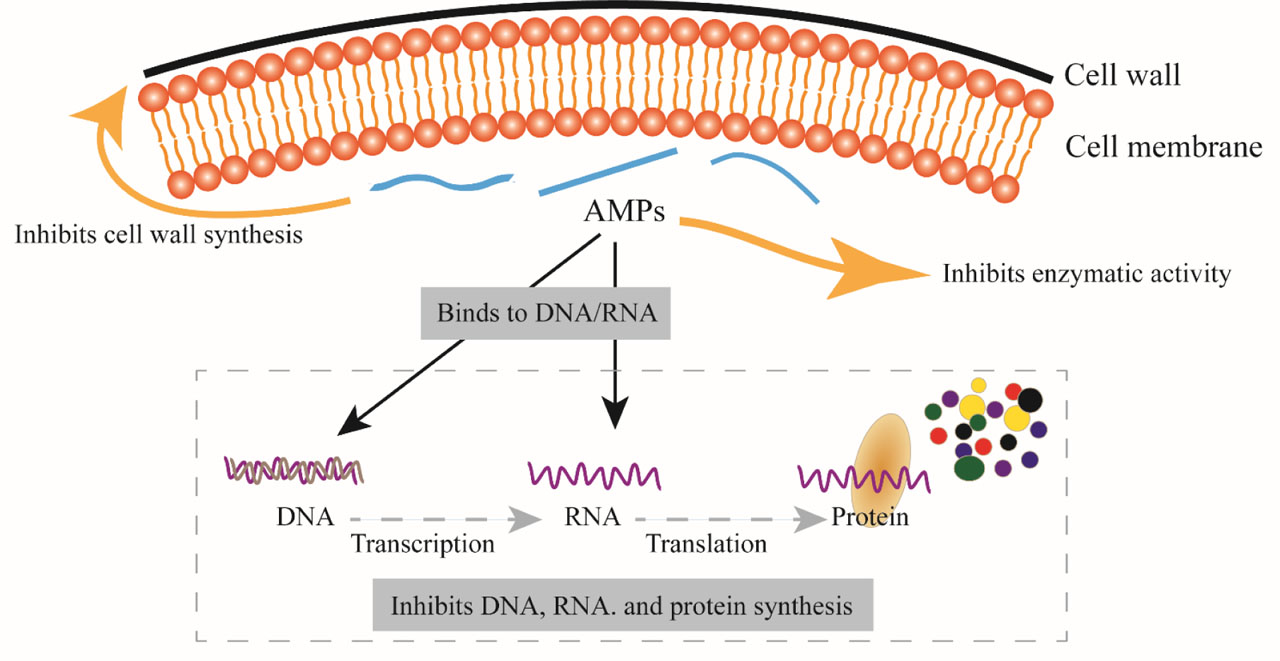
Figure 2.
Mechanism of intracellular damage.
The antimicrobial activity of peptides targeting nucleic acids (DNA/RNA) primarily arises from their ability to disrupt bacterial genetic processes through structural intercalation or electrostatic interactions (Chen et al., 2025 a). Positively charged AMPs bind to the anionic phosphate backbone of DNA via electrostatic adsorption, while hydrophobic domains enable intercalation into the DNA minor groove, destabilizing base-pair stacking. For instance, buforin II derivatives insert into DNA helices via hydrophobic interactions without disrupting the helical backbone (Rubio-Olaya et al., 2022; Uyterhoeven et al., 2008), whereas indolicidin forms covalent bonds with phosphate groups to block replication enzymes (Yuan et al., 2024). Structural specificity is crucially dependent on amphipathic α-helical conformations, where cationic residues (e.g., lysine, arginine) mediate electrostatic binding, and hydrophobic residues (e.g., leucine, phenylalanine) facilitate intercalation (Zhou and Pang, 2018; Zhu et al., 2015). Binding efficiency correlates with genomic AT content, as demonstrated by buforin II’s stronger affinity for AT-rich Staphylococcus aureus DNA compared to Escherichia coli. Functional outcomes include replication arrest and transcriptional suppression. AMPs like NK-18 stall replication forks by inhibiting helicase binding, while P5 peptide downregulates dnaA and rnhA expression by 2.79- and 2.36-fold, respectively, in E. coli (Yan et al., 2018). Charge and hydrophobicity critically modulate these interactions: increased net charge (e.g., P7 peptide, +7) enhances DNA binding, whereas excessive hydrophobicity may prioritize membrane over nucleic acid targeting (Dathe et al., 1997; He et al., 2021). Experimental validation employs gel-shift assays, spectral analyses (e.g., UV absorption shifts), and flow cytometry showing S-phase arrest (59.58% in P5-treated E. coli) (Lillebak and Kallipolitis, 2024; Thomson et al., 1999; Yakhnin et al., 2012). The multi-target nature of AMPs, simultaneously disrupting membranes and nucleic acids, reduces resistance risks, as seen in pleurocidin’s dual action against methicillin-resistant S. aureus (Piktel et al., 2024; Souza et al., 2013). Optimizing charge distribution and hydrophobic balance in peptide design could further enhance their precision in targeting genetic machinery, positioning AMPs as adaptable tools against evolving antimicrobial resistance.
AMPs inhibit protein synthesis through multi-tiered molecular targets, including ribosomal interference, translation factor blockade, chaperone inhibition, and energy disruption (Chen et al., 2025 a). By directly binding ribosomal subunits, AMPs such as Bac7 (lactococcal bacteriocin) disrupt initiation by blocking mRNA loading via interactions with initiation factor IF2 (Koch et al., 2022; Seefeldt et al., 2016), while TurlA/B (insect-derived AMPs) interfere with elongation by targeting elongation factor EF-Tu to prevent aminoacyl-tRNA entry (Zhan et al., 2022). Structural destabilization of ribosomes occurs when peptides like Cecropin-xJ insert into ribosomal RNA’s hydrophobic regions, causing 60S subunit dissociation (Liu et al., 2016; Ramos-Martín and D’Amelio, 2021). Translation is further impaired by AMPs targeting initiation factors. Indolicidin binds E. coli IF2 to block 30S subunit association (Caserta et al., 2006), and Microcin J25 indirectly halts initiation by inhibiting methionyl-tRNA formation (Ji et al., 2023). Molecular chaperones are also targeted. Apidaecin and pyrrhocoricin bind heat shock proteins (DnaK, HSP70), inhibiting their ATPase activity and preventing protein folding, leading to unfolded protein accumulation and apoptosis (Kragol et al., 2001). Energy depletion mechanisms include gramicidin S disrupting ATP synthase activity via phospholipid enzyme displacement (Berditsch et al., 2017) and pardaxin collapsing mitochondrial membrane potential to reduce ATP levels (Chen et al., 2021), while HGM-Hp peptides induce reactive oxygen species (ROS)-mediated damage to electron transport chain complexes (Peredo-Lovillo et al., 2020). Mitochondrial dysfunction further exacerbates protein degradation by triggering cytochrome c release. Melittin enhances Ca2+ uptake to activate apoptosis pathways (Wang et al., 2024), as seen with cGA-N12 in Candida tropicalis (Li et al., 2018). Experimental validations, such as SDS-PAGE showing reduced protein bands in Staphylococcus aureus treated with BCp12 (Shi et al., 2022) and proteomic analyses revealing decreased ATP synthase subunits in PR-39-exposed E. coli, confirm these mechanisms (Zhao et al., 2020). By simultaneously targeting ribosomes, translation machinery, chaperones, and energy pathways, AMPs create a multifaceted inhibition network that significantly reduces bacterial resistance potential.
Antimicrobial peptides disrupt bacterial physiology by targeting key enzymes and metabolic pathways. They inhibit cell wall synthesis by binding to lipid II precursors or directly suppressing Mur enzymes. For example, nisin and planosporicin block peptidoglycan chain elongation by interacting with lipid II (Prince et al., 2017; Wiedemann et al., 2001), while feglymycin inhibits MurA and MurC (Rausch et al., 2011). These peptides also interfere with nucleic acid metabolism by inhibiting RNA polymerase or DNA gyrase; McCJ25 binds to the β-subunit of RNA polymerase (Mukhopadhyay et al., 2004), and certain AMPs target topoisomerase IV (Yele and Azam, 2020).
AMPs further target metabolic pathway enzymes, such as hexokinase in the Embden-Meyerhof-Parnas (EMP) pathway or succinate dehydrogenase in the tricarboxylic acid (TCA) cycle, reducing ATP production (Capuano et al., 2025; Huang et al., 2023). SIF4, a metal-containing AMP, inhibits both hexokinase and succinate dehydrogenase in E. coli, decreasing glucose metabolism efficiency and energy output (Li et al., 2023, 2022). In terms of energy metabolism disruption, AMPs inhibit key enzymes like phosphofructokinase in the EMP pathway or components of the mitochondrial electron transport chain. For instance, magainin inhibits succinate dehydrogenase and NADH dehydrogenase, interrupting oxidative phosphorylation (Boostan and Yazdanparast, 2018). They also suppress ATPase activities, affecting ion homeostasis and energy supply. Additionally, SIF4 reduces Na+/K+-ATPase activity in E. coli, disrupting membrane potential (Li et al., 2023, 2022). Moreover, peptides like pardaxin damage mitochondrial membrane structures, inhibiting complex I, III, and IV activities (Chen et al., 2021), while HGM-Hp peptides induce ROS production, damaging mitochondrial DNA and enzymes (Wang et al., 2019). AMPs exert multiple effects through synergistic mechanisms. For example, SIF4 disrupts both the EMP and TCA pathways while damaging cell membranes, causing a dual collapse in energy and material metabolism. Daptomycin forms ion channels to disrupt membrane potential and simultaneously inhibits RNA synthesis, reducing the risk of resistance development (Huang, 2020; Müller et al., 2016). Experimental validation includes spectrophotometric assays showing SIF4 reduces Na+/K+-ATPase activity by over 50% (Li et al., 2023, 2022), metabolic profiling revealing decreased ATP and NADH levels in E. coli treated with PR-39 (Azari et al., 2020), and fluorescence probes demonstrating rapid mitochondrial membrane potential loss after magainin treatment (Lee and Lee, 2014). In summary, AMPs create a multi-layered antibacterial network by targeting key enzymes, energy metabolism pathways, and structural components, which can contribute to enhancing bactericidal efficacy and effectively delaying resistance development.
AMPs induce pathogen death by disrupting redox homeostasis and organelle integrity through oxidative stress and structural damage. These cationic peptides trigger excessive reactive oxygen species (ROS) production, such as H2O2 and superoxide anions, via membrane perturbation or metabolic interference. For instance, Maillard reaction-derived peptides (HGMHp1/Hp2) activate oxidative pathways, elevating intracellular H2O2 levels and causing DNA/protein oxidation, while histidine-rich AMPs bind mitochondrial membranes to disrupt respiratory complexes, amplifying ROS bursts (Habelreeh et al., 2025; Lipiski et al., 2013; Wang et al., 2019). Concurrently, AMPs cripple antioxidant defenses. LL-37 inhibits glutathione reductase, depleting glutathione (GSH) (Keshri et al., 2025; Zhang et al., 2022), and SIF4 blocks superoxide dismutase (SOD), preventing ROS neutralization (Tsai et al., 2011). Oxidative imbalance further activates proapoptotic pathways (e.g., p38 MAPK and JNK) and oxidizes thiol groups in cysteine residues, destabilizing critical enzymes. Mitochondrial dysfunction is central to AMP lethality. Magainin collapses membrane potential (ΔΨm), releasing cytochrome c and activating caspase-dependent apoptosis, while gramicidin S disrupts electron transport chain complexes (I, III), halting ATP synthesis (Berditsch et al., 2017; Lal et al., 2023). Endoplasmic reticulum (ER) stress compounds this damage, AWRK6 impairs sarcoendoplasmic reticulum calcium ATPase (SERCA) pumps, causing calcium efflux and unfolded protein response (UPR) activation, whereas chaperone inhibition (e.g., BiP/Grp78) accumulates misfolded proteins, triggering caspase-12-mediated apoptosis (Kawaguchi et al., 2020). Membrane integrity is breached through lipid peroxidation (e.g., malondialdehyde formation) and ion channel formation (cecropin A-induced K+/Na+ leakage), culminating in osmotic collapse. Experimental validation includes fluorescence probing to detect increased ROS levels, flow cytometry with rhodamine 123 to analyze mitochondrial membrane potential l (ΔΨm) changes, and transmission electron microscopy to observe organelle structural damage in treated bacteria (Neikirk et al., 2023; Wenzel et al., 2021). AMPs create a robust antibacterial environment based on a dual mechanism of oxidative stress and organelle damage that significantly minimizes resistance emergence.
The exceptional efficacy and low resistance propensity of AMPs stem from their multi-target synergistic mechanisms, which orchestrate a multidimensional antimicrobial network targeting nucleic acid synthesis, protein translation, metabolic pathways, and mitochondrial function. AMPs like buforin II exemplify this synergy by first compromising membrane integrity to expose intra-cellular DNA, then binding histone H2A to destabilize chromatin structure and block replication. Simultaneously, AMPs like LL-37 disrupt membrane integrity and bind fungal cell wall mannans to further inhibit nucleic acid repair (Tsai et al., 2011). Protein synthesis inhibition is coupled with metabolic blockades. For example, Bac7 binds 70S ribosomes to suppress translation while membrane damage reduces ATP synthase activity, exacerbating energy deficits (Mardirossian et al., 2018; Seefeldt et al., 2016). Apidaecin exemplifies molecular chaperone inhibition and post-translational regulation by blocking DnaK/GroEL-mediated protein folding and ubiquitin-proteasome systems, leading to unfolded protein accumulation (Huang et al., 2024). Metabolic and mitochondrial effects are intertwined. SR25 inhibits the TCA cycle enzyme succinate-quinone reductase (SQR) while collapsing mitochondrial membrane potential to trigger cytochrome c release and apoptosis (Luo et al., 2024). Melittin and HGM-Hp peptides further amplify lethality by inducing ROS-mediated mitochondrial damage and apoptosis (Wang et al., 2019; Wang et al., 2024; Wimley, 2018). Immunomodulatory synergy is achieved through AMPs like LL-37, which activate TLR4/MyD88-NF-κB pathways to boost pro-inflammatory cytokine release (IL-6, TNF-α) while directly killing pathogens, while defensins recruit neutrophils to enhance microbial clearance (Bodahl et al., 2022; Singh et al., 2014; Tsai et al., 2011). Clinically, AI-designed AMPs such as AMP-F2 combine membrane disruption and SQR inhibition for low minimum inhibitory concentration (MIC) values (0.5 μg/mL) against methicillin-resistance Staphylococcus aureus (MRSA) (Bajiya et al., 2025), and SR25-loaded hydrogels target biofilms and TCA pathways to achieve 80% efficacy in wound infections (Liu et al., 2023 a; Luo et al., 2024). By integrating membrane disruption, nucleic acid/protein inhibition, metabolic collapse, and immune activation into a four-dimensional network, AMPs create a complex, multitargeted defense that limits bacterial adaptive resistance.
AMPs act on host immune systems
AMPs modulate host immunity through multifaceted mechanisms, including innate immune activation, adaptive immune enhancement, inflammatory regulation, and tissue repair, creating a synergistic network to combat infections. They activate innate immunity by engaging pattern recognition receptors (PRRs) such as TLRs and NLRs (Liu et al., 2024, 2023 b; Owliaee et al., 2025; Thapa et al., 2020). LL-37 triggers neutrophil ROS release and cytokine production (IL-6, TNF-α) via TLR4/MyD88 signaling (Bodahl et al., 2022; Keshri et al., 2025; Zhang et al., 2022), while α-defensins recruit dendritic cells through CCL20 receptor activation to enhance antigen presentation (Bodahl et al., 2022; Keshri et al., 2025; Singh et al., 2014; Zhang et al., 2022). AMPs also act as chemokines, attracting immune cells like monocytes and macrophages to infection sites. β-defensins upregulate phagocytic receptors (e.g., CR3) on macrophages to boost pathogen clearance (Agarwal et al., 2022). In adaptive immunity, AMPs stimulate dendritic cell maturation and migration to lymph nodes, promoting B-cell differentiation into plasma cells that secrete antibodies (e.g., intestinal antimicrobial peptides enhance IgA production to reinforce mucosal barriers) (Liu et al., 2022). Simultaneously, some AMPs like prostate specific antigen (PSA) from Bacteroides fragilis activate regulatory T cells (Tregs), inducing IL-10 secretion to suppress excessive inflammation and protect tissues (Kayama and Takeda, 2014; Ramakrishna et al., 2019). AMPs dynamically balance inflammation. During acute phases, AMPs activate NF-κB and MAPK pathways to release pro-inflammatory cytokines (IL-1β, IL-12), recruiting immune cells (e.g., cathelicidins enhance neutrophil chemotaxis) (Zheng et al., 2025). In chronic inflammation, they counteract overactivation by inhibiting lipopolysaccharides (LPS)-induced TNF-α and neutralizing endotoxins, LL-37 directly binds LPS to reduce systemic inflammation, while S-thanatin lowers endotoxin and TNF-α levels in sepsis models (Yang et al., 2020 a). Tissue repair is supported by AMPs like LL-37, which activate EGFR signaling to promote epithelial cell proliferation/migration (enhancing wound healing) and upregulate tight junction proteins (e.g., occludin) to strengthen intestinal barriers (Yang et al., 2020 a). Additionally, AMPs stimulate vascular endothelial growth factor (VEGF) secretion, driving angiogenesis to improve microcirculation in chronic ulcers. Beyond bacteria, AMPs exhibit antiviral and antiparasitic effects. AMPs block viral entry by binding envelope proteins (e.g., HIV gp41), inhibit nucleic acid replication via ROS-mediated damage (e.g., HBV DNA), and activate interferon pathways to enhance antiviral responses (Neghabi Hajigha et al., 2024). Against parasites, AMPs like BMAP-27 disrupt mitochondrial membrane potential to suppress ATP synthesis, induce calcium influx, and trigger apoptosis while activating macrophages for synergistic clearance (Yang et al., 2019). This integrated immune modulation, combining direct pathogen killing, immune cell recruitment, inflammation control, and tissue repair, positions AMPs as versatile candidates for combating infections while mitigating resistance and promoting host recovery.
Application of AMPs
AMPs have gained significant attention due to their broad-spectrum antimicrobial activity, leading to their increasing application in diverse fields such as pharmaceuticals, food processing, animal production, and plant disease management.
Biomedical applications
AMPs are emerging as promising candidates to address multidrug-resistant bacterial challenges, offering both standalone therapeutic potential and synergistic effects when combined with antibiotics, antivirals, or other antimicrobial agents (Ali et al., 2022). Several AMPs have advanced to clinical or preclinical stages, such as omiganan and cethromycin. LTX-109, a fusion peptide of modified tumor necrosis factor α and β-defensin, has demonstrated efficacy in treating bacterial infections, musculoskeletal disorders, and respiratory diseases, completing phase I trials for bronchiectasis (Jayakumar et al., 2023; Sakr et al., 2019). The hLF1-11, a broad-spectrum antibacterial and antifungal peptide, is being developed to treat infections in immunocompromised stem cell transplant recipients (van der Velden et al., 2009), while synthetic DPK-060, derived from human kallikreinogen, exhibits activity against Gram-positive and Gram-negative bacteria, alongside anti-inflammatory properties, showing positive results in phase II trials for atopic dermatitis (Javia et al., 2022).
AMPs also hold promise for oral and skin infections. In dentistry, cariogenic bacteria like acid-producing species are major oral pathogens (Izadi et al., 2020), and CSA-13 effectively targets cariogenic and periodontal pathogens, such as Porphyromonas gingivalis, supporting its use in preventing and treating oral microbial diseases (Isogai et al., 2009). Histatins, rich in histidine, further control dental plaque and cariogenic bacteria, finding applications in oral care products (DiNubile and Lipsky, 2004). For skin infections, pexiganan, a naturally occurring peptide from African clawed frogs, became the first AMP evaluated for treating wound infections (Thapa et al., 2020), while LL-37 and tylotoin show therapeutic potential in managing severe skin infections (Heilborn et al., 2003; Mu et al., 2014). These advancements highlight AMPs’ versatility in addressing diverse clinical needs through direct pathogen inhibition and immune modulation.
Food industry
Traditional chemical food preservatives, often synthetic in origin, pose potential health risks to humans, driving growing interest in natural alternatives. AMPs have emerged as promising natural preservatives due to their potent inhibition of foodborne bacteria and fungi, making them a focal point in food preservation research.
Nisin, an AMP produced by Lactococcus lactis, is widely used in dairy products to inhibit pathogens like Salmonella and extend shelf life, classified as generally recognized as safe (GRAS) by the Food and Drug Administration (FDA) for food preservation (Cotter et al., 2005; Khan and Oh, 2016). Lactoferrin, an iron-binding defense protein extracted from milk, significantly reduces E. coli in beef when treated with its antimicrobial peptide form (Bruni et al., 2016). Enterocin AS-48 and enterocin CCM4231 demonstrate efficacy in preserving cider, fruit juices, and soy milk (Rai et al., 2016). Recent studies further highlight AMPs’ versatility. A study found that ACWWP1, an AMP isolated from mackerel, reduced Staphylococcus aureus in milk by 4.8 log CFU/mL within 24 hours, with continued bacterial decline over 72 hours (Pu and Tang, 2017). Another study identified LCWAP (amino acid sequence FTKPGVCPRRWGAG) from flounder whey acidic protein, which achieved a minimum inhibitory concentration (MIC) of 15.6 μg/mL against S. aureus. At twice the MIC, LCWAP eliminated all detectable bacteria in milk within 7 days, contrasting with untreated milk containing 9.2 log CFU/mL (Yang et al., 2020 b). Dong et al. (2024) combined mytimacin-4 (a cysteine-rich, cationic AMP from mussels) with chitosan to create a coating for pork preservation, extending shelf life by 3–4 days at 4°C by inhibiting spoilage bacteria and slowing quality degradation. Similarly, Bi et al. (2020) encapsulated Sm-A1 (a novel cationic peptide from flounder viscera) into a PVA/chitosan hydrogel for salmon preservation. This formulation slowed microbial growth, volatile base nitrogen (TVB-N), and lipid oxidation (measured by TBARS) over 14 days, maintaining safety and texture beyond untreated samples. These studies underscore AMPs’ potential to enhance food safety and shelf life through targeted antimicrobial activity while minimizing synthetic additives.
Animal production
AMPs, as environmentally friendly and side-effect-free antimicrobial agents, have emerged as a novel feed additive due to their broad-spectrum antimicrobial activity and unique bactericidal mechanisms. Researches indicated that AMPs can improve animal production performance, gut microbiota balance, immune response, and disease prevention (Feng et al., 2020; Liang et al., 2022), offering a promising alternative to conventional additives while addressing concerns over antibiotic resistance and adverse effects (Liang et al., 2024).
Cathelicidin BF can reduce diarrhea, relieve intestinal inflammation, enhance intestinal barrier function, and reduce the contents of serum IL-6, IL-8 and tumor necrosis factor in weaned piglets (Feng et al., 2020). The AMP gloverin2 from Bombyx mandarina was observed to have antimicrobial properties against the three piglet diarrhea-related bacteria, E. coli ATCC 25922, S. derby ATCC 13076, and Clostridium perfringens CVCC 2032 (Liang et al., 2022). Oral administration of mastoparan X (20 mg/kg diet) significantly improved growth performance, immunity, and intestinal permeability and micro-biota populations of broiler chickens (Zhu et al., 2022). Dietary supplementation with AMP products helps cats during transportation by modulating gut microbiota and metabolites, reducing oxidative stress and inflammation, and thus alleviating stress-induced diarrhea while promoting gut and host health (He et al., 2023). Moreover, dietary cecropin stimulated growth, immune response, maintained gut integrity and microbial homeostasis in nursery pigs (Ouyang et al., 2024). Another research with cecropin revealed various immunostimulatory function in the chicken primary hepatocyte-non-parenchymal cells, showing inflammatory mitigation and antioxidant enhancement (Márton et al., 2024). Recently, a novel AMP with selective antibacterial properties was identified from amphioxus, named as ribosomal protein L2751-72 (Chen et al., 2025 b).
Plant disease management
AMPs are gaining traction in agriculture as innovative biocontrol agents, offering sustainable solutions to combat plant pathogens and mitigate crop losses (Lin et al., 2023). Their application addresses critical challenges posed by fungal infections such as aflatoxin contamination in maize and peanuts, Penicillium digitatum-induced citrus green mold, Botrytis cinerea infections in strawberries, and postharvest mycotoxin accumulation in fruits (Liu et al., 2007). Transgenic approaches further amplify AMPs’ potential. For instance, citrus plants engineered with cecropin B genes exhibit enhanced resistance to citrus greening disease (huanglongbing), reducing reliance on synthetic fungicides (Zou et al., 2017). For combating soybean phytophthora blight, a study demonstrated that the triple-mutated peptide TP (D10K, G11I, S14L) exhibits significantly enhanced antimicrobial efficacy and reduced toxicity compared to the wild-type AMP_04, operating via a mechanism resembling the barrel-stave model during membrane disruption (Ran et al., 2024). By integrating AMPs into crop protection strategies, agricultural systems can achieve pathogen suppression while aligning with eco-friendly practices, ultimately safeguarding both yield and food safety.
Summary and future prospects
AMPs have emerged as a powerful tool against drug-resistant bacteria, leveraging their unique mechanisms of action to overcome traditional antibiotic limitations. As a potential alternative to conventional antibiotics, AMPs hold significant research value due to their broad-spectrum activity, low resistance development, and multi-target functionality. Their applications span diverse fields, including medicine (e.g., combating multidrug-resistant infections), food preservation (e.g., natural antimicrobial agents), animal production (e.g., enhancing animal health and growth), and plant disease resistance (e.g., transgenic crops with improved pathogen tolerance). This review provides an overview of AMPs classification, mechanisms of action, and their wide-ranging applications, while summarizing the latest research advancements and practical implementations in the field.
AMPs hold transformative potential across diverse fields, yet their full realization requires addressing key challenges through innovative strategies. (1) Mechanistic exploration and optimization. Leveraging machine learning and computational biology to design AMPs with enhanced stability, specificity, and reduced toxicity. For example, tools like AlphaFold and AMP-Designer can predict peptide structures and optimize sequences for targeted applications (Wang et al., 2025). Meanwhile, investigating AMPs in combination with traditional antibiotics or other therapeutic agents to enhance efficacy and overcome resistance mechanisms. (2) Clinical translation and therapeutic applications. Advancing AMP-based therapeutics for resistant infections, chronic wounds, and immunomodulation is essential, with clinical trials focusing on safety, pharmacokinetics, and efficacy for regulatory approval. Developing targeted delivery systems, such as nanocarriers (e.g., liposomes, hydrogels), can improve AMP stability, bioavailability, and targeted delivery to infection sites. (3) Agricultural and food industry innovations. Engineering transgenic plants expressing AMPs to enhance disease resistance and reduce pesticide use. Expanding the use of AMPs as natural preservatives to extend shelf life and reduce foodborne pathogens, with a focus on cost-effective production and regulatory compliance. (4) Sustainability and scalability. Developing sustainable methods for AMP synthesis, such as microbial fermentation or plant-based expression systems, to reduce production costs and environmental impact. Addressing challenges in low-resource settings by creating affordable and accessible AMP-based solutions for infections and agricultural losses. (5) Interdisciplinary collaboration. Encouraging collaboration between microbiologists, material scientists, computational biologists, and clinicians to accelerate AMP discovery and application. Establishing guidelines for the safe and ethical use of AMPs in medicine, agriculture, and food industries. (6) Emerging technologies. Utilizing gene-editing tools CRISPR and synthetic biology to engineer AMP-producing organisms or enhance host immune responses. Integrating AMPs with advanced materials (e.g., antimicrobial coatings, smart packaging) for multifunctional applications. By addressing these challenges and opportunities, AMPs can revolutionize antimicrobial strategies, offering sustainable and effective solutions to global health, food security, and agricultural productivity in the post-antibiotic era.
Acknowledgments
No funding. Authors are greatly thankful to Zhejiang Shuren University, Hangzhou 310015, China and Sun Yat-Sen University, Guangzhou, 510275, China.