
Table 1.
Production traits of Polish Red cows
| No. Farm | N | Housing system | Production traits | ||
|---|---|---|---|---|---|
| Milk (kg) | Fat (%) | Protein (%) | |||
| ±SD | ±SD | ±SD | |||
| 1 | 26 | stall barn | 3297.81±781.54 | 4.08±0.36 | 3.31±0.21 |
| 2 | 28 | free-stall barn | 3379.50±597.39 | 4.30±0.48 | 3.32±0.16 |
| 3 | 10 | stall barn | 4230.1±623.06 | 4.48±0.45 | 3.34±0.25 |
| 4 | 10 | stall barn | 3795.60±306.88 | 4.52±0.38 | 3.31±0.16 |
| 5 | 5 | stall barn | 2951.60±324.75 | 4.13±0.21 | 3.05±0.17 |
| 6 | 9 | stall barn | 2673.29±407.52 | 4.48±0.34 | 3.31±0.13 |
| 7 | 11 | stall barn | 3281.55±455.54 | 4.39±0.47 | 3.19±0.20 |
| 8 | 7 | stall barn | 3843.57±432.40 | 4.23±0.25 | 3.29±0.14 |
| 9 | 10 | stall barn | 3525.80±742.86 | 4.45±0.56 | 3.36±0.19 |
| 10 | 8 | stall barn | 2512.00±1092.32 | 4.43±0.47 | 3.32±0.17 |
Table 2.
Two-level assessment of cow temperament
| Animal classification | Assessment criteria |
|---|---|
| First level | |
| calm cow | The cow got used to milking during the first 1–7 days of lactation (day 7 presented no signs of anxiety during milking and/or attempts to kick/kicking and/or shifting from one foot to the other and/or aggressive behaviour towards the milker) |
| excitable cow | The cow did not get used to milking during the first 1–7 days of lactation (after day 7, there were still signs of anxiety during milking and/or attempts to kick/kicking and/or shifting from one foot to the other and/or aggressive behaviour towards the milker) |
| Second level | |
| calm cow | The cow got used to milking during the first 1–7 days of lactation (day 7 presented no signs of anxiety during milking and/or attempts to kick/kicking and/or shifting from one foot to the other and/or aggressive behaviour towards the milker) |
| excitable cow | The cow got used to milking during the first 8–14 days of lactation (day 14 presented no signs of anxiety during milking and/or attempts to kick/kicking and/or shifting from one foot to the other and/or aggressive behaviour towards the milker) |
| very excitable cow | The cow did not get used to milking during the first 14 days of lactation (after day 14, there were still signs of anxiety during milking and/or attempts to kick/kicking and/or shifting from one foot to the other and/or aggressive behaviour towards the milker) |
Table 3.
Characterization of identified SNPs in exon 3 of the bovine HTR2A gene
| Mutation | Mutation type | Type of change | Location | No rs |
|---|---|---|---|---|
| M1 | synonymous | G>C | 12:16836930 | rs110801604 |
| M2 | synonymous | C>T | 12:16836917 | rs43696138 |
| M3 | synonymous | G>A | 12:16836873 | rs43696137 |
| M4 | synonymous | A>G | 12:16836852 | rs43696136 |
Table 4.
The allele and genotype frequencies for identified SNPs within the bovine HTR2A gene
| Mutation | N | Genotype frequency | Allele frequency | ||
|---|---|---|---|---|---|
| M1 | 30 | GG | 0.242 | G | 0.500 |
| 64 | GC | 0.526 | C | 0.500 | |
| 30 | CC | 0.242 | |||
| M2 | 118 | CC | 0.952 | C | 0.976 |
| 6 | CT | 0.048 | T | 0.024 | |
| 0 | TT | 0.000 | |||
| M3 | 118 | GG | 0.952 | G | 0.964 |
| 3 | GA | 0.024 | A | 0.036 | |
| 3 | AA | 0.024 | |||
| M4 | 16 | AA | 0.129 | A | 0.399 |
| 67 | AG | 0.540 | G | 0.601 | |
| 41 | GG | 0.331 | |||
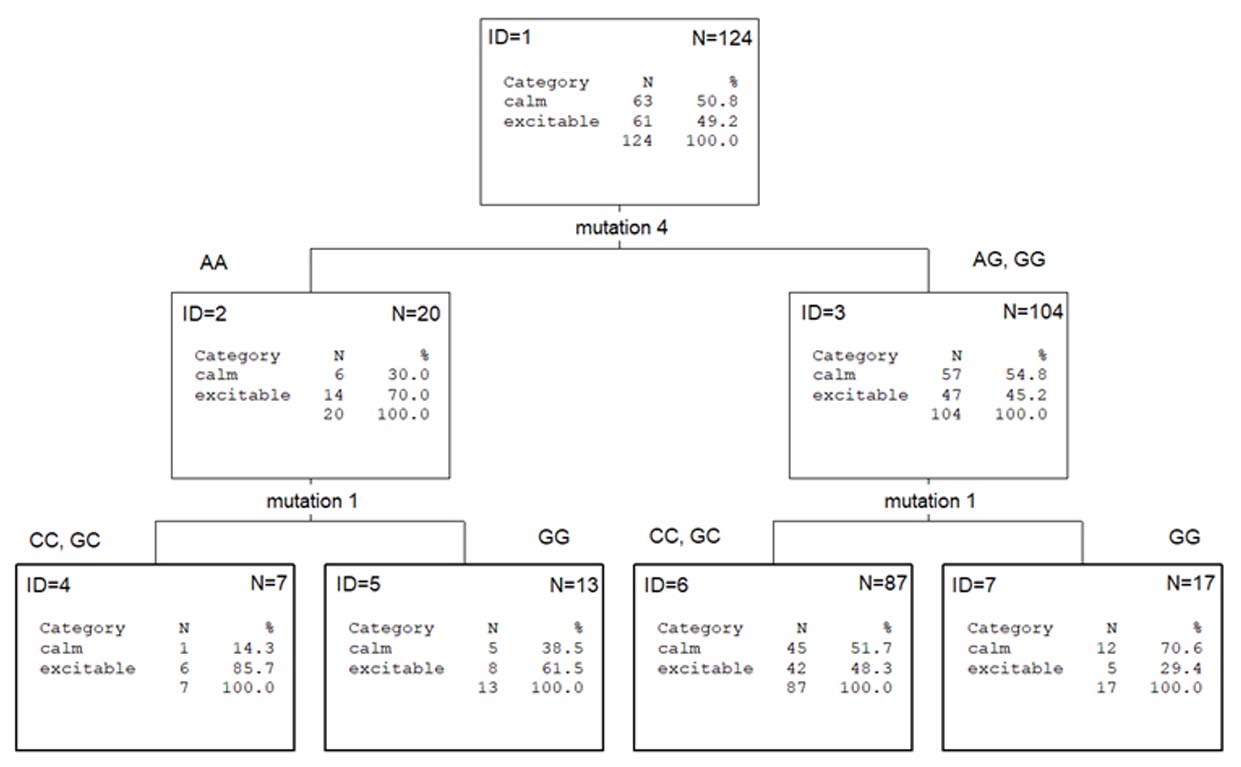
Figure 1.
CART classification tree for the first level of cow temperament assessment (calm cow/excitable cow). N = number of animals; ID = number of split; % – sample population in percentage; A, G, C – nucleobases in DNA molecule (adenine, guanine, cytosine)
Table 5.
Association (comparison) between cow temperament (calm/excitable) and genotype for mutation 4
| Mutation 4 | Calm cows N (%) | Excitable or very excitable cows N (%) | Total (%) |
|---|---|---|---|
| AG | 36 (50.7%) | 35 (49.3%) | 71 (100.0%) |
| GG | 21 (63.6%) | 12 (36.4%) | 33 (100.0%) |
| AA | 6 (30.0%) | 14 (70.0%) | 20 (100.0%) |
Table 6.
Cow temperament (calm/excitable) and mutation 4 reduced using the CART algorithm
| Mutation 4 | Calm cows N (%) | Excitable or very excitable cows N (%) | Total (%) |
|---|---|---|---|
| AA | 6 (30.0%) | 14 (70.0%) | 20 (100.0%) |
| AG lub GG | 57 (54.8%) | 47 (45.2%) | 104 (100.0%) |
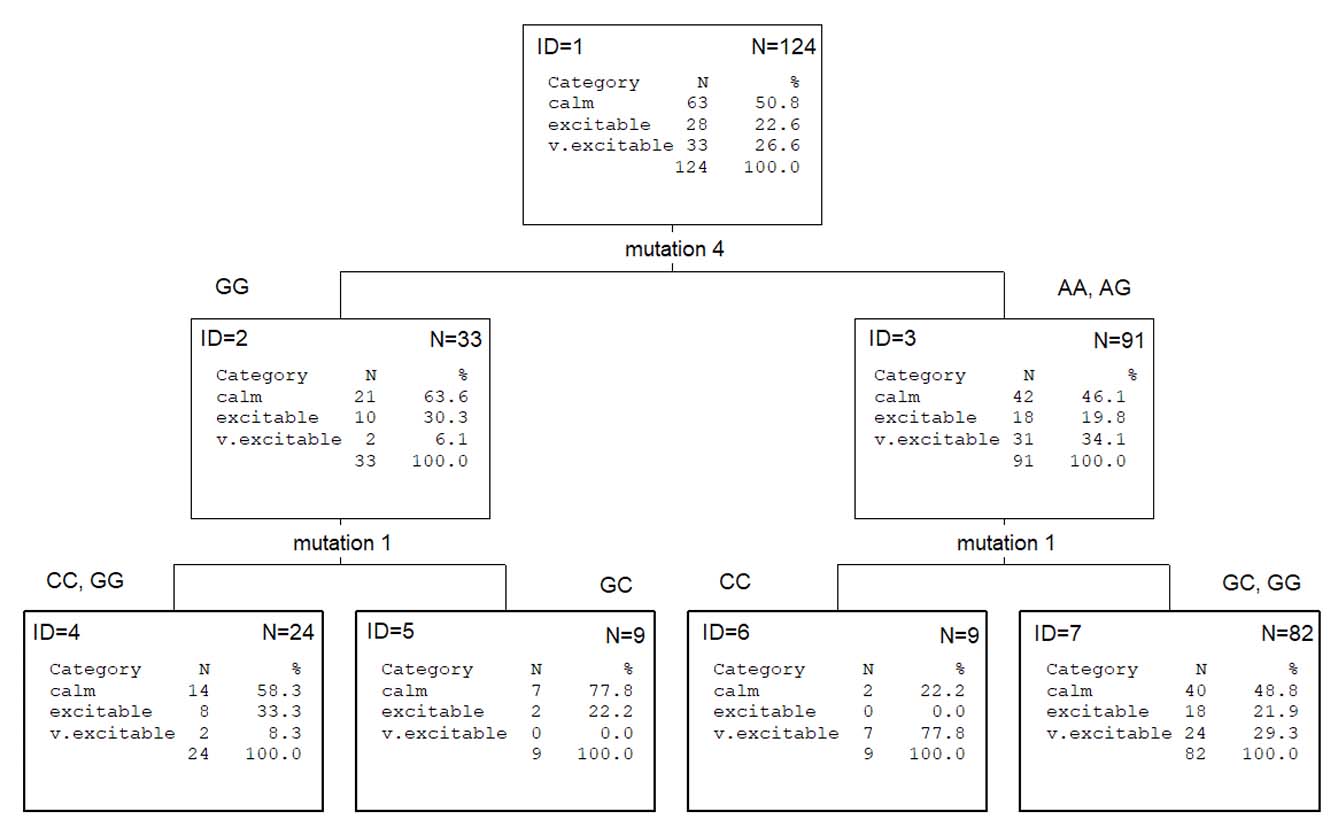
Figure 2.
CART classification tree for the second level of cow temperament assessment (calm cow/excitable cow/very excitable cow). N = number of animals; ID = number of split; % – sample population in percentage; A, G, C – nucleobases in DNA molecule (adenine, guanine, cytosine)
Table 7.
Cow temperament (calm/excitable/very excitable) and mutation 4
| Mutation 4 | Calm cows N (%) | Excitable cows N (%) | Very excitable cows N (%) | Total (%) |
|---|---|---|---|---|
| AG | 36 (50.7%) | 13 (18.3%) | 22 (31.0%) | 71 (100.0%) |
| GG | 21 (63.6%) | 10 (30.3%) | 2 (6.1%) | 33 (100.0%) |
| AA | 6 (30.0%) | 5 (25.0%) | 9 (45.0%) | 20 (100.0%) |