
Temperament is one of the basic behavioural factors that facilitated the domestication of cattle and a certain co-evolution of the human-animal relationship (Adamczyk, 2018). As an inheritable behavioural trait of cows that affects their production and health, temperament has significant consequences for herd management, production efficiency, animal health, and the safety of farmers and/or stockpersons (Chang et al., 2020; Pacheco et al., 2025; Pinto et al., 2025). It is one of the functional features that are systematically subjected to phenotypic control for the animals’ well-being; and in some countries (such as Australia and the Nordic countries), it is included in selection indices, mainly as “milking temperament” (Chang et al., 2020, Pinto et al., 2025). Genetic selection of cattle towards calmer behaviour during milking is a key breeding goal in many dairy cattle breeding programmes worldwide, as it improves milking efficiency (Pacheco et al., 2025).
Like other features related to cattle production, temperament may be the subject of genome selection (Chen et al., 2020; Pacheco et al., 2025). In recent years, there have been numerous studies on the genetic basis of temperament, especially among high-yielding dairy cattle (Sewalem et al., 2011; Stephansen et al., 2018; Szymik et al., 2021, Pacheco et al., 2025), and on the relationship between temperament and milk production (Van der Laak et al., 2016; Antanaitis et al., 2021; Mincu et al., 2021, Marçal-Pedroza et al., 2023). However, there have been very few studies on the temperament of local and/or domestic breeds (FAO, 2023). One such breed is the Polish Red (PR), a dual-purpose breed that is included in a genetic resources conservation programme (POZG, 2023). PR cows constitute only 0.4% of all cows included in the milk performance assessment and for the year 2024 the number of cows was 3,064 (Polish Federation of Cattle Breeders and Dairy Farmers, 2025). This breed is maintained in Southern Poland in a few small, family farms. Previous research has focused mainly on the phenotypic analysis of temperament and its impact on the production characteristics of PR cattle (Szymik et al., 2015; Kalińska and Slósarz, 2016), while the genetic determinants of PR behaviour have not yet been investigated.
In this context, the recent identification of several dozen genes that may determine the temperament of cattle is of particular interest (Garza-Brenner et al., 2017; Alvarenga et al., 2021; Shen et al., 2022; Paredes-Sánchez et al., 2023; Behren et al., 2023). Genes encoding proteins that are part of serotonergic pathways seem to be especially relevant to temperament. Serotonin (5-hydroxytryptamine, 5-HT) is a monoaminergic transmitter found in humans and animals, that mainly affects the central nervous system. It is also important for the regulation of many processes, such as sleep, learning, emotional state, food intake, pain, sexual behaviour, smooth muscle tension, and thermal regulation (Hoyer et al., 2002; Lv and Liu, 2017). Serotonin is also an example of a molecular biomarker of animal behaviour, along with other hormones and neurotransmitters such as cortisol, adrenaline, endorphins, dopamine, noradrenaline, and oxytocin (Pacheco et al., 2025). Serotonin acts by activating serotonin receptors. A total of seven types of these receptors (5HT1-5HT7) and 17 subtypes have been identified so far (Marin et al., 2020). The 2A (5HT2A) serotonin receptors interact with Gαq/11 proteins to activate phospholipase C (Hoyer et al., 2002; Wirth et al., 2017; Marin et al., 2020). Activation of phospholipase C leads to the production of secondary transmitters, such as inositol triphosphate (inositol-1,4,5-trisphosphate, IP3), which affects the release of intracellular calcium and diacylglycerol (DAG) in tissues, affecting the activity of protein kinase C (Marin et al., 2020). 5HT2A receptors are found in many tissues (including the brain, the intestines, and the cardiovascular system), but their highest concentration is in the central nervous system, particularly the cerebral cortex, the hippocampus, the basal ganglia, and the forebrain (Raote et al., 2007). SNP (single nucleotide polymorphism) mutations in the gene encoding the 5HT2A receptor (HTR2A) in humans have been associated with behavioural and neurological disorders such as depression, bipolar disorder, schizophrenia, obsessive-compulsive disorder (Abdolmaleky et al., 2011; Tan et al., 2014) and aggression (Banlaki et al., 2015). Although the mechanisms of behavioural disorders are difficult to define, it is now known that too many 5HT2A receptors can lead to intensified emotions and anxiety (Dos Santos et al., 2016).
Research on the HTR2A gene polymorphism in cattle has so far been conducted on beef breeds, investigating its relationship with meat quality and fat distribution, and temperament. The authors indicated that the HTR2A gene is important for cattle behavioural traits, especially the mutations in exon 3 of this gene (Garza-Brenner et al., 2017, 2019).
Determining the relationship between temperament and the genome depends on the selection of an effective analytical method, i.e. machine learning algorithms. Decision trees are among the most intuitive, easily interpretable and widely used machine learning algorithms. These models are tree-shaped, with tests performed on feature values in internal nodes and class labels in leaves (Timofeev, 2004; Rokach and Maimon, 2008). Nodes entail tests on conditional attributes, adopted in accordance with the splitting criterion. They divide selected data according to the values of their attributes (features), and the result is presented by means of the branches. New results are classified when moving through the nodes and appropriate tests in the tree, and the label on the last leaf for each result branch is its predicted class (Timofeev, 2004). Selecting a simple and intuitive method of building decision trees with the CART (classification and regression tree) algorithm means that small trees may prove to be more time-effective than other approaches (Rokach and Maimon, 2008). The CART algorithm is a non-parametric, recursive partitioning method used for both classification and regression tasks. As a nonparametric technique, CART does not assume any specific distributional form for the predictors or dependent variables, making it highly flexible and robust in handling various types of data. A key strength of CART lies in its ability to handle predictor variables measured on different scales, including nominal, ordinal, and interval levels. Furthermore, the method imposes no distributional assumptions on the independent variables, which allows it to be applied across a wide range of practical contexts. In cases where missing data are present during the classification of new cases, CART can utilize surrogate variables – predictors that closely mimic the primary splitting variable – to maintain the integrity of the classification process. CART is also well-suited to uncovering interaction effects between predictors, as the tree structure inherently reflects complex variable interdependencies. At each node, the algorithm selects the independent variable and corresponding split that best partitions the data into subsets that are most homogeneous with respect to the dependent variable, typically using measures such as Gini impurity for classification or least-squares deviation for regression (Timofeev, 2004).
The aim of this study was to identify a polymorphism in exon 3 of the HTR2A gene and analyse the relationship between identified SNP mutations and temperament in Polish Red cows by constructing decision trees (CART) with the chisquare test of independence.
Material and methods
Material
Animals
The study used data gathered from 124 Polish Red cows (cows, heifers) kept on individual farms in the Małopolska Voivodeship (Poland) in a stall-barn system (9 farms) and a free-stall system (1 farm). All animals had access to the pasture growing in the spring and summer. In autumn and winter, they were kept in the farm buildings and were fed with hay and haylage. For milking, either milking cups were used, or the cows were milked manually. Information on the breeding parameters of animals came from individual breeding cards (cow-heifer card), received directly from breeders. The average parameters of the performance characteristics of animals participating in the study are given in Table 1.
Table 1.
Production traits of Polish Red cows
| No. Farm | N | Housing system | Production traits | ||
|---|---|---|---|---|---|
| Milk (kg) | Fat (%) | Protein (%) | |||
| ±SD | ±SD | ±SD | |||
| 1 | 26 | stall barn | 3297.81±781.54 | 4.08±0.36 | 3.31±0.21 |
| 2 | 28 | free-stall barn | 3379.50±597.39 | 4.30±0.48 | 3.32±0.16 |
| 3 | 10 | stall barn | 4230.1±623.06 | 4.48±0.45 | 3.34±0.25 |
| 4 | 10 | stall barn | 3795.60±306.88 | 4.52±0.38 | 3.31±0.16 |
| 5 | 5 | stall barn | 2951.60±324.75 | 4.13±0.21 | 3.05±0.17 |
| 6 | 9 | stall barn | 2673.29±407.52 | 4.48±0.34 | 3.31±0.13 |
| 7 | 11 | stall barn | 3281.55±455.54 | 4.39±0.47 | 3.19±0.20 |
| 8 | 7 | stall barn | 3843.57±432.40 | 4.23±0.25 | 3.29±0.14 |
| 9 | 10 | stall barn | 3525.80±742.86 | 4.45±0.56 | 3.36±0.19 |
| 10 | 8 | stall barn | 2512.00±1092.32 | 4.43±0.47 | 3.32±0.17 |
Methods
Genotyping within the HTR2A gene
During milking, 10 mL milk samples from 124 Polish Red cows were collected and used to isolate the DNA from somatic cells according to the method developed by Pokorska et al. (2016). The isolated DNA was checked for purity and quantity using a NanoDrop 1000 spectrophotometer (Thermo Fisher Scientific). The average amount of DNA obtained was 85 ng with a purity factor of 1.82. The polymorphism analysis focused on the identification of mutations within the third exon of the HTR2A gene, which was amplified using the following primers: P1 – CTAATGCTAACCTTCTGCATCC (forward) and P2 – CTGAAATACTGTTCCACTTACCC (reverse), designed in the Primer3plus program (https://www.primer3plus.com) in relation to the gene reference sequence number NC_037339.1. The amplification reaction was performed in a C-1000 thermal cycler (Biorad) in a reaction mixture containing: 80 ng to 100 ng of genomic DNA, Phusion High-Fidelity PCR Kit (included 0.05 U/µL of Phusion high-fidelity DNA polymerase buffers, 1× HF PCR buffer containing MgCl2 and 1.2% DMSO) (Thermo Scientific, USA, Cat. No. F-530S), 200 µM of each dNTP (deoxynucleotide triphosphates) (Thermo Scientific, USA, Cat. No. R0241) 0.8 µM of primer P1 and P2 (Genomed S.A., Poland), and ultrapure water (Merck, Germany, Cat. No. 3315843001), in a thermal program entailing: initial denaturation 98°C – 2 minutes, 35 cycles of denaturation 98°C – 15 seconds, annealing 63°C – 10 seconds, elongation 72°C – 15 seconds, and final elongation 72°C – 4 minutes. The initial assessment of 247 bp amplicons was performed by separating them in a 2% agarose gel with the addition of ethidium bromide (20 mg/mL, Merck, Germany, Cat. No. E7637).
Next, PCR products were purified enzymatically with EPPiC (mixture containing enzymes that degrade dNTPs and primer left-overs from previous PCR mixtures) (A&A Biotechnology, Poland, Cat. No. 1021-500F), according to the manufacturer’s protocol. Purified PCR products were sequenced with BigDye™ Terminator v3.1 Cycle Sequencing Kit (Applied Biosystems by Thermo Fisher Scientific, USA, Cat. No. 4337456) and with the same primers as for the PCR reaction (separately for each primer). The sequencing PCR reaction thermal profile was: 10-minute, 96°C denaturation step, 25 cycles of 10-second, 96°C denaturation / 5-second, 55°C annealing / 4-minute, 60°C extending and 4°C hold stage. Sequencing products were purified with BigDye XTerminator™ Purification Kit (Applied Biosystems by Thermo Fisher Scientific, USA, Cat. No. 4376484), according to manufacturer’s protocol. Then, the sequences were read during capillary electrophoresis in the Genetic Analyzer 3500xl (Applied Biosystems by Thermo Fisher Scientific), with POP-7 polymer (Applied Biosystems by Thermo Fisher Scientific, USA, Cat. No. 4335615).
The collected results were analysed using Variant Reporter Software 2 (Applied Biosystems by Thermo Fisher Scientific), with reference to NC_037339.1, Bos taurus breed Hereford chromosome 12, ARS-UCD2.0, whole genome shotgun sequence. The SNP position was located according to this reference sequence. We used also BioEdit Sequence Alignment Editor.
Temperament assessment
The temperament of the cows was assessed via interviews conducted with their owners, who were in daily direct contact with the animals, according to the criteria described in Table 2, based on the behaviour of cows during milking (milking temperament). Each cow was subject to two assessments – the first level and second level, depending on the temperament and milking days (1 to ≥14).
Table 2.
Two-level assessment of cow temperament
| Animal classification | Assessment criteria |
|---|---|
| First level | |
| calm cow | The cow got used to milking during the first 1–7 days of lactation (day 7 presented no signs of anxiety during milking and/or attempts to kick/kicking and/or shifting from one foot to the other and/or aggressive behaviour towards the milker) |
| excitable cow | The cow did not get used to milking during the first 1–7 days of lactation (after day 7, there were still signs of anxiety during milking and/or attempts to kick/kicking and/or shifting from one foot to the other and/or aggressive behaviour towards the milker) |
| Second level | |
| calm cow | The cow got used to milking during the first 1–7 days of lactation (day 7 presented no signs of anxiety during milking and/or attempts to kick/kicking and/or shifting from one foot to the other and/or aggressive behaviour towards the milker) |
| excitable cow | The cow got used to milking during the first 8–14 days of lactation (day 14 presented no signs of anxiety during milking and/or attempts to kick/kicking and/or shifting from one foot to the other and/or aggressive behaviour towards the milker) |
| very excitable cow | The cow did not get used to milking during the first 14 days of lactation (after day 14, there were still signs of anxiety during milking and/or attempts to kick/kicking and/or shifting from one foot to the other and/or aggressive behaviour towards the milker) |
Statistical analysis
Statistical analysis was carried out using a machine learning analytical tool (decision tree CART algorithm) and the chi-square test of independence (STATISTICA®13, StatSoft, Poland).
Decision trees
A decision and regression trees (CART) algorithm was applied, which recursively divides the input data until endpoints, or terminal nodes, are achieved by splitting criterion (Gini measure) (Breiman et al., 1984; Rokach and Maimon, 2008). The CART approach essentially consists of an analytical process in which the relative importance of each predictor is assessed. It utilizes an integral process of identifying the optimal combination of independent variables in relation to the dependent variable. These tree-shaped models involve splitting criteria performed on feature values (variables) in internal nodes and class labels expressed in leaves. New results are classified while moving through the nodes, and appropriate tests in the tree, and the label on the last leaf for each result branch is its predicted class (Timofeev, 2004). This paper applies the leading CART (classification and regression tree) algorithm used in building decision tree models. A brief explanation of the technique is presented below.
Statistical procedures
The decision tree construction method, one of the machine learning methods, presents the results using an acyclic graph. In the research method, all nodes of the decision trees contained impurity measures on conditional attributes created following the adopted splitting criterion (Timofeev, 2004). Only two SNP mutations (1 and 4) were taken into consideration, because each of the selected loci was determined with an occurrence of all three genotypes, and their attendance was at least 5% in the analysed group of animals (N = 124). The measures of impurity were performed according to the division of data (genotypes for mutations 1 and 4: AA; AG; GG; CC; GC) depending on the value of their attributes (genotype). Then, each splitting result took the form of branches in the CART algorithm (Rokach and Maimon, 2008).
There are two splitting rules in the CART algorithm: the Gini index and twoing criterion. The first one can be expressed by Formula 1 (Breiman et al., 1984):
where:- GI
– Gini index,
- t
– number of objects in a tree node,
- j
– number of classes (categories of the dependent variable),
- p(j|t)
– probability of occurrence of objects from a given class in a tree node.
The lower the value of the Gini index, the better the split of a given node.
The second splitting criterion is the twoing rule, which is expressed by Formula 2 (Breiman et al., 1984):
where:- TR
– twoing rule,
- pL
– probability that the object will be located in the left child node,
- pR
– probability that the object will be located in the right child node,
- j
– number of objects from a given class (from a given category of the dependent variable) in the node,
- tL
– number of all objects in the left node,
- tR
– number of all objects in the right node.
The higher the TR value, the better the split of a given node.
In the case of a classification tree, the value of the probability of each instance in a given node belonging to a particular class was determined in accordance with the tree construction algorithm (the CART algorithm and Gini index). The classification within a given node was performed by selecting the class with the highest probability (Timofeev, 2004).
The chi-square test of independence and Cramer’s V values
The chi-square test of independence was used to check the statistical significance of the relationship between two qualitative variables. Moreover, Cramer’s V values were used to assess the strength of the relationship between variables (Formula 3). It ranges from 0 to 1 where 0 indicates no association between the two variables, 1 indicates a perfect association between the two variables.
Formula 3.
where:- x2
– the chi-square statistic,
- n
– total sample size,
- r
– number of rows,
- c
– number of columns.
An approach combining the CART algorithm with the chi-square test of independence was used to analyse the data. In the first step, based on decision tree models, the categories of the independent variable “mutation 4” were grouped. In the second step, contingency tables were constructed for the variable “cow temperament” and the independent variable “mutation 4”, once in its original form with separate categories AG, GG, AA and the second time according to the solution obtained from the decision tree model.
Results
The analyses led to the identification of 4 SNP mutations in the examined section of the HTR2A gene (Table 3).
Table 3.
Characterization of identified SNPs in exon 3 of the bovine HTR2A gene
| Mutation | Mutation type | Type of change | Location | No rs |
|---|---|---|---|---|
| M1 | synonymous | G>C | 12:16836930 | rs110801604 |
| M2 | synonymous | C>T | 12:16836917 | rs43696138 |
| M3 | synonymous | G>A | 12:16836873 | rs43696137 |
| M4 | synonymous | A>G | 12:16836852 | rs43696136 |
The genotypes and allele frequencies for individual SNPs within the examined section of the HTR2A gene are presented in Table 4.
Table 4.
The allele and genotype frequencies for identified SNPs within the bovine HTR2A gene
| Mutation | N | Genotype frequency | Allele frequency | ||
|---|---|---|---|---|---|
| M1 | 30 | GG | 0.242 | G | 0.500 |
| 64 | GC | 0.526 | C | 0.500 | |
| 30 | CC | 0.242 | |||
| M2 | 118 | CC | 0.952 | C | 0.976 |
| 6 | CT | 0.048 | T | 0.024 | |
| 0 | TT | 0.000 | |||
| M3 | 118 | GG | 0.952 | G | 0.964 |
| 3 | GA | 0.024 | A | 0.036 | |
| 3 | AA | 0.024 | |||
| M4 | 16 | AA | 0.129 | A | 0.399 |
| 67 | AG | 0.540 | G | 0.601 | |
| 41 | GG | 0.331 | |||
Further statistical analyses considered two polymorphic sites (“mutation 1” – rs110801604 and “mutation 4” – rs43696136), which were the most variable in the study population (whose allele frequency was at least 5%). In the CART decision tree, the algorithm used two selected mutations (1 and 4) as primary split variables. This outcome reflects the core principle of the CART algorithm, which is to select, at each node, the predictor that most effectively separates the classes of the dependent variable based on a chosen impurity measure (in this case, the Gini measure).
As the first step – according to the classification tree models – the categories of the independent variable “mutation 4” were grouped. The algorithm performed this action automatically to obtain the most homogeneous child nodes based on the distribution of the independent variable – the cow’s temperament. Figure 1 presents a CART classification tree model with a two-variant dependent variable (calm cow/excitable cow). It started at the root node (D1) and child nodes based on the split (ID2, ID3) as follows AA genotype (N=20) and AG, GG (N=104). The model had 4 terminal nodes (ID4–ID7) that indicated the temperament of the animals depending on the genotype within the polymorphic sites of the HRT2A gene marked as mutations 4 (rs43696136) and 1 (rs110801604):
node ID=4: 85.7% of cows with the AA genotype (M4) and the CC or GC genotype (M1) are excitable;
node ID=5: 61.5% of cows with genotype AA (M4) and genotype GG (M1) are excitable;
node ID=6: 51.7% of cows with the AG or GG genotype (M4) and the CC or GC genotype (M1) are calm;
node ID=7: 70.6% of cows with the AG or GG genotype (M4) and GG genotype (M1) are calm.
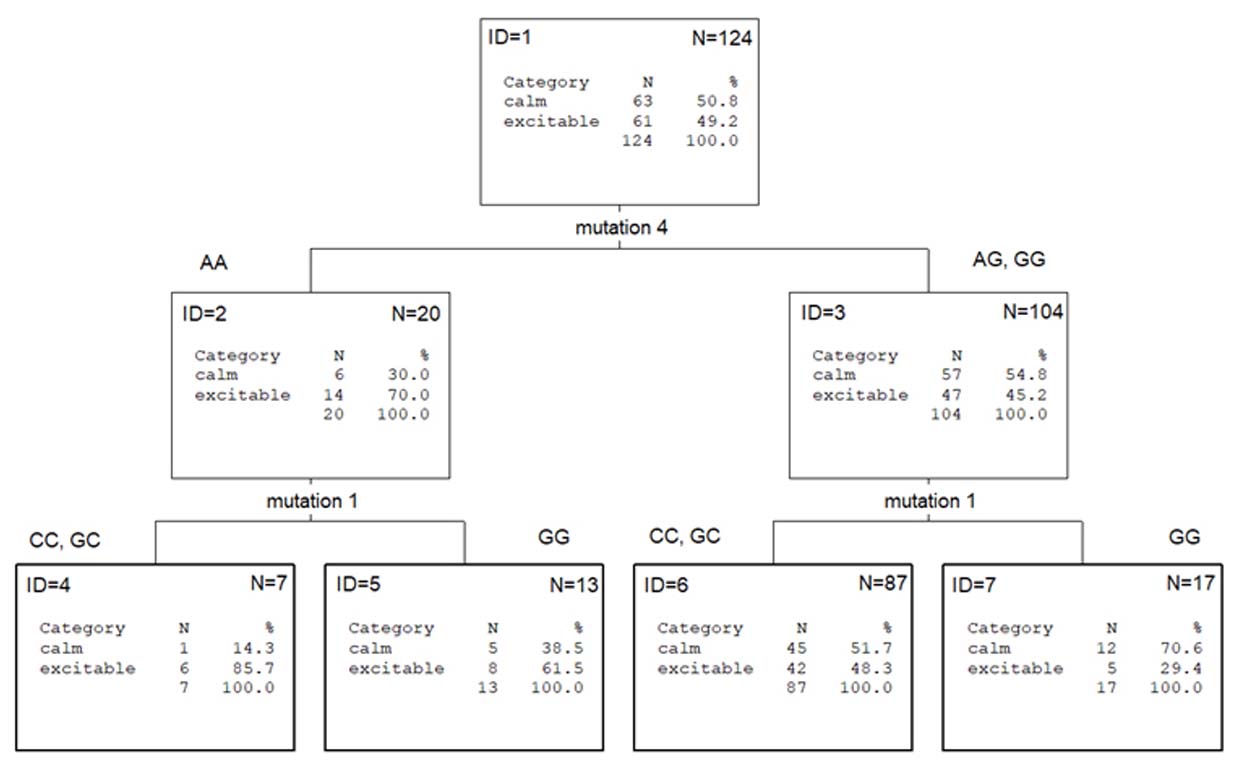
Figure 1.
CART classification tree for the first level of cow temperament assessment (calm cow/excitable cow). N = number of animals; ID = number of split; % – sample population in percentage; A, G, C – nucleobases in DNA molecule (adenine, guanine, cytosine)
Table 5 compares the two-variant variable “cow temperament” with the “mutation 4” variable in combination with the results of the chi-square test of independence (Pearson chi-square = 5.638). According to this criterion, 63 cows (50.8%) were found to be calm and 61 (49.2%) were excitable or very excitable. Alternative homozygotes differed in temperament; among the GG homozygotes, the majority were calm (63.6%), while the majority of AA homozygotes were excitable (70.0%). However, the probability value (p=0.060) did not provide grounds to reject the null hypothesis, i.e. there was no significant relationship between the variables.
Table 5.
Association (comparison) between cow temperament (calm/excitable) and genotype for mutation 4
| Mutation 4 | Calm cows N (%) | Excitable or very excitable cows N (%) | Total (%) |
|---|---|---|---|
| AG | 36 (50.7%) | 35 (49.3%) | 71 (100.0%) |
| GG | 21 (63.6%) | 12 (36.4%) | 33 (100.0%) |
| AA | 6 (30.0%) | 14 (70.0%) | 20 (100.0%) |
Table 6 compares the “cow temperament” variable with the “mutation 4” variable, using combination with the results of the chi-square test of independence (Pearson chi-square = 4.130), combining individuals with AG and GG genotypes into one group. With this approach, there was a statistically significant (P=0.042) relationship between the rs43696136 mutation (mutation 4) and animal temperament. The value of Cramer’s V coefficient reached 0.179, indicating a moderate strength of this relationship.
Table 6.
Cow temperament (calm/excitable) and mutation 4 reduced using the CART algorithm
| Mutation 4 | Calm cows N (%) | Excitable or very excitable cows N (%) | Total (%) |
|---|---|---|---|
| AA | 6 (30.0%) | 14 (70.0%) | 20 (100.0%) |
| AG lub GG | 57 (54.8%) | 47 (45.2%) | 104 (100.0%) |
In the second analytical approach, the cow’s temperament variable had 3 variants (calm/excitable/very excitable). The analysis began with the construction of a CART classification tree model (Figure 2), started at the root node (ID1) and child nodes based on the split (ID2, ID3) as follows GG genotype (N=33) and AG, AG (N=91), with the following results:
node ID=4: 58.3% of cows with the GG genotype (M4) and with the CC or GG genotype (M1) are calm;
node ID=5: 77.8% of cows with the GG genotype (M4) and GC genotype (M1) are calm;
node ID=6: 77.8% of cows with the AA or AG genotype (M4) and CC genotype (M1) are very excitable;
node ID=7: 48.8% of cows with the AA or AG genotype (M4) and with the GC and GG genotype (M1) are calm.
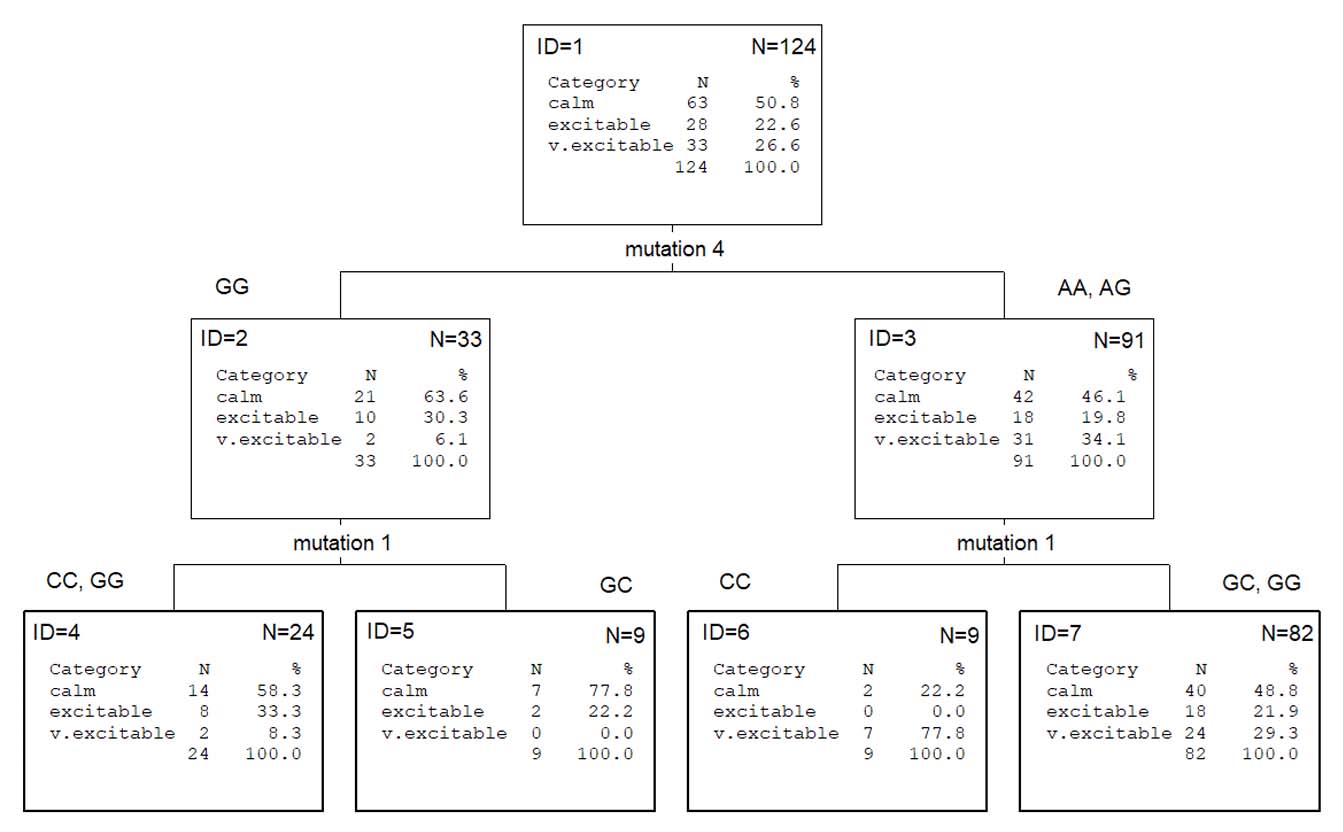
Figure 2.
CART classification tree for the second level of cow temperament assessment (calm cow/excitable cow/very excitable cow). N = number of animals; ID = number of split; % – sample population in percentage; A, G, C – nucleobases in DNA molecule (adenine, guanine, cytosine)
Table 7 compares the three-variant variable “cow temperament” with the “mutation 4” variable as well as the results of the chi-square test of independence (Pearson chi-square = 12.559). According to this criterion, 63 (50.8%) cows were found to be calm and 28 (22.6%) were excitable and 33 (26.6%) were very excitable. Moreover, calm animals constituted the majority (50.7%) of cows with the AG and GG genotypes (63.6%), while very excitable individuals dominated in the AA genotype group of cows (45.0%). The probability value (p=0.013) supported the conclusion that there is a relationship between the genotype within mutation 4 and cow temperament. Cramer’s V coefficient equal to 0.225 indicates a relatively strong relationship.
Table 7.
Cow temperament (calm/excitable/very excitable) and mutation 4
| Mutation 4 | Calm cows N (%) | Excitable cows N (%) | Very excitable cows N (%) | Total (%) |
|---|---|---|---|---|
| AG | 36 (50.7%) | 13 (18.3%) | 22 (31.0%) | 71 (100.0%) |
| GG | 21 (63.6%) | 10 (30.3%) | 2 (6.1%) | 33 (100.0%) |
| AA | 6 (30.0%) | 5 (25.0%) | 9 (45.0%) | 20 (100.0%) |
Using the CART classification tree (Figure 2) in creating the contingency table supported the discovery of a more profound relationship between extreme genotypes within the polymorphic site rs43696136 (mutation 4) and temperament (Table 8). This time, cows with AA and AG genotypes were combined into one group. As a result, the P-value decreased to 0.007, the chi-square test of independence was equal to 9.781 and the value of Cramer’s V coefficient increased to 0.281, indicating a strong relationship.
Discussion
The genetic determinants of cattle behaviour have not yet been described in sufficient detail. An estimated 20–60% of cattle temperament depends on polymorphic changes in the genome, but numerous variants of different genes may exert additional influence on temperament (Power and Pluess, 2015). Furthermore, the interaction between the animal genotype (purpose, breed) and the environment (including human-animal relations) can have an effect (Adamczyk et al., 2013; Pacheco et al., 2025), as illustrated by the differences in temperament/docility between Bos taurus and Bos indicus (Cooke, 2014), or beef and dairy cattle (Haskell et al., 2014; Vogt et al., 2017), or in cattle selected for years to develop their calm temperament traits and animals bred in the opposite direction (e.g. Toro Bravo cattle) (Haskell et al., 2014). It should be emphasized that in both breeding practice and much scientific research, milking temperament is a specific example of a behavioural trait that represents a key breeding objective due to its impact on milking efficiency and personnel safety (Miglior et al., 2017; Chang et al., 2020). It is assessed using subjective scoring systems, applying various categorization scales, such as 1 to 3, 1 to 5, or 1 to 9, where values typically reflect the level from very nervous to very calm animal behaviour (Adamczyk et al., 2013; Haskell et al., 2014; Pacheco et al., 2025). In the present study, the authors applied their own proprietary method of assessing cow temperament, which is comparable to the above-mentioned scoring schemes.
Importantly, the relationship between temperament levels and production traits can show statistical significance differently depending on the animal group studied. For instance, it has been demonstrated that in multiparous cows, those classified as “reactive” had statistically significantly higher milk yield, fat, protein, and lactose content compared to “calm” cows, which underscores the complexity of these relationships and their variability depending on the temperament test used and lactation (Pacheco et al., 2025).
Similarly, differences in temperament are noticeable when comparing breeds intensively selected for only one trait (e.g. Holstein-Friesian) and native breeds in which the breeding emphasis is on maintaining biodiversity (Biscarini et al., 2015). Typically, such cattle show greater individual variability than high yielding dairy cattle in terms of temperament (Haskell et al., 2014). Some studies suggest that calm individuals tend to show better performance, health, and longevity than animals with an excitable temperament (Hedlund and Løvlie, 2015; Smolinger and Škorjanc, 2021). Haskell et al. (2014) discovered calmer cows have a higher longevity, likely due to the willingness of breeders to cull those animals that are difficult to milk/handle, irrespective of their genetic potential in terms of production traits and fertility.
Genome-wide association studies (GWAS) made it possible to identify several dozen genes that could play a role in individual behaviour differences in cows (Chen et al., 2020; Luo et al., 2022; Shen et al., 2022), many of which are involved in modifying neurological pathways. These complex relationships depend mainly on the levels of hormones and neurotransmitters, changes in the concentrations of which affect not only temperament, but also the emotional and physiological states of animals (Shen et al., 2022). Chen et al. (2020) used the GWAS to pinpoint 20 associated loci and 18 candidate genes for ACTH (adrenocorticotropic hormone), cortisol, dopamine, glutamate and serotonin in Brahman and Yunling cattle.
Since the action of hormones and neurotransmitters is mediated through their receptors, polymorphic changes in the genes controlling these receptors may noticeably alter many physiological processes (Zmorzyński et al., 2021). As shown in this study, polymorphic changes within the serotonin receptor gene 2 (rs110801604, rs43696136) had a significant influence (P = 0.042; P = 0.007) on the temperament of Polish Red cattle.
The current literature on the association between the structure of the HTR2A gene and cattle behaviour is related to factors influencing the quality of beef (formation of fat tissue, fat deposition in meat). Garza-Brenner et al. (2017) showed that the rs43696138 polymorphism within this gene was important. In Charolais cattle, the heterozygous AG genotype at this locus significantly influenced temperament traits such as exit velocity and individual temperament scores, while AA homozygotes were characterized by higher daily body weight gains (Garza-Brenner et al., 2019). There was also a relationship identified between HTR2A gene polymorphism and feed efficiency index in Brangus cattle. In Yan Yellow cattle, overexpression of the HTR2A gene was associated with the development of fat tissue cells, which stimulated preadipocyte differentiation, while gene knockdown led to the disappearance of adipogenesis (Yun et al., 2018).
Although there are relatively few studies confirming the impact of HTR2A gene mutations on animal behaviour, the strong relationships between the rs110801604 and rs43696136 mutations and the behaviour of cattle suggest that they may act as temperament markers. These relationships should be confirmed in a much larger number of animals representing different breeds of cattle. The analysis of SNP mutations in this gene is important not only in the context of cattle behaviour, but also for production traits, as Matsuda et al. (2004) showed that serotonin acts as a paracrine-autocrine inhibitor of lactation in udder epithelial cells.
The decision tree (CART – classification and regression tree) as a method has been widely used in different disciplines because it is a reliable and effective decision-making technique and provides high accuracy in classification, especially for small size of the database (Stulp and Sigaud, 2015). This innovative methodology of statistical analyses used in this study allowed a precise description of the actual relationship between the temperament of cattle and their genetic conditions. Wijayaningrum and Utaminingrum (2016) confirmed the effectiveness of this algorithm (CART, Cramer’s value) over classical algorithms used in the genetic evaluation of animals. Decision tree algorithms were used in publications on, for instance, improving body weight in sheep breeding (Tariq et al., 2012) and the selection of biometric genetic markers (Hamadani et al., 2022). Topal et al. (2010) also used a regression tree approach to analyse the factors influencing the birth weight of dairy cattle. Further, Luik-Lindsaar et al. (2019) used the CART algorithm and the production parameters of cows to estimate which factors may improve the efficiency of dairy cattle breeding. Other authors (Piwczyński et al., 2013) used classification trees to analyse the impact of factors influencing easy calving in dairy cows. Also, the CART algorithm has been successfully applied in the study of the behaviour of various animal species, i.e. cows, sheep (Mamadani et al., 2022), pigs, horses, and goats (Debauche et al., 2021).
In this study the idea of combining decision trees algorithms with other analytical tools was used to build hybrid models with logistic regression (Lindahl and Winship, 1994; Steinberg and Cardell, 1998). The hybridization of these two analytical tools allowed more efficient search for significant and stronger relationships between variables than in other methods.
Conclusions
In cattle breeding, temperament is an extremely important feature that is increasingly being sought in genetic improvement programmes, as it affects not only behaviour, but also production traits. Unfortunately, temperament is a cattle trait with relatively low heritability which complicates efforts towards its genetic selection. Our results, developed using the CART algorithm, showed statistically significant relationships between mutations rs110801604 and rs43696136 in the HTR2A gene and temperament in Polish Red cows. These findings are particularly valuable given that the studied population represents a native dual-purpose breed maintained under low-intensity farming conditions. Importantly, the identified associations contribute to a better understanding of the genetic background of milking temperament – an essential component of workability traits routinely recorded in breeding programmes in many countries. This new knowledge could support the development of more accurate selection tools for improving temperament, both in local breeds like Polish Red and potentially in more intensively selected dairy cattle breeds.
Acknowledgements
The authors would like to thank the participating dairy farms in allowing us to use their facilities, cows, and records.
Notes
[10] Ethics approval
The research material consisted of the milk samples taken during milking by the experienced workers. The cows were provided with appropriate housing conditions in accordance with the following regulations: Directive 2010/63/EU of the European Parliament and of the Council of 22 September 2010 on the protection of animals used for scientific purposes, Regulation of the Minister of Agriculture and Rural Development of 15 February 2010 on the requirements and procedures for keeping livestock for which protection standards have been laid down in EU regulations. The collection of this biological material, in accordance with the Act on the Protection/Welfare of Animals Used for Research or Teaching Purposes, from 15 January 2015 (Journal of Laws of the Republic of Poland, 2015, item. 266, article 1, point 2/1) did not require the approval of the Ethics Committee.
[11] Data and model availability statement
The data/models were not deposited in an official repository. Data are available upon request to the corresponding author.