
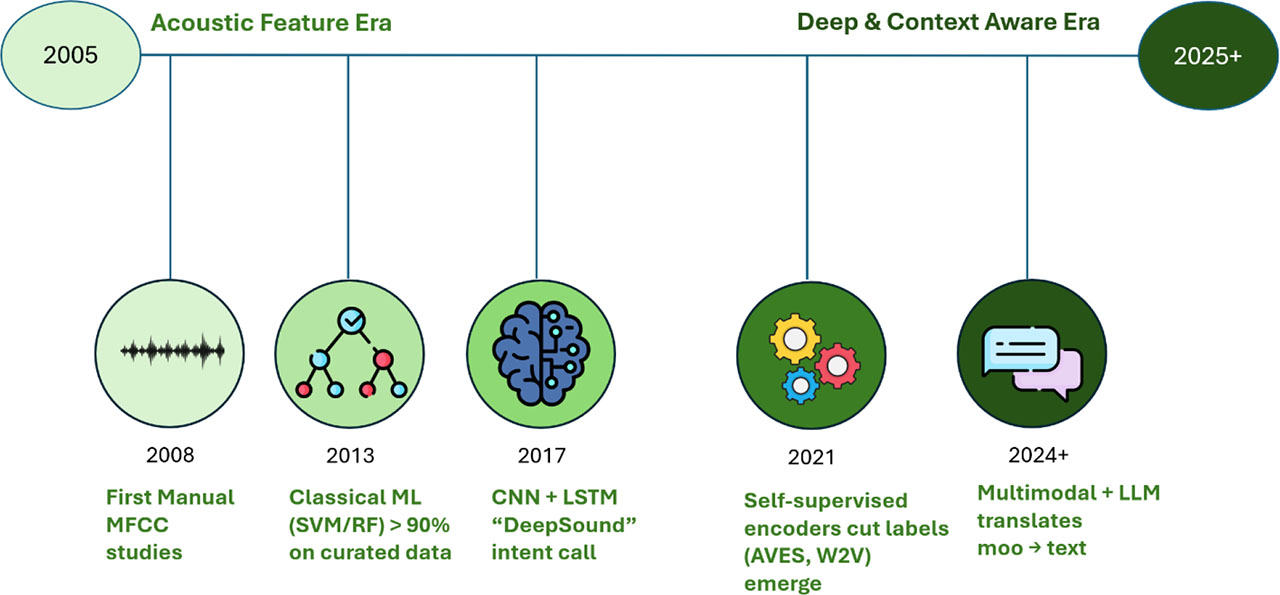
Figure 1.
Twenty-year evolution of AI methods for bovine vocalization research, illustrating the shift from manual spectrogram analysis to multimodal, edge-deployed models enhanced by large language models
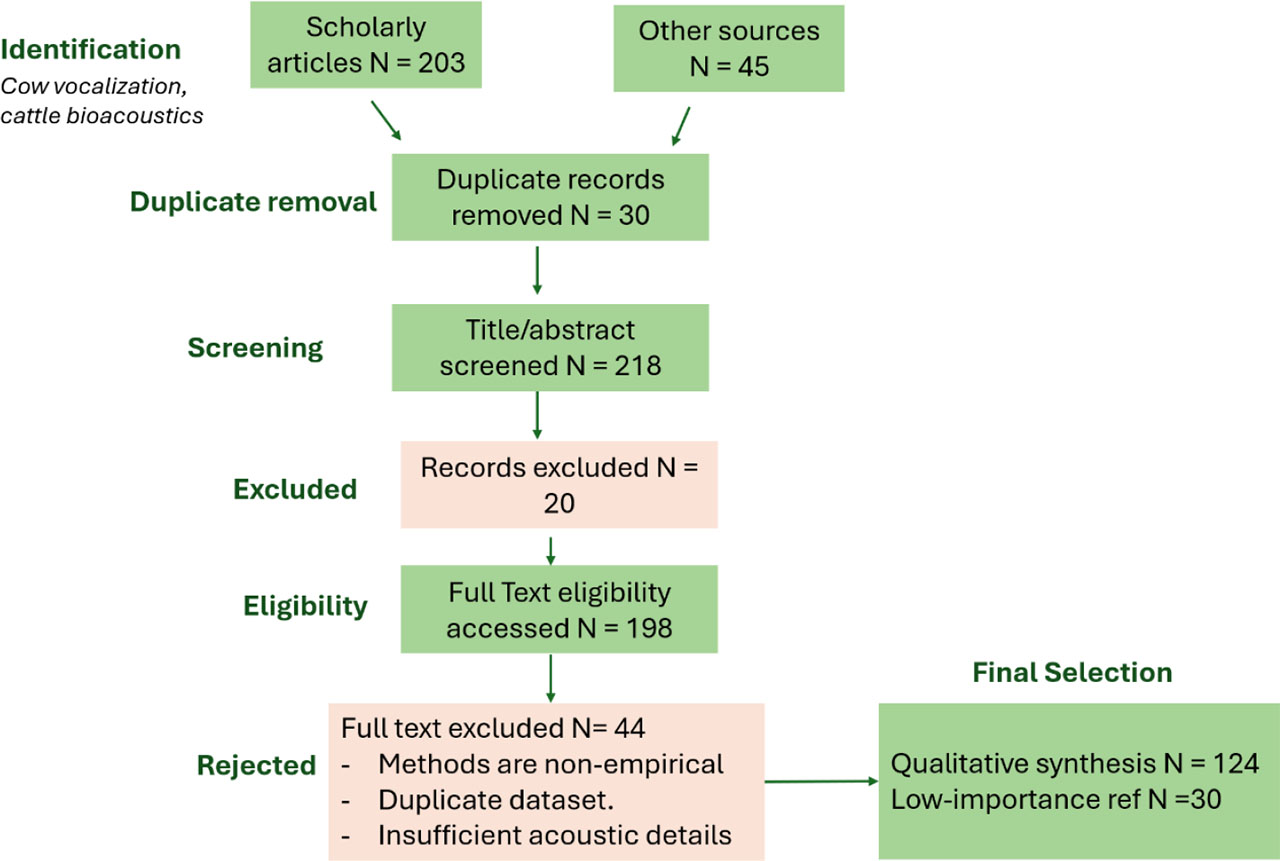
Figure 2.
PRISMA flow diagram summarizing the literature search and screening process. Out of 248 initially retrieved records, 124 core studies and 30 supporting background papers were included in the final qualitative synthesis
Table 1.
Acoustic characteristics and contextual interpretation of bovine vocalizations
| Vocalization type | Dominant frequency (Hz) | Typical duration (s) | Typical mouth/posture | Principal behavioral context | Practical welfare interpretation |
|---|---|---|---|---|---|
| Maternal contact (lowing/closed-mouth call) (Green et al., 2021) | F0 ∼120–280 Hz (mean ∼180 Hz) | ∼0.8–2.5 s | Closed or partially open, head lowered toward calf | Cow-calf proximity, gentle bonding, reassurance | Indicates calm social contact and maternal bonding, normally a positive welfare cue |
| Calf isolation distress call (Mac et al., 2022) | F0 ∼450–780 Hz | ∼1–4s (modal ∼2 s) | Open-mouth, elevated head, often repeated bouts | Calf separated from dam/herd | Signals acute distress, should trigger rapid reunion or comfort |
| Adult distress/pain call (Martinez-Rau et al., 2025) | F0 ∼600–1200 Hz | > 2 s (mean ∼3.1 s) | Fully open mouth, tense neck | Pain (e.g., lameness, injury) or extreme fear | High-urgency alert, immediate welfare check required |
| Hunger/feed-anticipation call (Sattar, 2022) | F0 ∼220–380 Hz | ∼0.5–2.0 s | Open-mouth, pacing near feed-gate | Imminent feeding, empty trough | Indicates motivational state (feed expectation) |
| Estrus (heat) call (Sharma and Kadyan, 2023) | F0 ∼160–320 Hz (rich harmonic stack) | ∼0.8–3 s | Extended vocal tract, head raised | Reproductive behavior, seeking mates | Reliable cue for breeding/AI scheduling, positive management indicator |
| Social affiliative call (Schnaider et al., 2022 a) | F0 ∼110–260 Hz | ∼0.4–1.2 s | Closed-mouth, nasal | Group re-joining, mild excitement | Normal herd cohesion signal, neutral/positive welfare |
| Alarm/novel object call (Miron et al., 2025) | F0 ∼650–1100 Hz | – | Sudden, sharp, head-up stance | Perceived predator, startling event | Short-term fear, monitor environment and animal safety |
| Cough/respiratory (Sattar, 2022) | Broadband burst 200–1 200 Hz | ∼0.12–0.35 s | Forced exhalation, closed glottis | Respiratory irritation or disease onset | Early health-risk indicator (e.g., BRD), triggers clinical exam |
| Pain-related moan (low-frequency) (Volkmann et al., 2021) | F0 ∼90–190 Hz | ∼1.5–5 s | Mouth partially open, minimal movement | Chronic discomfort (lameness, parturition) | Persistent occurrence warrants veterinary assessment |
| Play/excitement call (Vogt et al., 2025) | F0 ∼260–450 Hz | ∼0.3–0.9 s | Short bursts during running/bucking | Calf play, social excitement | Positive affect indicates good welfare environment |
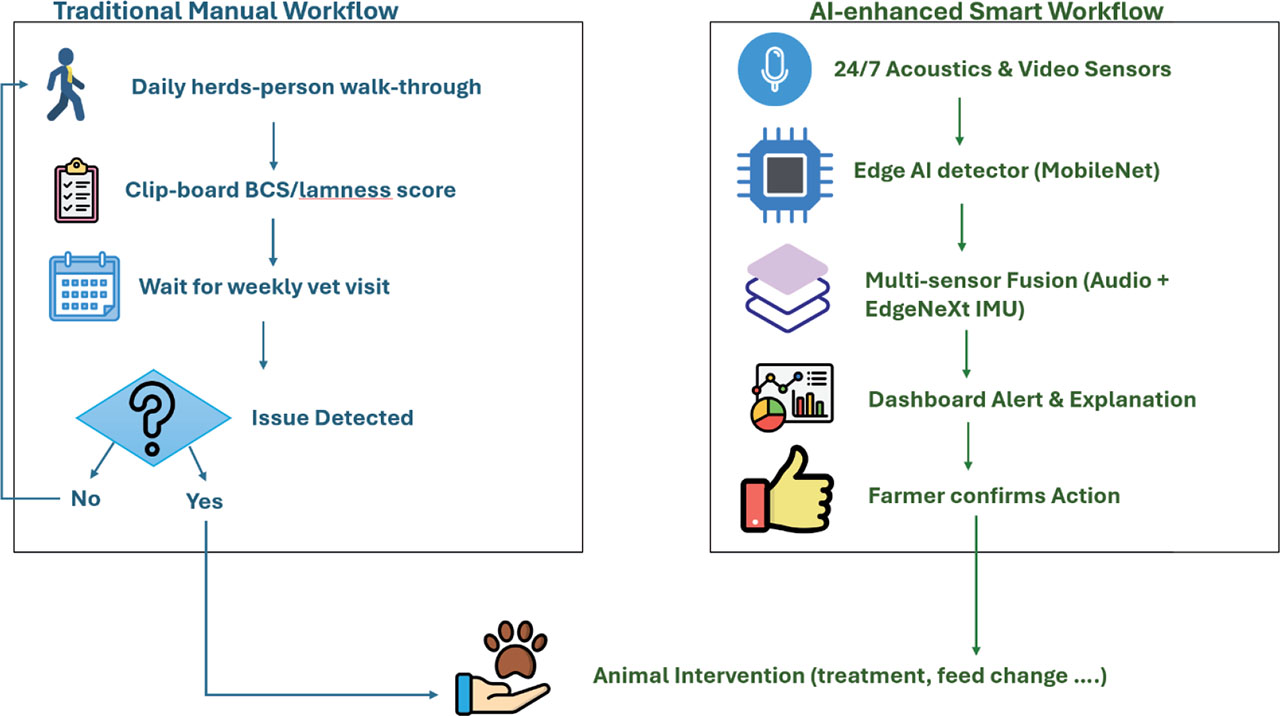
Figure 3.
Comparison of a traditional, human-centric welfare assessment workflow (left) with an AI-enhanced, sensor-driven loop (right). The manual pathway relies on periodic visual scoring and can delay intervention by days, whereas the smart pathway fuses continuous acoustic, motion and video data, runs edge AI for instant anomaly detection, and provides interpretable alerts that prompt rapid farmer action
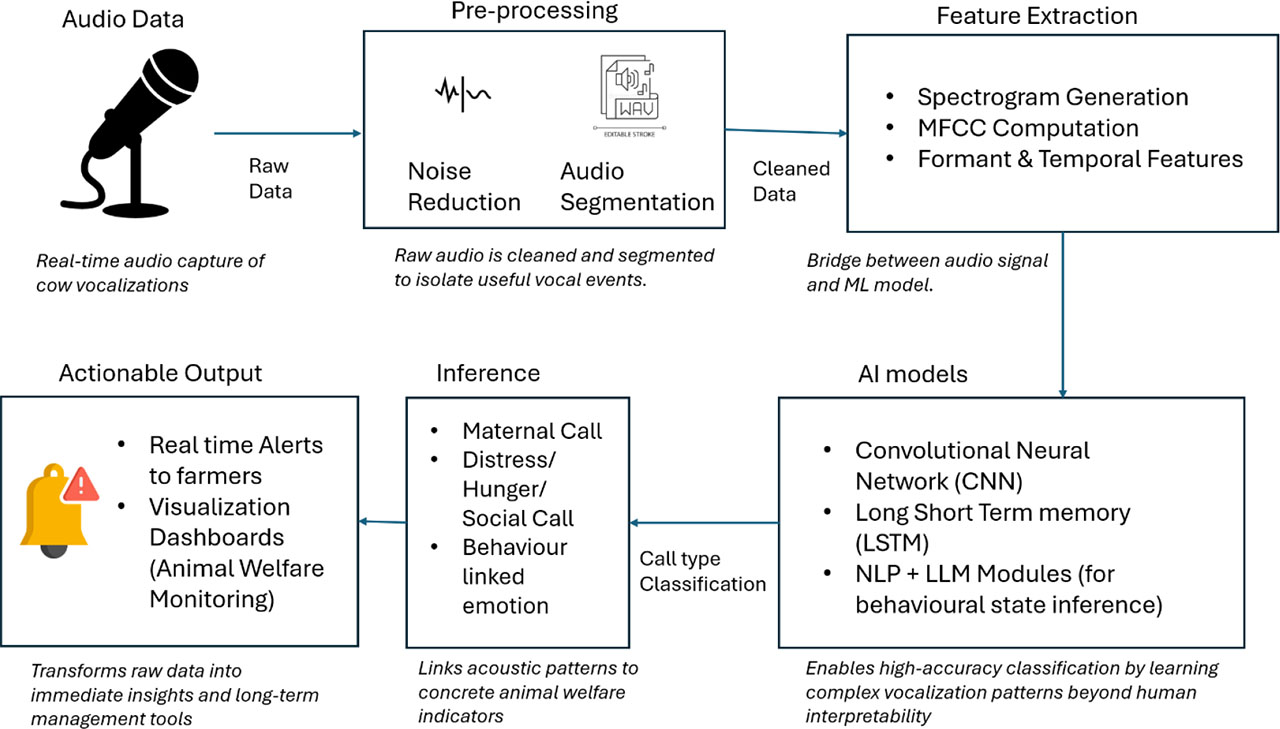
Figure 4.
Illustration of an AI-driven acoustic analysis pipeline for decoding bovine vocalizations, from audio acquisition through preprocessing and modeling to real-time farm alerts
Table 2.
Compact overview of sensor types that can be fused with barn-acoustic streams on low-power edge devices
| No. | Sensor (mount) | Signal + Edge load* | Audio-synergy example (welfare alert) | Field limitation |
|---|---|---|---|---|
| 1 | Tri-axial ACC (collar/ear) (Martinez-Rau et al., 2023 a; Peng et al., 2024) | 100 Hz; low (3 Kbps) | Chew rate high + high-F0 “feed call” → early feeding cue | Battery life: collar fit |
| 2 | UWB/RFID (tag grid) (Wang et al., 2022) | Distance events; low | >10 m isolation + distress bawl → weaning-stress alert | Antenna cost; metal interference |
| 3 | Thermal cam (fixed) (Slob et al., 2021) | 5–15 fps; med (0.5 Mbps) | Eye-temp high + panting sound → heat-stress risk | Night IR; occlusion |
| 4 | Top view RGB cam (Arazo et al., 2022) | 25 fps; high unless pruned | Limp posture + low-F moan → lameness warning | Bandwidth; privacy; dirt |
| 5 | Directional mic (collar) (Röttgen et al., 2020) | 16 kHz; low | High-F0 estrus call detected → identify cycling cow | Collar fit; battery life |
| 6 | NH3/CO2 gas (wall) (Pérez-Granados and Schuchmann, 2023) | 1 Hz; low | Gas spike + drop in calling → respiratory risk | Sensor drift |
| 7 | Water trough pressure mat (Shi et al., 2024) | Sip events; low | Few sips + thirst call → blocked drinker alert | Hardware wear |
Table 3.
Expanded key studies on bovine vocalization analysis
| No. | Reference | Context | Recording setup | Algorithm applied | Data volume (calls/hours) | Performance metric(s) | Major insight/Key finding |
|---|---|---|---|---|---|---|---|
| 1 | Mac et al., 2022 | Calf distress at weaning | 3 chest-high mics, 44.1 kHz, indoor pen | k-NN on MFCC mean ± SD | 600 calls | 94% accuracy | High-pitched, long calls reliably indicated distress |
| 2 | Sharma and Kadyan, 2023 | Dairy estrus detection | Neck collar mic, 16 kHz | SVM, RF comparison | 2000 calls | SVM 95% accuracy | Estrus vocalization has signature harmonic pattern |
| 3 | Vidana-Vila et al., 2023 | Continuous barn monitoring | 12 ceiling mics, 8 kHz | MobileNet CNN detector | 25 h audio | AUROC 0.93 | Real-time detection feasible on edge device |
| 4 | Patil et al., 2024 | Hunger vs. cough vs. estrus | Hand-held recorder, 48 kHz | 7-layer CNN | 5200 clips | 0.97 accuracy | Deep CNN discriminates four intent categories |
| 5 | Ferrero et al., 2023 | 6-class health dataset | Static barn mic array | CNN-LSTM hybrid | 7800 segments | 0.80 macro-F1 | Temporal context Boosts recall on rare classes |
| 6 | Röttgen et al., 2020 | Individual ID in group | Dual-mic collar (airborne + structure-borne) | CNN | ∼2171 events | 87% correct cow ID | Wearable sensors enable individual vocal detection |
| 7 | Hagiwara, 2023 | Self-supervised AVES | Mixed-species archive, cow subset | Transformer encoder | 160 h unlabeled + 800 labeled | + 7 pp F1 vs. CNN | SSL cuts annotation cost, improves few-shot |
| 8 | Martinez-Rau et al., 2023 a | Chew detection collar | Collar mic + accel | RF on chewing spectra | 4 h per cow × 20 | 92% chew vs. rumination | Detects feeding bouts for intake estimation |
| 9 | Gavojdian et al., 2024 | Stress isolation study | Lav-mics, 22 kHz | Bi-LSTM | 3000 sequences | 0.91 F1 | Sequence model spots stress more reliably |
| 10 | Sattar, 2022 | Multi-intent cough/food/estrus | 6 mics, 48 kHz | Spectrogram CNN | 4400 clips | 0.82 macro-F1 | Combined dataset demonstrates multi-class viability |
| 11 | Peng et al., 2024 | Behavior fusion EdgeNeXt | Audio + ACC | EdgeNeXt + fusion | 220 h | 95% behavior acc. | Multimodal fusion > single modality |
Table 4.
Comparative analysis of AI methods in bovine vocalization classification
| No. | AI approach/Architecture | Typical training data volume | Key input representation | Reported best accuracy/F1 | Strengths in reviewed studies | Main limitations/Failure modes | Representative use-case(s) |
|---|---|---|---|---|---|---|---|
| 1 | Random Forest (RF) | ≈500–3 000 labeled calls | Hand-crafted MFCC + temporal stats | 88–93% F1 (distress vs. non-distress) | Robust to noise, interpretable feature importance | Needs manual feature engineering, weak on temporal context | Estrus-call detection (Sharma and Kadyan, 2023) |
| 2 | Support Vector Machine (SVM) | 200–2 000 calls | MFCC mean ± SD, fundamental F0 | 86–95% accuracy (estrus vs. baseline) | Performs well on small datasets, strong margins | Sensitive to parameter tuning, scales poorly with >10 k samples | Early estrus detection wearables (Peng et al., 2023) |
| 3 | k-Nearest Neighbour (k-NN) | 600 calls | Spectral centroid, duration, energy | 94% accuracy for open- vs. closed-mouth calls | Simple, no training time | Storage heavy, cannot model sequence | Call-type classifier in Japanese Black cattle (Peng et al., 2023) |
| 4 | CNN (2-D spectrogram) | ≥5000 call segments | Mel-spectrogram images (128 bins) | 97% accuracy, 0.96 F1 (multi-class-4) | Learns spectral patterns, no manual features | Needs GPU and large data, poor temporal memory alone | Multi-intent classifier (hunger, cough, estrus, normal) (Patil et al., 2024) |
| 5 | Lightweight CNN (MobileNet) | 25 h continuous barn audio | 64-bin log-mel | AUROC 0.93 at 1 s stride | Fast edge inference (<20 ms), low power | Precision drops in heavy machinery noise | Real-time call detection collar (Vidana-Vila et al., 2023) |
| 6 | LSTM/Bi-LSTM | 3000 labeled sequences | Per-frame MFCC + delta MFCC (time series) | 91% F1 (calf isolation vs. contact) | Captures temporal dynamics, good on sequences | Over-fitting on short clips, GPU-heavy | Isolation stress monitor (Martinez-Rau et al., 2025) |
| 7 | Hybrid CNN + LSTM | 7800 segments (6 classes) | CNN spectrograms embedding -> LSTM | 80% overall F1, +6 pp over CNN-only on rare classes | Combines spectrum + sequence info | Needs >10 k samples to beat pure CNN | Multi-class health event detector (Ferrero et al., 2023) |
| 8 | Transformer Audio Encoder (AVES) | 160 h unlabeled pretrain + 800 labels finetune | Raw 16 kHz waveform | 3–7 pp increases F1 over baseline CNN | Self-supervised, strong few shots; domain adaptable | Needs GPU for pretrain, complex | Few-shot call classification after self-pre-training (Hagiwara, 2023) |
| 9 | EdgeNeXt Multi-Sensor Fusion | 220 cow-hours (ACC, audio) | Spectrogram + 6-DoF inertial images | 95% accuracy behavior classification | Multimodal, noise-robust | Needs synchronized sensors, heavy preprocessing | Social licking vs. ruminating (Peng et al., 2024) |
| 10 | Explainable AutoML DT/Rule set | 1200 calls | 24 acoustic stats features | 90% accuracy, full rule trace | Human-readable decision paths | 3–4 pp lower F1 vs. deep nets | White-box distress detection |
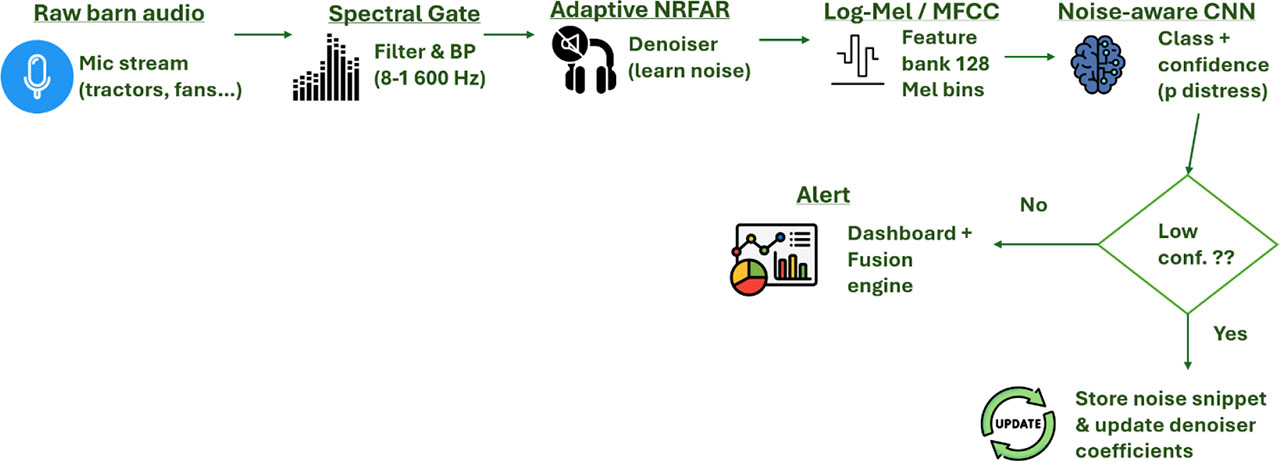
Figure 5.
Noise adaptation pipeline used in our review’s NRFAR style studies. Raw barn audio first undergoes spectral gating and bandpass filtering, then an adaptive denoiser whose coefficients are fine-tuned on site-specific noise samples. A log-Mel feature bank feeds a noise-aware CNN that outputs both class and confidence; low-confidence events trigger a feedback loop that stores new noise exemplars and refreshes denoiser parameters, maintaining robustness without full model retraining
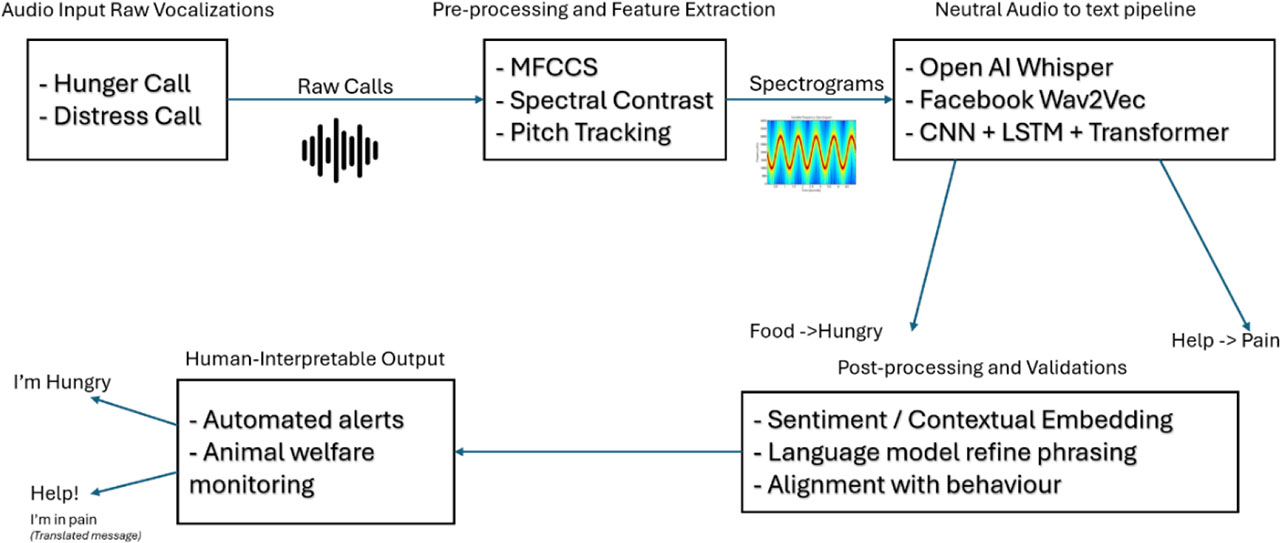
Figure 6.
NLP and LLM approaches to “cow language” translation
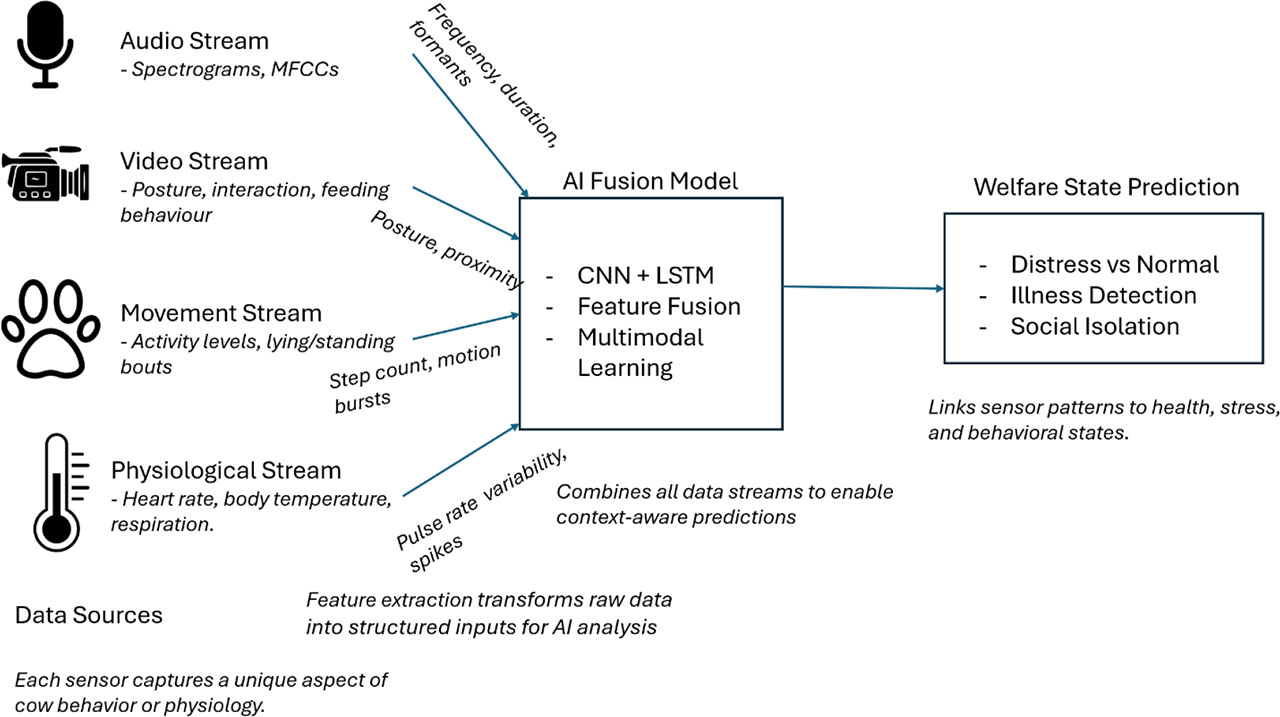
Figure 7.
Schematic model for multimodal data integration (audio, movement, video) in precision livestock farming, emphasizing how sensor fusion yields context-rich insights into animal health and stress
Table 5.
NLP/LLM techniques applied to bovine vocalizations
| No. | Technique/Model | Up-stream pre-training base | Fine-tuning data (bovine) | Key output/Capability | Demonstrated advantage | Current limitations |
|---|---|---|---|---|---|---|
| 1 | Wav2Vec 2.0 (SSL) | 960 h Librispeech human speech | 2 h labeled cow calls | 768-dim latent embeddings → downstream classifier | Cuts labeled data need by ≈70% (Hagiwara, 2023) | Requires long GPU pre-train, bovine prosody differs, latent units not explainable |
| 2 | HuBERT-style Audio LM | 60 k h Youtube-Audio8M | 5 h cow distress calls | Discrete token stream for LLM conditioning | Self-supervised tokens improve LLM prompt ability | – |
| 3 | Whisper (large-v2) | 680 k h multilingual speech | Zero-shot (no cow data) | “Transcript” string + log-prob | Noise-robust segmentation, auto-timestamp | Tokenizer trained on words → outputs nonsense on raw moos; needs post-filter |
| 4 | AudioGPT Controller | GPT-4 (text) + plug-in ASR/encoders | 50 labeled prompts (few-shot) | Multi-step reasoning over acoustic embeddings | Flexible zero-shot Q&A about herd sounds | Heavy compute, pipeline latency, still prototype |
| 5 | CNN Encoder + GPT-2 Decoder | ImageNet CNN weights | 7 k spectrograms with text tags | Generates sentence caption (e.g., “hungry calf call”) | Early end-to-end audio-caption success | Needs dataset of paired call + explanation, currently small |
| 6 | Prompt-Tuned GPT-J | 6 B-param code GPT | 400 synthetic “call→meaning” pairs | Rapid adaptation to cow vocabulary (<1 epoch) | Works with minimal GPU | Synthetic pairs risk bias; real validation pending |
| 7 | Spec-BERT | 100 h farm audio (masked) | 800 labeled segments | Predicts masked time-frequency patches, improves downstream F1 +4 pp | Learns robust representations under barn noise | Mask strategy sensitivity; limited to short clips |
Table 6.
Key public (or semi-public) datasets and benchmarks for bovine bioacoustics – scope, best-fit models, and limitations
| No. | Dataset/Benchmark | Scope and modality snapshot | Best-fit models and intended task | Strengths for model development | Main limitation |
|---|---|---|---|---|---|
| 1 | CowVox-2023 Mini (Sharma and Kadyan, 2023) | 8 h audio, 10k labeled calls, 2 Holstein farms | SVM/RF for estrus-call detection | Clean labels, free download (CC-BY) | Narrow breed and low noise |
| 2 | DeepSound26 Archive (Ferrero et al., 2023) | 120 h audio + 5 h collar IMU, 4 farms/3 breeds | CNN-LSTM fusion for multimodal health events | Synchronized streams; individual IDs | Non-standard file names; requires resync |
| 3 | BEANS bovine subset (Hagiwara et al., 2023) | 6 h cow audio inside 35 h multi-species corpus | Wav2Vec 2.0 or AVES SSL encoder for zero-/few-shot stress detection | Noise-rich clips; ready for SSL pre-train | Sparse bovine labels; class imbalance |
| 4 | Agri-LLM Pilot Set (Chen et al., 2024) | 200 paired “call → English tag” clips, Jersey herd | AudioGPT/GPT-J prompt-tuning for captioning | Paired acoustic–semantic examples | Tiny; heavy text bias |
| 5 | SmartFarm Open-Noise (Martinez-Rau et al., 2025) | 40 h barn ambience (negative class), 5 barn layouts | Spec-BERT masking or NRFAR denoiser pre-train | Diverse negative class for contrastive learning | No positive calls; must be combined with other sets |
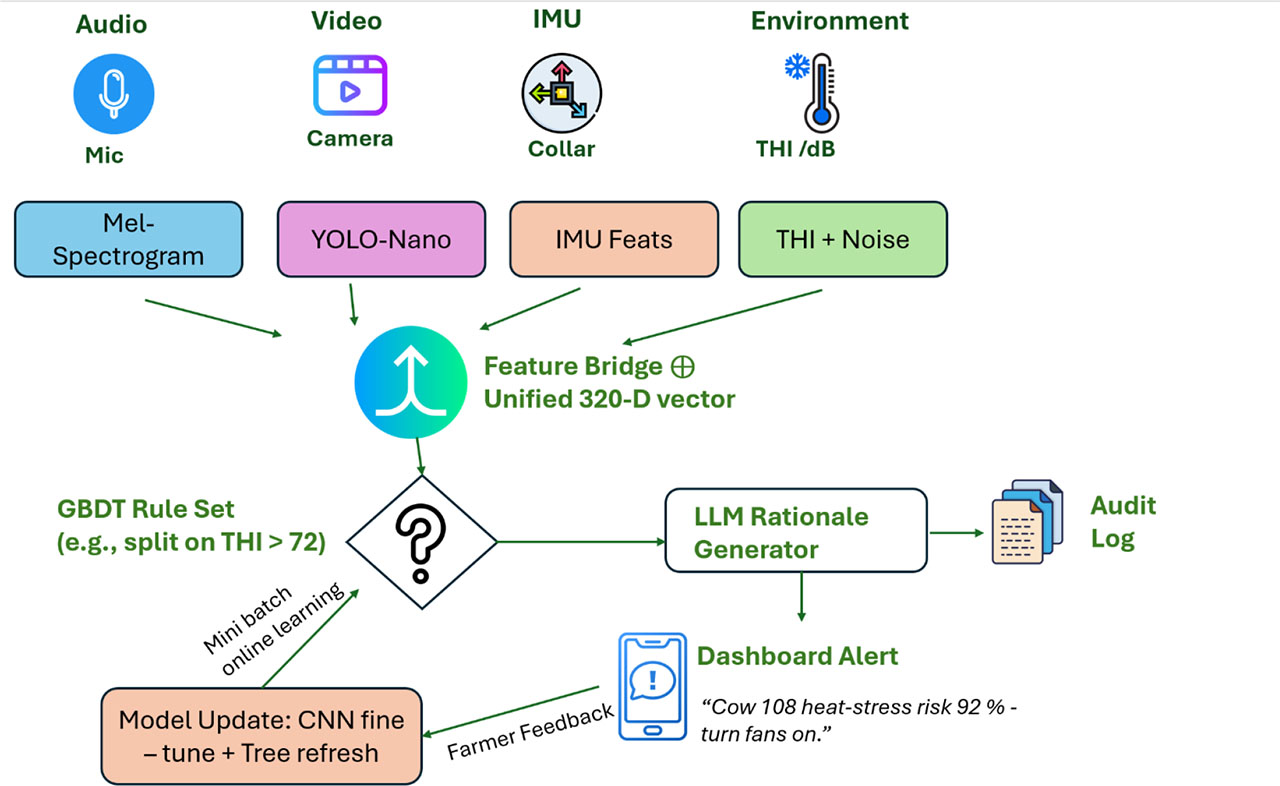
Figure 8.
Hybrid explainable AI multimodal (HEAM) pipeline. Four synchronous streams audio, video, collar IMU signals and environmental sensors are preprocessed and fused into a unified 320-dimensional feature vector. A gradient-boosted decision-tree classifier provides transparent rule-based predictions, while a large language model (LLM) converts those rules plus sensor context into plain language guidance for the farmer. A feedback loop allows new labeled events to fine-tune the CNN front-end and refresh the tree, enabling continuous on-farm adaptation without sacrificing interpretability
Table 7.
Key technical and ethical challenges in AI-driven bovine bioacoustics vs. proposed solutions
| No. | Challenge/Pain-point | Underlying cause(s) and typical manifestation | Impact on research/farm adoption | Proposed technical/operational solutions |
|---|---|---|---|---|
| 1 | Data scarcity and class imbalance | Costly, time-consuming manual labeling of calls Rare yet critical events (e.g., pain bawls, calving distress) under-represented Farm privacy limits data sharing | Over-fitting, poor generalization Models ignore rare but critical classes | Large open acoustic repositories (multi-farm, multi-breed) Self-supervised pre-training (Wav2Vec, AVES) to cut labels by ∼70% Synthetic data via generative models (GAN vocoders) to upsample rare calls Transfer learning to share model weights, not raw audio |
| 2 | Cross-farm variability and domain shift | Differences in barn acoustics, microphone type, breed dialects, management routines | Performance drop when models deployed outside training site, farmer distrust | Domain-adversarial training, feature-space alignment Calibration period and incremental fine-tuning on each new farm Capture meta-data (mic height, barn SNR) for conditional normalization |
| 3 | Background noise and multi-speaker overlap | Machinery, wind, multiple cows calling simultaneously | High false positives/negatives, missed welfare events | Beam-forming or multi-mic arrays for source separation Bi-spectral denoising + mask-based enhancement Event-wise confidence scoring and noise-aware thresholds |
| 4 | Limited interpretability (AI) | Deep nets learn latent features not visible to users | Farmers hesitant to trust alerts, regulators demand transparency | SHAP/LIME heatmaps on spectrograms Rule-extraction or surrogate decision trees Dashboard displays “Top 3 acoustic drivers” behind each alert |
| 5 | Sparse contextual labeling (why a call occurred?) | Audio often logged without behavioral or physiological context | Misclassification of benign calls as distress (or vice-versa) | Multimodal fusion sync audio with accelerometer, video Mobile annotation apps for on-farm event tagging |
| 6 | Real-time processing on resource-constrained edge devices | GPU-heavy models vs. limited power/connectivity in barns | Latency or dropout; costly cloud fees | Lightweight architectures (MobileNet, DistilBERT-audio) On-device quantization and pruning |
| 7 | Ethical risk of anthropomorphism and over-interpretation | AI may project human emotion labels inaccurately Farmers may act on unverified alerts | Questionable welfare interventions, misleading claims | Cross-validation against physiological stress markers Expert-in-the-loop verification before deploying new labels |
| 8 | Farmer adoption and usability barriers | Alert fatigue, complex interfaces, unclear ROI | System ignored despite accuracy; missed welfare benefit | Tiered alerting (red/high vs. yellow/medium) ROI calculators (savings on vet costs, improved conception) Hands-on training and local language interfaces |
| 9 | Data privacy and ownership concerns | Audio streams may reveal proprietary operations | Reluctance to share data, slows collaborative progress | Federated or encrypted model updates Clear data-use agreements; farmer retains raw-data ownership On-premises processing options |
| 10 | Regulatory alignment and standardization gaps | No harmonized acoustic welfare metrics yet | Hard to benchmark systems; variable certification hurdles | Develop ISO-style standards for recording and annotation Open benchmarking datasets and leaderboards Engage policymakers early to shape guidelines |