
Lameness in cattle is a painful condition characterized by gait abnormalities and discomfort, often caused by injuries to the hooves or limbs (Foditsch et al., 2016). In dairy cows, interdigital dermatitis (IDD) is currently the most prevalent disease associated with lameness (Harris-Bridge et al., 2018). Lameness negatively impacts animal health, as affected cows often show clear signs of discomfort, such as spending more time lying down, which increases the risk of pressure sores and udder disorders. Additionally, cows with limb pain tend to eat less, making them more susceptible to developing a negative energy balance, which can lead to more severe secondary diseases (Ózsvári, 2017). Lameness also has significant repercussions on livestock reproduction, mainly due to the stress caused by chronic pain and inflammation and to behavioural changes (Tsousis et al., 2022).
Gait scoring systems are used to visually assess locomotion and evaluate lameness in cows (Schlageter-Tello et al., 2014). These methods use various traits such as asymmetric gait, limb abduction and adduction, joint stiffness, weight-bearing issues, tracking up, arched back and head movement as lameness indicators (Offinger et al., 2013). The methods are non-invasive and farm-friendly (Whay, 2002), and regular weekly locomotion assessments by trained farm personnel are recommended (Alsaaod et al., 2019). However, the methods are often time-consuming, subjective and labour-intensive, and variations in scoring systems affect consistency between observers (Alsaaod et al., 2019; Rodríguez et al., 2016; Schlageter-Tello et al., 2014).
The increase in the size of farms (Barkema et al., 2015) has reduced the time available for monitoring, and underestimation of the prevalence of lameness is of concern. Research suggests that difficulties in detecting early behavioural changes often lead to underestimation of the prevalence of lameness (Espejo et al., 2006). Many livestock farmers are unaware of the financial implications of lameness and do not recognize how the problem affects the productivity and profitability of their dairy operations (Leach et al., 2010). The average cost per case has been estimated to be US$ 216 for sole ulcer and US$ 133 for digital dermatitis, and lameness in general is estimated to cost the UK livestock industry around £54 million annually (Foditsch et al., 2016). The economic losses caused by lameness are due to reduced milk production, lower revenue due to a longer calving interval, live weight loss, early culling, high treatment costs and extra labour costs (Ózsvári, 2017). Early detection of hoof pathologies would enable prompt treatment and is considered the best method for reducing the overall severity of lameness diseases (Alsaaod et al., 2014; Lin et al., 2018). Early diagnosis would also shorten the treatment period required (Lin et al., 2018), and the reduced use of antibiotics would contribute to the fight against antimicrobial resistance (Opheim et al., 2023).
Infrared thermography (IRT) measures infrared radiation and creates a thermogram that represents surface temperature patterns of an object. This method can potentially be used as an alternative to visual methods of assessing lameness (Alsaaod and Büscher, 2012). IRT has shown potential for detecting inflammation-related temperature changes in cow hooves, offering a non-invasive and automatable solution (Alsaaod and Büscher, 2012; Harris-Bridge et al., 2018). In cattle, the temperatures of surfaces and extremities are primarily influenced by blood circulation and tissue metabolism. Changes in blood flow affect the amount of radiated heat, particularly when inflammation is present (Bobic et al., 2024). For instance, previous studies have shown that the surface temperature of the coronary band is higher in hooves with lesions than in healthy hooves (Alsaaod and Büscher, 2012). However, IRT cannot distinguish between different types of lesions (Wood et al., 2015). Although the use of IRT to identify lameness and hoof lesions has increased in recent years, owing to the non-invasive properties, possibility of automation and gradual decreases in costs (Alsaaod et al., 2019), practical use of the method for early lameness detection requires further evaluation. IRT measures infrared radiation to create a visual map of surface temperatures, enabling the detection of localized inflammation (Harris-Bridge et al., 2018; Eddy et al., 2001). Nevertheless, environmental factors such as air temperature, dirt and humidity can affect the accuracy of IRT. Therefore, cow management and the production system in which the herd is maintained greatly affect the temperature, altering the precision of IRT (Alsaaod and Büscher, 2012; Werema et al., 2023).
Visual assessment of locomotion requires an effort that is not feasible in modern livestock farming, and an automated alternative method is required. Therefore, this study aimed to determine whether IRT can be used for the early diagnosis of hoof pathology, with a view to automated application of the method. The specific study objectives were as follows: 1) to establish the relationship between the maximum temperature (MT) of the coronary band in each hind foot and the locomotion score (LS); 2) to relate the MTs of the sole, interdigital space and the coronary band to lameness; and 3) to evaluate how parity influences the MT of various hoof regions.
Material and methods
Animals and image sampling
The study was carried out on a dairy farm (Prolesa SAT) located in the province of Lugo (Galicia, NW Spain), with a total of 520 Holstein Friesian milking cows. The cows were housed in free-stall barns with individual sand-bedded cubicles and concrete floors. The study was conducted according to guidelines established in the European Union legislation (Directive 2010/63/EU) and the Spanish Regulations for the protection of animals used for scientific purposes (RD 53/2013). A total of 231 cows (27–528 days in milk, DIM) were examined in experiment 1. The IRT images were captured, between December 2023 and February 2024, with an infrared camera (see section ‘Infrared thermography images’). Thermal images were taken of both hind hooves, cranial (CR) and caudal (CD) views (Figure 1). Cows were standing in the stall-feeding corridor when the IRT images were obtained. The coronary band images were taken from a distance of 97 (±10) cm, and the time of recording was constant for all cows. The cows were then released and the LS for each cow was evaluated following the criteria described by Sprecher et al. (1997) (Table 1). Different researchers took the IRT images and evaluated the LS.
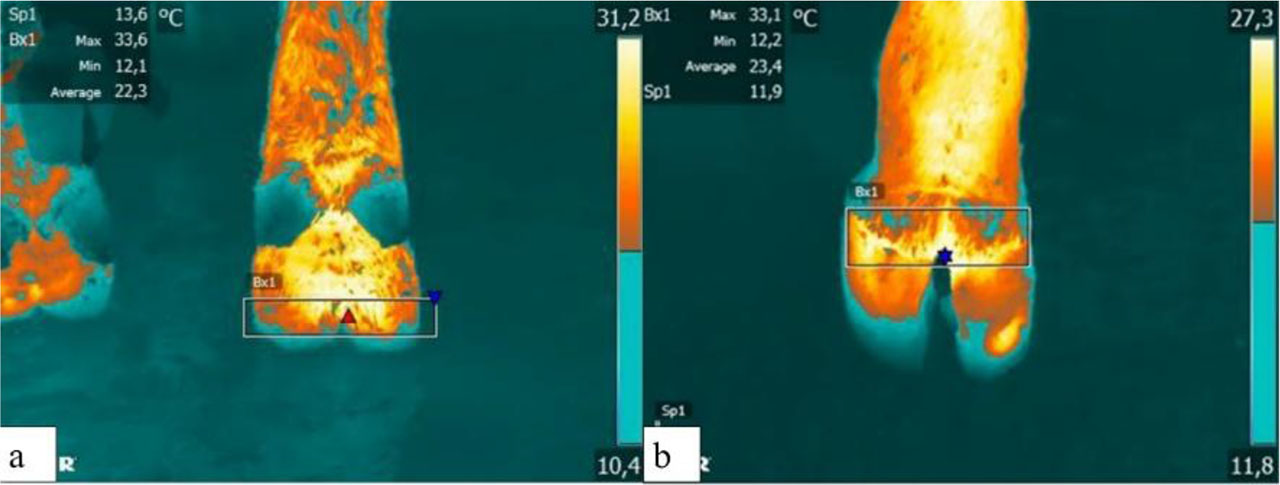
Figure 1.
Infrared thermography images of the hind hoof of a high-producing Holstein cow. The rectangular area represents the analysed surface in experiment 1, caudal (a) and cranial (b) views
Table 1.
Criteria used to evaluate the locomotion score in Holstein cows (n=231). Adapted from Sprecher et al. (1997)
| Level | Locomotion | Back line | Walk | Head movement | Weight bearing |
|---|---|---|---|---|---|
| 1 | Soft and fluid movement | Straight back | Long and sure strides | Stable | All legs bear weight equally |
| 2 | Imperfect movement, but can move freely | Slightly arched back | Slightly asymmetric walk | Slight head roll | Lameness indicated |
| 3 | Free movement affected | Arched back | Short strides | Head raised when the affected hoof is placed on the ground | Lameness certain |
| 4 | Free movement is more affected | Pronounced arched back | Short, uncertain strides | Head clearly raised when the affected hoof is placed on the ground | Reluctant to place the affected hoof on the ground |
| 5 | Movement capacity severely affected | Exaggerated arched back | Very short, deliberate and uncertain strides | Exaggerated raised head when the affected hoof is placed on the ground | Incapable of placing the affected hoof on the ground |
A total of 137 cows (5–671 DIM) were examined in experiment 2. In this case, IRT images of hind feet were captured during routine hoof trimming. For recording the coronary band temperature (CR and CD views), cows were standing in the hoof trimming chute. The search area was chosen as depicted in Figure 2. The plantar view of the heel was captured from a distance of 59 (±0.7) cm, and the time of recording was constant for all the cows. Sole (SL) and interdigital (ID) temperatures were also recorded. If the hoof was dirty and the underside thus not visible, the dirt was wiped off (by hand) before the temperature was recorded. A qualified cattle foot trimmer then raised and examined the hooves.
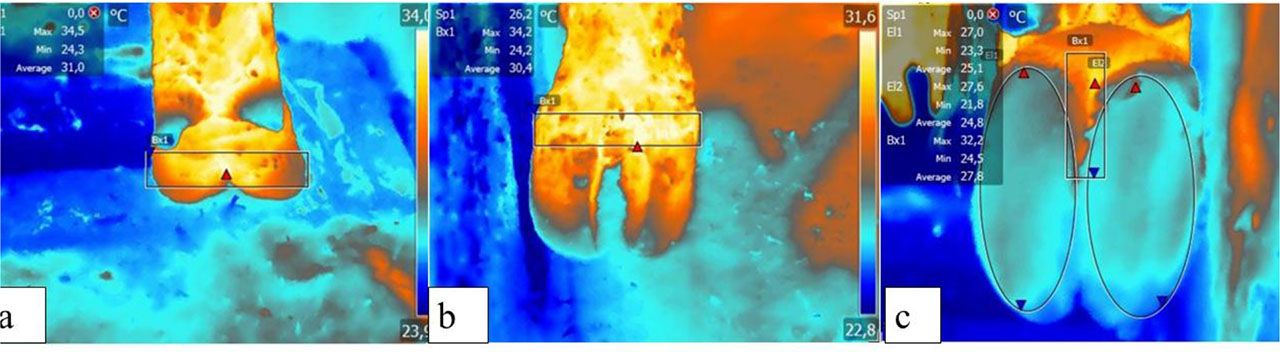
Figure 2.
Images of dairy cattle hooves in experiment 2: (a) caudal, (b) cranial and (c) sole views. The maximum temperatures (MTs) denoted in images a, b and c by rectangles, measured in the caudal, cranial and interdigital areas respectively. The average MT in image c, denoted by oval areas, was the MT of the sole used in the study
Infrared thermography images
Images were taken in both experiments using a thermal camera (model FLIR E95, Teledyne FLIR, Oregon, EEUU) following the guidelines established by McManus et al. (2022). The emissivity value was set at 0.95. The accuracy of the thermal images was checked by measuring the temperatures with a mercury thermometer. In order to minimize disruption of daily management practices, the hooves were not washed and the skin between the heel bulbs was not cleaned before thermal imaging in either experiment. The recordings were made without direct or reflected sunlight. Ambient environmental temperature and relative humidity were recorded at the start, during and end of each recording session, and the values were taken into account for calibration of the thermal camera measurements. During the data collection, mean ambient temperature was 15 (13.50–21.00) °C and the mean ambient humidity was 85 (70–95) %. A rectangular search area was chosen for reflected MT recording, by using the FLIR Tools software, version 5.2.15161.1001 (2015), and the MT search tool (Figures 1 and 2). In order to simplify the method, the core body and ocular temperature were not measured.
Statistical analysis
In experiment 1, cows were classified according to the LS (Healthy=1, Subclinical=2, Clinical=3, 4 and 5), considered a categorical variable. Similarly, in experiment 2, feet were classified by their hoof health status (Healthy, IDD: with interdigital dermatitis, and Other: with axial flexure, thin sole, white line disease, corkscrew claw, heel erosion, haematoma or heel necrosis). Due to the different prevalence of the various diseases, IDD (11.68%) was analysed separately from the other diseases (14.64%). In both experiments, parity (1: primiparous, 2: second calving and 3: more than two calvings), environmental temperature (1=≤15ºC and 2=>15ºC) and humidity (1=≤85 and 2=>85) were considered categorical variables. The cut-off points between categories for environmental temperature and humidity were established according to the mean value obtained for each variable. In experiment 1, healthy and lame hooves were not distinguished, and the MTs for CR and CD were average values of both hind feet. In both experiments, MT measurements (CR, CD, SL and ID) were considered continuous variables.
The impact of LS, hoof health status, parity, environmental temperature and humidity on the MT in all areas were analysed using a univariate general linear model. LS, parity, environmental temperature and humidity were considered factors in experiment 1, and hoof health, parity, environmental temperature and humidity were considered factors in experiment 2. At the same time, the MT measured in all hoof areas was considered in both experiments as the dependent variable. Homogeneity was analysed using the Levene test, and normality was tested using kurtosis and asymmetry (values ranging from −0.5 to 0.5).
All statistical analyses were conducted with IBM SPSS Statistics version 29.0.1.0 (IBM Corp., Armonk, NY, USA). Differences were considered significant at P≤0.05.
Results
In experiment 1, the prevalence rates of LS 1, 2 and ≥3 were respectively 37.93%, 37.36% and 24.71%. The results of the univariate general linear model applied to the data (Figure 3) revealed significant differences (P<0.001) between cows with LS≥3 (CR=34.15±2.07ºC, CD=32.48±3.02ºC) and cows with LS=1 (CR=32.13±4.72ºC, CD=30.09±5.81ºC) in the coronary band MT measurements. Additionally, cows with LS=1 had significantly lower MT than LS=2 in the CR measurement (33.76±2.12ºC, P<0.001), although no significant differences were observed for the CD measurement (CD=31.67±3.64ºC, P>0.05) between these two groups. On the other hand, cows with LS=2 did not significantly differ from cows with LS≥3 in any measurement.
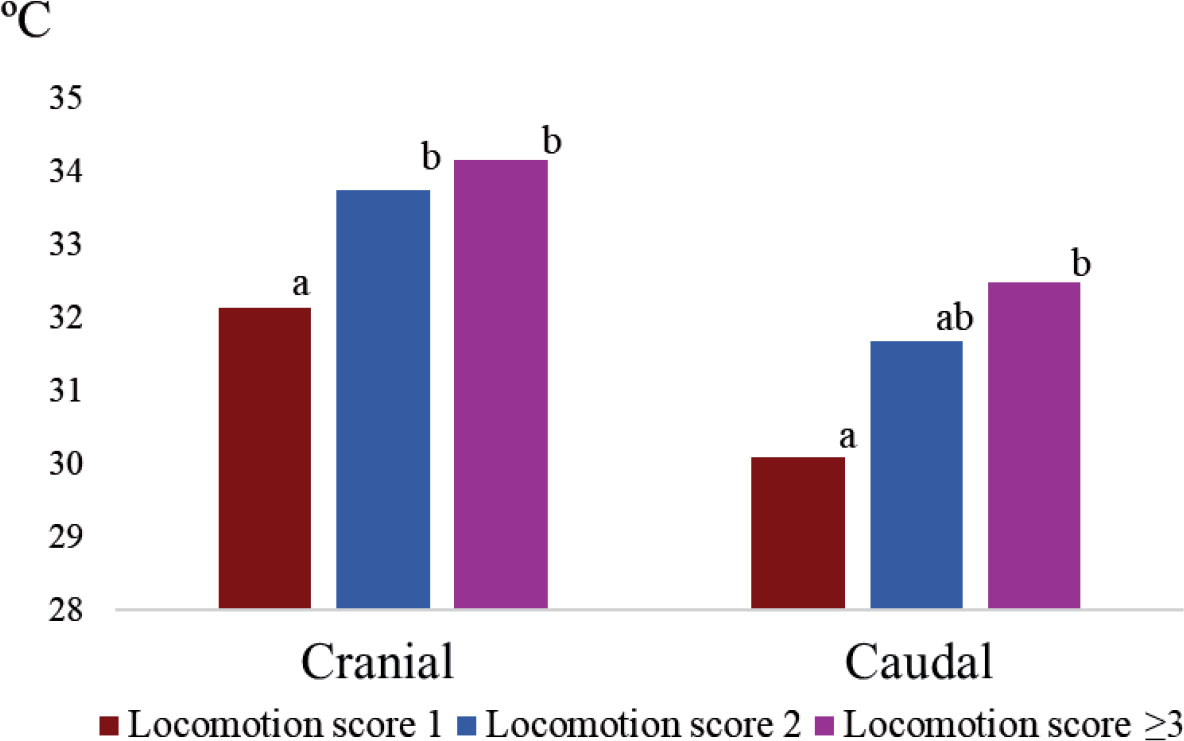
Figure 3.
Average maximum hoof temperatures, according to the locomotion scores, in 231 dairy cows. Different letters indicate significant differences (P<0.05)
In experiment 2, the foot lesions detected in hind feet were interdigital dermatitis (IDD, 11.68%), axial flexure (2.92%), thin sole (2.92%), white line disease (2.92%), corkscrew claw (2.19%), heel erosion (1.50%), haematoma (1.46%) and heel necrosis (0.73%).
The results showed (Figure 4) that healthy hooves (CR=31.47±3.29, CD=29.22±3.21, SL=25.82±3.16, ID=30.60±3.22) had significant lower MT in the ID measurement (P<0.001) than hooves with IDD (CR=32.17±2.24, CD=30.66±3.67, SL=26.91±2.48, ID=33.83±2.40), but did not differ significantly in the MT analysed in the remaining areas (P>0.05). However, there were no significant differences between healthy hooves and hooves with a hoof pathology other than IDD (CR=31.55±3.29, CD=29.53±3.49, SL=25.15±1.95, ID=31.11±3.18, P>0.05). In addition, hooves with IDD did not significantly differ from hooves with a different lesion in any measurement (P>0.05).
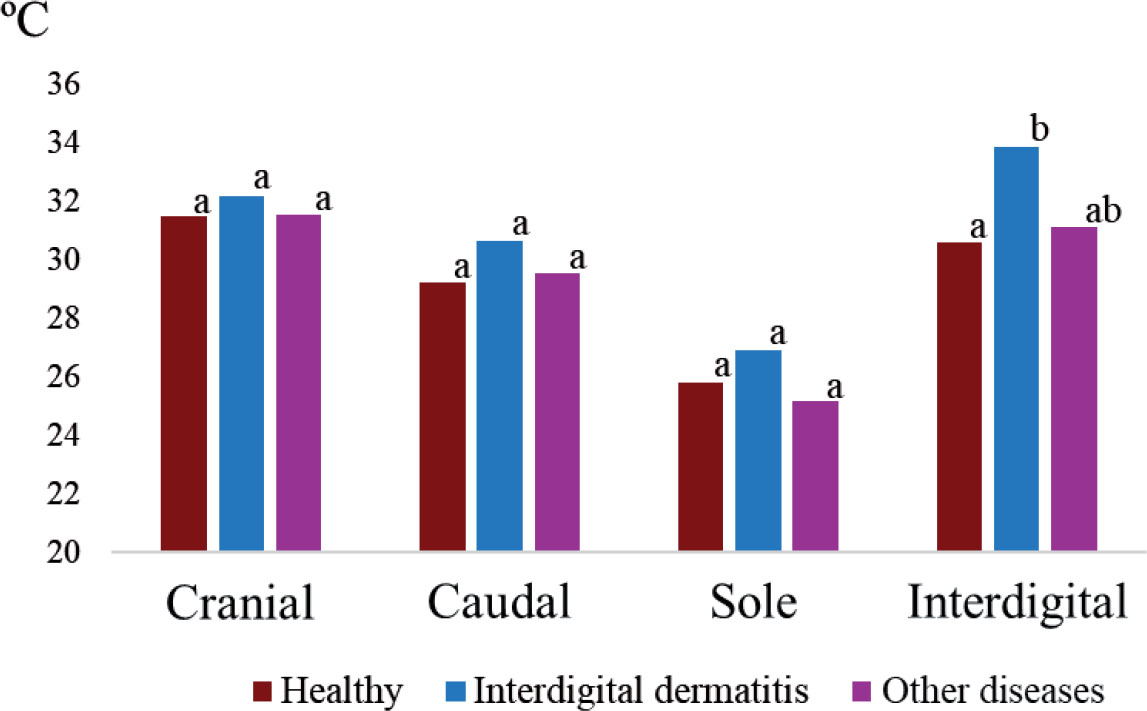
Figure 4.
Maximum temperatures measured in different areas of the hoof according to hoof health diagnosis in 137 dairy cows. Different letters indicate significant differences (P<0.05)
Parity was found to have a significant effect on hoof MT in both experiments (Table 2). In this regard, cows with ≥3 calvings differed significantly (P<0.001) from primiparous cows in CR, CD and SL MT. However, MT in the ID area did not differ between primiparous and cows with ≥3 calvings (P=0.075). Primiparous and second calving cows did not show significant differences in any area measured. No significant differences were observed between second calving and other multiparous cows in CR and CD views in experiment 1 (Table 2). At the same time, in experiment 2, there were no significant differences in the CR, SL and ID measurements. Finally, the CD measurement different significantly (P=0.025) among multiparous groups.
Table 2.
Maximum temperatures (ºC) in dairy cattle hooves in the different areas examined in relation to parity (1: primiparous; 2: second calving; ≥3: 3 or more calvings)
| Parity | N (cows) | Cranial area | Caudal area | Sole | Interdigital area |
|---|---|---|---|---|---|
| Experiment 1 | |||||
| 1 | 48 | 34.38±2.91 a | 32.84±4.23 a | ||
| 2 | 88 | 32.88±3.54 ab | 31.19±4.52 ab | ||
| ≥3 | 74 | 32.65±3.60 b | 30.07±4.53 b | ||
| Experiment 2 | |||||
| 1 | 48 | 32.28±2.24 a | 29.90±2.81 a | 26.48±2.20 a | 31.70±2.53 a |
| 2 | 46 | 31.60±3.22 ab | 29.85±2.94 a | 25.80±2.82 ab | 31.70±3.12 a |
| ≥3 | 42 | 30.94±3.43 b | 28.62±3.54 b | 25.35±3.34 b | 30.66±3.57 a |
In experiment 1, no significant differences (P>0.05) in MT were observed in any area measured in cows examined at environmental humidity ≤85% (CR=31.81±3.24ºC, CD=29.44±3.53ºC) and >85% (CR=31.96±3.38ºC, CD=29.67±3.98ºC). Similarly, MT measured under wetter (CR=32.05±3.27, CD=29.75±3.86, SL=25.91±2.97, ID=31.40±2.91) and drier (CR=31.85±4.07, CD=29.64±3.43, SL=25.40±3.00, ID=31.35±3.15) environmental conditions did not differ significantly (P>0.05) in experiment 2. Likewise, no significant effect was observed in either experiment between the different environmental temperature groups (P>0.05). In experiment 1, cattle examined at an environmental temperature >15ºC had a MT of 32.12±2.27 and 29.84±3.35ºC in CR and CD areas, respectively. On the other hand, the MT in cattle examined at environmental temperatures ≤15ºC was 30.70±5.35 and 27.65±5.00ºC in CR and CD views, respectively. In experiment 2, MT measured under warmer conditions (CR=31.35±3.45, CD=29.41±4.56, SL=26.32±2.25, ID=31.25±2.67) did not differ significantly from MT measured under colder (CR=30.05±3.68, CD=28.20±2.80, SL=24.86±2.98, ID=30.45±3.03) environmental conditions (P>0.05).
Discussion
The study findings revealed a significant relationship between locomotion score and the MT measured in the hind limbs. Specifically, the MT was higher in limbs with LS ≥3 than in limbs with LS 1 in both views. No significant differences were observed between LS 2 and ≥3, in either CR or CD views. On the other hand, there was a significant difference between LS 1 and 2 in the CR view (Figure 4). In a recent study, Werema et al. (2023) considered the need for alternatives to traditional locomotion scoring for detecting lameness in dairy cattle and demonstrated that IRT can provide a more objective and accurate assessment of hoof health. The researchers concluded that the method could be particularly useful in settings where resources are limited and staff training is not feasible. In the aforementioned study, mean MTs were higher for cows with LS 1 than for those with LS 0; the values were also higher for cows with LS 2 than for those with LS 1 and also for cows with LS 3 than for those with LS 2. In the present study, the prevalence rates of LS 1, 2 and ≥3 were respectively 37.93%, 37.36% and 24.71%, and there was a statistically significant difference between cows with LS ≥3 and cows with LS=1 in the CR and CD values of the MT coronary artery strip. Nevertheless, different methods were used to assess the locomotion score in the two studies.
On the other hand, Lin et al. (2018) show that foot temperature, measured by infrared thermography, was strongly associated with LS, with lame cows having higher foot temperatures than non-lame cows. In the study, only 16 cases were assigned a LS of 3, and these cases were therefore combined with the cases with LS 2, producing similar results to those of our study. Nevertheless, a previous study demonstrated that chronic hoof lesions were probably assigned higher LS values than acute injuries (O'Callaghan, 2002). By contrast, acute inflammation is often characterized by an increase in local temperature.
MT measurement was used in the present study, as several researchers have shown that this variable is more relevant in IRT than the minimum or average temperature (Rainwater-Lovett et al., 2009; Stokes et al., 2012). The use of MT was justified by Stokes et al. (2012), as the measure that produced the most consistent results. Rainwater-Lovett et al. (2009) justified the use of MT owing to the positive correlation between hoof temperature and both body temperature and ocular temperature. Moreover, the findings of this study also supported the use of MT, as it proved the most reliable measure relative to more affordable devices. On the other hand, the IRT images in this experiment were obtained without the limbs first being cleaned, which could have influenced the results (Robinson et al., 1981; Van Hoogmoed et al., 2000). Nonetheless, Stokes et al. (2012) reported that after hooves were cleaned, the rate of false positives was two and a half times higher than the rate of true positives, so that injury detection was more reliable in dirty feet. In practice, this enables rapid detection of lameness with minimal disruption to the daily routine on the farm. Other intrinsic factors, such as lactation stage, can also affect the measurements. Nikkhah et al. (2005) analysed 16 cows twice, either in early/mid-lactation (≤200 DIM) or in late lactation (>200 DIM), and observed that limb temperature was higher in cows at the beginning or mid-lactation than in cows at the end of lactation. However, lactation status was not considered in the present study. In the light of the above findings, further work is necessary to combine thermography and other electronic methods of detecting lameness and to elucidate their association with lesion-specific lameness (Renn et al., 2014).
IDD is currently one of the most prevalent infectious diseases associated with lameness (Archer et al., 2010). Although the prevalence of IDD has not been investigated in Spain (Pérez-Cabal and Alenda, 2014), it has been estimated to affect around 70% of all dairy herds in the UK (Archer et al., 2010). The within-herd prevalence of IDD has been estimated to be between 0% and 74% (Solano et al., 2015; Somers et al., 2005). The prevalence of IDD on the study farm was 11.68%, and the overall prevalence of all other pathologies (erosion, white line disease, axial flexure, corkscrew claw, thin sole, necrosis and haematoma) was only 14.64%. Another study conducted in the UK found sole ulcer was more prevalent than other hoof diseases such as IDD (Murray et al., 1996). The data obtained showed an increase in MT in cows with IDD, which may be related to inflammation of both the skin and hooves of affected animals (Alsaaod et al., 2014). This difference was statistically significant in the case of IDD, and it was almost significant in the case of SL (Figure 4). These findings are consistent with those reported by Fabbri et al. (2020), who showed a representative IRT of a foot affected by IDD with the selected regions of interest. Temperatures were also statistically significantly higher (P<0.001) in the central and interdigital areas than in the lateral and medial areas of the hind hooves of both healthy and diseased cows. Specifically, the temperature of the central areas of the hind feet was 2.80°C higher in sick cows than in healthy cows (an increase of 10.15%).
As a method of detecting lameness in cows, IRT has as the advantage that it does not require direct physical contact with the hoof, thus enabling remote reading of the MT without disturbing the animals. Furthermore, it is inexpensive, easy to automate, fast and efficient, and it also enables collection of data in external environments (Fabbri et al., 2022). Additionally, as in the present study, it is essential to consider environmental conditions, such as humidity and temperature, which can have a significant influence on IRT measurements (Casas-Alvarado et al., 2024; Wood et al., 2015). However, our findings showed that neither environmental temperature nor humidity affected MT, possibly due to the similarity in environmental conditions on the different IRT measurement days. It is important to consider circadian, infradian and ultradian rhythms when planning the application of IRT or interpreting the results, as these factors influence body temperature (Rekant et al., 2015). Lefcourt et al. (1993) reported that physiological factors, such as plasma cortisol concentration in dairy cows, also follow these rhythms and may thus also affect body temperature. An increase in cortisol leads to a rise in temperature due to increased blood flow (Whittaker et al., 2023). The present study did not consider cortisol levels, but all animals analysed were reared under the same management conditions. Other researchers have suggested that IRT might be more effective at night, as the technology relies on detecting temperature differences, and the contrast between the subject and its surroundings will be greater at night (McCafferty et al., 2011). In the present study, the measurements were taken during routine trimming on the farm, which is done in the morning. This recommendation would be particularly relevant for IRT performed on animals kept outdoors. On the other hand, Church et al. (2014) also observed that hair colour causes differences in animal body temperature and, therefore, has a significant effect on IRT temperature readings. However, the cattle examined in this study had the same hair colour in both hind hooves.
Regarding the accuracy of IRT, some previous studies have described the specificity and sensitivity of this technique. Lin et al. (2018) reported a sensitivity of 78.5% and specificity of 39.2%, while the corresponding figures reported by Rodríguez et al. (2016) and Stokes et al. (2012) were respectively 46.7% and 89.7%, and 80% and 73%. As with optimal cut-off, more data are required on the factors determining the variability in specificity and sensitivity, probably driven by the differences in the protocols used among studies.
Finally, in both experiments, parity was included as a possible confounding variable. However, no interaction with the LS or hoof pathology was observed in either case. On the other hand, we found that cows that had calved more often had significantly lower MT than primiparous cows, as also observed by Nikkhah et al. (2005). This finding could be explained by the greater growth of keratinous tissue in younger cows and the increased blood supply that it requires. It could also be explained by the possible influence of stress (which may be more intense in younger cows) caused by human presence during the imaging, thereby increasing cortisol production. Bobic et al. (2018) also observed higher hoof temperature in younger cows than in older cows, although parity did not have a significant effect on coronary band temperature in cows with confirmed lesions. Regarding the lactation stage, there was a significant difference between injured cows in first and second parity. The aforementioned authors also found that the situation was quite different in cows without lesions, as both parity and stage of lactation significantly affected the coronary band temperature. Lesions were found in 54% of cows in the first parity group, 78% in the second parity group and 91% in the third and further parity groups. Renn et al. (2014) suggested that adult cows have a higher risk of developing rear limb injuries, while the front limbs of heifers are more often affected, which may be related to changes in hoof formation after calving.
We conclude that IRT is a useful diagnostic method for identifying cows with moderate to severe lameness (LS≥3). Similarly, IRT may be useful for detecting the presence of IDD on farms, as it was able to detect an increase up to 3ºC in affected cows. However, parity must be considered when using IRT to detect hoof pathologies, as hoof temperature is lower in older cows. Further research is required to determine how to automate IRT for use in dairy herds. Daily records of each cow would be valuable for posterior comparison and could be obtained with automatic systems, which could also record data at different times of the day. One limitation of the study is that the findings cannot be generalized to larger populations, highlighting the need to include a higher number of farms in future research.
Acknowledgements
The authors acknowledge the Seragro S.C.G. farm service cooperative for providing hoof trimming facilities and for assistance provided throughout the study. Jacobo Álvarez Torres holds a predoctoral contract funded by the Fundación Caixa Rural Tomás Notario Vacas (2024 call). Uxía Yáñez Ramil holds a postdoctoral contract funded by the Xunta de Galicia (Ref. ED481B_033/2024).