
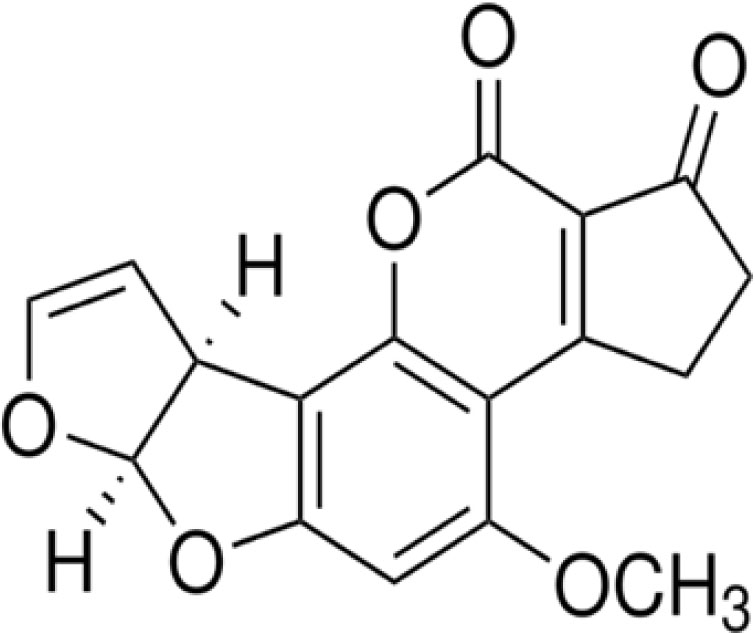
Figure 1.
Aflatoxin B1 chemical structure
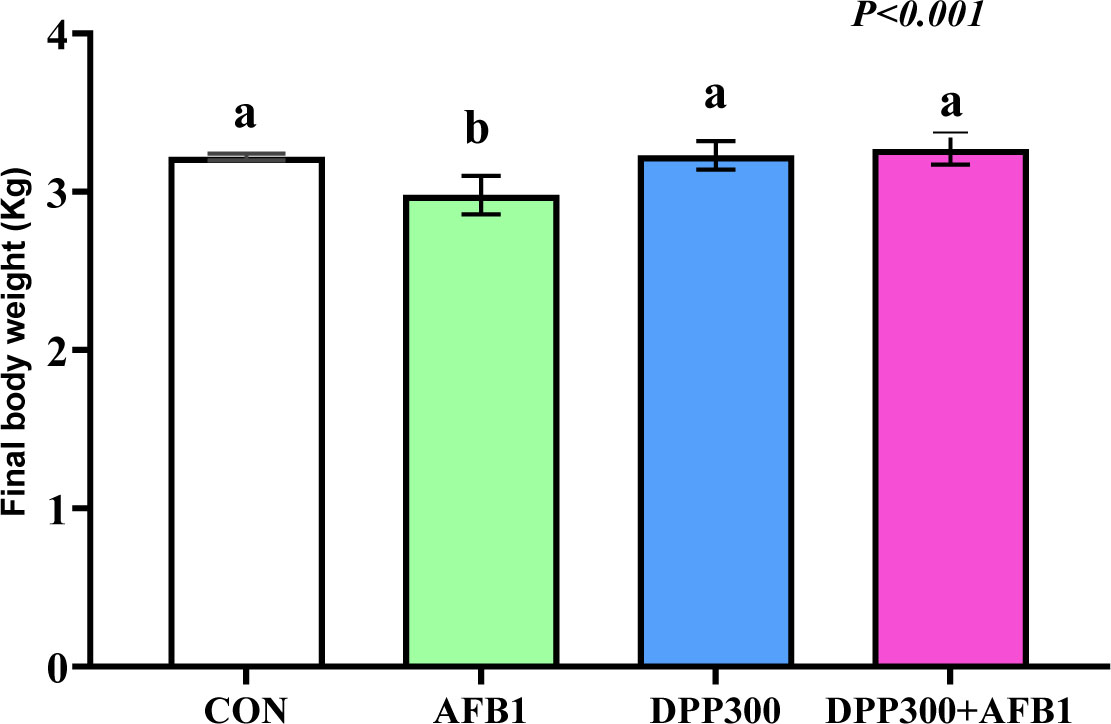
Figure 2.
The final body weights of rabbit bucks were measured in response to dietary inclusion of AFB and treatment with date palm pollen (DPP). The rabbit bucks were fed a basal diet (CON), contaminated diets with AFB1 (AFB1), date palm pollen (DPP), or AFB1+DPP for two months. a, b – values with different letters indicate a significant difference (P<0.05)
Table 1.
Impacts of dietary date palm pollen (DPP) in mitigating the negative effect of aflatoxin B1 (AFB1) on the blood metabolites of male rabbits
| CON | AFB1 | DPP300 | DPP300+AFB1 | ||
|---|---|---|---|---|---|
| TP, mg/dL | 5.89±0.10 b | 4.33±0.11 c | 6.77±0.10 b | 8.15±0.15 a | <0.001 |
| ALB, mg/dL | 4.63±0.14 b | 3.13±0.05 c | 4.53±0.17 b | 5.82±0.33 a | <0.001 |
| GLO, mg/dL | 1.26±0.23 b | 1.20±0.16 b | 2.24±0.10 a | 2.34±0.36 a | 0.013 |
| CREA, mg/dL | 1.42±0.01 b | 2.34±0.01 a | 1.20±0.02 b | 1.20±0.01 b | <0.001 |
| Urea, mg/dL | 52.25±1.04 b | 70.99±0.80 a | 36.43±1.84 c | 52.92±1.16 b | 0.086 |
| TB, mg/dL | 0.61±0.01 c | 0.82±0.02 a | 0.76±0.01 b | 0.77±0.02 b | <0.001 |
| TC, mg/dL | 75.53±0.64 b | 122.75±1.01 a | 75.32±0.67 b | 74.54±0.93 b | <0.001 |
| TG, mg/dL | 81.71±0.28 b | 111.19±3.09 a | 81.40±0.70 b | 81.18±0.93 b | <0.001 |
| LDL, mg/dL | 31.94±0.47 b | 41.84±0.60 a | 32.49±0.31 b | 31.76±0.87 b | <0.001 |
| HDL, mg/dL | 33.57±2.03 b | 25.04±0.91 c | 42.82±1.19 a | 41.89±0.93 a | <0.001 |
| LDH, U/L | 31.89±0.86 b | 66.89±2.21 a | 33.53±0.36 b | 31.45±1.67 b | <0.001 |
| GGT, U/L | 22.00±0.58 b | 26.00±1.15 a | 19.00±0.51 c | 17.00±0.58 c | <0.001 |
| AST, U/L | 19.67±0.87 b | 34.67±0.84 a | 22.00±0.52 b | 20.00±0.58 b | <0.001 |
Table 2.
Impacts of dietary date palm pollen (DPP) in mitigating the negative effect of aflatoxin B1 (AFB1) on semen quality and seminal plasma antioxidants of male rabbits
| CON | AFB1 | DPP300 | DPP300+AFB1 | ||
|---|---|---|---|---|---|
| Sperm concentration, 106/mL | 335.00±3.87 b | 285.00±9.75 c | 329.60±2.94 b | 363.00±6.24 a | <0.001 |
| Sperm motility, % | 50.20±1.28 b | 40.60±1.69 c | 62.40±1.03 a | 49.40±1.91 b | <0.001 |
| Viability, % | 52.60±1.17 b | 31.80±0.92 c | 69.60±1.03 a | 51.20±1.91 b | <0.001 |
| Membrane function, % | 49.40±0.87 b | 37.40±2.18 c | 63.60±1.36 a | 51.00±1.05 b | <0.001 |
| Sperm abnormality, % | 19.20±1.02 b | 22.40±0.81 a | 17.60±1.03 b | 18.60±0.88 b | 0.013 |
| Seminal plasma | |||||
| GSH, mmol/mL | 38.88±0.59 b | 20.29±8.23 c | 44.95±0.66 a | 36.08±0.63 b | 0.005 |
| TAC, nmol/L | 0.26±0.01 a | 0.19±0.01 b | 0.24±0.01 a | 0.25±0.01 a | <0.001 |
| MDA, nmol/mL | 47.07±1.17 c | 64.76±1.07 a | 34.78±0.90 d | 56.26±2.82 b | <0.001 |
| nitric oxide, nmol/mL | 43.17±1.10 a | 33.39±0.73 b | 43.37±0.59 a | 45.93±0.67 a | <0.001 |
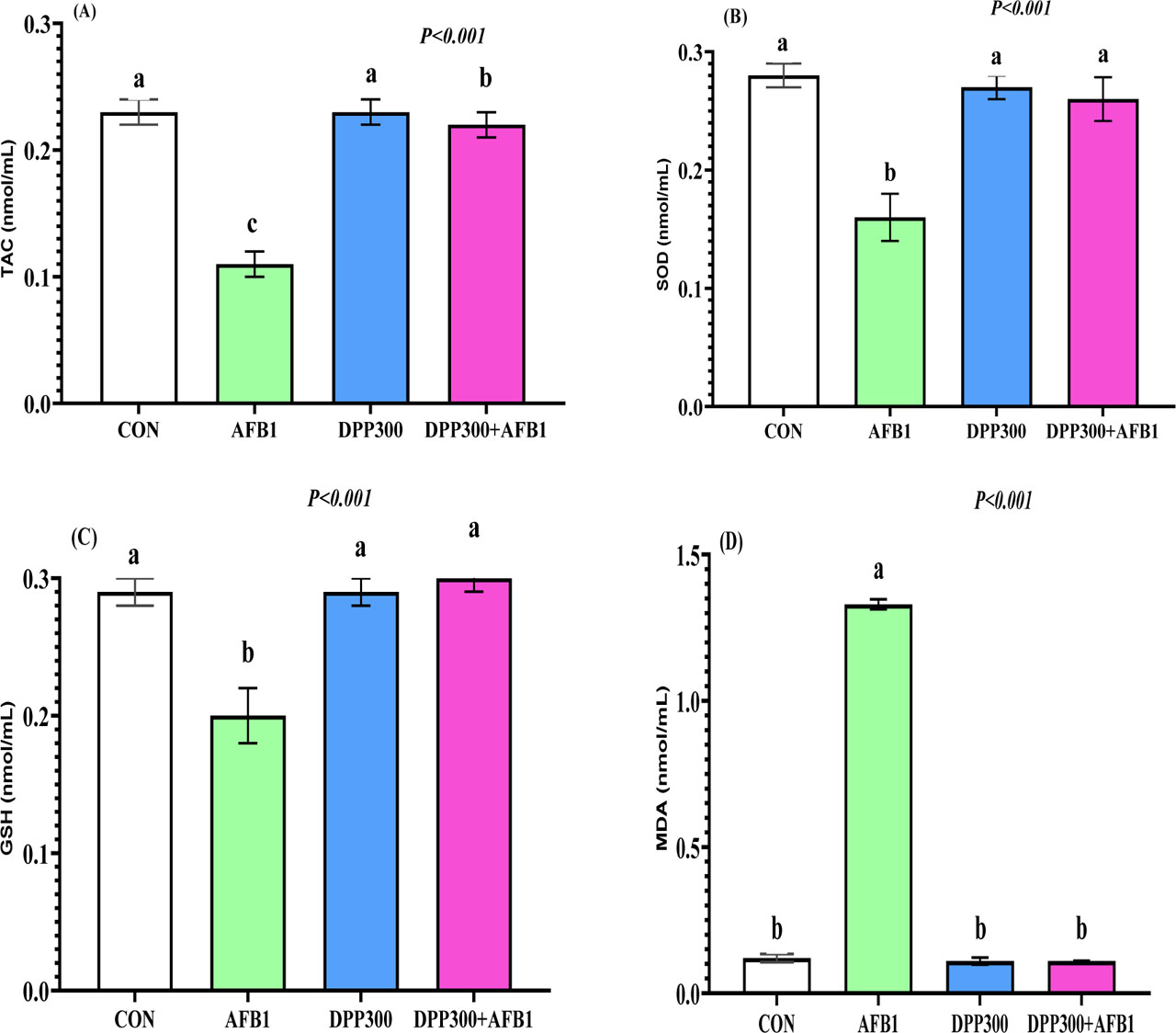
Figure 3
(A–D). Impacts of dietary date palm pollen (DPP) in mitigating the negative effect of aflatoxin B1 (AFB1) on serum redox homeostasis of male rabbits. a, b, c – values with different letters indicate a significant difference (P<0.05). Data presented as mean± SEM (standard error of means). The rabbit bucks were fed a basal diet (CON), contaminated diets with AFB1 (0.3 mg/kg), date palm pollen (DPP, 300 mg/kg diet), or AFB1+DPP for two months
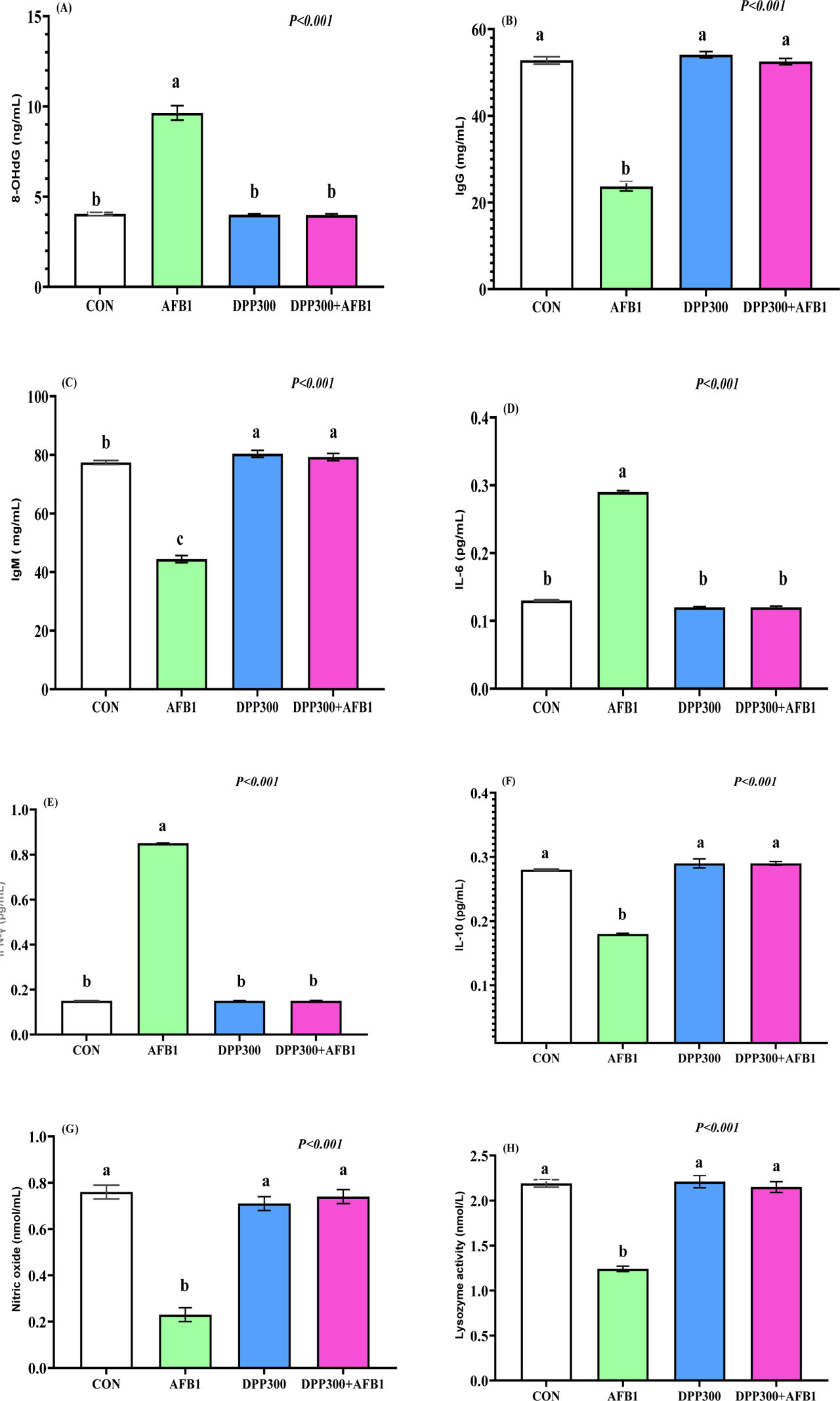
Figure 4
(A–H). Impacts of dietary date palm pollen (DPP) in mitigating the negative effect of aflatoxin B1 (AFB1) on DNA of oxidative DNA damage (Figure 4 A), immunoglobins G (IgG, Figure 4 B) and immunoglobins M (IgM, Figure 4 C), and pro-inflammatory cytokines such as IL-6 (Figure 4 D) and interferon-γ (IFN-γ; Figure 4 E), IL-10 (Figure 4 F), nitric oxide (Figure 4 G) and lysosome activity (Figure 4 H) of male rabbits. a, b, c – values with different letters indicate a significant difference (P<0.05). Data presented as mean ± SEM (standard error of means). The rabbit bucks were fed a basal diet (CON), contaminated diets with AFB1 (0.3 mg/kg), date palm pollen (DPP, 300 mg/kg diet), or AFB1+DPP for two months
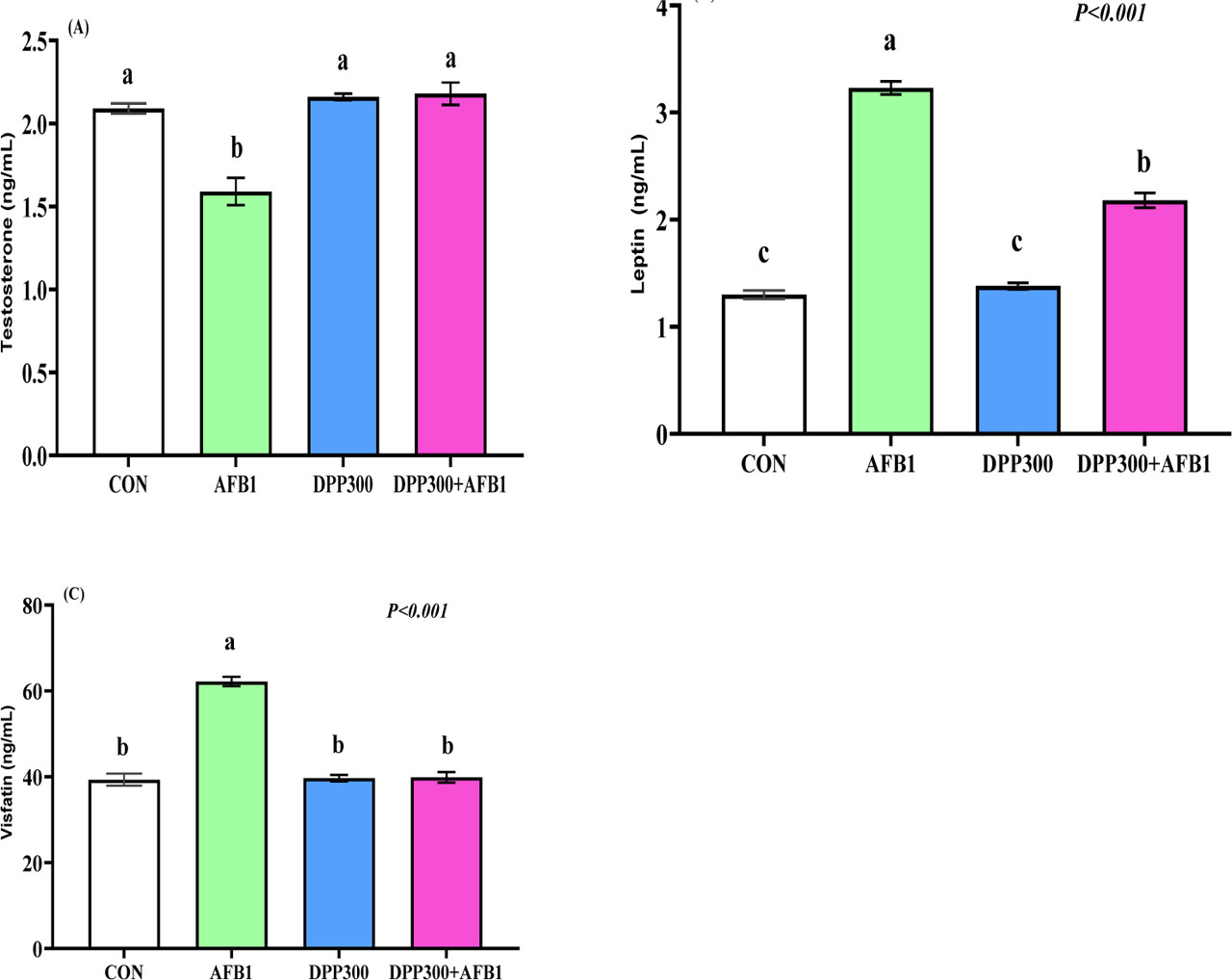
Figure 5
(A–C). Impacts of dietary date palm pollen (DPP) in mitigating the negative effect of aflatoxin B1 (AFB1) on serum testosterone (Figure 5 A) and adipokines such as leptin (Figure 5 B) and vistatin (Figure 5 C) of male rabbits. a, b, c – values with different letters indicate a significant difference (P<0.05). Data presented as mean± SEM (standard error of means). The rabbit bucks were fed a basal diet (CON), contaminated diets with AFB1 (0.3 mg/kg), date palm pollen (DPP, 300 mg/kg diet), or AFB1+DPP for two months
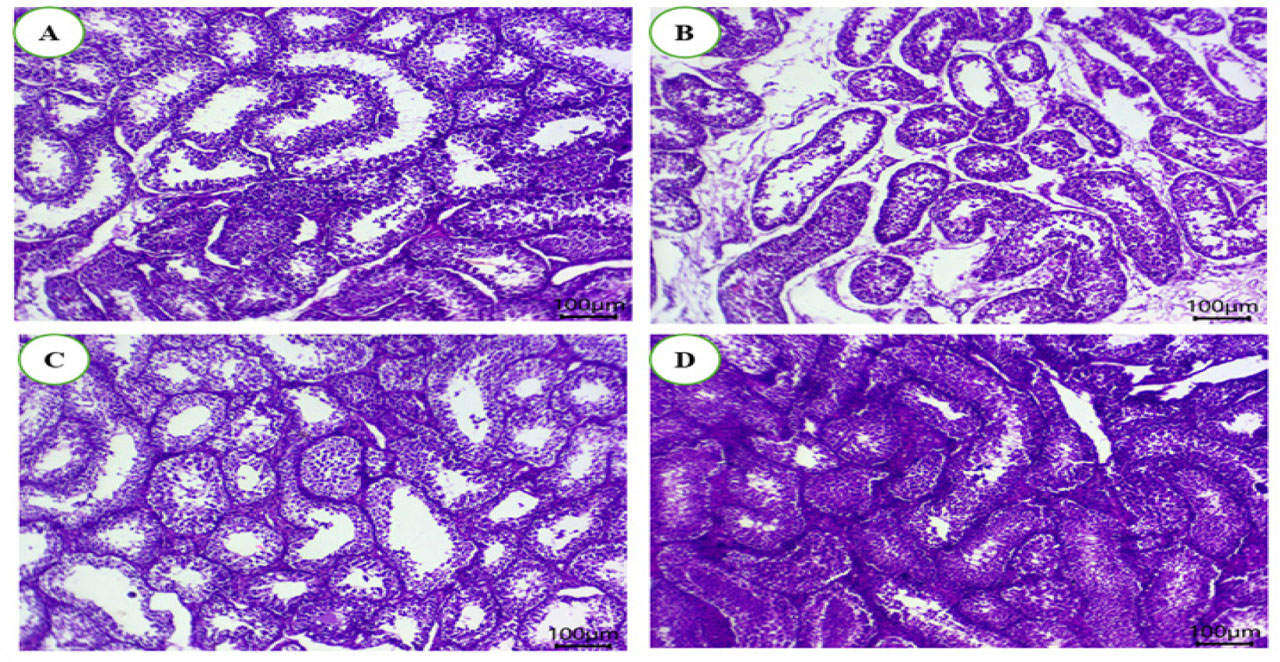
Figure 6
(A–D). The impact of dietary date palm pollen (DPP) on mitigating the negative effects of AFB1 on histopathological changes in testicular tissues of male rabbits. The rabbit bucks were fed a basal diet (CON), contaminated diets with AFB1 (0.3 mg/kg), date palm pollen (DPP, 300 mg/kg diet), or AFB1+DPP for two months. Bucks in the AFB1-fed group showed tissue atrophy and necrotic germinal epithelial lining. Additionally, interstitial edema was observed in animals from this group (Figure 6 B). Bucks in the control group (Figure 6 A) and DPP (Figure 6 B) had normal histology of seminiferous tubules and Leydig cells. Bucks in the therapy group (Figure 6 D) had moderate architectural changes in the majority of seminiferous tubules, less edema, and a reduced number of germ cells in some tubules
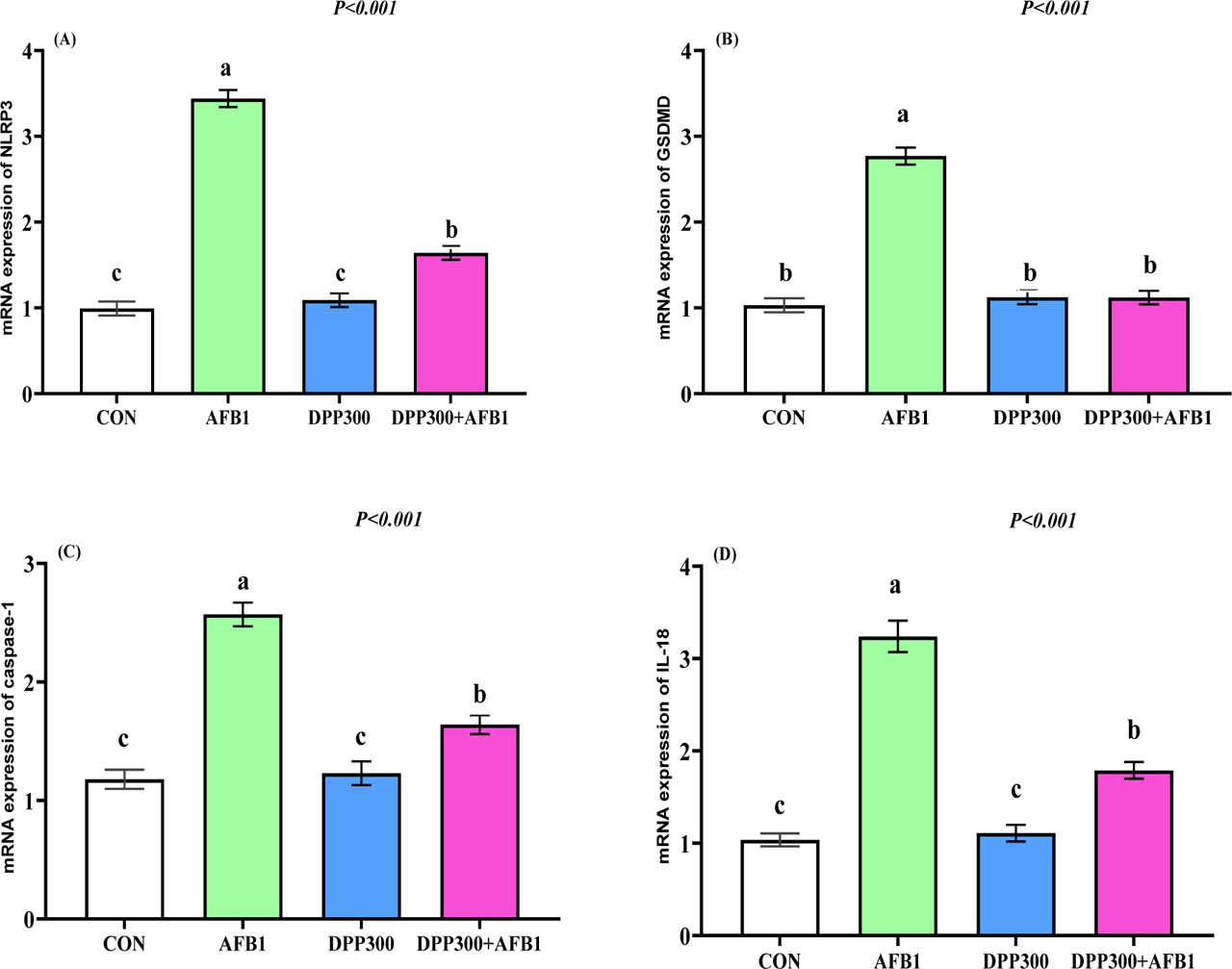
Figure 7
(A–D). Impacts of dietary date palm pollen (DPP) in mitigating the negative effect of aflatoxin B1 (AFB1) on pyroptosis-related genes such as NLRP3 (Figure 7 A), GSDMD (Figure 7 B), Caspase-1 (Figure 7 C), and IL-18 (Figure 7 D) in testicular tissues of male rabbits. a, b, c – values with different letters indicate a significant difference (P<0.05). Data presented as mean ± SEM (standard error of means). The rabbit bucks were fed a basal diet (CON), contaminated diets with AFB1 (0.3 mg/kg), date palm pollen (DPP, 300 mg/kg diet), or AFB1+DPP for two months
Table 3.
The main identified molecules found in date palm pollen of Egyptian palm tree
| Compound name | Molecular formula | 2D structure | Biological activity | Reference |
|---|---|---|---|---|
| 1 | 2 | 3 | 4 | 5 |
| Disaccharide | C12H22O11 |

| Antimicrobial action Provide hydroxyl groups to maintain their integrity in absence of water | Zhang et al. (2014) |
| Kaempferol-3-O-hexoside (2″-sulfate) | C21H19O14S |

| Antioxidant activity | Abdallah et al. (2023) |
| Quercetin-3,4′-di-O-hexoside | C27H29O17 |

| Improve fertility in female rats | Abdallah et al. (2023); Otify et al. (2021) |
| Isorhamnetin-3-O-(2-rhamnosyl) hexoside | C28H31O16 |

| Anti-obesity and anti-inflammatory activity | González-Arceo et al. (2022) |
| Quercetin | C15H9O7 |

| Antioxidant activity Anti-inflammatory Detoxification activity | Dai et al. (2024) |
| Isorhamnetin | C16H11O7 |

| Antibacterial and anti-obesity | González-Arceo et al. (2022) |
| Dihydroxy-palmitic acid | C16H31O4 |

| Antioxidant activity | Otify et al. (2021) |
| Dihydroxy-linoleic acid | C18H31O4− |

| Antioxidant activity | Otify et al. (2021) |
| Caffeoyl-palmitic acid derivative | C25H39O5 |

| Antioxidant activity | Joujou et al. (2024) |
| Estrone acetate | C20H23O3 |

| Antioxidant activity | Abdallah et al. (2023) |
| Octadecadienoic acid derivative | C46H69NO5 |

| Antibacterial and antifungal | Hawar et al. (2023) |
| Hydroxy-stearic acid | C18H35O3 |

| Antiproliferative | – |