
One of the cattle breeds subject to the conservation of livestock genetic resources in Poland is the Polish Red-and-White (PRW) breed. The conservation program for this breed, introduced in 2007, provided the basis for selecting individuals from the heavily crossbred Holstein-Friesian (HF) population those individuals that retained the characteristics of old-type red-and-white cattle. These traits include excellent adaptation to harsh environmental conditions, hardiness, low feeding requirements, good fertility, longevity, and high quality of both milk and meat (Conservation Program; IZ-PIB, 2024). These traits determine the high resilience of these cattle to harsh environmental conditions, as well as their ability to be used for high-quality food production. This breed is not specialized, and is characterized by dual-purpose (meat and milk) production. The average milk yield of cows included in the performance evaluation is approximately 4100 kg per lactation (Polish Federation of Cattle Breeders and Dairy Farmers, 2023). The breed is characterized by high fattening suitability of bulls (slaughter yield of about 47%) and meat quality (Sosin-Bzducha, 2017; Sosin-Bzducha and Puchała, 2017). Within the framework of the conservation program, a farm model is promoted in which, in addition to traditional dairy use, improvements in the economic performance of the farm are achieved by fattening bulls.
According to the Polish Federation of Cattle Breeders and Dairy Farmers, more than 2,200,000 dairy cows were kept in Poland in 2023, 38% of which were in the so-called active population (subject to performance recording). The PRW breed is small in number. In 2007, after many years of Holsteinization, due to declining numbers and the continuing demand for less demanding dual-purpose cattle adapted to harsh environmental conditions, more than 1,700 PRW cows were protected, and the conserved population currently numbers 3,200 cows (IZ-PIB, 2024).
Breeding work carried out within the framework of the conservation program aims to maintain meat and milk yields by reducing the proportion of Holstein-Friesian (HF) blood. This breed was introduced in the 1970s to improve the milk yield and growth performance of cows. Due to the strong crossbreeding of the population and the low proportion of animals registered in herdbooks and under evaluation, initially (until 2013) cows with no known ancestry or with a relatively high proportion of HF blood were eligible for the program, based on phenotypic evaluation and compliance with the breed standard set in the conservation program. In subsequent years, cows of known ancestry were accepted into the program based on verification of pedigrees and the assumption of a gradual reduction in the proportion of foreign HF breed from 50%, through 37.5% to 25%. Phenotypic evaluation of compliance with the breed standard was performed randomly on a small portion of the population. Protecting this breed from the beginning has been a major challenge, as at the time of starting the program there was only semen from the four purebred PRW bulls left for use in conservation herds. For this reason, it was decided to allow bulls with as much as 50% HF inheritance to be used in breeding, with the assumption that it would gradually decrease as the program was implemented. Despite these difficulties, conducted mating plans and supervision in conservation herds allowed the program to be implemented correctly, and analysis of the population structure in terms of HF percentage showed that the proportion of animals with a low share of HF blood (below 25%) is about 92% (Sosin and Dziad, 2024). In such a small population with a limited number of bulls, low effective population size and the threat of loss of genetic variability remain a problem. Despite the fact that the population of the PRW breed, when compared to other conserved cattle populations, is relatively large, as it numbered approximately 3,200 cows in 2024, the effective size of this population, which is a measure of genetic variability, is small. It amounts to only 60 and is more than four times lower than the effective population size of another conservation breed of similar size, the Polish Red breed. Such a low effective population size is one of the factors affecting the threatened status, which is 1.7 for the PRW breed (Polak et al., 2020). As of 2023, mandatory ancestry testing using microsatellite DNA polymorphism (STRs) or single nucleotide polymorphism (SNP) analysis methods has been introduced for the PRW breed, as for other breeds of conserved cattle.
Strict breeding efforts aimed at achieving a high “breed purity” of the PRW population, with a limited number of bulls, may lead to a reduction in the breed's genetic variability. The development of molecular biology tools based on the identification and assignment of individuals to a breed using a genetic profile is a relatively new approach, and one that can be used with advanced genetic and computer techniques and a sufficiently large reference population. Such studies can support work aimed at verifying and improving genetic variability, thereby maintaining or improving the productive value of animals. In the long term, high genetic variability makes it possible to maintain high suitability of animals for production and to preserve traits related to product quality, which in turn translates into production profitability.
For the study of variability and genetic structure of livestock, including cattle, STR markers have been successfully used for many years (Radko and Rychlik, 2009; Radko, 2010; Demir and Balcioglu, 2019; Madilindi et al., 2019; Ocampo et al., 2021; Bora et. al., 2023; Shang et al., 2024), and recently SNPs have also been widely used (Hulsegge et al., 2019; Hu et al., 2021; Martinez et al., 2023; Jasielczuk et al., 2024). However, high-throughput SNP panels, the analysis of which requires specialized equipment and bioinformatics tools, and is usually carried out for multiple samples simultaneously, can be used to a limited extent (Jaiswal et al., 2016). Particularly for small populations, the use of SNP markers can be difficult to perform a quick test for one or a few samples from a small number of native cattle populations. The use of these markers for breed identification may be reasonable when a cattle population is included in a genomic evaluation and SNP testing is performed routinely. In the case of breeds that are small in number, genomic evaluation is not used due to the difficulty of establishing a suitable reference population, the high risk of increased inbreeding and loss of genetic variability, and the inaccuracy of such evaluation. In the breeding of native breeds, work is carried out in the direction of maintaining or improving the existing genetic variability by preserving genotypically suitable animals under traditional housing and feeding conditions, and this is associated with the management of small, family herds.
Currently, many labs around the world are still using the STR analysis method for individual identification of cattle. In 2022–2023, 63 labs for STR only, and 25 labs for both STR and SNP (https://www.isag.us/Docs/Workshop_report_CMMPT_2023.pdf) participated in the International Comparison Tests organized by ISAG.
The purpose of the presented research was to determine DNA profiles at 12 microsatellite loci recommended by the International Society for Animal Genetics (ISAG) and the International Committee for Animal Registration (ICAR) for routine verification of cattle pedigrees and to determine the genetic structure of the native PRW cattle breed based on polymorphism analysis of selected STR markers. An evaluation was also carried out to determine whether Bayesian Markov chain Monte Carlo (MCMC) methods and genetic structure of breeds would allow genetic determination of the PRW breed, detection of intrabreed substructures and determination of the degree of admixture with other breeds. In addition, the practical goal of the task was to develop a DNA test that allows precise genetic determination of the breed affiliation of the PRW breed, and to assess the possibility of its use and effectiveness in the cattle population under study.
Material and methods
Experimental material for the study of identification of polymorphism of microsatellite DNA sequences were actual samples collected from cattle under routine parentage control at the National Research Institute of Animal Production. Samples of biological material were used in the form of ear tissue and hair roots from 400 individuals of the PRW cattle included in the conservation program or submitted for qualification
DNA profiles established for Polish Holstein-Friesian Black-and-White (HO) and Polish Holstein-Friesian Red-and-White (RW) cattle, samples of which were collected as part of ongoing parentage analyses, were used for genetic structure analysis to determine breed admixture. DNA profiles were selected from cattle that had a confirmed pedigree from their parents.
Methods
DNA was extracted from hair and blood samples using the Sherlock AX Kit (A&A Biotechnology, Gdynia, Poland), following the manufacturer's protocol. Extracted DNA was quantified using a NanoDrop 2000 spectrophotometer (Thermo Scientific, Wilmington, DE, USA). In the analysis, we selected 12 loci from the recommended ISAG core panel for the identification of individuals and parentage testing in cattle: BM1818, BM1824, BM2113, ETH3, ETH10, ETH225, INRA23, SPS115, TGLA53, TGLA122, TGLA126 and TGLA227 (Table 1).
Table 1.
Microsatellite markers of the main set (12-plex) for verification of pedigrees and primers for their amplification
| Locus | Starter sequences (5'-3') |
|---|---|
| BM1818 | agctgggaatataaccaaagg, agtgctttcaaggtccatgc |
| BM1824 | gagcaaggtgtttttccaatc, cattctccaactgcttccttg |
| BM2113 | gctgccttctaccaaataccc, cttcctgagagaagcaacacc |
| INRA023 | gagtagagctacaagataaacttc, taactacagggtgttagatgaactc |
| ETH3 | gaacctgcctctcctgcattgg, actctgcctgtggccaagtagg |
| ETH10 | gttcaggactggccctgctaaca, cctccagcccactttctcttctc |
| ETH225 | gatcaccttgccactatttcct, acatgacagccagctgctact |
| SPS115 | aaagtgacacaacagcttctccag, aacgagtgtcctagtttggctgtg |
| TGLA53 | gctttcagaaatagtttgcattca, atcttcacatgatattacagcaga |
| TGLA122 | ccctcctccaggtaaatcagc, aatcacatggcaaataagtacata |
| TGLA126 | ctaatttagaatgagagaggcttct, ttggtctctattctctgaatatcc |
| TGLA227 | cgaattccaaatctgttaatttgct, acagacagaaactcaatgaaagca |
The STR loci were amplified using QIAGEN Multiplex PCR Kit (QIAGEN, Hilden, Germany). The PCR reaction was performed on Veriti® Thermal Cycler amplifier (Applied Biosystems, Foster City, CA, USA), using the following thermal profile: 5 min of initial DNA denaturation at 98°C, followed by 30 cycles of denaturation at 98°C for 15 s, annealing at 58°C for 75 s, elongation of starters at 72°C for 30 s, and final elongation of starters at 72°C for 5 min. The obtained PCR products were analyzed using an ABI 3500xl capillary sequencer (Applied Biosystems, Foster City, CA, USA). The amplified DNA fragments were subjected to electrophoresis in a 7% denaturing POP-7 polyacrylamide gel in the presence of a standard length of 500 Liz and a reference sample. The results of the electrophoretic separation were analyzed automatically using the GeneMapper® Software 4.0 (Applied Biosystems, Foster City, CA, USA).
Data analysis
Population structure was analyzed using a Bayesian clustering algorithm implemented in STRUCTURE software version 2.3.4 (Pritchard et al., 2000), considering an admixture model with correlated allele frequencies between breeds. The lengths of the burn-in and Markov Chain Monte Carlo (MCMC) simulations were 100,000 and 500,000, respectively, in 5 runs for each number of clusters (K) ranging between 2 and 6. The population relationships based on principal coordinate analysis (PCoA) were obtained using the GenAlEx ver. 6.51 software (Peakall and Smouse, 2012).
The statistical analysis of the obtained results was carried out based on the genetic parameters: observed heterozygosity (HO), expected heterozygosity (HE), inbreeding coefficient (FIS) and test for Hardy–Weinberg equilibrium (HWE) with χ2 test to Nei and Roychoudhury (1974), and Wright's (1978). Polymorphic information content (PIC) was estimated by Botstein et al. (1980). The probability of parentage exclusion was calculated for two cases when the genotypes of one and both parents are known – PE1 and PE2 (Jamieson and Taylor, 1997). The statistical analysis was carried out using the IMGSTAT software ver. 2.10.1 (2009) supporting the National Research Institute of Animal Production Laboratory.
Case study
The test to determine breed affiliation (PRW Breed ID Test) was conducted based on Bayesian analysis of an established reference population of 150 PRW cattle and DNA profiles determined for 3 PRW cattle included in the genetic resources conservation program with a declared breed proportion of 70% and 80%, and for a purebred individual (at more than 85%).
Results
Analysis of DNA profiles at 12 microsatellite STRUCTURE loci carried out in 400 individuals declared as PRW breed allowed selection of a population of 150 individuals with assignment values Q = 0.944, and for RW and HO were 0.959 and 0.906, respectively (Figure 1).
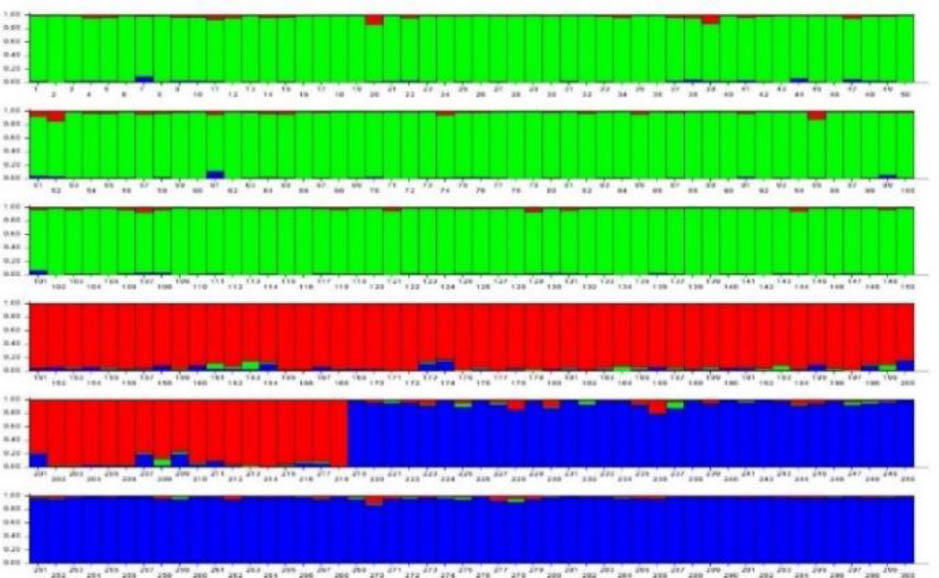
Figure 1.
STRUCTURE analysis of 12 STR genotypes from cattle studied. The samples were grouped by the 3 breeds (K=3): PRW – Polish Red-and-White; HO – Polish Holstein Black-and-White variety; RW – Polish Holstein Red-and-White variety. The average proportion of assignments to the cluster (Q) above 94% was found for the PRW breed, and above 95% and 91% for RW and HO, respectively
Principal coordinate analysis (PCoA) was used to estimate the genetic distance between the studied cattle breeds and to confirm STRUCTURE results. The pattern genotype distributions on the plot showed separate clustering of the study breeds and revealed a high pattern of groupings. PCoA results obtained with clearly separated 3 groups are in perfect concordance with the results of STRUCTURE analyses, which indicated the 3 clusters, representing 3 cattle breeds (Figures 1 and 2).
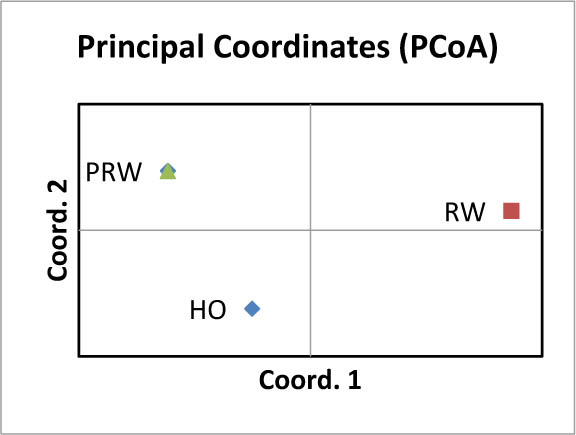
Figure 2.
Principal Coordinates Analysis (PCoA). PCoA analysis based on genetic distances showed 3 clustered populations corresponding to the cattle breeds studied. PRW – Polish Red-and-White; HO – Polish Holstein Black-and-White variety; RW – Polish Holstein Red-and-White variety
The established reference population of 150 PRW cattle was subjected to genetic variability assessment based on the analysis of STR markers selected for the study. In 12 microsatellite loci, 102 alleles were identified, and the average number of alleles determined per locus was 8.5 alleles. Based on the concordance of the distribution of observed and expected genotypes Hardy-Weinberg genetic equilibrium (HWE) was determined. The obtained significance values are given in Table 2. The conducted HWE test showed that the studied cattle population is in genetic equilibrium for 11 tested STRs, only for SPS115 a deviation from genetic equilibrium was observed at P≤0.01 (Table 2).
Table 2.
Assessment of the Hardy-Weinberg equilibrium (HWE)
| STR | P | χ2 |
|---|---|---|
| BM1818 | 0.9015 | 4.8412 |
| BM1824 | 0.9199 | 4.5361 |
| BM2113 | 0.6321 | 24.9210 |
| ETH3 | 0.7852 | 21.9160 |
| ETH10 | 0.9562 | 7.0514 |
| ETH225 | 0.6810 | 17.4897 |
| INRA23 | 0.8853 | 19.3997 |
| SPS115 | 0.0014* | 28.5992 |
| TGLA53 | 0.9428 | 39.5093 |
| TGLA122 | 0.9103 | 51.1787 |
| TGLA126 | 0.6592 | 12.2608 |
| TGLA227 | 0.9057 | 25.4194 |
Based on the 102 alleles identified, polymorphism was estimated at 12 microsatellite loci in PRW cattle. Of the analyzed markers, a high degree of observed heterozygosity (HO) and the degree of polymorphism (PIC) amounting to more than 70% was shown for 6 STRs, and HO and PIC exceeded 60% for 3 STRs. The average HO and PIC values calculated for the core set of 12 markers were 0.74 and 0.68, respectively.
The estimated values of expected heterozygosity were generally close to the values of observed heterozygosity. Calculated on the basis of the HO to HE ratio, the mean inbreeding coefficient (FIS) took a negative value of −0.022, suggesting the absence of inbreeding in the studied breed. A slight disparity between the value of HO and HE (FIS= −0.12), was obtained at the BM1818 locus. The values of observed heterozygosity (HO), expected heterozygosity (HE), degree of polymorphism index (PIC) and inbreeding coefficient (FIS) for each marker are shown in Table 3.
Table 3.
Polymorphism indices of the 12 STR markers analyzed in PRW cattle
| STR | HO | HE | Fis | PIC | PD | PE1 | PE2 |
|---|---|---|---|---|---|---|---|
| BM1818 | 0.6250 | 0.5640 | −0.1082 | 0.4769 | 0.7017 | 0.1624 | 0.2803 |
| BM1824 | 0.7083 | 0.6834 | −0.0365 | 0.6178 | 0.8263 | 0.2468 | 0.4038 |
| BM2113 | 0.8889 | 0.8281 | −0.0735 | 0.8044 | 0.9388 | 0.4788 | 0.6528 |
| ETH3 | 0.7431 | 0.7204 | −0.0315 | 0.6864 | 0.8843 | 0.3223 | 0.5057 |
| ETH10 | 0.5139 | 0.5684 | 0.0959 | 0.5151 | 0.7578 | 0.1695 | 0.3230 |
| ETH225 | 0.7500 | 0.7481 | −0.0025 | 0.7053 | 0.8927 | 0.3420 | 0.5173 |
| INRA23 | 0.8333 | 0.8024 | −0.0386 | 0.7742 | 0.9282 | 0.4349 | 0.6118 |
| SPS115 | 0.5625 | 0.5515 | −0.0200 | 0.5112 | 0.7345 | 0.1668 | 0.3298 |
| TGLA53 | 0.8542 | 0.8580 | 0.0044 | 0.8420 | 0.9596 | 0.5541 | 0.7154 |
| TGLA122 | 0.8403 | 0.7989 | −0.0518 | 0.7746 | 0.9323 | 0.4479 | 0.6229 |
| TGLA126 | 0.6806 | 0.6859 | 0.0078 | 0.6250 | 0.8382 | 0.2550 | 0.4162 |
| TGLA227 | 0.8264 | 0.8200 | −0.0078 | 0.7956 | 0.9414 | 0.4682 | 0.6426 |
| Means | 0.736 | 0.72 | −0.022 | 0.677 | |||
| Cumulative value | 1 | 0.994407 | 0.99986 |
The demonstrated polymorphism in the studied population of PRW cattle indicates the suitability of the tested STR set for individual identification and verification of PRW pedigrees. The estimated power of discrimination (PD), which is an indicator that determines the suitability of STR panels for pedigree purposes, reached PD>0.7 for most loci. In contrast, the combined power of discrimination (CPD), calculated from the entire set of 12 STRs, was close to unity (Table 3). The direct parameter routinely used to evaluate each STR marker for pedigree studies is the probability of exclusion (PE), with which the origin of a given individual from a given parental pair can be confirmed or excluded. The probability of exclusion for each marker in the cattle studied (Table 3) was used to calculate the combined probability of exclusion in the case where the genotype of one parent is known (CPE1) and where the genotypes of both parents are known (CPE2). The use of the tested set of 12 STR loci in the PRW breed allowed us to confirm the origin of the cattle with 99.44% and 99.98% accuracy for CPE1 and CPE2, respectively.
Case study
An evaluation of the usefulness of an established DNA test based on Bayesian simulation of the DNA profile and a reference population of 150 PRW individuals showed the possibility of assigning the tested individuals to the PRW breed and determining the percentage of their genotype to the PRW breed-specific genotype (Figure 1).
The results of the analysis of the established DNA profiles for these individuals showed concordance with the PRW reference population at 75.7%, 87.4% and 97.4% (Figure 3).
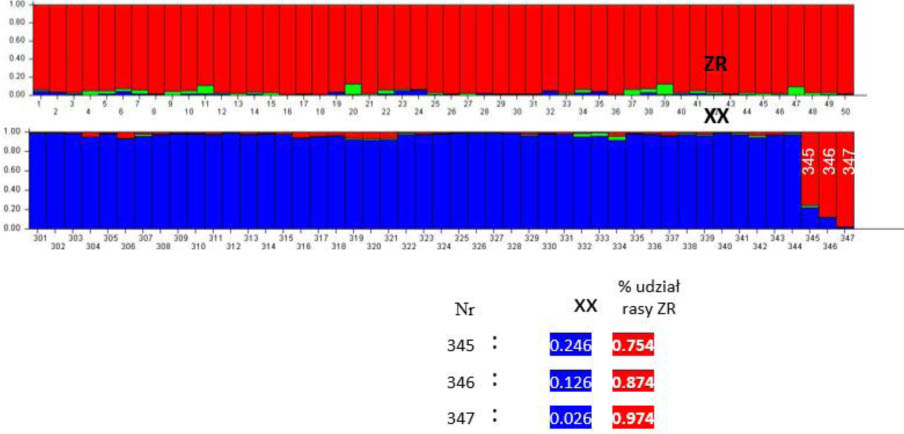
Figure 3.
Determination of the % of the Polish Red-and-White breed for three PRW individuals included in the genetic resources conservation program
Discussion
Choosing microsatellite markers can not only reduce the cost, but also provide greater computational ease to identify the breed at DNA level with an indication of the degree of admixture (Jaiswal et al., 2016). Jaiswal et al. (2016) reported breed prediction accuracy of 95, 96 and 97% for 8 cattle breeds with 5, 10 and 18 STR, respectively. In our study, based on 12 STRs determined for 400 individuals of PRW cattle and the use of the Bayesian Monte Carlo method (MCMC) implemented in STRUCTURE software, we were able to establish a reference population for the PRW. 150 individuals of the PRW breed of cattle were selected, with the percentage of PRW blood above 85% as the criterion for selecting individuals for the reference population, and an average of 94.4% for the entire population. The results indicate that genetic structure analysis using STR markers can be a useful tool in small populations as additional support alongside standard breeding methods for optimizing breeding decisions, selecting animals for mating and/or for inclusion in genetic resources conservation programs. Such measures can be useful in maintaining and improving the genetic variability of conservation breeds, which is crucial for conservation programs.
Rigorous breeding work in herds under genetic resources conservation aimed at reducing the proportion of the HF breed carries a high risk of reducing or lowering genetic variability within the population. An assessment of genetic variability of a group of 150 individuals forming a reference population showed a high degree of observed heterozygosity (Ho) and degree of polymorphism (PIC) of 74% and 67%, respectively. The values of HO and PIC parameters in different cattle breeds are comparable with those reported in other studies (Radko et al., 2005; Radko, 2008; Van de Goor et al., 2011; Opara et al., 2012; Madilindi et al., 2019).
The observed heterozygosity values were close to the expected values. The calculated negative low FIS value (–0.022) suggests the absence of inbreeding in the studied population of the PRW breed, which indicates that breeding work was properly carried out. The relatively high level of genetic variability and the negative inbreeding coefficient (Fis) observed in the population despite its small size may be attributed both to the genetically diverse origin of the first animals accepted into the conservation program – despite lacking pedigree data – and to the initial breeding strategy, which, due to a shortage of purebred bulls, temporarily allowed the use of bulls with a higher proportion of Holstein-Friesian (HF) genes. In subsequent generations, the proportion of HF genes was gradually reduced through carefully planned matings aimed at restoring breed purity while maintaining genetic diversity.
The HWE test also showed a state of genetic equilibrium, except for the SPS115 locus, which showed the lowest heterozygosity. At the current stage of the study, it is not possible to say what the reason is for the genetic imbalance at this locus, while this information should be periodically verified.
The combined power of discrimination (PD) close to unity and the high probability of exclusion when one parent's genotype is known (CPE1) and when both parents can be analyzed (CPE2) have demonstrated the high suitability of the set of 12 STRs recommended by ISAG for individual identification and parentage verification in the conserved PRW cattle population. The use of the entire panel of 12 STRs when knowing the genotype of one parent showed that we could confirm parentage with 99.44% accuracy, while when knowing both parents, with more than 99.986% accuracy. The power of discrimination and likelihood ratios are similar to those obtained in most European (Radko, 2008; Radko and Rychlik, 2009; van de Goor et al., 2011) or Asian (Shang et al., 2024) and North American cattle breeds (Schnabel et al., 2000). However, studies of the local Pirenaica cattle, the most important autochthonous cattle breed within the Protected Geographic Indication (PGI) beef quality label in the Basque region, in northern Spain, have shown that the use of the 12 STR recommended by ISAG is insufficient and requires the use of an additional set of STRs (Gamarra et al., 2020). This example shows that it is important to monitor the implemented breeding program and genetic variability in small local cattle populations, and if necessary to use an additional panel of STRs or if possible SNPs.
The introduction of routine pedigree verification of PRW cattle newly qualified for the conservation program, starting in 2023, has made it possible to eliminate from the population under conservation breeding those with incorrect pedigree data. The percentage of exclusions at parentage testing was 11.38% (2023, LGM IZ-PIB data). Cases of the occurrence of PRW cattle of unknown origin and the impossibility of confirming the origin from the indicated parents, but characterized by valuable phenotypic and functional traits from the point of view of breeding, resulted in the need to develop a genetic tool to confirm or determine the genetic contribution for the PRW breed. The developed DNA test of breed affiliation based on Bayesian simulation of the DNA profile and a reference population was successfully applied to determine the genetic contribution of the PRW breed in cattle where ancestry from a given parental pair was excluded, while the cattle phenotypically conformed to the pattern defined for the breed. Analysis of the genetic structure of 3 selected cows with pedigree-documented proportions of the PRW breed at 70%, 80%, and above 90%, included in the genetic resources program, made it possible to determine the degree of genetic admixture of other breeds. The developed method of determining breed affiliation and the presented results can be used for entry into herdbooks or conducting conservation programs, and can also be applied to the breeding of other native breeds.
Conclusions
The marker panel used turned out to be useful for assessing the genetic structure and genetic assignment of cattle to the PRW breed.
The analysis of the differences in genetic variation in the population of the Polish Red-and-White conservation breed may indicate that the conservation program for this breed is being conducted properly.
The developed method of identifying the PRW breed (breed affiliation test) for determining the genetic contribution of the PRW breed in cattle with unknown parentage (lack of confirmed ancestry from the parents in question in the pedigree) may find application in conservation breeding of cattle. The pilot study and conduct of the PRW breed test confirm the applicability of the developed test to assign cattle of unknown origin phenotypically corresponding to the breed standard, which can be used as an additional condition for entry into herdbooks and may be important for improving the genetic variability of the population under conservation programs. Moreover, it is worth mentioning that the developed method of breed identification may also find application in monitoring the origin of products from the PRW breed, e.g. passporting native breed beef, which may contribute to the development of premium products from this breed, e.g. within the framework of the RASA RODZIMA (“NATIVE BREED”) quality system introduced for conservation breeds in Poland from 2021.