
Table 1.
A comparative study of potential flocculant types for use in BFT
| Type | Example | Characteristics | Reference |
|---|---|---|---|
| Inorganic | Aluminium sulphate, ferric chloride, ferric sulphate | Effective, inexpensive, corrosive, can leave behind residual chemicals | Agunbiade et al. (2016) |
| Organic | Polyacrylamide, polyacrylic acid | Less corrosive than inorganic flocculants, do not leave behind residual chemicals, can be more expensive | Xia et al. (2017) |
| Specialty | Designed for specific applications, such as wastewater treatment or mining | Can be more effective or more cost-effective than general-purpose flocculants | Kurniawan et al. (2023) |
Table 2.
Bioflocculants used in wastewater treatment at various concentrations and having potential to be used in BFT
| Source of flocculants | Effective concentration | References |
|---|---|---|
| Abelmoschus esculentus | 80 mg/L | Carneiro-Marra et al. (2019) |
| Banana juice | 90 mL | Gautam and Saini (2020) |
| Bitter gourd seed | 400 mg/L | Babarao and Verma (2015) |
| Cactus | 0.4 g/L | Deshmukh and Hedaoo (2018) |
| Castor oil cake | 40 mL | Sheikh et al. (2016) |
| Cicer arietinum | 0.1 g/L | Ferrari et al. (2016) |
| Cicer arietinum | 68 mg/L | Laksmi et al. (2017) |
| Cotton seed oil cake | 40 g/L | Narmatha et al. (2017) |
| Dolichos lablab | 450 mg/L | Daverey et al. (2019); Laksmi et al. (2017) |
| Hibiscus rosa sinensi | 500 mg/L | Awang and Aziz (2012) |
| Malva sylvestris (mallow) | 12 mg/L | Anastasakis et al. (2009) |
| Moringa oleifera | 1 g/L; 9.4 mL/L | Chonde and Raut (2017); de Paula et al. (2018) |
| Ocimum basilicum | 1.6 mg/L | Shamsnejati et al. (2015) |
| Opuntia mucilage | 21.1 mg/L | Carpinteyro-Urban et al. (2012) |
| Plantago major L. | 297.6 mg/L | Gautam and Saini (2020) |
| Plantago ovata | 1.5 mg/L | Ramavandi and Farjadfard (2016); Mishra and Bajpai (2005) |
| Psyllium husk | 0.4 g/L and 7.2 g/L | Gautam and Saini (2020) |
| Sechium edule (chayote) | 15 mg/L | Almeida et al. (2017) |
| Strychno spotatorum | 60 mL | Dehghani and Alizadeh (2016) |
| Surjana seed | 30 g/L | Patel and Vashi (2013) |
| Tamarind indica | 1250 mg/L | Laksmi et al. (2017) |
| Tanfloc SG | 20 mg/L | Gautam and Saini (2020) |
| Trigonella foenum-graecus | 0.1 g/L | Patil and Hugar (2015) |
| Zea mays | 30 g/L | Patel and Vashi (2013) |
Table 3.
Chemical coagulants utilized for wastewater treatment
| Coagulants | Chemical formula | Concentration | References |
|---|---|---|---|
| Aluminium sulphate | Al2(SO4)3 | 7.2 mL/L and 40 mg/L | Akinwole et al. (2016); Dehghani and Alizadeh (2016); de Paula et al. (2018) |
| Ferric chloride | FeCl3 | 3.6 mL/L | Sarparastzadeh et al. (2007); de Paula et al. (2018) |
| Ferric sulphate | Fe2(SO4)3 | 400 mg/L | Babarao and Verma (2015) |
| Iron (III) chloride hexahydrate | Cl3FeH12O6 | 500 mg/L | Gautam and Saini (2020) |
| Lime | CaO | 600 mg/L | Lin et al. (2017) |
| Magnesium chloride | MgCl3 | 120 mg/L | Verma et al. (2012) |
| Poly aluminium chloride (PAC) | 500 mg/L | Gautam and Saini (2020) | |
| Poly aluminium ferric chloride (PAFC) | 3 mg/L | Gkotsis et al. (2017) | |
| Poly aluminium silicate chloride (PASic) | 9 mg/L | Liao and Zhang (2018) | |
| Poly ferric acetate | 24 mg/L | Wei et al. (2017) | |
| Poly ferric sulphate | 20 mg/L | Wei et al. (2017) | |
| Potassium aluminium sulphate KAl | (SO4)2×12H2O | 0.25 g/L | Malik (2018) |
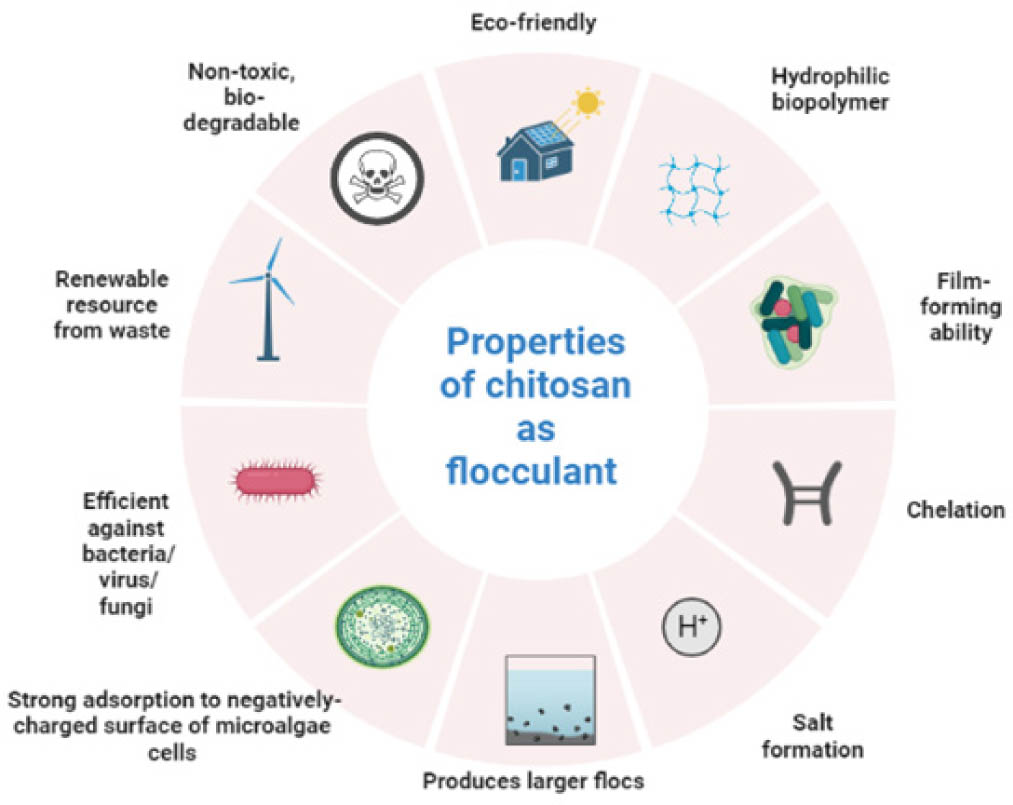
Figure 1.
Properties of chitosan as flocculating agent