
Table 1.
Origin of horticulture waste and its by-product
| Processing stage | Commodity | Origin of waste | Raw material generated | Percentage (%) | Reference |
|---|---|---|---|---|---|
| Harvesting and handling | Apple | Damaged and non-marketed | Rejected apple | 30–40 | (Bakshi and Wadhwa, 2013) |
| Banana | Production process | Failing to meet quality standards – small-sized, damaged bananas, banana peels, leaves, young stalks and pseudostems | 30–40 | ||
| Carrot | Glut season | Culled out or surplus carrots | 20–40 | ||
| Cabbage | Removal of outer leaves,field trimmings | Outer wrapper leaves | 5–25 | (Raj et al., 2016) | |
| Peas | Shelling and pod removal | Shell | 6–79 | ||
| Processing | Apple | Juice extraction | Pomace | 20–30 | (Catana et al., 2018) |
| Seeds | 2–4 | ||||
| Stem | 1 | ||||
| Mango | Pulp extraction | Peel | 15–20 | (Mitra et al., 2010; Gurumeenakshi et al., 2019) | |
| Seed | 14–22 | ||||
| Inoperable pulp | 15–20 | ||||
| Citrus | Juice extraction | Peel | 60–65 | (Crawshaw, 2001) | |
| Internal tissues | 30–35 | ||||
| Seed | 10 | ||||
| Grape | Juice extraction | Stem, skin and seeds | 20–25 | (Yu and Ahmedna, 2013) | |
| Papaya | Pulp extraction | Peel waste | 8.5 | (Ovando-Martinez et al., 2018) | |
| Seed | 6.5 | ||||
| Unusable pulp | 32 | ||||
| Pineapple | Peeling and coring for drying and dehydration | Peels | 35.5 | (Upadhyay et al., 2010; Hemung et al., 2022) | |
| Core | 14.7 | ||||
| Pomace | 6 | ||||
| Crown | 4.3 | ||||
| Bud end | 4.3 | ||||
| Tomato | Pulping and deseeding for sauce and ketchup production | Skin, core and seeds | 20–30 | (Raj et al., 2016) | |
| Potato | Peeling for chip making | Peel, starch and fiber | 15–40 | (Kot et al., 2020) | |
| Carrot | Dehydration and pickling | Peel, top portion, pomace | 18–52 | (Raj et al., 2016) |
Table 2.
Chemical composition of fruit and vegetable waste (% DM basis)
| Fruit and vegetable waste | DM | CP | CF | CA | EE | HC | CEL | Reference |
|---|---|---|---|---|---|---|---|---|
| Red apple pomace | 16.47 | 2.78 | 6.27 | 2.14 | 0.99 | 4.3 | – | (Neshovska, 2024; NRC, 2001) |
| Green apple pomace | 19.69 | 4.10 | 10.46 | 2.52 | 1.62 | – | – | (Neshovska, 2024) |
| Green banana peel | 11.7 | 7.0 | 24.1 | 8.8 | 6.0 | 10.5 | 18.2 | (Hossain et al., 2015; Bakshi and Wadhwa, 2013) |
| Ripe banana peel | 7.7 | 6.8 | 16.8 | 12.1 | 7.8 | – | – | (Hossain et al., 2015) |
| Banana fruit stalk | – | 1.9 | 15.5 | 9.1 | – | – | – | (Okareh et al., 2015) |
| Citrus pulp | 9.5 | 10.5 | – | 4.5 | 5.8 | 2.0 | 12.8 | (Bakshi and Wadhwa, 2013) |
| Grape pomace | 35.0 | 12.2 | – | 7.9 | 5.0 | 3.5 | 54.0 | (Zalikarenab et al., 2007) |
| Pineapple bran | 9.9 | 4.6 | – | 3.5 | 1.5 | 36.0 | - | (NRC, 2001) |
| Muskmelon peels | 12.6 | 9.5 | – | 14.9 | 5.8 | 23.6 | 14.8 | (Bakshi and Wadhwa, 2013) |
| Watermelon rind | 10.5 | 7.9 | – | 7.9 | 1.8 | 3.1 | 26.4 | (Bakshi and Wadhwa, 2013) |
| Mango peel | – | 9.12 | 15.43 | 3.24 | – | – | – | (Jalal et al., 2023) |
| Pineapple peel | – | 8.8 | 16.3 | 5.0 | – | – | – | (Wimalasiri and Somasiri, 2021) |
| Papaya peel | – | 20.2 | 16.5 | 11.6 | – | – | – | (Wimalasiri and Somasiri, 2021; Romelle et al., 2016) |
| Pomegranate peel | – | 3.46 | 17.63 | 6.07 | – | – | – | (Jalal et al., 2023; Romelle et al., 2016) |
| Potato peel | 16.3 | 13.0 | 12.5 | 9.0 | 0.9 | – | – | (Hossain et al., 2015) |
| Cauliflower leaves | 13.0 | 17.0 | – | 13.7 | 4.2 | 8.1 | 15.2 | (Wadhwa and Bakshi, 2005) |
| Pea husk | 89.2 | 6.2 | 48.4 | 12.6 | 2.3 | 12.7 | 24.0 | (Hossain et al., 2015; Bakshi and Wadhwa, 2013) |
| Tomato pomace | 23.5 | 22.1 | – | 6.0 | 11.5 | 12.0 | 12.0 | (Bakshi et al., 2012) |
| Pumpkin peel | 3.3 | 16.5 | 14.8 | 4.6 | 1.9 | – | – | (Hossain et al., 2015) |
| Cabbage leaves | 10.0 | 19.9 | – | 15.8 | 2.6 | 11.1 | 13.7 | (Wadhwa and Bakshi, 2005) |
| Bottle gourd pulp | 12.3 | 24.3 | – | 9.3 | 2.4 | 10.4 | 10.5 | (Wadhwa et al., 2015) |
| Bottle gourd peel | 6.6 | 7.0 | 23.0 | 9.6 | 2.1 | – | – | (Hossain et al., 2015) |
Table 3.
Mineral content (%) in fruit and vegetable waste
| Commodity | Ca | Mg | P | Na | K | Mn | Zn | Fe | Reference |
|---|---|---|---|---|---|---|---|---|---|
| Red apple pomace | 0.20 | 363 | 0.14 | 0.04 | 0.73 | 1.8*10−2 | 2.50 | 0.01 | (NRC, 2001) |
| Green apple pomace | 4.29 | 4.68 | 7.24 | 0.22 | 47.57 | 0.1*10−2 | 0.15 | - | (Neshovska, 2024) |
| Ripe banana peel | 0.29 | 0.30 | 0.18 | 0.01 | 1.11 | 5.2*10−2 | 0.11 | 0.29 | (Bakshi and Wadhwa, 2013) |
| Banana fruit stalk | 0.12 | 0.01 | 0.18 | 0.25 | 0.03 | – | – | 0.01 | (Okareh et al., 2015) |
| Citrus pulp | 0.49 | 0.11 | 0.14 | 0.02 | 0.66 | 0.02*10−4 | 0.04 | 0.08 | (Bakshi and Wadhwa, 2013) |
| Grape pomace | 0.61 | 0.10 | 0.06 | 0.09 | 0.62 | – | 2.4*10−3 | 4.1*10−3 | (NRC, 2001) |
| Pineapple bran | 0.23 | – | 0.13 | – | – | – | – | 0.05 | (NRC, 2001) |
| Muskmelon peel | 0.62 | 0.43 | 0.44 | 0.49 | 0.44 | 2.0*10−3 | 4.0*10−3 | 0.02 | (Bakshi and Wadhwa, 2013) |
| Watermelon rind | 0.47 | 0.36 | 0.43 | 0.21 | 0.74 | 1.4*10−3 | 3.9*10−3 | 0.01 | (Bakshi and Wadhwa, 2013) |
| Mango peel | 0.06 | – | – | – | – | 0.4*10−3 | 0.6*10−3 | 0.01 | (Romelle et al., 2016) |
| Pomegranate peel | 0.05 | – | – | – | – | 0.5*10−3 | 0.9*10−3 | 9.2*10−3 | (Romelle et al., 2016) |
| Potato peel | 0.08 | 0.12 | 0.22 | 0.01 | 2.15 | 7.5*10−4 | 1.4*10−3 | 3.9*10−3 | (NRC, 2001) |
| Cauliflower leaves | 2.17 | 0.84 | 0.34 | 0.39 | 0.60 | 4.0*10−3 | 4.0*10−3 | 0.03 | (Wadhwa and Bakshi, 2005) |
| Cabbage leaves | 2.38 | 0.68 | 0.23 | 0.43 | 0.44 | 5.4*10−3 | 4.8*10−3 | 0.08 | (Wadhwa and Bakshi, 2005) |
| Tomato pomace | 0.22 | 0.28 | 0.47 | 0.12 | 0.98 | 1.1*10−3 | 5.4*10−3 | 0.05 | (NRC, 2001) |
| Pea pods | 0.85 | 0.38 | 0.38 | 0.03 | 0.63 | 2.3*10−3 | 2.7*10−3 | 0.02 | (Bakshi and Wadhwa, 2013) |
Table 4.
Phytonutrient in horticulture by-products and its potential effect
| By-product | Bioactive compounds | Potential effect | Reference |
|---|---|---|---|
| Apple pomace | Catechins, hydroxyl-cinnamates, phloretin glycosides, quercetin glycosides, procyanidins, epicatechin, procyanidin B2 (dimer), trimer, tetramer and oligomer, chlorogenic acid, phloridzin, 3-hydroxy phloridzin | Antioxidant, anti-inflammatory, antimicrobial, improves gut health | (Gupta et al., 2017) |
| Banana peel | Butylated hydroxyanisole (BHA), butylated hydroxytoluene (BHT), succinic acid, β-sitosterol, palmitic acid, malic acid, 12-hydroxystearic acid, glycosides, d-malic acid | Anti-inflammatory, antibacterial, antioxidant, anticancer; weight gain and increases carcass quality | |
| Citrus peel | Flavones, flavanones, flavonols, lavones, anthocyanidins, flavanols, limonoids | Anti-inflammatory, antioxidant, antiallergic, immunomodulatory; improve gastrointestinal structure and function; boost mucosal and cellular immunity; alleviate heat stress in livestock | |
| Grape pomace | Gallic acid, catechin, epicatechin, procatechin, phenolic acids, flavonoids, lignans, stilbenes, anthocyanins, hydroxycinnamic acids, flavanols, flavonol glycosides, procyanidins, resveratrol, quercetin, syringic acid | Antimutagenic, anticarcinogenic, antiallergenic, antimicrobial, anti-inflammatory, anti-aging, antitumor, antioxidant, antilipotropic, antithrombotic, cardioprotective, insulinotropic, vasodilatory; promotes gut bacterial proliferation | (Gupta et al., 2017; Spissu et al., 2022) |
| Mango peel | Syringic acid, quercetin, mangiferin pentoside, ellagic acid | Antioxidant, antimicrobial, anti-inflammatory, antiproliferative | (Ajila et al., 2010) |
| Pineapple bran | Bromelain, gallic acid, myricetin, salicylic acid, tannic acid, trans-cinnamic acid, p-coumaric acid | Enhances growth performance, provides economic benefits, improves meat quality | (Gupta et al., 2017) |
| Tomato | Phenols, phenolic acids, coumarins, flavonoids (including flavanones, flavonols, isoflavones, flavanols, anthocyanins), tannins, lignin; carotenoids (lutein, β-cryptoxanthin, zeaxanthin) | Increases antioxidant capacity of animal plasma | (Ban et al., 2022) |
| Potato | Hydroxycinnamic acids (chlorogenic, caffeic, ferulic, p-coumaric), hydroxybenzoic acids (gallic, vanillic, protocatechuic, p-hydroxybenzoic), flavonoids (flavonols, flavanols, flavones, isoflavones, anthocyanins) | Antioxidant activity via free radical neutralization, metal ion chelation, and enhancement of enzymatic (catalase, superoxide dismutase, glutathione peroxidase) and non-enzymatic (glutathione) antioxidant systems | (Melini et al., 2020) |
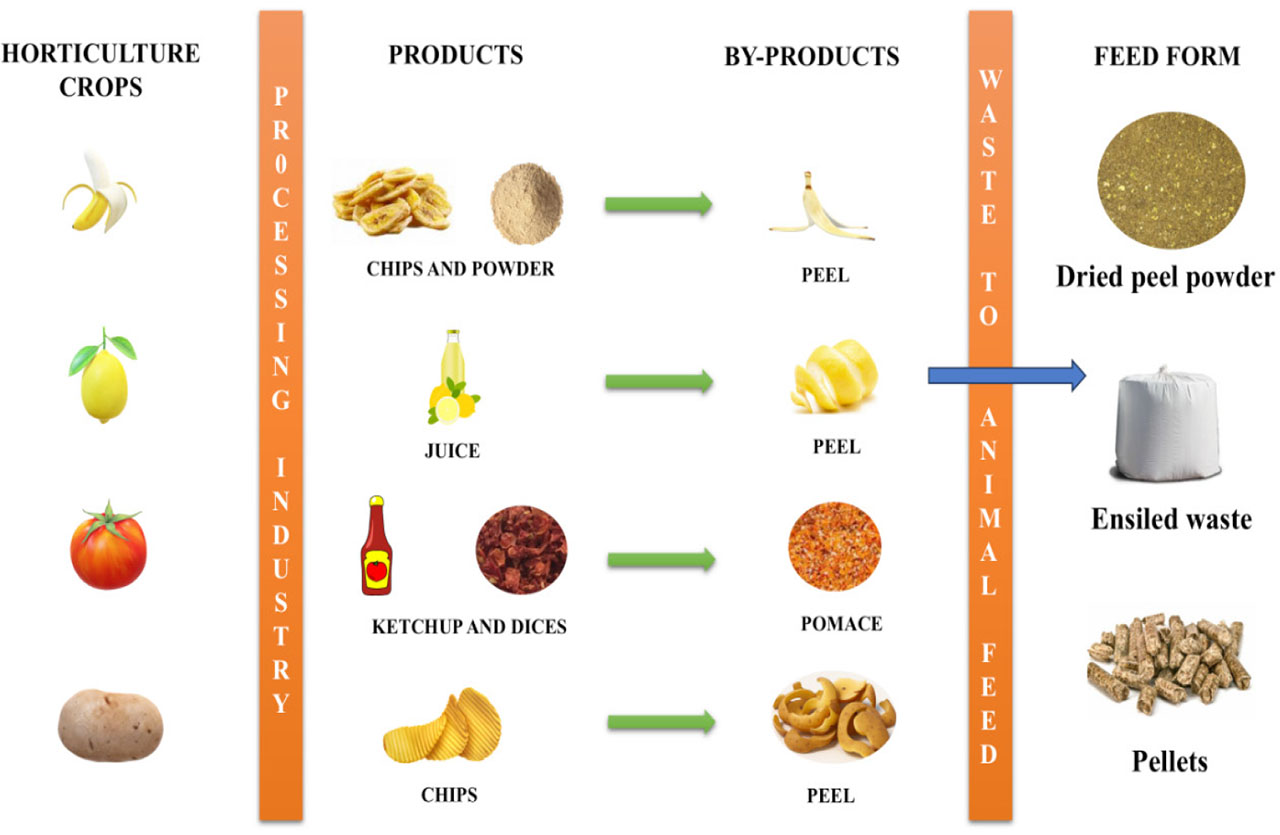
Figure 1.
Diagrammatic view for processing of horticulture waste into an animal feed
Table 5.
Effect of fruit and vegetable waste on the livestock
| By-product | Diet level | Experimental duration | Animal type | Initial weight | Effect | Reference |
|---|---|---|---|---|---|---|
| 1 | 2 | 3 | 4 | 5 | 6 | 7 |
| Apple pomace | ||||||
| Ensiled apple pomace | An 85:15 mixture of apple pomace and wheat straw | 8 weeks | Calves | 62.22 and 61.15 kg | Wheat straw and AP together could result in increased dry matter intake, weight gain, and feed efficiency ratio. | (Chauhan et al., 2024) |
| Fermented apple pomace | 11% | 56 days | Lamb | 25.37±2.9 kg | Reduced lipid oxidation during 4°C storage, while maintaining high quality in terms of color, pH, water-holding capacity, drip loss, and tenderness. | (Alarcon-Rojo et al., 2019) |
| Dried apple pomace | 150 g/kg of dry matter | 64 days | Dairy cows | 630±30 kg | Lowered methane emissions, enhanced food digestibility, and raised the content of ruminal volatile fatty acids by altering the populations of ruminal microorganisms. Higher levels of PUFA and n-3 are reflected in the milk. | (Gadulrab et al., 2023) |
| Banana peel | ||||||
| Banana peel | 15, 30, 45, and 60% | 80 days | F1 Holstein × Zebu cows | 500 kg | A lower calorie intake is indicated by the low temperature of the rectum during the morning shift with 60% DM banana peel eating. | (Santos et al., 2022) |
| Fermented banana peel | 2.5–7.5% | 12 weeks | Rabbit | Different body weight | The growth of Escherichia coli and Coliform in the hindgut is inhibited by the increased consumption of fermented banana peels. Additionally, the digestibility of proteins, energy, and dry matter has increased. | (Nuriyasa et al., 2020) |
| Single cell protein peel of banana, potato and pea | 2, 4, and 6 g/kg | – | Broilers | – | Stronger immunity and improved gut microbiota contribute to the health and meat of broilers. | (Khan et al., 2024) |
| Citrus fruit waste | ||||||
| Dried Citrus sinensis peel (DCSP) | 2.50, 5.00, and 7.50% | 8 weeks | Broilers | – | At 7.5% it decreased the feed conversion ratio, final weight, and body weight gain. Feeds up to 5.00% have no negative impact on carcass and growth metrics. Progressive decrease in pancreatic weight as dietary DCSP intake increased. | (Aro et al., 2024) |
| Multi-nutrient concentrate (25% ground corn + 25% citrus by-product) | 0, 25, and 50% | 90 days | Lambs | 15.67±0.30 kg | Creates favorable conditions for the rumen’s cellulolysis. | (Saddick and Nayel, 2024) |
| Dried Nagpur orange peel essential oil powder (limonene) | 500 g/ton of antibiotic, 50 g/ton, 100 g/ton, 150 g/ton | 6 weeks | Broiler | – | At 100 g/ton there is increased feed consumption, feed conversion ratio, gizzard weight, organic matter, crude protein, dry matter, crude fiber and ether extract. Higher globulin concentration. | (Gore et al., 2024) |
| Grape pomace | ||||||
| Red grape pomace (RGP) treated with ozone (O3) gas | 0, 20, and 40% | 7 days post-partum to 45 days in milk. | Dairy ewes | 51±2 kg | The dry matter’s and the neutral detergent fiber’s digestibility coefficients rose. The number of ruminal protozoa increased linearly. The concentration of albumin and plasma glucose increased, as did the production of milk and its fat, protein, and lactose contents. | (Asadnezhad et al., 2024) |
| Ensiled grape pomace | 0, 10, 20, and 40% | 35 days | Lamb | 21.5±3.0 kg | Increasing daily consumption of ether extract | (Massaro Junior et al., 2021) |
| Wine grape pomace | 10% dietary WGP | 74 days | Lamb | 25.0±0.2 kg | Total antioxidative capacity (TAOC), glutathione peroxidase 4 (GPx4), superoxide dismutase (SOD) activity, body weight, average daily gain, feed to gain ratio, Warner-Bratzler shear force, and collagen content all were increased. | (Zhao et al., 2018) |
| Pineapple pomace | ||||||
| Fermented pineapple pomace | 0, 25, and 50% | 30 days | Simmental bull | 546±44 kg | The average daily weight gain were increased. At 50% the muscle’s levels of proline, cysteine, and crude fat had increased. At 25%, the relative abundance of Lachnospiraceae bacterium RM44 was much lower, whereas tyrosine, proline, and phenylalanine were significantly elevated. | (Deng et al., 2022) |
| Fermented pineapple peel residue | 0, 25, and 50% | 35 days | Chuanzhong black goats | 10.23±1.42 kg | Enhanced the quantity of probiotics, including Ruminococcus albus, Butyrivibrio fibrisolvens, and Blautia. | (Yang et al., 2022) |
| Pineapple waste silage | 25% | 6 weeks | Myanmar local cattle | 255.00±6.19 and 275.46±31.42 kg | Greater intakes of dry matter, non-fiber carbohydrates, crude protein, neutral detergent fiber and energy, and energy balance. | (Kyawt et al., 2020) |
| Tomato pomace | ||||||
| Dried tomato pomace | Feel free to provide | 36 days | Comisana goat | 14.53±2.16 kg | L*, b*, C*, and H* increased (where H* stands for hue, L* for lightness, C* for chroma, and b* for yellowness). Lipid oxidation and growth performance are unaffected. Reduced reactive compounds of 2-thiobarbituric acid, or TBARS. | (Valenti et al., 2018) |
| Ensiled tomato pomace | 10% | – | Holstein cow | 710.9±15.5 kg | No impact on the content and output of milk. Increased digestibility, DM intake, and milk’s vitamin content. Elevated levels of IgA, IgG, and IgM, serum aspartate aminotransferase, antioxidants, total cholesterol, and high-density lipoprotein cholesterol. | (Tuoxunjiang et al., 2020) |
| Dried tomato pomace | 3, 6, 9, and 12% | 8 weeks | Japanese quail | – | Enhances digestive enzymes, antioxidant qualities, and immunological function. Reduces LDL (low density lipoprotein), or cholesterol. Lycopene deposition benefited from increased HDL (high density lipoprotein), hatchability, and egg weight, the biggest of which was 6%. | (Reda et al., 2022) |
| Roots and tuber peel | ||||||
| Yam tuber waste meal | 0, 12, 22, and 32% | 8 weeks | Broiler | – | There was an increase in live weight, dress weight, and dress percentage. Feed conversion ratio, the average weight gain, feed utilization efficiency, and eight gained were all noticeably improved. | (Anigbogu et al., 2023) |
| Sweet potato tuber waste (by-products) | 0, 10, 20, 30, and 40% | 21 days | Goat | 23.4±1.91 kg | Enhanced daily weight growth, feed conversion, and feed and nutritional consumption. | (Truong and Tuan, 2024) |
| Cassava peels biodegraded by white rot fungi (Pleurotus tuber-regium) | 0, 25, 50, 75, and 100% | 84 days | West African Dwarf (WAD) goats | 6.17±0.96 kg | Crude protein was higher (above 17%) than recommendation of the diet. Additional CP content may compensate for poor digestion and an imbalance in the amino acid composition created during protein breakdown. | (Barde et al., 2015) |