
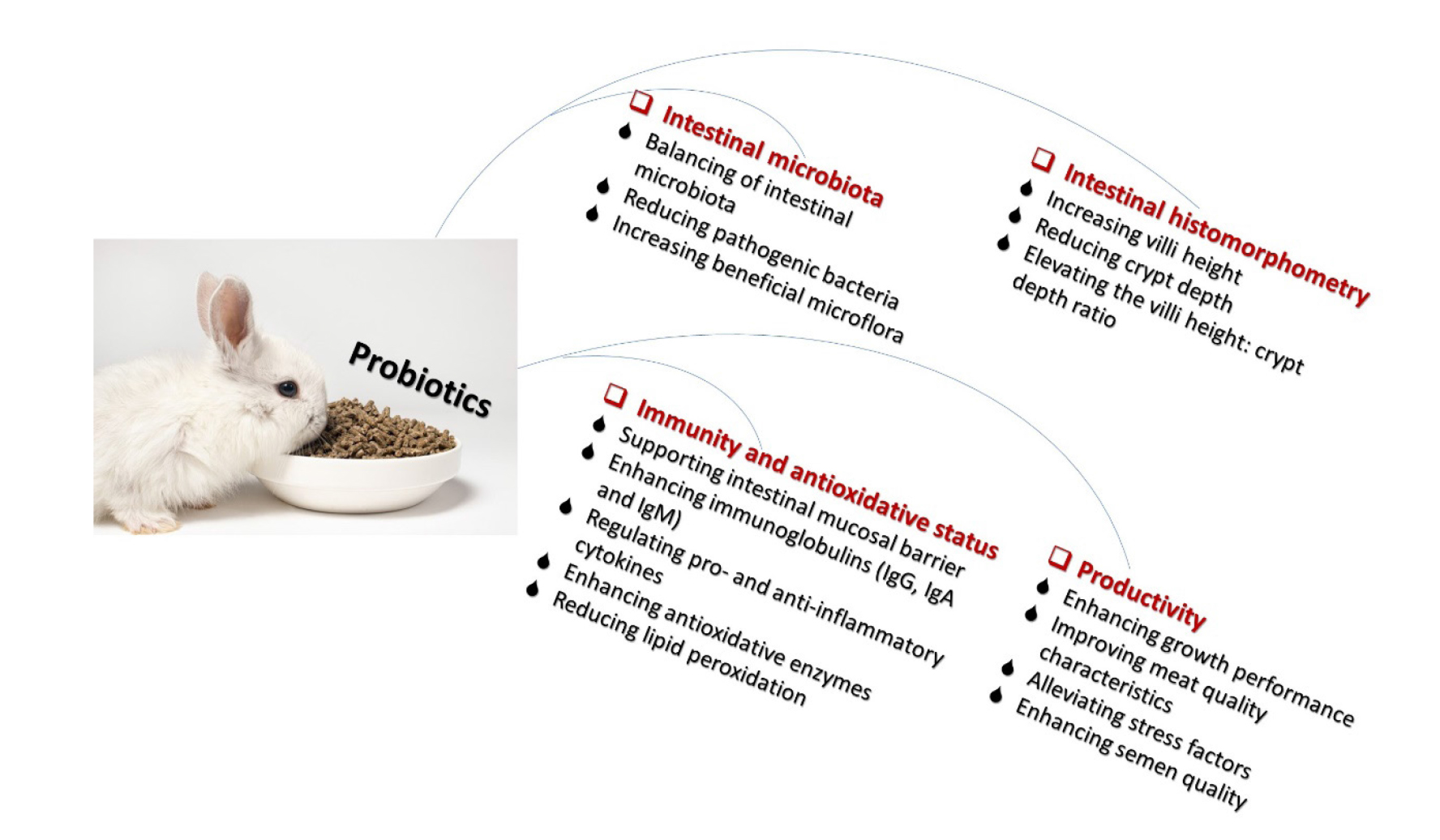
Figure 1.
Beneficial effects of probiotics on rabbit’s productivity and health
Table 1.
Summary of the beneficial effects of probiotics on rabbit’s productivity and health
| Probiotic | Level | Animal | Main impacts | References |
|---|---|---|---|---|
| 1 | 2 | 3 | 4 | 5 |
| Saccharomyces cerevisiae | 5 g/kg diet | New Zealand White growing rabbits | Increased Lactobacillus count. | Elbaz et al. (2023) |
| Minimized E. coli count. | ||||
| Enhanced ileal villus height and villi height: crypt depth ratio. | ||||
| Improved all nutrients’ digestibility. | ||||
| Elevated serum values of thyroid hormones (T3 and T4). | ||||
| Enterococcus faecium NCIMB 11181 and Clostridium butyricum | 1 × 10⁸and 2.5 × 10⁶ CFU/kg diet | New Zealand White growing rabbits | Enhanced serum concentrations of total protein, globulin, IgM, and HDL-cholesterol. | Alagawany et al. (2023) |
| Improved cecal contents of total volatile fatty acids and propionic acid. | ||||
| Improved duodenal histomorphology parameters (greater villus height, greater muscular layer thickness, and lesser crypt depth). | ||||
| Improved growth performance traits. | ||||
| Saccharomyces cerevisiae and Bacillus subtilis | 1×10⁸ CFU/g and 3×10⁷ CFU/g | New Zealand White growing rabbits | Increased length of small intestine. | Helal et al. (2021) |
| Increased villus height and crypt depth. | ||||
| Reduced E. coli and Clostridium perfringens count. | ||||
| Increased Lactobacillus count. | ||||
| Aspergillus awamori | 100 and 150 mg/kg diet | APRI growing rabbits | Enhanced villi parameters (height and thickness). | El-Deep et al. (2021) |
| Enhanced digestibility coefficients of protein, lipids, and fibres. | ||||
| Improved the catalase activity and decreased malondialdehyde concentration. | ||||
| Improved average body weight and weight gain and decreased feed conversion ratio. | ||||
| Improved phagocytic activity and phagocytic index. | ||||
| Bacillus BSWJ2017001, BSWJ2017002, and BSWJ2017003 | 1.0 × 10⁵– 1.0 × 10⁷ CFU/g | Rex growing rabbits | Enhanced villus height and villi height: crypt depth ratio and decreased crypt depth in jejunum. | Wang et al. (2020) |
| Enhanced gut count of Lactobacillus and Bacillus, and reduced number of E. coli. | ||||
| Increased indexes of thymus and vermiform appendix. | ||||
| Improved serum concentrations of superoxide dismutase, glutathione peroxidase, and catalase. | ||||
| Reduced serum concentrations of malondialdehyde. | ||||
| Elevated caecal contents of acetic, propionic, and butyric acids. | ||||
| Enhanced activities of protease, amylase, and cellulose. | ||||
| Improved feed conversion ratio. | ||||
| Clostridium butyricum | 1.0 × 10⁴– 1.0 × 10⁵ CFU/g | Rex growing rabbits | Elevated the abundance of total bacteria, Ruminococcus albus, Ruminococcus flavefaciens, Firmicutes, Butyrivibrio fibrisolvens, Bacteroidetes, Clostridium cluster IV, Clostridium cluster XIVa, Lactobacillus, and Bifidobacterium in duodenum, jejunum, ileum, cecum, and colon. | Liu et al. (2019) |
| Increased height of villi and villi height: crypt depth ratio and reduced depth of crypts in small intestine segments. | ||||
| Increased relative expressions of MyD88, TLR2, and TLR4 and decreased pro-inflammatory cytokines (IL-6, INF-γ, and TNF-α). | ||||
| Increased secretory IgA (sIgA) in duodenum and ileum. | ||||
| Increased activities of superoxide dismutase, glutathione peroxidase, and catalase and reduced the malondialdehyde content in duodenum and ileum. | ||||
| Increased average daily weight gain. | ||||
| Lactobacillus acidophilus or mixture of Bacillus subtilis + L. acidophilus | 1×10⁶ CFU/g or 0.5×10⁶ CFU/g + 0.5×10⁷ CFU/g | New Zealand White growing rabbits | Increased gut useful bacteria count (Lactobacilli and Bacilli), and decreased coliforms’ count. | Phuoc and Jamikorn (2017) |
| Improved body weight gain and feed conversion ratio. | ||||
| Improved digestibility coefficients of dry matter, organic matter, crude protein, neutral detergent fibre, and gross energy. | ||||
| Bacillus subtilis | 1.0 × 10⁶ CFU/g | New Zealand White growing rabbits | Improved the relative abundance of Ruminococcus and reduced the percentage of Bacteroides and Clostridium at the phylum level. | Guo et al. (2017) |
| Enhanced the expressions of innate immune-related genes (nucleotide oligomerization domain 1 “NOD1”, NOD-like receptor C3 “NLRC3”) and NLRX1) in jejunum. | ||||
| Enhanced the expressions of innate immune-related genes (nucleotide oligomerization domain 1 “NOD1”, NOD-like receptor C3 (“NLRC3”) and NLRX1) in jejunum. | ||||
| Elevated serum concentrations of IgG and IgA. | ||||
| Increased thymus % and spleen %. | ||||
| Improved growth performance. |