
1. Mathematical model
Bifurcation theory is a powerful tool in studying deformations of elastic beams, shells or plates. Lots of works have been devoted to the study of bifurcation in elasticity theory, see for instance [1], [4], [5], [11], [12], [14] and references therein.
Our study was motivated by gas balloons. Precisely, we are interested in the behaviour of the part of a balloon that is called an envelope. Following the description in [8], the fabric of the envelope is flexible (elastic). It is composed of large vertical sections called gores. Each gore is made up of the same number of horizontal sections called panels. The panels and gores are held together by stitching and by heavy duty flexible load tapes which help support the weight of the balloon and minimize a strain on the fabric. The top part of the envelope consisting of one panel of each gore is named a parachute (see Fig. 1). The standard parachute possesses a circular deflation port – a crown ring that is closed off by a circular panel which is held sealed during a flight by a flexible hook-and-loop closure. Moreover, we can treat a parachute in a balloon envelope as a two-dimensional object, because its height is much smaller than the length of a top rim - a horizontal tape between the parachute and the rest of envelope. An equilibrium form of the gas balloon parachute is described in polar coordinates by a 2π- periodic Cm+2-smooth positive function r(θ), m ∈ ℕ ∪ {0}.
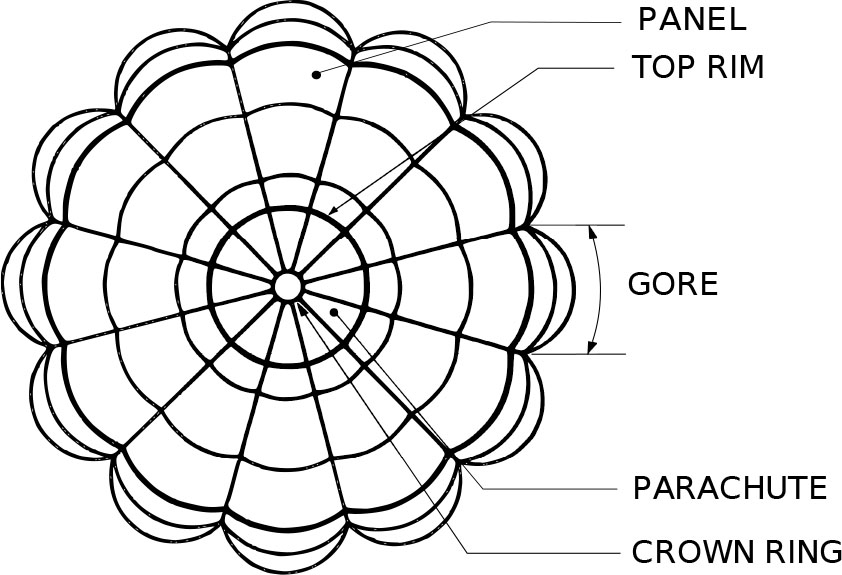
Figure 1.
A balloon envelope: view from above
Let Cm(2π), m ∈ ℕ ∪ {0}, denote the Banach space of 2π-periodic Cm-smooth functions r(θ) with the standard norm
where r(k)(θ) denotes the k-th derivative of r(θ) and r(0)(θ) = r(θ). It is well known that Cm(2π) is continuously embedded into the Hilbert space L2(2π) with the scalar productThe total energy of the parachute is given by:
where α > 0 is an elasticity coefficient of heavy duty load tapes, β > 0 is a physical parameter describing a compressed gas inside the gas balloon, and S denotes the area of parachute, i.e.Gas balloons are inflated with a gas of lower molecular weight than the ambient atmosphere. The most popular gas here is helium. Let us point out that a similar model was investigated by the second author and J. Janczewska in [7] and [8]. As a result of conversations with J. Janczewska, the formula for the energy functional has been improved (simplified). The component of the energy functional corresponding to the energy of compresses gas inside the gas balloon depends only on one parameter. However the main conclusions concerning deformations of the parachute are the same.
It can be easily calculated that the Fréchet derivative of the energy functional E with respect to the variable r is of the form:
where α, β ∈ ℝ+, r, h ∈ Cm+2(2π) and r(θ) > 0 for θ ∈ [0, 2π]. Critical points of the energy functional E(r, α, β) are 2π-periodic Cm+2-smooth positive solutions of the equation We are interested in radially symmetric solutions of the equation (1.2). Substituting r(θ) ≡ r into (1.2), we get an algebraic equation with a solution given by which corresponds to a circular shape of the top rim of radius Rα. To sum up, for all β ∈ ℝ+ there exists a family of radially symmetric solutions of the equation (1.2) given by where Rα is defined by (1.3).2. Symmetry-breaking bifurcation problem
We now want to find all values of the parameter α for which the radially symmetric solution Rα loses its stability. For this purpose we will study bifurcation from the set of radial solutions with respect to α.
Definition 2.1
(Rα, α) ∈ Γβ is called a symmetry-breaking bifurcation point of the equation (1.2) with respect to the set Γβ if there exists a branch of non-radially symmetric solutions (r(t), α(t)) of (1.2), depending on |t| < ε, with r(0) = Rα and α(0) = α.
Set
Theorem 2.2
For each k ≥ 2, there exists a smooth family of non-radially symmetric solutions (r(t), α(t)) of (1.2), defined for |t| < ε, satisfying
In particular, at t = 0 we have r(0) = Rαk and α(0) = αk. This implies that (Rαk, αk) ∈ Γβ is a symmetry-breaking bifurcation point for the equation (1.2).The proof of the above theorem relies on the Crandall-Rabinowitz theorem concerning simple bifurcation points (see [6]). We will apply the gradient (variational) version of this theorem, developed by A. Yu. Borisovich (see [2], [3]). To enhance clarity, let us state this theorem.
Theorem 2.3
Assume that H is a Hilbert space with a scalar product (·, ·)H. Let X and Y be Banach spaces continuously embedded in H. Suppose that a Cr-operator F : Xδ(0)× ℝδ(α0) → Y and a Cr+1-functional E : Xδ(0)× ℝδ(α0) → ℝ, where r ≥ 2, satisfy the following conditions:
F (0, α) = 0 for α ∈ ℝδ(α0),
dim ker , , (e, e)H = 1,
codim im ,
for (x, α) ∈ Xδ(0) × ℝδ(α0) and h ∈ X,
.
Let us introduce the symbol , m ∈ ℕ ∪ {0} be the subspace of Cm(2π) of even functions. Set
Given any α0 ∈ ℝ+ take (Rα0, α0) ∈ Γβ. Starting now, Xδ(0) and (ℝ+)δ(α0) denote balls of radius δ around 0 in X and α0 ∈ ℝ+, correspondingly. For ϱ ∈ Xδ(0) and α ∈ (ℝ+)δ(α0) define Note that r(θ) represents a small perturbation in X from Rα given by (1.3). Substituting (2.2) in (1.1), we get the new energy functional Ê given by where ϱ ∈ Xδ(0), α ∈ (ℝ+)δ(α0) and Furthermore, the Fréchet derivative of Ê with respect to ϱ is expressed by Let us define the mapping F̂ : Xδ(0) × (ℝ +)δ(α0) → Y by the formula Of course F̂ is smooth. It is easy to notice the followingLemma 2.4
The mapping F̂ is the variational gradient of Ê with respect to the inner product in L2(2π), i.e.,
fol all ϱ ∈ Xδ(0), h ∈ X and α ∈ (ℝ+)δ(α0).Consider the equation of the form
The equation (2.3) has a trivial family of solutions In order to prove the existence of a symmetry-breaking bifurcation branch of solutions of the equation (1.2) at (Rαk, αk), we will investigate bifurcation from the set of trivial solutions of the equation (2.3).The proof is similar to that in [8]. It is sufficient to show that is the sum of a Fredholm map of index 0 and a completely continuous map. According to the implicit function theorem, a necessary condition for bifurcation from the trivial solutions of (2.3) at (0, α0) is that dim ker . To determine the critical values of the bifurcation parameter, we need to solve the equation
considering two additional constraints and The evenness of h(θ) and the condition (2.6) prevent any displacement of the mass center of the parachute. Additionally, conditions (2.6) and (2.7) rule out h(θ) = cos(θ) and h(θ) = const ≠ 0. Consequently, assumption (2.7) leads to a loss of radial symmetry. Furthermore, assumption (2.7) reduces equation (2.5) to We choose the bifurcation mode for k ≥ 2. Using formula (1.3), we finally obtainNow, it is enough to show that
It follows from Lemma 2.4 that Applying (2.4) and substituting h = g = ek, we obtain Finally, differentiating (2.8) with respect to α we have and thus It follows from Theorem 2.3 that (0, αk) is a bifurcation point of (2.3) and the solution set of (2.3) in a neighbourhood of this point is the sum of and a smooth curve (ϱ(t), α(t)), |t| < ε, such that ϱ(0) = 0, α(0) = αk and which, together with (2.2), proves Theorem 2.2.3. Subcritical behaviour of the parachute of gas balloon.
In the previous section, using the Crandall–Rabinowitz theorem, we proved the existence of a family of non-radially symmetric solutions of the equation (1.2) at the point (Rαk, αk), parameterized by a real parameter t ∈ (−ε, ε).
As the next step, our goal is to parameterize the non-radially symmetric branches of solutions of the equation (1.2) using the bifurcation parameter α. To achieve this, we will apply the Lyapunov–Schmidt finite-dimensional reduction and Sapronov’s key function method. For the convenience of the reader, we state this theorem.
Assume that the assumptions of Theorem 2.3 are satisfied. Let us consider the equation
where x ∈ Xδ(0), α ∈ ℝδ(α0) and ξ ∈ ℝ. By the implicit function theorem there are open sets S ⊂ ℝ × ℝδ(α0) and U ⊂ Xδ(0) and there exists a Cr-smooth function x̃ : S → U such that the solution set of (3.1) in a neighbourhood of (0, 0, α0) ∈ Xδ(0) × ℝ × ℝδ(α0) is the graph of x̃ and x̃(0, α0) = 0.Define Φ: S → ℝ by
Φ is called the key function. It is known that (0, α0) ∈ X × ℝ is a bifurcation point of (2.1) if and only if (0, α0) ∈ ℝ × ℝ is a bifurcation point of the equation Φξ(ξ, α) = 0 (see [9], Proposition 2.3).Theorem 3.1 (The key function method, [13]).
Under the conditions stated above:
(i) If then (0, α0) ∈ X × ℝ is a bifurcation point of the equation (2.1) and the solution set of (2.1) in a small neighbourhood of (0, α0) is a union of two branches: Γ1 = {(0, α): α ∈ ℝδ(α0)} and a Cr−2-curve Γ2, intersecting only at (0, α0).
(ii) If and then (0, α0) ∈ X × ℝ is said to be a transcritical bifurcation point of (2.1), and the curve Γ2 can be parametrized as follows:
where and 0 < η ≤ δ (see Fig. 2(a)).(iii) Let
Set
If D < 0 then (0, α0) ∈ X × ℝ is said to be a subcritical bifurcation point of (2.1), and the curve Γ2 can be parametrized as follows:
where 0 < η ≤ δ (see Fig. 2(b)).If D > 0 then (0, α0) ∈ X × ℝ is said to be a postcritical bifurcation point of (2.1), and the curve Γ2 can be parametrized as follows:
where 0 < η ≤ δ (see Fig. 2(c)).
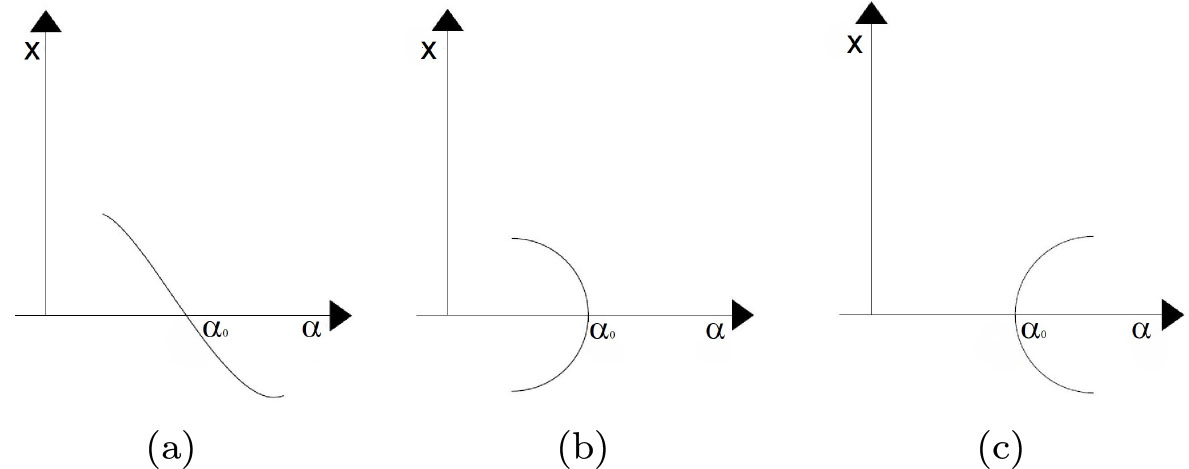
Figure 2.
Transcritical, subcritical and postcritical bifurcation diagrams
Fact 3.2 (see [10]).
The first few terms of the Taylor series of the key function Φ(ξ, α) at the point (0, α0) are given by the following formulae:
where h is a unique solution of the equationTheorem 3.3
Let αk = k2 − 1, k ≥ 2 be a critical value of bifurcation parameter α ∈ ℝ+. Then (0, αk) ∈ X × ℝ+ is a subcritical bifurcation point of the equation (2.3).
Proof
Fix k ≥ 2. Consider the key function corresponding to the equation (2.3) in a neighbourhood of (0, αk). According to Theorem 3.1 we have to show that and . . For this purpose we will use Fact 3.2. From the previous section, we have
Using Fact 3.2 it follows that A straightforward calculation gives According to Lemma 2.4, we obtain Combining this with Fact 3.2, we conclude that . We check at once that is a unique solution of the equation It follows that Finally, we obtain and as a result, using Fact 3.2, we get Hence According to Theorem 3.1 we conclude that (0, αk) is a subcritical bifurcation point of the equation (2.3). Furthermore, in a small neighbourhood of this point, the solution set consists of the trivial branch and a C∞-curve , which is parametrized as follows: where 0 < η ≤ δ.4. Graphical representation of the parachute of gas balloon in the neighbourhood of bifurcation points
We have shown that for the elasticity parameter values αk = k2 − 1, k ∈ ℕ, k ≥ 2, non-radially symmetric solutions (r(t), α(t)) of our problem appear. Using the simplified formula
and the Mathematica software, we present below how the top rim of a parachute may behave for k = 3, 4, 7, 8, 9, 12.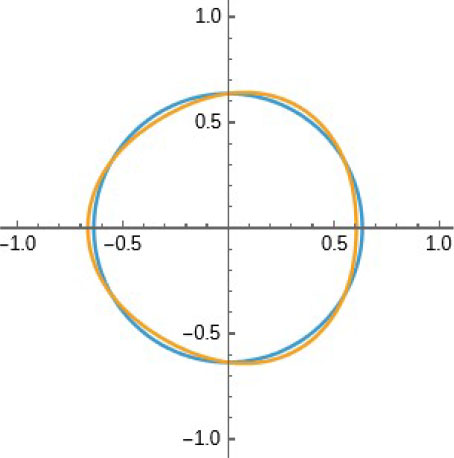
Figure 3.
k = 2, β = 18, t = −0.05
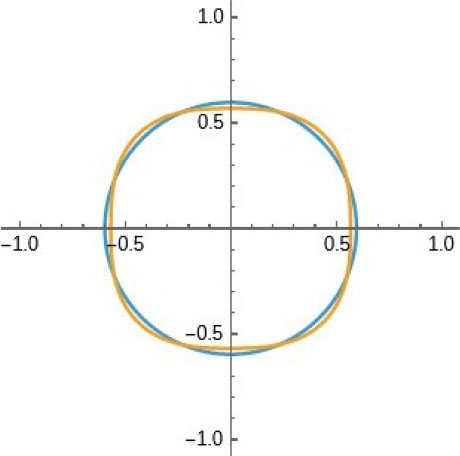
Figure 4.
k = 4, β = 30, t = −0.05
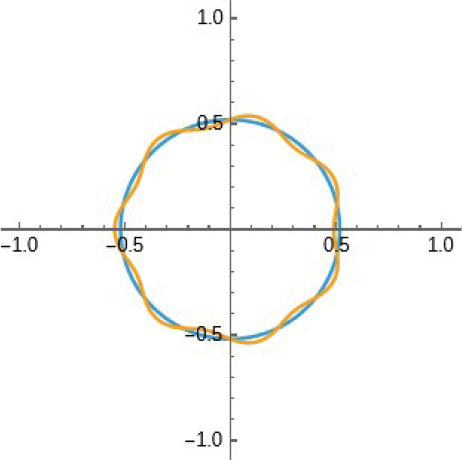
Figure 5.
k = 7, β = 80, t = −0.05
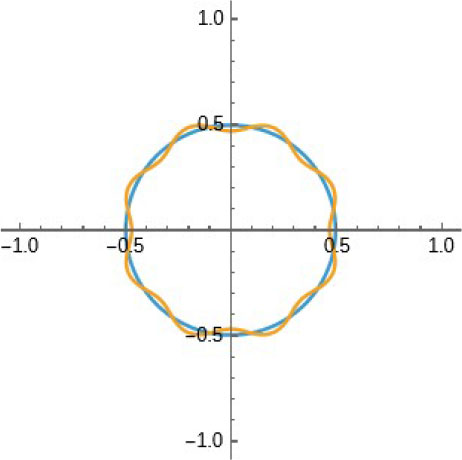
Figure 6.
k = 8, β = 100, t = −0.05
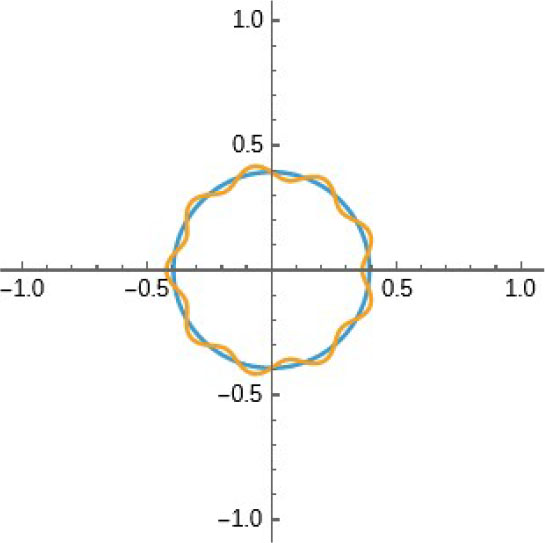
Figure 7.
k = 9, β = 100, t = −0.05
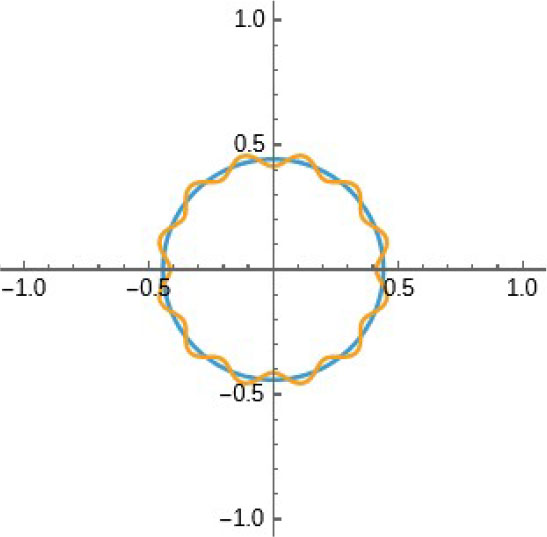
Figure 8.
k = 12, β = 200, t = −0.05