
1. Introduction
In 1936, J.A. Clarkson [21] introduced the notion of uniform convexity (also called uniform rotundity) in normed linear spaces. This notion is stronger than the notion of strict convexity (also known as rotundity), which was introduced independently by Clarkson [21] and Krein (see [1, 2]). Geometrically, rotundity requires that for any two points on the surface of the unit sphere of the normed linear space, the mid-point lies strictly inside the unit sphere. The uniform rotundity says that the mid-point of the variable chord of the unit sphere of the space can not approach the surface of the sphere unless the length of the chord goes to zero (see [29]). Moreover, it also gives the measure of the depthness of the mid-point of the variable chord of the unit sphere. These two concepts have been extremely fertile and found to be very useful and interesting in many branches of mathematics.
Soon after the appearance of Clarkson’s article, various researchers took up the study of rotund and uniformly rotund normed linear spaces. They introduced and discussed different weaker forms of uniform rotundity in normed linear spaces. Many of them have defined and studied the geometric properties of those spaces whose strength lies between rotundity and uniform rotundity. The geometric properties of most of these spaces can be classified as either localization or directionalization of uniform rotundity. This paper surveys the available literature on uniformly rotund normed linear spaces and their weaker forms. The topics discussed are their inter-relationships, their comparisons and applications of most of these rotundities to some of the branches of approximation theory. Some open problems have been listed at appropriate places. We also discuss the following questions:
The traditional method of surveying a topic of mathematics, that is, stating theorems in both chronological order or order of increasing generality, omitting proofs and concentrating on explaining the results, has been used in this article. Therefore, the results have been given without proof. For proofs, terminology and notations not given in this paper, we refer to the respective cited references. We do not claim that the article is complete in itself. Some of the results might have been omitted due to various reasons.To what extent does the geometry of the factor spaces influence the geometry of the product space?
To what extent is the geometry of the space inherited by its quotient spaces and subspaces?
The subsequent sections of this article are organized in the following manner. In Section 2, we introduce certain notations and review various kinds of uniform rotundity available in the literature. We also discuss concepts related to best approximation, farthest points, and Chebyshev centers, which will be relevant in the subsequent sections. In Section 3, an analysis is presented on the inter-relationships and comparisons among the various types of rotundities discussed in Section 2. In the following section, we examine the geometric properties of product spaces, quotient spaces, and subspaces in relation to the concept of rotundities. In Section 5, we discuss applications of some of these rotundities in the theory of best approximation, farthest points and Chebyshev centers. In the last section, we give directions for future research. Several open problems have been presented in the relevant sections of the article. The paper concludes with a comprehensive list of sources that have been cited throughout the article.
2. Notations and definitions
This section gives some notations and definitions needed in the sequel. The notations and definitions not given here can be found in the respective cited references.
Throughout, X* denotes the conjugate space of a normed linear space X, BX and SX denote the unit ball and unit sphere, respectively in X.
Definition 2.1.
A normed linear space (X, ‖.‖) is said to be
(i) strictly convex [21] or strictly normalized [1, 52] or rotund (R) [30] if , whenever ‖x‖ = ‖y‖ = 1 and x ≠ y.
Equivalently,
(ii) uniformly convex or uniformly rotund (UR) [21] if to each ɛ, 0 < ɛ ≤ 2, there corresponds a δ(ɛ) > 0 such that the conditions ‖x‖ = ‖y‖ = 1, ‖x − y‖ ≥ ɛ imply .
Equivalently (see [69, p.447]), if
(a) whenever {xn} and {yn} are sequences in X such that ‖xn‖ → 1, ‖yn‖ → 1 and ‖xn + yn‖ → 2, then ‖xn − yn‖ → 0, or
(b) whenever {xn} and {yn} are sequences in SX and , then ‖xn − yn‖ → 0, or
(c) whenever {xn} and {yn} are sequences in BX and , then ‖xn − yn‖ → 0;
(iii) weakly uniformly rotund (WUR) [93] if whenever {xn} and {yn} are sequences in X such that ‖xn‖ → 1, ‖yn‖ → 1 and ‖xn + yn‖ → 2, then ‖xn − yn‖ → 0 weakly;
(iv) locally uniformly rotund near a point (LURNP) [27] x0 ∈ X with ‖x0‖ = 1, if there is a sphere about x0 in which the condition of uniform convexity holds;
(v) locally uniformly rotund (LUR) [67] if given ɛ > 0 and an element x ∈ X with ‖x‖ = 1, there exists δ(ɛ, x) > 0 such that whenever ‖x − y‖ ≥ ɛ and ‖y‖ = 1, y ∈ X.
Equivalently (see [69, p.461]), if
(a) whenever x ∈ X and {xn} a sequence in X such that ‖x‖ = 1, ‖xn‖ → 1 and ‖x + xn‖ → 2, then xn → x, or
(b) whenever x ∈ SX, {xn} a sequence in BX and ‖x + xn‖ → 2, then xn → x, or
(c) whenever x ∈ SX and {xn} a sequence in X, ‖xn‖ → 1 and ‖x + xn‖ → 2, then xn → x;
(vi) weakly locally uniformly rotund (WLUR) [67] if for each ɛ > 0 with 0 < ɛ < 1 and each x0 ∈ X with ‖x0‖ = 1, there is a δ(ɛ, x0) > 0 such that for every f ∈ X* satisfying f(x0) = 0, ‖f‖ = 1, we have f(x) ≥ 1−ɛ whenever and ‖x‖ = 1.
Equivalently, if whenever x ∈ X and {xn} is a sequence in X such that ‖x‖ = 1, ‖xn‖ → 1 and ‖x + xn‖ → 2, then xn → x weakly;
(vii) point locally uniformly rotund (PLUR) [43] if whenever a sequence {xn} in X with ‖xn‖ → 1 has no weak cluster point of norm strictly less than one, and if, for some x0 ∈ X with ‖x0‖ = 1, , then xn → x0;
(viii) mid-point locally uniformly rotund (MLUR) [6] if given ɛ > 0 and x0 ∈ X with ‖x0‖ = 1, there exists δ(ɛ, x0) > 0 such that whenever ‖x − y‖ ≥ ɛ and x, y ∈ X with ‖x‖ = ‖y‖ = 1.
Equivalently (see [69, p.473]), if whenever x ∈ X, {xn} and {yn} are sequences in X such that ‖x‖ = 1, ‖xn‖ → 1, ‖yn‖ → 1 and ‖2x − (xn + yn)‖ → 0, then ‖xn − yn‖ → 0;
(ix) uniformly rotund in every direction (URED) [46] if whenever z ≠ 0 ∈ X, {xn} and {yn} are sequences in X such that ‖xn‖ = 1, ‖yn‖ = 1, for every n, ‖xn + yn‖ → 2, and xn − yn = αnz, then αn → 0.
Equivalently (see [31]), if there are sequences {xn} and {yn} in X such that ‖xn‖ ≤ 1, ‖yn‖ ≤ 1, for every n, ‖xn + yn‖ → 2, xn − yn → z ∈ X, then z = 0;
(x) compactly locally uniformly rotund (CLUR) (compactly weakly locally uniformly rotund (WCLUR)) [99] if x, xn ∈ X with ‖x‖ = 1, ‖xn‖ = 1 for all n and imply that {xn} has a convergent subsequence (weakly convergent subsequence);
(xi) uniformly rotund in weakly compact sets of directions (URWC) [88] if whenever z ∈ X, {xn} and {yn} are sequences in X such that ‖xn‖ = 1, ‖yn‖ = 1, for every n, ‖xn + yn‖ → 2, and xn − yn → z weakly, then z = 0;
(xii) nearly uniformly rotund (NUR) [54] if for every ɛ > 0 there exists δ(ɛ) in (0, 1) such that whenever {xn} is a sequence in BX and ‖xn − xm‖ ≥ ɛ (n ≠ m), then there exist an integer N, ai ∈ (0, 1), with for some integers n(1), . . . , n(N);
(xiii) strongly convex (K) [94] if limt→d diam(Z ∩ tBX) = 0 for any convex subset Z of X, where d = dist(0, Z).
Equivalently (see [43]), if whenever {xn} is a sequence in SX for which there is an element x* of SX* such that Re x* (xn) → 1, then the sequence {xn} is Cauchy;
(xiv) strongly rotund (SR) [13] if given x ∈ SX, x* ∈ SX* such that x*(x) = 1 and {xn} a sequence in BX such that x*(xn) → x* (x) = 1, then {xn} is a convergent sequence;
(xv) nearly strongly rotund (NSR) [13] if given x ∈ SX, x* ∈ SX* such that x* (x) = 1 and {xn} a sequence in BX such that x* (xn) → x* (x) = 1, then the set {xn : n = 1, 2, 3, . . .} is relatively compact;
(xvi) almost locally uniformly rotund (ALUR) [13] if for any sequence {xn} in unit ball BX in X and sequence in unit ball BX* in X*, the condition , imply xn → x;
(xvii) k-rotund (kR) [42] if every sequence {xn} in X satisfying
is a convergent sequence.If such a sequence is weakly convergent, then X is said to be weakly k-rotund (WkR).
In particular, X is said to be 2-rotund (2R) [95] if every sequence {xn} in X converges whenever ‖xn + xm‖ converges as n, m → ∞;
(xviii) k-uniformly rotund (kUR) [55], k > 1 if for every ɛ > 0 there is a δ(ɛ) > 0 such that if x1, x2, . . . , xk are in BX with ‖xn − xm‖ ≥ ɛ for n ≠ m, then
Equivalently,(a) [55] if for every ɛ > 0 there is a δ(ɛ) > 0 such that if {xn} is a sequence in BX with ‖xn − xm‖ ≥ ɛ for n ≠ m, then there exist a1, a2, . . . , ak ≥ 0 with and for all n, or
(b) [57] if for every ɛ > 0 there is a δ(ɛ) > 0 such that if {xn} is a sequence in BX with ‖xn − xm‖ ≥ ɛ for n ≠ m, then for each n ≥ 1 there exist an,1, an,2, . . . , an,k ≥ 0 with and ;
(xix) k-locally uniformly rotund (kLUR) [55] if for any x ∈ X, ‖x‖ = 1 and ɛ > 0, there exists δ(ɛ, x) > 0 such that whenever x1, x2, . . . , xk−1 are in BX with ‖x − xi‖ ≥ ɛ, then ;
(xx) having Property (D) [43] if whenever {xn} is a sequence in SX for which there is an element such that limn→∞ x* (xn) = 1, then {xn} is convergent;
(xxi) having Efimov–Stechkin Property (CD) [86] if whenever {xn} is a sequence in SX for which there is an element such that limn→∞ Re x* (xn) = 1, then {xn} has a convergent subsequence;
(xxii) having Property (H) or Radon–Riesz Property or Kadec–Klee Property [91] if whenever x ∈ X and {xn} a sequence in X such that ‖xn‖ → ‖x‖ and xn → x weakly, then xn → x.
If X is H and R, then X is (HR).
Definition 2.2.
A subset M of a metric space (X, d) is said to be
(i) residual if it is a Gδ dense subset of X,
(ii) boundedly connected if M ∩ B(x, r) is connected for every open ball B(x, r) in X,
(iii) boundedly compact, if M ∩ B[x, r] is compact for every closed ball B[x, r] in X, equivalently, if every bounded sequence in M has a convergent subsequence,
(iv) relatively compact if its closure is compact,
(v) relatively boundedly compact, if M ∩ B[x, r] is relatively compact for every closed ball B[x, r] in X.
Definition 2.3.
A subset M of a normed linear space X is said to be
(i) boundedly weakly compact if every bounded sequence in M has a weakly convergent subsequence,
(ii) weakly closed or weakly sequentially closed if every sequence {xn} in M converges weakly to an element of M, that is x* (xn) → x* (x), for all x* ∈ X*, x ∈ X,
(iii) a sun if for each x ∈ X and m0 ∈ PM (x), m0 ∈ PM [λx + (1 − λ)m0], for every λ ≥ 0.
Next, we set some notations and recall a few concepts from the theory of approximation, which will be needed in the sequel.
For a non-empty subset M of a metric space (X, d) and x ∈ X, let Φ(x) = inf{d(x, y) : y ∈ M} ≡ dist(x, M) be the distance function associated with M. PM (x) = {y ∈ M : d(x, y) = Φ(x)} denotes the set of best approximation in M to x ∈ X.
Definition 2.4.
The set M is said to be
(i) proximinal if PM (x) ≠ ∅ for each x ∈ X,
(ii) antiproximinal if PM (x) = ∅ for each x ∈ X\M,
(iii) semi-Chebyshev or uniqueness set if PM (x) is at most singleton for each x ∈ X,
(iv) uniquely proximinal or Chebyshev if PM (x) is exactly a singleton for each x ∈ X,
(v) almost proximinal (almost Chybyshev) if the set x ∈ X which admits best approximation (unique best approximation) from M is a set of second category in X,
(vi) approximatively compact (weakly approximatively compact) if for each x ∈ X every sequence {yn} in M satisfying limn→∞ d(x, yn) = d(x, M) has a convergent subsequence (weakly convergent subsequence). Such a sequence {yn} in M is called a minimizing sequence for x ∈ X.
Definition 2.5.
The mapping which takes each x ∈ X to the set PM (x) is called the metric projection or nearest point map or best approximation map. The metric projection PM associated with proximinal subset M of X is said to be
(i) lower semi-continuous if the set {x ∈ X : PM (x) ∩ U ≠ ϕ} is open whenever U is open in X,
(ii) upper semi-continuous if the set {x ∈ X : PM (x) ∩ F ≠ ϕ} is closed whenever F is closed in X.
Definition 2.6.
A pair (A, B) of non-empty subsets of a normed linear space X is said to have d-property if ‖x1 − y1‖ = ‖x2 − y2‖ = dist(A, B), imply ‖x1 − x2‖ = ‖y1 − y2‖, where x1, x2 ∈ A, y1, y2 ∈ B.
A normed linear space X is said to have d-property if and only if every pair (A, B) of non-empty and closed convex subsets of X has d-property.
We denote by min(x, M) the problem of best approximation of x by elements of M: find m0 ∈ M such that d(x, m0) = d(x, M). We say that the problem min(x, M) is well posed if it has a unique solution m0 ∈ M and every minimizing sequence for x in M converges to m0.
Definition 2.7.
The set M is said to be strongly approximatively compact or strongly Chebyshev for x ∈ X if every minimizing sequence {yn} in M for x is convergent in M.
If M is strongly Chebyshev for every x ∈ X, then we call M a strongly Chebyshev set. Such sets are precisely approximatively compact and Chebyshev.
Definition 2.8.
For a non-empty bounded subset K of a metric space (X, d) and x ∈ X, let Ψ(x) = sup{d(x, y) : y ∈ K} ≡ δ(x, K) and FK(x) = {y ∈ K : d(x, y) = Ψ(x)} be the set of farthest points to x in K.
The set K is said to be
(i) remotal if FK(x) ≠ ∅ for each x ∈ X,
(ii) antiremotal if FK(x) = ∅ for each x ∈ X,
(iii) uniquely remotal if FK(x) is exactly a singleton for each x ∈ X,
(iv) nearly compact or M-compact if for each x ∈ X every sequence {yn} in K satisfying has a convergent subsequence.
Such a sequence {yn} in K is called a maximizing sequence for x ∈ X.
The mapping which takes each x ∈ X to the set FK(x) is called a farthest point map.
For the bounded set K, the number δ(x, K) is called the outer radius of K at x ∈ X. The collection of all elements of K at which δ(x, K) is attained for some x ∈ X is denoted by Far(K), that is .
A center or Chebyshev center of K is an element xk for which
The number r(K) = infx∈X supy∈K d(x, y) is called the Chebyshev radius of K. We denote by Z(K) the collection of Chebyshev centers of K, that is,
The bounded set K is said to have a Chebyshev center or simply a center if there exists some xk ∈ X such that FK(xk) = r(K). The normed linear space X is said to admit centers if each non-empty bounded subset in X has at least one center.
The set K is said to be centerable if the Chebyshev radius of K is half of its diameter, that is, .
Definition 2.9.
The set K is said to be
(i) a CCF set if there is a Chebyshev center of K that belongs to Far(K),
(ii) a CCNF set if it is not a CCF set.
Definition 2.10.
The space X is said to be
(i) a CCF space if it contains a non-trivial CCF set,
(ii) a CCNF space if it is not CCF, that is, all non-trivial subsets of X are CCNF.
Definition 2.11.
Given a subset K of a normed linear subspace X and a bounded subset F of X, an element k* ∈ K is said to be a best simultaneous approximation to the set F if
In particular, for any two elements x1, x2 ∈ X, k* ∈ K is a best simultaneous approximation to x1 and x2 if
Remarks 2.1.
Some of the weaker forms of uniform rotundity (for example, (iv)-(viii), (x)) are localizations of uniform rotundity since in each of these definitions a point of the unit sphere is fixed. Some other forms (for example, (iii), (ix), (xi)) are directionalizations of uniform rotundity since each of them can be expressed in terms of the directional modulus of unity. Smith in [91] has given six examples, illustrating the distinctions among some of these generalizations of uniform rotundity. The first two examples of Smith [91] show the independence of the localizations and directionalizations of uniform rotundity. Examples of this type also appeared in Zizler [110].
The unit ball (unit sphere) of a normed linear space X determines the shapes of all balls (all spheres) in X, so the conditions of uniform rotundity and their weaker forms can be written for arbitrary balls (spheres).
A normed linear space is rotund if the mid-point of each chord of the unit sphere lies beneath the surface, and a normed linear space is uniformly rotund if the mid-point of all chords of the unit sphere whose lengths are bounded from below by a positive number are uniformly burried beneath the surface (see [91]). So, stated in geometric terms, a norm is uniformly rotund if whenever the mid-point of a variable chord in the unit sphere of the space approaches the boundary of the sphere, the length of the chord goes to zero.
Geometrically, local uniform rotundity differs from uniform rotundity in that it is required that one end point of the variable chord remains fixed. Geometrically, uniform rotundity near a point differs from uniform rotundity in that variable chord in the unit sphere is contained in a sphere about some fixed point. Thus, the notions of local uniform rotundity and local uniform rotundity near a point are essentially different.
J.A. Clarkson [21] introduced a method of renorming Banach spaces to satisfy the rotundity condition and proved that every separable Banach space has an equivalent rotund norm. His method of renorming (see [91]) is the following:
Furthermore, Clarkson showed that if T is an injection and (B2, ‖.‖2) is rotund, then (B1, ‖.‖1) is also rotund. Later Zizler [110] and Smith [90] showed that if T is an injection and (B2, ‖.‖2) is URED or URWC, then (B1, |‖.‖|) is also URED or URWC, respectively. Using the technique given in [110], one can show that if (B1, ‖.‖1) has any one of the properties defined in (i)–(iii), (v), (viii), (ix) or (xi), then (B1, |‖.‖|) also has that property. Thus, none of these existing properties of B1 is destroyed when employing Clarkson’s scheme of renorming. Malto et al. [73], Damai and Bajracharya [24], Hajek and Quilis [51] have also discussed the question of renorming the Banach spaces so as to satisfy some of the rotundity conditions.If T : (B1, ‖.‖1) → (B2, ‖.‖2) is a continuous linear mapping, then |‖.‖|, defined for x in B1 by , is an equivalent norm on B1.
The problem: When is a Banach space isomorphic to another Banach space which has more pleasant geometric properties than the first, or equivalently, the problem of renorming the space without changing the topology in such a way that the new norm has some geometric properties not possessed by the first has been discussed by Cudia [23], Day [29] and others in detail. This problem has not been taken up in this article.
The modulus of uniform rotundity (see [69, pp. 442–446]) of a normed linear space X is the function δX : [0, 2] → [0, 1] defined by
The space X is uniformly rotund if and only if δX(ɛ)>0 for every 0 < ɛ ≤ 2.The notions of uniform rotundity and local uniform rotundity have been introduced and discussed in asymmetric normed linear spaces by Alimov and Tsarkov [4] and Tsarkov [98].
Recently, Wanjara [104] has given a survey of some standard results on the rotundity of norms in Banach spaces.
3. Inter-relationships and comparisons
It is well known (see [21]) that Euclidean spaces of all dimensions, Hilbert spaces, Lp and lp spaces for 1 < p < ∞ are all uniformly rotund. There are many spaces known in the literature which are not uniformly rotund but satisfy one or the other weaker form of uniform rotundity. In this section, we survey the available literature on inter-relationships and comparisons between different forms of rotundities considered in Section 2.
It was proved by Clarkson [21] that every uniformly rotund space is rotund, and a finite dimensional rotund space is uniformly rotund. Thus (UR) ⇒ (R). But what about the converse? The answer is in the negative. There are plenty of spaces (see, for example, [26, 30, 55, 67, 69, 70, 87]) known in the literature which are rotund but not uniformly rotund. So, (R) ⇏ (UR).
Another generalization of uniform rotundity is local uniform rotundity introduced by Lovaglia [67]. Every zero dimensional normed linear space is (LUR). (LUR) is not preserved by isomorphism, but it is preserved under isometric isomorphism. This is true for most of the weaker forms of uniform rotundity (see [69]). It is clear from the definitions that uniform rotundity implies local uniform rotundity, local uniform rotundity implies rotundity, uniform rotundity implies weak uniform rotundity, and weak uniform rotundity implies rotundity as well as uniform rotundity in weakly compact sets of directions. So, (UR) ⇒ (LUR) ⇒ (R), (UR) ⇒ (WUR) ⇒ (URWC) and (WUR) ⇒ (R). On the other hand (WUR) ⇏ (UR) and (WUR) ⇏ (H) (see [91]), (LUR) ⇏ (WUR) (see [91]) and (WUR) ⇏ (LUR) (see [91]). Lovaglia [67] illustrated the facts that uniform rotundity is stronger than the local uniform rotundity, and local uniform rotundity is stronger than rotundity. Therefore, (LUR) ⇏ (UR) and (R) ⇏ (LUR).
Day [27] proved that if a space X is locally uniformly rotund near a point x0, then X is isomorphic to a uniformly rotund space. Hence, local uniform rotundity near a point x0 implies isomorphism of the space X with a locally uniform rotund space. On the other hand, example following Theorem 1.1 of [67] shows that the notion of the local uniform rotundity and Day’s notion of local uniform rotundity near a point are essentially different. Local uniform rotundity and weak uniform rotundity have a common generalization stronger than rotundity called weak local uniform rotundity (see [67]). Thus (LUR) ⇒ (WLUR), (WUR) ⇒ (WLUR) ⇒ (R).
Fan and Glickberg [43], who introduced the notion of point locally uniformly rotund, proved that (LUR) ⇒ (PLUR), (PLUR) ⇒ (H), and (Rf) + (PLUR) ⇒ (MLUR). In fact, they proved that a space X is reflexive (Rf) and (PLUR) if and only if X is reflexive and satisfies (H), that is, (Rf) + (PLUR) ⇔ (Rf) + (H).
Anderson [8] introduced mid-point local uniform rotundity and proved that (LUR) ⇒ (MLUR) ⇒ (R), and also proved that neither of these implications is reversible, that is, (MLUR) ⇏ (LUR) and (R) ⇏ (MLUR).
Vyborny [103] proved that every locally uniformly rotund space has the Radon-Riesz property, that is, (LUR) ⇒ (H). Anderson [8] also proved that (LUR) ⇒ (H), and if the space is reflexive (Rf) and satisfies (H), then X is mid-point locally uniformly rotund, that is, (Rf) + (H) ⇒ (MLUR). Anderson [8] raised the question: Does a Banach space satisfy property (H) if it is (MLUR)? Smith [92] gave an example of a Banach space which is (MLUR) but does not satisfy property (H) and so not (HR), that is, (MLUR) ⇏ (H), (MLUR) ⇏ (HR).
Smith [91] has given an example (Example 3) of a rotund reflexive Banach space that has property (H) but is not locally uniformly rotund. The question of whether such a Banach space exists was raised by Fan and Glickberg [43]. Anderson [8] proposed the construction of such an example. Thus (H) ⇏ (LUR), in fact (Rf) + (H) + (R) ⇏ (LUR). Smith [91] also gave an example (Example 4) of a rotund reflexive Banach space, which is not uniformly rotund in every direction. Thus (R) + (Rf) ⇏ (URED). An example of a rotund space that has property (H) but is not mid-point locally uniformly rotund was also given by Smith ([91, Example 5]), thereby solving the problem raised by Anderson [8]. Thus (R) + (H) ⇏ (MLUR). [91, Example 6] shows that none of (URED), (URWC), (LUR) implies (WUR), that is, (URED) ⇏ (WUR), (URWC) ⇏ (WUR), (LUR) ⇏ (WUR).
Vlasov [99] introduced the concept of compact local uniform rotundity (CLUR). It is easy to see (see [33]) that every finite dimensional normed linear space is (CLUR), every (CLUR) space is (CWLUR) and (CLUR) generalizes the notion of (LUR). Thus (CLUR) ⇒ (CWLUR), (LUR) ⇒ (CLUR).
Moreover (see [77]), it can be easily verified that X is (LUR) if and only if X is (CLUR) and (R), that is, (LUR) ⇔ (CLUR) + (R) (see [77]).
Panda and Kapoor [77] gave examples of:
(i) an infinite dimensional reflexive space which is (CLUR) but not (LUR),
(ii) a non-reflexive space which is (CLUR) but not (LUR),
(iii) (CD) space which is not (CLUR).
It was proved in ([69, p. 467]) that every uniformly rotund normed linear space is strongly convex and every strongly convex space is strictly convex, that is, (UR) ⇒ (K) ⇒ (R).
Fan and Glickberg [43] proved that every strongly convex normed linear space has the Radon–Riesz property, that is, (K) ⇒ (H), and every reflexive rotund normed linear space having property (H), is strongly convex. In fact, for Banach space, it was proved (see [22]) that (Rf) + (R) + (H) ⇔ (K). From this, it follows (see [69, p. 472]) that every reflexive locally uniformly rotund space is strongly convex, that is, (Rf) + (LUR) ⇒ (K). Although reflexive locally uniformly rotund normed spaces are strongly convex, nonreflexive locally uniformly rotund spaces are not strongly convex (see [69, p. 472]). So (LUR) ⇏ (K). Smith [91] contains examples to show that (K) neither implies nor is implied by any of the properties (LUR), (WUR) and (WLUR), that is, (K) ⇏ (LUR), (K) ⇏ (WUR), (K) ⇏ (WLUR), (LUR) ⇏ (K), (WUR) ⇏ (K), (WLUR) ⇏ (K). Megginson ([69, p. 473]) proved that every normed linear space which is strongly convex is mid-point locally uniformly rotund, that is, (K) ⇒ (MLUR) but (MLUR) ⇏ (K). Smith’s [91] paper also contains examples to show that (MLUR) neither implies nor is implied by either (WUR) or (WLUR), that is, (MLUR) ⇏ (WUR), (MLUR) ⇏ (WLUR), (WUR) ⇏ (MLUR) and (WLUR) ⇏ (MLUR).
It was shown by Megginson (see [69, p. 468]) that a Banach space is strongly convex if and only if it is strongly rotund, that is, (K) ⇔ (SR).
The implications that exist among various rotundity properties are summarized in Figure 1. The implications existing in reflexive Banach spaces are indicated by dotted arrows. None of the dotted arrows can be reversed. None of the dotted arrows can be replaced by solid arrows.
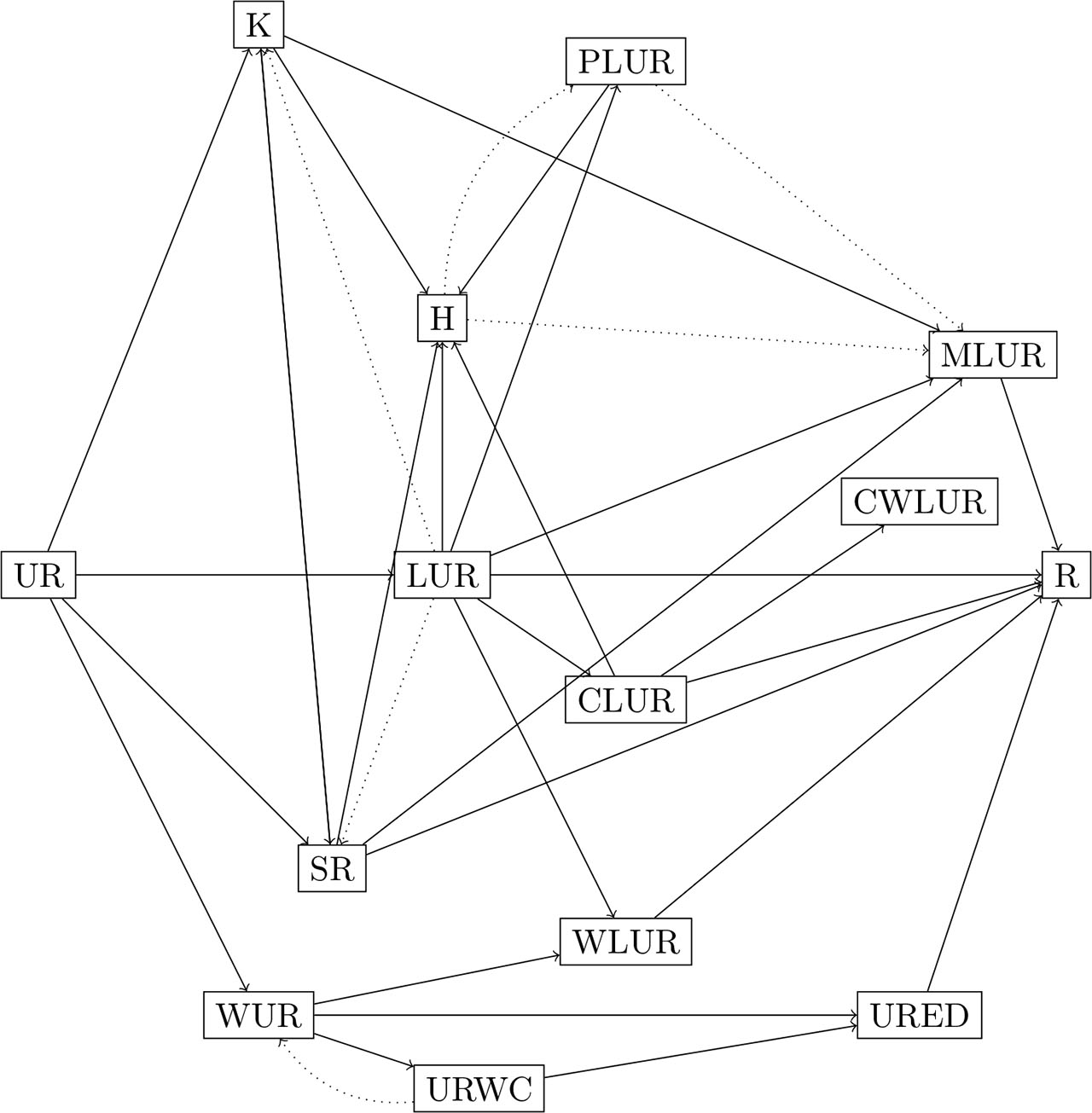
Figure 1.
Implications among various rotund properties
Efimov–Stechkin property (CD) was introduced and discussed by Singer in [86], where it was proved (see [69, pp. 468–479]) that every strongly convex Banach space has the Efimov–Stechkin property, that is, (K) ⇒ (CD), every normed linear space with the Efimov–Stechkin property has the Radon-Riesz property, that is, (CD) ⇒ (H), (CD) ⇔ (Rf) + (H), but (CD) ⇏ (R). However (see [69, p. 479]), a normed linear space is a strongly convex Banach space if and only if it is rotund and has the Efimov–Stechkin property, that is, for Banach spaces, (K) ⇔ (R) + (CD). It is known (see [70, pp. 394–395]) that (CLUR) ⇒ (H), (D) ⇔ (CD) + (R).
It was proved in [57] that a nearly uniformly rotund space need not be uniformly rotund, that is, (NUR) ⇏ (UR). Guiaro and Montesinos [49] proved that (NSR) ⇒ (H) and it was shown by Gupta and Narang [50] that converse is not true, that is, (H) ⇏ (NSR). However (see [50]), a Banach space X is reflexive and has property (H) if and only if X is reflexive and is (NSR), that is, (Rf) + (H) ⇔ (Rf) + (NSR). Moreover, it was shown in [50] that (MLUR) ⇏ (NSR), (ALUR) ⇏ (LUR), for Banach spaces, (SR) ⇔ (ALUR) and (CLUR) ⇒ (NSR).
The relationships shown in Figure 2 follow from the results given by Bandyopadhyay et al. [14], Guirao and Montesinos [49], Panda and Kapoor [77], Smith [91], Wu and Li [105]. Although these papers are silent about the implications (SR) ⇒ (LUR), (NSR) ⇒ (SR), property (H) ⇏ (NSR), but they do show that none of the other implications shown in the figure can be reversed. However, it was shown by Gupta and Narang [50] that these implications too do not hold, that is, (SR) ⇏ (LUR), (NSR) ⇏ (SR), property (H) ⇏ (NSR) and therefore, none of the implications shown in Figure 2 can be reversed.
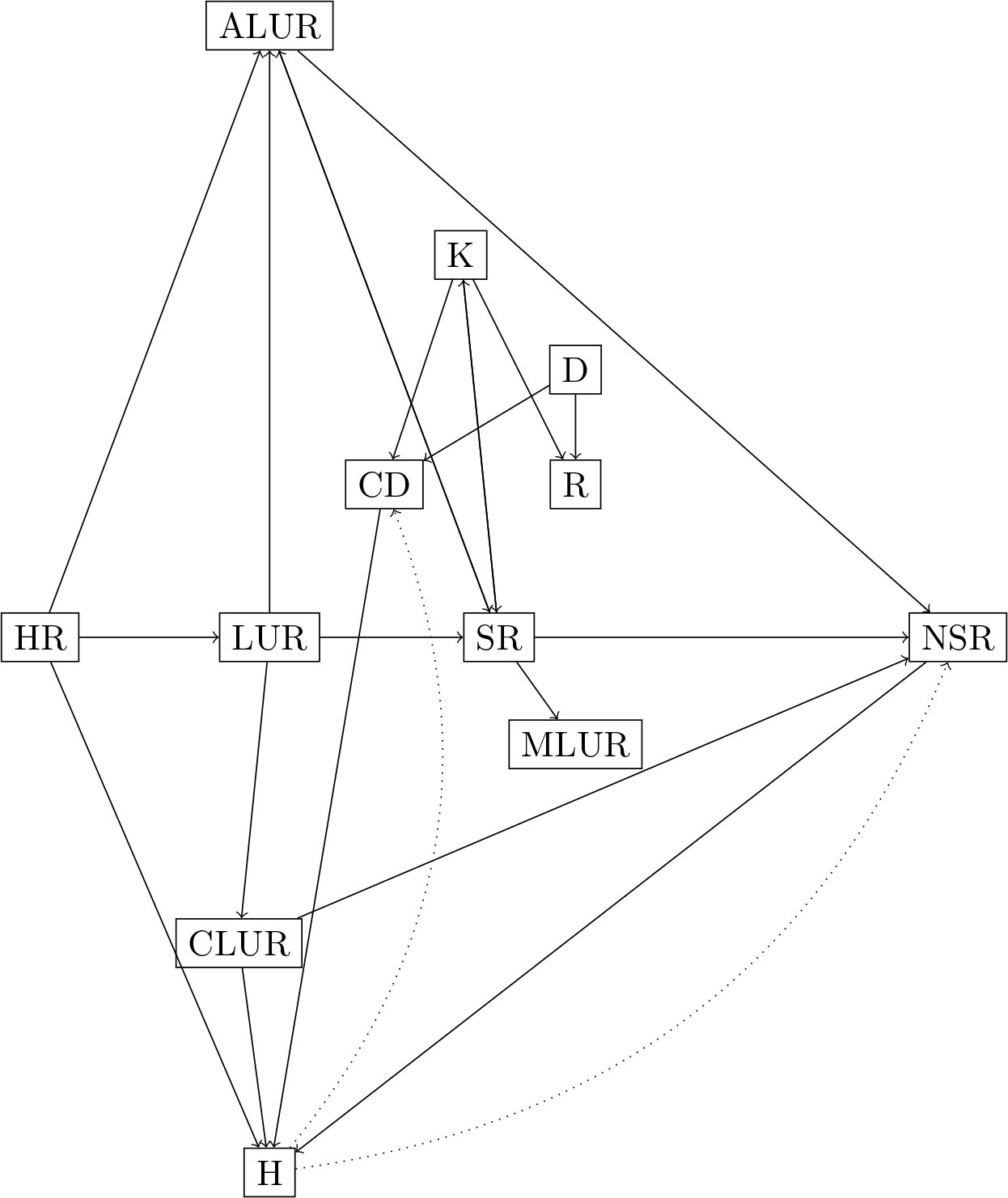
Figure 2.
Implications among various rotund properties in Banach spaces
The property (2R) was first considered by Smulian [93]. Fan and Glickberg [42, 43] made extensive investigations of (2R) property and its several generalizations. In [43], they raised the question of whether (LUR) is a consequence of (2R) or its generalizations. It was shown in [43] that a number of weaker properties than (2R) implies an analogous weakening of (LUR). A converse question was posed by Milman [71] and answered by Smith [94] who gave an example of a reflexive (LUR) space which is not (2R) and so, (LUR) ⇏ (2R). Polak and Sims [81] gave an example of a (2R) space which is not (LUR). They showed that the space l2 with the equivalent norm
is (2R) but not (LUR), since while ‖e1 − en‖ → 2. This space was used by Smith [90, 91] as an example of a rotund, indeed uniformly rotund in every direction space which is not (WLUR) or (URWC). An l2-sum of this space with the space of Smith [91] provides (see [81]) an example of a reflexive rotund space which is neither (LUR) nor (2R). Thus (2R) ⇏ (LUR), (UR) ⇏ (WLUR), (UR) ⇏ (URWC), (R) ⇏ (LUR), and (R) ⇏ (2R). However (see [69, pp. 477–478]), (2R) ⇒ (R), (WUR) ⇒ (URWC) ⇒ (R), (Rf) + (WUR) ⇔ (Rf) + (URWC), (URWC) ⇒ (URED), (WUR) ⇒ (URED) ⇒ (R).Sullivan [97] showed that if a Banach space is (kUR) for some k, then it is ((k + 1)UR) and remarked that it is not hard to construct examples of spaces which are (kUR) but not ((k − 1)UR). Moreover, if X is (UR), then X is (2UR), locally (1UR) is just the same as (LUR), (1UR) space is rotund, that is, (1UR) ⇒ (R), (2UR) space is reflexive but (2UR) space need not be rotund, that is, (2UR) ⇏ (R). Lin and Tai [66] proved that a rotund space which is also (kUR) is ((k + 1)R), but a (2R) space need not be (kUR) for all k ≥ 1, (2R) space need not be (LUR), ((k + 1)R) space need not be (kR). Moreover, for each k ≥ 2, there exists a rotund Banach space which is (kUR) but is not fully k-convex. Therefore, (R)+(kUR) ⇒ ((k+1)R), (2R) ⇏ (kUR) for all k ≥ 1, (2R) ⇏ (LUR), ((k + 1)R) ⇏ (kR), (R) + (kUR) ⇏ (kR) for k ≥ 2. However, (UR) spaces are fully 2-convex [42], (kUR) or fully k-convex spaces are reflexive [66].
Fan and Glickberg [42] showed that if X is (UR), then X is (kR) for any k ≥ 2 but the converse is false. Thus (UR) ⇒ (kR) but (kR) ⇏ (UR), k ≥ 2. They also proved that (kR) ⇒ ((k + 1)R), and (WkR) ⇒ (W (k + 1)R) for k ≥ 2.
Bae and Choi [12] proved that Istrăţescu [55] notion of k-uniform (k-locally uniform) rotundity of a Banach space is actually equivalent to the notion of uniform (locally uniform) rotundity, that is, (kUR) ⇔ (UR) and (kLUR) ⇔ (LUR) for k ≥ 2. These relationships are summarized in Figure 3.
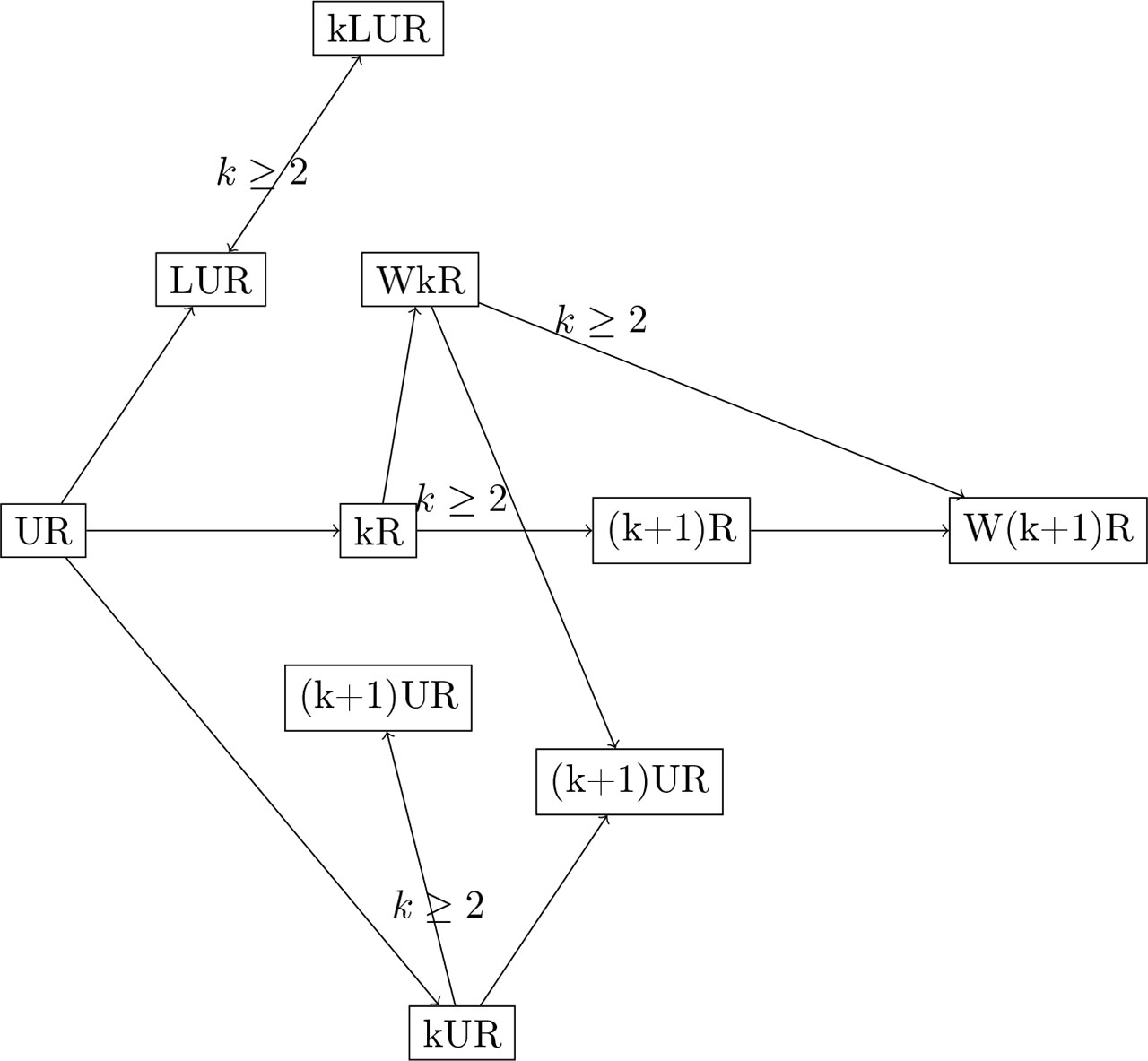
Figure 3.
Implications among various k-rotund properties
4. Product spaces, quotient spaces and subspaces
In this section, we consider the following questions:
(i) To what extent does the geometry of the factor spaces influence the geometry of the product space and
(ii) to what extent is the geometry of the space inherited by its quotient space and subspaces?
Concerning the product of uniformly rotund spaces, Clarkson [21] proved the following:
Theorem 4.1.
The uniformly convex product of a finite number of uniformly rotund Banach spaces is uniformly rotund.
Concerning the product of locally uniformly rotund spaces, Lovaglia [67] proved the following:
Theorem 4.2.
The locally uniformly convex product of locally uniformly rotund spaces is locally uniformly rotund.
Lovaglia [67] remarked that such a result does not hold for uniformly rotund Banach spaces. However, Day [26] showed that such a result is possible if all the factor spaces have a common modulus of uniform rotundity. Fan and Glickberg [42] proved analogous result for product of (kR) spaces, Anderson [8] for product of (MLUR) spaces and Day [25] for the product of (R) spaces. Such a result is true (see Cudia [23]) for the product of (H) spaces.
The following question was raised by Day ([30, p. 148]):
Smith [89] answered this question in negative. However, the following positive result was proved by him in this paper.Is the product of a collection of (URED) Banach spaces over a (URED) Banach space still (URED)?
Theorem 4.3.
The product space PxBs is URED if each Bs and X is URED and X contains no closed sublattice order isomorphic to l∞.
Suppose L is a closed linear subspace of a normed linear space B, the quotient space B/L with the norm ‖x + L‖ = inf{‖x + y‖ : y ∈ L} is a normed linear space.
Let us discuss the question:
To what extent are rotundity or uniform rotundity inherited by the quotient spaces?
If L is a closed linear subspace of a rotund space X then X/L need not be rotund (see [69, p. 437]), but if X is (UR) then X/L is (UR) (see [69, p. 455]).
Day [28] showed that a Banach space B is (UR) if and only if there is a common modulus of uniform rotundity for all the quotient spaces of B, or if and only if there is a common modulus of uniform rotundity for all the two-dimensional quotient spaces of B. Concerning the rotundity, Day [28] observed that a sufficient condition for rotundity of B is the rotundity of every two-dimensional quotient space of B. It was further shown that this is not a necessary condition for rotundity. However (see Cudia [23]), in case the two-dimensional subspaces have a common modulus of uniform rotundity, then these conditions are equivalent since then B is (UR) and hence reflexive. Clearly, if B is (UR), then the subspaces of B have a common modulus of uniform rotundity. Klee [60] showed that if L is a reflexive subspace of B, then the rotundity of B is transmitted to the quotient space B/L and that, in general, no more can be expected. However (see [69, p. 441]), it is now known that if L is proximinal (every reflexive subspace is proximinal), then B/L is rotund.
It is easy to see (see [69, p. 436]) that a normed linear space is rotund or uniformly rotund if and only if each of its subspaces is so. Moreover (see [69, p. 436]), a normed space is rotund if and only if each of its two-dimensional spaces is rotund.
Although (URED) is inherited by all the subspaces, it need not be inherited by the factor spaces of (URED) spaces (see [31]).
5. Applications in approximation theory
Uniform rotundity and its weaker forms have played a vital role in many branches of mathematics. To name a few, they have been very useful in the geometry of Banach spaces, the theory of linear operators, fixed point theory, approximation theory and many others (see, for example, [7, 20, 23, 30, 41, 48, 53, 69, 87]).
In this section, we briefly survey those results in some of the branches of approximation theory that have a direct bearing on rotundity and its weaker forms.
5.1. Applications in theory of best approximation
In the theory of best approximation, which is one of the main branches of approximation theory, it is sometimes important to know if a Banach space X has the property that whenever x ∈ X and {xn} is a minimizing sequence for x in a closed convex subset M of X, then {xn} converges. It is known (see [69, p. 459]) that for a Banach space X to have this property, it is necessary that X is rotund and sufficient that X is uniformly rotund. However, it is known (see [69, p. 459]) that there are rotund Banach spaces lacking this property and Banach spaces that have this property without being uniformly rotund. Thus, this property can be viewed as a strong form of rotundity that lies properly between rotundity and uniform rotundity. Many other properties lying properly between rotundity and uniform rotundity which have been defined in this paper, and this property are also directly linked to the theory of best approximation. We survey the available literature on all these aspects.
In normed linear spaces, there is a strong connection between the rotundity of the space and uniqueness of the best approximation. Day [25] proved that each non-empty closed convex subset of a rotund and reflexive normed linear space is Chebyshev. It is known (see [69, p. 436]) that if a normed linear space is reflexive, then each of its non-empty closed convex subset is proximinal and a normed linear space is reflexive if every non-empty closed convex subset is proximinal (James Theorem). We have the following Day-James Theorem (see [69, p. 436]):
Theorem 5.1.
A normed linear space X is rotund and reflexive if and only if each non-empty closed convex subset of X is Chebyshev.
H. Buseman [18] characterized rotund finite-dimensional Banach spaces as those in which every closed convex set is Chebyshev. The reverse inclusion characterizes finite-dimensional Banach spaces, which are smooth and rotund. Thus, the class of Chebyshev sets coincides with the class of closed convex sets in a finite-dimensional Banach space if and only if the space is smooth and rotund. Extending the result of Buseman, Klee [61] proved that in a finite dimensional Banach space each Chebyshev set is a sun (in a smooth space it is convex).
Recalling that the rotund spaces are those whose unit spheres contain no line segments, one obtains (see [23]) that rotund spaces are precisely those in which every one-dimensional subspace is a Chebyshev set. For infinite-dimensional rotund normed linear spaces, Klee [59] proved the following:
Theorem 5.2.
(i) If M is a boundedly weakly compact or locally weakly compact closed convex subset of a rotund space X, then M is Chebyshev.
(ii) A Chebyshev convex subset of a rotund space is a sun.
(iii) A boundedly compact Chebyshev subset of a smooth reflexive rotund space having property (P) is convex.
In best approximation, it is useful to know when a Banach space is strongly convex as this notion is closely related to the notion of minimizing sequences and approximative compactness of sets. These relationships are evident from the following theorem proved by Fan and Glickberg [43] (see also [69, p. 470]).
Theorem 5.3.
(a) A normed linear space X is strongly convex if and only if whenever M is a nonempty convex subset of X and {yn} is a minimizing sequence in M with respect to some x ∈ X, then the sequence {yn} is Cauchy.
(b) Suppose X is a Banach space. Then the following are equivalent:
(i) X is strongly convex;
(ii) whenever M is a non-empty convex subset of X and {yn} is a minimizing sequence in M with respect to some x ∈ X, then {yn} converges;
(iii) whenever M is a non-empty closed convex subset of X and {yn} is a minimizing sequence in M with respect to some x ∈ X, then {yn} converges to an element of M;
(iv) every non-empty closed convex subset of X is approximatively compact Chebyshev set, that is, it is strongly Chebyshev.
R.R. Phelps [80] proved the following for rotund spaces:
Theorem 5.4.
If M is a Chebyshev subset of rotund space X and the metric projection PM is non-expansive, that is,
for all x, y ∈ X, then the set M is convex.Since every uniformly rotund space is rotund (see [69, p. 447]) and every uniformly rotund Banach space is reflexive (Milman–Pettis Theorem – see [69, p. 452]), Theorem 5.1 implies that every closed convex subset of a uniformly rotund Banach space is a Chebyshev set. For uniformly rotund spaces, Klee [60] proved the following:
Theorem 5.5.
If X is a uniformly rotund normed linear space whose norm is uniformly Gâteaux differentiable, then a subset M of X is closed and convex if and only if M is a weakly closed Chebyshev set.
For weakly closed Chebyshev sets, Klee [60] proved:
Theorem 5.6.
In a uniformly rotund and uniformly smooth Banach space, every weakly closed Chebyshev set is convex.
Efimov and Stechkin [40] proved the following:
Theorem 5.7.
(i) In a uniformly rotund Banach space, every weakly sequentially closed set is approximatively compact.
(ii) In a uniformly rotund Banach space X, an approximatively compact set M is a sun if and only if M is Chebyshev.
(iii) In a uniformly rotund smooth Banach space X, a Chebyshev set M is convex if and only if M is approximaively compact.
S.B. Stechkin [96] showed that if M is a non-empty subset of a rotund space X, x0 ∈ X\M and z0 ∈ PM (x0), then PM (x) = {z0} for every x in the interval [z0, x0). The following characterizations of rotund spaces were given by him in [96]:
Theorem 5.8.
(i) A Banach space X is rotund if and only if each subspace of X is semi-Chebyshev.
(ii) A Banach space X is rotund if and only if each convex subset of X is semi-Chebyshev.
(iii) A normed linear space X is rotund if and only if for every subset M of X, the set Q(M) = {x ∈ X : PM (x) contains at most one element} is dense in X.
Stechkin [96] also showed that in a rotund Banach space, the set Q(M) is a set of second category in X if M is relatively boundedly compact and is of Gδ- type if M is also closed. Stechkin raised the following questions in [96]:
Suppose that a Banach space X has the property that the set Q(M) is dense in X for every subset M of X, or the set Q(M) is of second category in X for every compact subset M of X, then must X be rotund?
Stechkin [96] also proved the following:
Theorem 5.9.
(i) Let X be a locally uniformly rotund Banach space. Then, the set Q(M) is of second category in X for every subset M of X.
(ii) Let X be a uniformly rotund Banach space and M be a closed subset of X. Then the set Q1(M) = {x ∈ X : PM (x) is exactly a singleton} is a set of second category in X.
As a consequence of Theorem 5.9(ii), we obtain (see [22]) the following:
Theorem 5.10.
If X is a uniformly rotund Banach space, then for every non-empty closed subset M of X, the complement of the set of all x ∈ X for which the problem min(x, M) is well posed, is of first Baire category.
The following results were proved by Singer [86] and by Konyagin and Tsarkov (see [22]):
Theorem 5.11.
(i) If X is a reflexive Banach space with property (H) and M is a Chebyshev subspace of X, then the metric projection PM is continuous.
(ii) For a Banach space X, the following conditions are equivalent:
(a) X is a reflexive Banach space with property (H),
(b) every non-empty closed convex subset of X is approximatively compact,
(c) every weakly sequentially closed subset of X is approximatively compact,
(d) every weakly closed subset of X is approximatively compact,
(e) every weakly sequentially closed subset is proximinal with lower semi-continuous metric projection,
(f) every weakly closed set is proximinal with lower semi-continuous metric projection,
(g) every closed convex set is proximinal with lower semi-continuous metric projection.
L.P. Vlasov [100] extended parts of Theorem 5.7 (ii),(iii) and proved the following:
Theorem 5.12.
In a locally uniformly rotund Banach space, every approximatively compact Chebyshev set is a sun, and if the space is also smooth, then the set is convex.
In 1968, Vlasov [101] proved the following:
Theorem 5.13.
In a smooth uniformly rotund Banach space, every locally compact Chebyshev set is convex.
The following result was proved by Edelstein [38]:
Theorem 5.14.
If M is a non-empty closed subset of a uniformly rotund Banach space X, then the set P (M) of all points x ∈ X for which there is a point m ∈ M such that d(x, m) = d(x, M) is dense in X.
D.E. Wulbert [106] proved the following:
Theorem 5.15.
(i) A closed subset of a uniformly rotund Banach space X is convex if and only if it is boundedly connected in every equivalent uniformly rotund norm topology on X.
(ii) A closed subset of a uniformly rotund Banach space X is convex if and only if in every equivalent uniformly rotund topology on X, it is a Chebyshev set which admits a continuous metric projection.
(iii) A compact subset of a rotund Banach space X is convex if and only if it is a Chebyshev set in every equivalent rotund norm topology on X.
Blatter et al. [16] proved the following:
Theorem 5.16.
If M is a proximinal subset of a rotund normed linear space X and the metric projection map PM is continuous, then M is Chebyshev. Further, if X is a rotund smooth Banach space and M is a boundedly compact subset of X, then the following are equivalent:
(i) PM is continuous;
(ii) M is Chebyshev;
(iii) M is convex.
Since every locally uniformly rotund space is rotund, and every approximatively compact subset of a metric space is proximinal, Blatter [15] obtained the following:
Theorem 5.17.
(i) Let M be a proximinal subset of an (LUR) smooth Banach space X. If the metric projection PM is lower semi-continuous, then M is convex.
(ii) Let M be a non-empty subset of an (LUR) smooth reflexive Banach space X, then the following are equivalent:
(a) M is approximatively compact uniquely proximinal subset of X;
(b) M is uniquely proximinal and PM is continuous;
(c) M is proximinal and PM is lower semi-continuous;
(d) M is convex uniquely proximinal subset of X.
The following characterizations of rotund spaces are given in Singer ([87, p. 110]):
Theorem 5.18.
Let X be a normed linear space. Then the following statements are equivalent:
(i) all linear subspaces of X are semi Chebyshev;
(ii) all linear subspaces of X of certain fixed dimension n (1 ≤ n ≤ dim X−1) are semi Chebyshev;
(iii) all linear subspaces of X of certain fixed codimension m (1 ≤ m ≤ dim X − 1) are semi Chebyshev;
(iv) X is rotund.
The implications (iv) ⇒ (ii) (hence in particular (iv) ⇒ (i) as well as (iv) ⇒ (iii)) are well known (see [1, Chapter I, Section 11]; these have been given essentially, by M.G. Krein). Similar characterizations of (kR) spaces are also given in Singer ([87, p. 130]).
Bosco and Franco [32] discussed k-semi-Chebyshev subspaces and showed the following known general result for (kR) spaces:
A normed linear space X is rotund if and only if every subspace Y of X is semi-Chebyshev.
The following characterizations of reflexive rotund Banach spaces are also given in Singer ([87, p. 111]):
Theorem 5.19.
Let X be a Banach space. Then the following statements are equivalent:
(i) all closed linear subspaces of X are Chebyshev;
(ii) all closed linear subspaces of X of certain fixed dimension m (1 ≤ m ≤ dim X − 1) are Chebyshev;
(iii) X is reflexive and rotund.
The implication (iii)⇒ (i) has been given by Day ([30], p. 316). The equivalence (i) ⇔ (iii) was noted by Cudia [23].
Ivan Singer ([87, p. 369]) made the following remarks:
For a set M in a smooth and uniformly rotund Banach space X, the following statements are equivalent:
(i) M is closed and convex;
(ii) M is weakly closed Chebyshev set;
(iii) M is approximatively compact Chebyshev set.
E.V. Oshman [75] extended Theorem 5.7 (iii) and proved the following:
Theorem 5.20.
If M is a Chebyshev set in a smooth (CLUR) Banach space X, then the following statements are equivalent:
(i) M is convex;
(ii) M is approximatively compact;
(iii) the metric projection PM is continuous.
Amir and Deutsch [6] introduced the notion of moon in normed linear spaces and showed that:
(i) every sun is a moon,
(ii) the unit sphere S(X) of a normed linear space X is not a sun, but it is a moon if the space X is rotund.
Further, they gave the following characterization of rotund spaces:
Theorem 5.21.
Let X be a two-dimensional normed linear space. Then S(X) is a moon if and only if X is rotund.
The following results are given in [102]:
Theorem 5.22.
(a) If in a rotund space X, each Chebyshev sun having a continuous metric projection is convex, then X is smooth.
(b) In an (LUR) Banach space, a Chebyshev set with a continuous metric projection is a sun.
(c) In a uniformly rotund smooth Banach space, each locally compact or boundedly compact Chebyshev set is convex.
(d) The following conditions on a Banach space X are equivalent:
(i) X is smooth and satisfies property (D);
(ii) the class of approximatively compact Chebyshev sets coincides with the class of closed convex sets;
(iii) the class of Chebyshev sets with continuous metric projection coincides with the class of closed convex sets.
Brosowski and Deutsch [17] observed that in a rotund space, every proximinal sun is a Chebyshev set. They extended Theorem 5.16 of Blatter et al. [16] and proved the following:
Theorem 5.23.
(a) If M is a proximinal subset of a rotund normed linear space X, then metric projection PM is inner radially lower (IRL) continuous if and only if M is Chebyshev.
(b) If M is a boundedly compact subset of a rotund smooth Banach space X, then the following are equivalent:
(i) PM is lower semi-continuous;
(ii) PM is (IRL) continuous;
(iii) M is Chebyshev;
(iv) M is convex;
(v) PM is convex valued;
(vi) M is a sun.
Ivan Singer [86] proved that if M is an approximatively compact Chebyshev set in a metric space (X, d), then the metric projection PM is continuous. In general, the continuity of PM supported by a Chebyshev set M does not imply that the set is approximatively compact. Panda and Kapoor [76] showed that it is so in a large class of Banach spaces including (LUR) spaces. The results proved in [76] are:
Theorem 5.24.
(i) Let M be a Chebyshev subset of a (CLUR) normed linear space X. Then M is approximatively compact if and only if the metric projection PM is continuous.
(ii) If M is a proximinal sun in a (CLUR) space X, then
(a) M is approximatively compact;
(b) PM is upper semi-continuous on X.
(iii) If M is a Chebyshev set in a (CLUR) space X, then PM is continuous on a subset dense in X.
(iv) If M is either
(a) a closed subset of an (UR) Banach space, or
(b) a proximinal subset of a (LUR) Banach space,
P.S. Kenderov [58] proved the following:
Theorem 5.25.
(a) If M is a proximinal subset of a rotund Banach space X and the metric projection PM is upper semi-continuous, then PM is single-valued on a residual subset of X.
(b) If M is a weakly closed subset of a reflexive rotund Banach space X, then the metric projection PM is single-valued on a residual subset of X.
Remark 5.1.
As a consequence of Theorem 5.25(a), we obtain the following result proved by Stechkin [96]:
If M is a boundedly compact subset of a rotund Banach space X, then PM is single-valued on a residual subset of X.
Theorem 5.25(b) answers partially a question of Vlasov [102]:
Whether every metric projection PM defined by a closed subset M of a rotund reflexive space X is single-valued on a residual subset of X?
Theorem 5.25 (b) says that it is so if M is weakly closed.
Ka-Sing Lau [65] proved the following for U-spaces (every U-space is reflexive [65]).
Lau in [65] remarked that it is not known whether this result is true in (LUR) reflexive spaces. However, Lau in [64] proved that this is true.
Stechkin [96] asked whether Theorem 5.9(ii) and so Theorem 5.10, hold in locally uniformly rotund spaces.
Edelstein [39] gave an example to show that these results do not hold in rotund reflexive Banach spaces. However, Lau [64] proved that these results hold in reflexive locally uniformly rotund spaces.
Theorem 5.27 ([64]).
If X is a reflexive Banach space satisfying property (H), then every closed subset of X is almost proximinal.
Since (LUR) spaces satisfy property (H), Lau [65] obtained:
Francis Sullivan [95] proved the following:
Theorem 5.28.
If M is a Chebyshev subspace of a locally (2UR) space X, then the metric projection PM is continuous.
F. Deutsch and J.M. Lambert [33] showed that the main results of Panda and Kapoor [68] in (CLUR) spaces can be extended to the setting of proximinal (rather than Chebyshev) sets and outer radially lower semi-continuous (rather than continuous) metric projections. The result proved in [33] is:
Theorem 5.29 ([33]).
Let M be proximinal subset of a (CLUR) space X. If the metric projection PM is outer radial lower semi-continuous (orlsc) and PM is compact valued, then M is approximatively compact.
Panda and Kappor [76] proved this result in a special case when M is Chebyshev set with a continuous metric projection.
Since every approximatively compact Chebyshev set has a continuous metric projection (see [86]), we obtain:
Theorem 5.30 ([33]).
Let M be Chebyshev subset of a (CLUR) space. Then the following are equivalent:
(i) M is approximatively comapct;
(ii) PM is continuous;
(iii) PM is orlsc.
Theorem 5.31 ([33]).
Let M be proximinal subset of a (CLUR) space X, x ∈ X, y ∈ PM (x), 0 < λ < 1 and z = λx + (1 − λ)y. Then:
(i) every minimizing sequence for z has a convergent subsequence;
(ii) PM is upper semi-continuous at z;
(iii) PM is compact.
In particular, there is a dense subset of X on which PM is upper semi-continuous and compact valued.
Corollary 5.2 ([76]).
If X is a (CLUR) space, then the metric projection onto each Chebyshev set is continuous on a dense subset of X.
Remark 5.2 ([33]).
It is not known whether the converse of Theorem 5.29 is valid. However, Theorem 5.30 shows that the converse is valid for Chebyshev sets.
It is natural to ask whether an approximation theoretic characterization of (CLUR) spaces exists. For example, are there spaces characterized by the property that the class of approximatively compact sets coincides with the class of proximinal sets having upper semi-continuity (or orlsc) and compact valued metric projections?
Acknowledging a correspondence with L.P. Vlasov, Deutsch and Lambert in [33] remarked that if in Theorem 5.29, one strengthens the orlsc of PM to outer radial lower continuity, we obtain the following result:
In a complete (CLUR) space, every proximinal set with an outer radial lower continuous metric projection is approximatively compact. (Notice that one now need not have PM to be a compact-valued map.)
Vlasov also attributes Corollary 5.3 to Oshman [75] and not to Panda and Kapoor [76].
Fitzpatrick [44] proved the following:
Theorem 5.32.
(a) If M is a closed subset of a rotund Banach space X, then M is semi-Chebyshev if the distance function Φ is Gâteaux differentiable at each x ∈ X.
(b) If M is a closed subset of a smooth (LUR) reflexive Banach space X and distance function Φ is Fréchet differentiable at each x ∈ X\M, then M is convex.
Zhivkov [109] proved the following results (which were announced by him in [108]):
Theorem 5.33.
(a) If M is an approximatively compact subset of a rotund Banach space X, then the metric projection PM is single-valued on a dense Gδ set.
(b) If M is a subset of a rotund Banach space X, and PM is upper semi-continuous at every point x ∈ X where PM (x) is a singleton, then the set A = {x ∈ X : PM (x) = ∅ or PM (x) is upper semi-continuous at x and PM (x) = {y}} is a residual subset of X.
(c) If M is a subset of a (LUR) Banach space, then the set A as defined in (b) is a residual subset of X.
For (LUR) spaces, Astaneh [10] proved the following:
Theorem 5.34.
If M is a proximinal subset of a (LUR) space X, then PM is both single-valued and upper semi-continuous on a dense subset of X.
A.A. Astaneh [10] gave the following characterization of rotund spaces:
Theorem 5.35.
A normed space X is rotund if and only if the set Q(X) = {x ∈ X : ‖x‖ ≥ 1} is a Chebyshev set with respect to X ∼ {0}.
The following characterization of rotund spaces has been proved in [82]:
Using this characterization, the following known result was proved in [82]:
Corollary 5.4.
If M is a non-empty closed convex subset of a reflexive and (R) normed linear space, then M is Chebyshev.
Astaneh also proved that if the space is (LUR), then Q(X) is a Chebyshev set with respect to X ∼ {0} and each minimizing sequence in Q(X) for every non-zero x in the interior of the unit sphere U(X), converges to the nearest point of Q(X) to x. If X is (CLUR), then each minimizing sequence for nonzero x ∈ U0(X) has a convergent subsequence.
Megginson proved that (MLUR) spaces also have a characterization (see [69, p. 474]) in terms of approximative compactness analogous to (i) ⇔ (iv) of Theorem 5.3 (b).
Theorem 5.37.
A normed linear space X is (MLUR) if and only if every closed ball in X is an approximatively compact Chebyshev set, that is, if and only if it is strongly Chebyshev.
Dutta and Shunmugraj [35] proved the following:
Theorem 5.38.
A Banach space X is reflexive and has property (H) if and only if every closed convex subset of X is approximatively compact.
For non-reflexive Banach spaces, Guirao and Montesinos [49] proved the following:
Theorem 5.39.
A non-reflexive Banach space X is (NSR) if and only if every proximinal convex subset of X is approximatively compact.
Gupta and Narang [50] proved the following:
Theorem 5.40.
(a) A non-reflexive Banach space X is (NSR) if and only if every proximinal convex subset of X is strongly Chebyshev.
(b) Every proximinal convex subset of a (CLUR) Banach space is approximatively compact.
(c) If M is a closed convex subset of a Banach space X having property (H) (and so if X is a (CLUR) Banach space), then the following are equivalent:
(i) M is proximinal;
(ii) M is weakly approximatively compact;
(iii) M is approximatively compact.
Since for a closed convex subset of a (LUR) Banach space, a best approximation, if it exists, is always unique, we obtain:
Corollary 5.5.
If M is a closed convex subset of a (LUR) Banach space X, then the following are equivalent:
(i) M is Chebyshev;
(ii) M is weakly approximatively compact;
(iii) M is approximatively compact;
(iv) M is strongly Chebyshev.
Revalski and Zhikov [83] have discussed some best approximation problems in compactly locally uniformly rotund and in compactly uniformly rotund Banach spaces.
5.2. Applications in theory of farthest points
Uniform rotundity and its weaker forms have also played a very important role in another branch of approximation theory, known as the theory of farthest points. We briefly survey some known results in this theory.
Analogous to Theorem 5.14 in the theory of best approximation, the following result was proved by Edelstein [37]:
Theorem 5.41.
If K is a non-empty closed bounded subset of a uniformly rotund Banach space X, then the set S of all those points x in X for which there is a farthest point y ∈ K, that is, d(x, y) = δ(x, K) is dense in X.
E. Asplund [9] extended this result and proved the following:
Theorem 5.42.
If K is a non-empty closed bounded subset of a reflexive locally uniformly rotund Banach space X, then the set S of all those points x in X for which there is a farthest point in K contains a dense Gδ subset of X.
Ka-Sing Lau [63] proved this result for bounded weakly closed sets. Lau also introduced a dense Gδ-set D(K) for a non-empty closed bounded set K, and obtained a further generalization of Asplund’s result. Miyajima and Wada [72] also investigated the dense Gδ-set D(K) and discussed some results on the uniqueness of farthest points.
From the definition of local uniform rotundity, it is obvious that every maximizing sequence in unit ball B = {x ∈ X : ‖x‖ ≤ 1} of a normed linear space X, for an element x ∈ X with ‖x‖ = 1 is compact in B. The question is whether B is M-compact. The following theorem of Panda and Kapoor [78] answers this question:
Theorem 5.43.
Let X be a reflexive (LUR) Banach space. If 0 ≠ x0 ∈ X, then every maximizing sequence {xn} in B for x, is compact in B.
The following results were proved by Panda and Kapoor [78]:
Theorem 5.44.
(i) Let X be a reflexive (LUR) Banach space and K be a bounded closed subset of X. If the farthest point map FK is Fréchet differentiable in closure convex hull of K, then K is a singleton.
(ii) Let X be a reflexive (LUR) strongly smooth Banach space, and K be a uniquely remotal subset of X. If x0 ∈ X is a point of continuity of the farthest point map FK, then every maximizing sequence in K for x0 is compact.
Using Theorem 5.42, Panda and Kapoor [78] proved the following:
Theorem 5.45.
Let X be a reflexive (LUR) Banach space and K be any bounded closed subset of X. Then there exists a subset G dense in X such that
(i) if x ∈ G, then every maximizing sequence for x is compact in K;
(ii) the farthest map FK : G → K is single-valued and continuous.
Corollary 5.6.
Let K be any set having a unique farthest-point property in a reflexive (LUR) Banach space X. Then the farthest-point map is continuous on a dense subset of X.
Astaneh [10] remarked that this result is true for (CLUR) normed linear spaces.
The following extension of Theorem 5.42 of Asplund was proved by Panda and Kapoor [79]:
Theorem 5.46.
If K is a bounded closed subset of a reflexive (CLUR) space X, then the set D of all points of X that admit a farthest point in K is dense in X and is of second category.
Panda and Kapoor [79] generalized and extended Theorem 5.45 and its Corollary 5.6, and proved the following:
Theorem 5.47.
(a) Let X be a reflexive (CLUR) Banach space, and K be a non-empty bounded closed subset of X. Then there exists a subset G dense in X such that
(i) if x ∈ G, then every maximizing sequence for x is compact in K;
(ii) the farthest-point map FK restricted to G is upper semi-continuous.
(b) Let X be a (LUR) Banach space and K be a uniquely remotal subset of X. Then
(i) if x0 ∈ X is a point of continuity of the farthest-point map FK, then every maximizing sequence in K for x converges to FK(x0);
(ii) the farthest-point map FK is continuous on a dense subset of X.
(c) Let X be a reflexive (LUR) Banach space and K be a bounded subset of X. If the farthest-point map FK is Fréchet differentiable in a neighbourhood Nx of x, then the restriction of the farthest-point map to Nx is single-valued and continuous.
Analogous to Theorem 5.32(a), Fitzpatrick [44] proved the following:
Theorem 5.48.
Suppose K is a bounded subset of a rotund Banach space X. If x is a point of Gâteaux differentiability of the distance function Ψ(x), then there is at most one farthest point in K to x.
Nikolai V. Zhivkov proved the following results in [109] (which were announced by him in [108]):
Theorem 5.49.
(a) If K is a bounded weakly compact subset of a rotund Banach space X, then the farthest-point map FK is single-valued on a residual subset of X.
(b) If K is an M-compact subset of a rotund space X, then the farthest-point map FK is single-valued on a Gδ- set.
(c) If K is a bounded subset of a rotund Banach space X and the farthest-point map FK is upper semi-continuous at every point x ∈ X where FK(x) is a singleton, then the set B = {x ∈ X : FK(x) = ∅ or FK is upper semi-continuous and FK(x) = {y}} is a residual subset of X.
(d) If K is a bounded subset of a (LUR) Banach space X, then the set B defined in (c) is residual in X.
(e) If X is a rotund Banach space which is weakly differentiable and M is a bounded subset of X, then the set B defined in (c) is residual in X.
Astaneh [10] gave the following characterizations of rotund, (CLUR) and (LUR) spaces:
Theorem 5.50.
(a) A normed linear space X is rotund if and only if the unit sphere U(X) of X is uniquely remotal with respect to X ∼ {0}.
(b) A normed linear space X is (CLUR) if and only if each maximizing sequence for every x ≠ 0, in U(X) has a convergent subsequence.
(c) A normed linear space X is (LUR) if and only if U(X) is uniquely remotal with respect to X ∼ {0} and each maximizing sequence for every x ≠ 0, in U(X) converges to a farthest point of x in U(X).
Using this theorem, the following improved form of Theorem 5.45 and its Corollary 5.6 was proved in [10]:
Theorem 5.51.
Let K be a remotal subset of a (LUR) normed linear space X. Then the farthest-point map FK is both single-valued and upper semi-continuous on a dense subset of X.
Deville and Zizler [34] proved the following:
Theorem 5.52.
Let K be a bounded closed subset of a rotund Banach space X such that the set D = {x ∈ X : x has a farthest point in K} is dense in X. Then the set E = {y ∈ X : y has a unique farthest point in K} is also dense in X.
Miyajima and Wada [72] gave the following characterizations of rotund spaces:
Theorem 5.53.
A normed linear space X is rotund
(i) if and only if for any bounded closed convex subset K of X, far(K) ⊂ ext(K);
(ii) if and only if for any compact convex subset K of X, far(K) ⊂ ext(K). (Here far(K) ≡ {x ∈ K : x is a farthest point in K for some point of X} and, ext(K) is the set of all extreme points of K).
Sain et al. [85] have proved that if A is a uniquely remotal subset of a rotund space X, then is also uniquely remotal.
It is still unknown whether the result holds in any normed linear space.
It is known that in a normed linear space, if A is M-compact, then is M-compact, but the converse is not true.
Sain et al. [85] showed that the converse holds if the space is rotund and the set A is uniquely remotal. They also gave an elementary proof of the well-known result that every uniquely remotal subset of a rotund finite dimensional normed linear space is a singleton.
Recently, Alimov [3] has proved some results on the solarity and stability properties of the farthest point map (also called max-projection operator) for max-approximation problems using uniform rotundity and local uniform rotundity.
5.3. Applications in Chebyshev centres
Uniform rotundity and its weaker forms have played a key role in the study of Chebyshev centres. We survey below some of the results on this topic.
The following result (see [53]) is well-known:
Theorem 5.54.
If X is a uniformly rotund Banach space, then every bounded subset of X has a unique Chebyshev centre. For rotund space X, every compact set in X has at most one Chebyshev centre.
For (UR) spaces, Amir [5] proved the following:
Theorem 5.55.
A Banach space X is (UR) if and only if for every bounded subset A of X, the set Z(A) is a singleton, and the map A → Z(A) is uniformly continuous.
Garkavi [46] proved the following:
Theorem 5.56.
A necessary and sufficient condition for every bounded subset of a normed linear space X to have at most one Chebyshev centre is that the space X is (URED).
Garkavi [46] has given some sufficient conditions for a normed linear space to admit centers. He has also established the fact that the uniform rotundity of the norm in every direction is a necessary and sufficient condition for a normed linear space to admit at most one center to every bounded subset.
Astaneh [11] proved that completeness of the space is a necessary condition for a normed linear space to admit centers. It is shown that in an incomplete (CLUR) space there is a bounded closed convex subset which is antiproximinal and antiremotal.
The following result on Chebyshev centres is well known (see [74]):
Theorem 5.57.
If X is a rotund reflexive Banach space (or rotund dual Banach space), then every convex remotal set A in X has a unique Chebyshev centre.
Since every nearly compact (compact) convex subset in a metric space is remotal, we obtain:
Corollary 5.7.
If A is a nearly compact (compact) convex subset of a reflexive rotund Banach space, then A has a unique Chebyshev centre.
Extending a part of Theorem 5.54, Narang and Gupta [74] proved the following:
Theorem 5.58.
If A is a remotal subset of a rotund space X, then the set Z(A) is at most a singleton.
Theorem 5.59 ([74]).
If A is a remotal subset of a rotund space X for which the farthest distance function ψ(x) attains its infimum on X, then Z(A) is exactly a singleton.
Sain et al. [84] proved the following results:
Theorem 5.60.
If A is a bounded centerable subset of a uniformly rotund Banach space and A contains its Chebyshev centre, then A is CCNF.
Theorem 5.61.
(i) If X is a two-dimensional real Banach space, then X is rotund if and only if every bounded set A which contains its Chebyshev centre is CCNF.
(ii) If X is a finite-dimensional Banach space, then X is rotund if and only if every bounded centerable subset A of X which contains its Chebyshev centre is CCNF.
(iii) If X is a Banach space, then X is rotund if and only if every bounded centerable nearly compact subset A of X which contains its Chebyshev centre is CCNF.
6. Conclusions
As can be seen, much work remains to be done on the inter-relationships and comparisons of different rotundities defined in Section 2, and on product spaces, subspaces and quotient spaces discussed in Section 4. There are some other weaker forms of uniform rotundity available in the literature, which we have not discussed in this article. One may refer to Chakraborty [19], Cheng et al. [20], Cudia [23], Day [30], Dutta and Shunmugaraj [36], Eshita and Takahashi [41], Gayathri and Thota [47], Huff [54], Istrăţescu [55], Klee [56], Konyagin [62], Megginson [68, 69], Mhaskar and Pai [70], Revalski and Zhikov [83], Vlasov [102], Zhao et al. [107] for other forms of rotundities as well as their characteristics and relationships.
We have seen in Section 5 that uniform rotundity and its weaker forms have played a vital role in the theory of best approximation, farthest point theory and in Chebyshev centres. We have not discussed their applications to other branches of approximation theory, viz. that of best co-approximation, best simultaneous approximation, strong proximinality of sets, relative Chebyshev centres, closest and minimal points, best proximity pairs, convexity of Chebyshev sets, solar properties of sets, characterization of those Banach spaces in which every Chebyshev set is convex, singletonness of uniquely remotal sets and many other branches. Many results have been proved in these branches using different rotundities. Moreover, applications of uniform rotundity and its weaker forms to other fields of Mathematics have not been discussed in this article. These will be discussed elsewhere.
This survey is an effort to provide an updated bibliography of available literature on the topics discussed in this article. The pressure of time and space forced the omission of many interesting results on this topic. We hope that this article might serve to motivate, inspire and benefit some of the next generation of mathematicians working in the area. The article may help them to tackle, and perhaps even solve, the long outstanding open problems of Approximation Theory, viz. the problem of convexity of Chebyshev sets (see [45]), characterization of those Banach spaces in which every Chebyshev set is convex (see [22]) and singletonness of uniquely remotal sets (see [22]).
The second author is thankful to the National Board of Higher Mathematics, Department of Atomic Energy, India, for the research grant 02011/11/2020/NBHM (RP)/R&DII/7830.