
1. INTRODUCTION
The growing of modern technology requires the creation of devices characterized by high durability and operational reliability. This applies particularly to machine components and assemblies manufactured for the aviation industry [1, 2]. Each newly designed component or assembly must undergo an appropriate set of simulation tests to be approved for further development stages related to its final application in aircraft structures. One of the important factors that may significantly disrupt or limit the functioning of aviation structure elements is the possibility for vibrations occurring of individual elements or assemblies [1, 3]. For economic reasons and the reliability of the results, it is advantageous to conduct simulation calculations using appropriate calculation procedures using dedicated commercial software [2, 3].
The rapid development of computer technology and computational systems based, among others, on the finite element method (FEM) allows for the analysis of vibrations of systems characterized by complex structure and geometry [1, 2, 4]. Publication [3] is one of the first scientific works that comprehensively discusses the issues of vibrations of gear wheels in aviation transmissions, taking into account simulation and experimental studies. In the FEM simulation models used in this work an axisymmetric approach is utilized. The books [1, 5] comprehensively discuss the issue of vibrations, taking into account the issues of vibration modeling and measurement, with the work [1] referring mainly to measurement techniques and the work [5] concerning the theory of vibrations of continuous systems, including circularly symmetric systems. In the work [2] the problem of vibrations of systems with circular symmetry (gears, rings with an elastic layer) was discussed using FEM simulation techniques and theoretical analysis. In the above work, only one case of a gear wheel was considered. The book publication [4] primarily discusses the issue of quality measures for developed FEM simulation models. This information was used, among others, in the work [6] to effectively develop a numerical FEM model of the shaft cover of an aircraft engine turbine for the purpose of vibration analysis. In paper [7] is proposed a mathematical model based on a physical neutral surface (PNS) for the natural vibrations analysis of functionally graded (FG) thin circular annular plates with a power-law distribution of material properties along the thickness and various boundary conditions. The proposed approach was numerically verified using FEM. In the paper [8] the issues of transverse vibration of gear wheel with geometric discontinuities in the form of through holes in the discs were discussed using FEM numerical methods. The discussed issues mainly concerned the proposed in the paper algorithm for determining the deformed mode shapes of transverse vibrations of the wheel. The article [9] also discusses gear vibration issues using simulation techniques similar to those in the previously mentioned work. The numerical analyses required in the mentioned paper were performed using full FEM models of discussed gear wheels.. In the works [10, 11, 12] the theoretical basis of the methodology for analyzing the vibration of systems characterized by cyclic symmetry properties was discussed. Among other things, paper [10] presents a method for analyzing the steady-state vibrations of cyclically symmetric bladed discs subjected to arbitrary loads distributed in space and periodic in time. The authors of [11] used the dynamic properties of cyclically symmetric structures to develop a method for detecting damage in the form of gaps and cracks. The proposed method utilizes an analysis of the sensitivity of natural frequencies to changes in the system's design parameters. Whereas, the PhD disertation [12] investigates the modal properties of general cyclically symmetric systems and multistage systems with cyclically symmetric stages, such as planetary gears, systems with centrifugal pendulum vibration absorbers (CPVAs), multistage planetary gears, etc. Methods are proposed to improve the computational efficiency for numerically solving the vibration equations of discussed cyclically symmetric structures. In the paper [13] the transverse vibrations of a circularly symmetric plate with complex geometry were discussed using the properties of cyclic symmetry and experimental studies. Similarly, in the work [14] the problem of transverse vibrations of a circularly symmetric plates with eccentric holes was analyzed using numerical simulation and experimental tests. In the proposed finite element (FE) models of the plates the observed properties of cyclic symmetry were utilized. The cyclic symmetry model proposed in the paper [13] represented one-sixth part of the whole plate, and each cyclic symmetry model in the article [14] represented one-fifth part of the each plate analyzed. Paper [15] discusses the rules governing the splitting or non-splitting of natural frequencies for any nodal diameter for an axisymmetric annular stepped plate with circumferentially uniformly spaced groups of mass blocks. The proposed analytical solutions were verified by numerical and experimental studies. In the paper [16] there is proposed an extension of the spectro-geo-metric method (SGM), which is addressed to the orthotropic vibration problem of rectangular plates, to analyze the free and forced vibrations of annular sector plates and annular plates subjected to general boundary constraints (including cyclic symmetry). The effectiveness of the methodology was confirmed by numerical simulations. In the works [17, 18] simplified FEM models were effectively used to analyze the problems of transverse vibrations of gears, in which, after omitting the meshing geometry, it was possible to use the properties of cyclic symmetry. The models with cyclic symmetry proposed in the article [17] constituted one sixth part of each analyzed wheel. Whereas the simplified FE models proposed in the work [18] referred to the cases of two spur gears with straight teeth. In the papers [19, 20] the static and dynamic issues of the strength of gears with an unusual tooth profile and the problems of determining the contact pattern area in gear meshing were discussed. The effectiveness of the proposed methodology has been confirmed by numerical simulations and experimental studies. Paper [21] analyzes the in-plane flexural vibrations of a periodic electric motor stator modeled by a circular ring with cyclically symmetric properties and taking into account magnetic phenomena. The proposed methodology was numerically verified using the finite element method. Article [22] proposes a method for solving the free vibration equation of rotationally repetitive structures, enabling the optimal design of cyclically symmetric structures with frequency constraints. The effectiveness of the proposed method was numerically verified on two large-scale axisymmetric objects. Much work concerns the use of cyclic symmetry properties in modeling turbine disks (including the previously mentioned work [10]). Paper [23] demonstrates the use of cyclic symmetry properties in the vibration analysis of multistage structures, such as compressors or turbines in turbomachinery. Example results obtained using FEM are presented. In article [24], a numerical method for analyzing the vibrations of a turbine disc with blades was proposed, utilizing the cyclic symmetry properties of the structure. In the analysis process the friction phenomenon in the blade mounting area was included. In article [25] there are discussed the development a high-fidelity full-rotor aeromechanics analysis capability for a system subjected to distorted inlet flow by employing a cyclically symmetric finite element modeling approach. The numerical analysis results were validated by wind tunnel tests. The paper [26] presents a reduced-or-der modeling process applied to the study of vibrations of systems with circular symmetry (the stator vane model). The relevant vibration equations were solved using the harmonic balance procedure and a classical iterative nonlinear solver.
Present work discusses the transverse natural vibrations of toothed wheels intended for operation in aviation power transmission systems or in the transmission of aircraft engine aggregates. The cases of gears with straight, oblique and circular arc teeth were analyzed. In the considerations, simplified toothed rim models were proposed for each gear in the form of rings made of a hypothetical material with satisfactory physical properties (equivalent values of Young's modulus and the density). In the proposed models were also taken into account the properties of cyclic symmetry observed in the studied objects. For four discussed wheels, four simplified models with different segment angles were considered. Two models with cyclic symmetry properties were proposed for a wheel with eccentric holes. The influence of the type and size of finite element on the quality of the obtained results was also investigated. To confirm the validity of the simulation research methodology, for one of the analyzed gears, the results of the numerical simulations were experimentally verified on a real object. The above-mentioned research scope constitutes, in the authors' humble opinion, a new approach to the research topic being pursued, significantly expanding the research discussed in other works by the authors. The main part of the work is the assessment of the usefulness of the proposed simplified models of the analyzed wheels in the vibration simulation process. The article is a continuation of the authors research work relating to the issues of static and dynamic of toothed wheels.
2. FORMULATION OF THE PROBLEM
The object of consideration in this paper is the analysis of transverse vibrations of aircraft transmissions gear wheels. Such wheels are required to be highly reliable while maintaining the lowest possible weight [2, 3]. Hence the need to conduct dynamic analyzes at the design stage to assess the possibility of wheel vibrations occurring during operations [2, 3]. Due to their geometric shape and the nature of work, gear wheels are most often exposed to transverse vibrations. Modern computational methods using FEM allow for all kinds of dynamic analyzes by using numerical models of engineering objects [1, 2, 4]. Typically, numerical analyzes of dynamic problems consume significant hardware resources of computing machines. It becomes reasonable to develop a methodology that will significantly reduce the hardware needs during FEM numerical calculations, while maintaining the quality parameters of the obtained results, in the sense of the adopted criterion.
The main goal of this work is to discuss the methodology for preparing FE (finite element) models of toothed gears, taking into account the cyclic symmetry properties of the considered systems. In this approach, the geometric features of rotational structural elements are used, the shape of which can be composed of a finite number of identical segments arranged symmetrically with respect to the axis of rotation. Each such segment, apart from being identical in shape and material, is subject to identical physical phenomena during the operation of the rotating element to which it belongs. Each segment has two boundary areas of cooperation with neighboring segments, called side 1 and side 2 (see Fig. 1). Physical phenomena occurring in individual segments must satisfy the compatibility conditions at the boundaries between segments, i.e. [11, 12]:
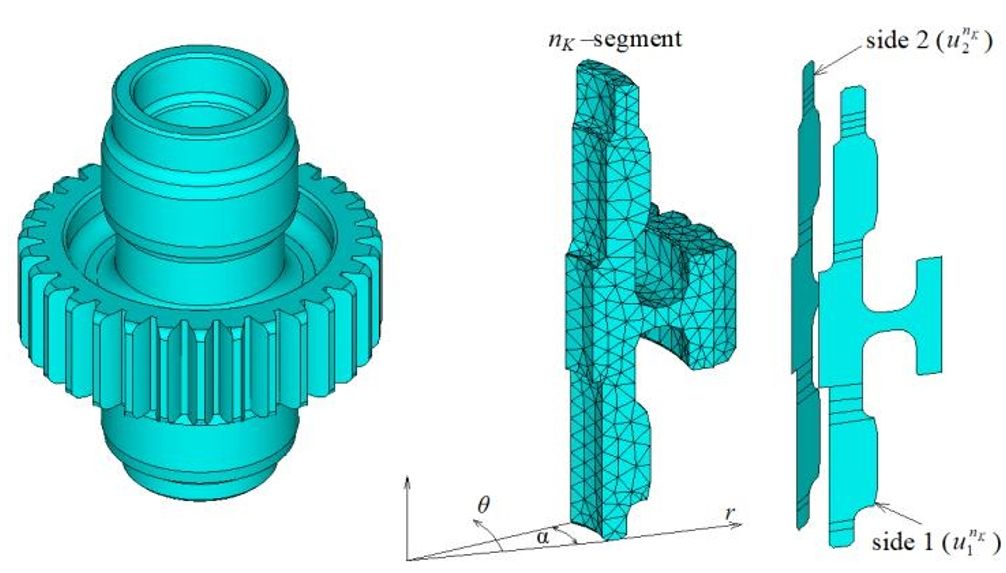
Fig. 1.
Model with the nK segment with cyclic symmetry features
In the above equation, , refer to the analyzed component of physical phenomenon in segments (displacement, force, stress, temperature, etc.), the superscript refers to the segment number, the subscript refers to the side index and N is the number of segments into which the system is divided. Taking into account the same physical properties of the individual segments, it can be written that [11]. Eq. (1) represent the constraint equation between the physical segments.
The transformation equation between the physical components and the cyclic components is written in the form [11, 25]:
where: unk can be any physical component (displacement, force, etc.) in the nKth segment and , , and are so-called cyclic components. The summation limit KL takes the value KL = (N – 1)/2 if N is odd and KL = (N – 2)/2 if N is even. The term α represents the angle of the segment and the term exist only when N is even. The term k is the harmonic index. The Eq. 2 include the finite number of Fourier series terms so it can be called a finite Fourier transformation [12]. Using the inverse transform one can determine the cyclic components. In this work, the ANSYS software is used for analysis. In the software computational algorithms the duplicate sector method is used to solve the relevant equations which takes into acount the properties of cyclic symmetry [2, 25].
As mentioned earlier, the main objective of this paper is to discuss the methodology for creating FE models of gear wheels, with including the properties of cyclic symmetry. Taken into consideration wheels have a toothed ring with oblique (or circular-arc) or straight teeth. The design features of the analyzed wheel cases result, to a large extent, from the applications of the analyzed wheels in aviation power transmission systems or in the transmission of aircraft engine aggregates.
In the first stage, solid models of the wheels were made in CATIA software. Then, the geometry of the models was simplified by removing elements that did not significantly affect the vibration phenomenon of the systems (roundings, chamfers, etc.) [1, 2]. In the Fig. 2 it is shown the geometric models of the objects under investigation which are prepared for the next stage of the process. These are treated as the so-called basic (or reference) models of the analyzed wheels. More technical data about these wheels can be found in Tab. 1.
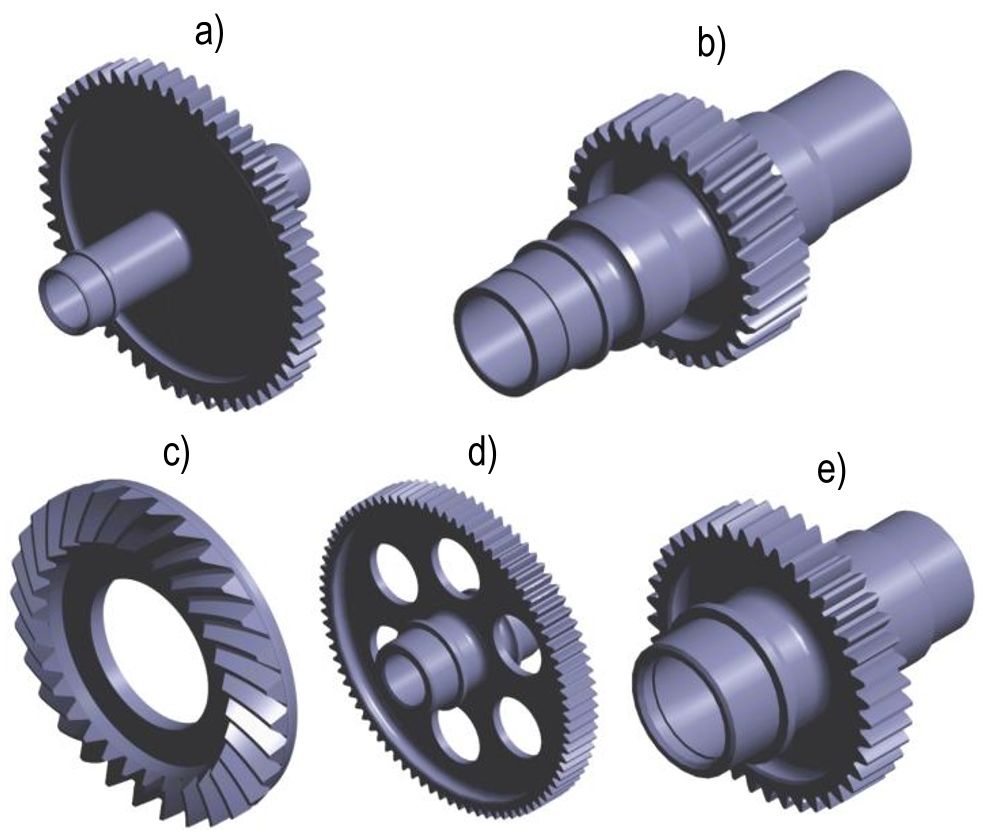
Fig. 2.
Geometric models of the gears under investigation: a) GR1_1, b) GR2_1, c) GR3_1, d) GR4_1, e) GR5_1
Tab. 1.
The toothed gears in question
| No. of wheel | Tooth count z | Gear module m0 | Denotation in the article | Description |
|---|---|---|---|---|
| 1 | 55 | 2.12 | GR1_1 | aviation toothed wheel (for aggregates, see Fig. 2a) |
| 2 | 31 | 3 | GR2_1 | aviation toothed wheel (for power transmission, see Fig. 2b) |
| 3 | 30 | 6 | GR3_1 | spiral bevel gear (for power transmission, see Fig. 2c) |
| 4 | 83 | 2.5 | GR4_1 | aviation toothed wheel (for aggregates, see Fig. 2d) |
| 5 | 41 | 2.5 | GR5_1 | aviation toothed wheel (for power transmission, see Fig. 2e) |
As mentioned earlier, in the proposed simplified models the cyclic symmetry properties can be used, which can be seen by analyzing the geometry of the considered wheels. It should be expected that this method of proceeding will allow for obtaining much smaller (in terms of file size due to the complexity of the geometry) FE models and will enable a reduction in the required computational resources of computing machines. For easier identification, the full names of the individual models and their designation in the article are provided in Tab. 2.
Tab. 2.
Description of the cyclic symmetry models of the discussed gears
| Denotation in the article | Description | Denotation in the article | Description |
|---|---|---|---|
| GR1_2 | cyclic symmetry segment model of the GR1_1 wheel, covering one tooth, cut along the centers of the inter – tooth slots (α = 6.55˚) | GR2_2 | cyclic symmetry segment model of the GR2_1 wheel, covering one tooth, cut along the centers of the inter – tooth slots (α = 11.61˚)) |
| GR1_3 | cyclic symmetry segment model of the GR1_1 wheel without teeth (full ring), covering a 1/50th – circle segment (α = 7.2˚) | GR2_3 | cyclic symmetry segment model of the GR2_1 wheel without teeth (full ring), covering a 1/50th – circle segment (α = 7.2˚) |
| GR1_4 | cyclic symmetry segment model of the GR1_1 wheel without teeth (full ring), covering a 1/16th – circle segment (α = 22.5˚), see Fig. 3a) | GR2_4 | cyclic symmetry segment model of the GR2_1 wheel without teeth (full ring), covering a 1/16th – circle segment (α = 22.5˚), see Fig. 3a) |
| GR1_5 | cyclic symmetry segment model of the GR1_1 wheel without teeth (full ring), covering a 1/10th – circle segment (α = 36˚) | GR2_5 | cyclic symmetry segment model of the GR2_1 wheel without teeth (full ring), covering a 1/10th – circle segment (α = 36˚) |
Interesting models, in terms of their future use in systems with a complex shape of the wheel disc (e.g. holes in the disc), are simplified models in which the toothed ring is replaced by a uniform ring (see Tab. 2) with equivalent physical properties [2, 18]. In Fig. 3 it is shown examples of simplified models related to the toothed wheels in question (see Fig. 2), where toothed rings are simplified in to full rings (the yellow part of each model). In each simplified model, the outer diameter of the ring is equal the head diameter of the gear.
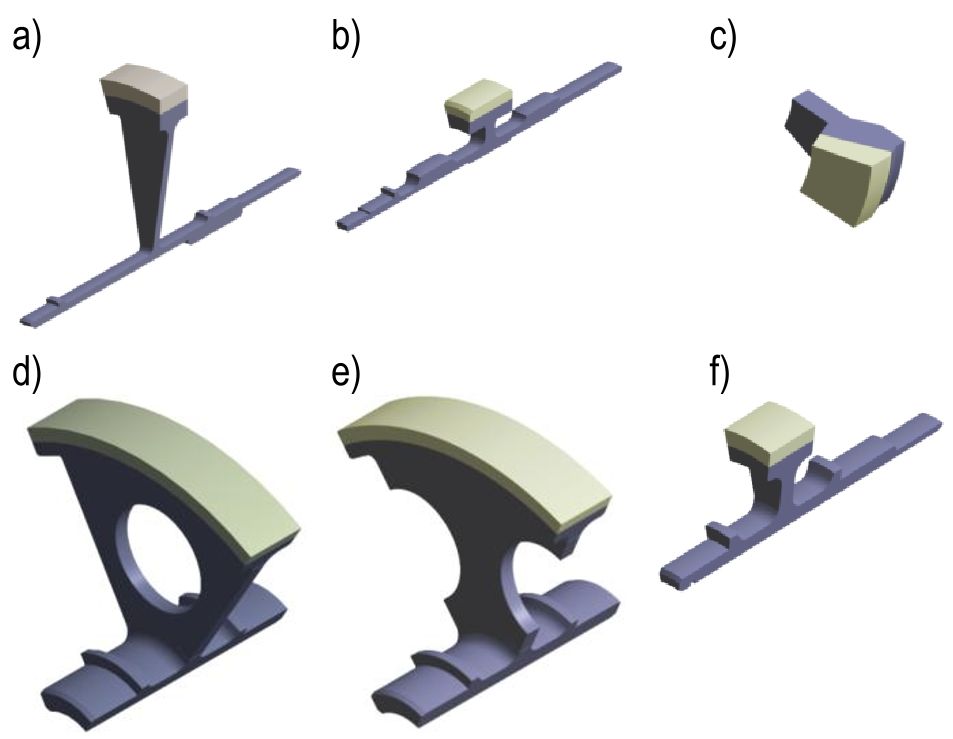
Fig. 3.
Examples of simplified geometric models of the discussed gears with full ring: a) GR1_4, b) GR2_4, c) GR3_4, d) GR4_3, e) GR4_4, f) GR5_4
This approach allows to develop a simplified cyclic symmetry model of the GR4_1 wheel. For this wheel two simplified models were developed. In the first simplified model designated as GR4_3 (see Fig. 3d), the cyclic symmetry sector of the wheel GR4_1 includes the entire eccentric hole of the wheel disc. In the second simplified model of the GR4_1 wheel (model designation GR4_4, see Fig. 3e), the boundary areas of the segment are led through the centers of symmetry of the eccentric holes of the wheel disc. Both models have the same angle value α = 60˚ (angle of the segment). The description of the remaining simplified models developed is presented in Tabs. 2–3.
Tab. 3.
Description of the cyclic symmetry models of the discussed gears
| Denotation in the article | Description | Denotation in the article | Description |
|---|---|---|---|
| GR3_2 | cyclic symmetry segment model of the GR3_1 wheel, covering one tooth, cut along the centers of the inter – tooth slots (α = 12˚) | GR4_3 | cyclic symmetry segment model of the GR4_1 wheel, covering the entire eccentric hole of the wheel disc (α = 60˚, see Fig. 3d) |
| GR3_3 | cyclic symmetry segment model of the GR3_1 wheel without teeth (full ring), covering a 1/50th – circle segment (α = 7.2˚) | GR4_4 | cyclic symmetry segment model of the GR4_1 wheel where the boundary areas of the segment are led through the centers of symmetry of the eccentric holes of the wheel (α = 60˚, see Fig. 3e) |
| GR3_4 | cyclic symmetry segment model of the GR3_1 wheel without teeth (full ring), covering a 1/16th – circle segment (α = 22.5˚, see Fig. 3a) | GR5_2 | cyclic symmetry segment model of the GR5_1 wheel, covering one tooth, cut along the centers of the inter – tooth slots (α = 8.78˚) |
| GR3_5 | cyclic symmetry segment model of the GR3_1 wheel without teeth (full ring), covering a 1/10th – circle segment (α = 36˚) | GR5_3 | cyclic symmetry segment model of the GR5_1 wheel without teeth (full ring), covering a 1/50th – circle segment (α = 7.2˚) |
| GR5_4 | cyclic symmetry segment model of the GR5_1 wheel without teeth (full ring), covering a 1/16th – circle segment (α = 22.5˚, see Fig. 3a) | GR5_5 | cyclic symmetry segment model of the GR5_1 wheel without teeth (full ring), covering a 1/10th – circle segment (α = 36˚) |
The problems of natural vibrations of the discussed systems were solved using the finite element method in the ANSYS computational software. The wheels in question can be treated as annular plates of a complex shape, with four of them additionally installed on hollow stepped shafts [1, 5]. For this reason, for each solution for which the nodal lines are nodal diameters, one obtain two identical systems of nodal lines, rotated with respect to each other by an angle β = π/(2n), where n is the number of nodal diameters. In accordance with the circular and annular plate vibration theory, in this paper the particular natural frequencies of vibration are denoted by ωmn, where m refers to the number of nodal circles andn refers to the mentioned number of nodal diameters [5].
3. FINITE ELEMENT REPRESENTATION OF THE DISCUSSED SYSTEMS
The developed geometric models (basic/reference – see Fig. 2 and simplified – see Fig. 3 and Tabs. 2 and 3) were meshed by using available procedures of the ANSYS software. In order to test different variants and obtain general knowledge, three types of finite elements were used in the meshing process, i.e. solid185, solid186 and solid187. The Solid185 element is an eight-node brick element with three degrees of freedom at each node (nodal translations in three mutually perpendicular directions). The solid186 element is a higher-order brick element consisting of twenty nodes and three degrees of freedom at each node. The solid187 element is a ten-node higher-order tetrahedral element and, like in the previous case, has three degrees of freedom at each node. This element is well-suited and recommended for meshing systems with irregular geometry [2, 4, 25]. During the meshing process, the maximum length of each element side was assumed to be no greater than 1 [mm]. Including simplified models, fifteen FE model cases were considered for each of the GR1_1 and GR5_1 wheels, thirteen FE model cases were considered for each of the GR2_1 and GR3_1 wheels, and nine FEM model cases were considered for the GR4_1 wheel. Due to difficulties in generating a high-quality FEM mesh, the results obtained for the simplified GR2_2_m and GR3_2_m models with solid185 and solid186 elements were not considered.
Information on the number of elements and nodes in the developed FEM models is provided in Tabs. 4 and 5. Selected FEM reference models (full model) of the analyzed wheels are shown in Fig. 4. While in Fig. 5 it is shown examples of simplified models (taking into account the properties of cyclic symmetry) of the wheels in question.
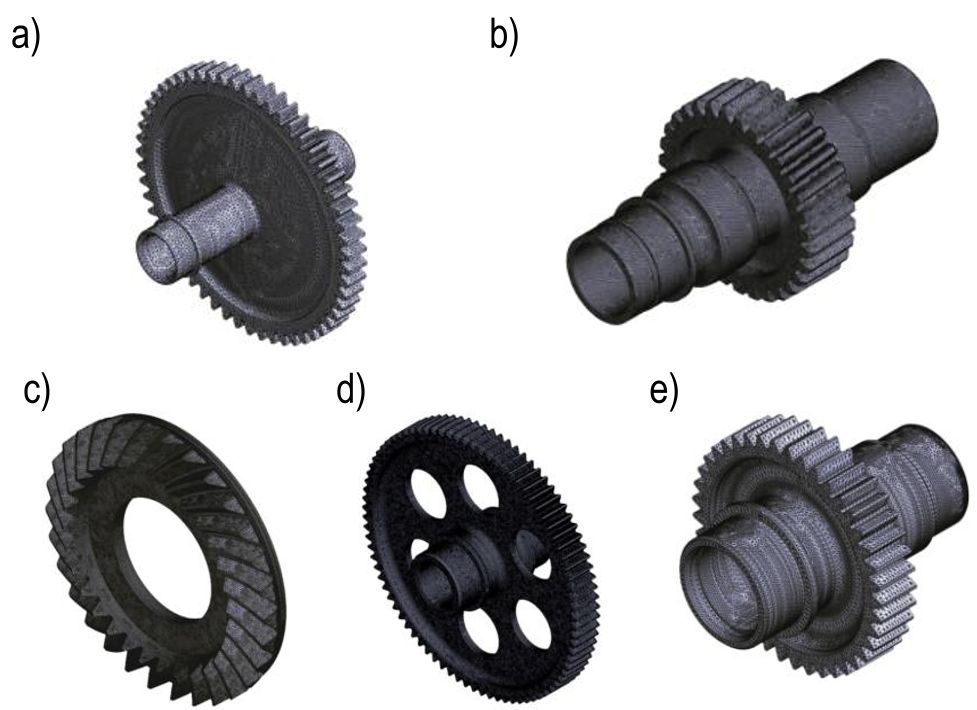
Fig. 4.
FEM models (reference FEM models) of the gears under investigation: a) GR1_1_m, b) GR2_1_m, c) GR3_1_m, d) GR4_1_m, e) GR5_1_m
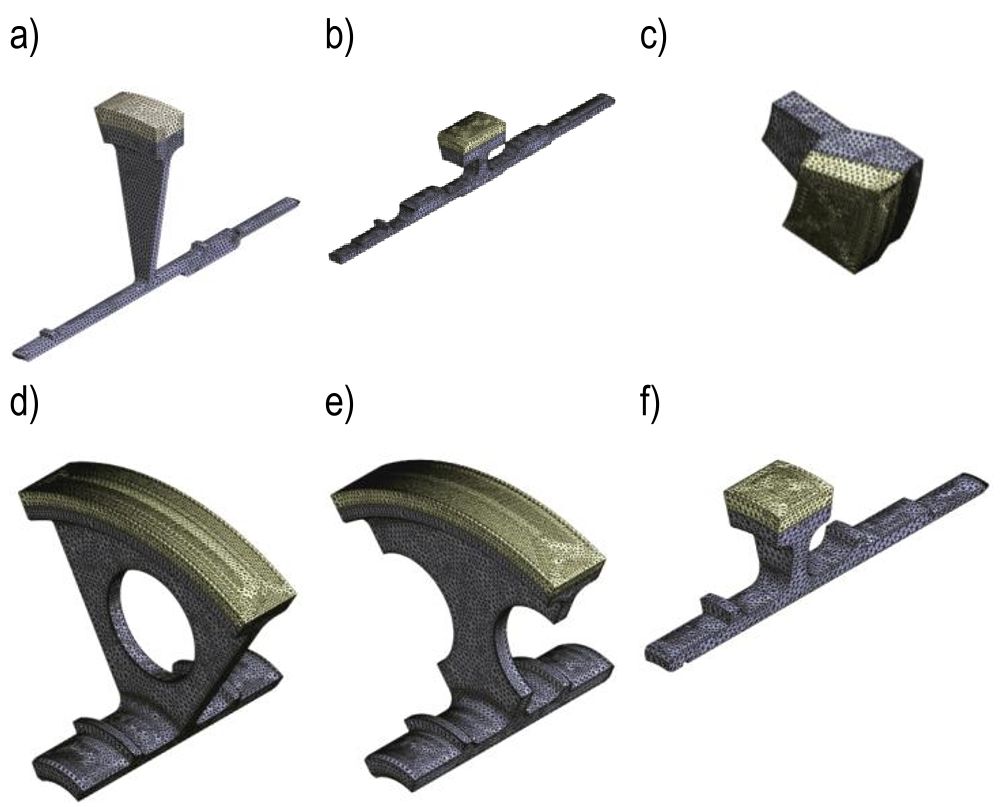
Fig. 5.
Examples of simplified FE models of the discussed gears with full ring: a) GR1_4_m, b) GR2_4_m, c) GR3_4_m, d) GR4_3_m, e) GR4_4_m, f) GR5_4_m
Tab. 4.
Description of the FE models of the discussed gears
| Model | Type of element | No. of nodes | No. of elements |
|---|---|---|---|
| GR1_1_m | solid185 | 67248 | 48690 |
| solid186 | 252018 | 48690 | |
| solid187 | 302701 | 175996 | |
| GR1_2_m | solid185 | 986 | 474 |
| solid186 | 10684 | 1740 | |
| solid187 | 7937 | 3912 | |
| GR1_3_m | solid185 | 4415 | 2756 |
| solid186 | 15592 | 2756 | |
| solid187 | 26348 | 15784 | |
| GR1_4_m | solid185 | 12544 | 9295 |
| solid186 | 46017 | 9295 | |
| solid187 | 61715 | 39127 | |
| GR1_5_m | solid185 | 19867 | 11476 |
| solid186 | 57726 | 11476 | |
| solid187 | 35246 | 19867 | |
| GR2_1_m | solid185 | 301199 | 274231 |
| solid186 | 1159443 | 269157 | |
| solid187 | 1864765 | 1255089 | |
| GR2_2_m | solid187 | 24814 | 13141 |
| GR2_3_m | solid185 | 10040 | 6988 |
| solid186 | 36823 | 6984 | |
| solid187 | 19767 | 10445 | |
| GR2_4_m | solid185 | 27958 | 22633 |
| solid186 | 105797 | 22529 | |
| solid187 | 50490 | 29057 | |
| GR2_5_m | solid185 | 42042 | 34980 |
| solid186 | 159088 | 34500 | |
| solid187 | 75913 | 44480 |
Tab. 5.
Description of the FE models of the discussed gears
| Model | Type of element | No. of nodes | No. of elements |
|---|---|---|---|
| GR3_1_m | solid185 | 589498 | 517008 |
| solid186 | 2282912 | 517008 | |
| solid187 | 1982857 | 1311702 | |
| GR3_2_m | solid187 | 88522 | 57266 |
| GR3_3_m | solid187 | 13981 | 11516 |
| solid186 | 53317 | 11516 | |
| solid187 | 19617 | 10780 | |
| GR3_4_m | solid185 | 40871 | 35796 |
| solid186 | 158222 | 35796 | |
| solid187 | 54010 | 30838 | |
| GR3_5_m | solid185 | 64379 | 57024 |
| solid186 | 249935 | 57024 | |
| solid187 | 83817 | 48093 | |
| GR4_1_m | solid185 | 531889 | 459614 |
| solid186 | 2050232 | 459210 | |
| solid187 | 2344962 | 1551003 | |
| GR4_3_m | solid185 | 91201 | 78860 |
| solid186 | 352131 | 78860 | |
| solid187 | 152873 | 93255 | |
| GR4_4_m | solid185 | 92403 | 80593 |
| solid186 | 359510 | 80593 | |
| solid187 | 156865 | 96142 | |
| GR5_1_m | solid185 | 211681 | 194979 |
| solid186 | 827639 | 194979 | |
| solid187 | 513791 | 301014 | |
| GR5_2_m | solid185 | 7002 | 4925 |
| solid186 | 26853 | 4925 | |
| solid187 | 33275 | 20285 | |
| GR5_3_m | solid185 | 7296 | 5215 |
| solid186 | 27022 | 5215 | |
| solid187 | 15102 | 8055 | |
| GR5_4_m | solid185 | 19472 | 15615 |
| solid186 | 72705 | 15615 | |
| solid187 | 37489 | 21520 | |
| GR5_5_m | solid185 | 30250 | 24816 |
| solid186 | 114078 | 24816 | |
| solid187 | 58919 | 34468 |
In the developed FE models there are two types of boundary conditions. The first type of boundary conditions refers to cyclic symmetry properties and is imposed systemically (through appropriate software procedures) after defining such properties. These types of boundary conditions only appear in simplified FE models of the wheels discussed. It is important in this case to use the same mesh layout (the same division into finite elements) on the boundary areas in each sector [2, 25]. Another kind of boundary condition results from the mounting or bearing method of the wheels in question. In this case, in all FE models (basic and simplified) of the wheels, the appropriate degrees of freedom were removed on the surfaces interacting with the bearings.
The quality of the proposed FEM models is determined by calculating the relative frequency error (the so-called frequency error), defined by the following Eq. [2,4]:
where ωf is the natural frequency comes from the numerical model and ωe is the natural frequency of the reference system.
4. NUMERICAL ANALYSIS
Based on all the previously discussed FEM models, numerical calculations were performed to determine the natural frequencies and their corresponding transverse vibration modes. The analyzed systems are made of steel with physical properties given in Table 6.
Tab. 6.
Technical data related to the discussed models
| No. of wheel | Young modulus E [Pa] | Density ρ [kg/m3] | Poisson’s ratio v | Equivalent Young’s modulus Ez [Pa] | Equivalent density ρz [kg/m3] |
|---|---|---|---|---|---|
| 1 | 2.031011 | 7.86103 | 0.3 | 2.9109 | 4.0583 103 |
| 2 | 4.3568 103 | ||||
| 3 | 3.8928 103 | ||||
| 4 | 4.0387 103 | ||||
| 5 | 3.9492 103 |
As mentioned earlier, in order to obtain similar physical properties of models with omitted tooth geometry (with full ring, see Tables 2 and 3) to those of the relevant reference models, it was necessary to determine equivalent values of the Young’s modulus Ez and the density ρz of the tooth modeling rings. The geometrical dimensions of the simplified models were assumed to be the same as those of the modeled wheels. In each simplified model it was assumed that the outer diameter of the rim modelling the gear ring is equal to the head diameter of the corresponding gear wheel. With the exception of Young's modulus and the density of the rim, the same technical data was assumed for the simplified models as for the corresponding gears. In each simplified model, the density parameter of the rim was determined based on the volume fraction of the modeled gear ring in that rim. Young’s modulus of the rim of the each simplified model is selected during numerical simulation to be in accordance with the reference solution in terms of the adopted criterion (3). The numerical simulation results presented in this paper were obtained with the values of the substitute quantities mentioned, relating to individual wheels, given in Tab. 6. For all model cases, calculations were performed over a wide frequency range until the frequency value W16 was determined.
At the beginning, statistical data will be discussed. The following statistical parameters were taken into account: WO - relative elapsed time, MU – sum of memory used by all processes [GB], RU – sum of disk space used by all processes [GB]. The WO parameter determines the relative computational time related to
the numerical analysis time of the reference FE models of discussed wheels. For this reason, WO = 1 was assumed for each reference FE model of the wheels in question (see Tabs. 7-10). If for a given simplified model WO < 1 it means that the calculation time of this model is shorter than the calculation time of the basic model, in the case when WO > 1 the calculation time is longer. The statistical data presented below were obtained using a computer with the following technical parameters in the calculation process: processor CPU – 4 Cores, Threads @3.8GHz, Cache 6MB, RAM memory – 4 x 8GB, DDR4 SDRAM, software ANSYS Workbench 2025 R1. In Tabs. 7-10 there are presented the statistical data recorded during the dynamic analyses of the reference and simplified FE models discussed.
Tab. 7.
Calculation statistics data for FE models of the GR_1_1 wheel
| Model | WO | MU | RU | ||||||
|---|---|---|---|---|---|---|---|---|---|
| solid185 | solid186 | solid187 | solid185 | solid186 | solid187 | solid185 | solid186 | solid187 | |
| GR1_1_m | 1 | 1 | 1 | 2.57 | 15.51 | 10.98 | 0.5 | 2.2 | 2.26 |
| GR1_2_m | 0.16 | 0.58 | 0.32 | 0.06 | 0.86 | 0.47 | 0.03 | 0.38 | 0.21 |
| GR1_3_m | 0.65 | 0.88 | 1.72 | 0.25 | 1.39 | 2.23 | 0.1 | 0.9 | 1.12 |
| GR1_4_m | 0.68 | 1.39 | 1.88 | 0.88 | 5.32 | 6.49 | 0.42 | 1.82 | 2.23 |
| GR1_5_m | 0.61 | 1.05 | 0.41 | 1.14 | 6.92 | 2.66 | 0.61 | 3.21 | 1.98 |
Tab. 8.
Calculation statistics data for FE models of the GR_2_1 wheel
| Model | WO | MU | RU | ||||||
|---|---|---|---|---|---|---|---|---|---|
| solid185 | solid186 | solid187 | solid185 | solid186 | solid187 | solid185 | solid186 | solid187 | |
| GR2_1_m | 1 | 1 | 1 | 14.39 | 31.4 | 40.61 | 3.49 | 21.1 | 27.8 |
| GR2_2_m | - | - | 0.03 | - | - | 6.50 | - | - | 5.36 |
| GR2_3_m | 0.94 | 0.15 | 0.05 | 2.52 | 14.18 | 5.22 | 3.11 | 11.94 | 6.15 |
| GR2_4_m | 1.13 | 0.21 | 0.05 | 8.60 | 29.66 | 15.57 | 3.95 | 14.98 | 7.17 |
| GR2_5_m | 1.06 | 0.19 | 0.04 | 13.49 | 25.99 | 14.53 | 4.77 | 11.80 | 7.47 |
Tab. 9.
Calculation statistics data for FE models of the GR_3_1 wheel
| Model | WO | MU | RU | ||||||
|---|---|---|---|---|---|---|---|---|---|
| solid185 | solid186 | solid187 | solid185 | solid186 | solid187 | solid185 | solid186 | solid187 | |
| GR3_1_m | 1 | 1 | 1 | 27.56 | 36.93 | 32.39 | 6.22 | 23.46 | 22.08 |
| GR3_2_m | - | - | 0.41 | - | - | 24.17 | - | - | 11.69 |
| GR3_3_m | 0.17 | 0.49 | 0.058 | 4.61 | 31.74 | 6.11 | 2.33 | 12.31 | 3.29 |
| GR3_4_m | 0.17 | 1.43 | 0.055 | 14.09 | 14.53 | 15.16 | 3.29 | 14.46 | 4.31 |
| GR3_5_m | 0.39 | 6.67 | 0.18 | 29.77 | 29.83 | 32.53 | 4.54 | 9.99 | 8.97 |
Tab. 10.
Calculation statistics data for FE models of the GR_4_1 and GR5_1 wheels
| Model | WO | MU | RU | ||||||
|---|---|---|---|---|---|---|---|---|---|
| solid185 | solid186 | solid187 | solid185 | solid186 | solid187 | solid185 | solid186 | solid187 | |
| GR4_1_m | 1 | 1 | 1 | 24.62 | 48.40 | 41.78 | 6.90 | 31.94 | 36.65 |
| GR4_3_m | 1.14 | 1.29 | 0.07 | 26.14 | 29.25 | 15.46 | 8.32 | 25.77 | 7.86 |
| GR4_4_m | 1.41 | 1.45 | 0.07 | 26.98 | 29.85 | 15.74 | 8.44 | 23.89 | 7.94 |
| GR5_1_m | 1 | 1 | 1 | 8.61 | 24.16 | 13.18 | 1.77 | 14.40 | 10.41 |
| GR5_2_m | 0.44 | 0.05 | 0.01 | 1.43 | 9.21 | 8.96 | 0.99 | 4.17 | 2.69 |
| GR5_3_m | 0.79 | 0.06 | 0.01 | 1.47 | 9.46 | 3.39 | 1.22 | 4.89 | 2.53 |
| GR5_4_m | 1.10 | 0.10 | 0.02 | 5.03 | 18.54 | 9.84 | 1.57 | 5.73 | 3.05 |
| GR5_5_m | 1.26 | 0.15 | 0.02 | 8.61 | 32.63 | 16.80 | 2.01 | 8.95 | 3.94 |
When analyzing the data from Tab. 7, it is noted that for all FE models of the GR1_1 wheel , in terms of all parameters, the most favorable results (the lowest values) were obtained using the solid185 element, and the relatively worst results were obtained using the solid186 element.
In the case of the GR2_1 wheel (see Tab. 8), for all models the most favorable values of the WO parameter were recorded using the solid187 element and the weakest for the case of the solid185 element. The MU and RU parameters have the most favorable values for the solid185 element. When analyzing only simplified models, the weakest results are obtained for the case of the solid186 element. It should also be noted that in the case of the simplified model GR2_2_m, it was not possible to develop FE models with solid185 and solid186 elements of sufficient quality.
In the case of the GR3_1 wheel models (see Tab. 9), the WO parameter is most favorable for the solid187 element, and the remaining parameters (MU and RU) are most favorable for the solid185 element and least favorable for the solid186 element. As before, no simplified FEM GR3_2_m models with solid185 and solid186 elements were developed with satisfactory quality.
Similarly, in the case of the GR4_1 and GR5_1 wheel models (see Tab. 10), the WO parameter is the most favorable for the solid187 element. For simplified models of the GR1_1 wheel, for the MU and RU parameters, the best values are observed for the solid187 element and the weakest for the solid186 element. In the case of simplified FE models of the GR51_1 wheel, the most favorable values of the MU and RU parameters are observed for the solid185 element and the weakest for the solid 186 element.
Considering the observed statistical results (relative elapsed time (WO parameter) and computer resource consumption (MU and RU parameters)) and the ease of generating simplified models of satisfactory quality, it seems reasonable to conclude that it is beneficial to use the solid187 element in the FEM mesh generation process of individual models. As mentioned earlier, it is a 3D ten-node tetrahedral element. It is also worth noting that this element is the most frequently recommended element for the implementation of calculation processes of engineering structures.
Next, issues related to the quality of the proposed simplified FE models will be discussed. In the tables below in this chapter are provided the values of the natural frequencies of the transversal vibrations of the wheels in question and the frequency errors. Taking into account the results of statistical tests, full FE models with the solid187 element were adopted as the reference models for individual wheels. The frequency values given in Tabs. 11-15 of this paper were obtained from full FE models of individual wheels with a finite element of the solid187 type. Due to the large amount of data, the values of natural frequencies for the remaining analyzed model cases are not included in this paper.
Tab. 11.
Values of natural frequencies Wmn[Hz] (reference FE model of the GR1_1 wheel)
| n | ||||||||
|---|---|---|---|---|---|---|---|---|
| 0 | 1 | 2 | 3 | 4 | 5 | 6 | ||
| m | 1 | 1613 | 637 | 1676 | 4584 | 8549 | 13313 | 18668 |
| 2 | 6570 | p>7312 | 8615 | 11307 | 14970 | |||
| 3 | 12433 | 14468 | 17164 | |||||
| 4 | 15004 | |||||||
Tab. 12.
Values of natural frequencies Wmn[Hz] (reference FE model of the GR2_1 wheel)
| n | ||||||||
|---|---|---|---|---|---|---|---|---|
| 0 | 1 | 2 | 3 | 4 | 5 | 6 | ||
| m | 1 | 6615.3 | 4794 | 5630.9 | 11975 | 19232 | 26465 | 32030 |
| 2 | 20610 | 21263 | 25065 | |||||
Tab. 13.
Values of natural frequencies Wmn[Hz] (reference FE model of the GR3_1 wheel)
| n | ||||||||
|---|---|---|---|---|---|---|---|---|
| 0 | 1 | 2 | 3 | 4 | 5 | 6 | ||
| m | 1 | 3220 | 780 | 1471 | 3876.9 | 6905.9 | 10366 | 13986 |
| 2 | - | 4901.1 | 8386.7 | 12587 | ||||
Tab. 14.
Values of natural frequencies Wmn[Hz] (reference FE model of the GR4_1 wheel)
| n | ||||||||
|---|---|---|---|---|---|---|---|---|
| 0 | 1 | 2 | 3 | 4 | 5 | 6 | ||
| m | 1 | 613 | 430 | 955 | 2639 | 4944 | 7796 | 10859 |
| 2 | 4700 | 4944 | 5678 | 6250 | 9370 | 10267 | ||
| 3 | 10510 | |||||||
Tab. 15.
Values of natural frequencies ?mn[Hz] (reference FE model of the GR5_1 wheel)
| n | ||||||||
|---|---|---|---|---|---|---|---|---|
| 0 | 1 | 2 | 3 | 4 | 5 | 6 | ||
| m | 1 | 5169 | 4363 | 4981 | 9836 | 16467 | 23702 | 31072 |
| 2 | 22007 | 22655 | ||||||
In the case of the GR1_1 wheel (see Tab. 11), sixteen natural frequencies of transversal vibration were identified within the analyzed frequency range.
For the GR2_1 wheel (see Tab. 12), ten natural frequencies were identified within the analyzed frequency range.
For the GR3_1 wheel (see Tab. 13), ten natural frequencies were also identified within the analyzed frequency range.
In the case of the GR4_1 wheel (see Tab. 14), fourteen natural frequencies of transversal vibration were identified within the analyzed frequency range.
The fewest natural frequencies, i.e. nine (see Tab. 15), were identified for the case of the GR5_1 wheel.
Tables 16-21 present the results relating to the quality of the discussed FE models of wheels, defined in accordance with Eq. (3) (the so-called frequency error). As mentioned earlier, the results of numerical simulations of the relevant full FE models of the wheels (i.e. GR1_1_m, GR2_1_m, GR3_1_m, GR4_1_m, GR5_1_m) with the solid187 element were used as reference data.
Tab. 16.
Values of natural frequencies Wmn[Hz] (reference FE model of the GR1_1 wheel)
| εmn | GR1_1_m | GR2_1_m | GR3_1_m | GR4_1_m | GR5_1_m | |||||
|---|---|---|---|---|---|---|---|---|---|---|
| solid185 | solid186 | solid185 | solid186 | solid185 | solid186 | solid185 | solid186 | solid185 | solid186 | |
| ε11 | -0.79 | 0,16 | -0.61 | 0.02 | -1.03 | -0.26 | -1.16 | -093 | 0.62 | -0.14 |
| ε10 | -0.56 | 0,12 | -0.70 | 0.02 | -2.48 | -0.31 | -0.51 | -0.02 | 0.57 | -0.13 |
| ε12 | -1,19 | 0,24 | -1.33 | 0.01 | -1.43 | -0.14 | -0.94 | 0.00 | 0.74 | -0.21 |
| ε13 | -1,11 | 0,22 | -1.74 | 0.01 | -1.14 | -0.01 | -1.04 | 0.02 | 0.73 | -0.23 |
| ε20 | -0,85 | 0,18 | -1.60 | 0.01 | - | - | -0.50 | 0.01 | 0.59 | -0.20 |
| ε21 | -1,18 | 0,21 | -0.59 | 0.02 | -0.49 | -0.03 | -0.56 | 0.02 | 0.60 | -0.17 |
| ε14 | -1,37 | 0,20 | -1.97 | 0.01 | -1.22 | -0.06 | -1.03 | 0.03 | 0.76 | -0.25 |
| ε22 | -1,50 | 0,24 | -0.86 | 0.02 | -0.53 | -0.01 | -0.67 | 0.01 | 0.62 | -0.21 |
| ε23 | -1,53 | 0,22 | -1.01 | 0.02 | -0.99 | -0.08 | -0.67 | 0.02 | - | - |
| ε30 | -0,63 | 0,12 | - | - | - | - | -0.53 | 0.01 | - | - |
| ε15 | -1,62 | 0,21 | -1.18 | 0.02 | -1.40 | -0.11 | -1.08 | 0.02 | 0.82 | -0.27 |
| ε31 | -2,92 | -1,24 | - | - | - | - | - | - | - | - |
| ε24 | -1,59 | 0,19 | - | - | - | - | - | - | - | - |
| ε25 | - | - | - | - | - | - | -0.81 | 0.01 | - | - |
| ε40 | -1,16 | 0,20 | - | - | - | - | - | - | - | - |
| ε32 | -1,43 | 0,23 | - | - | - | - | - | - | - | - |
| ε16 | -1,91 | 0,21 | -1.40 | 0.02 | -084 | -0.08 | -1.09 | -0.58 | 0.89 | -0.29 |
Tab. 17.
Values of the frequency error εmn [%] (comparison results comes from simplified FE models of GR1_1 wheel)
| εmn | GR1_2_m | GR1_3_m | GR1_4_m | GR1_5_m | ||||||||
|---|---|---|---|---|---|---|---|---|---|---|---|---|
| solid185 | solid186 | solid187 | solid185 | solid186 | solid187 | solid185 | solid186 | solid187 | solid185 | solid186 | solid187 | |
| ε11 | -4.08 | 0.16 | 0.00 | -0.31 | 0.47 | 0.47 | -0.16 | 0.31 | 0.31 | -0.31 | 0.47 | 0.31 |
| ε10 | -1.74 | 0.25 | 0.06 | -0.56 | -0.25 | -0.25 | -0.56 | -0.25 | -0.25 | -0.62 | -0.25 | -0.31 |
| ε12 | -1.37 | 0.96 | 0.72 | -1.79 | -1.43 | -1.49 | -1.73 | -1.43 | -1.43 | -1.85 | -1.49 | -1.55 |
| ε13 | -1.00 | 0.94 | 0.74 | -1.66 | -1.37 | -1.40 | -1.59 | -1.33 | -1.33 | -1.68 | -1.40 | -1.42 |
| ε20 | -1.99 | 0.56 | 0.26 | -0.02 | 0.44 | 0.44 | 0.06 | 0.47 | 0.46 | -0.05 | 0.44 | 0.37 |
| ε14 | -1.19 | 0.96 | 0.75 | -1.56 | -1.24 | -1.24 | -1.49 | -1.19 | -1.19 | -1.59 | -1.24 | -1.25 |
| ε22 | -3.53 | 0.17 | 0.07 | -0.98 | -0.16 | -0.19 | -0.86 | -0.15 | -0.17 | -1.02 | -0.17 | -0.33 |
| ε23 | -3.00 | 0.34 | 0.25 | -0.73 | 0.04 | 0.02 | -0.63 | 0.05 | 0.03 | -0.77 | 0.03 | -0.12 |
| ε30 | 0.39 | 1.43 | 1.27 | 1.30 | 1.66 | 1.71 | 1.27 | 1.66 | 1.71 | 1.28 | 1.71 | 1.56 |
| ε15 | -1.54 | 1.00 | 0.77 | -1.48 | -1.07 | -1.08 | -1.41 | -1.02 | -1.03 | -1.53 | -1.07 | -1.10 |
| ε24 | -2.49 | 0.30 | 0.21 | -0.66 | 0.05 | 0.03 | -0.59 | 0.06 | 0.04 | -0.70 | 0.05 | -0.11 |
| ε40 | -1.66 | 1.29 | 1.05 | 1.44 | 1.75 | 1.76 | 1.49 | 1.76 | 3.56 | 1.43 | 1.77 | 1.69 |
| ε16 | -1.98 | 1.02 | 0.80 | -1.41 | -0.90 | -0.90 | -1.32 | -0.85 | -0.85 | -1.47 | -0.90 | -0.92 |
Tab. 18.
Values of the frequency error εmn [%] (comparison results comes from simplified FE models of GR2_1 wheel)
| εmn | GR2_2_m | GR2_3_m | GR2_4_m | GR2_5_m | ||||||
|---|---|---|---|---|---|---|---|---|---|---|
| solid187 | solid185 | solid186 | solid187 | solid185 | solid186 | solid187 | solid185 | solid186 | solid187 | |
| ε11 | 0.13 | 0.53 | 0.46 | 0.48 | 0.54 | 0.45 | 0.49 | 0.54 | 0.46 | 0.49 |
| ε12 | -0.24 | -2.33 | -2.88 | -2.85 | -2.32 | -2.87 | -2.59 | -2.33 | -2.87 | -2.59 |
| ε10 | -0.20 | 0.31 | 0.25 | 0.26 | 0.32 | 0.23 | 0.28 | 0.31 | 0.23 | 0.28 |
| ε13 | 0.44 | -3.13 | -3.48 | -3.47 | -3.12 | -3.49 | -3.29 | -3.12 | -3.47 | -3.29 |
| ε14 | -0.63 | -3.77 | -4.07 | -4.06 | -3.76 | -4.07 | -3.99 | -3.76 | -4.07 | -3.99 |
| ε20 | 0.32 | 2.43 | 2.43 | 2.41 | 2.43 | 2.42 | 2.42 | 2.43 | 2.42 | 2.41 |
| ε21 | -0.19 | -0.04 | -0.04 | -0.06 | -0.04 | -0.04 | -0.05 | -0.03 | -0.04 | -0.05 |
| ε22 | -0.45 | -1.25 | -1.62 | -1.61 | -1.25 | -1.61 | -1.46 | -1.25 | -1.62 | -1.47 |
| ε15 | 0.25 | -3.80 | -4.04 | -4.06 | -3.79 | -4.03 | 4.01 | -3.79 | -4.03 | -4.01 |
| ε23 | -0.54 | -2.64 | -2.83 | -2.82 | -2.63 | -2.82 | -2.68 | -2.64 | -2.83 | -2.68 |
| ε16 | -0.22 | -4.11 | -4.34 | -4.31 | -4.11 | -4.33 | -4.23 | -4.11 | -4.34 | -4.24 |
Tab. 19.
Values of the frequency error εmn [%] (comparison results comes from simplified FE models of GR3_1 wheel
| εmn | GR3_2_m | GR3_3_m | GR3_4_m | GR3_5_m | ||||||
|---|---|---|---|---|---|---|---|---|---|---|
| solid187 | solid185 | solid186 | solid187 | solid185 | solid186 | solid187 | solid185 | solid186 | solid187 | |
| ε11 | 0.90 | -3.08 | -2.95 | -3.08 | -2.56 | -3.08 | -3.21 | -2.56 | -3.08 | -3.08 |
| ε12 | -0.36 | 4.46 | 4.49 | 4.46 | 4.83 | 4.62 | 4.49 | 4.76 | 4.28 | 3.54 |
| ε10 | -0.37 | 4.66 | 4.69 | 4.66 | 4.10 | 4.01 | 3.85 | 4.10 | 4.04 | 4.01 |
| ε13 | -0.36 | 4.35 | 4.35 | 4.35 | 4.00 | 3.82 | 3.74 | 3.97 | 3.85 | 3.85 |
| ε21 | -0.37 | 0.35 | 0.36 | 0.35 | 0.83 | 0.73 | 0.63 | 0.79 | 0.77 | 0.75 |
| ε14 | -0.36 | 3.90 | 3.91 | 3.90 | 4.03 | 4.03 | 4.01 | 4.03 | 4.03 | 4.03 |
| ε22 | -0.32 | -1.51 | -1.47 | -1.51 | -1.15 | -1.28 | -1.37 | -1.18 | -1.27 | -1.25 |
| ε15 | -0.68 | 3.17 | 3.19 | 3.17 | 3.61 | 3.34 | 3.30 | 3.63 | 3.36 | 3.35 |
| ε23 | -0.39 | -1.57 | -1.55 | -1.57 | -1.01 | -1.34 | -1.39 | -1.00 | -1.33 | -1.37 |
| ε16 | -0.34 | 3.31 | 3.32 | 3.31 | 3.75 | 3.62 | 3.60 | 3.76 | 3.63 | 3.61 |
Tab. 20.
Values of the frequency error εmn [%] (comparison results comes from simplified FE models of GR4_1 wheel
| εmn | GR4_3_m | GR4_4_m | ||||
|---|---|---|---|---|---|---|
| solid185 | solid186 | solid187 | solid185 | solid186 | solid187 | |
| ε11 | -3.26 | -3.26 | -3.26 | -3.26 | -3.26 | -3.24 |
| ε10 | -4.42 | -4.26 | -4.26 | -4.47 | -4.24 | -4.26 |
| ε12 | -4.21 | -4.31 | -4.10 | -4.48 | -4.33 | -4.21 |
| ε13 | -3.85 | -3.82 | -3.79 | -3.89 | -3.83 | -3.81 |
| ε20 | -1.35 | -1.16 | -1.18 | -1.38 | -1.17 | -1.20 |
| ε21 | -2.36 | -2.14 | -2.18 | -2.38 | -2.14 | -2.17 |
| ε22 | -3.44 | -3.35 | -3.32 | -3.48 | -3.37 | -3.32 |
| ε23 | -0.93 | -0.78 | -0.77 | -0.90 | -0.77 | -0.77 |
| ε15 | -3.86 | -3.77 | -3.68 | -3.82 | -3.66 | -3.78 |
| ε25 | -2.84 | -2.59 | -2.58 | -2.82 | -2.56 | -2.56 |
| ε30 | -1.89 | -1.56 | -1.63 | -1.94 | -1.52 | -1.63 |
| ε16 | -3.28 | -3.49 | -3.51 | -3.21 | -3.45 | -3.48 |
Tab. 21.
Values of the frequency error εmn [%] (comparison results comes from simplified FE models of GR5_1 wheel
| εmn | GR5_2_m | GR5_3_m | GR5_4_m | GR5_5_m | ||||||||
|---|---|---|---|---|---|---|---|---|---|---|---|---|
| solid185 | solid186 | solid187 | solid185 | solid186 | solid187 | solid185 | solid186 | solid187 | solid185 | solid186 | solid187 | |
| ε11 | 0.48 | -0.14 | -0.13 | -0.69 | -1.22 | -1.16 | -0.69 | -1.21 | -1.12 | -0.69 | -1.20 | -1.12 |
| ε12 | 0.37 | -0.40 | -0.38 | 0.86 | 0.43 | 0.48 | 0.86 | 0.43 | 0.51 | 0.86 | 0.44 | 0.51 |
| ε10 | 0.33 | -0.22 | -0.21 | -0.34 | -0.76 | -0.72 | -0.35 | -0.76 | -0.70 | -0.35 | -0.75 | -0.70 |
| ε13 | 0.22 | -0.57 | -0.56 | 1.76 | 1.52 | 1.54 | 1.76 | 1.52 | 1.55 | 1.76 | 1.53 | 1.55 |
| ε14 | 0.30 | -0.58 | -0.56 | 1.69 | 1.46 | 1.47 | 1.69 | 1.46 | 1.48 | 1.69 | 1.46 | 1.48 |
| ε20 | 0.33 | -0.24 | -0.23 | -1.07 | -1.57 | -1.51 | -1.11 | -1.57 | -1.45 | -1.08 | -1.56 | -1.45 |
| ε21 | 0.32 | -0.26 | -0.24 | -0.46 | -0.93 | -0.86 | -0.48 | -0.93 | -0.81 | -0.45 | -0.92 | -0.80 |
| ε15 | 0.43 | -0.57 | -0.55 | 1.54 | 1.27 | 1.29 | 1.54 | 1.27 | 1.29 | 1.54 | 1.28 | 1.30 |
| ε22 | 0.29 | -0.36 | -0.33 | 0.50 | 0.01 | 0.09 | 0.49 | 0.01 | 0.16 | 0.51 | 0.02 | 0.17 |
| ε16 | 0.5 | -0.57 | -0.55 | 1.44 | 1.12 | 1.14 | 1.45 | 1.12 | 1.15 | - | - | - |
The results presented in Table 16 refer to the errors (frequency errors) of fitting the results obtained from the full FE models of the discussed wheels with solid185 and solid186 elements with the relevant reference data. In each analyzed case, the best fit is observed for models with a solid186 element.
The results in Tab. 17 refer to fitting errors of the frequency obtained from the simplified FEM models of the GR1_1 wheel. The best fit is obtained by results come from the GR1_2_m model with the solid187 element. In the case of the GR1_3_m model, the fit of the results come from the models with solid186 and solid187 elements is comparable. All results come from the GR1_4_m and GR1_5_m models show comparable fit to reference data.
In the case of the GR2_1 wheel (see Tab. 18), the best fit to the reference data is shown by the results from the simplified GR2_2_m model. The results from the remaining cases of simplified models show a slightly weaker and mutually comparable fit.
The results of fitting the simplified FE models of the GR3_1 wheel (see Tab. 19) to the reference data show significant similarity to the results for the GR2_1 wheel. The best fit to the reference data is shown by the results from the simplified GR3_2_m model and the results from the remaining cases of simplified models show a slightly weaker and mutually comparable fit.
In case of GR4_1 wheel (see Tab. 20), all results come from the GR4_3_m and GR4_4_m models show comparable fit to reference data but the results from the FE models with solid186 and solid187 elements show a slightly better fit in comparison to results from models with solid185 element.
Analyzing the results presented in Tab. 21, it is noted that the best fit to the reference data is for the GR5_2_m model, with a particular preference for the model with the solid187 element. In the remaining cases of simplified models, the fit of the results to the reference data is slightly worse and mutually comparable, but satisfactory.
Summarizing the presented results, it can be noted that in all cases of the FE models, the frequency error values are below 5%, which is satisfactory. The smallest frequency errors are observed for the FE models of GR1_1 and GR5_1 wheels (frequency error below 5%). The models that perform the worst are the simplified models of GR3_1 and Gr4_1 wheels (frequency error below 5%). For all the wheels discussed, the fit of the results obtained from simplified FE models with the solid187 element is relatively favorable.
5. EXPERIMENTAL INVESTIGATIONS
This section discusses the experimental research to verify the proposed FE models for the system. The Polytec measuring system (see Fig. 6) composed of PSV-400 laser vibrometer, LMS SCA-DAS SYSTEM and TIRAvib electrodynamic shacker, is used in the experiment. The measuring experiment is planned and performed in such a way as to identify the transverse natural forms in the system under consideration. The experiment was performed for one of the wheels discussed. Due to the technical parameters of the available measuring equipment, the GR1_1 wheel was used in the experiment. The quality of full FE models of the wheel was verified, which were generated using three types of finite element (solid185, solid186, solid187). This object was excited by harmonic signals with a wide frequency band. A grid of measurement points was superimposed on the wheel. The number of selected measurement points was 500. At each point the response of the system in the transverse direction was measured using a laser vibrometer.
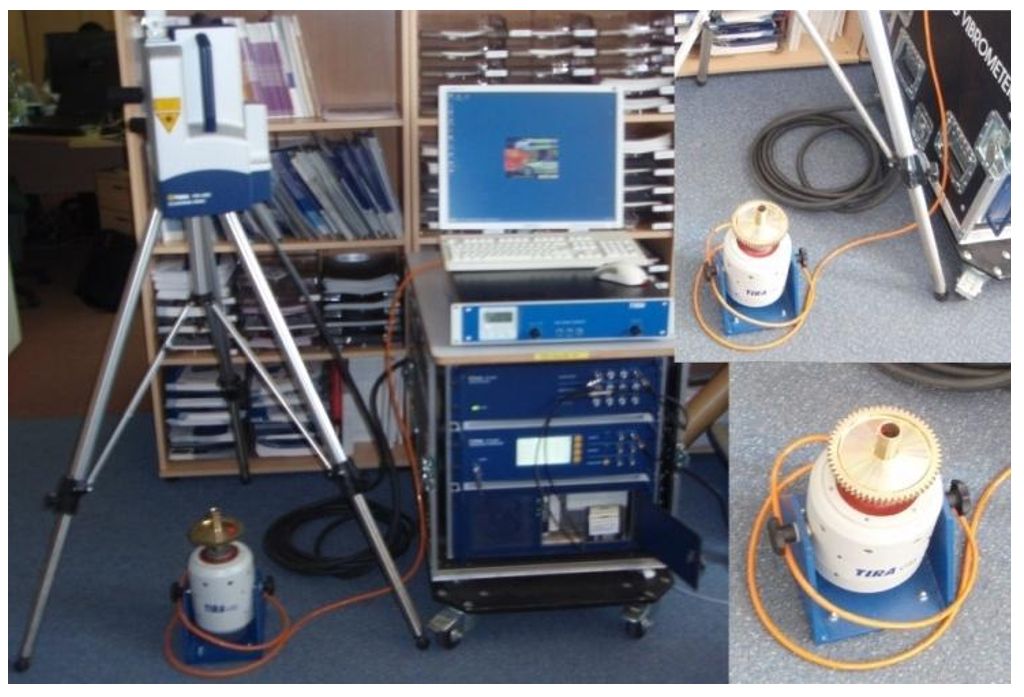
Fig. 6.
The laboratory test stand
The values of the excited and identified natural frequencies of the transversal vibrations of the wheel in question are given in Tab. 22. These values were treated as reference data.
Tab. 22.
Experimental values of natural frequencies ωmn[Hz] (the GR1_1 wheel)
| ωmn | ω11 | ω21 | ω22 | ω23 | ω24 | ω31 | ω32 |
|---|---|---|---|---|---|---|---|
| GR1_1 | 684.38 | 7460 | 8760 | 11440 | 15020 | 15390 | 17600 |
The natural frequency values obtained from the FEM analysis of the complete wheel models were compared with the experimental results presented in Table 22. Table 23 presents the frequency error values (3) resulting from the comparison of FEM results with experimental results.
Tab. 23.
Values of the frequency error εmn [%] (the comparison results come from the experimental data of the GR1_1 wheel)
| εmn | ε11 | ε21 | ε22 | ε23 | ε24 | ε31 | ε32 | |
| GR1_1_m | solid185 | -6.19 | -0.83 | -0.19 | 0.35 | 1.25 | -3.24 | -1.08 |
| solid186 | -7.07 | -2.19 | -1.90 | -1.38 | -0.52 | -4.82 | -2.70 | |
| solid187 | -6.92 | -1.98 | -1.66 | -1.16 | -0.33 | -5.99 | -2.48 | |
Analyzing the obtained results, it was noted that in all FE models, the largest frequency error occurs at frequencies ω11 (error below 7.08%) and ω31 (error below 6%). In the remaining frequency cases, for the model with the solid186 element, the frequency error is less than 2.71 %, and for the model with the solid187 element, the frequency error is less than 2.5% and in some cases of the FE models even less than 1 %.
Considering the results obtained, it can be concluded that the results obtained from each model are generally satisfactory. Nevertheless, the best fit in terms of the adopted criterion is characterised by the model with the solid185 element. The model with the solid187 element also shows comparable compliance. Considering the signs of the data in Table 23, it can be concluded that the developed FE models (except for the two natural frequencies of the FE model with the solid185 element) exhibit slightly lower stiffness compared to the actual object.
Then, the effect of mesh density on the FEM solution results is considered. Simulation studies were conducted using the full FE model of the GR_1_1 wheel. The cases with solid185, solid186 and solid187 elements were analyzed, assuming that the lengths of the finite element mesh sides did not exceed the values of 0.5 [mm], 0.7 [mm], 1 [mm], 1.5 [mm], 2 [mm], 4 [mm] and 8 [mm], respectively. In order to obtain the best possible fit with the experimental results, a model updating procedure of the FE models used was carried out. In subsequent simulation steps, the parameter relating to the density of the material from which the toothed wheel was made was varied. The results presented in this article (Tabs. 24-27) were obtained with a density coefficient of ρ = 7758 [kg/m3]. For the FE models with the solid187 element, the values of the natural frequencies of the transverse vibration (see Tab. 24) and the frequency error (see Tab. 25) determined according to equation (3) are provided. For the remaining FE model cases (with the solid186 and solid185 elements), only the frequency errors are provided (see Tabs. 26-27).
Tab. 24.
Values of the natural frequencies ωmn[Hz] (for the different values of the length of element side of the GR1_1 wheel, solid187)
| ωmn | ω11 | ω21 | ω22 | ω23 | ω24 | ω31 | ω32 | |
|---|---|---|---|---|---|---|---|---|
| length of element side [mm] | 0.5 | 639.30 | 7343 | 8648.5 | 11353 | 15035 | 14739 | 17233 |
| 0.7 | 639.40 | 7344.6 | 8650.4 | 11356 | 15039 | 14742 | 17237 | |
| 1 | 640.06 | 7350 | 8658.5 | 11365 | 15050 | 14756 | 17252 | |
| 1.5 | 640.79 | 7356 | 8664.8 | 11373 | 15059 | 14768 | 17264 | |
| 2 | 642.00 | 7367.8 | 8681 | 11395 | 15088 | 14799 | 17296 | |
| 4 | 648.00 | 7431 | 8783 | 11538 | 15279 | 15000 | 17493 | |
| 8 | 660.68 | 7553.5 | 8974 | 11818 | 15714 | 15342 | 17858 | |
Analyzing the frequency values for individual FE models with the solid187 element (see Tab. 24), a value stabilization (slowing down of the value changes) is observed for individual frequencies for models with elements side lengths ranging from 0.5 [mm] to 2 [mm]. A similar finding can be observed when analyzing the frequency errors (see Tab. 25). Within the specified element side length range, with the exception of the ω24 frequency, the frequency errors are negative for all other frequencies. For FE models with side lengths ranging from 4 mm to 8 mm, there are more frequencies for which the frequency error sign is positive.
Tab. 25.
Values of the frequency error εmn [%] (for the different values of the length of element side of the GR1_1 wheel, solid187)
| εmn | ε11 | ε21 | ε22 | ε23 | ε24 | ε31 | ε32 | |
|---|---|---|---|---|---|---|---|---|
| length of element side [mm] | 0.5 | -6.59 | -1.57 | -1.27 | -0.76 | 0.10 | -4.23 | -2.09 |
| 0.7 | -6.57 | -1.55 | -1.25 | -0.73 | 0.13 | -4.21 | -2.06 | |
| 1 | -6.48 | -1.48 | -1.16 | -0.66 | 0.20 | -4.12 | -1.98 | |
| 1.5 | -6.37 | -1.39 | -1.09 | -0.59 | 0.26 | -4.04 | -1.91 | |
| 2 | -6.19 | -1.24 | -0.90 | -0.39 | 0.45 | -3.84 | -1.73 | |
| 4 | -5.32 | -0.39 | 0.26 | 0.86 | 1.72 | -2.53 | -0.61 | |
| 8 | -3.46 | 1.25 | 2.44 | 3.30 | 4.62 | -0.31 | 1.47 | |
For the FE models with the solid186 element (see Tab. 26), a stabilization of the values for individual frequencies is observed for the FE models with element side lengths ranging from 0.5 [mm] to 4 [mm]. For the FE model with an element side length up to 8 [mm], a positive value of the frequency error occurs for two frequencies. The fitting results of the FE models with the solid186 element are only slightly less favorable compared to the results in Tab. 25.
Tab. 26.
Values of the frequency error εmn [%] (for the different values of the length of element side of the GR1_1 wheel, solid186)
| εmn | ε11 | ε21 | ε22 | ε23 | ε24 | ε31 | ε32 | |
|---|---|---|---|---|---|---|---|---|
| length of element side [mm] | 0.5 | -6.67 | -1.64 | -1.35 | -0.83 | 0.04 | -4.30 | -2.17 |
| 0.7 | -6.64 | -1.63 | -1.35 | -0.82 | 0.05 | -4.30 | -2.16 | |
| 1 | -6.62 | -1.63 | -1.33 | -0.81 | 0.05 | -4.28 | -2.15 | |
| 1.5 | -6.49 | -1.55 | -1.27 | -0.76 | 0.09 | -4.22 | -2.10 | |
| 2 | -6.62 | -1.61 | -1.27 | -0.73 | 0.19 | -4.24 | -2.03 | |
| 4 | -6.16 | -1.44 | -1.22 | -0.69 | 0.20 | -4.17 | -1.91 | |
| 8 | -6.09 | -0.65 | -0.06 | 0.60 | 1.88 | -3.57 | -0.96 | |
For FE models generated using the solid185 element (see Tab. 27), a certain stabilization of the frequency values is observed for frequency groups within the element site length range from 0.7 mm to 1.5 mm. The simulation results from the FE models within the specified element length range demonstrate a favorable match with the experimental results. A less favorable fit (frequency errors above 10%) is observed for FE models with element side of 0.5 [mm], 4 [mm], and 8 [mm].
Tab. 27.
Values of the frequency error εmn [%] (for the different values of the length of element side of the GR1_1 wheel, solid185)
| εmn | ε11 | ε21 | ε22 | ε23 | ε24 | ε31 | ε32 | |
|---|---|---|---|---|---|---|---|---|
| length of element side [mm] | 0.5 | -6.48 | -1.35 | -0.10 | -0.49 | 0.37 | 15.5 | -1.84 |
| 0.7 | -6.30 | -1.08 | -0.69 | -0.19 | 0.67 | -3.76 | -1.53 | |
| 1 | -6.02 | -0.64 | -0.17 | 0.32 | 1.19 | -3.35 | -1.09 | |
| 1.5 | -4.71 | 0.58 | 1.20 | 1.66 | 2.55 | -1.86 | 0.28 | |
| 2 | -4.60 | 1.45 | 2.57 | 2.95 | 3.87 | -1.03 | 1.34 | |
| 4 | 0.82 | 9.37 | 10.8 | 11.5 | 13.2 | 4.22 | 7.49 | |
| 8 | -2.92 | 15.4 | 18.4 | 25.9 | 36.9 | 9.90 | 19.6 | |
Analyzing the obtained results (see Tabs. 25-27), it is noted that the numerical simulation results for all FE models with element side lengths ranging from 0.7 mm to 2 mm demonstrate satisfactory agreement with the experimental results. Regarding the FE models with solid186 and solid187 elements, the numerical simulation results for the remaining element side length ranges are also satisfactory. For these FE model cases (except for the errors related to the frequency W11), the frequency errors obtained are significantly below 5%, which is beneficial. For FE models with the solid185 element and with element side lengths of 0.5 mm, 4 mm, and 8 mm, for several natural frequencies, the frequency errors exceed 10%, which is very unfavorable and eliminates the usefulness of these models in the simulation process. Comparing the results in Tab. 23 with the corresponding results in Tabs. 25-27 (FE models for the case of a 1 mm element side), a better match between the simulation results and the experimental results is observed for the FE models subjected to the model tuning procedure.
In Figs. 7-13 it is show the normal modes of natural frequencies excited in the experiment and the corresponding mode shapes generated in the numerical simulation. As mentioned earlier, the analyzed wheel can be treated as a circularly symmetric plate, and shapes of the normal modes in which the nodal lines form circles and nodal diameters are expected. The displacement values of individual points generated for individual mode shapes in the numerical simulation and experiment do not correspond to the actual displacements resulting from forced vibrations. In Figs. 7-13, the areas with the expected largest relative point displacements are colored red or blue. Areas with minimal or zero relative point displacements are colored green (so-called nodal line areas). Analyzing the shapes of the obtained natural forms, it can be concluded that they are not as regular as those of a classic circularly symmetrical plate, but they are sufficiently recognizable and show mutual shape similarity. The geometry of the gear rim teeth does not significantly affect the shape of the individual normal modes. Therefore, there is no need to use the additional mode shapes similarity criterion (MAC value) [4].
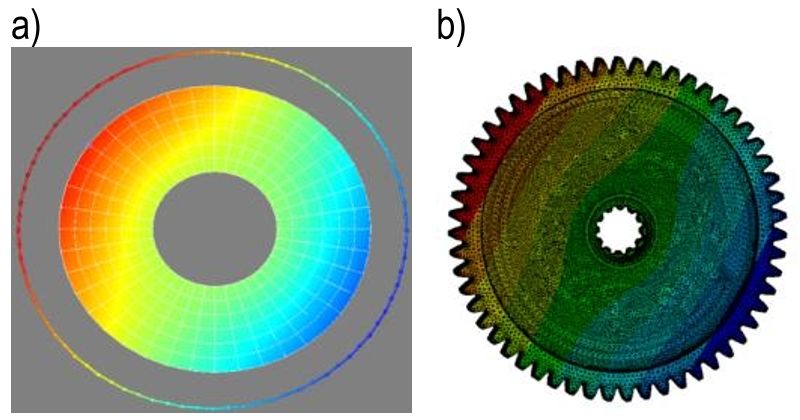
Fig. 7.
Mode shapes related to frequency ω11: a) experimental results, b) full FE model
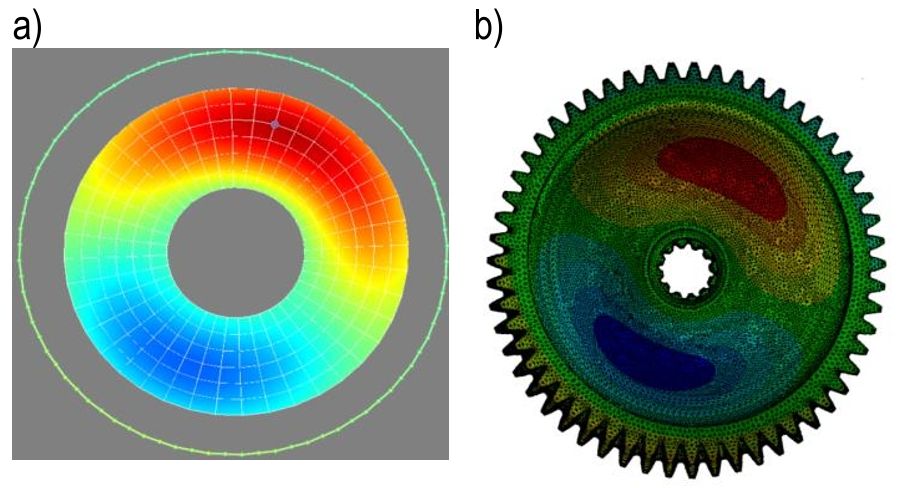
Fig. 8.
Mode shapes related to frequency ω21: a) experimental results, b) full FE model
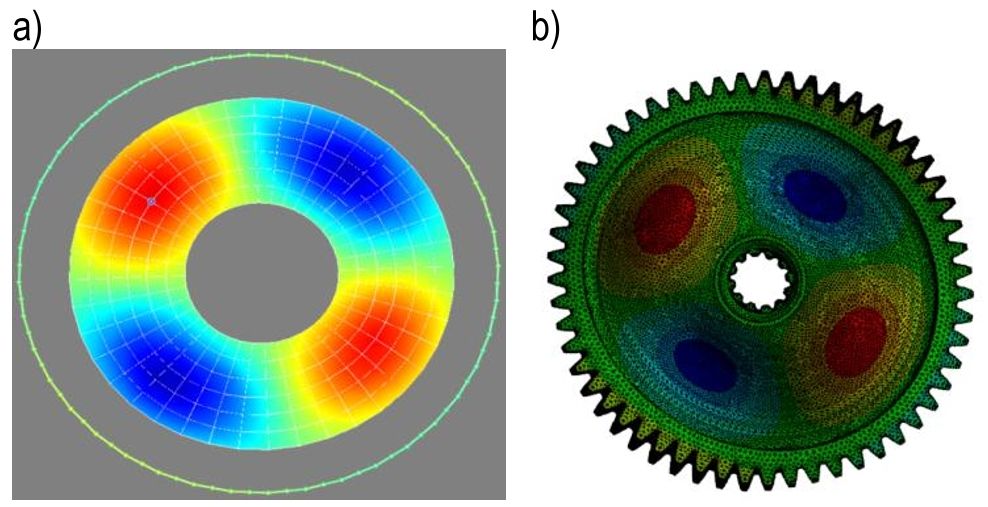
Fig. 9.
Mode shapes related to frequency ω22: a) experimental results, b) full FE model
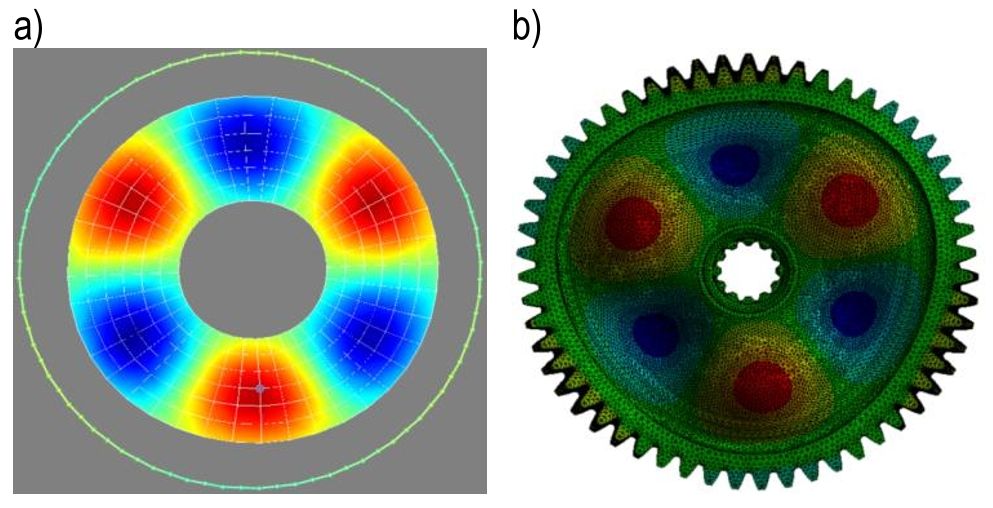
Fig. 10.
Mode shapes related to frequency ω23: a) experimental results, b) full FE model
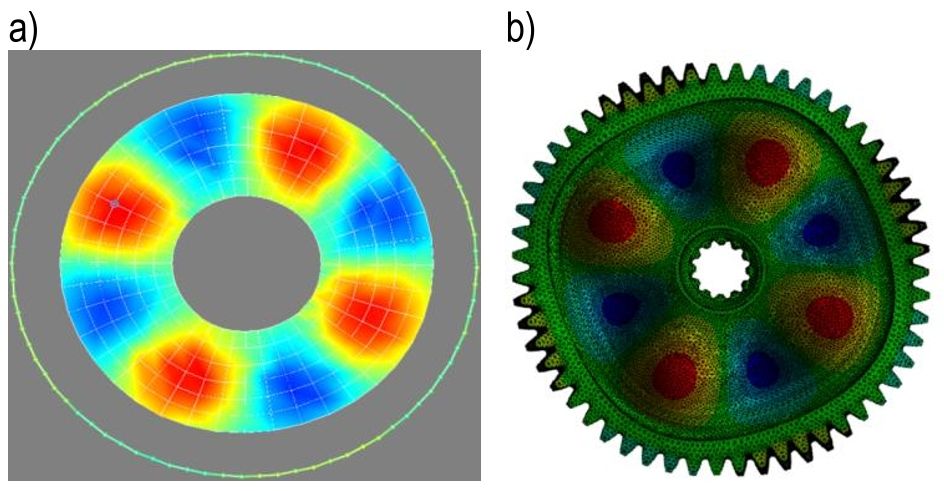
Fig. 11.
Mode shapes related to frequency ω24: a) experimental results, b) full FE model
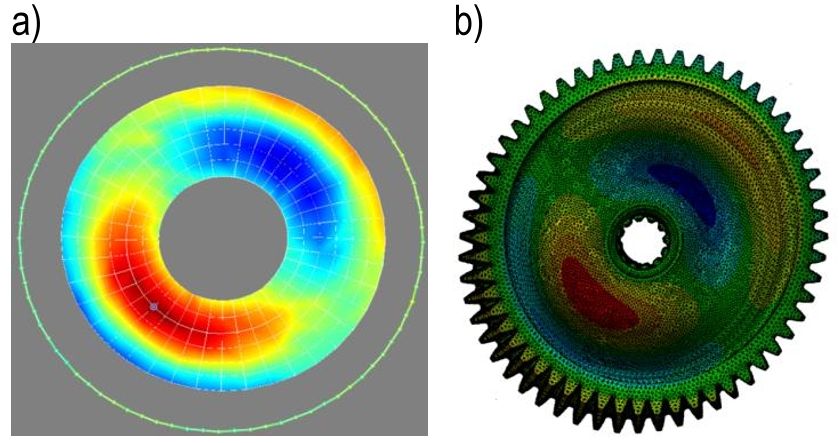
Fig. 12.
Mode shapes related to frequency ω31: a) experimental results, b) full FE model
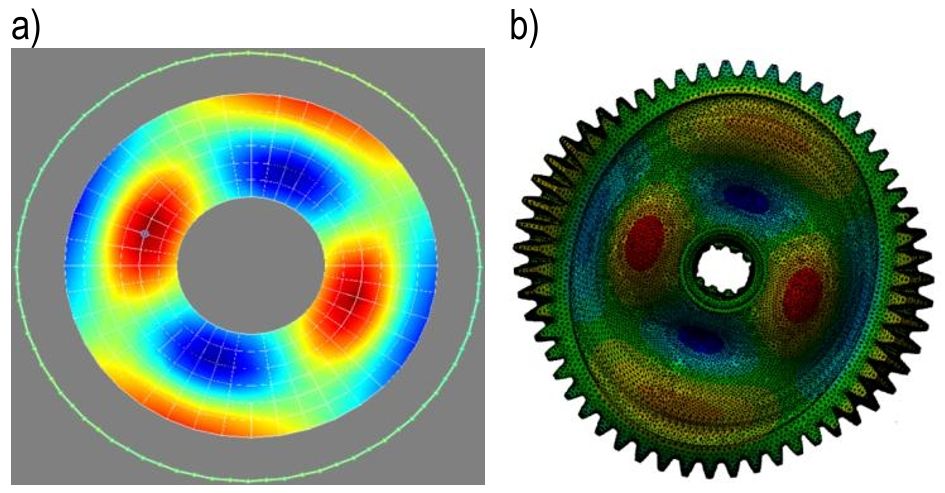
Fig. 13.
Mode shapes related to frequency ω32: a) experimental results, b) full FE model
6. CONCLUSIONS
The paper deals with the natural transversal vibrations of toothed wheels designed for use in aircraft power transmission systems or in the transmission of aviation engine aggregates. The analysis was lead by using wheels with straight, oblique and circu-lar-arc teeth, as well as with a full wheel disc and a wheel disc with eccentric holes. Simplified geared rim models were proposed for each gear in the form of uniform ring made of the material with satisfactory physical properties. In the proposed simplified models were also taken into account the cyclic symmetry properties observed in the studied objects. The required numerical calculations were performed using the commercial ANSYS software. The influence of the type and size of finite elements on the quality of the obtained results was also examined. Simplified FE models of gears include a significantly smaller number of finite elements compared to the corresponding high resolution reference models.
The numerical calculations conducted using the proposed methodology were analyzed in two categories: statistical analysis of the calculation process and the quality of the proposed simplified models in terms of the adopted criterion. For statistical analysis, the following parameters were considered: relative elapsed time (WO), sum of memory used by all processes (MU), and sum of disk space used (RU).
Considering the values of the previously mentioned statistical results obtained for a computer with the technical parameters specified in the article and the ease of generating simplified models of satisfactory mesh quality, it seems reasonable to conclude that the use of the solid187 element in the FEM mesh generation process of individual models is beneficial.
In the case of testing the quality of the results generated by the proposed simplified models, the analysis results obtained from the full FE models of the considered wheels with the finite element solid187 were taken as reference data. Analyzing the obtained results, it can be seen that in all cases of the simplified FE models, the frequency error values are below 5%, which is a satisfactory result. For all the wheels in question, the fit of the results achieved from the simplified FE models with the solid187 element is relatively favorable. In computational practice [3, 4], the fitting results are considered favorable and acceptable if the frequency errors for individual natural frequencies, excluding the frequency with the lowest value, do not exceed 5%.
Considering the results from the experimental studies, it can be concluded that the results obtained for each FE model of the tested wheel are generally satisfactory. However, the best agreement with respect to the adopted criterion is demons trated by the results from the model with the solid186 element. The model with the solid187 element also demonstrates a comparable fit. Considering the signs of the frequency error (see Table 23), it can be concluded that the developed FEM models are characterized by slightly lower transversal stiffness compared to the actual tested object. Considering the analysis results regarding the effect of element size on the quality of the obtained results, it can be seen that for the wheel in question, satisfactory results can be obtained from FE models with solid185, solid186, and solid187 elements with element side lengths ranging from 0.7 mm to 2 mm. All FE models of the gear wheels analyzed in this work fall within this range. It is also beneficial to perform a procedure for tuning FE models to the experimental results. It can also be seen that satisfactory results of compliance with experimental test are generated from FE models of a wheel with solid186 and solid187 elements with element side lengths of 0.5 mm, 4 mm and 8 mm.
When developing simplified FE models with cyclic symmetry, the geometric shape of the model (including the segment angle) must first be determined. The preferred finite element is solid187 or equivalent. If possible, retain the gear rim geometry. If not, develop an equivalent gear rim model according to the procedure outlined in this paper. Next, the mesh density is determined using the model tuning procedure or, if not necessary, by numerical FEM calculations with available technical data.
The conducted analyses indicate that the effective use of simplified models and the appropriate selection of the finite element type significantly improve the advanced computational process, with a slight, and in some cases negligible, increase in the fitting errors of the proposed simplified FE models. It should be noted that the presented research fit into the contemporary trends of automation and acceleration of numerical calculations, and may be helpful to engineers dealing with the vibration analysis of gear wheels.
Nomenclature
E – Young moduli,
Ez – equivalent Young’s modulus,
MAC – modal assurance criterion,
MU – sum of memory used by all processes,
N – number of segments,
RU – sum of disk space used by all processes,
WO – relative elapsed time,
k – the harmonic index,
kL – the summation limit,
m – the number of nodal circles,
n – the number of nodal diameters,
nK – the superscript refers to the segment number,
u – the component of physical phenomenon in segments,
ū – cyclic components,
α – the angle of segment,
β – the angle of rotation of nodal lines,
ε – the frequency error,
v – Poisson’s ratio,
ρ – density,
ρz – equivalent density,
ωe – the natural frequency of the reference system,
ωf – the natural frequency comes from the numerical model,
ωmn – the natural frequency of the transverse vibration.