
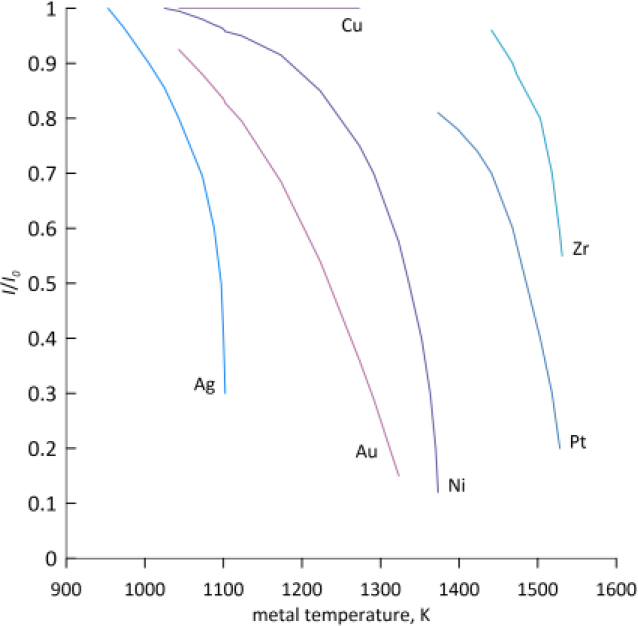
Fig. 1.
Normalized electron thermionic emission current of a dispenser cathode operating at 1373.2 K as a function of metal temperature (based on [10, 11])
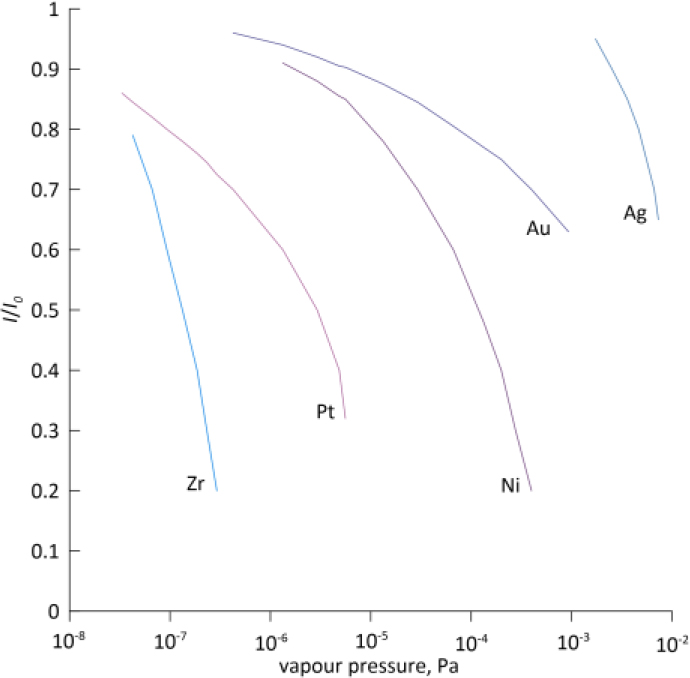
Fig. 2.
Normalized electron thermionic emission current of a dispenser cathode operating at 1373.2 K as a function of metal vapor pres-sure (based on [10, 11])
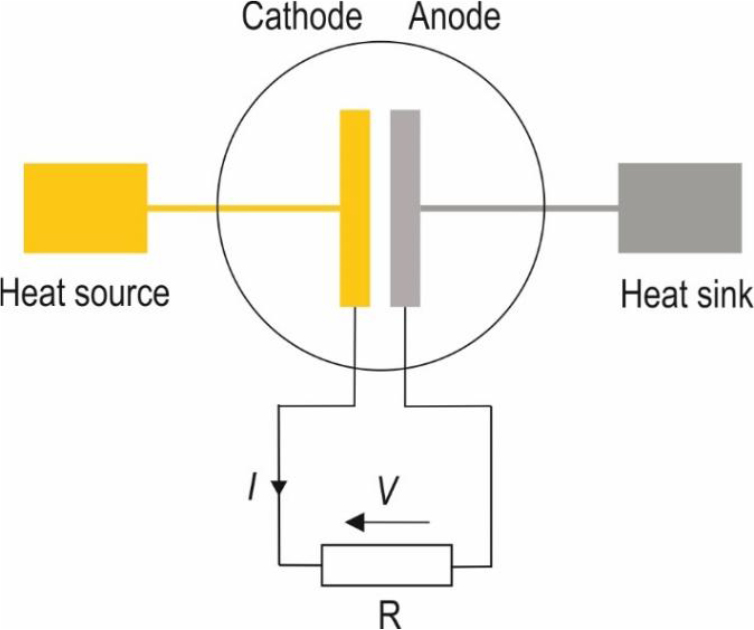
Fig. 3.
Schematic diagram of a thermionic energy converter
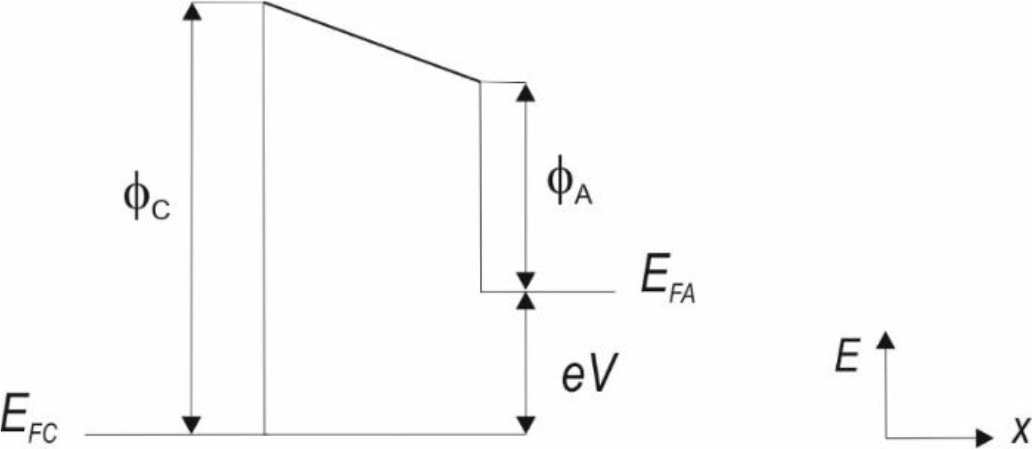
Fig. 4.
S. Distribution of potential energy of an electron in the cathodeanode region for an ideal converter (based on [12, 13])
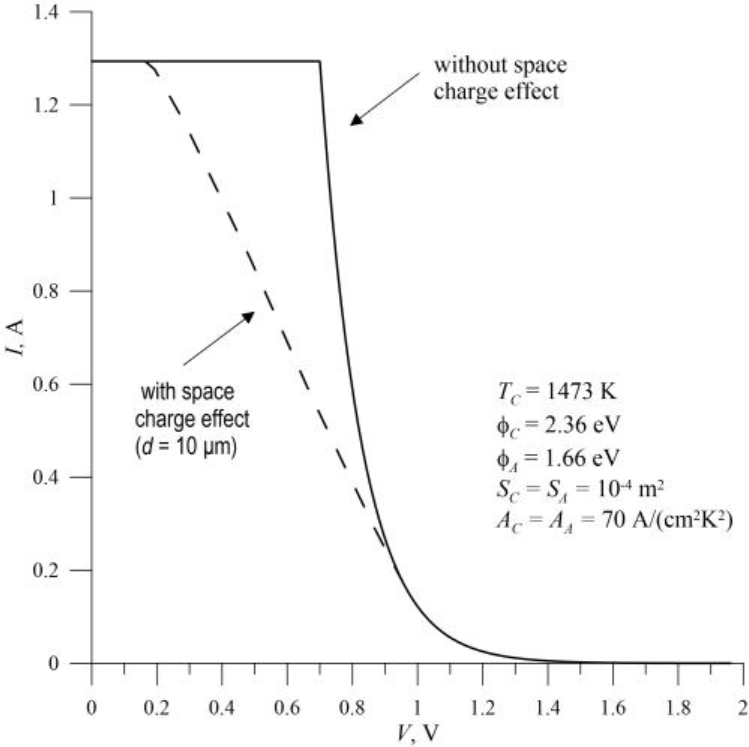
Fig. 5.
Model of current-voltage characteristics for an ideal converter and a real converter, taking into account the influence of negative space charge in the cathode-anode area. d is the mutual distance between the cathode and the anode
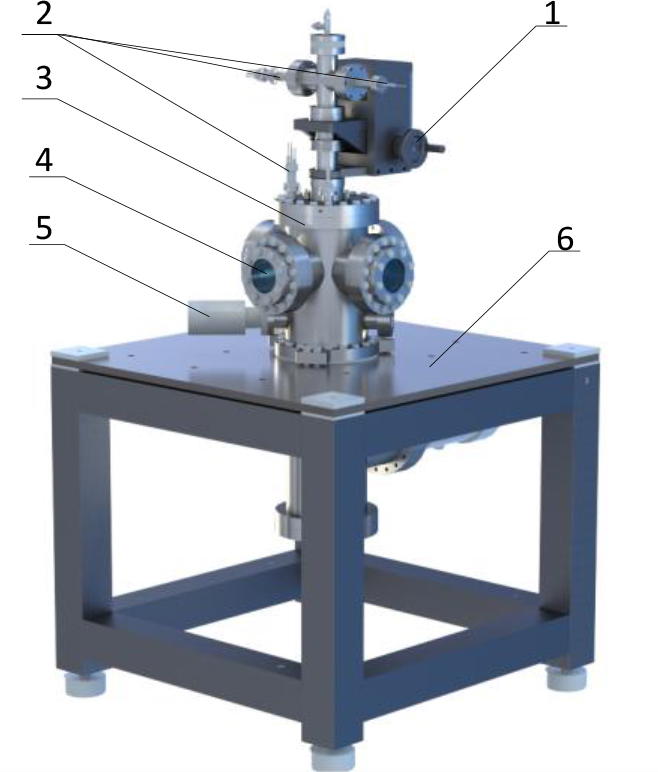
Fig. 6.
Model of a vacuum thermionic heat-to-electric energy converter test stand. 1 – manipulator, 2 – vacuum electrical feedthroughs, 3 – vacuum chamber, 4 – viewing window, 5 - vacuum gauge, 6 - test stand frame
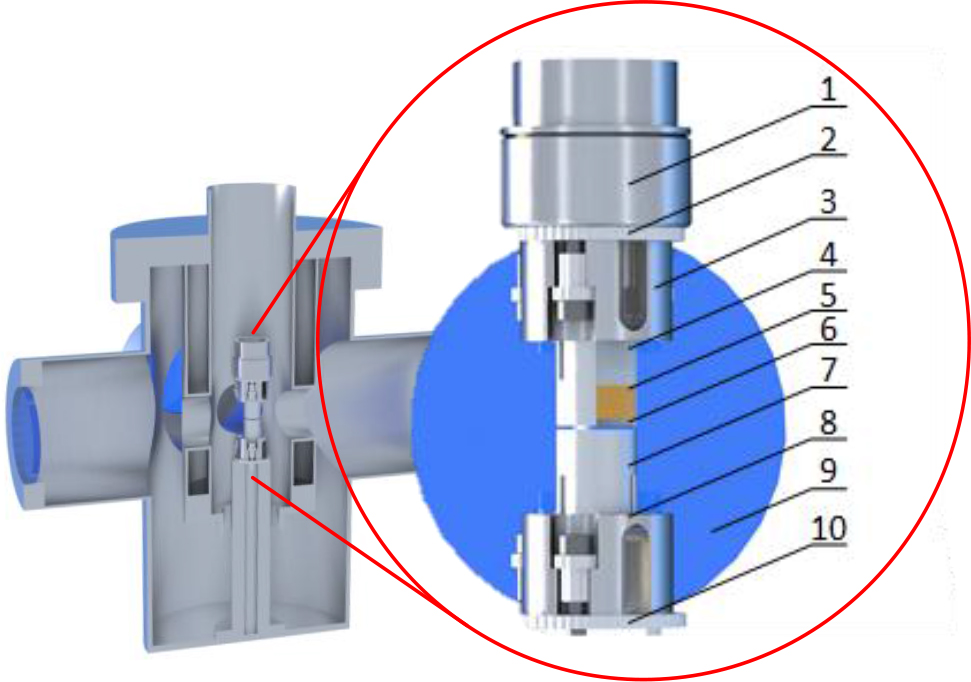
Fig. 7.
Virtual model of the chamber in a semi-cross-section view, adapted for numerical analysis. 1 – manipulator core, 2 – ceramic cathode pad, 3 – cathode mounting base, 4 – internal cathode insulation (half-cross-section view), 5 – cathode heater, 6 – cathode front surface, 7 – anode, 8 – anode mounting base, 9 – borosilicate glass of the viewfinder, 10 – ceramic anode pad
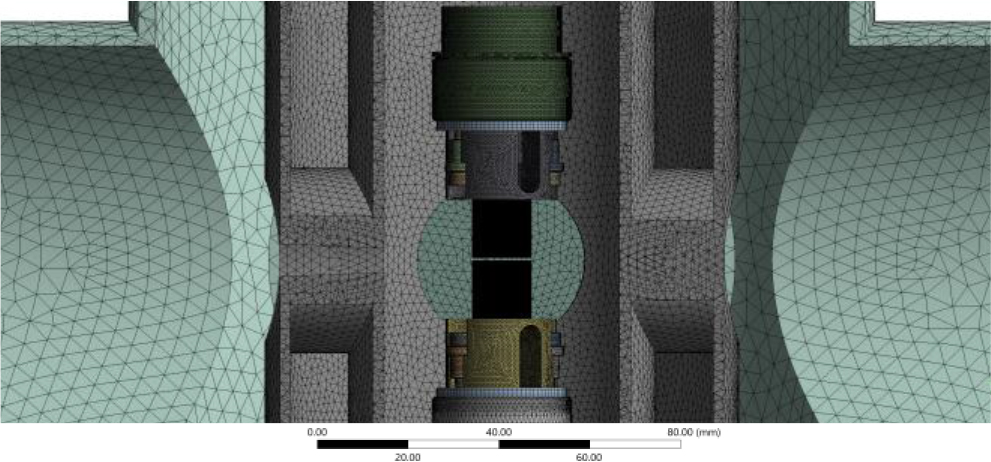
Fig. 8.
Discrete model of the test chamber
Tab. 1.
Thermal and physical properties of materials used in the model
| Material | Thermal Conductivity [W/(m·K)] | Specific heat [J/(kg·K)] | Density [kg/m3] | Emissivity [–] |
|---|---|---|---|---|
| Stainless Steel 316L | 16.2 | 500.0 | 8000 | 0.28 |
| Molybdenum (Mo) | 138.0 | 250.0 | 10200 | 0.05 |
| Copper (Cu) | 398.0 | 385.0 | 8960 | 0.03 |
| Aluminum Oxide (Al2O3) | 30.0 | 880.0 | 3960 | 0.25 |
| Pyrex 7740 borosilicate glass | 1.14 | 830.0 | 2230 | 0.92 |
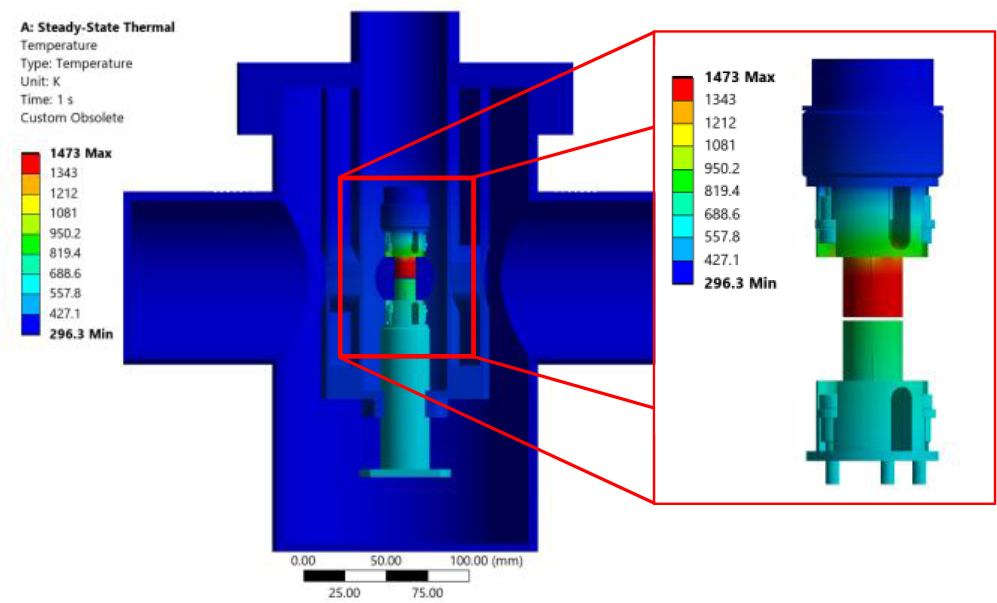
Fig. 9.
Temperature distribution in the test chamber model
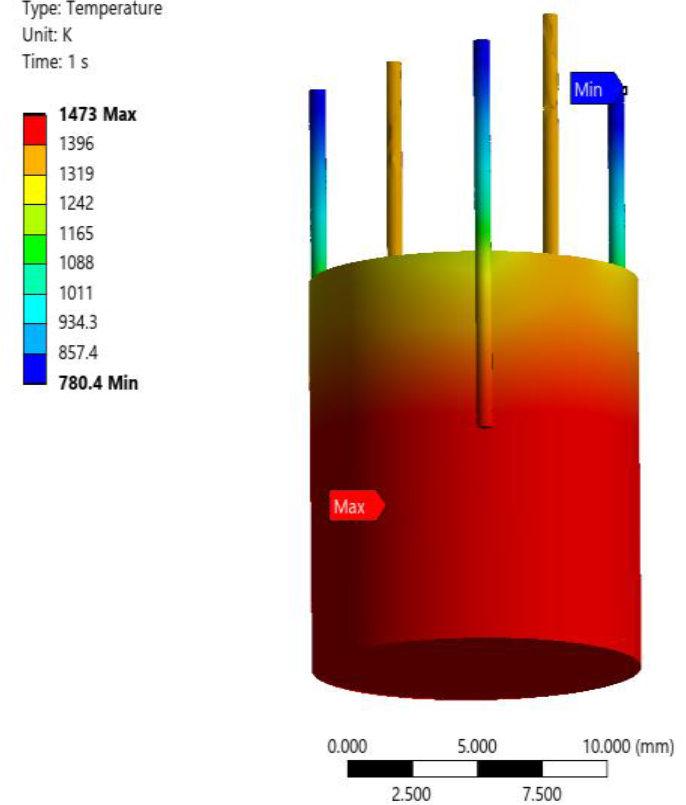
Fig. 10.
Temperature distribution in the cathode model
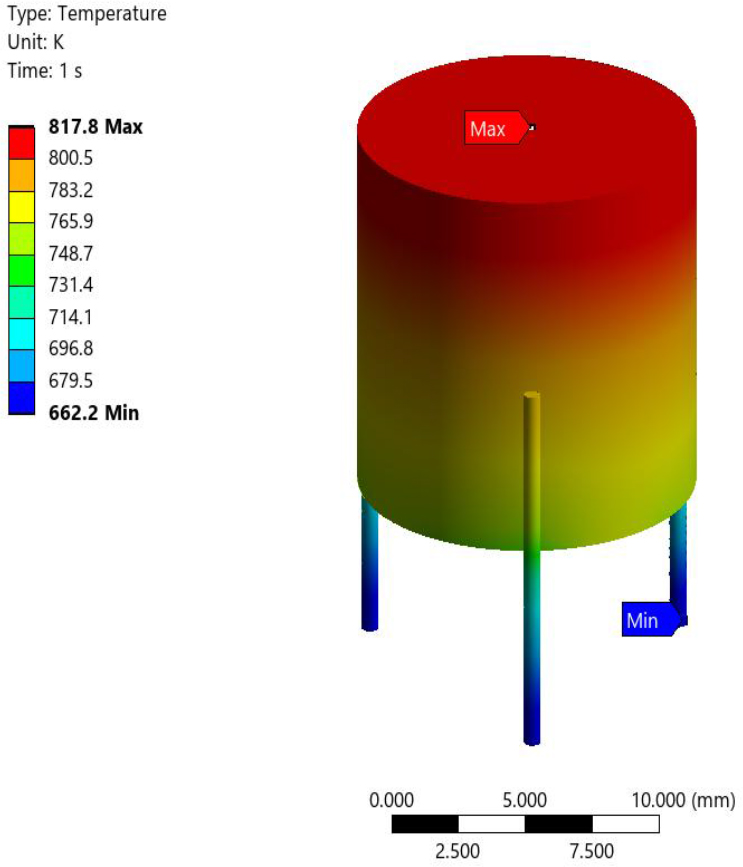
Fig. 11.
Temperature distribution in the anode model
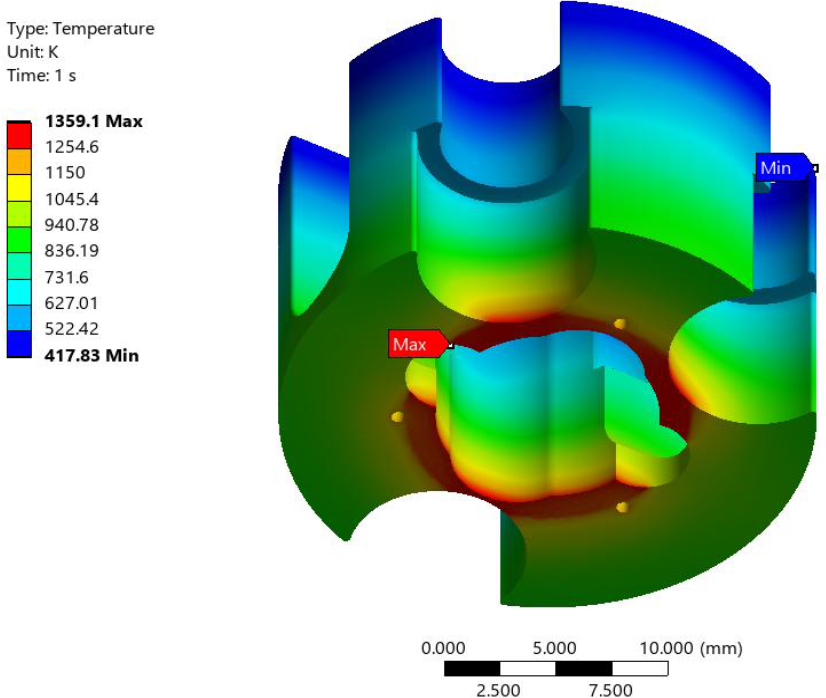
Fig. 12.
Temperature distribution in the cathode mounting base model
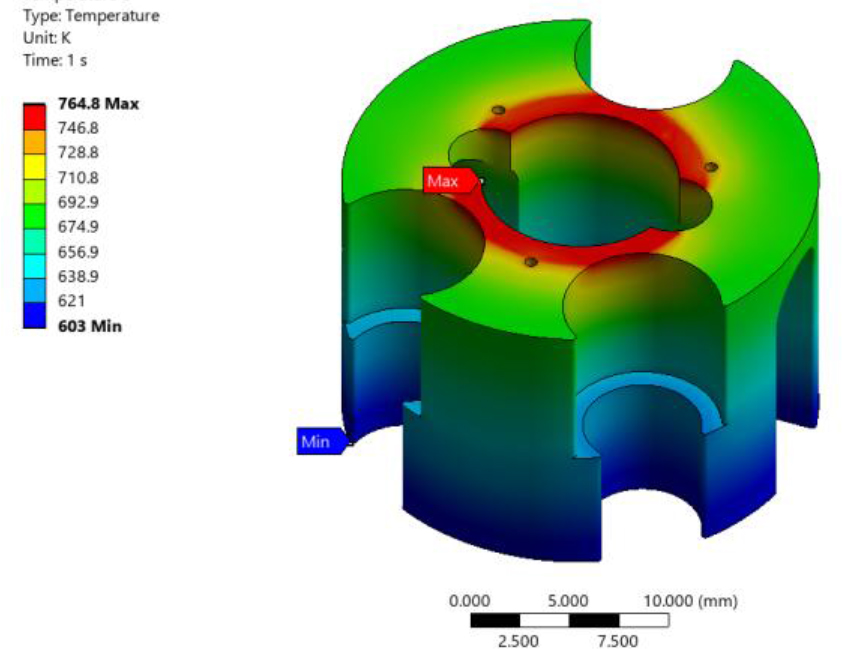
Fig. 13.
Temperature distribution in the anode mounting base model
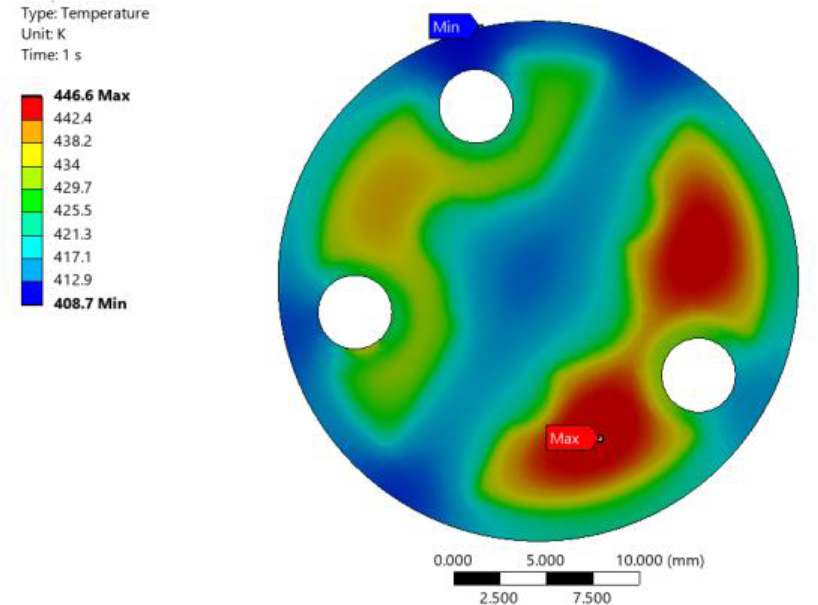
Fig. 14.
Temperature distribution in the model of the cathode ceramic pad surface
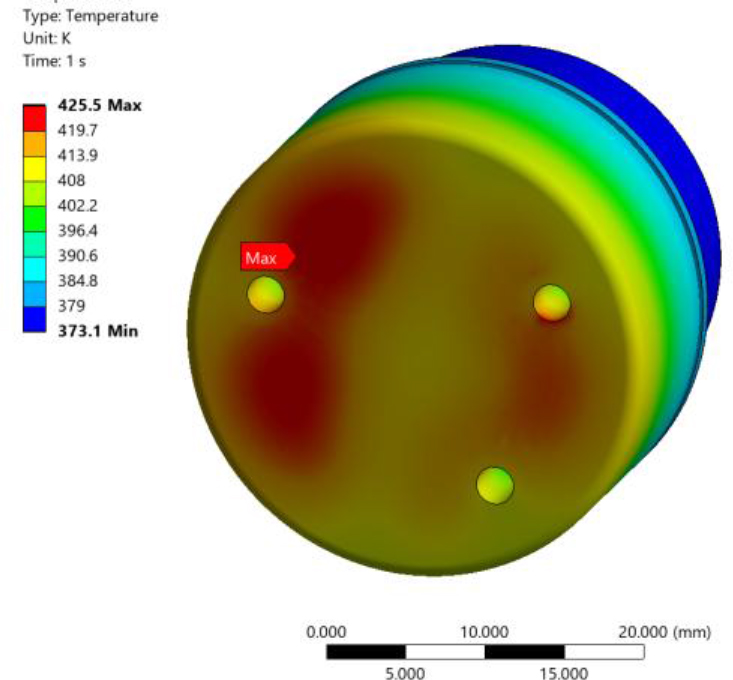
Fig. 15.
Temperature distribution in the manipulator core model
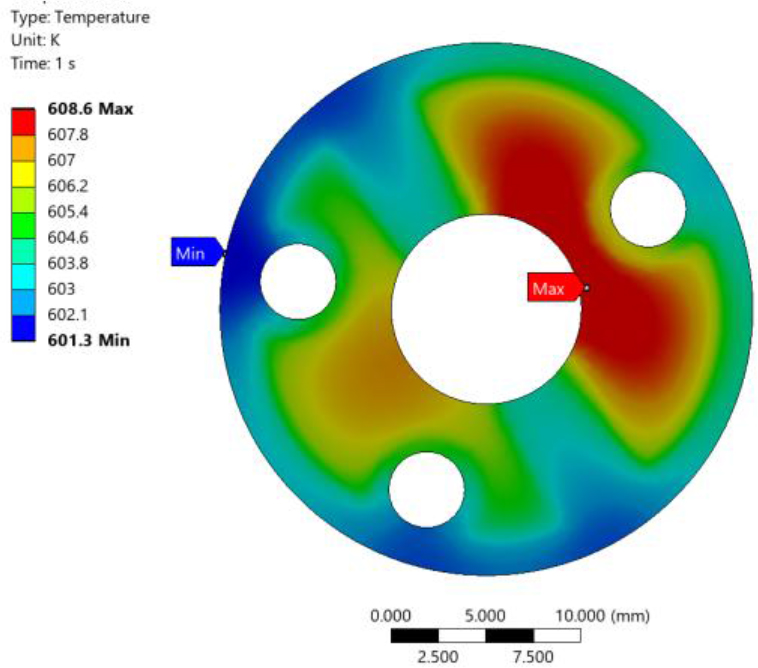
Fig. 16.
Temperature distribution in the model of the anode ceramic pad surface
Tab. 2.
Temperature values of key converter components as a function of tungsten microheater temperature in a design with bases made of 316L steel
| Theater [K] | 873.2 | 973.2 | 1073.2 | 1173.2 | 1273.2 | 1373.2 | 1473.2 | |
|---|---|---|---|---|---|---|---|---|
| Cathode | Taverage | 839.7 | 932.8 | 1025.8 | 1118.7 | 1211.4 | 1304.0 | 1396.4 |
| Tmax | 873.2 | 973.2 | 1073.2 | 1173.2 | 1273.2 | 1373.2 | 1473.2 | |
| Tmin | 555.7 | 592.1 | 628.4 | 664.6 | 700.7 | 736.6 | 780.4 | |
| Cathode base | Taverage | 540.1 | 573.4 | 606.6 | 639.6 | 672.6 | 705.5 | 738.2 |
| Tmax | 817.3 | 905.7 | 993.8 | 1081.5 | 1169.0 | 1255.9 | 1359.1 | |
| Tmin | 393.4 | 397.5 | 401.6 | 405.8 | 409.9 | 414.0 | 417.8 | |
| Anode | Taverage | 420.3 | 465.9 | 517.9 | 576.2 | 640.0 | 709.3 | 783.6 |
| Tmax | 424.8 | 472.8 | 528.0 | 590.4 | 659.4 | 735.1 | 817.8 | |
| Tmin | 403.4 | 440.1 | 480.1 | 523.0 | 567.9 | 614.5 | 662.2 | |
| Anode base | Taverage | 402.2 | 438.2 | 477.4 | 519.3 | 562.9 | 607.9 | 653.8 |
| Tmax | 417.9 | 462.2 | 512.5 | 568.5 | 629.5 | 695.3 | 764.8 | |
| Tmin | 394.8 | 426.9 | 461.0 | 496.5 | 532.2 | 567.9 | 603.2 | |
Tab. 3.
Temperature values of key converter components as a function of tungsten microheater temperature for design with molybdenum bases
| Theater [K] | 873.2 | 973.2 | 1073.2 | 1173.2 | 1273.2 | 1373.2 | 1473.2 | |
|---|---|---|---|---|---|---|---|---|
| Cathode | Taverage | 795.5 | 879.9 | 964.2 | 1048.6 | 1132.8 | 1217.0 | 1300.7 |
| Tmax | 873.2 | 973.2 | 1073.2 | 1173.2 | 1273.2 | 1373.2 | 1473.2 | |
| Tmin | 520.9 | 550.4 | 579.9 | 609.3 | 638.7 | 668.0 | 697.2 | |
| Cathode base | Taverage | 516.4 | 544.9 | 573.5 | 602.0 | 630.5 | 658.9 | 687.2 |
| Tmax | 649.4 | 704.5 | 759.6 | 814.5 | 869.4 | 924.2 | 978.6 | |
| Tmin | 450.6 | 466.1 | 481.5 | 497.0 | 512.4 | 527.8 | 543.1 | |
| Anode | Taverage | 397.9 | 432.1 | 468.8 | 507.7 | 548.6 | 590.8 | 633.6 |
| Tmax | 408.0 | 447.6 | 491.8 | 540.5 | 593.7 | 651.4 | 713.1 | |
| Tmin | 404.0 | 441.5 | 482.7 | 527.6 | 575.9 | 627.5 | 681.6 | |
| Anodebase | Taverage | 397.8 | 432.0 | 468.6 | 507.4 | 548.2 | 590.3 | 632.9 |
| Tmax | 400.1 | 435.5 | 473.8 | 514.9 | 558.5 | 604.0 | 650.9 | |
| Tmin | 396.7 | 430.3 | 466.1 | 503.8 | 543.3 | 583.7 | 624.3 | |
Tab. 4.
Temperature values of key converter components as a function of tungsten microheater temperature for design with copper bases
| Theater [K] | 873.2 | 973.2 | 1073.2 | 1173.2 | 1273.2 | 1373.2 | 1473.2 | |
|---|---|---|---|---|---|---|---|---|
| Cathode | Taverage | 779.4 | 860.6 | 941.8 | 1022.9 | 1104.0 | 1185.0 | 1266.0 |
| Tmax | 873.2 | 973.2 | 1073.2 | 1173.2 | 1273.2 | 1373.2 | 1473.2 | |
| Tmin | 509.1 | 536.3 | 563.5 | 590.6 | 617.7 | 644.7 | 671.7 | |
| Cathode base | Taverage | 509.1 | 536.2 | 563.3 | 590.4 | 617.5 | 644.5 | 671.5 |
| Tmax | 570.4 | 609.8 | 649.2 | 688.5 | 727.8 | 767.0 | 806.2 | |
| Tmin | 474.9 | 495.3 | 515.6 | 535.9 | 556.2 | 576.4 | 596.7 | |
| Anode | Taverage | 402.3 | 438.9 | 479.0 | 522.3 | 568.7 | 618.0 | 669.7 |
| Tmax | 406.3 | 445.1 | 488.0 | 535.2 | 586.6 | 642.0 | 701.4 | |
| Tmin | 397.4 | 431.3 | 467.7 | 506.2 | 546.5 | 588.2 | 630.5 | |
| Anode base | Taverage | 397.4 | 431.3 | 467.6 | 506.1 | 546.5 | 588.1 | 630.4 |
| Tmax | 398.2 | 432.5 | 469.5 | 508.8 | 550.1 | 593.0 | 636.9 | |
| Tmin | 396.9 | 430.6 | 466.6 | 504.7 | 544.4 | 585.3 | 626.9 | |
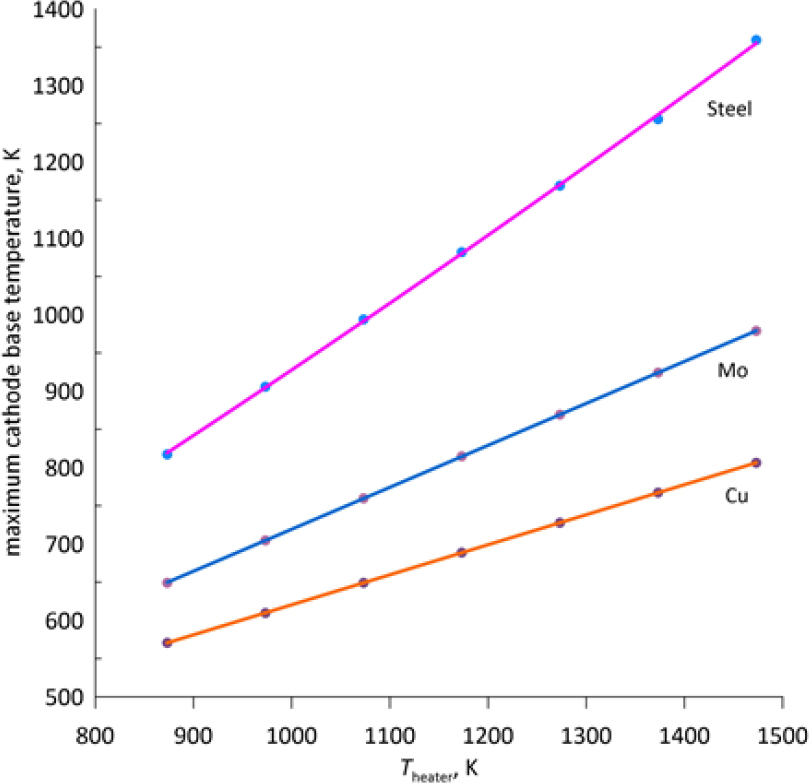
Fig. 17.
A comparative graph of the maximum cathode base temperature for three materials as a function of heater temperature
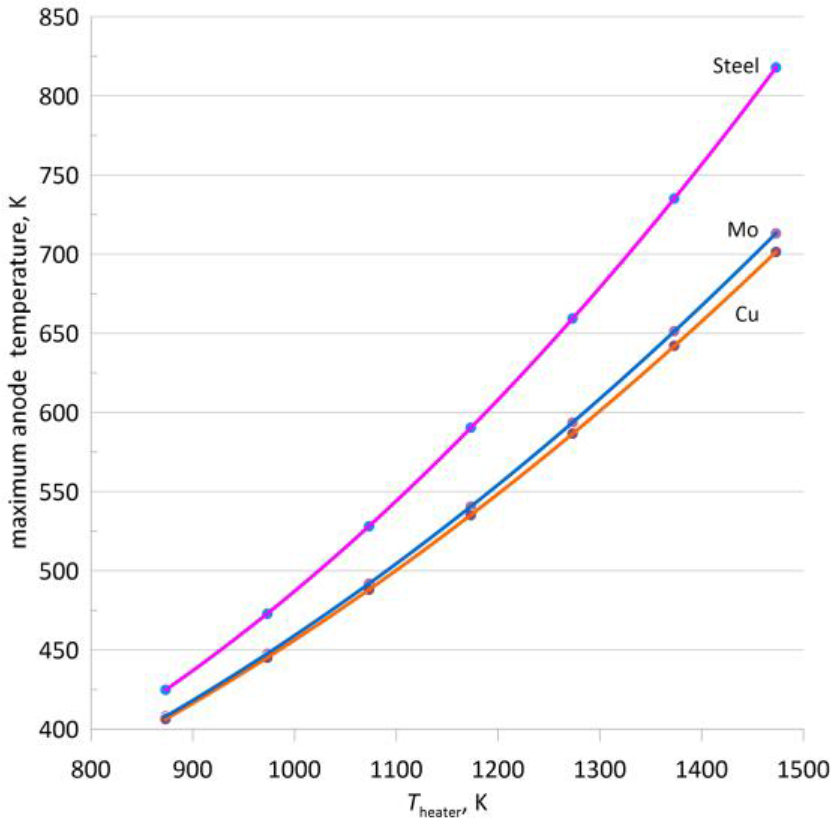
Fig. 18.
A comparative graph of the maximum anode temperature for three materials as a function of cathode temperature