
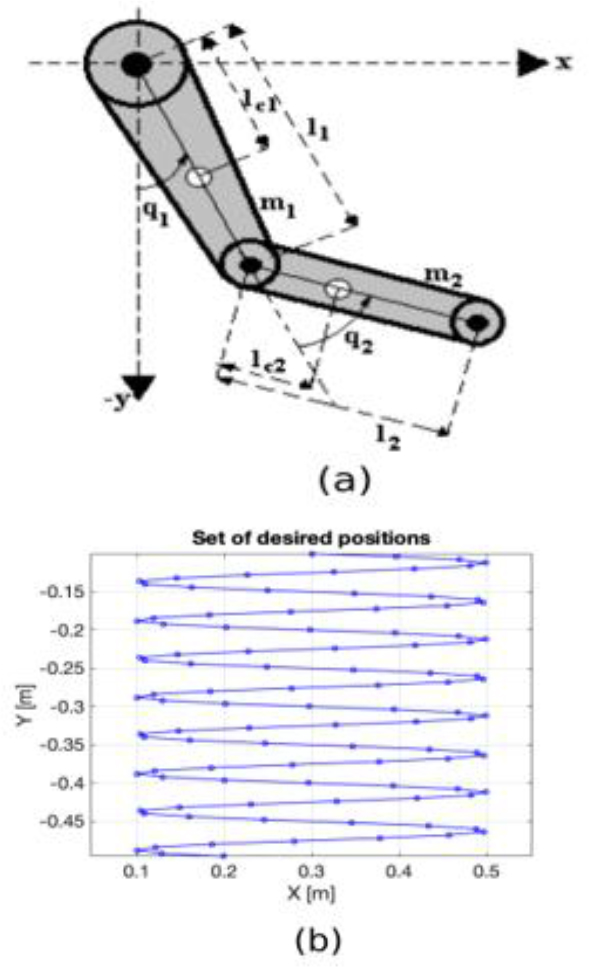
Fig. 1.
(a) Two-DOF manipulator diagram; (b) Desired positions in the workspace for RBF training
Tab. 1.
Parameters of the simulated anthropomorphic arm manipulator
| Parameter | Value |
|---|---|
| l1, l2 (link lengths) | 0.45m |
| 150 Nm, 15 Nm | |
| kg1(q), kg2(q) | 40.28 Nm, 1.81 Nm |
| Inertia Matrix | |
| Coriolis Matrix | |
| Gravitational torque vector | |
| Friction coefficient matrix |
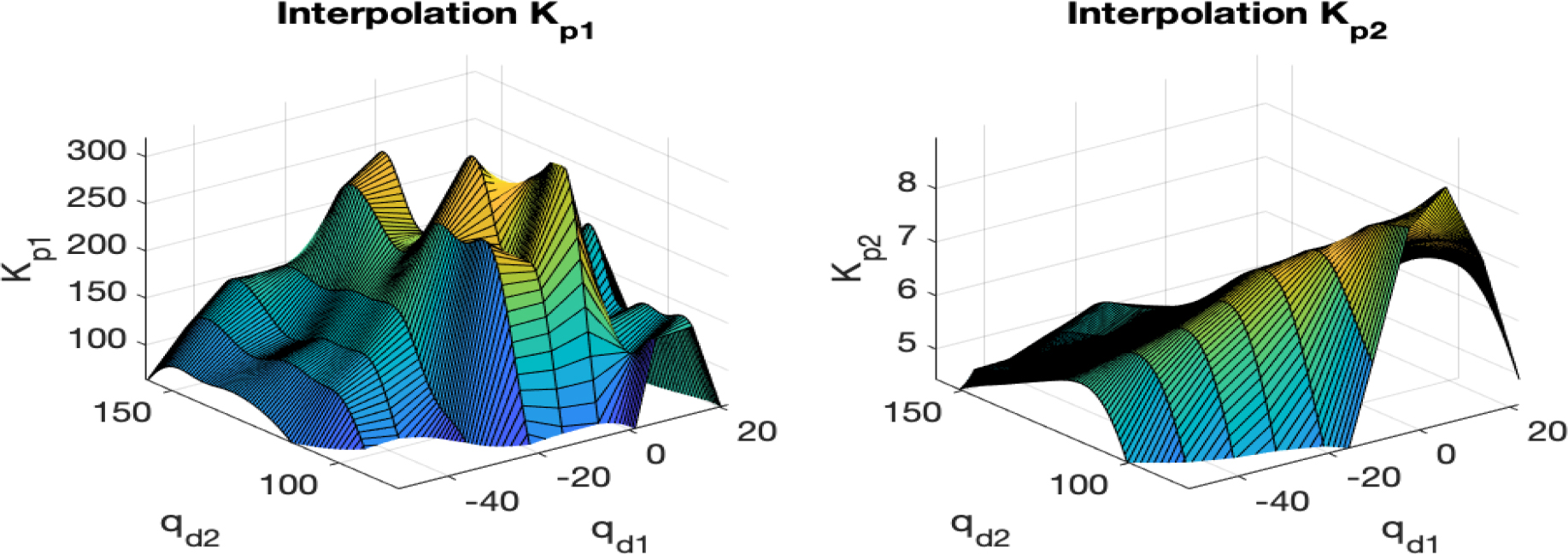
Fig. 2.
Interpolation of kp1(qd1, qd2) and kp2(qd1, qd2)
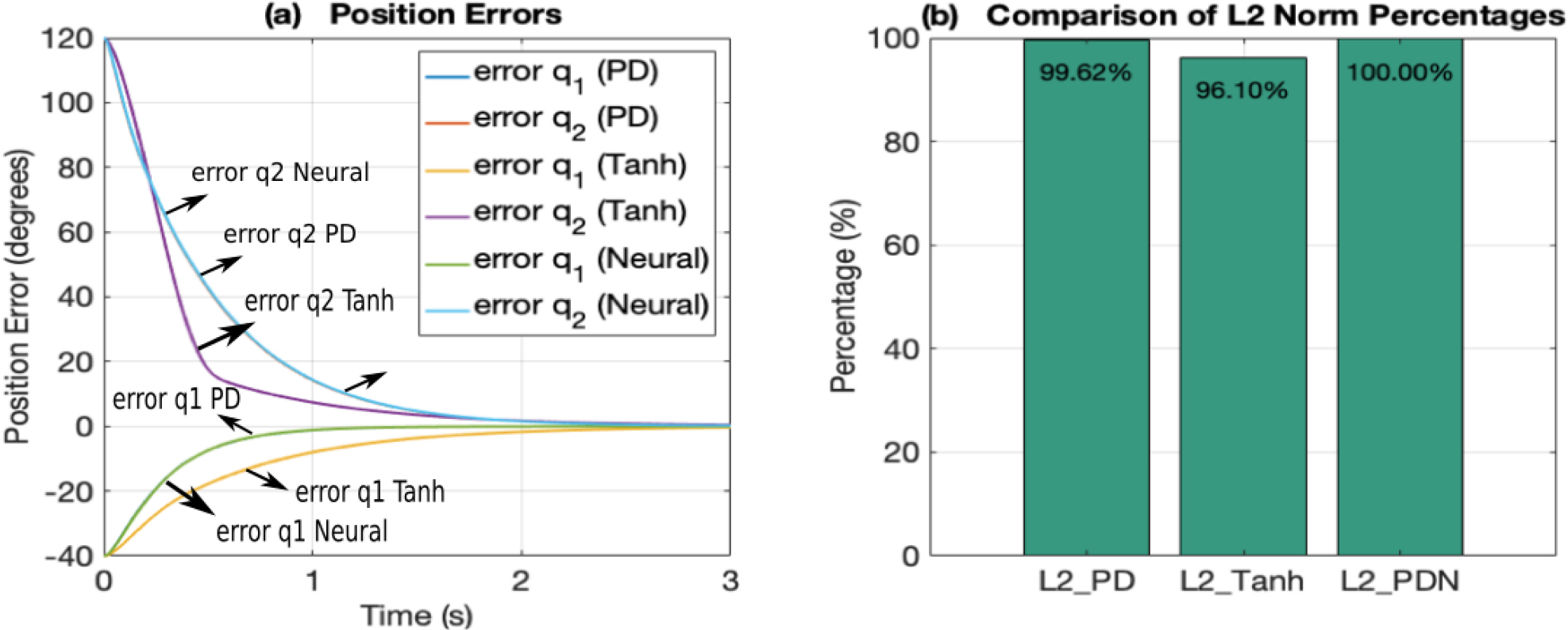
Fig. 3.
Responses for qd1 = –40° and qd2 = 120°. (a) Position errors. (b) Comparison of ℒ2 Norms
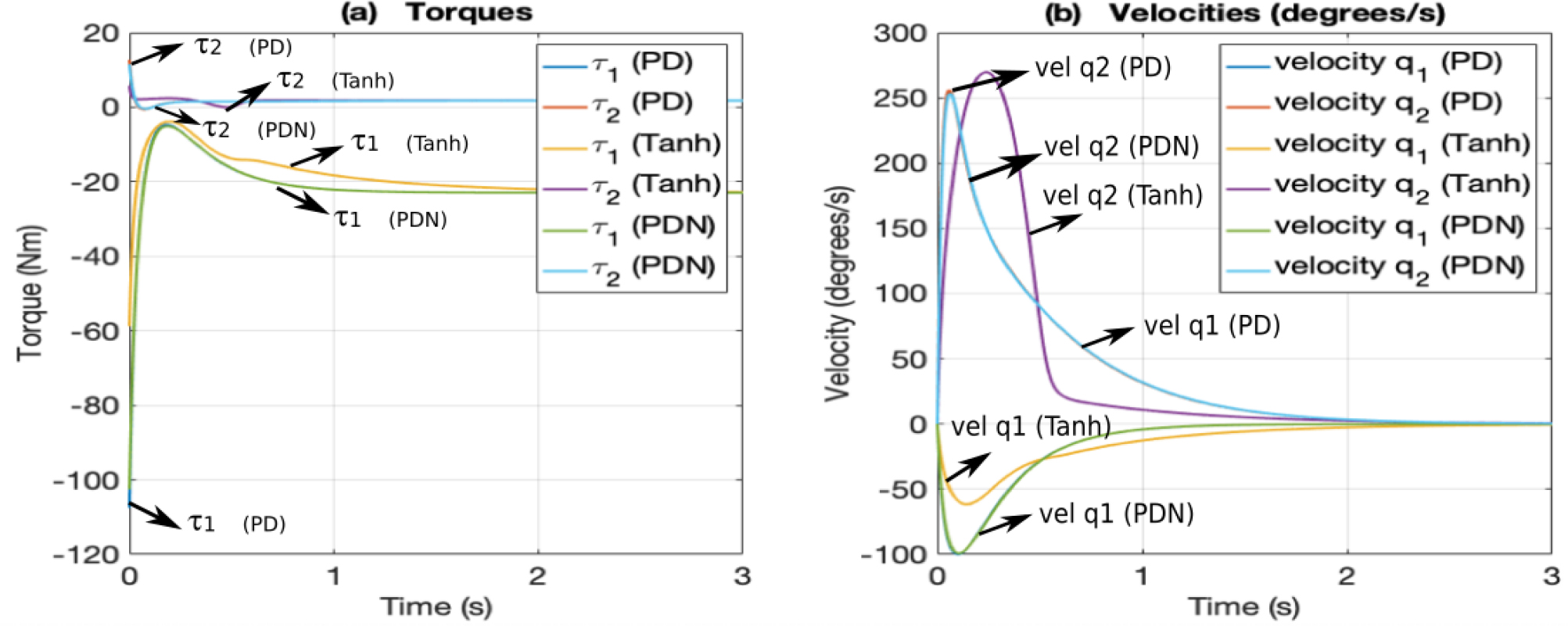
Fig. 4.
Responses for qd1 = –40° and qd2 = 120°. (a) Torque responses. (b) Angular velocities
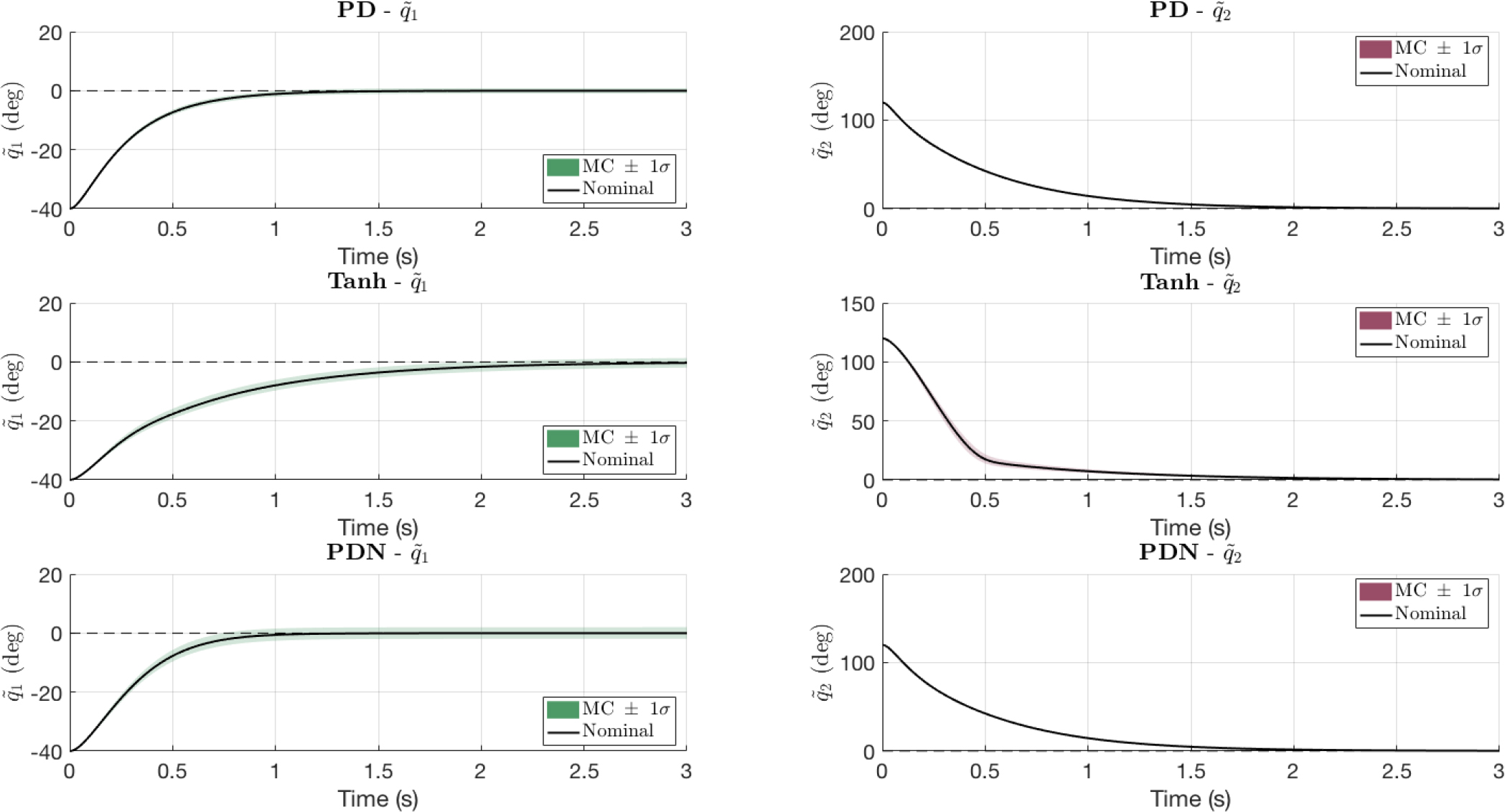
Fig. 5.
Monte Carlo robustness of PD, Tanh, and PDN controllers under parametric uncertainty and (qd1, qd2) = (–40°, 120°)
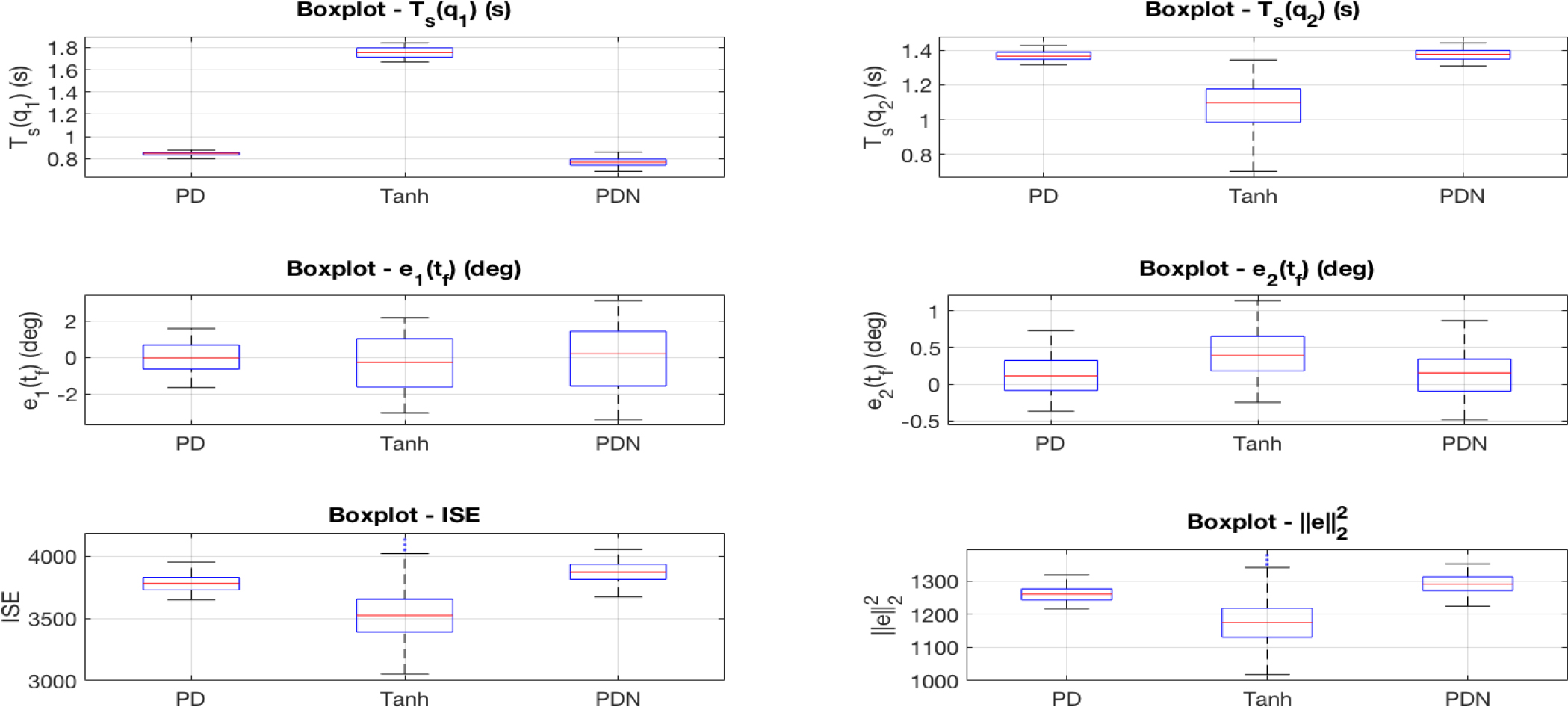
Fig. 6
Boxplots of robustness metrics (Ts, e(ts), ISE, and ℒ2 – i. e., ∥e∥2 –) for PD, Tanh, and PDN controllers with (qd1, qd2) = (–40°, 120°), ±15% parametric uncertainty, and 200 Monte Carlo trials
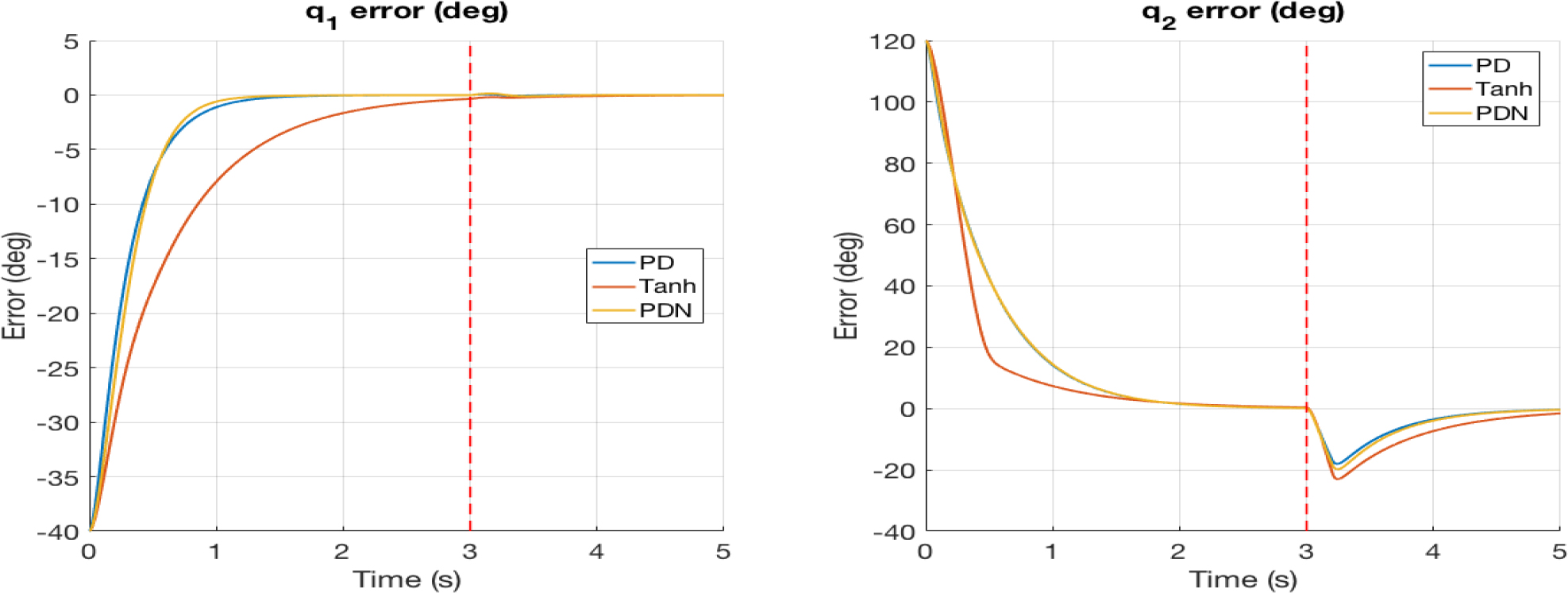
Fig. 7.
Disturbance Rejection to a 6 Nm, 0.15 s Torque Pulse at Joint 2 (t = 3 s): q1 and q2 Position Errors for PD, Tanh, and PDN
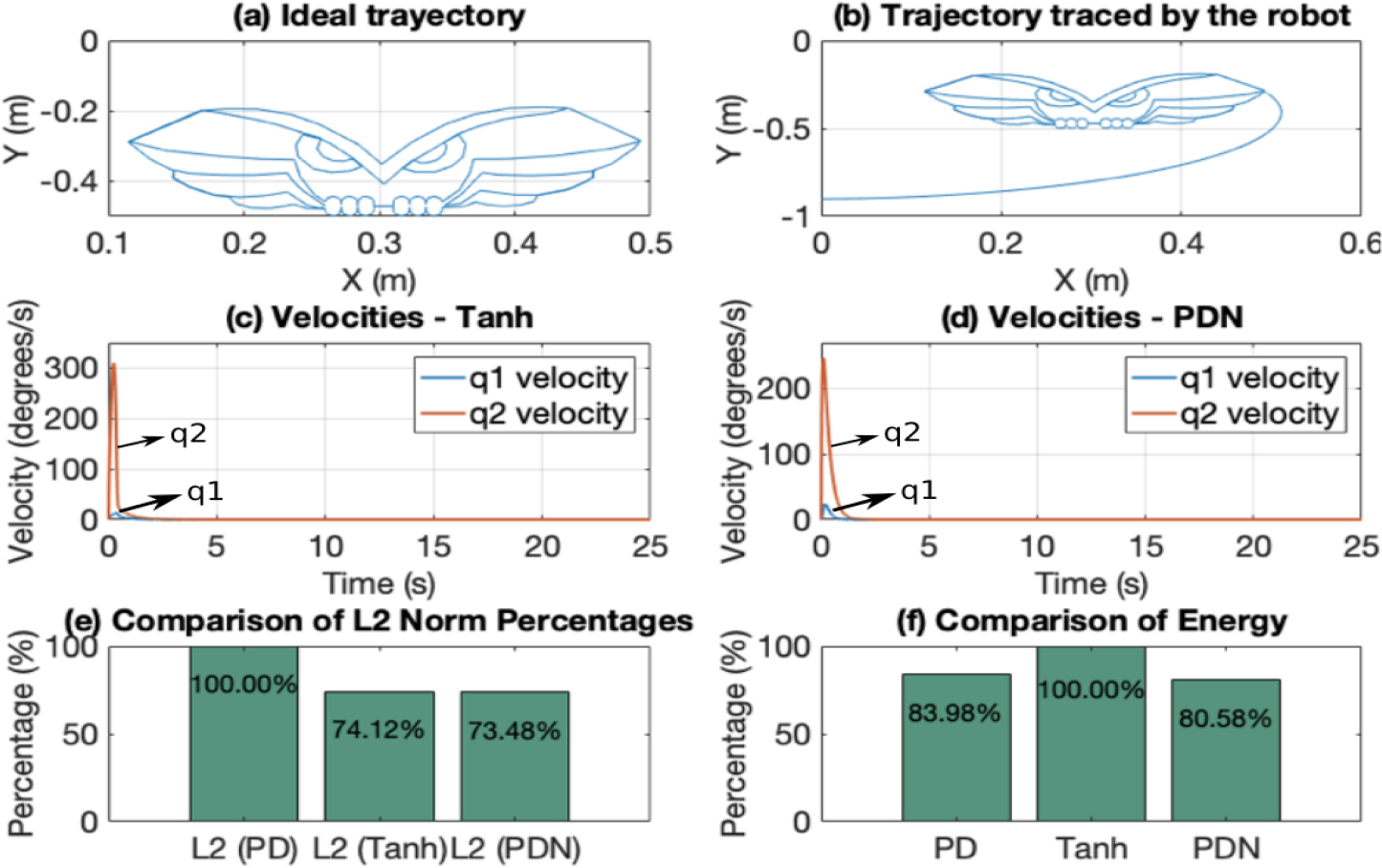
Fig. 8.
Point-to-point "Owl" trajectory tracking. (a) Ideal trajectory. (b) Trajectory with the PDN controller. (c) Actuator speed with the Tanh controller. (d) Actuator speed with the PDN controller. (e) Comparison of ℒ2 norms. (f) Comparison of energy consumption.
Tab. 2.
Comparative table of studies on PD controllers with variable gains
| Study | Controller Type | Variable Gain Structure | Stability Analysis Method | Validation Approach |
|---|---|---|---|---|
| [4] | PD-like with variable gains | Variable; state-, position-, and velocity-dependent; smooth functions (e.g. cos2 (tanh (error+velocity))) | Lyapunov theory; global asymptotic stability; gravity compensation required | Simulation; two-DOF direct-drive robot; joint regulation; L2 norm |
| [15] | PD iterative neural-network learning (PDISN) | Likely variable/adaptive; neural network and iterative learning | Extended Lyapunov theories; stability type not specified | Simulation; manipulator characteristics not specified; scenario not specified |
| [16] | Proportional-derivative (PD) | Variable; tuned by self-organizing fuzzy algorithm | Not analyzed (no details) | Simulation; manipulator characteristics not specified; tracking control; position error metric |
| [17] | Self-tuning PD | Bounded, time-varying; neurofuzzy recurrent scheme | Lyapunov theory; semi-global exponential stability | Simulation; manipulator characteristics not specified; trajectory tracking |
| [18] | Nonlinear PID with fuzzy self-tuned PD gains | Variable, position-dependent; fuzzy logic | Not mentioned; global asymptotic stability; no gravity compensation | Experiments; type not specified; scenario and metrics not specified |
| [19] | Adaptive PD | Adaptive to gravity parameters | Not mentioned; global convergence | Simulation; three-DOF manipulator; point-to-point and tracking |
| [20] | PD-type robust | Variable, error-varying; parameterized by perturbing parameter | Singular perturbation theory; stability type not explicit | Physical experiment; planar two-DOF direct-drive robot; trajectory tracking |
| [21] | Adaptive iterative learning control (ILC)-PD | Variable; iterative learning, two iterative variables | Lyapunov theory; asymptotic convergence | Simulation; two-DOF manipulator; trajectory tracking |
| [22] | PD-type | Variable, state-dependent | Not mentioned; global asymptotic stability claimed | Physical experiment; two-DOF directdrive arm; scenario not specified |
| [23] | Linear and nonlinear PD-type | Nonlinear functions of system states | Not mentioned; global asymptotic stability claimed | Simulation; single-link and two-DOF robots; trajectory tracking |
| This work | PD-like with variable gains | Variable; desired position dependent proportional gains with RBF interpolation networks trained offline | Lyapunov theory; global asymptotic stability; gravity compensation required | Simulation; two-DOF direct-drive robot; joint regulation; L2 norm, point-to-point tracking; regulation performance evaluated with parametric uncertainties and external perturbations |