
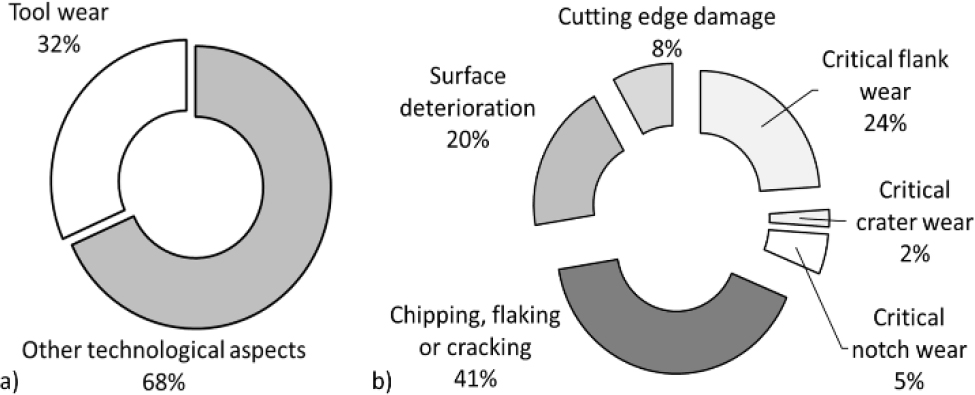
Fig. 1.
a)Reasons for premature tool replacement, b) forms of tool wear
Tab. 1.
Critical value of tool wear symptoms
| Tool wear symptom | Critical value |
|---|---|
| maximum width of flank wear VBB (ISO 3685 [4]); crater wear on the rake face | VBB = 0.6 mm in case the wear area is not regular; average wear width VBB = 0.3 mm for a regular wear surface in zone B of the cutting tool flank |
| intensive wear on the major or minor flank VBN | notch wear VBN exceeding 1 mm when it dominates other tool wear phenomena |
| chipping, flaking or cracking | excessive chipping, flaking or cracking of the cutting edge |
| sudden deterioration of the machined surface quality caused by destruction of the minor flank | Ra of the machined surface exceeds 0.4 μm, 0.8 μm, 1.6 μm, 3.2 μm, 6.3 μm, 12.5 μm (ISO 3685 [2]), other roughness or waviness parameters |
| cutting edge damage | catastrophic failure defined as sudden failure of the cutting edge under the influence of both load and increasing cutting temperature (ISO 3685 [2]). |
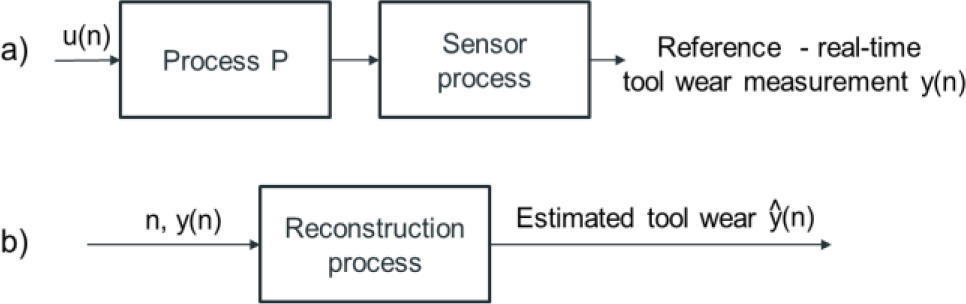
Fig. 2.
a)Measuring reference data, b) off-line identification of reference value model
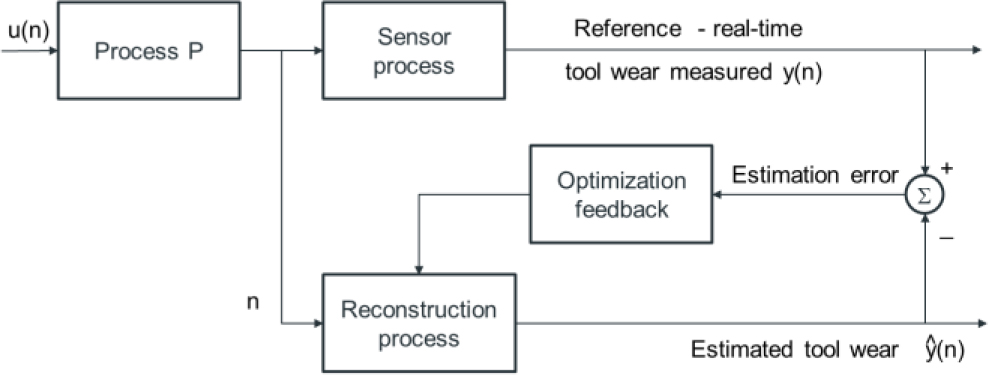
Fig. 3.
Recursive model of tool wear
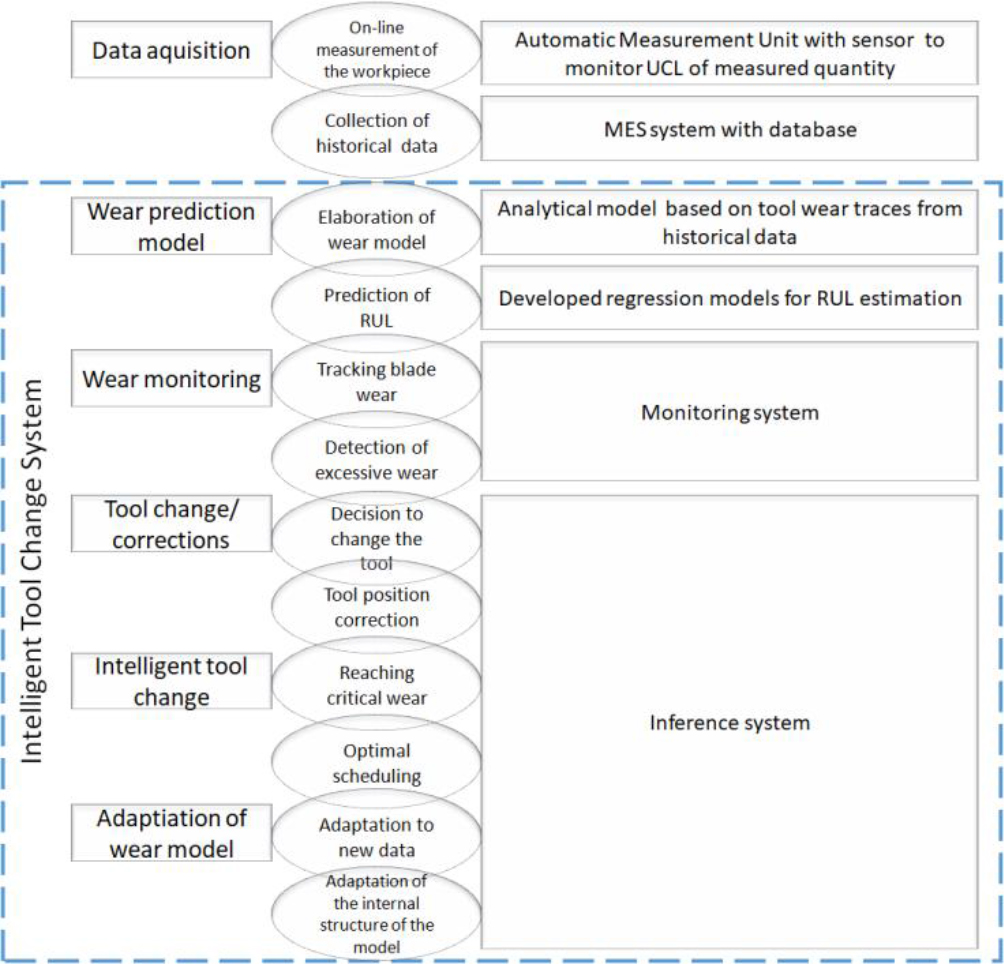
Fig. 4.
The strategy for developing wear model useful in Intelligent Tool Change System
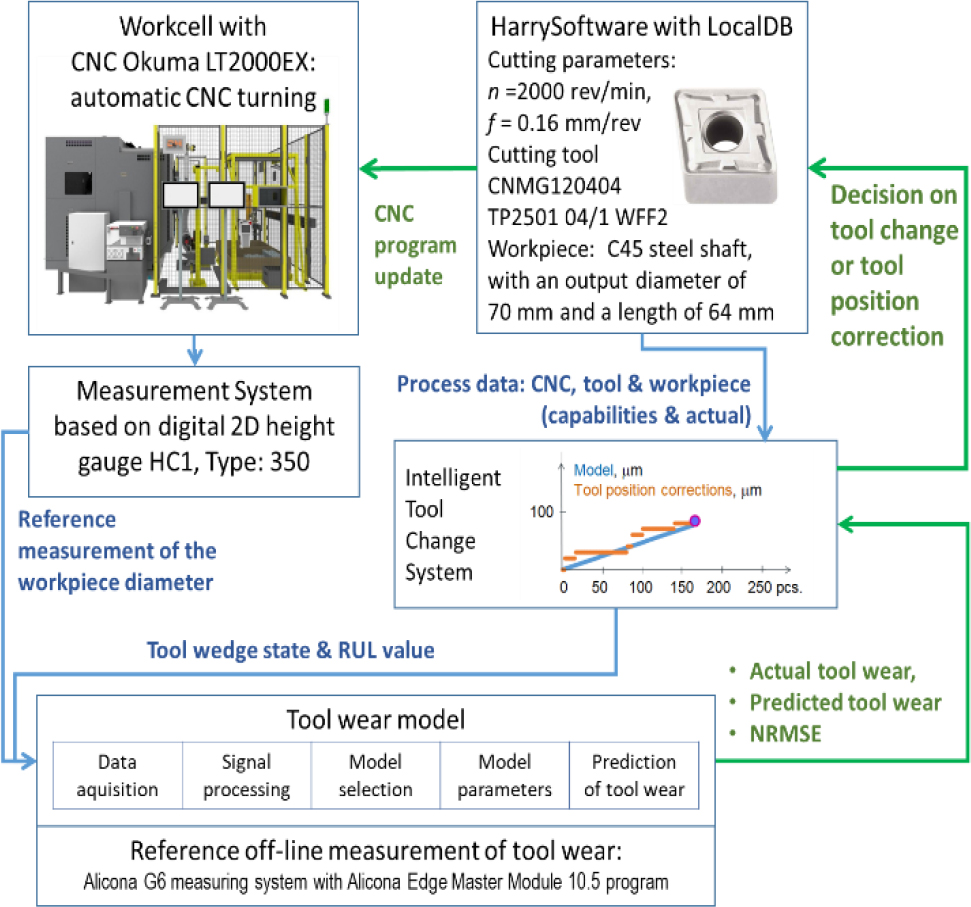
Fig. 5.
Schematic diagrams of the cutting experiment and tool wear measurement setup
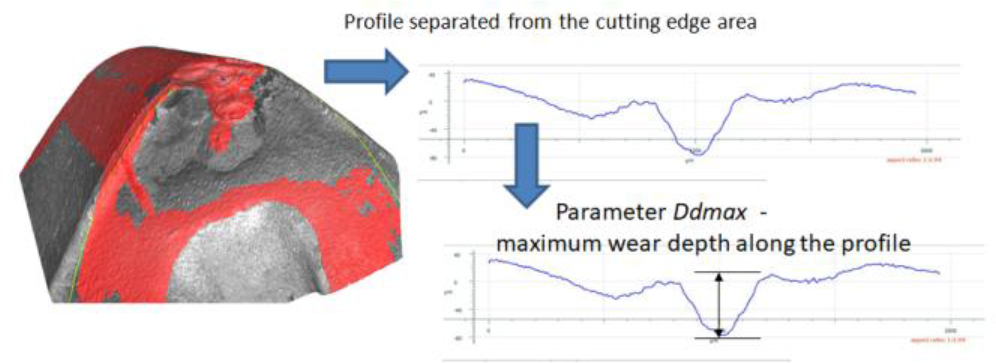
Fig. 6.
Determination of the blade shortening KEmax using the Ddmax parameter
Tab. 2.
Summary of assumptions for building the cutting tool wear model
| Assumptions | RUL | Tool position correction |
|---|---|---|
| The model should represent the change in tool edge reduction over time. The output of the model should be the tool edge reduction value KE, and the independent variable should be cutting time. | The edge reduction value over time allows for summing values and comparing them with the critical value. | The edge reduction value over time allows for determining current corrections in the process and predicting corrections for subsequent time units. |
| The model should enable the determination of the tool infeed, taking into account the tool edge reduction. The infeed value determined on the basis of the model should enable the correction of the position due to the assumed accuracy of the workpiece. | The infeed value determined on the basis of the model enables comparison with the critical infeed value, above which it is not possible to achieve the assumed dimensional and shape accuracy and surface roughness. | The infeed value determined on the basis of the model makes it possible to achieve the assumed accuracy of the workpiece. |
| The model should reflect the progression of tool wear over time, i.e. a typical S-shaped profile, with rapid initial growth, an almost flat middle region, and a final rapid growth. The model is nonlinear and it should be taken into account that the wear pattern changes with time tA. | The gradient of the S-shaped function determines three areas of wear changes over time: the first area with a decreasing value, the second area of a constant value and the third area of accelerated wear, the value of which increases over time and which allows for the estimation of the RUL. | The gradient of the W-shaped function determines three areas of wear changes over time and thus allows for estimating the correction values for each of the areas. |
| The model should take into account tool wear mechanisms. Model parameters must be interpretable in terms of tool edge reduction over time. Parameters must enable assessment of the intensity of wear mechanisms over time for different cutting conditions. | Model parameters resulting from the intensity of elementary wear processes can be used to estimate the RUL value. | Model parameters resulting from the intensity of elementary wear processes enable the determination of corrections to tool life based on them. |
| The model should take into account the constant cutting process load as an input signal. In principle, the undeformed chip thickness for each tool feed has a constant value, which at a constant cutting speed allows the assumption of a constant load (material removal rate), described by a unit stroke function. | The model taking into account the constant cutting load makes it possible to predict RUL. | Assuming a constant cutting load allows the influence of other factors influencing the wear process to be limited and thus the error in predicting corrections in the process to be limited. |
Tab. 3.
Summary of assumptions for building the tool wear model
| Cutting edge reduction KE | NRMSE | |
|---|---|---|
| Linear model | First order inertial model | |
| 10% | 1.2 | 0.17 |
| 50% | 0.86 | 0.47 |
| 75% | 0.75 | 0.39 |
| 100% | 0.33 | 0.43 |
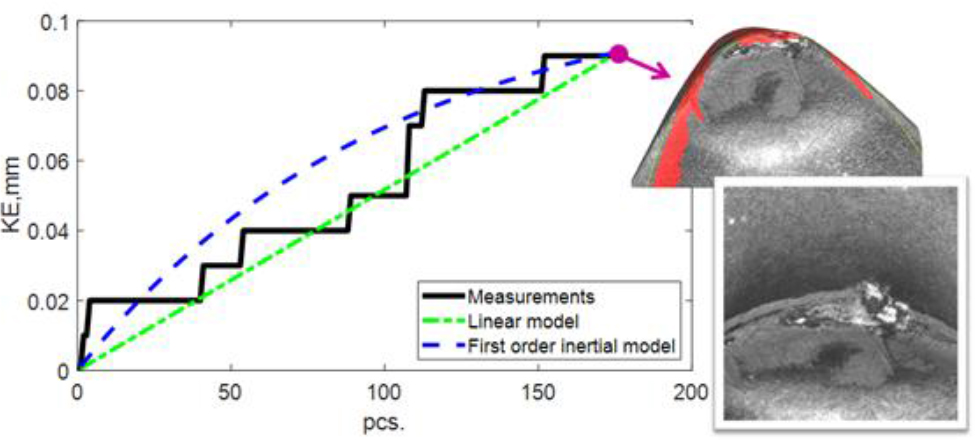
Fig. 7.
Example of application of linear and first-order inertial models in the estimation of tool wear
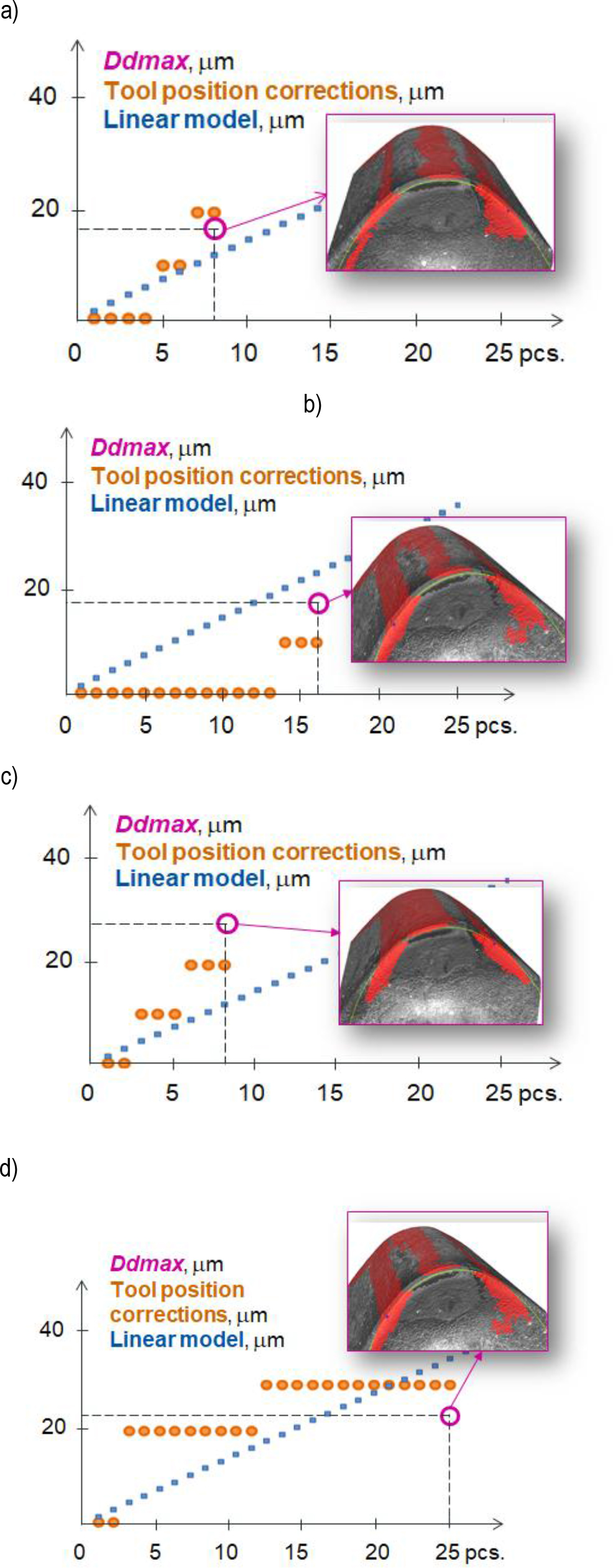
Fig. 8.
Tool wear cases as a function of the number of workpieces, highlighting the Ddmax values
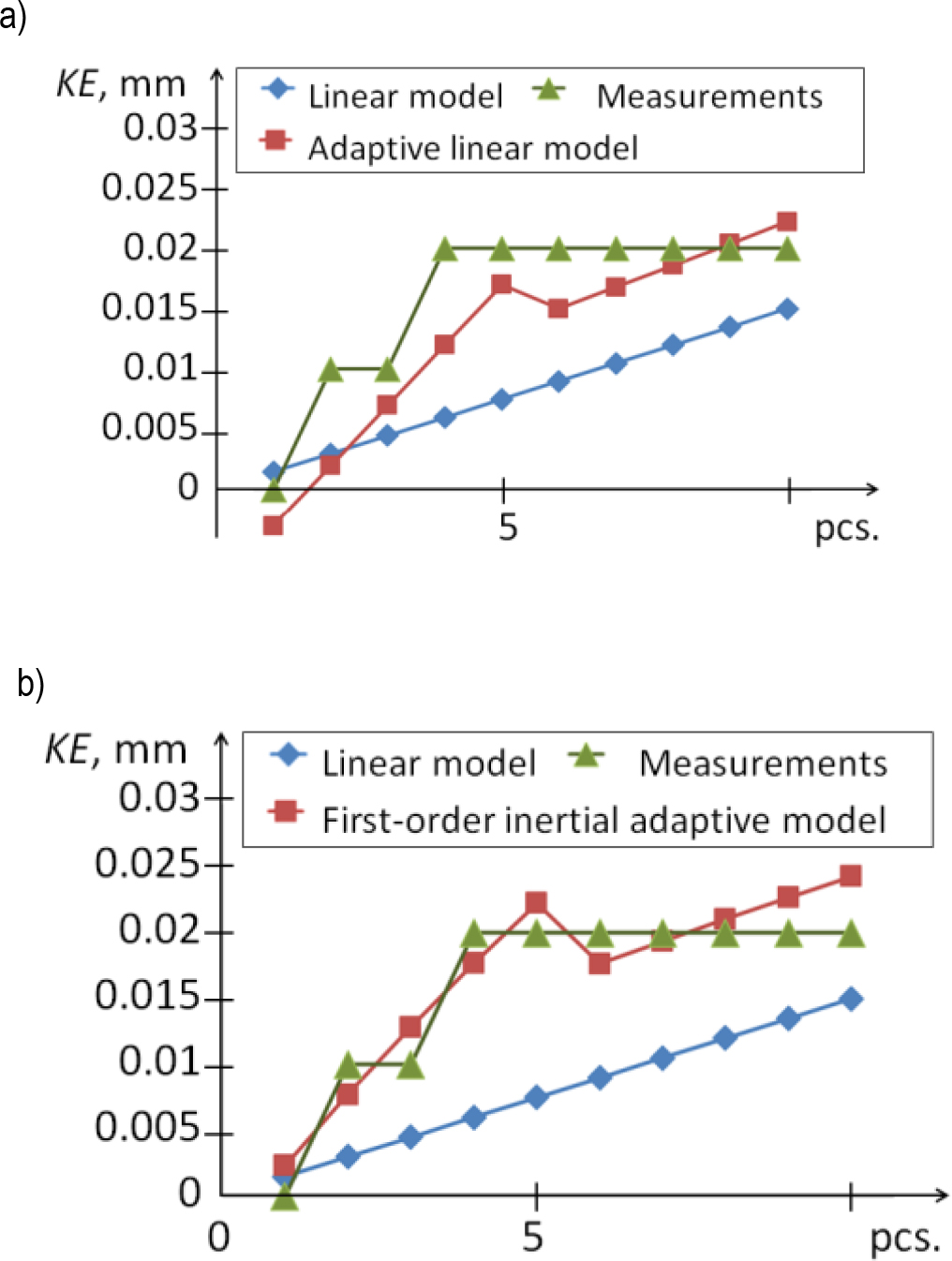
Fig. 9.
comparison of tool wear measurements and data generated using the linear model, as well as the adaptive linear model (a) and first-order inertial adaptive model (b), as reference data for tool position correction for the first 10 pieces
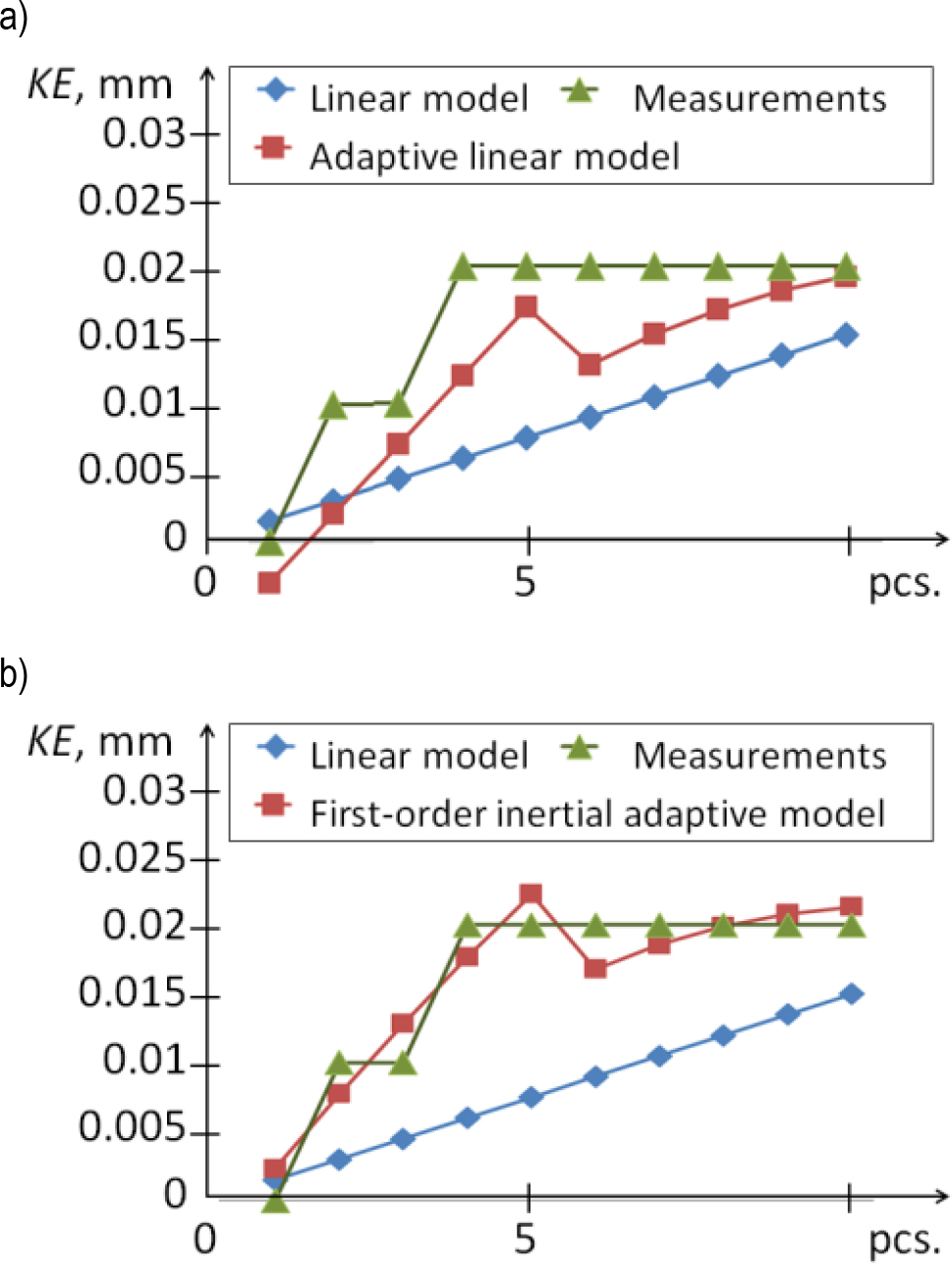
Fig. 10.
A comparison of tool wear measurements and data generated using the linear model and the adaptive linear model (a) and first-order inertial adaptive model (b), as reference data for tool position correction, considering a smoothing window for the first 10 pieces
Tab. 4.
Adaptive linear function models with a 50-piece FIFO buffer
| Recursive model with parameter estimation every 5 pieces | Averaging recursive model | |
|---|---|---|
| Adaptive linear model | 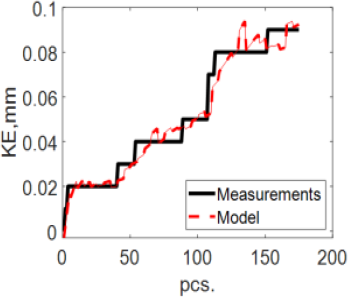 𝑁𝑅𝑀𝑆𝐸=0.2087 | 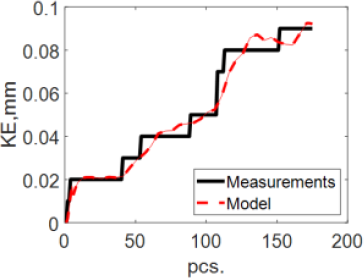 𝑁𝑅𝑀𝑆𝐸=0.1964 |
| Model of the monotonic function | 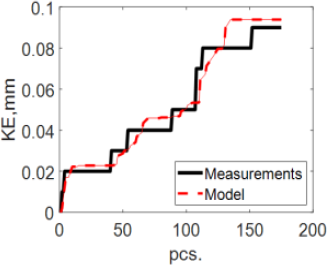 𝑁𝑅𝑀𝑆𝐸=0.2350 | 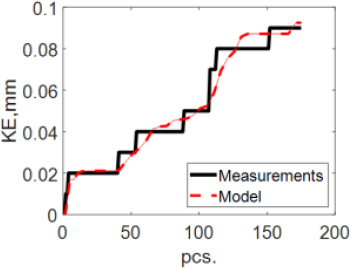 𝑁𝑅𝑀𝑆𝐸=0.1884 |
| Model with a constant increment of 5 μm | 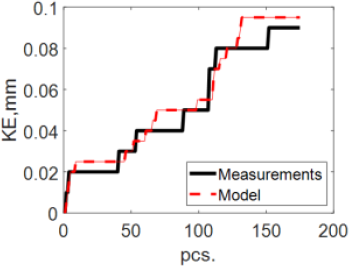 𝑁𝑅𝑀𝑆𝐸=0.2674 | 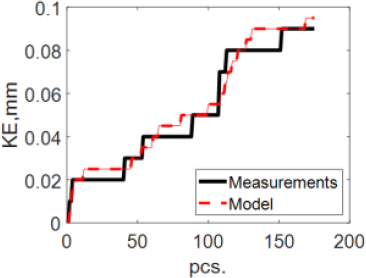 𝑁𝑅𝑀𝑆𝐸=0.2187 |
Tab. 5.
First order inertial adaptive model with a 50-piece FIFO buffer
| Recursive model with parameter estimation every 5 pieces | Averaging recursive model | |
|---|---|---|
| First order inertial adaptive model | 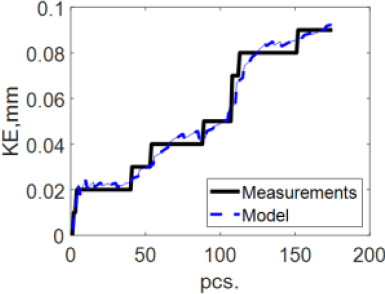 𝑁𝑅𝑀𝑆𝐸=0.1515 | 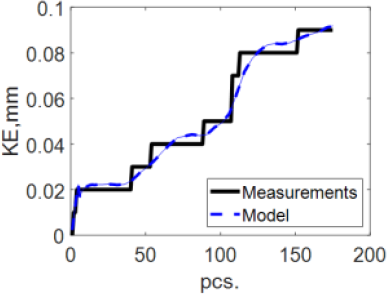 𝑁𝑅𝑀𝑆𝐸=0.1527 |
| Model of the monotonic function | 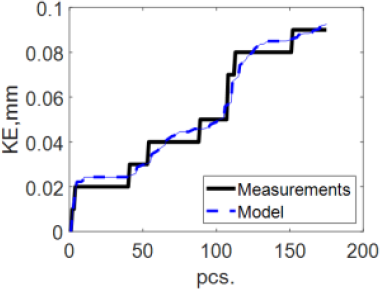 𝑁𝑅𝑀𝑆𝐸=0.1685 | 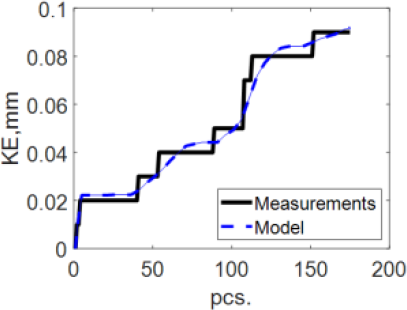 𝑁𝑅𝑀𝑆𝐸=0.1543 |
| Model with a constant increment of 5 μm | 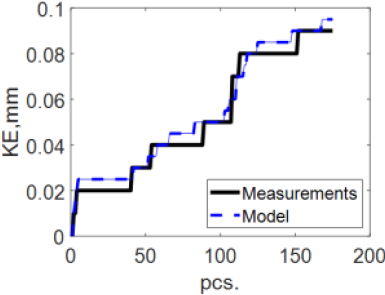 𝑁𝑅𝑀𝑆𝐸=0.1890 | 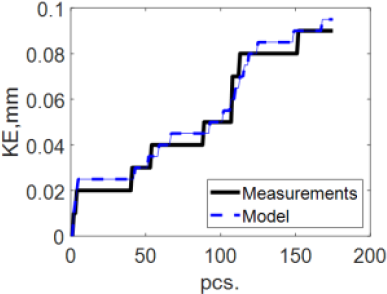 𝑁𝑅𝑀𝑆𝐸=0.1783 |