
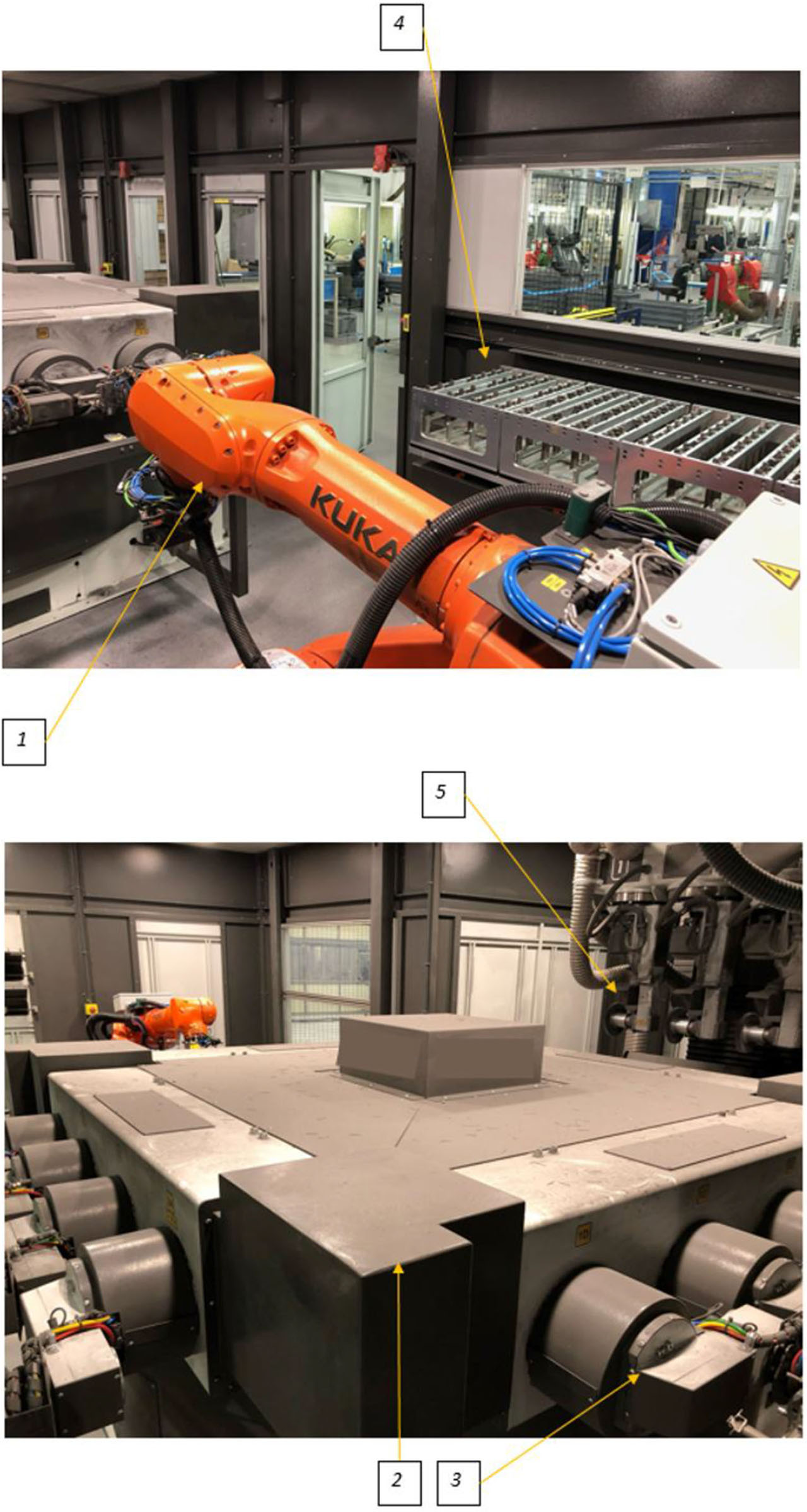
Fig. 1.
Work station (1 - industrial manipulator, 2 - rotary table, 3 - workpiece gripper, 4 - workpiece magazine, 5 - tool holder)
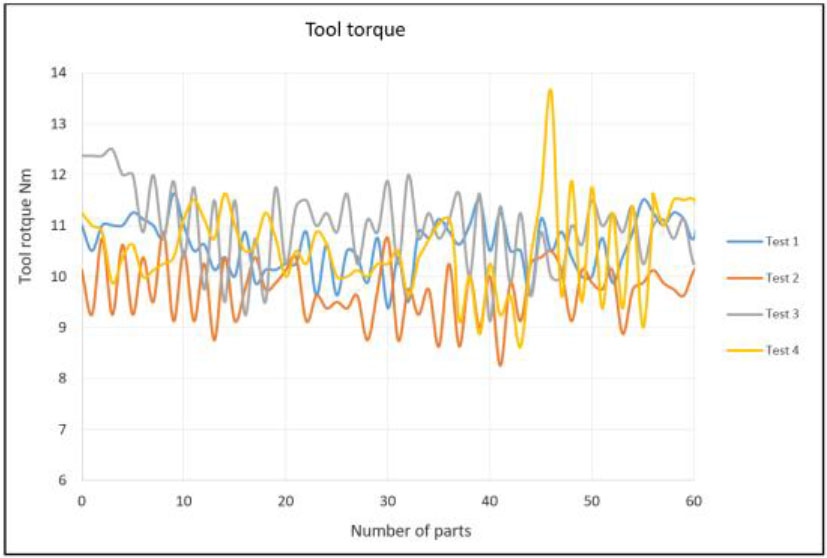
Fig. 2.
Tool torque in relations with numer of brushed parts
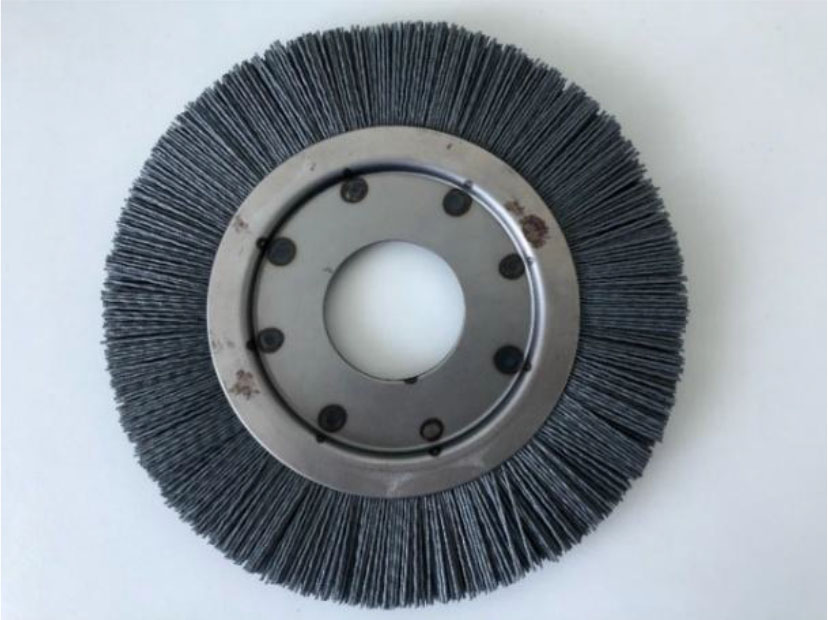
Fig. 3.
A brush-type tool used in the production process
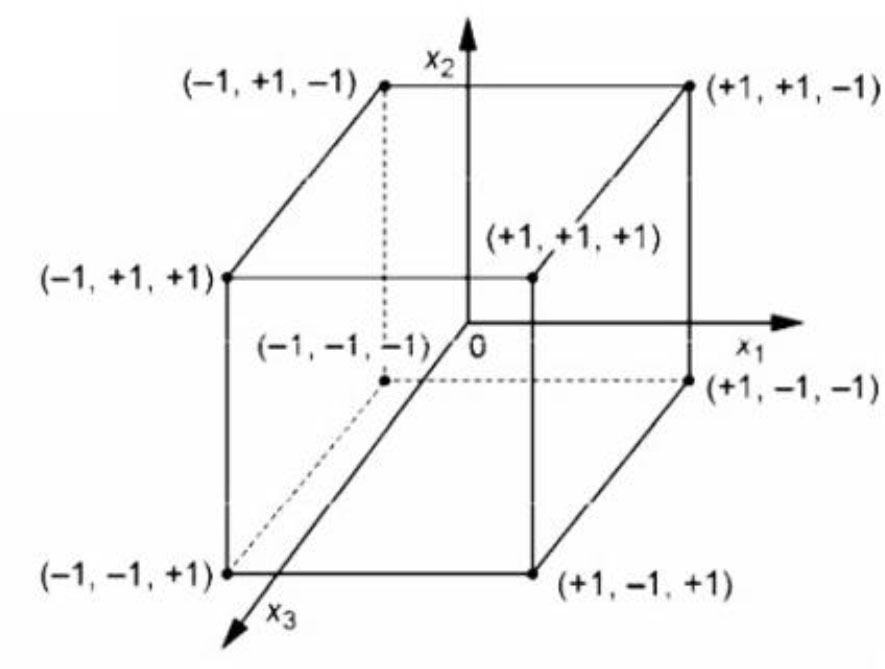
Fig. 4.
Implementation scheme of experiment (3 input factors on 2 levels) [42]
Tab. 1
Test matrix, columns X1, X2, X3 define the top level (“+”) and bottom level (“−”) of selected process parameters
| Test number | X1 | X2 | X3 | Rotationai speed rpm | Engagement as brush diameter mm | Number of brushed parts |
|---|---|---|---|---|---|---|
| 1 | + | + | + | 2000 | 200 | 60 |
| 2 | + | + | − | 2000 | 200 | 30 |
| 3 | + | − | + | 2000 | 198 | 60 |
| 4 | + | − | − | 2000 | 198 | 30 |
| 5 | − | + | + | 1400 | 200 | 60 |
| 6 | − | + | − | 1400 | 200 | 30 |
| 7 | − | − | + | 1400 | 198 | 60 |
| 8 | − | − | − | 1400 | 198 | 30 |
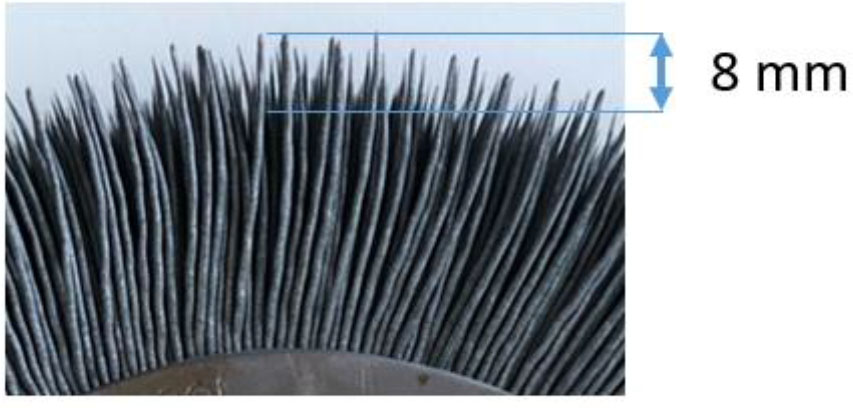
Fig. 5.
The depth to which the brush tool was wear
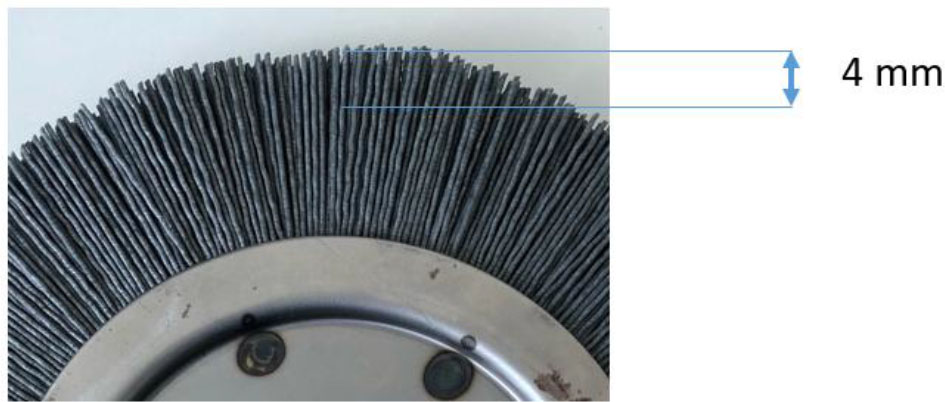
Fig. 6.
Place of measurement of bristle thickness after the test
Tab. 2
Test results – measured bristle thickness
| Test number | y1 | y2 | y3 | y4 | y5 | y6 | y7 | y8 | y9 | y10 | y11 | y12 | ȳ |
|---|---|---|---|---|---|---|---|---|---|---|---|---|---|
| 1 | 0.64 | 0.55 | 0.55 | 0.63 | 0.73 | 0.64 | 0.59 | 0.51 | 0.41 | 0.41 | 0.55 | 0.56 | 0.56 |
| 2 | 0.9 | 0.6 | 0.83 | 0.48 | 0.66 | 0.74 | 0.73 | 0.64 | 0.43 | 0.95 | 0.86 | 0.86 | 0.72 |
| 3 | 0.6 | 0.52 | 0.62 | 0.53 | 0.53 | 0.54 | 0.53 | 0.58 | 0.55 | 0.55 | 0.6 | 0.54 | 0.56 |
| 4 | 0.57 | 0.48 | 0.46 | 0.75 | 0.6 | 0.55 | 0.61 | 0.69 | 0.66 | 0.55 | 0.62 | 0.7 | 0.60 |
| 5 | 0.4 | 0.54 | 0.42 | 0.64 | 0.64 | 0.69 | 0.76 | 0.8 | 0.7 | 0.82 | 0.74 | 0.85 | 0.67 |
| 6 | 0.8 | 0.92 | 0.75 | 0.69 | 0.83 | 0.8 | 0.62 | 0.5 | 0.62 | 0.45 | 0.7 | 0.65 | 0.69 |
| 7 | 0.47 | 0.67 | 0.3 | 0.45 | 0.46 | 0.4 | 0.36 | 0.4 | 0.38 | 0.35 | 0.56 | 0.5 | 0.44 |
| 8 | 0.3 | 0.4 | 0.55 | 0.59 | 0.3 | 0.63 | 0.53 | 0.56 | 0.64 | 0.77 | 0.89 | 0.49 | 0.55 |
Tab. 3
Error variance for individual trials
| Test number | S2 |
|---|---|
| 1 | 0.0079 |
| 2 | 0.0253 |
| 3 | 0.0010 |
| 4 | 0.0070 |
| 5 | 0.0200 |
| 6 | 0.0171 |
| 7 | 0.0094 |
| 8 | 0.0276 |
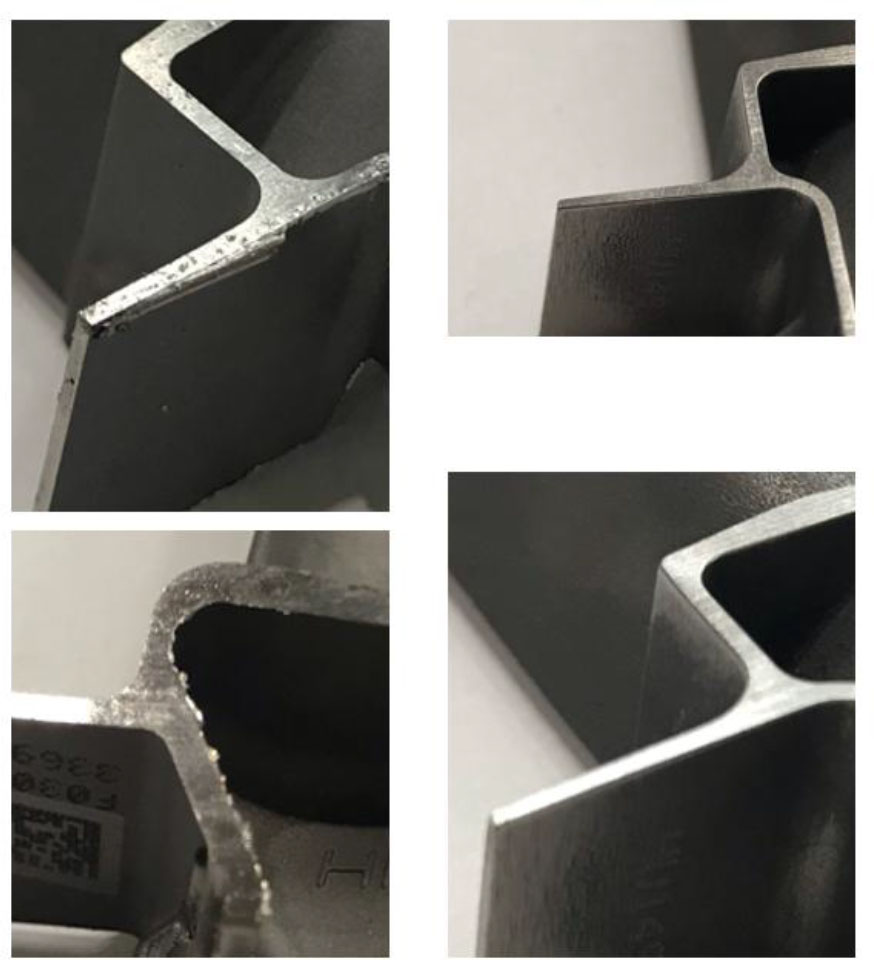
Fig. 7.
Typical parts condition before (left side) and after (right side) of brushing process
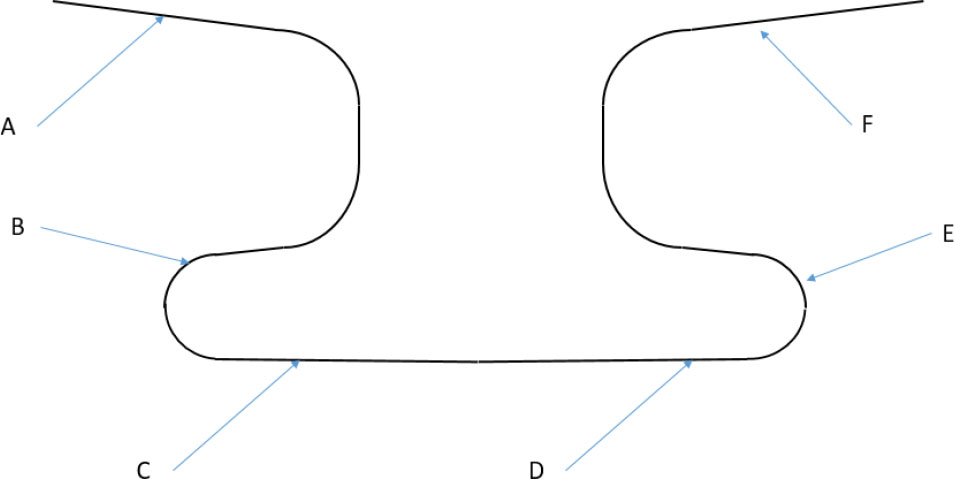
Fig. 8.
Location of control points – blade lock
Tab. 4
Results of the tests - the radius of edge break in chosen locations of the detail
| Test number | Measured value of Edge break, mm | |||||
|---|---|---|---|---|---|---|
| - | A | B | C | D | E | F |
| 1 | 0.16 | 0.11 | 0.17 | 0.16 | 0.31 | 0.29 |
| 2 | 0.15 | 0.10 | 0.13 | 0.15 | 0.34 | 0.36 |
| 3 | 0.18 | 0.19 | 0.17 | 0.14 | 0.25 | 0.27 |
| 4 | 0.27 | 0.16 | 0.19 | 0.19 | 0.33 | 0.3 |
| 5 | 0.17 | 0.12 | 0.18 | 0.14 | 0.24 | 0.27 |
| 6 | 0.13 | 0.11 | 0.13 | 0.13 | 0.29 | 0.25 |
| 7 | 0.13 | 0.12 | 0.15 | 0.13 | 0.30 | 0.30 |
| 8 | 0.14 | 0.10 | 0.20 | 0.13 | 0.32 | 0.35 |
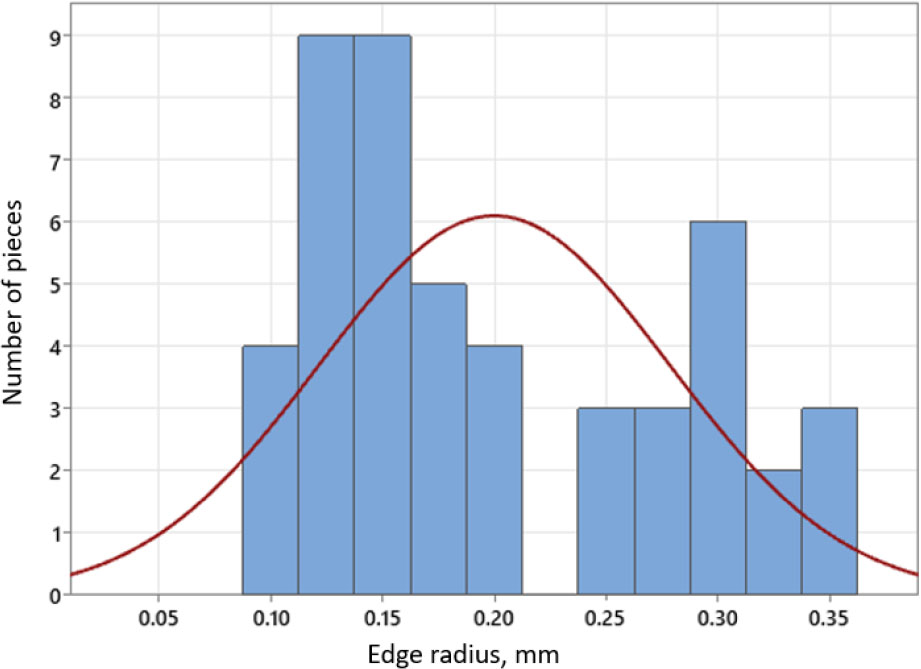
Fig. 9.
Results of test- histogram
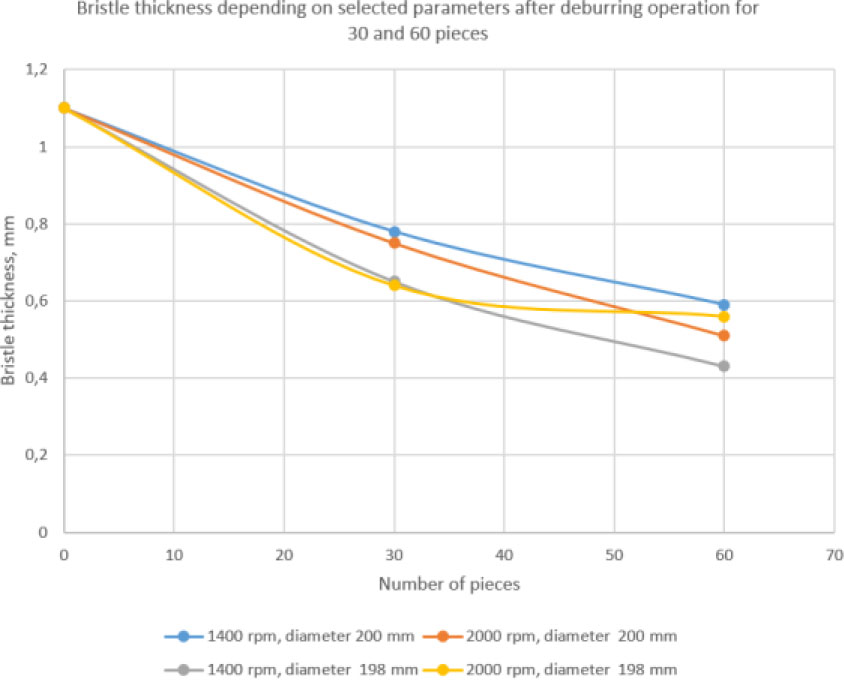
Fig. 10.
Bristle thickness depending on selected parameters after deburring operation for 30 and 60 pieces
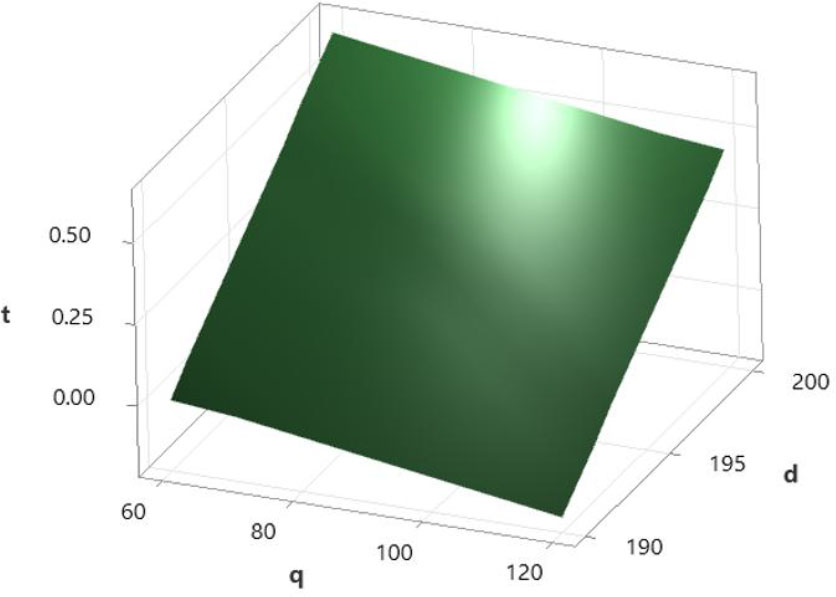
Fig. 11.
Graphical presentation of equation (35) (t – bristle thickness mm, d – brush diameter mm, q – number of processed parts)