
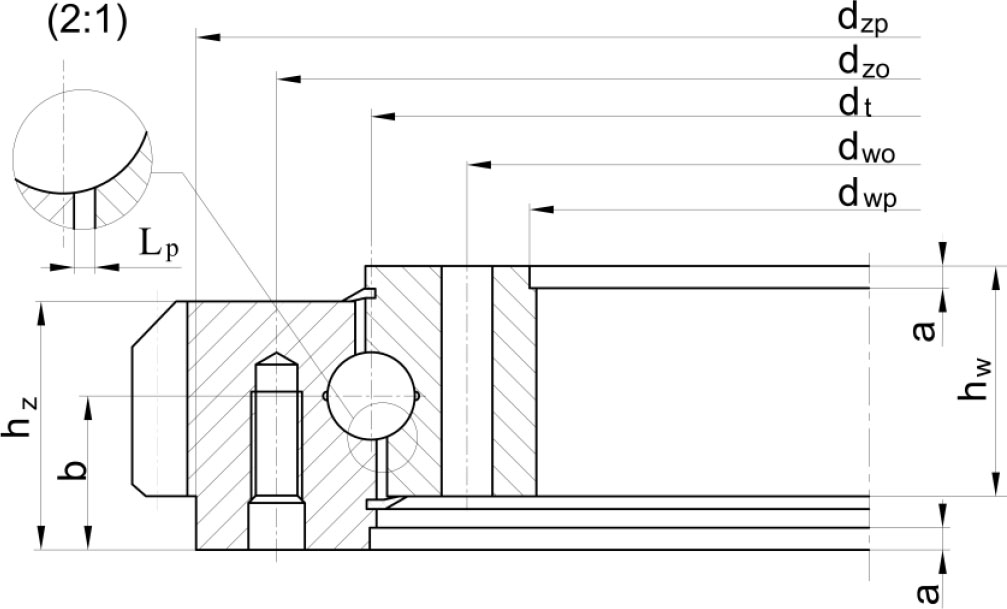
Fig. 1.
Basic geometric parameters of the single-row ball slewing bearing
Tab. 1.
Values of basic parameters of the single-row ball slewing bearing
| Parametr of the bearing | Value | |
|---|---|---|
| 1 | The track diameter of the bearing dt [mm] (Fig. 1) | 1105 |
| 2 | The ball diameter dk [mm] | 44 |
| 3 | Quotient rays of ball and receway kp [2, 34] | 0,96 |
| 4 | Dimension dzp[mm] (Fig. 1) | 1260 |
| 5 | Dimension dzo [mm] (Fig. 1) | 1200 |
| 6 | Dimension dwo[mm] (Fig. 1) | 1010 |
| 7 | Dimension dwp [mm] (Fig. 1) | 960 |
| 8 | High of the bering h [mm] | 137 |
| 9 | Dimension a [mm] (Fig 1) | 10 |
| 10 | Dimension b [mm] (Fig. 1) | 71 |
| 11 | Dimension hw [mm] (Fig. 1) | 117 |
| 12 | Dimension hz [mm] (Fig. 1) | 122 |
| 13 | Axial clearance [mm] | 0,5 |
| 14 | The clearance between the rings Lp [mm] (Fig. 1) | 7 |
| 15 | Nominal contact angle αo[°] | 45 |
| 16 | Row fill facctor | 0,83 |
| 17 | Number of bearing balls | 64 |
| 18 | The surface balls hardness | 62HRC |
| 19 | The surface raceway hardness | 56HRC |
| 20 | Number of the bolts mounting in the internal/external ring | 42/42 |
| 21 | The size and strength class mounting bolts by [DIN] [31] | M24-12.9 |
| 22 | Mounting tension force Sw [kN] | 242 |
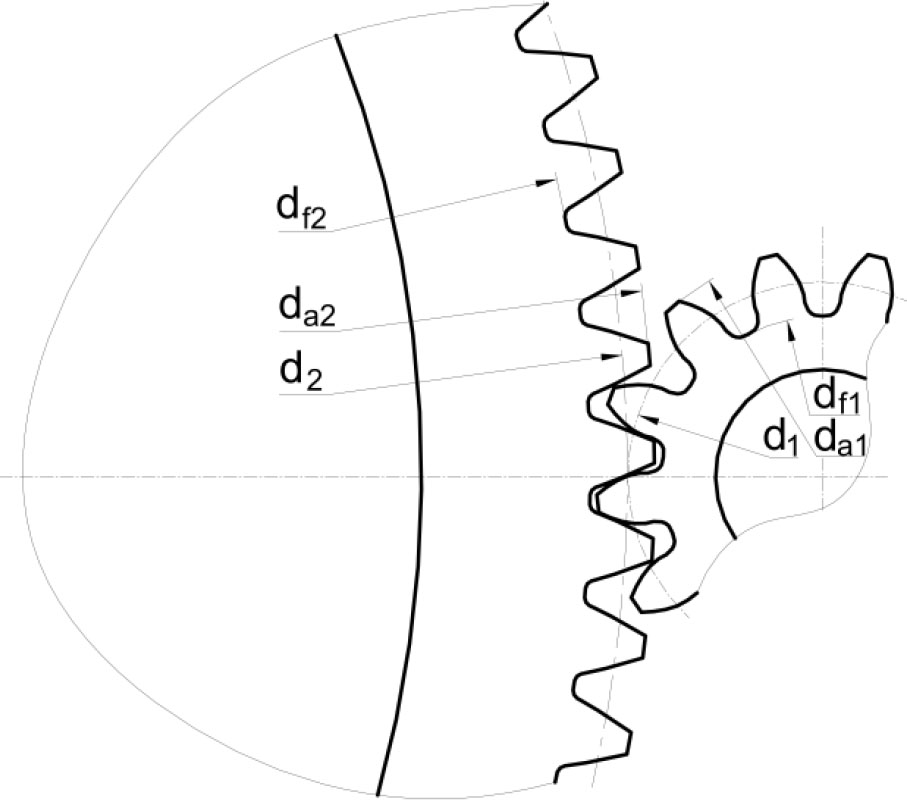
Fig. 2.
The basic geometric parameter of a pinion and a toothed ring
Tab. 2.
Values of gears basic parameters
| Name of parameters | Pinion | Toothed rim | |
|---|---|---|---|
| 1 | Reference diameter [mm] | d1=182 | d1=1274 |
| 2 | Tip diameter [mm] | da1=211,763 | da1=1322,823 |
| 3 | Root diameter [mm] | df1=151,577 | df1=1262,637 |
| 4 | Profile shift coefficient | x1=0,1135 | x2=0,7942 |
| 5 | Number of tooth | z1=13 | z2=91 |
| 6 | Module [mm] | m=14 | |
| 7 | Backlash [mm] | jn=0,56 | |
| 8 | Center distance [mm] | aw=740 | |
| 9 | Reference pressure angle | αn=20° | |
| 10 | Working pressure angle | αw=22,414° | |
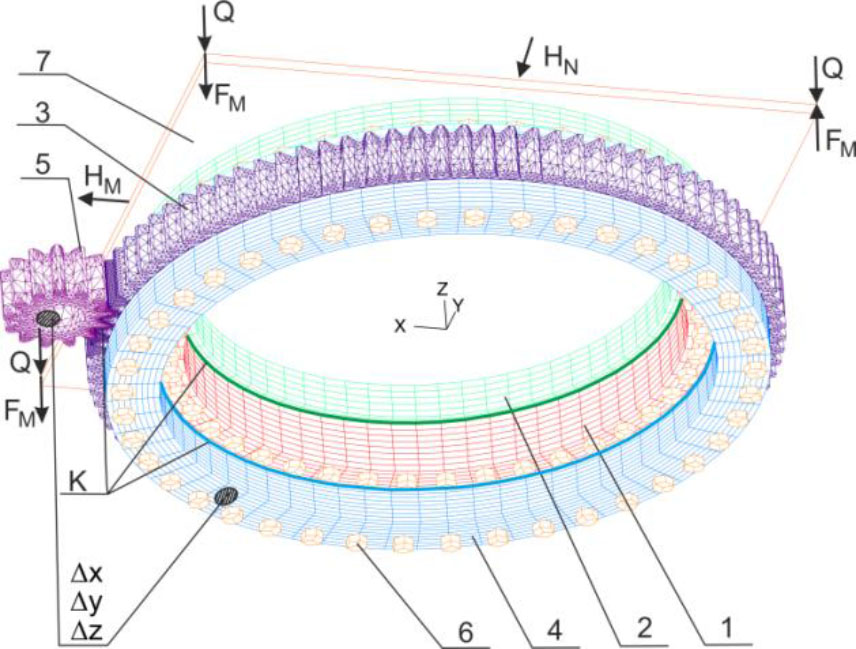
Fig. 3.
A visualisation of finite elements of single-row ball slewing bearing, coupled with a drive pinion
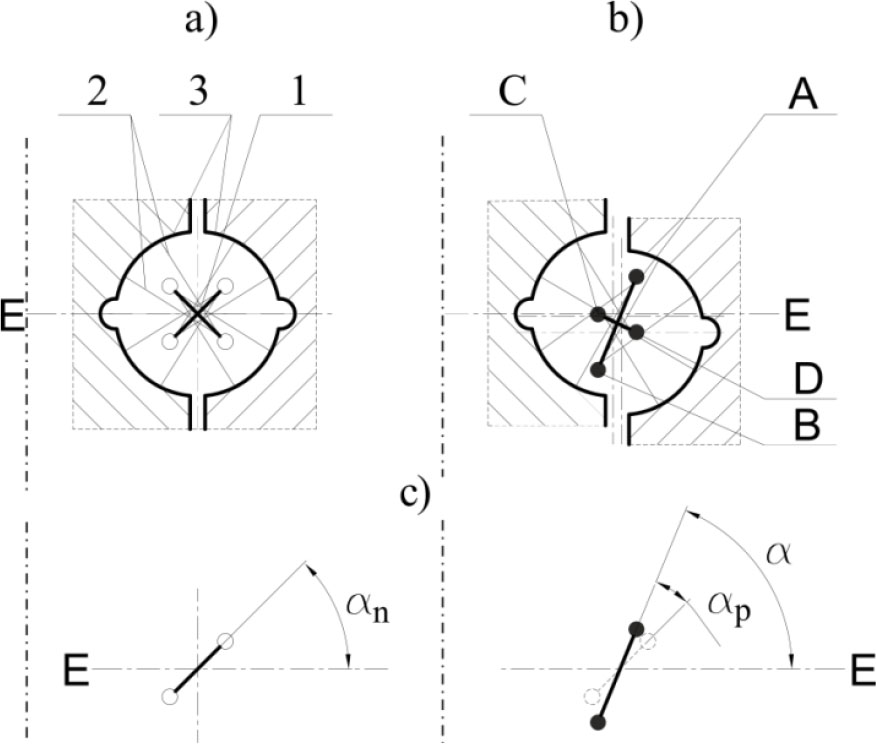
Fig. 4.
Schematic position of bearing rings and replacement elements in a state before (a) and after (b) load inflicted with mapping changing of contact angle of balls in slewing bearing (c)
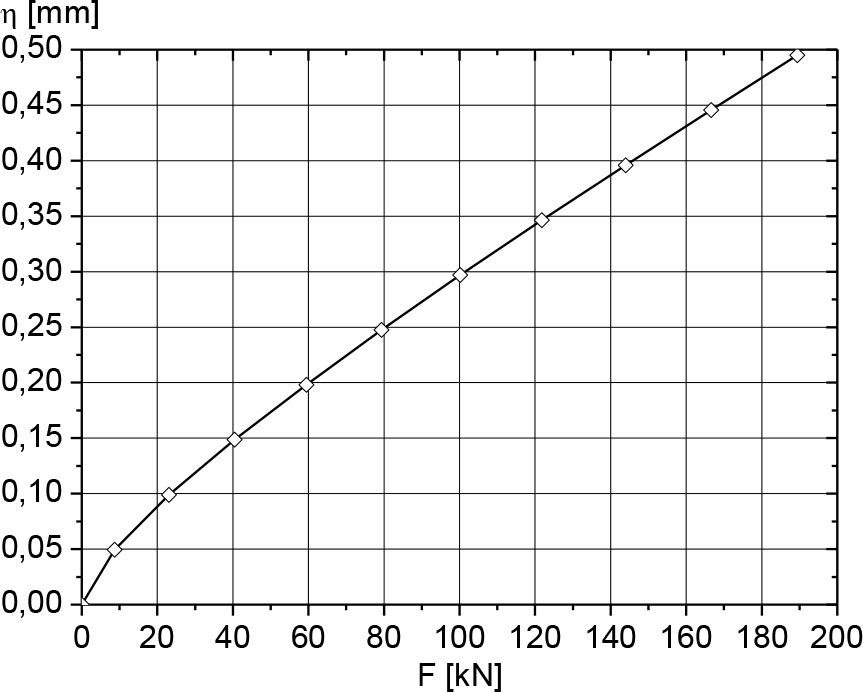
Fig. 5.
Characteristic of the contact zone replacement
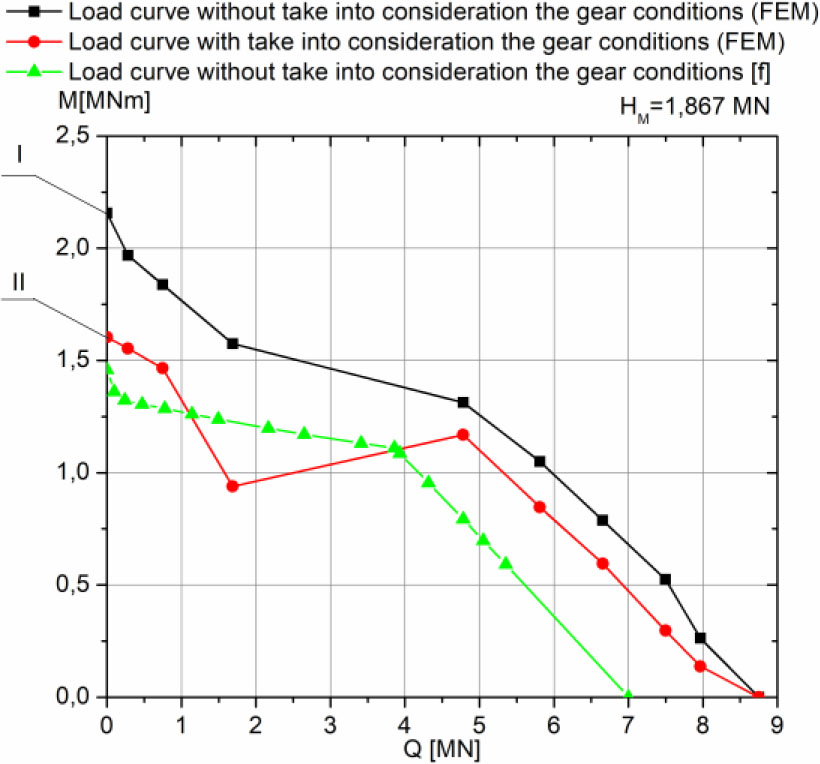
Fig. 6.
Juxtaposition of static carrying capacity curves of the single-row ball slewing bearings loaded by radial forces directed positively with and without taken into consideration gear condition
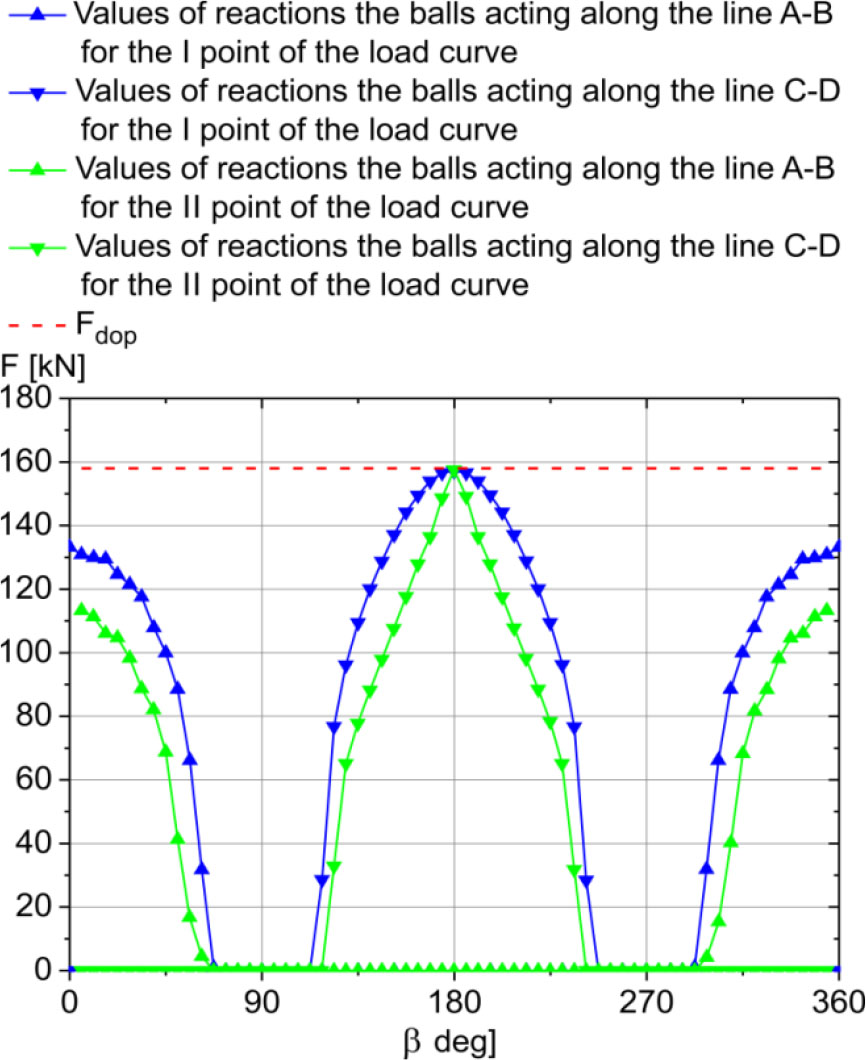
Fig. 7.
Comparison of distributions of the forces acting on balls of the single-row ball slewing bearing for the points of work: I and II according to Fig. 6, β- angular coordinate
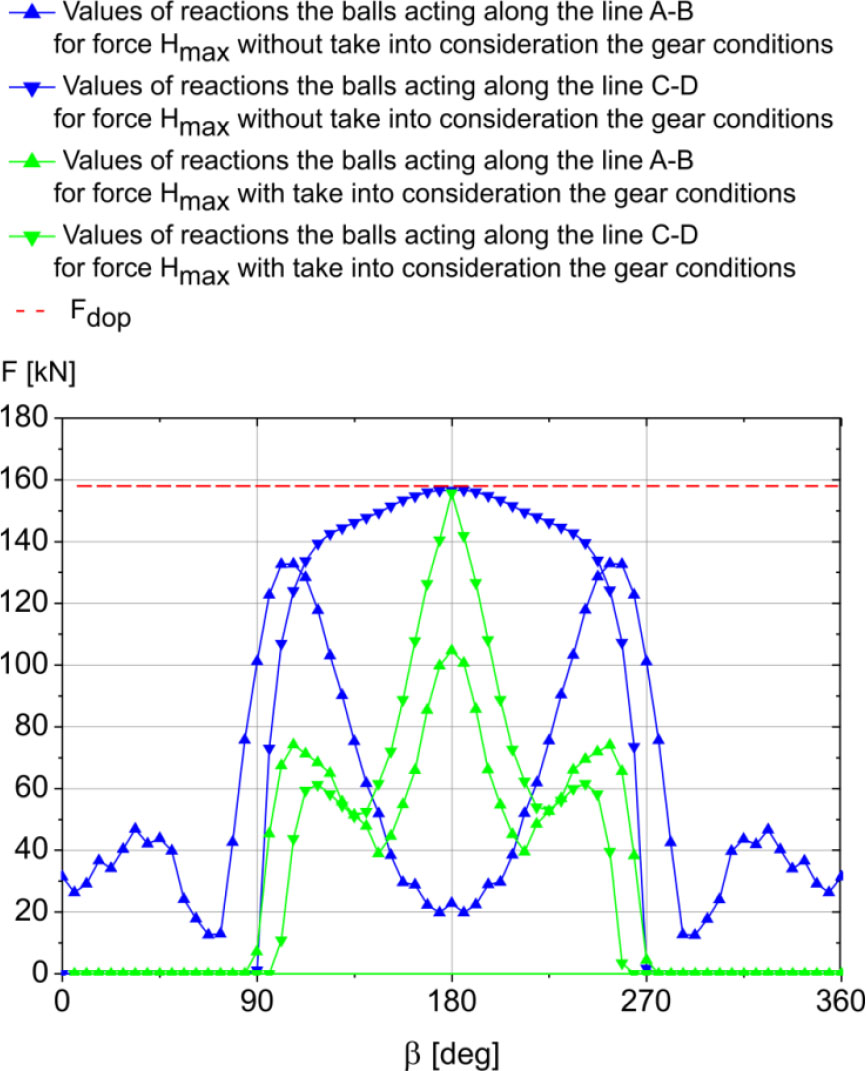
Fig. 8.
Comparison of distribution of the forces acting on balls of the single-row ball slewing bearing for the maximum radial force with taken into consideration (Hmax=5,977 [MN]) and without(Hmax=3,3 MN) the gear condition, β- angular coordinate
Tab. 3.
Juxtaposition of statistical parameters describing the nature of the load of ball of single-row ball slewing bearing (Fig. 8) for the selected points of work I and II (Fig. 7)
| Model of bearing | External load components | Number of forces | Ball reaction values Fi | |||
|---|---|---|---|---|---|---|
| Q [MN] | M [MNm] | HM [MN] | Arythmetic average [kN] | Standard deviation [kN] | ||
| Without pinion | 0 | 1,603 | 1,120 | 49 | 108,7 | 40,7 |
| With pinion | 0 | 2,156 | 1,120 | 44 | 89,5 | 38,6 |
| Without pinion | 0 | 0 | Hmax=3.3 | 98 | 81,4 | 52,4 |
| With pinion | 0 | 0 | Hmax=5,977 | 63 | 65,5 | 31,5 |
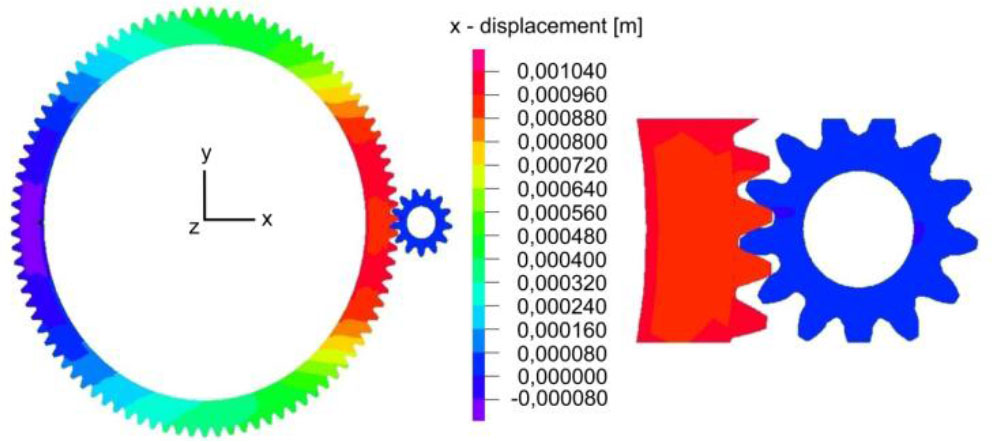
Fig. 9.
The distribution of displacements in the direction of the radial force HM for operation points marked in Fig. 6 as II
Tab. 4.
Overview of features characterizing individual FE models of slewing bearings against the model presented in the article [*]
| Feature of the presented model | Reference number | |
|---|---|---|
| 1 | The use of replacement elements for modeling rolling parts | [1], [2], [7], [9], [11], [13], [15], [18], [24], [25], [26], [32], [33], [35], [36], [37], [38],[*] |
| 2 | Taking into account the support structures in slewing bearings | [2], [7], [9], [10], [11], [25], [26], [32], [33], [35], [36], [38], [*] |
| 3 | Taking into account interactions between the bearing and bolts | [1], [2], [7], [9], [11], [13], [25], [26], [32], [33], [35], [36], [38], [*] |
| 4 | Taking into account flexible rings | [1], [2], [7], [9], [10], [11], [13], [15], [18], [24], [25], [26], [32], [33], [35], [36], [37], [38], [*] |
| 5 | Taking into account of radial forces | [1], [2], [7], [9], [10], [11], [13], [15], [18], [24], [25], [26], [32], [33], [35], [36], [38], [*] |
| 6 | Modeling of the contact zone taking into account the elastic-plastic material model | [2], [7], [11], [15], [18], [24], [26], [33], [35], [36], [*] |
| 7 | Modeling of the bearing taking into account the cooperation conditions between a toothed bearing’s ring and a drive pinion | [*] |
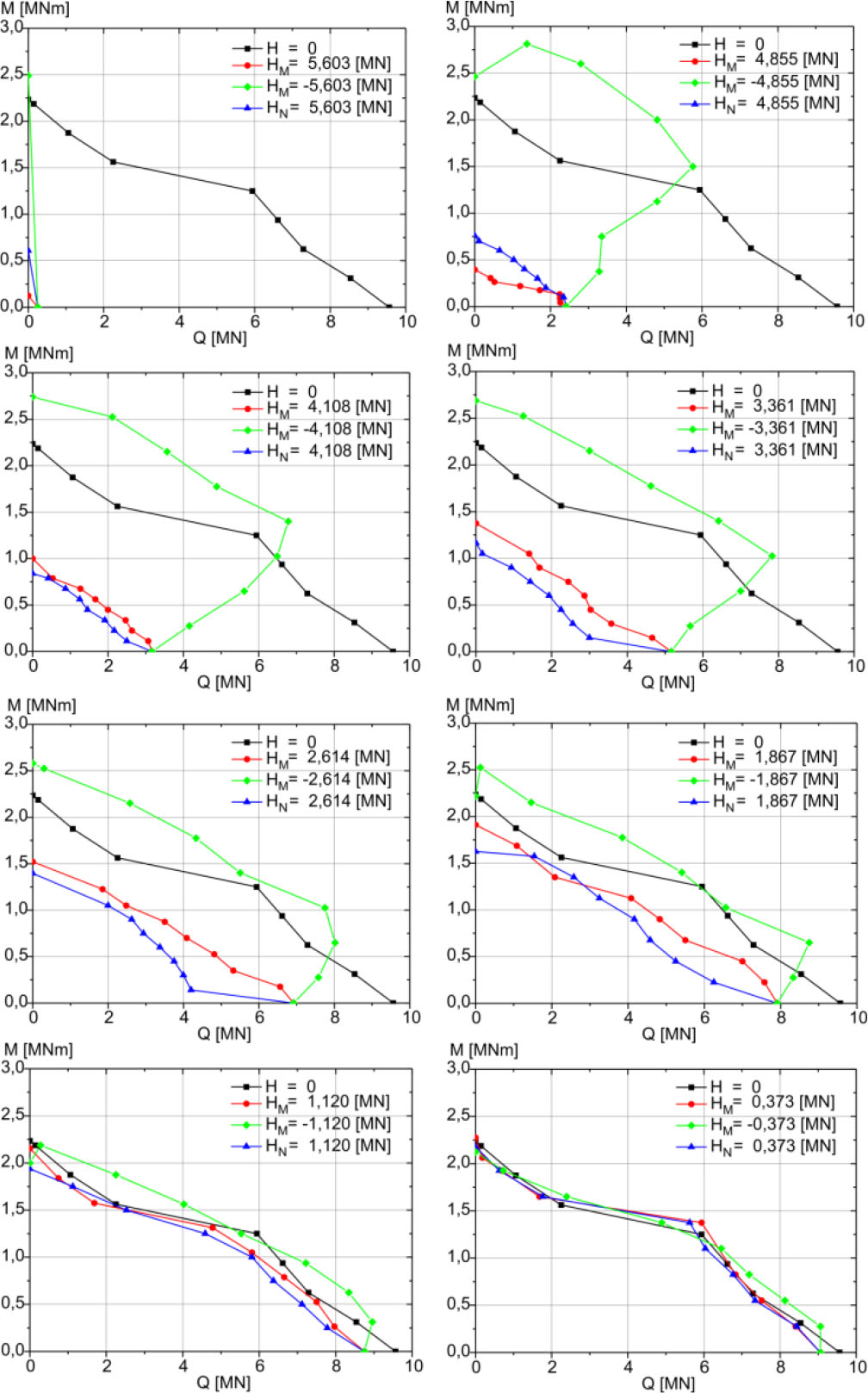
Fig. A1.
Juxtaposition of static carrying capacity curves of the single- row ball slewing bearing loaded by constant values of the radial forces defined positively, negatively and orthogonaly
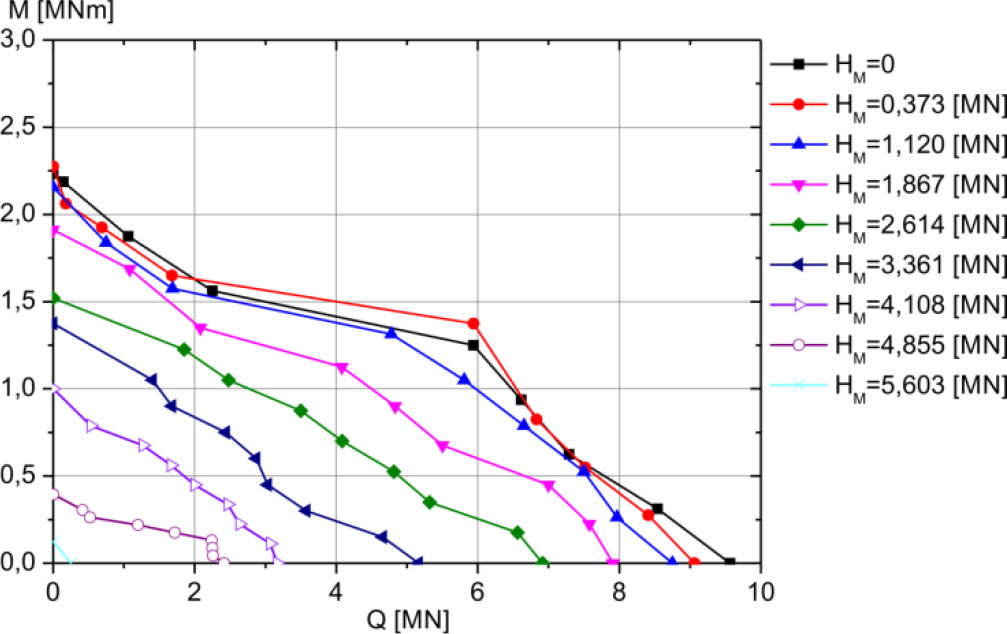
Fig. A2.
uxtaposition of static carrying capacity curves of the single-row ball slewing bearing loaded by the main radial forces HM defined positively
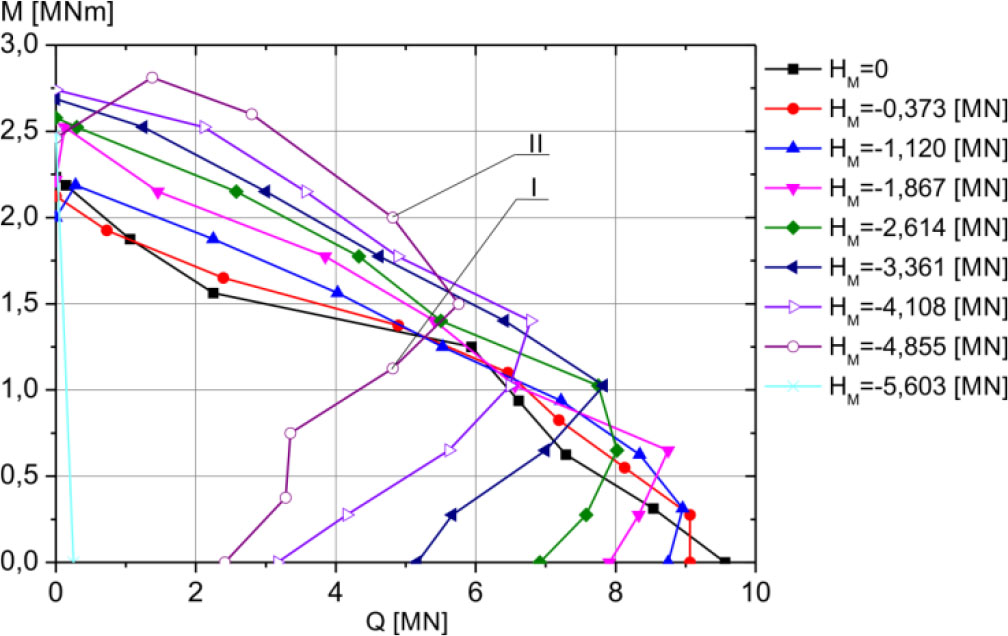
Fig. A3.
Juxtaposition of static carrying capacity curves of the single-row ball slewing bearing loaded by the main radial forces HM defined negatively
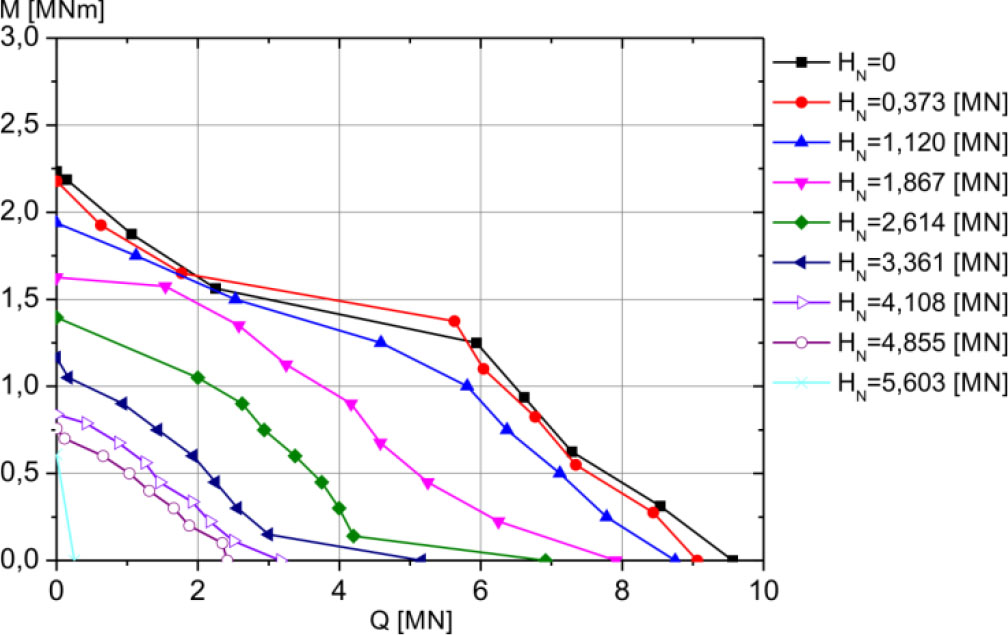
Fig. A4.
Juxtaposition of static carrying capacity curves of the single-row ball slewing bearing loaded by radial forces HN defined orthogonally
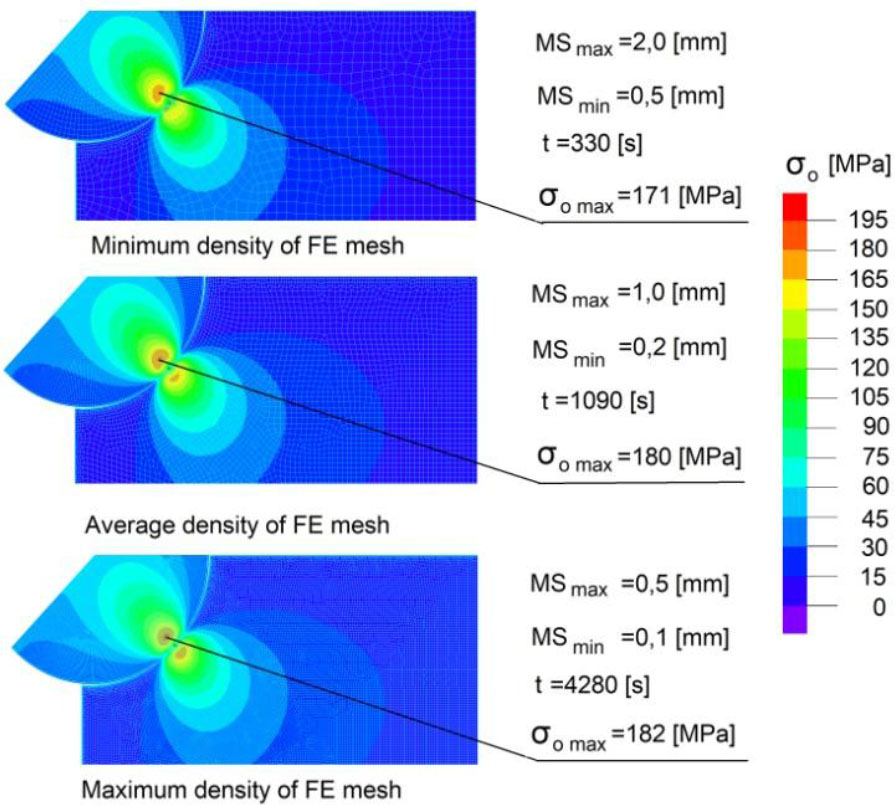
Fig. B1.
Distributions of the effective stress for the tested meshes of the contact zone model
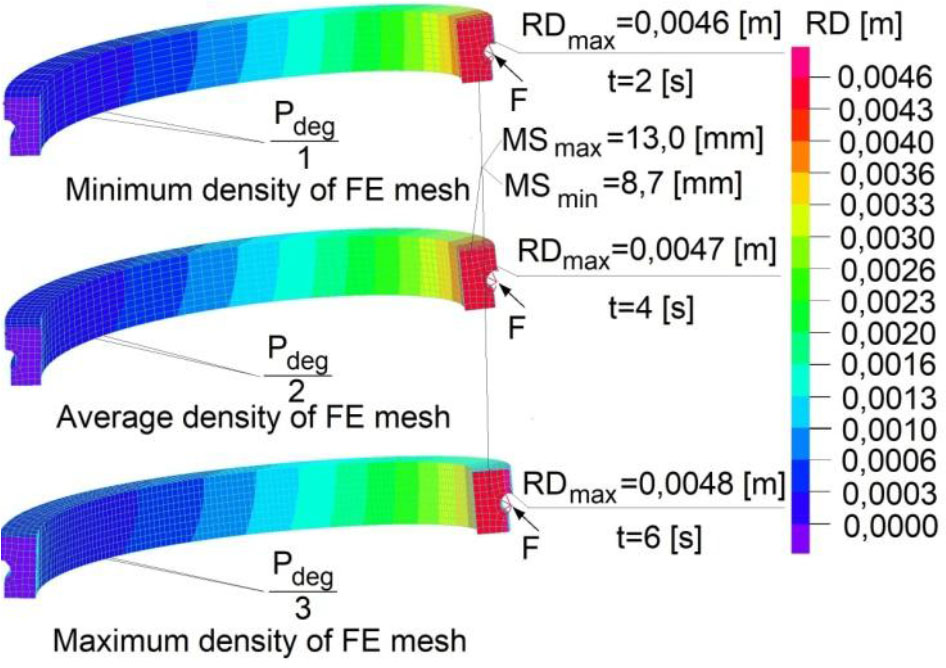
Fig. B2.
Distributions of the displacements for the tested meshes of the slewing bearing ring model
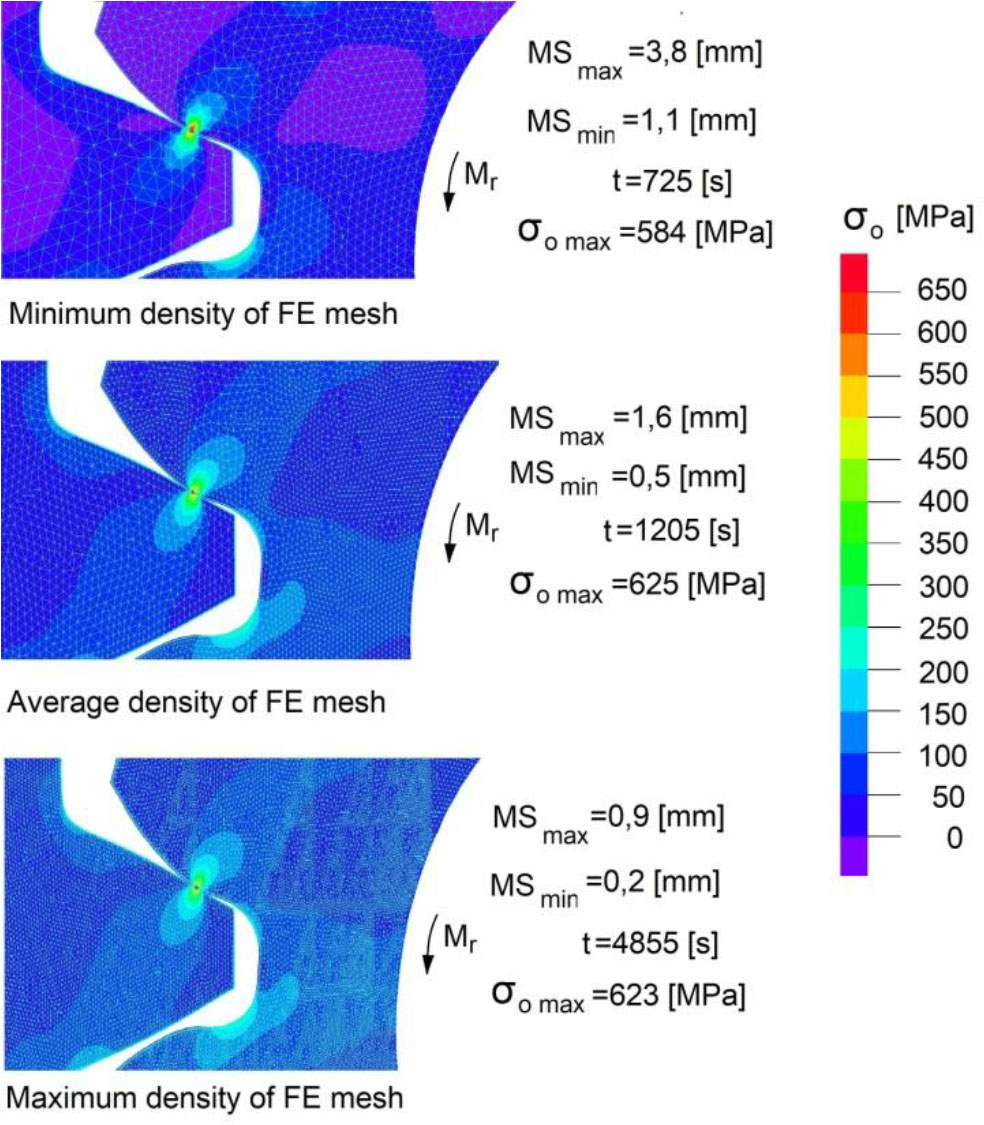
Fig. B3.
Distributions of effective stress for the tested meshes of the contact zone model of a toothed rim and a drive pinion
Tab. B1.
Statistical data of the FE model of the slewing bearing
| The modeled object | Finite element type | Number of finite elements |
|---|---|---|
| The ball as a Superelement | Truss | 128 |
| Beam | 512 | |
| Inner ring | 3D-Solid | 3584 |
| Outer ring | 3D-Solid | 3584 |
| Bolts | Beam | 84 |
| Heads of the mounting bolts | 3D-Solid | 5040 |
| Upper support structure | 3D-Solid | 3392 |
| lower support structure | 3D-Solid | 3392 |
| Płyta | 3D-Solid | 1 |
| Toothed rim | 3D-Solid | 56340 |
| Pinion | 3D-Solid | 37651 |