
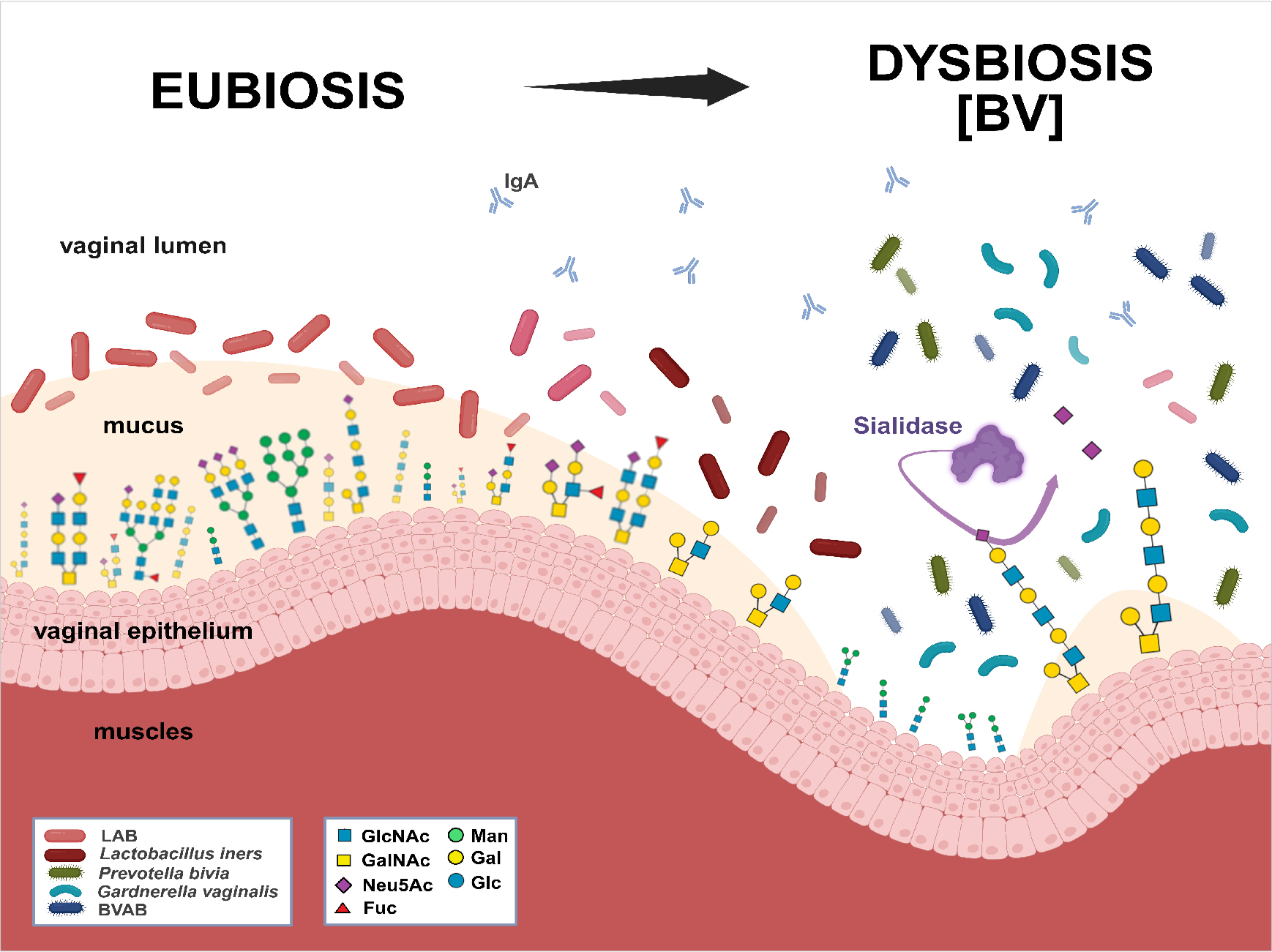
Fig. 1.
Bacterial shift from eubiosis to dysbiosis in bacterial vaginosis (BV) development. Own graphic design according to Biorender software (https://BioRender.com/ulmg6r6).
Legend: LAB – Lactic Acid Bacteria; BVAB – BV-associated bacteria; sugar residues forming the structures of N- and O-glycans: GlcNAc – N-acetylglucosamine; GalNAc – N-acetylgalactosamine; Man – Mannose; Gal – Galactose; Neu5Ac – N-acetylneuraminic acid; Glc – Glucose; Fuc – Fucose.
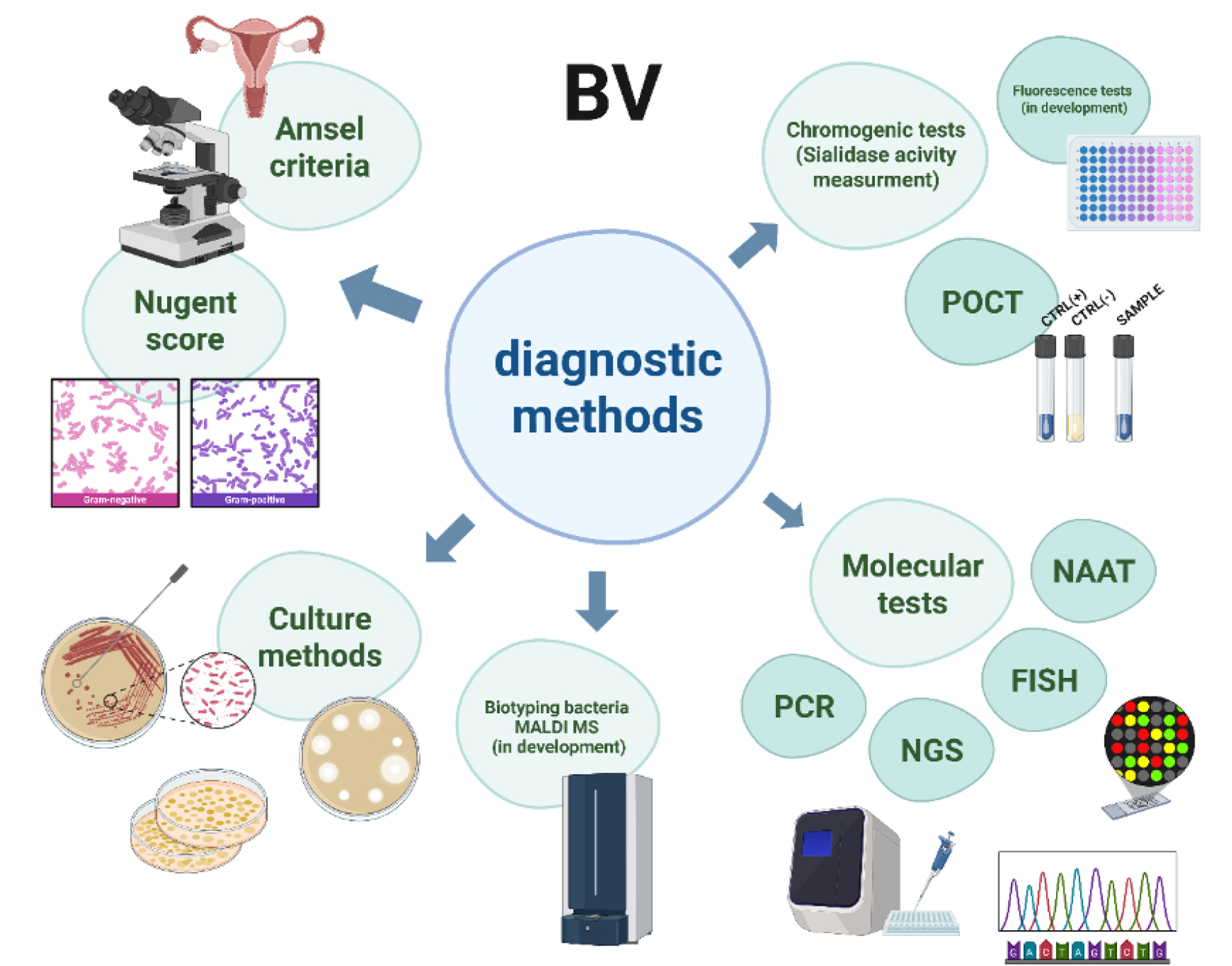
Fig. 2.
Overview of bacterial vaginosis diagnosis. Own graphic design using Biorender software (https://BioRender.com/entt8c0).
Legend: BV – Bacterial Vaginosis; POCT – Point-Of-Care Tests; NAAT – Nucleic Acid Amplification Test; FISH – Fluorescence In Situ Hybridization; NGS – Next-Generation Sequencing; PCR – Polymerase Chain Reaction; MALDI MS – Matrix-Assisted Laser Desorption/Ionization Mass Spectrometry.
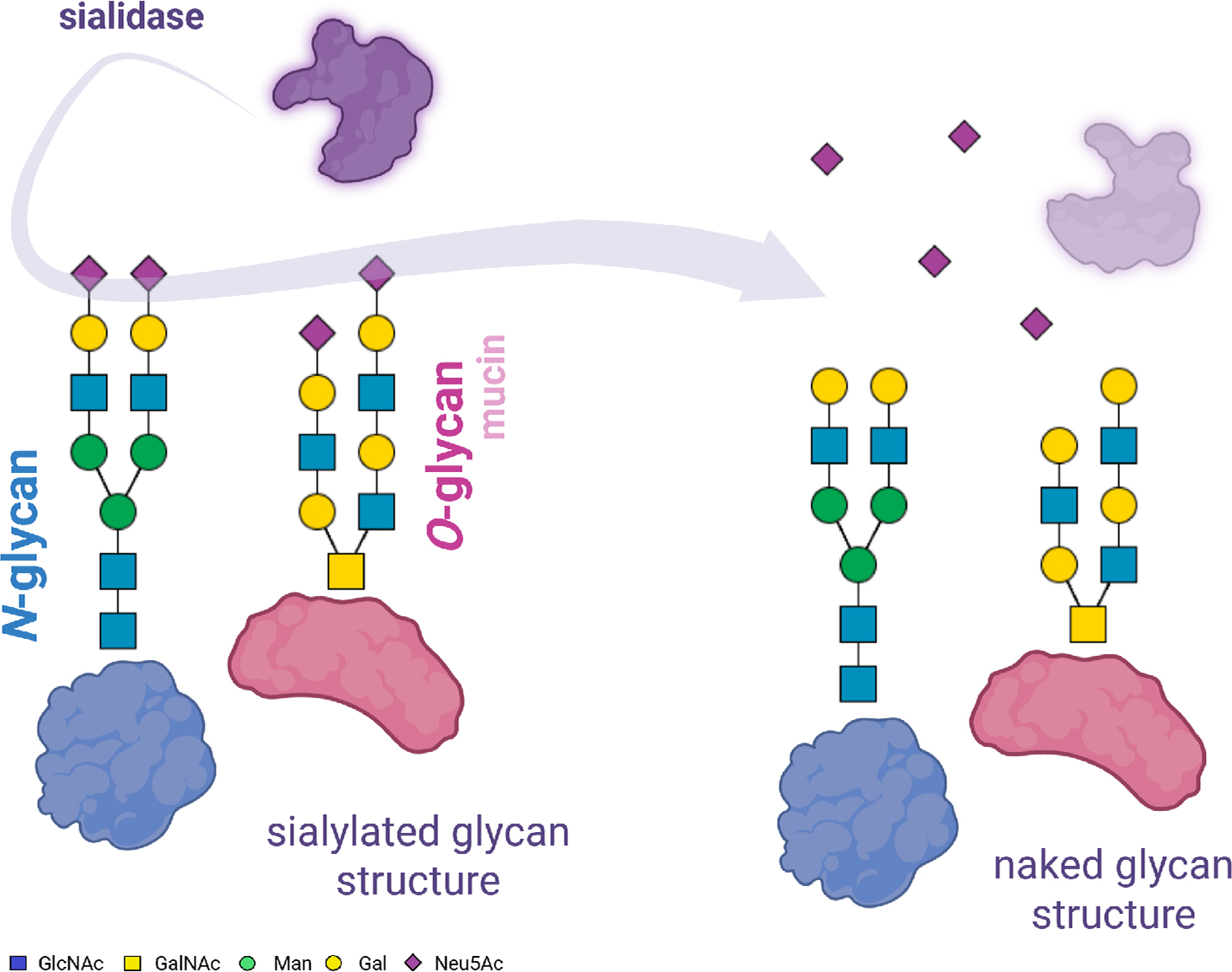
Fig. 3.
Sialidase mechanism of action. Own graphic design according to Biorender software (https://biorender.com/97qvka8).
Legend: Sugar residues forming the structures of N- and O-glycans: GlcNAc – N-acetylglucosamine; GalNAc – N-acetylgalactosamine; Man – Mannose; Gal – Galactose; Neu5Ac – N-acetylneuraminic acid.
Table 1.
Comparison of bacterial and human sialidases.
| Organism | Sialidase type | Substrate | Result of action | References |
|---|---|---|---|---|
| Gardnarella vaginalis | GvNanH1 GvNanH2 GvNanH3 | α-2,3 and α-2,6-linked Neu5Ac or Neu5Gc on N- and O-glycans in the vaginal and cervical environment | major virulence factor to BV; diagnostic marker (GvNanH3); mucin and glycoprotein degradation; GvNanH1 and GvNanH2 are stronger obligations than GvNanH3 | Novak et al. 2023 |
| Prevotella timonensis | PtNanH1 PtNanH2 | α-2,3 and α-2,6-linked Neu5Ac or Neu5Gc on O-glycans (mucin type) in the vaginal and cervical environment and IgA or IgG glycans | strong mucin degradation; contributes to BV and epithelial glycocalyx disruption; PtNanH2 are stronger obligations than PtNanH1 | Pelayo et al. 2024; Segui-Perez et al. 2024 |
| Streptococcus pneumoniae | NanA | α-2,3; α-2,6- and α-2,8-linked Neu5Ac on glycans in the respiratory environment and the blood-brain barrier | involved in colonization and pathogenesis of respiratory infections; NanA is exo- or hydrolytic sialidase, hydrolyzing its substrates to release Neu5Ac; NanB is intramolecular trans-sialidase | Manco et al. 2006; Tseng et al. 2021 |
| NanB | α-2,3 linked Neu5Ac on glycans in the respiratory environment | |||
| Clostridium perfringens | NanH NanI NanJ | α-2,3; α-2,6- and α-2,8-linked sialid acid in glycoproteins, glycolipids, colominic acid | tissue degradation; virulence factor | Wang 2020 |
| Homo sapiens | NEU1 NEU3 NEU4 | α-2,3 and α-2,6-linked Neu5Ac on N- and O-glycans in the every cell organism | NEU1 is a lysosomal sialidase, NEU3 is a plasma membrane-associated sialidase, NEU4 is found in lysosomes, mitochondria, and the endoplasmic reticulum; glycan remodeling, potential role in homeostasis and dysbiosis | Zhou et al. 2020, Chen et al. 2024 |