
Table I.
Current classification and nomenclature of biotics according to ISAPP.
| Name | ISAPP definition | Examples | Examples of commercial products | Reference |
|---|---|---|---|---|
| Probiotic | Live microorganisms that, when administered in adequate amounts, confer a health benefit on the host. | Lactobacillus acidophilus DSM 20079, Lactiplantibacillus plantarum 299v, Bifidobacterium longum subsp. infantis UCD272, Saccharomyces boulardii CNCM I-745 | Vivomixx® Lacidofil® Enterol® | Hill et al., 2014 |
| Prebiotic | A substrate that is selectively utilized by host microorganisms conferring a health benefit. | galactooligosaccharides (GOS), fructooligosaccharides (FOS), Inulin | Orafti®Inulin NutraFlora®FOS BLF®100 | Gibson et al., 2017 |
| Synbiotic | A mixture comprising live microorganisms and sub-strate(s) selectively utilized by host microorganisms that confers a health benefit on the host. | Lactiplantibacillus plantarum ATCC 202195 and fructooligosaccharides (FOS) | Ther-Biotic® Synbiotic Acidolac®Baby Multilac® | Swanson et al., 2020; Kleerebezem and Führen, 2024 |
| Postbiotic | Preparation of inanimate microorganisms and/or their components that confers a health benefit on the host. | pasteurized Akkermansia muciniphila MucT heat-killed Lacticaseibacillus para-casei MCC1849 | SANPROBI® Premium EpiCor® BPL1™ Postbiotic | Salminen et al., 2021; Kato et al., 2024 |
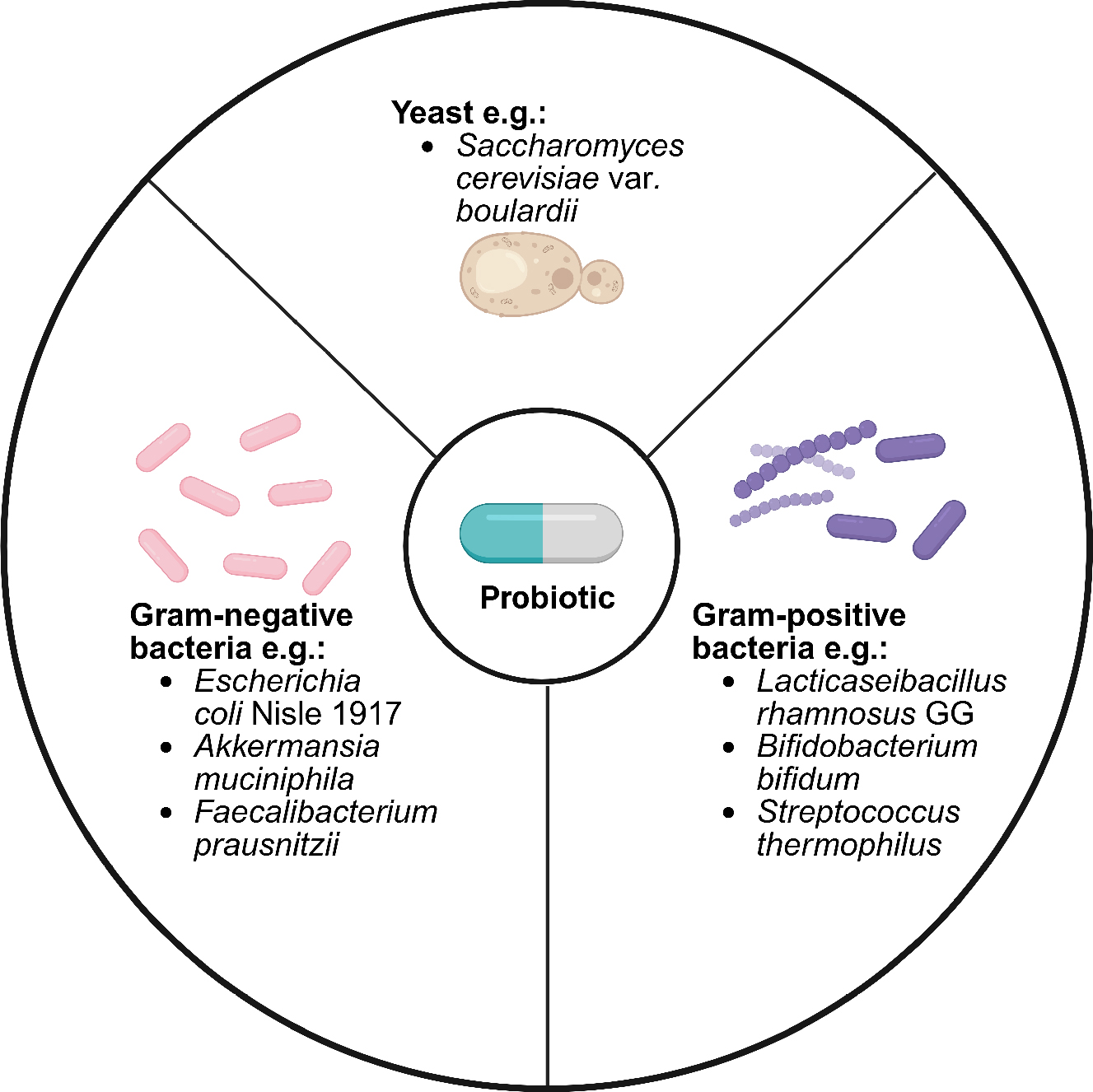
Figure 1.
Classification of microorganisms constituting probiotics with representative examples. Created in BioRender.
Table II.
Examples of health benefits demonstrated by probiotics, prebiotics, synbiotics and postbiotics in clinical trials.
| Composition | Classification | Health benefits | Daily dose and duration | Reference |
|---|---|---|---|---|
| Lactiplantibacillus plantarum PS128 | Probiotic | Amelioration of symptoms in children with ASD, such as:
| 3x10¹⁰ CFU for 28 days | Liu et al., 2019 |
| Bifidobacterium bifidum BGN4 Bifidobacterium longum BORI | Probiotic |
| 1x10⁹ CFU 1x10⁹ CFU for 12 weeks | Kim et al., 2020 |
| Lacticaseibacillus rhamnosus ŁOCK 0900 Lacticaseibacillus rhamnosus ŁOCK 0908 Lacticaseibacillus casei ŁOCK 0918 | Probiotic | Significant improvement in atopic dermatitis symptom severity | 1x10⁹ CFU for 3 months | Cukrowska et al., 2021 |
| Bifidobacterium bifidum W23 Bifidobacterium lactis W51 Lactobacillus acidophilus W37 Lactobacillus acidophilus W55 Lacticaseibacillus paracasei W20 Lactiplantibacillus plantarum W62 Lacticaseibacillus rhamnosus W71 Ligilactobacillus salivarius W24 | Probiotic | Reduced risk of diarrhoea during and 7 days after antibiotic treatment | 1x10¹⁰ CFU during antibiotic treatment + 7 days | Łukasik et al., 2022 |
| Bacillus subtilis BS50 | Probiotic | Alleviation of gas-related gastrointestinal symptoms | 2x10⁹ CFU for 6 weeks | Garvey et al., 2022 |
| Bacillus subtilis MB40 | Probiotic | Elimination of Staphylococcus aureus without altering the microbiota | 1x10¹⁰ CFU for 30 days | Piewngam et al., 2023 |
| Lacticaseibacillus rhamnosus CECT 30031, Arthrospira platensis BEA_ IDA_0074B | Probiotic | Significant reduction in the severity of acne vulgaris | 1x10⁹ CFU for 12 weeks | Eguren et al., 2024 |
| Escherichia coli Nissle 1917 | Probiotic | Potential use of engineered E. coli Nissle 1917 in adenoma diagnosis and therapy of colorectal cancer | 1x10⁹ CFU for 14 days | Gurbatri et al., 2024 |
| Saccharomyces boulardii CNCM I-745 | Probiotic | In patients with SIBO, associated with dietary advice:
| 500 mg for 15 days | Bustos Fernández, Man and Lasa, 2023 |
| Streptococcus thermophilus BT01 | Probiotic | Reduction of urease activity in faecal samples | 1x10¹¹ aFU for 1 week | Martinović et al., 2023 |
| Lactobacillus crispatus DSM32717 DSM32720, DSM32718, DSM32716 | Probiotic | Reduction of the signs and symptoms of bacterial vaginosis
| 3x10¹⁰ CFU for 3 months | Mändar et al., 2023 |
| Lactobacillus acidophilus Lactiplantibacillus plantarum Bifidobacterium lactis Saccharomyces boulardii (LactoLevureR) | Probiotic |
| 1,75x10⁹ CFU 0,5x10⁹ CFU 1,75x10⁹ CFU 1,5x10⁹ CFU for 6 months | Zikou et al., 2023 |
| Lacticaseibacillus rhamnosus GG | Probiotic | Beneficial modulation of gut and skin microbiome | 1x10¹⁰ CFU for 12 weeks | Carucci et al., 2022 |
| Bifidobacterium longum CECT 7347 | Probiotic | Reducing IBS symptom severity | 1x10⁹ for 84 days | Srivastava et al., 2024 |
| Opuntia ficus-indica extract (Odilia™) | Prebiotic | Positive modulation of gut microbiota composition:
| 300 mg for 8 weeks | Mellai et al., 2024 |
| Inulin and oligofructose | Prebiotic |
| 15 g for 3 months | Yang et al., 2024 |
| Yeast mannan | Prebiotic |
| 1,1 g for 4 weeks | Tanihiro et al., 2024 |
| Bifidobacterium adolescentis, Bifidobacterium bifidum, Bifidobacterium longum and galactooligosaccharides, xylooligosaccharides, resistant dextrin (SIM01) | Synbiotic | Alleviation of multiple symptoms of PACS | 2x10¹⁰ CFU for 6 months* | Lau et al., 2024 |
| Bifidobacterium lactis HN019, Lacticaseibacillus rhamnosus HN001 and fructooligosaccharide | Synbiotic | Decrease in pro-inflammatory biomarkers (CRP and IFN-γ) and increased anti-inflammatory cytokine (IL-10 and sIgA) | 1,5x10⁸ CFU 7,5x10⁷CFU and 500 mg for 8 weeks | Li et al., 2023 |
| Lacticaseibacillus rhamnosus FloraActive™ 19070-2, Lactobacillus acidophilus DSMZ 32418, Bifidobacterium lactis DSMZ 32269, Bifidobacterium longum DSMZ 32946, Bifidobacterium bifidum DSMZ 32403 and fructooligosaccharides | Synbiotic | Significant amelioration in:
| 1,96x10⁹ CFU 9,80x10⁸ CFU 5,88x10⁹ CFU 5,88x10⁸ CFU 5,88x10⁸ CFU and 1,894 g for 8 weeks | Skrzydło-Radomańska et al., 2020 |
| Lactobacillus acidophilus La-14, Lactiplantibacillus plantarum Lp-115, Bifidobacterium animalis subsp. lactis CBG-C10 and fructooligosaccharide (LactominPlus®) | Synbiotic |
| 2,9x10⁷ CFU 4,7x10⁷ CFU 2,4x10⁷ CFU and 1,2 g for 8 weeks | Jung et al., 2022 |
| Bifidobacterium bifidum MIMBb75 | Postbiotic | Alleviating IBS and its symptoms | 1x10⁹ cells for 8 weeks | Andresen, Gschossmann and Layer, 2020 |
| Limosilactobacillus reuteri DSM17648 (Pylopass) | Postbiotic | Improved effectiveness of Helicobacter pylori eradication therapy in patients with functional dyspepsia | 2x10¹⁰ cells for 28 days | Ivashkin et al., 2024 |
| Bifidobacterium longum CECT 7347 | Postbiotic |
| 2,5x10⁹ cells for 8 or 12 weeks | Naghibi et al., 2024; Srivastava et al., 2024 |
| Akkermansia muciniphila HB05 | Postbiotic | Significant increase in muscle strength among individuals aged 60 years or older | 1x10¹⁰ cells for 12 weeks | Kang et al., 2024 |
| Lacticaseibacillus paracasei MCC1849 | Postbiotic |
| 5x10¹⁰ cells for 4 weeks | Kato et al., 2024 |
1 Legend: ASD – autism spectrum disorder, SIBO - small intestinal bacterial overgrowth, PACS - post-acute COVID-19 syndrome, CRP - C-reactive protein, IFN-γ - interferon gamma, IL-10 - interleukin-10, sIgA - secretory immunoglobulin A, IBS – irritable bowel syndrome, non-HDL - non–high-density lipoprotein, CFU – colony forming unit, aFU - active fluorescent unit,
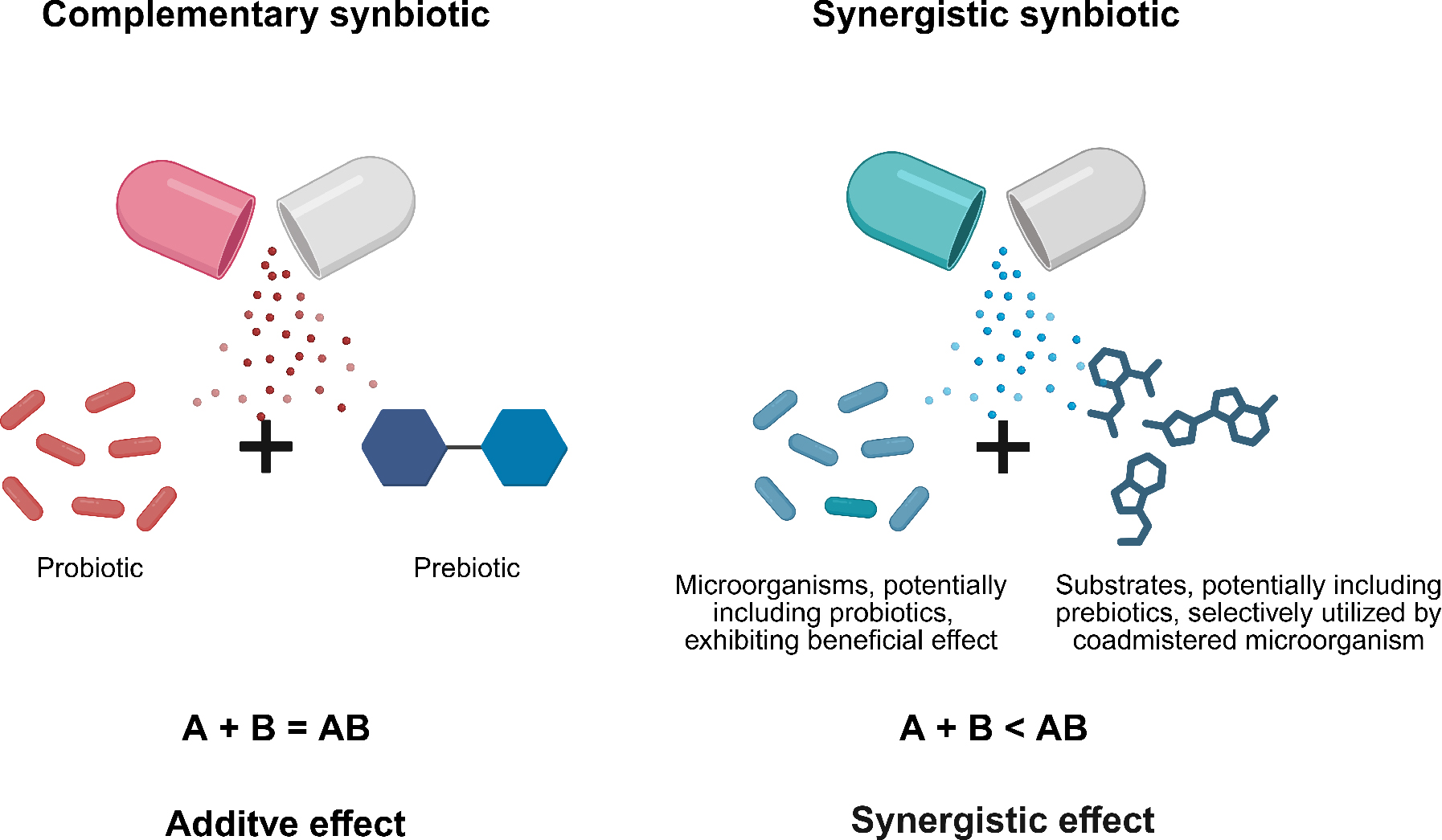
Figure 2.
Comparative characteristics of complementary and synergistic synbiotics. Created in BioRender.
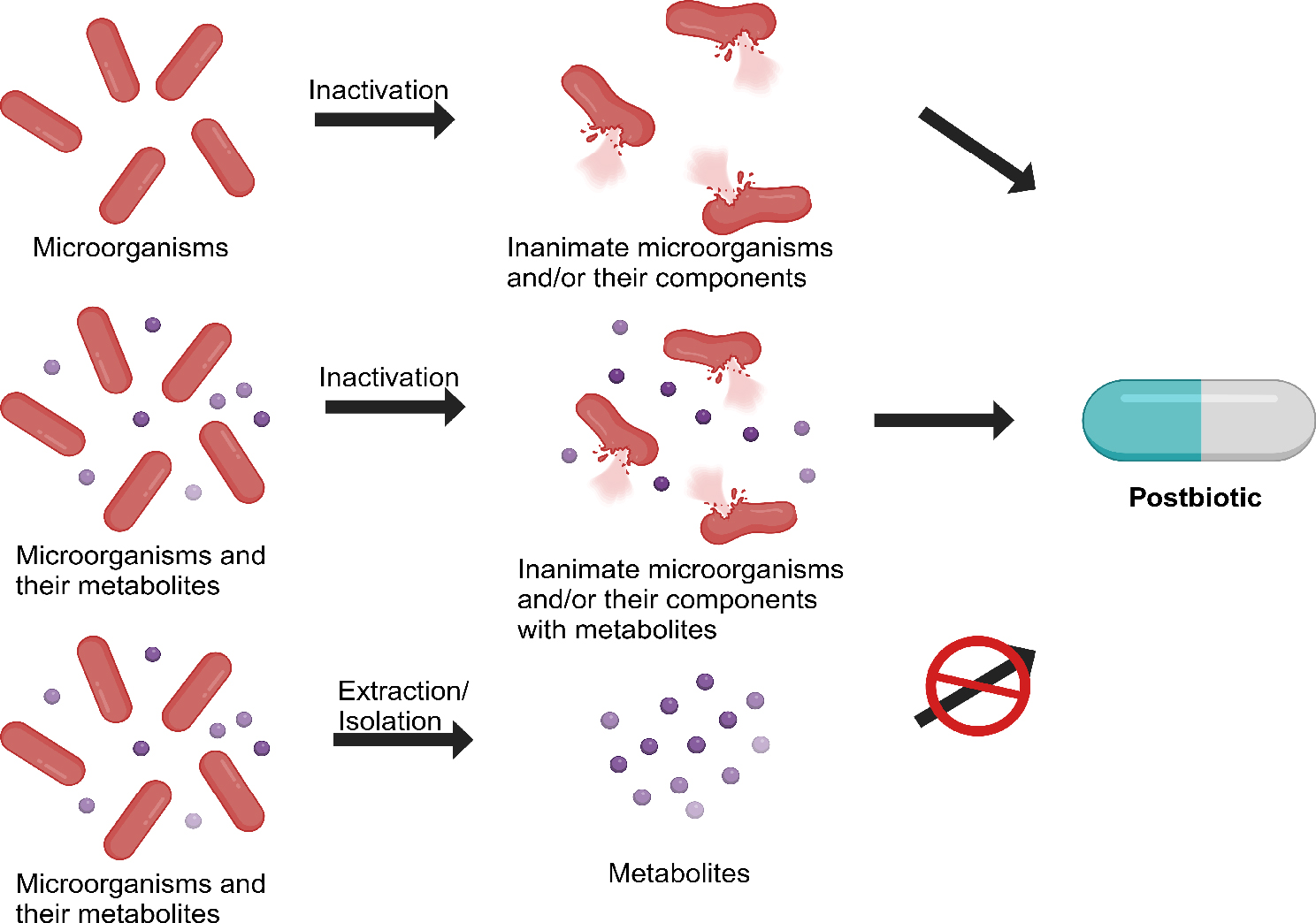
Figure 3.
Postbiotic components vs. independent metabolites (Salminen et al. 2021; Vinderola et al. 2024). Created in BioRender.
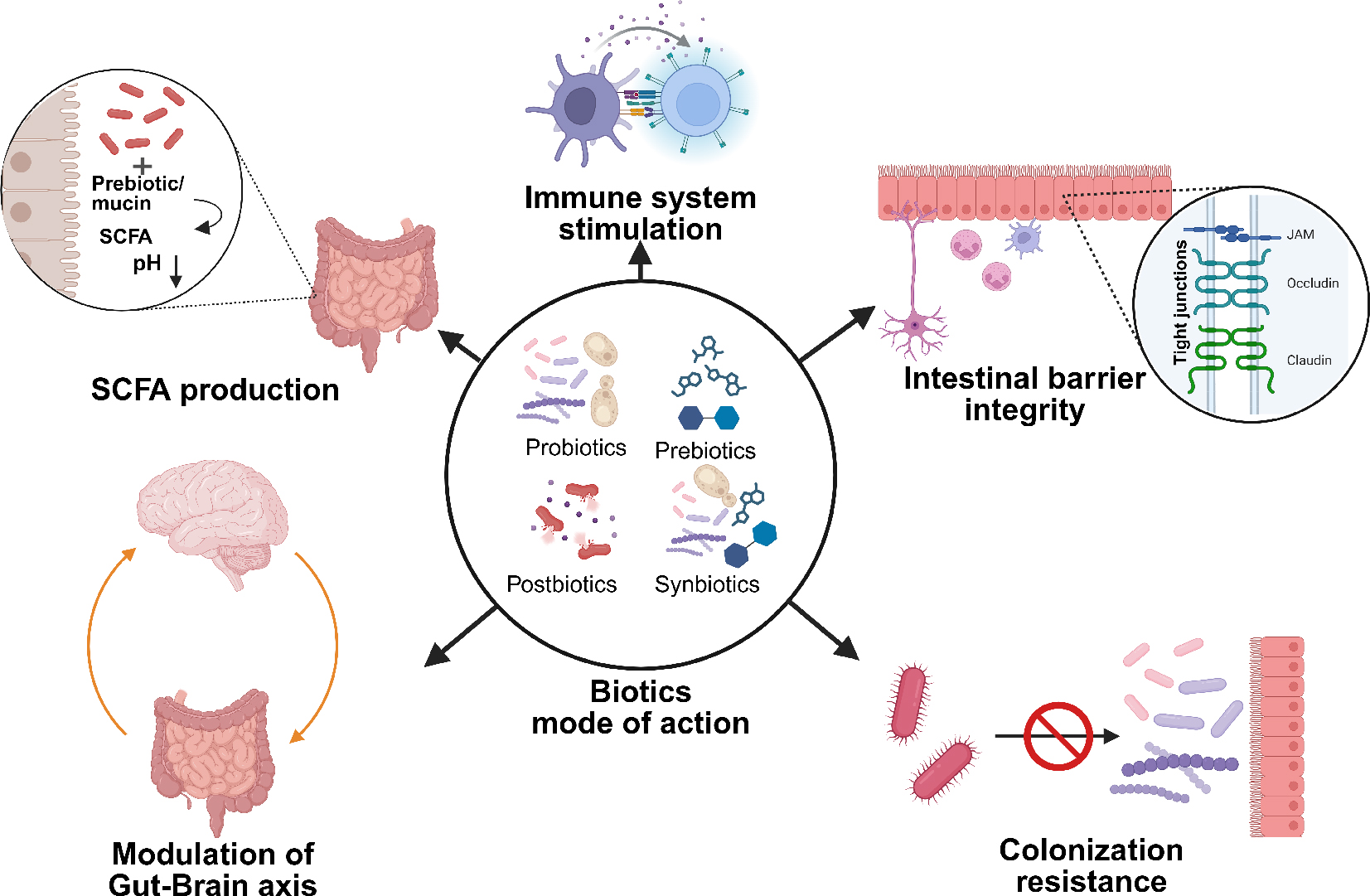
Figure 4.
Basic mode of action of biotics. Created in BioRender.
Table III.
Orally administered probiotics and postbiotics, commercially available in Poland and registered as drugs.
| Name | Classification | Content per one capsule or sachet | Recommended use |
|---|---|---|---|
| Lakcid Forte - POLPHARMA S.A. | Probiotic | 10x109 CFU:
| Treatment of antibiotic-associated colitis, including pseudomembranous colitis; supportive treatment during and after antibiotic therapy; prevention of traveller’s diarrhoea |
| Lakcid Entero - POLPHARMA S.A. | Probiotic | 250 mg (≥1010 CFU/1 g)
| Treatment of acute infectious diarrhoea, diarrhoea in IBS, AAD, recurrent Clostridium difficile diarrhoea; prevention of diarrhoea associated with enteral nutrition, traveller’s diarrhoea, as an adjunct in treatment of H. pylori |
| Lacidofil - LALLE-MAND S.A.S. | Probiotic | 2x10⁹ CFU*:
| Treatment of recurrent pseudomembranous colitis, supportive treatment during and after antibiotic therapy; prevention of traveller’s diarrhoea |
| Enetrol – BIOCODEX | Probiotic | 250 mg:
| Treatment of acute infectious diarrhoea, recurrent Clostridium difficile diarrhoea; prevention of diarrhoea associated with enteral nutrition, traveller’s diarrhoea; as an adjunct in treatment in IBS diarrhoea |
| Lacteol Fort 340 mg - DSM-Firmenich Houdan SAS | Postbiotic | 340 mg including:
| Supportive treatment of diarrhoea |
| Trilac - Krotex Pharm | Probiotic | 1,6x10⁹ CFU:
| Treatment of antibiotic-associated colitis, including pseudomembranous colitis; prevention of traveller’s diarrhoea; supportive treatment after antibiotic therapy |
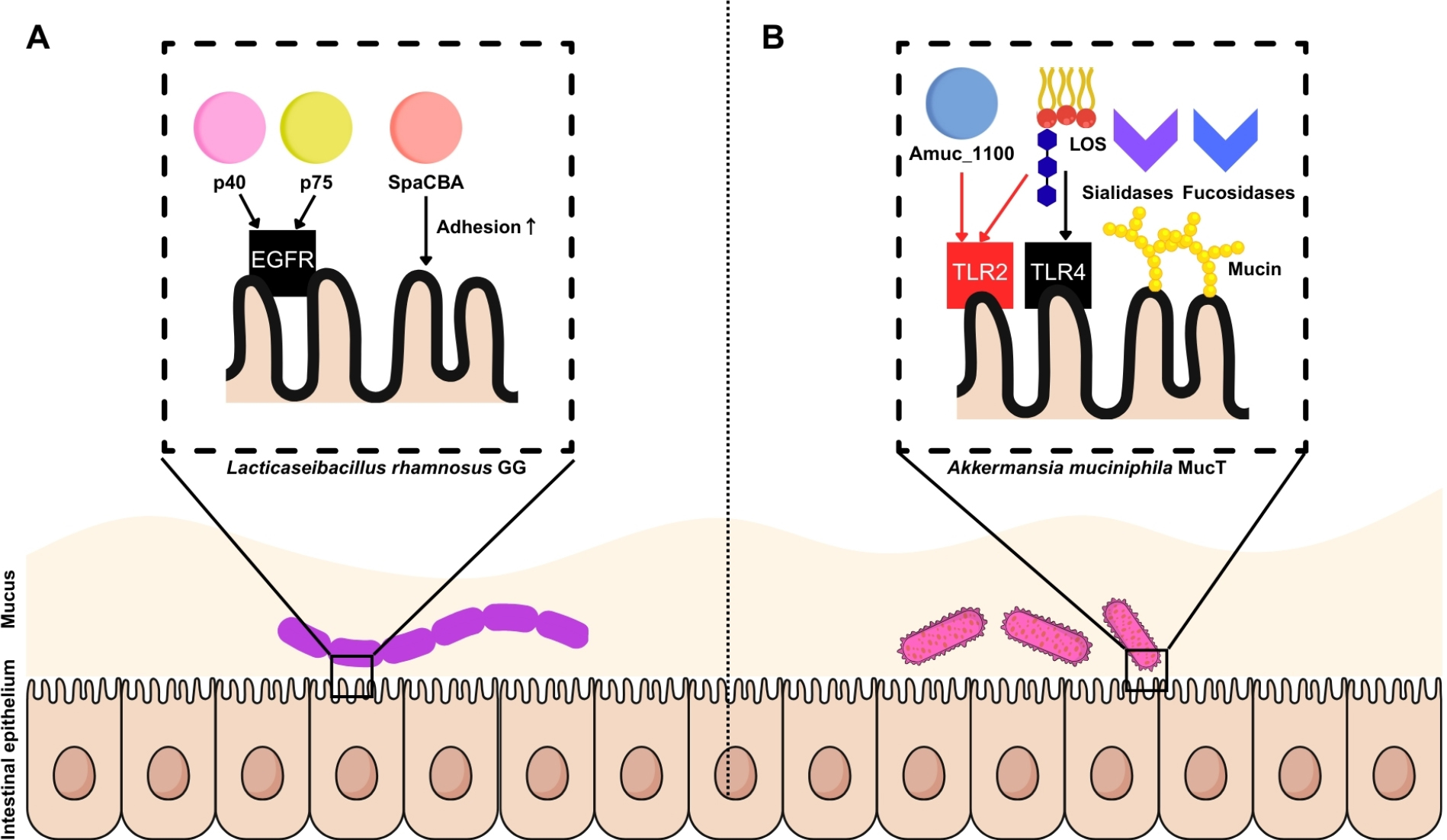
Figure 5.
Selected molecular mechanisms by which two probiotic strains, A - Lacticaseibacillus rhamnosus GG and B –Akkermansia muciniphila MucT, interact with host intestinal epithelium. Panel A illustrates L. rhamnosus GG indirect interactions mediated by p40 and p75, which interact with EGFR, as well as direct interactions induced by SpaCBA. Panel B illustrates A. muciniphila MucT direct and indirect interactions, the former shown as Amuc_1100 and LOS interactions with TLR2 and TLR4, the latter as sialidases and fucosidases degrading mucin.
Legend: Amuc_1100 – A. muciniphila MucT pilus protein; LOS – lipooligosaccharide; TLR2 – Toll-like receptor 2; TLR4 – Toll-like receptor 4; p40/p75 – L. rhamnosus GG secreted proteins; EGFR - epidermal growth factor receptor; SpaCBA - L. rhamnosus GG pilus protein.
Table IV.
Non-orally administered probiotics registered as drugs in Poland.
| Name | Classification | Content per one capsule | Recommended use |
|---|---|---|---|
| Lakcid Intima – POLPHARMA S.A. | Probiotic |
| Preventive use to maintain or restore normal vaginal microbiota |
| Lactovaginal – BIOMED S.A. | Probiotic |
| Preventive use; treatment of vaginal discharge and inflammation of reproductive organs after the antibacterial, antitrichomonal, or antifungal treatment |
| inVag – BIOMED S.A. | Probiotic | ≥109 CFU:
| Prevention of genitourinary infections; supportive treatment in vaginitis, during and after antibiotic and/or antifungal treatment |
| Protrivagin – Verco S.A. | Probiotic |
| Normalization of the disrupted vaginal microbiota after antibiotic therapy for bacterial vaginosis; maintaining normal vaginal microbiota in recurrent infections |