
Learning objectives
Hanging occurs in the context where a fixed ligature provides the interface for neck compression. Force is transmitted into the ligature by the weight of the body (Nichols, 2025). Hanging can occur by means of accidental, intentional, homicidal and judicial actions. It is important for neuroscience nurses to understand the wide spectrum of presentations following a near hanging, this being where an individual survives until hospital). These cases do involve a high mortality rate; they are complex, and often result in multisystem trauma that requires rapid, specialised nursing assessment and brisk interventions to give individuals the best chance of life.
Key areas of focus include the initial presentation of individuals and the demographics of near hangings. Nurses often face challenges regardless of whether an attempt at one’s life was accidental, impulsive, spur of the moment, or an intended act (that may have a clear plan or not to end their own life). The impact and demographics of indigenous presentations are explored and the key area of the association between near hanging with psychiatric illness, cervical injuries and outcomes including the links with cardiac arrest on presentation.
Reading this article should provide a clear understanding of near hanging. The reader should gain an understanding of the epidemiology and related information linked to the occurrence of near hangings and their presentation, including the common injuries that are sustained. The reader will also gain knowledge in relation to the care and the initial management of individuals following a near hanging including assessment and care interventions. The outcomes of near hanging are discussed, and the reader should gain insight into them as well as extended care needs post the initial care period.
Introduction
The frequency of suicide is increasing worldwide and hanging is one of the most common forms of suicide (Gunnell et al., 2005; Isaacs et al., 2022). The Covid -19 pandemic was associated with a dramatic increase of individuals presenting with suicidal ideation (Dorfman, 2023). More recent events including wars in Gaza, and the Middle East as well as Russia’s invasion of Ukraine have all resulted in uncertainty for people and a troubling air as these events are streamed 24/7 on phones, devices and televisions. Hanging occurs secondary to external pressure on the neck from an applied ligature that is tightened by the gravitational weight of an individual’s body that is suspended either partially or wholly (Adams, 1999; Dimaio, 2000; McHugh & Stout, 1983; Saukko, 2004). Near hanging refers to the process of hanging that has not resulted in immediate death, and the individual survives long enough to reach hospital (Chikhani & Winter, 2014). There are many factors that influence an individual’s survival or death, including the hanging process they employed, the drop or fall, and the time before they were found. Individuals who survive a near hanging are brought to emergency departments for their resuscitation and management (Berke et al., 2019). At the front line responding and caring for individuals post a near hanging are nurses (Ellis, 2007).
Hanging and near hanging is an international epidemic. Whilst the typical hanging victim is generally a young to middle aged male with a history of prior mental illness or substance abuse (Tugaleva et al., 2016), as nurses we need to be prepared for any presentation. The age range of individuals presenting is increasingly widening and range from young children to older individuals. In Australia, hanging surpassed firearm inflicted wounds as the leading cause of death associated with suicide following the Port Arthur Massacre and the introduction of gun reform (Australian Institute of Health and Welfare, 2026b). Hanging represents 46% of all suicides in Australia (Australian Bureau of Statistics, 2006; Beck et al., 2019), with this rate similar to international figures of around 41–45% (Coombs & Ashton-Cleary, 2023; Pajonk et al., 2002; Spicer & Miller, 2000; Statistics, 2022).
Individuals who engage in hanging as a form of suicide generally do not immediately die. Death associated with suicidal hanging usually occurs secondary to a consequence of cerebral obstruction associated with the obstruction of vasculature by the ligature around the neck and weather an individual is partially or wholly suspended (Adams, 1999; McHugh & Stout, 1983; Taylor et al., 1997). Individuals who attempt suicide by hanging are generally young and a large percentage of cases individuals will have a past psychiatric history (Bansal & Nayyar, 2023)
Hangings can be classified in terms of intent. For example, hangings can be accidental, autoerotic, homicidal, suicidal or judicial (Mahajan et al., 2019). For individuals who survive a hanging and reach hospital, the term near-hanging is utilised (Adams, 1999; Gandhi et al., 2011; McHugh & Stout, 1983). These are the individuals that we as nurses can make a difference. Nurses have a chance to be not only a technician that responds to the physiological changes associated with healing post a near hanging event, but can also be an understanding ear, a person that listens without judgement and offers not solutions and sugar-coated promises, but hope.
Near hanging presents a challenge in terms of its associated injuries and the risk of permanent disability (Boots et al., 2006). It is estimated that if an individual reaches hospital, 80–90% will survive post a near hanging (Gunnell et al., 2005) and many without neurological sequalae. Prevention of suicide is paramount and hinges on access and accessibility to mental health support and psychiatric care, including addressing key factors such as drug and alcohol abuse as well as supporting family dynamics and addressing any areas of concern (Coombs & Ashton-Cleary, 2023).
Methods
Undertaking this literature review and quantitative meta-analysis required astute awareness and the ability to assess the authenticity and relevance of works, as well as the accuracy of sources. Papers that glorified suicide, with exaggerations permeating throughout, were deemed unsuitable to support this work and stood only as examples of how not to approach the topic of suicide. Methods employed to protect against failure or to ensure success will not be discussed in this review. This study utilises weighted averages to bring together the results of different studies, to enable a re-analysis of the disparate results within the context of their common endpoints and synthesise them as a single summary endpoint. A weighted average achieves its outcome by scaling each data point based on its relative importance before combining them into a single representative number. Instead of treating every value as an equal contributor, it mathematically ensures that high-priority, high-volume, or heavy-impact items drive the final result more than smaller, less important ones.
An extensive systematic online search was undertaken utilising the following electronic databases.
The search terms included, ‘near hanging’, ‘hanging’, ‘suicide’, ‘nurse’, ‘nursing’, ‘neuroscience’, ‘neurosurgical’. Boolean operators were included to encompass multiple possible combinations of the search terms. Titles and abstracts were screened, and any duplicates were removed. Additionally, citations were hand searched to identify any relevant references that might have otherwise been missed. Out of hospital cases and forensic papers were excluded as they did not provide details regarding outcome (except for death) and they did not discuss care needs and interventions. Articles were included it they studied non-judicial hanging, suicidal hanging, and death due to hanging and a separate search was undertaken to explore hanging within the Australian context with a focus on Aboriginal and Torres Strait Islander peoples (henceforth respectfully referred to as indigenous) near hanging rates, culture and interventions. Additional data pertaining to Australian statistics related to suicide and hanging were collected from the Australian Bureau of Statistics and using available online data. Several themes were identified in the literature including ‘indigenous health’, ‘demographics’, ‘cardiac arrest’, ‘Glasgow Coma Scale’, ‘cervical injury’, and ‘psychiatric/ substance abuse’. The importance of these themes was considered in relation to their effect on not only outcome but their relevance to neuroscience nursing and caring for an individual post a near hanging.
Categorical data were summarised and presented as counts and proportions/percentages. Outcome is presented as death and the documentation of cases that had a favourable or good outcome. Weighted averages were used when summarising the baseline characteristics of the combined results of all the studies. Weighted averages ensured that studies with more precise data have a greater influence on the final "pooled" result. This was achieved through inverse-variance weighting where the weight of each study was calculated, and the study’s effect size was multiplied by its weight to get the weighted effect. The weighted effects were summed and then divided by the sum of the total of all weights. Weighted averages were vital as differing data points carried varying importance, including sample size. For example, more weight was given to studies with larger sample sizes. The weighted average ensured that values contributed proportionally to the final result based on the assigned weight and avoided the equal weight assumption of a simple average, providing a clearer picture of data distributions. The weighted averages were calculated using the statistical program R.
The initial search identified 610 manuscripts and of these the abstracts of 505 manuscripts were reviewed (Figure 1). A total of 437 studies were assessed for eligibility and following the exclusion of 419 manuscripts, a total of 18 manuscripts were included in this study, with additional literature supporting the discussion. A range of study designs, size and country of origin, were included when analysing the demographics associated with near hanging. Between studies, there was some variation in the terminology, however in this work, an attempt has been made to standardise the terminology used. Articles were excluded if the main text component was not written in English. The included studies were predominantly retrospective, with limited prospective studies identified.
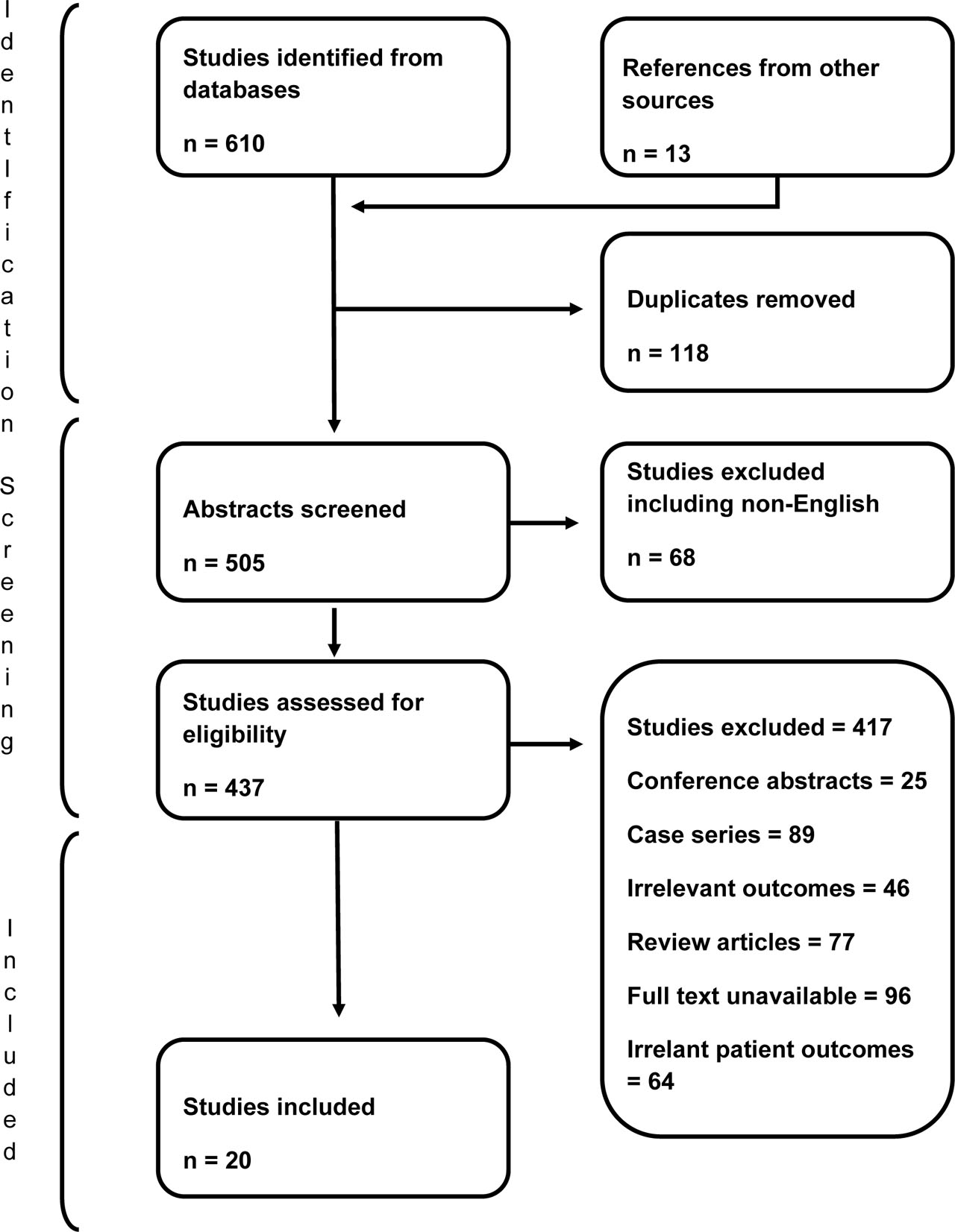
Figure 1.
Flow Chart for Manuscript Attainment
From the initial search of the literature, a number of individual factors were identified related to each theme. The identified factors were presented in varying combinations in the literature in relation to hanging and near hanging. What was absent from the literature is how these individuals’ factors impact on the care needs and care provided by neuroscience nurses post a near hanging event. There are frequent references to factors that influence both prevalence and outcome following a hanging event. This review and analysis bring together those factors and analyses them as a collective, presenting results that adjusts for the weight of the results.
During the preparation of this work the author utilised the generative AI tool ChatGPT. AI was utilised as a search strategy, to draft summaries and to locate specific literature related to topics. AI utilisation improved the language, clarity and accuracy of this manuscript. The author reviewed and revised all AI generated data and/or links to original published works and takes full responsibility for the accuracy and integrity of the final content.
Every attempt in this manuscript has been taken to write about the topics of attempted and suicide in a careful and evidenced based approach. This has included using non-sensational language and grammar, utilising accurate language and focusing on prevention. No details about methods, location or success of differing suicide methods have been discussed to prevent contagion. Crisis resources are included at the beginning of this paper and to avoid stigmatisation terms such as ‘committed’ or ‘successful/unsuccessful’ have been replaced with examples including ‘made an attempt to take their own life’, ‘a non-fatal attempt’ or ‘survived a suicide attempt or event’. Suicide is real and for those suffering a mental health crisis an attempt at one’s life is not selfish, a cry for attention or cowardly in any way. Pain, fear, vulnerability, hopelessness and feelings of worthlessness are real. Often the contributing factors to suicidal intent are not simple, and there is rarely a singular cause or explanation. A key element of this work is to highlight hope and help, noting that treatment for underlying conditions do work.
Ethics Statement
This study utilises no direct individual analysis and this work was completed in accordance with Australian ethics guidelines and institutional direction. The ethical restrictions that prohibit the use and re-publication of full datasets did not apply to this body of work as only a small amount of data from published works was transcribed for analysis and all works were acknowledged, cited and referenced.
Conflict of Interest
The author declares that this manuscript has been developed in the absence of any financial or commercial relationships that could be construed as a potential conflict of interest.
History
Hanging is one of the oldest forms of execution (Mahajan et al., 2019; Nichols, 2019), with the earliest account of hanging as a means of capital punishment noted in the 22nd book of Homer’s Odyssey (Rayes et al., 2011). Whilst it is still used in some countries by justice officials as a form of corporal punishment, hanging is more frequently used by individuals wanting to end their own lives.
Historically one name dominates the literature regarding near hanging and survival of a judicial hanging, and that is Anne Greene. Anne was a 22-year-old maid servant when in 1650 she was hung after being convicted of the crime of infanticide, following the miscarriage of a foetus of approximately 17 weeks. Anne was hung for over half an hour, and numerous measures were undertaken to speed her passing, yet when she arrived at the anatomists table, she was found to be still alive. Thomas Willis was one of the anatomists who revived Anne and the events served to enhance his reputation, making him quite prosperous and to a degree famous in Oxford, England (Choudhari et al., 2008; Dewhurst, 1972). Judicial hanging would continue as an inefficient form of execution until the 19th century when the long-drop method was adopted for judicial use. The long-drop method resulted in the almost instantaneous severing of the cerebral vertebrae and death. Using this technique, judicial hanging would continue in Britian and many countries like Australia until the latter half of the 20th century (Nichols, 2025).
Self-hanging as a means of suicide is an ineffective, slow and imprecise procedure (Rayes et al., 2011). The process is very different to that used in the judicial system (Hellier & Connolly, 2009; Martin et al., 2005; Nichols, 2025; Rhodes et al., 2020). Sadly, most cases of self-hanging mirror that of Anne’s time, where there is rarely a significant drop, hang time, or catastrophic spinal damage (Maier et al., 1999). The understanding of cerebral and collateral blood flow in the human body was significantly advanced by the case of Anne Greene and the work of Dr. Petty and Dr. Willis (Nichols, 2025). Anne’s survival provided the evidence that even when the carotid arteries are blocked, there can be collateral blood flow (Symonds & Feindel, 1969) and survival is possible.
Results
A total of 20 articles were included in the main study, with additional literature included in the discussion. 18 manuscripts were located that clearly described the demographics of hanging and near hanging internationally. The publication dates for the studies ranged from 1994 to 2023. Four studies were Australian, and the other studies represent an international distribution of studies. The total number of cases described was 4230 with an average of 235 cases per study, ranging from 25 to 886 cases per study. Males represented a total of 3212 (75.9%) of individuals. The weighted average of males was 80.1% for the 18 studies, that ranged from 46.9% to 100%. All of the studies indicated a predominance of male cases except for a single Indian study (Kumar et al., 2005) who presented 53.1% of their cohort as female. Similarly, one Bangladesh study that was excluded, as it was a postmortem study, also indicated a predominance of females (58.6%) (Ahmad & Hossain, 2010). Of the studies included, the highest predominance of females were recorded in Davidson (2003) who reported 31.9% in their Australian study, Yıldırım et al. (2015) who recorded that 34.9% of their Turkish cohort were female and Rhodes et al. (2020) who noted that 36.0% of their North American cohort were female.
The combined age range was 12 to 88 years taken from ten studies (Table 1.). A total of nine studies described a average age ranging from 24.2 years to 39.0 years and five studies indicated a medium age of 21.4 to 40.5 years. The weighted average of individuals who died was 61.3%, ranging from 5.5% in (Davidson, 2003) to 82.4% in (Salvetti et al., 2023). Eleven studies, representing 3379 individuals, noted that 1790 individuals had a good outcome and the weighted average of good outcomes was 58.4%, with a range of 17.6 to 90.7%. It should be noted that the study design and collection point of cases varied from emergency departments to intensive care settings, with this a significant influencing factor when analysing the data
Table 1.
Included Demographic Studies, noting that blank cells represent missing data
| Study | Study type and objective | Study location and design | Time period | Number of cases | Male | Female | Age range | Died | Good outcome |
|---|---|---|---|---|---|---|---|---|---|
| (Aufderheide et al., 1994) | Retrospective | North America (multi centre) | 1978–1990 (12 years) | 306 | 230 | 76 | 239 | ||
| (Penney et al., 2002) | Retrospective | New South Wales Australia (Single centre) | 1996–2001 (5 years) | 42 | 38 | 4 | 13–68 | 5 | 35 |
| (Davidson, 2003) | Descriptive retrospective review | Darwin Australia (single Centre) | 1995–2000 (5 years) | 72 | 49 | 23 | 4 | ||
| (Martin et al., 2005) | Retrospective | Iran (Single Centre) | 1993–2003 (10 years) | 655 | 551 | 104 | 211 | 232 | |
| (Kumar et al., 2005) | Prospective | India (Single centre) | 2000–2001 (2 years) | 64 | 30 | 34 | 9–55 | 4 | 52 |
| (Boots et al., 2006) | Retrospective cohort audit | Queensland Australia (multi centre) | 1991–2000 (10 years) | 161 | 132 | 13 | 13–88 | 26 | 118 |
| (Solhi et al., 2012) | Retrospective | Iran (Single centre) | 2000–2009 (9 years) | 43 | 43 | 0 | 12–38 | 4 | 39 |
| (Yildirim 2015) | Retrospective | Turkey (Single centre) | 2006–2013 (7 years) | 43 | 28 | 15 | 26 | ||
| (Gantois et al., 2017) | Observational study | France (Single centre) | (5 years) | 231 | 199 | 32 | 30–50 | 95 | 136 |
| (Jawaid et al., 2017). | Prospective study | India (Single Centre | 2016–2016 (2 years) | 101 | 72 | 29 | 19–39 | 6 | |
| (Hsu et al., 2018) | Retrospective study | North America (Multi centre) | 1992–2015 (23 years) | 692 | 557 | 135 | 24 - 43 | 532 | |
| (Berke et al., 2019) | Retrospective study | North America (Single centre) | 2005–2015 (10 years) | 98 | 74 | 24 | 20–39 | 19 | |
| (Schellenberg et al., 2019) | Prospective study | North America (multi centre) | 2008–2015 (8 years) | 71 | 64 | 7 | 10 | ||
| (Rhodes et al., 2020) | Retrospective cross sectional | North America (Single Centre) | 2013–2017 (5 years) | 25 | 16 | 9 | 15–49 | 6 | 17 |
| De Charentenay et al., 2020 | Retrospective | Europe (multi centre) | 1992–2014 (22 years) | 886 | 705 | 181 | 389 | 479 | |
| (Bansal & Nayyar, 2023) | Retrospective explorative study | Sydney Australia (Single centre) | 2014–2019 (6 years) | 47 | 33 | 14 | 14 | 16 | |
| Mitra 2023 | Registry based cohort | Victoria Australia (multi centre) | 2010–2019 (9 years) | 243 | 189 | 54 | 134 | 71 | |
| (Salvetti et al., 2023) | Retrospective observational study | France Belgium (multi centre) | 1992–2014 (23 years) | 450 | 350 | 100 | 34–52 | 371 | 79 |
Indigenous Australian Studies
A total of six Australian studies were identified, and four of these reports differentiated indigenous from non-indigenous persons (Table 2.). The study periods ranged from 1995 to 2019, with the majority of studies being metropolitan. The study of Davidson (2003) was unique in representing a regional centre with a significantly higher proportion of indigenous persons in the population.
Table 2.
Indigenous Australian Studies
| Study | Study type | Study location | Study time period | Number of cases | Non-Indigenous Individuals | Indigenous Individuals |
|---|---|---|---|---|---|---|
| (Kosky & Dundas, 2000) | Retrospective | Queensland (Multi centre) | 1995–1996 (2 years) | 137 | 102 | 35 |
| (Penney et al., 2002) | Retrospective | New South Wales Australia (Single centre) | 1996–2001 (5 years) | 42 | NO DEFINITION | |
| (Davidson, 2003) | Descriptive retrospective review | Darwin Australia (single Centre) | 1995–2000 (5 years) | 72 | 19 | 53 |
| (Boots et al., 2006) | Retrospective cohort audit | Queensland Australia (multi centre) | 1991–2000 (10 years) | 161 | 153 | 8 |
| (Deasy et al., 2013) | Retrospective cohort audit | Victoria Australia (multi centre) | 2000–2009 (9 years) | 1321 | NO DEFINITION | |
| Mitra 2023 | Registry based cohort | Victoria Australia (multi centre) | 2010–2019 (9 years) | 243 | NO DEFINITION | |
| (Bansal & Nayyar, 2023) | Retrospective explorative study | Sydney Australia (Single centre) | 2014–2019 (6 years) | 47 | 43 | 3 |
From 417 persons in total, 99 persons identified as Indigenous. The weighted average of 49.4% of indigenous individuals reflected a higher predominance and relative importance of the case numbers in some studies, despite the lower case numbers in other metropolitan based studies, with each study contributing proportionally based on the total number of case numbers. The weighted results equalise the demographics, ensuring that this one regional study is represented proportionally to their actual population size.
Psychiatric and Drug Abuse
A total of eight studies focused on psychiatric illness, substance abuse and a past history of self-harm that included suicide attempts (Table 3.). The studies included both Australian and European cohorts as well as a mix of single centre and multi centre designs. The studies were undertaken over a period of 1995 to 2019 with the study period averaging 12.3 years. A total of 2581 cases were included in the study with an average of 322 individuals in each study, ranging from Penney et al. (2002) with 42 cases in their single centre Australian study, to de Charentenay et al. (2020) who had 866 individuals in their European multi-centre study.
Table 3.
Psychiatric illness, Substance Abuse and a Past History of Self-Harm
| Study | Study type | Study location | Study time period | Number of cases | Psychiatric Illness | Substance abuse | Past History of Self Harm |
|---|---|---|---|---|---|---|---|
| (Penney et al., 2002) | Retrospective | New South Wales Australia (Single centre) | 1996–2001 (5 years) | 42 | 22 | 30 | 17 |
| (Davidson, 2003) | Descriptive retrospective review | Darwin Australia (single Centre) | 1995–2000 (5 years) | 72 | 34 | 40 | |
| (Boots et al., 2006) | Retrospective cohort audit | Queensland Australia (multi centre) | 1991–2000 (10 years) | 161 | 67 | 71 | 42 |
| (Gantois et al., 2017) | Observational study | France (Single centre) | (5 years) | 231 | 118 | 69 | 50 |
| (Hsu et al., 2018) | Retrospective study | North America (Multi centre) | 1992–2015 (23 years) | 692 | 403 | 157 | 40 |
| De Charentenay et al., 2020 | Retrospective | Europe (multi centre) | 1992–2014 (22 years) | 886 | 600 | 315 | 266 |
| (Bansal & Nayyar, 2023) | Retrospective explorative study | Sydney Australia (Single centre) | 2014–2019 (6 years) | 47 | 22 | 8 | Inc with psychiatric |
| (Salvetti et al., 2023) | Retrospective observational study | France Belgium (multi centre) | 1992–2014 (23 years) | 450 | 305 | 139 | 28 |
A total of 1571 individuals were identified as having a diagnosed psychiatric illness, the weighted average was 62.1%, noting that the average presented in the data was consistent ranging from 41.6 to 67.8%. A total of 695 individuals were reported as having either presented with evidence of substance abuse or a history of substance abuse. It was not possible to differentiate between presenting with or a past history of, likewise the data was not consistent in differentiating between the types or means of substance abuse. The descriptions included both ‘ingested alcohol’, smoked drugs and ‘injected’ drugs. The weighted average of individuals presenting with a history of substance abuse was 38.4% noting that the studies ranged from 17.0% to 71.4%. Six studies documented a history of self-harm. However, the descriptions of self-harm were varied, and it was not possible to clearly identify which of these had suicidal intent. The studies included both Australian and European cohorts and a total number of 443 individuals were included in the analysis. The weighted average of individuals presenting with a past history of self-harm was 27.0% noting that the averages of the cohorts ranged from 6.2% to 40.5%. It is important to note that these presentations are often coexist, with a diagnosed psychiatric illness, and/or concurrent substance abuse.
Cardiac Arrest
Cardiac arrest is a key indicator of outcome following a hanging attempt, a total of six studies were identified that described the number of cardiac arrests in their cohort together with the number of individuals that survived and those who died (Table 4.). The studies included both Australian and European studied and ranged from 1991 to 2019, including a total of 3338 individuals.
Table 4.
Cardiac Arrest Studies
| Study | Study type | Study location | Study time period | Number of cases | Number of Cardiac Arrest | Cardiac Arrest and Survived | Cardiac Arrest and Died |
|---|---|---|---|---|---|---|---|
| (Boots et al., 2006) | Retrospective cohort audit | Queensland Australia (multi centre) | 1991–2000 (10 years) | 161 | 52 | 24 | 28 |
| (Deasy et al., 2013) | Retrospective case review | Melbourne Australia (Multi centre) | 2000–2009 (9 years) | 1321 | 1321 | 44 | 1277 |
| (Gantois et al., 2017) | Observational study | France (Single centre) | (5 years) | 231 | 104 | 11 | 93 |
| (Hsu et al., 2018) | Retrospective study | North America (Multi centre) | 1992–2015 (23 years) | 692 | 199 | 57 | 142 |
| (Bansal & Nayyar, 2023) | Retrospective explorative study | Sydney Australia (Single centre) | 2014–2019 (6 years) | 47 | 47 | 15 | 32 |
| (Salvetti et al., 2023) | Retrospective observational study | France Belgium (multi centre) | 1992–2014 (23 years) | 886 | 450 | 79 | 371 |
A combined total of 2173 individuals experienced a cardiac arrest associated with a hanging or near hanging event. Two of the studies were excluded when calculating the weighted average of cardiac arrest events due to their cohort being comprised of 100% cardiac arrest incidents. The weighted average was 44.0% for the 805 individuals identified as having experienced a cardiac arrest, with the cohort ranging from 28.8 to 50.8%. Interestingly, if the two studies where the cohort included 100% cardiac arrest events, the weighted average skewed to 79.1% while the averages in the cohorts ranged from 28.8 to 100%. A total of 224 individuals survived their hanging associated cardiac arrest with a weighted average of 13.7%, noting that the averages associated with survival ranged from 3.3 to 25.6%. A total of 1943 individuals are recorded as dying because of a hanging associated cardiac arrest, with a weighted average of 80.2%, noting that the averages associated with death ranged from 17.4% to 96.7%.
Initial Glasgow Coma Scale
A total of five studies were analysed in relation to presenting GCS score. Whilst several manuscripts noted that the initial GCS was 3 on presentation, totalling 200 individuals with a weighted average of 44.5% of cases (Bansal & Nayyar, 2023; Boots et al., 2006; Gantois et al., 2017; Penney et al., 2002). These cases did not categorise or further explore the presenting GCS values in any further depth. The five cases in (Table 5.) covered a time period of 1993 to 2019 and included a total of 1024 cases. The cases were categorised into three categories the first being a GCS of 3 to 8, the second being a GCS of 9 to 12 and the third being a GCS of 13 to 15.
Table 5.
Studies Related to Glasgow Coma Scale
| Study | Study type | Study location | Study time period | Number of cases | 3–8 | 9–12 | 13–15 |
|---|---|---|---|---|---|---|---|
| (Martin et al., 2005) | Retrospective | Iran (Single Centre) | 1993 – 2003 (10 years) | 655 | 68 | 393 | 153 |
| (Jawaid et al., 2017). | Prospective study | India (Single Centre | 2016–2016 (2 years) | 101` | 56 | 22 | 23 |
| (Hsu et al., 2018) | Retrospective study | North America (Multi centre) | 1992 – 2015 (23 years) | 692 | 391 | 36 | 234 |
| (Rhodes et al., 2020) | Retrospective cross sectional | North America (Single Centre) | 2013 – 2017 (5 years) | 25 | 16 | 0 | 9 |
| Mitra 2023 | Registry based cohort | Victoria Australia (multi centre) | 2010 – 2019 (9 years) | 243 | 215 | 20 | 8 |
When exploring the GCS category of 3 to 8, a total of 746 individuals across the five studies presented, with a weighted average of 61.9%. The individual papers ranged from 10.4% to 88.5%. A total of 471 individuals presented with a GCG of 9 to 12 ranging from 0.00% to 60.0% with a weighted average of 51.8%. A total of 427 individuals were recorded as having a GCS score of 13 to 15 on presentation to hospital, with the individual studies ranging from 3.3% to 36.0% and a weighted average of 28.9%. It should be noted that a total of 41 cases were missing from the combined dataset.
Cervical Spinal Area Injuries and Rates of Occurrence Associated with Near Hanging
A total of nine studies described injuries to the cervical spine region including fractures, vascular damage and structural/cartilage damage (Table 6.). Overall, there were 243 cases of injuries of the cervical spine region with a weighted average of 14.6%, noting a variance between the studies of 2.0 to 39.5%. When looking specifically at cervical spine injuries there were 81 examples reported with a weighted average of 6.0%. The calculated averages varied ranging from 2.0 to 37.5%. Laryngotracheal injuries (89 events) had a weighted average of 7.7%, noting that the individual average of the studies varied from 1.2 to 25.6%. In relation to vascular injuries, there were a total of 59 cases with a weighted average of 4.9%, noting that the individual studies reported a range of 0.0% to 6.1%.
Table 6.
Studies Related to Cervical Spinal Area Injuries
| Study | Study type | Study location | Study time period | Number of cases | Injury Cervical spine fracture | Injury Laryngo tracheal | Injury Vascular |
|---|---|---|---|---|---|---|---|
| (Martin et al., 2005) | Retrospective | Iran (Single Centre) | 1993 – 2003 (10 years) | 655 | 40 | 30 | 10 |
| (Boots et al., 2006) | Retrospective cohort audit | Queensland Australia (multi centre) | 1991–2000 (10 years) | 161 | 4 | 2 | 2 |
| (Yildirim 2015) | Retrospective | Turkey (Single centre) | 2006–2013 (7 years) | 43 | 6 | 11 | 0 |
| (Jawaid et al., 2017). | Prospective study | India (Single Centre | 2016–2016 (2 years) | 101` | 2 | 0 | 0 |
| (Hsu et al., 2018) | Retrospective study | North America (Multi centre) | 1992 – 2015 (23 years) | 692 | 20 | 37 | 42 |
| (Berke et al., 2019) | Retrospective study | North America (Single centre) | 2005 – 2015 (10 years) | 98 | 3 | 3 | 2 |
| (Schellenberg et al., 2019) | Prospective study | North America (multi centre) | 2008–2015 (8 years) | 71 | 4 | 2 | 3 |
| (Rhodes et al., 2020) | Retrospective cross sectional | North America (Single Centre) | 2013 – 2017 (5 years) | 25 | 2 | 1 | 0 |
| (Bansal & Nayyar, 2023) | Retrospective explorative study | Sydney Australia (Single centre) | 2014 - 2019 (6 years) | 47 | 0 | 3 | 0 |
Discussion
It is estimated that 96% of all near hangings are suicidal in intent (Bennewith et al., 2005). Although the average age of females compared to males was not analysed in this research, previous works have indicated a average age of male presentations following a near hanging being 39.8 years and a similar average age for females of 39.5 years (Tugaleva et al., 2016). The age range of 12 to 88 years covered a significant proportion of older individuals. Noting that hanging incidents are increasing in both age extremes, for infants and those in early childhood, near hanging generally occurs as an accidental process. For preteenagers and teenagers there is often intent to take one’s life, with bullying and torment that that can occur either physically or (now more commonly) via social media key factors. Berke et al. (2019) note that since 1992 there has been an increasing trend in suicides by hanging in young people in the age group of 10 to 24 years. In older individuals hanging can occur as an accident or with intent, with depression closely associated to intentional events (Chan et al., 2024).
Whilst this study demonstrates a broad age range across the literature surveyed, it needs to be recognised that this demonstrates only the diversity of the ages of individuals associated with near hanging and hanging. It is simply the span or the distance from one outlier at the youngest age to the point marking the eldest age. Analysing a mean (average) or medium was difficult as studies frequently interchanged the terms and the reported average ranged from 24.2 to 39.0 years, while the median ranged from 21.4 to 40.5 years. Interchanging and / or combining the mean (average) and the medium is generally not recommended (Wan et al., 2014), so in this case whilst the results were similar, they were not pooled. Hanging and near hanging is most common in individuals aged less than 40 years of age with (Kumar et al., 2005; Penney et al., 2002) noting that 80.0 to 88.0% of their cases occurred in individuals aged less than 40 years.
There is a consistently higher proportion of males presenting after a near hanging, ranging from 81.3 to 90.0% (Penney et al., 2002; Tugaleva et al., 2016). This study presented a predominance of males in the studies reviewed ranging from 46.9 to 100%. Of the 18 studies included, 7 reported a predominance of males greater than 80.0%. Two studies indicated a predominance of females in their cohort (Ahmad & Hossain, 2010; Kumar et al., 2005). There are a number of factors that may influence this higher rate of females, including (but not limited to) subcontinent cultural factors and treatment of females as well as socioeconomic factors, marital disappointment, dowry and physical abuse as the primary reasons behind suicide attempted by hanging in the subcontinent (Debnath & Basak, 2022; Simi et al., 2026).
It is important to note that the majority of the studies reviewed were unable to represent the true incidence of hanging and near hanging, as their study designs were primarily hospital based and thus excluded all out of hospital deaths. This in part can be addressed through the Australian Bureau of Statistics data. When documented, the preponderance of hangings and near hanging occurring in the home was 65.4% to 100% (Ahmad & Hossain, 2010; Bennewith et al., 2005; Kumar et al., 2005). The result is that out of hospital deaths are generally processed through coronial pathways, and data related to these cases is stored separately and is not connected or obtainable through hospital-based studies. Individuals may be transported to hospital in some futile cases where they are still being actively resuscitated; however, upon death documentation is generally brief, including statements such as ‘dead or died on arrival’. Without modern techniques of data linkage across ambulance, hospital and coronial pathways there will continue to be an underestimation of the risk and lethality of hanging. As the data is not missing at random, and it is truncated due to deaths that occurred outside the hospital system, it does introduce selection bias as the survivors differ from those who died. This bias is evident in the studies with a range of 5.5 to 82.4% of individuals dying across the included studies.
This, like many of the results, was also influenced by the study design and point in the trajectory of care where data was collected. The collection points were varied and ranged from the emergency department to general wards and intensive care units. The number of individuals who were discharged with a conclusion of a good outcome varied from 17.6 - 90.7%.
Clinical Assessment
The removal of the ligature is the first priority and is usually undertaken by bystanders, family members or first responders. Relieving the weight by means of a chair for the person to stand on if still conscious or manually lifting the person up. Near hanging is an emergency condition and the outcome is dependent on restoring the oxygen supply to the brain as soon as possible. Emergency workers who are first at the scene will undertake their own assessments and interventions. Table 7. outlines the potential signs and symptoms following a hanging injury. Individuals may present with varying degrees of consciousness as well as difficulty breathing (evidenced by cyanosis) and possibly including tachypnoea. Other symptoms may include (but are not limited to) numbness, tingling, dizziness, drowsiness, and an unexplained feeling of euphoria or despondence. Further symptoms that may develop can include agitation, confusion, myoclonus and seizures (Coombs & Ashton-Cleary, 2023).
Table 7.
Potential Presenting Injuries, Signs and Symptoms Following a Hanging Injury
| Airway and Respiratory | • Hoarseness, coughing, hypoxia, dyspnoea, and respiratory failure |
| Cardiac | • Arrhythmia and arrest |
| Cerebral and Brain | • Confusion, seizure, infarct, loss of consciousness |
| Vasculature | • Carotid bruit and neck swelling |
| Dermatological | • Ligature marks, abrasions, petechiae and subcutaneous emphysema |
| • Petechial haemorrhages | |
| Ophthalmological | • Eyelid and or conjunctival petechiae, haemorrhagic retinopathy |
| Gastrointestinal | • Difficulty swallowing, incontinence and vomiting |
It can be difficult to obtain a medical history and a history of the events leading up to the hanging. Victims may not be able to provide details themselves, and family members or bystanders may be hesitant or in shock and unable to describe the events. The documentation of a complete and accurate history and physical examination on presentation is important and should be as complete as possible. Information can include (but is not limited to) forensic descriptions, and measurements (Stellpflug et al., 2022).
Several factors such as the degree of drop, the length of time a body has hung and the degree of suspension (complete or incomplete) all impact survival and guide interventions (Nichols, 2025). There is a significant degree of uncertainty regarding the recovery of individuals following a near hanging. This almost always mandates aggressive initial interventions and restorative care (Penney et al., 2002). It is not unusual for physicians to be unable to provide family and loved ones with any certainty, and it is only with time that a clear understanding regarding the futility of an individual can be made.
Nursing an individual following a near hanging can be confronting; an individual’s face may be swollen and discoloured, there may also be evidence of soft tissue damage and ligature marks from where the rope or ligature was positioned. Despite this it is imperative that nurses can make critical decisions and formulate timely interventions, all while multiple medical teams are present, reviewing the individual and pushing their own treatment priorities.
Interventions begin with airway, breathing and circulation. Assessment of the airway should include an examination for swelling, changes in voice or breath sounds that can include high pitched or horse sounds and the individual’s ability to manage their own secretions should be monitored as their condition can change rapidly (Dorfman, 2023). It is not uncommon for individuals to require intubation, assisted ventilation, resuscitation and intensive care interventions (Boots et al., 2006; de Charentenay et al., 2020; Mahajan et al., 2019; Morris & Reid, 2005). This intervention is generally undertaken sooner rather than later and almost always in the setting of a reduced GCS (Jawaid et al., 2017; Morris & Reid, 2005). Regardless of the intervention required, all individuals should be observed in a monitored bedspace for at least 24–48 hours as airway swelling, pulmonary oedema or compromise of the respiratory system can develop even in individuals who initially presented with benign symptoms. Cerebrovascular insult can occur post the initial injury.
Blood tests and screening, including arterial blood gases and blood chemicals, are undertaken shortly after arrival at hospital and repeated during the initial phase of care. Table 8. outlines the initial emergency interventions following a near hanging. Spinal precautions are perhaps one of the key interventions that an individual is likely to be non-compliant with. Whilst the potential plan for suspected spinal injuries is being decided, individuals should be managed with full spinal precautions, for example head blocks and tape (Coombs & Ashton-Cleary, 2023)
Table 8.
Emergency Intervention Following a Near Hanging
| Airway and Respiratory |
|
| Cardiac |
|
| Cerebral and Brain |
|
| Imaging and Testing |
|
| Psychiatry |
|
All nursing interventions should follow spinal precautions and a team approach to roll or transfer individuals. Despite the unlikely risk of a cervical spine injury, it is generally assumed that an injury is present until ruled out. The literature is varied on this topic, with Gubbins (2016) questioning the requirement of traditional spinal precautions and immobilisation, including cervical collars, given the rarity of spinal fractures. The literature does trend towards sand bags and tape rather than hard cervical collars that can possibly raise intracranial pressure (Mobbs et al., 2002).
Frequent assessment for signs of neurological injury or changes in mental status is paramount, often requiring neurosurgical high dependency or intensive care admission for closer management. Nurses also play a key role in ccoordinating immediate psychiatric consultation and implementing standardised safety protocols, such as continuous observation, for individuals following a self-harm attempt. This includes ensuring that the immediate environment is safe and free from potential hazards, adhering to hospital protocols for psychiatric safety, with a particular focus on ward structure, access to potential ligature items and 24/7 supervision (Hunt et al., 2012).
Nurses also play a key role in providing compassionate care and emotional support to the individual and their family members, while also utilising institutional support systems for staff members involved in the crisis. It is important that nurses work within a multidisciplinary team involving trauma surgeons, respiratory therapists, and mental health professionals to ensure a comprehensive plan of care is delivered (Kannamani et al., 2024). Forensic awareness is an important nursing consideration, which includes maintaining accurate medical records and following institutional policies regarding the handling of personal effects and clinical evidence in accordance with local regulations.
Indigenous Australians
Indigenous Australians have inhabited Australia and its surrounding islands for over 65 000 years, making them one of the oldest cultures worldwide (Dudgeon et al., 2025; Pascoe & Horton, 2018). Indigenous suicide by hanging rates have been increasing from the late 1980’s to a point where levels are substantially higher than the non-indigenous population (Hunter & Milroy, 2006). The number of Indigenous presentations vary greatly between Australian studies, with Boots et al. (2006) reporting 8% in their metropolitan cohort and 74% reported in a regional Northern Territory cohort (Davidson, 2003). This relative to the distribution of Indigenous Australians across Australia, where the Indigenous population is significantly greater as a percentage of the total population in Northern Australia is due to a combination of geographical barriers to European colonisation, historical land retention, and distinct demographic trends. While highly populated states like New South Wales and Queensland have larger total numbers of individuals identifying as Indigenous. Indigenous people make up over 30% of the total population in the Northern Territory, compared to less than 4% nationwide.
A weighted average of 49.4% of individuals identifying as indigenous across the four Australian studies, which indicates a significant overrepresentation (Kosky & Dundas, 2000), given that there were 983,700 persons who identified as Indigenous in 2021, representing only 3.8% of the Australian population (Australian Bureau of Statistics, 2021). Unfortunately, however, the overrepresentation of indigenous Australians from regional areas in suicide events is also associated with Indigenous individuals experiencing a burden of disease and injury 2.3 times that of non-Indigenous Australians (Australian Institute of Health and Welfare, 2021).
Indigenous persons (particularly young men) are more likely to have, or be experiencing, psychological trauma, deprivation and relative misery when compared to non-indigenous people (Armstrong et al., 2017; Dudgeon et al., 2017; Ellis, 2007; Hunter & Harvey, 2002). This may be one of many factors contributing to Indigenous hanging rates, as it is estimated that 88% of Indigenous deaths by suicide are male, with a average age of 26 years, and of these deaths between 78 to 90% occurred by hanging (De Leo et al., 2011; Hunter & Harvey, 2002). Socio-economic disadvantage may also play a role, with indigenous persons experiencing higher unemployment rates, with the rate on average twice that of non-indigenous people (De Leo et al., 2011; Kosky & Dundas, 2000). There is also often reckless behaviour predominantly linked to excessive alcohol consumption (Davidson, 2003; Hunter & Harvey, 2002), noting that there are complex challenges regarding alcohol-related harm in some indigenous communities with some Indigenous people more likely to consume higher volumes on a single occasion resulting in reckless and risky behaviour (Australian Institute of Health and Welfare, 2026a).
Hanging carries a significant symbolic meaning of martyrdom and injustice, it is an expression of disempowerment, poverty and despair, holding a specific cultural significance that is viewed as a form of political protest and an expression of anger towards historical racism, and mainstream white society (Cantor & Baume, 1998; Ellis, 2007; Hunter, 1993). Understanding the high rates of hanging in Indigenous communities requires an empathetic acceptance of history and the cultural and symbolic landscape of the past, present and future factors. Suicide in indigenous communities may play a role as a powerful and visual form of communication in both life and death regarding one’s pain and sense of injustice. It is a complex socio-cultural, political and psychological occurrence that needs to be understood within the context of colonisation, racism, grief, trauma and discrimination (Armstrong et al., 2017; Davidson, 2003; Hunter & Harvey, 2002).
Cardiopulmonary Considerations
Pulmonary oedema occurs in a hanging situation when an individual is breathing against an occluded airway, where significant negative intrathoracic pressure is created with the associated respiratory effort (Coombs & Ashton-Cleary, 2023). Negative respiratory pressures can be as high as -140cm H2O (Bhattacharya et al., 2016). Individuals face increasing difficulty in breathing as fluid rapidly accumulates in the alveolar interstitial space and then progresses to the alveolus (Lemyze & Mallat, 2014). The process is not cardiogenic and the oedema and / or respiratory failure can progress even following the successful removal of the ligature pressure (Berdai et al., 2013; Mansoor et al., 2015; Trujillo et al., 2007). Individuals may present with frothy secretions, and treatment includes oxygen supplementation (positive pressure ventilation) and diuresis with an aim of a negative fluid balance. Appropriate treatment can result in a resolution within 40 hours (Bhattacharya et al., 2016). However, symptoms can be subtle, and other injuries sustained may take priority, which may result in the delayed treatment of pulmonary oedema progressing to a life-threatening stage.
Cardiac arrest is one of the most feared and severe complications of hanging, and the reported estimates vary between 20–60% of individuals who will experience a cardiac arrest associated with a near hanging (Boots et al., 2006; de Charentenay et al., 2020; Gantois et al., 2017; Hsu et al., 2017; Hsu et al., 2018; Kim et al., 2016). The weighted average of this study indicated that 44.0% of individuals experienced a cardiac arrest associated, with the cohort ranging from 28.8 to 50.8%. It is estimated that after being cut down, 32–45% of individuals require cardiopulmonary resuscitation following a near hanging (Boots et al., 2006)(Gantois et al., 2017). A distinction between intensive care, emergency department and general admission, or ward based studies, is that cardiac arrest is more common withing intensive care and emergency department cohorts, thus reporting higher rates (de Charentenay et al., 2020). Ambulance and first responder-based studies also present higher rates of cardiac arrest. It is important to note that emergency responders are not obliged to commence CPR when an individual presents with injuries that are inconsistent or incompatible with life (Bansal & Nayyar, 2023). A vast majority of individuals will die due to the limitation of active life support measures (Bansal & Nayyar, 2023) and / or advanced life support measures.
It is well documented that individuals who experience a cardiac arrest, will experience a worse outcome when compared to those who do not experience a cardiac arrest (Boots et al., 2006; Hsu et al., 2018; Mitra et al., 2023). Individuals will generally be found in cardiac arrest by bystanders or family members and despite cardiopulmonary resuscitation, the most common rhythm recorded by first responders is asystole (Salvetti et al., 2023), with reversal dependent on individual responses to medications and defibrillation. This work demonstrated a weighted average of 13.7% of individuals who experienced a cardiac arrest as surviving. The number of survivals, and inversely the number of deaths, varied significantly in the literature with 62.9 to 96.7% of individuals who experience a cardiac arrest associated with a near hanging dying as a result of their injuries (de Charentenay et al., 2020; Deasy et al., 2013; Elnour & Harrison, 2008; Gantois et al., 2017; Shin et al., 2014) The weighted average of individuals dying because of a hanging associated cardiac arrest in this study was 80.2%.
Psychiatric Care
Individuals may present with varied backgrounds, toxicological, psychiatric or psychological past histories are common. Survivors should always receive psychiatric care and interventions, noting that some individuals will be challenged by varying degrees of incapacity. Hospital security staff may be present to support the provision of a safe and monitored situation. Hsu et al., (2018) presented that 58.2% of individuals in their cohort presented had a history of psychiatric disorders. The weighted average for this study was 62.1%, ranging from 41.6 to 67.8%. Gantois et al. (2017) reported that 52% of individuals in their cohort presented with a depressive syndrome, precedent suicide was found in 21.9% of individuals and only 3.3% were experiencing a psychotic disorder. Bansal and Nayyar (2023) noted that 64% of individuals in their cohort had a pre-existing psychiatric comorbidity. Boots et al. (2006); Salvetti et al. (2023) noted that a psychiatric diagnosis was associated with 42.0 to 98.0% of individuals presenting with a near hanging.
It is important to support the health and safety of all individuals post a near hanging, including individuals that do or do not openly expression suicidal ideation. Previous literature has presented a percentage of 23.1 to 42.0% of individuals having previously attempted suicide (de Charentenay et al., 2020; Hsu et al., 2018). The weighted average of individuals presenting with a history of self-harm was 27.0% in this study. Boots et al. (2006) reported that 10% of individuals in their cohort had undertaken a previous hanging attempt. An initial referral to psychiatry was not always inevitable, and only a small percentage of individuals will receive psychological follow up appointments (Boots et al., 2006; de Charentenay et al., 2020; Geulayov et al., 2019). Individuals’ lives are dependent on psychiatric evaluation and treatment to reduce the risk of secondary attempts at their lives (Nielsen et al., 2013; Runeson et al., 2010).
It is estimated that 70% of fatal hanging in one study cohort tested positive for serum toxicology findings for both prescription drugs and/or illicit drugs (San Nicolas & Lemos, 2015). It was not possible to differentiate individuals’ history of substance abuse from most studies analysed. The weighted average presented in this study was 38.4%, noting that the studies ranged from 17.0% to 71.4%. The literature included (Hsu et al., 2018) who in their study were able to clarify the type of substance abuse, which included alcohol (22.7%), tobacco (22.3%), and drug use (14.5%). Boots et al. (2006) reported concomitant drug use in 57% of their cohort, most commonly alcohol (37%), and included 42 % with psychiatric illness. (Tugaleva et al., 2016) reported a total of 63 % of cases as having a psychiatric history and 54% indicated intent via a note (20.5%) or threat. In a 2020 cohort a total of 68% of individuals presented with psychiatric comorbidities, 26% with a history of alcohol abuse and 9% with a history of substance abuse (de Charentenay et al., 2020). Cooke et al. (1995) reported that alcohol was detected in the blood stream of 30% of individuals in their series. As a whole, these studies evidence the complexity of the setting for individuals presenting following a near hanging. Given this, it is essential to ensure that there is involvement of support networks including psychiatry and psychology teams. For individuals who survive a near hanging the underlying social situation and mental health issues must be addressed as a priority to reduce the risk of further suicidal attempts.
GCS Monitoring
A reduced GCS has been shown to be associated with adverse and poor neurological outcomes following a near hanging (Karanth & Nayyar, 2005; Matsuyama et al., 2004). In the setting of a near hanging the GCS needs to be judicially monitored for any deterioration, as rapid deterioration can occur and active resuscitation and or intubation may be need. It is estimated that only 16.8% of individuals will present with a GCS of 15 on admission (Jawaid et al., 2017). It is vital that assessments are undertaken in a timely manner as neurological sequelae are a clear and evident mortality risk factor (Matsuyama et al., 2004; Vande Krol & Wolfe, 1994). It is estimated that 21.2% of individuals will experience neurological sequelae at discharge (Gantois et al., 2017). This can vary from mild neurological insult to poor neurological outcomes (Baldursdottir et al., 2010; Salim et al., 2006; Wee et al., 2012).
The GCS categories utilised by the majority of studies followed the nomenclature utilised to classify the severity of a brain injury, with 3–8 associated with a severe injury, 9–12 associated with a moderate injury and mild injuries generally associated with a GCS of 13–15 (Cook et al., 2025; Evans, 2021; Howley et al., 2021; Jain et al., 2025). The weighted average in this study was 44.5% of cases presenting with a GCS of 3. A further five cases categorised the GCS as a weighted average of 61.9% of individuals presenting with a GCS of 3–8 was calculated.
Whilst a GCS of 3 at presentation is a predicter of poor outcome (Boots et al., 2006; Matsuyama et al., 2004). Mahajan et al. (2019) presents survival rates of up to 32% in the presentation of a GCS of 3. This supports the need for active resuscitation of individuals following a near hanging irrespective of their GSC score. Aggressive stabilisation and resuscitation is imperative, even for unresponsive individuals with fixed and dilated pupils who may be successfully resuscitated and discharged with no neurological sequalae (Penney et al., 2002). It is estimated that for individuals with a GCS of 3 at the scene, 32–42% will have a full recovery (Boots et al., 2006).
Cervical Spinal Region Injuries
During a hanging attempt, injury can occur to the cervical spine, laryngotracheal features and to the vascular structures of the cervical spine region, either individually or in combination (Abd-Elwahab Hassan et al., 2013). When undertaking imaging to evaluate structural damage, computed tomography (CT) angiogram is generally regarded as the gold standard (Stellpflug et al., 2020). However, its use is guided by physical assessment, suspicion of injury, and resource availability (Berke et al., 2019; Matusz et al., 2020; Zuberi et al., 2019). The calculated weighted average of cervical spinal region injury was 14.6%, noting the variance between the studies analysed was 2.0 to 39.5%. Whilst the risk of injuries is considered low (Berke et al., 2019; Chikhani & Winter, 2014; de Charentenay et al., 2020; James & Nasmyth-Jones, 1992; Schellenberg et al., 2019) any injury to the cervical structures including the bony, cartilage, vascular or airway are clinically significant (de Charentenay et al., 2020). It is important to assume injury to the cervical spinal region until they are ruled out, as individuals may experience secondary oedema, vascular obstruction, asphyxia, carotid sinus stimulation or spinal cord damage all of which can result in asphyxiation, unconsciousness and possibly death (Dorfman, 2023; Vande Krol & Wolfe, 1994).
This study presented a weighted average of 6.0% of near hanging resulting in a cervical spinal fracture. The main risk factors for fractures include increased age, body mass index and the height of the fall (Chikhani & Winter, 2014; Jayaprakash & Sreekumari, 2012; Tugaleva et al., 2016). The most common fracture associated with hangings is the Hangman’s fracture. The Hangman’s fracture refers to four fracture types and is generally classified using the Levine and Edwards’ scheme (Figure 2.).
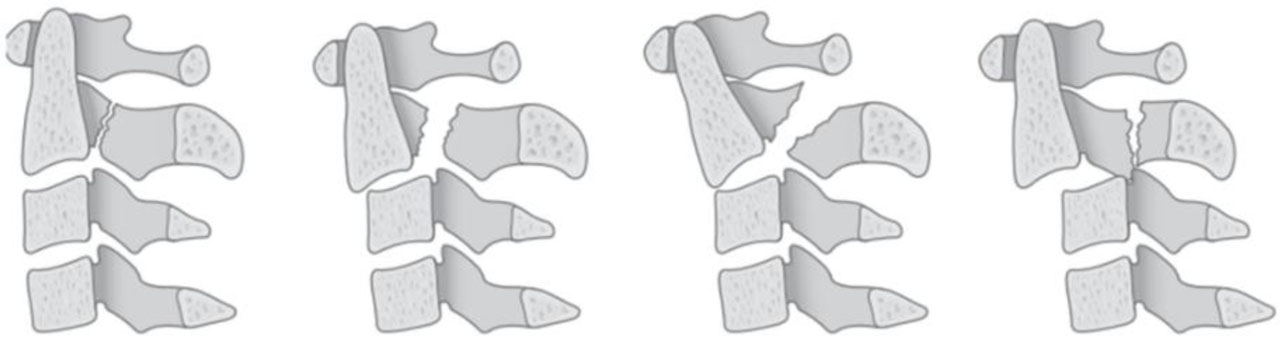
Figure 2.
Schematic Drawing of Hangman’s Fractures by Levine and Edwards classifications (Type I, Type II, Type IIa, and Type III (reading left to right).). Reprinted from https://orthofixar.com/spine/hangmans-fracture.
Type I, non-displaced fracture of the pars interarticularis.
Type II, displaced fracture of the pars interarticularis.
Type IIa, displaced fracture of the pars interarticularis with disruption of the C2–3 disco-ligamentous complex.
Type III, dislocation of C2–3 facet joints with fractured pars interarticularis. (See Figure 2.) Hangman’s Fractures involve traumatic spondylolisthesis with the fracture of both pedicle, neural arch or pars interarticularis of the axis vertebrae without involvement of the odontoid process (Li et al., 2006; Mahajan et al., 2019; Pal & Pratihari, 2017; Penney et al., 2002). Hangman’s fractures result in almost instantaneous death as the force results in bilateral fractures and separation of the anterior section of the axis that remains attached to the cervical spine and the atlas remains attached to the skull (Coombs & Ashton-Cleary, 2023; Maier et al., 1999; Nichols, 2025; Rayes et al., 2011; Wood-Jones).
Laryngotracheal injuries, including fractures, had a calculated weighted average of 7.7%, noting that the individual average in the literature varied from 1.2 to 25.6% (Azmak, 2006; Elfawal & Awad, 1994; Salim et al., 2006; Sen Gupta, 1965). Both the hyoid bone and the laryngeal cartilages of the thyroid and the cricoid may be fractured by the applied external force of a ligature (Dorfman, 2023; Fukumoto et al., 2021; Kaki et al., 1997). Injury to an individuals’ airway occurs secondary to compression of the pharynx and larynx, and can result in respiratory distress (Deshpande, 1998; Iserson, 1984; Kaki et al., 1997). Whilst the airway can be compromised, the trachea tends to maintain its integrity in cases of near hanging due to its cartilage structure (Aufderheide et al., 1994; Coombs & Ashton-Cleary, 2023; Tintinalli et al., 2016), and complete compression of the airway generally requires a greater force than achievable in near hanging, or significant opposing anterior and posterior pressure (Kodikara, 2006; McCance & Huether, 2014; Stellpflug et al., 2020).
The vasculature of the neck is relatively unprotected and is vulnerable to injury and occlusion. Vascular injuries presented a weighted average of 4.9%, noting that the individual studies reported a range of 0.0 to 6.1%. Vascular occlusion is purported to be the primary contributor to hanging related fatalities (Sauvageau et al., 2010). Ligature constriction on the neck vessels can result in intimal tears, flexion, rotation, vasospasm, dissection and occlusion (Chikhani & Winter, 2014; Clément et al., 2010; Adams, 1999). Noting that injury or occlusion can be bilateral as weight may be distributed evenly over the ligature (Adams, 1999; Yamasaki et al., 2009). CT angiography remains the gold standard for identifying cervical injuries associated with near hanging (Dorfman, 2023) and decisions to scan (or not) are generally physician led and rates do vary significantly between institutions. Individuals need to be monitored for cerebral oedema, hypoxic brain injury, as well as thrombosis and further exacerbates cerebral ischaemic injury (Jawaid et al., 2017; Stellpflug et al., 2022).
It is estimated that arterial injury occurs in 0.5 to 2% of cases of near hanging (Ahmad & Hossain, 2010; Martin et al., 2005; Salim et al., 2006). When the carotid arteries are occluded, there can be cerebral blood flow stagnation, resulting in hypoxia and a loss of consciousness. The vertebrobasilar system can provide a means of blood flow into the brain (Figure 3.) (Nichols, 2019; Stellpflug et al., 2020). The vertebral arteries course through the transverse foramen of the cervical vertebrae, and are relatively protected from external compressive forces, except extreme rotation and / or flexion which can result in shearing or dissection (Kaki et al., 1997). Dissection of the vertebral artery can result in a rapid and catastrophic subarachnoid haemorrhage that has a high likelihood of rapidly occurring and fatal rebleeding (Adams, 1999; Biffl et al., 1999; James & Nasmyth-Jones, 1992; Reay et al., 1994; Wallace et al., 1994; Yamada et al., 2004). Such cases are almost always incompatible with life.
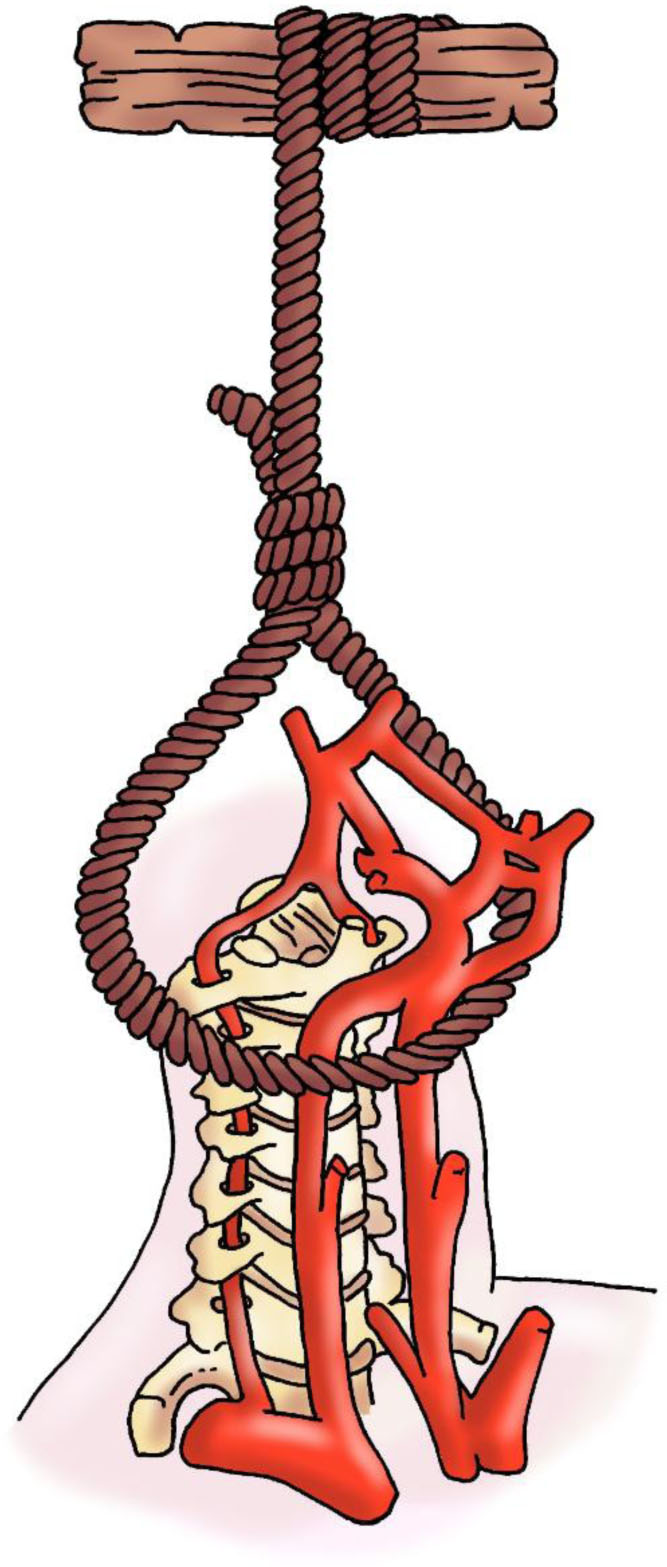
Figure 3.
A Schematic Drawing of the Cervical spine Demonstrating the Cerebrovascular System and the Vulnerability of the Carotid Arteries to Hanging, the Protection that the Vertebrae Provide to the Vertebral Arteries and the Collateral Pathways of the Circle of Willis are also Demonstrated.
Phillip Hughes the Australian cricket player. That video that some of you might remember watching, within seconds of being hit in the neck with a cricket ball, he stopped and swayed before collapsing to the ground, and following this his team mates and doctors were administering CPR in a vain effort to save his life however, the damage and dissection of his vertebral artery had resulted in a catastrophic and subsequently fatal subarachnoid haemorrhage. His death from a ruptured vertebral artery happened so quickly and so tragically.
The jugular venous system is reasonably exposed and are the first structures to be compressed following a near hanging (Coombs & Ashton-Cleary, 2023; Jawaid et al., 2017; Kaki et al., 1997). When compared to the arterial vessels, the venous vessels are more malleable and have a lower intravascular pressure, leaving them more vulnerable to ligature damage (Kaki et al., 1997; Rozzi & Riviello, 2019).
Impairment of venous return is associated with reduced flow of blood from the brain, resulting in increased intracranial pressure and inversely reduced cerebral perfusion pressure that poses a life-threatening prognosis as it can swiftly fall below the capability of autoregulation (Champion et al., 2013; Stellpflug et al., 2020).
Outcomes and Outlook
Suicides accounted for 1.7% of all deaths registered in Australia in 2003, of these hanging are attributed to 45% of cases (Australian Bureau of Statistics, 2004). It is estimated that up to 83% of near hanging presentations are of intended self-harm or suicidal intent (Gantois et al., 2017; Mitra et al., 2023), with up to 85% of individuals who self-attempt hanging will die of their endeavours (Cai et al., 2022; Elnour & Harrison, 2008; Gantois et al., 2017; Gunnell et al., 2005)..
For those that reach hospital, the mortality rates are significantly lower at 44% (de Charentenay et al., 2020). Sadly, the individuals who do make it to hospital only represent a fraction of those that partake in hanging as a suicidal means (Rigozzi & Nichols, 2019)
The majority of individuals will hang themselves at night and in their own home or place of residence (Ahmad & Hossain, 2010; Bansal & Nayyar, 2023; Coombs & Ashton-Cleary, 2023; de Charentenay et al., 2020; Gantois et al., 2017; Gubbins, 2016; Salvetti et al., 2023). A small proportion (around 10%) of suicidal hangings occur in controlled environments such as hospitals, psychiatric units, prisons or in police custody (Gunnell et al., 2005). Although geographical location can significantly change this proportion, with the percentage of indigenous deaths in police custody or prison significantly higher in some geographical areas.
Prognostic and mortality factors related to outcome following near hanging include the length or height of the hanging, the initial level of consciousness, period of sub optimal oxygen levels, if the individual was partially or fully suspended, and if an individual went into cardiac arrest (Boots et al., 2006; Gunnell et al., 2005). Cardiac arrest is a key indicator of outcome, with only 34.0 % of individuals experiencing a good neurological outcome following a near hanging cardiac arrest. (Bansal & Nayyar, 2023). The hang time, which is critical threshold for determining a favourable outcome, is estimated to be less than five minutes (Mahajan et al., 2019; Yıldırım et al., 2015). Despite this, survival is still possible following a prolonged hanging time with minimal neurological sequalae. Survival is also influenced by the physical process, with hanging considered as partial or incomplete when part of an individual’s body touches the ground (Ahmad & Hossain, 2010). It can be difficult to provide support and reassurance to relatives and loved ones in the first few days following a near hanging, as predicting the outcome can be difficult and assessments and imaging are generally required to guide interventions and care (Stellpflug et al., 2020). There is also the difficult situation where conversations and decisions regarding the limitation of therapy, may need to take place.
It is estimated that 46.8% of individuals will have a complete neurological recovery following a near hanging (Gantois et al., 2017). Although survival may come with retrograde amnesia of the hanging and even events leading up to it (Jawaid et al., 2017). Survival following a near hanging may change an individual’s life forever, their ability to speak, walk and control their movements may be impacted. In one Australian study the median duration of hospitalisation was only 6 days, ranging from 1 to 4 days (Boots et al., 2006). This leaves very little time for medical and nursing staff to have a positive and lasting impact on individuals’ lives. Caring for an individual following a near hanging can also be impacted by cognitive function, including poor concentration, varying emotions and varying states of involvement in care needs and rehabilitative activities. Sadly suicidal recidivism rates remain high with 18.2% of individuals reattempting suicide within a year of a near hanging (Gantois et al., 2017),which reinforces the importance of nursing support and psychiatric care following the event
Strengths and Limitations
To fully capture the scope of the incidence and mortality rates, data relating to hangings must be collected utilising robust methods of data linkage and accessing overlapping sources that are accessed from both tertiary and regional hospitals, as well as from ambulance and death registry sources (Nichols et al., 2021; Nichols et al., 2018). It is only through this process that verification and validation of cases can be undertaken. Data linkage would also enable critical time points to be analysed enabling an analysis of both system and individual time factors (Nichols et al., 2020). This is an important approach when assessing data and analysing the overall gauge of cases and factors that influence outcome. As an example, there is a dearth of literature pertaining to neurosurgical units and their care of individuals post a near hanging, with most studies focusing on the emergency department interventions or care within the intensive care setting.
The difficulties in recording and publishing any data related to suicides is that there is a social stigma and reporting is ambiguous and not standardised. The main reason as to why suicides or attempts are not publicised is to prevent contagion or the ‘Werther Effect’. All guidelines strongly advise against reporting details to prevent spikes in copycat behaviours and those wishing in emulate and imitate. Whilst this is generally applicable to the media and not academic writing, there has been a flow on effect and there is a certain hesitancy in the literature when discussing the topic of near hanging. Despite this, research can be beneficial by aiding best practice and reducing the risk of further attempts
Data representing rare presentations such as near hangings is often retrospective and unvalidated data, however this study remains significant in opening the conversation and generating methods and hypothesis for future studies, despite its scoping nature and the use of weighted averages. When analysing singular papers, averages simply determine the central value of a dataset, by summing all the data points and dividing by the total number. The use of weighted averages enabled a more precise result to be calculated, through the analysis of multiple datasets, where the significance of data points are considered and factored in the analysis. A weighted average assigns a different weight to each of the values, and this reflects the importance or the frequency, and provides a more accurate representation of the dataset. A weighted average differs from a simple average in that it adjusts the final average based on the sum of weights, this enables a clearer view of the distributions with differing weights and varying numbers.
There were multiple studies where there was missing data or if documentation was not found in the literature, one could either assume that events did not happen or that editorial constraints did not allow for analysis and discussion of a topic. It is perhaps an academic’s worst flaw to make the mistake of assuming missing data means an absence of occurrence. One final limitation is that this work was undertaken by a single author. Whilst this enables a unique intellectual ownership, there remains a fundamental need to proactively mitigate risks including bias, subjective interpretation and limitations. This is addressed through ensuring an open and transparent methodology and external validation that is achieved through an extensive literature review as well as an external and independent review of this work. Undertaking an independent approach to this topic has enabled a deep analytical thought process and conceptual approach to produce high quality research that has relied on independent and individual insight. As a single author work, this manuscript has clearly presented a cohesive, consistent and distinct voice, that is unambiguously credited to the author. Potential shortcomings, such as researcher bias or limited perspectives involves systematic transparency, reflexivity, and the implementation of rigorous, structured methods to minimise the impact of personal perspectives. The research process has been clearly documented to allow for replication and evaluation of how the data was collected, analysed and interpreted. Addressing limited perspectives as a single author involves a deliberate, structured approach to self-reflection, extensive research, and the validation of findings. Peer review processes have enabled the author to address gaps in the literature and methodology, demonstrating an openness to review and analyse. The author would like to propose that future research could use a collaborative team approach to expand on the findings presented in this manuscript.
Conclusion
A weighted average is a statistical tool used to calculate overall mortality rates, neurological outcomes, or risk factors by accounting for the varying sizes of different study groups. This study utilised a weighted average approach to synthesise outcomes from 4230 near hanging events across multiple clinical and geographical settings. The use of weighted averages has enabled this study to accurately represent a diverse population by correcting for demographics and masking individual risk. The utilisation of weighted averages accounted for the differences in individual focus areas related to sex, race and age, and it ensured that minority groups such as indigenous Australians were not under-represented. Significant individual variability was masked using weighted averages. For example, factors such as geographical location that is a significant and life-threatening factor for specific individuals or cohorts, can be moderated in terms of its effect across a population. These findings indicate a pooled survival rate of 38.7%, suggesting that aggressive resuscitation is warranted even in cases of profound initial neurological depression. The weighted analysis identifies initial GCS and cardiac arrest as the most significant predictors of mortality. However, the low weighted prevalence of cervical spine fractures (0.6%) suggests that while C-spine precautions remain a standard of care, they should not delay life-saving airway interventions. Ultimately, this weighted synthesis provides a more robust clinical roadmap for neuroscience nurses than individual case series, though prospective, standardised reporting remains necessary to address the heterogeneity of 'time-of-suspension' data.
Nurses play a key role in ensuring that individuals receive specific discharge instructions and referrals to supportive services following a near hanging, this is fundamental to support recovery and reduce the risk of secondary attempts at their own lives. The outcome following a near hanging is complex and multi-faceted. Outcomes are associated on factors such as the need for CPR and presentation with a poor GCS score prior to admission to hospital. There is also significant out of hospital mortality rates. Many of the studies reviewed generally focused on statistical findings rather than exploring factors such as reasoning, thought processes and events that led up to the hanging event, as well as the psychological burden experienced by individuals, family, friends, first responders, nursing and medical staff. There is a certain courage that is required for survivors, there will always be fear of the unknown, but this must be managed and controlled for individuals to begin to heal and move forward rather than look for future ways to attempt one’s life. The risk of recidivism is real and as important to address as the risk of other outcomes. Psychiatric care and follow up should become routine practice and regarded with paramount importance. Considerable importance and weight are applied to upper cervical spinal imaging, despite the low risk of injury. This emphasis is perhaps to the detriment of psychiatric care. As nurses, we have only a brief period of time to aid and assist, and we need to be advocating for a system that is supportive.
Notes
[2] Content Warning
This manuscript discusses sensitive terms such as ‘suicide’ and ‘self-harm’. All attempts have been made not to focus on or dramatise the emotional aspects of suicide and death. If having suicidal thoughts, or thoughts of self-harm, help and support is available. The Australian helplines and support groups include:
Lifeline 131114 or text 0477 131 114
Beyond Blue 1300 224 636
Suicide Call Back Service 1300 659 467
13YARN 139276
For immediate life-threatening danger call 000