
1. Introduction
Natural Cytotoxic Receptors (NCRs) were discovered in the late 1990s, and thanks to the pioneering studies of Moretta et al. 2001, NCRs have been characterized as crucial elements in the immune response of Natural Killer (NK) cells, confirming the principles of the “missing-self” hypothesis proposed in the late 1980s (Kärre et al. 1986; Moretta et al. 2001; Raulet 2006). Presently, it is well known that NCRs are surface receptors located on NK cells, which are crucial elements of the first line of defense against infections and tumors. NK cells equipped with NCRs can recognize and destroy pathologically altered cells, such as cancer cells and virus-infected cells, without the need for prior activation or antigen presentation (Bogunia-Kubik and Łacina 2021).
There are three NCRs: NKp30 (NCR3/CD337), NKp44 (NCR2/CD336), and NKp46 (NCR1/CD335), each possessing activating effects and serving quite specific but similar functions in the immune process (Bogunia-Kubik and Łacina 2021). The NKp30 and NKp44 are located on human chromosome 6, while NKp46 is encoded on chromosome 19 (Barrow et al. 2019). NKp30 is involved in tumor recognition and regulation of immune responses against parasites (Pinheiro et al. 2020). NKp44 is the only NCR with an additional inhibitor domain (ITIM), and in some circumstances it may weaken cell activity (Campbell et al. 2004). Moreover, it plays a role in antiviral and antibacterial responses (Arnon et al. 2001). NKp46 is critical in eliminating cancer cells and virus-infected cells (Mandelboim et al. 2001; Berhani et al. 2019). These receptors, through interaction with ligands on the surface of pathological cells, induce cytotoxic mechanisms and cytokine production, leading to the destruction of target cells (Kruse et al. 2014).
NCRs play a pivotal role not only in the direct elimination of threats but also in modulating other components of the immune system, making them essential for understanding and manipulating immune responses. Their role is particularly significant in cancer therapy and stem cell transplant, where they can function in multiple ways. NCRs contribute to the elimination of residual cancer cells primarily through the activation of NK cells, leading to direct cytotoxicity via the release of granzymes and perforin or through antibody-dependent cellular cytotoxicity (Hudspeth et al. 2013; Gail et al. 2023). Additionally, activated NK cells can mediate immune system mobilization by producing cytokines such as interferon (IFN)-γ or tumor necrosis factor-α (Almishri et al. 2016). Furthermore, NCRs enhance the immune surveillance capabilities of NK cells, allowing them to continuously monitor and detect residual cancer cells that might evade initial treatments. This ongoing surveillance aids in maintaining long-term remission and preventing relapse (Luna et al. 2017). In the context of hematopoietic stem cell transplantation (HSCT), where the patient's immune system is significantly compromised, the role of NCRs in controlling the development of infections, such as cytomegalovirus (CMV) infection, and modulating graft-versus-host disease (GvHD) becomes critically important, as these are common post-transplant complications, and NK cells are the first population of donor-derived lymphocytes to reconstitute after HSCT (Palmer et al. 2013; Ghadially et al. 2014; Alvarez et al. 2016). In our previous studies, we demonstrated correlations between the levels and polymorphic variability of other activating NK cell receptors belonging to the NKG2 family and the predisposition to complications in recipients after HSCT (Siemaszko et al. 2023, 2024). These findings led us to believe that analyzing additional activating NK cell receptors could be significant in the context of understanding the functional patterns of NK cells after HSCT. Understanding the mechanisms of NCR action on NK cells may help in their potential use in therapy and open new possibilities for treating cancer and post-transplant complications. In light of this information, we investigated the potential of NCR receptors in controlling patient outcomes following HSCT, focusing on changes in expression (on the cell surface and on mRNA level) of these receptors and the genetic variability in the NCR1, NCR2, and NCR3 genes.
2. Materials and Methods
2.1. Selection of the study group
For this study, peripheral blood samples were collected from 167 recipients (R) who underwent allogeneic stem cell transplantation, as well as from 120 donor-recipient pairs, across five transplantation centers in Poland, totaling 407 individuals (287 recipients and 120 donors). Patients eligible for transplantation were over 18 years of age and met the criteria set by the European Hematology Association and the European Society for Blood and Marrow Transplantation. The median age in the donor group was 42 years old (range 14–72), while in the recipient group it was 51 years old (range 18–73). The most common diagnosis among the recipients was acute myeloid leukemia. Smaller subgroups dedicated to subsequent analyses, that is gene expression and flow cytometry, were selected from the main cohort of patients described above. The reduced sample size of these groups was determined by the study design and the shorter time frame allocated for implementing these specific project tasks.
During the pre-transplant preparation phase, recipients underwent conditioning tailored to their individual condition and needs using one of the following protocols: (1) myeloablative conditioning (MAC): high-dose chemotherapy and radiation were used to completely eradicate the patient's bone marrow and immune system, (2) reduced-intensity conditioning (RIC): lower doses of chemotherapy and radiation were administered, aiming primarily to significantly weaken the immune system; (3) non-myeloablative conditioning (NMA): minimal bone marrow suppression was employed, focusing mainly on immunosuppression to facilitate donor cell engraftment. Additionally, donors and recipients were matched based on high-resolution genotyping of all HLA-class I and class II loci, including DRB1 and DQB1. The serological status of anti-CMV IgG antibodies was also determined for all patients. Viral replication was defined as the detection of CMV viremia using quantitative real-time PCR (qPCR) performed with the AltoStar CMV PCR Kit 1.5 (Altona Diagnostics GmbH, Hamburg, Germany). Patients underwent routine CMV monitoring at weekly intervals. Detailed patient characteristics are presented in Table 1.
Table 1.
Patients'characteristics
| N = 287 | % | |
|---|---|---|
| Recipient sex | ||
| M/F | 167/120 | 58.19/41.81 |
| Donor-Recipient sex match | ||
| Male to male | 127 | 44.25 |
| Male to female | 69 | 24.04 |
| Female to female | 48 | 16.72 |
| Female to male | 39 | 13.59 |
| Donor type | ||
| MUD | 94 | 32.75 |
| MMUD | 16 | 5.58 |
| MSD | 115 | 40.07 |
| Haploidentical | 62 | 21.60 |
| Recipient conditioning | ||
| MAC | 148 | 51.57 |
| RIC | 135 | 47.70 |
| NMA | 3 | 1.04 |
| GvHD prophylaxis | ||
| CSA + MTX | 188 | 65.51 |
| PTCy + TAC + MMF | 50 | 17.42 |
| CSA + MMF | 7 | 2.44 |
| TAC + MTX | 3 | 1.05 |
| TAC + MMF | 3 | 1.05 |
| Other | 36 | 12.54 |
| CMV IgG status | ||
| Recipient positive | 234 | 81.15 |
| Donor positive | 189 | 65.85 |
| Post-transplant complications | ||
| aGvHD | 114 | 39.72 |
| grade I | 54 | 18.82 |
| grade II | 41 | 14.29 |
| grades II-IV | 19 | 6.62 |
| cGvHD | 59 | 20.56 |
| CMV infection | 101 | 35.19 |
| Relapse | 45 | 15.68 |
| Death | 48 | 16.72 |
[i] CMV, cytomegalovirus; CSA, cyclosporine A; MAC, myeloablative conditioning; MMF, mycophenolate mofetil; MMUD, mismatched unrelated donor; MSD, matched sibling donor; MTX, methotrexate; MUD, matched unrelated donor; NMA, non-myeloablative conditioning; PTCy, Post-transplant cyclophosphamide; RIC, reduced intensity conditioning; TAC, tacrolimus.
The study was approved by the Wroclaw Medical University Ethics Committee (identification code: KB-561/2019).
2.2. DNA isolation and single nucleotide polymorphism genotyping
Peripheral blood from patients was collected into tubes containing the anticoagulant ethylenediaminetetraacetic acid (EDTA). Subsequently, DNA was extracted from whole blood using NucleoSpin Blood kits (MACHEREY-NAGEL, Düren, Germany), which are column-based isolation kits. Genotyping was performed on isolated DNA via real-time PCR to identify polymorphic variants in genes encoding NCR receptors: NCR1 (NKp46), NCR2 (NKp44), and NCR3 (NKp30). Commercial TaqMan single nucleotide polymorphism (SNP) Genotyping Assays (Thermo Fisher Scientific Inc., Waltham, MA, USA) were utilized for genotyping, with endpoint genotyping, which was used to determine geno-types. The polymerase chain reaction was conducted using a LightCycler 480 II thermocycler (Roche Diagnostics, Rotkreuz, Switzerland).
A total of seven polymorphisms were investigated: NCR1 rs2278428 (C > A), rs34549987 (C > T), rs1433097 (C > T); NCR2 rs2236369 (T > C), rs9394782 (T > C), rs2273962 (A > G); and NCR3 rs11575836 (A > G). These polymorphisms were selected based on input from the SNPs Function Prediction tool (Xu and Taylor 2009), as well as data from databases such as Ensembl and the National Center for Biotechnology Information. Attention was given to the minor allele frequency in European populations and the potential functional consequence of the polymorphisms. Detailed characteristics of the selected polymorphisms are provided in Table 2.
Table 2.
Characteristics of selected SNPs in NCR genes
| Gene | rs number | Allelic variants | Consequence | Amino acid | MAF | Position |
|---|---|---|---|---|---|---|
| NCR1 | rs2278428 | C > A | Missense variant | Q (Gln) > K (Lys) | 0.08 | chr19:54906696 |
| rs34549987 | C > T | Intron variant (potential TFBS) | N/A | 0.46 | chr19:54905596 | |
| rs1433097 | C > T | Intron variant (potential TFBS) | N/A | 0.16 | chr19:54907100 | |
| NCR2 | rs2236369 | T > C | Missense variant | S (Ser) > P (Pro) | 0.41 | chr6:41341814 |
| rs9394782 | T > C | Initiator codon variant | M (Met) > T (Thr) | 0.33 | chr6:41335854 | |
| rs2273962 | A > G | Missense variant | M (Met) > V (Val) | 0.23 | chr6:41350700 | |
| NCR3 | rs11575836 | A > G | 5'UTR variant (potential TFBS) | N/A | 0.13 | chr6:31592925 |
2.3. RNA isolation, reverse transcription, and gene expression
A group of 89 patients post-HSCT was selected for the gene expression study. The chosen patients were divided into subgroups based on the occurrence of post-transplant complications: 22 patients with CMV infection, 18 patients with chronic GvHD, 24 patients with acute GvHD, and 25 patients without complications.
RNA was isolated from peripheral blood mononuclear cells separated from whole blood and preserved in RNA Extracol (EURx, Gdańsk, Poland). The isolation was performed using a chemical extraction method, in which RNA was separated from the aqueous phase formed by the addition of chloroform. Next, RNA was precipitated using isopropanol and washed with ethanol to obtain a purified isolate. RNA concentration was measured on a DeNovix DS-11 spectrophotometer (DeNovix Inc., Wilmington, DE, USA). RNA samples were stored at −80°C until further use.
Reverse transcription was performed using the High-Capacity cDNA Reverse Transcription Kit (Applied Biosystems™, Foster City, CA, USA) with RNase inhibitor (Applied Biosystems™, Foster City, CA, USA) and 2000 ng of RNA per sample. The final volume of the reaction mix was 20 µL. The reaction was carried out in a SimpliAmp™ Thermal Cycler (Applied Biosystems®, Foster City, CA, USA) using a four-step program, as recommended by the kit manufacturer. Samples with cDNA were then stored at −20°C. Subsequently, cDNA was used in quantitative PCR using TaqMan Gene Expression Assays (Applied Biosystems™, Foster City, CA, USA) to detect expression of NCR1 (Hs00183118_m1), NCR2 (Hs00183113_m1), NCR3 (Hs00394809_m1), IFNG (Hs00989291_m1), ACTB (Hs01060665_g1), and GAPDH (Hs99999905_m1) in patients post-HSCT. GAPDH, encoding glyceraldehyde-3-phosphate dehydrogenase, and ACTB, encoding beta-actin, were used as reference genes to normalize the expression data. The reaction was conducted using the Real-Time PCR Instrument 480 (Roche Diagnostics, Rotkreuz, Switzerland) with applied conditions as follows: (1) 10 min/95°C – initial denaturation, (2) 15 s/95°C–45 cycles of denaturation, and (3) 1 min/60°C–annealing. All the samples were measured in duplicate, and expression was calculated relative to the control group without complications. The 2−ΔΔCt method was used to calculate relative expression.
2.4. Flow cytometry
A group of 47 transplant recipients, eligible for HSCT and recruited from Wroclaw Medical University transplantation center, was engaged for the flow cytometry analysis. Blood for cytometric analysis was collected on EDTA in five time-points: pre-transplant, days 21, 30, and 60, and post-transplant 90 days.
To detect surface NCR receptor expression on NK cells, a panel of mouse anti-human antibodies conjugated with fluorochromes was used in the following configuration: CD16-PE, CD337-PerCP-Cy5.5, CD56-PC-7, CD336-APC, CD3-APC-H7, CD335-V450, and CD45-V500. All antibodies were sourced from Becton Dickinson and Company (BD, San Jose, CA, USA). The analysis of nucleated cells was performed using an 8-color FACS Canto II flow cytometer (BD, San Jose, CA, USA). For each sample, we aimed to collect as many cells as possible, with an average of 500,000 cells per test tube. Data were analyzed using BD, San Jose, CA, USA. Dot plot results were gated to isolate singlets, all lymphocytes, all NK cells, NK CD56dim and CD56bright subpopulations, and then NCR receptors were detected within each subgroup of NK cells. Percentages of positive events were used for statistical analysis. Detailed gating strategy is presented below (Figure 1).
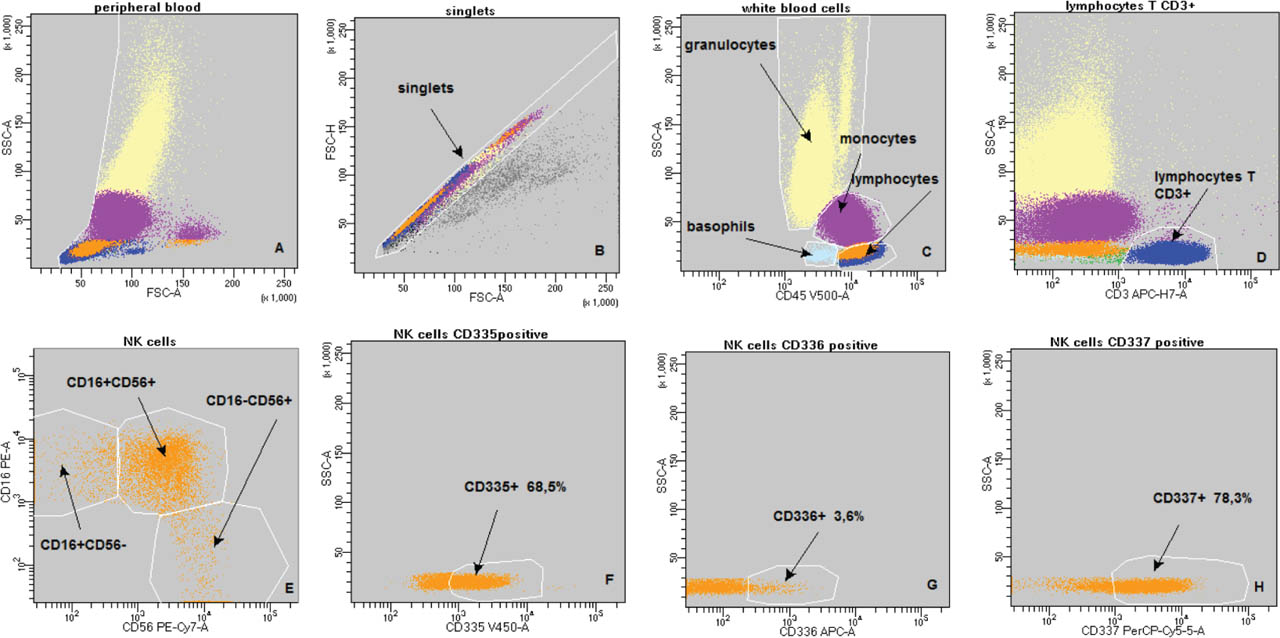
Fig 1.
The gating strategy: (A–H): singlets in peripheral blood after excluding doublets and debris; dark blue—lymphocytes T CD3+; orangeNK cells; pink—monocytes; yellow—granulocytes; blue—basophils. (A) discrimination of debris (FSC-A vs. SSC-A); (B) discrimination of doublets (FSC-A vs. FSC-H); (C) gating of the peripheral blood leukocyte populations (CD45 vs. SSC-A); (D) lymphocytes T CD3+ and NK cells—(CD3 vs. SSc-A); (E) NK cell subpopulations (CD56 vs. CD16); (F) NK cells CD335 positive (CD335 vs. SSc-A); (G) NK cells CD336 positive (CD336 vs. SSc-A); (H) NK cells CD337 positive (CD337 vs. SSc-A).
2.5. Statistical analysis
Quantitative traits were compared using Mann–Whitney U and Student's t tests, depending on whether the trait followed a normal distribution, as assessed by the Shapiro-Wilk test. Fisher's exact test for 2 × 2 tables was used for qualitative traits. A logistic regression model was used in a multivariate analysis to test for factors associated with CMV infection. Survival was illustrated by Kaplan–Meier curves and calculated with the Gehan–Breslow–Wilcoxon test. Correlations were assessed using the Spearman correlation coefficient. Calculations were performed using GraphPad Prism 8.0.1 software (version 8.0.1, GraphPad Software, San Diego, CA, USA) and RStudio (RStudio, PBC., Boston, MA, USA), with a significance level set at p < 0.05.
3. Results
3.1. NCR mRNA levels and CMV infection
We studied mRNA expression of genes encoding NCR receptors and IFN-γ (IFNG), an important cytokine released during anti-viral immune response. It was found that the expressions of NCR1 and NCR3 were higher in patients with CMV infection compared to those who did not develop the infection. For NCR1, a clear upward trend was observed (p = 0.0673) (Figure 2a), while for NCR3, the relationship was statistically significant (p = 0.0058) (Figure 2b). As expected, patients who developed CMV infection also exhibited significantly higher IFNG expression levels than those without complications (p = 0.0060) (Figure 2c). No associations with NCR2 were detected; furthermore, NCR2 expression was below the detection threshold in a large group of patients included in the study.
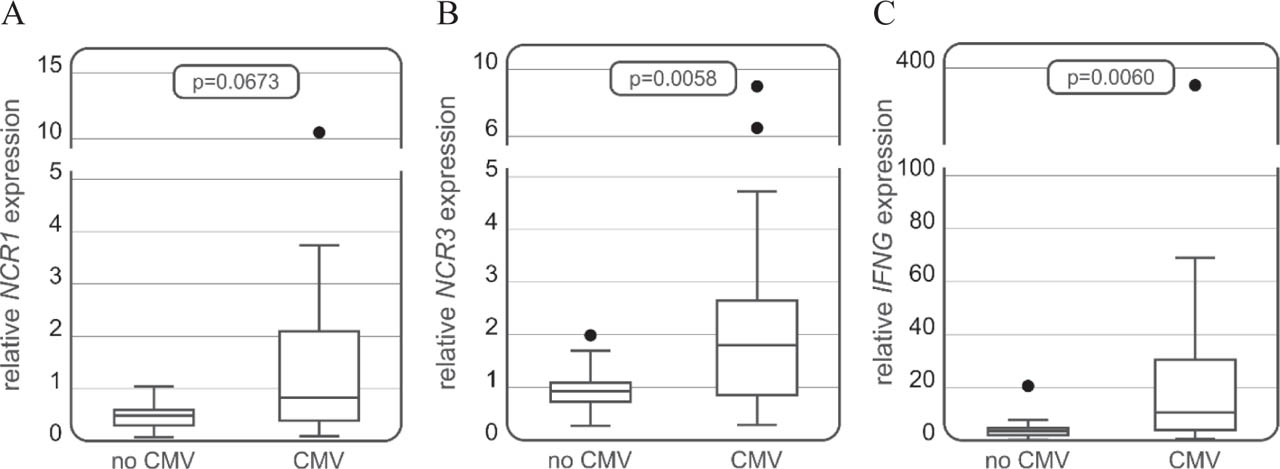
Fig 2.
Differences in the expression of genes encoding NCR1 and NCR3 receptors and IFN-γ (IFNG) in HSCT patients with CMV infection and in patients without complications. (A) NCR1 expression level in CMV-positive patients vs. patients without complications; (B) NCR3 expression level in CMV-positive patients vs. patients without complications; (C) IFNG expression level in CMV-positive patients vs. patients without complications. CMV, cytomegalovirus; HSCT, hematopoietic stem cell transplantation.
These findings prompted us to also test for a potential correlation between expression of IFNG and that of NCR1 and NCR3 in patients with CMV infection. This analysis revealed a significant positive correlation between the expression levels of NCR1 and IFNG (p = 0.0022; R = 0.689) (Figure 3a), as well as between NCR3 and IFNG (p = 0.0001; R = 0.804) (Figure 3b). These results suggest a strong association between NCR gene expression and the anti-viral immune response associated with IFN-γ release.
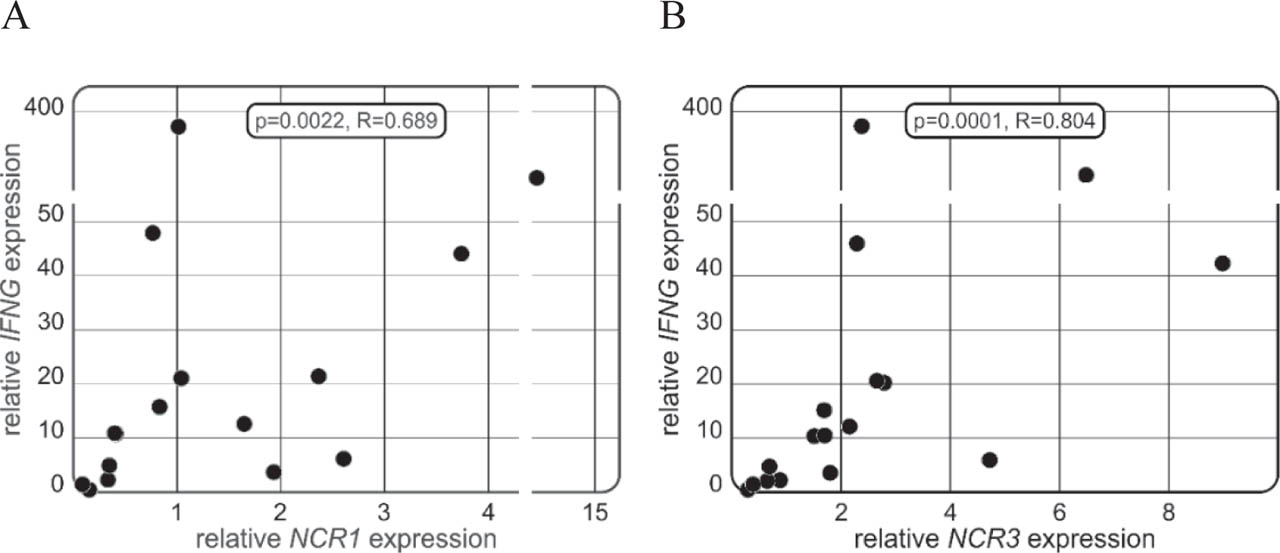
Fig 3.
Correlation between INF-γ (IFNG) expression and NCR1 and NCR3 genes (A,B) in patients with CMV infection after HSCT. A strong correlation between IFNG and both NCR1 and NCR3 can be observed. CMV, cytomegalovirus; HSCT, hematopoietic stem cell transplantation.
3.2. Frequencies of NCR expressing NK cells and CMV infection
Furthermore, we also used flow cytometry to study differences in the frequency of NK cells expressing NCR1, NCR2, and NCR3 over time in patients with various post-transplant complications. We observed a difference regarding NCR1+ NK cell frequency between patients who developed CMV infection and those who did not. The frequency of NCR1+ NK cells begins to diverge around day 30 post-transplant and shows significant discrepancies 60 and 90 days after HSCT, with lower frequency in CMV patients (p = 0.0041 and p = 0.0302, respectively) (Figure 4). Dividing NK cells into CD56dim and CD56bright subpopulations reveals that the difference in NCR1 expression is primarily and significantly observed in the CD56bright subpopulation, which is more numerous in the early post-transplant period in comparison to the CD56dim subgroup. The percentage of NCR1+ CD56bright NK cells was higher in patients without CMV infection at day 60 (p = 0.0017) and day 90 (p = 0.0329) after HSCT.
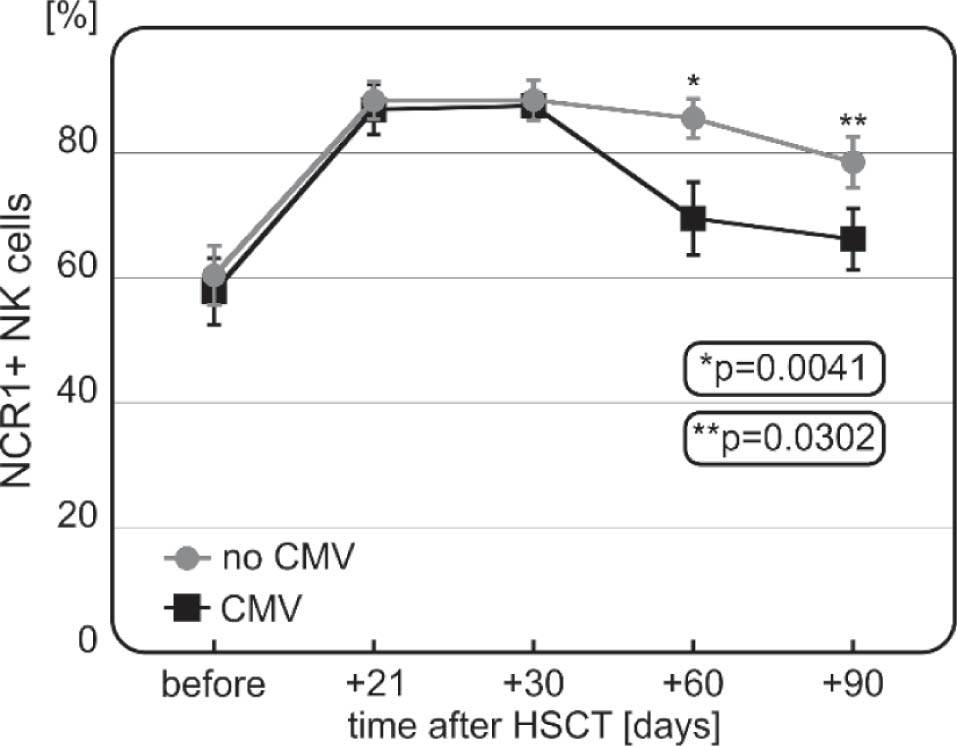
Fig 4.
Change over time in the percentage of NK cells expressing the NCR1 receptor in patients with or without CMV infection post-HSCT. CMV, cytomegalovirus; HSCT, hematopoietic stem cell transplantation; NK, natural killer.
3.3. Distribution of genotypes in donors and recipients
Genotyping of SNPs in the genes coding for NCR1, NCR2, and NCR3 revealed a distribution of alleles and genotypes as presented in Table 3. The frequency of the minor allele aligns with the data available in the dbSNP Short Genetic Variations database maintained by the National Library of Medicine (NIH) (Sherry et al. 1999). Furthermore, the distribution of alleles and genotypes for all analyzed polymorphisms conforms to the Hardy-Weinberg equilibrium.
Table 3.
Distribution of genotypes in NCR genes in HSCT recipients and donors
| Gene | rs number | Allel/Genotype | Donors n = 120 [%] | Recipients n = 279 [%] |
|---|---|---|---|---|
| NCR1 | rs2278428 | C | 13 [5.42] | 34 [6.09] |
| A | 227 [94.58] | 524 [93.91] | ||
| CC | 0 [0.00] | 8 [2.87] | ||
| AA | 107 [89.17] | 253 [90.68] | ||
| CA | 13 [10.83] | 18 [6.45] | ||
| rs34549987 | C | 125 [52.08] | 305 [54.66] | |
| T | 115 [47.92] | 253 [45.34] | ||
| CC | 38 [31.67] | 82 [29.39] | ||
| TT | 33 [27.50] | 56 [20.07] | ||
| CT | 49 [40.83] | 141 [50.54] | ||
| rs1433097 | C | 29 [12.39] | 75 [54.35] | |
| T | 205 [87.61] | 63 [45.65] | ||
| CC | 1 [0.85] | 6 [2.19] | ||
| TT | 89 [76.07] | 205 [74.82] | ||
| CT | 27 [23.08] | 63 [22.99] | ||
| NCR2 | rs2236369 | T | 109 [45.42] | 239 [42.83] |
| C | 131 [54.58] | 319 [57.17] | ||
| TT | 19 [15.83] | 46 [16.49] | ||
| CC | 30 [25.00] | 86 [30.82] | ||
| TC | 71 [59.17] | 147 [52.69] | ||
| rs9394782 | T | 91 [37.92] | 202 [36.20] | |
| C | 149 [62.08] | 356 [63.80] | ||
| TT | 13 [10.83] | 34 [12.19] | ||
| CC | 42 [35.00] | 111 [39.78] | ||
| TC | 65 [54.17] | 134 [48.03] | ||
| rs2273962 | A | 80 [33.33] | 159 [28.49] | |
| G | 160 [66.67] | 399 [71.51] | ||
| AA | 10 [8.33] | 26 [9.32] | ||
| GG | 50 [41.67] | 146 [52.33] | ||
| AG | 60 [50.00] | 107 [38.35] | ||
| NCR3 | rs11575836 | A | 207 [86.25] | 502 [89.96] |
| G | 33 [13.75] | 56 [10.04] | ||
| AA | 90 [75.00] | 225 [80.65] | ||
| GG | 3 [2.50] | 2 [0.72] | ||
| AG | 27 [22.50] | 52 [18.64] |
Analysis linking specific genetic variants of the studied polymorphisms with clinical parameters of patients post-HSCT identified significant associations in five out of the seven investigated polymorphisms.
3.4. Donor NCR genotypes and overall survival
Neither NCR1 nor NCR2 genetic variants were found to affect patients'survival. However, it was observed that the presence of the NCR3 rs11575836 AA homozygous genotype in donors was associated with longer overall survival following HSCT (p = 0.0330) (Figure 5).
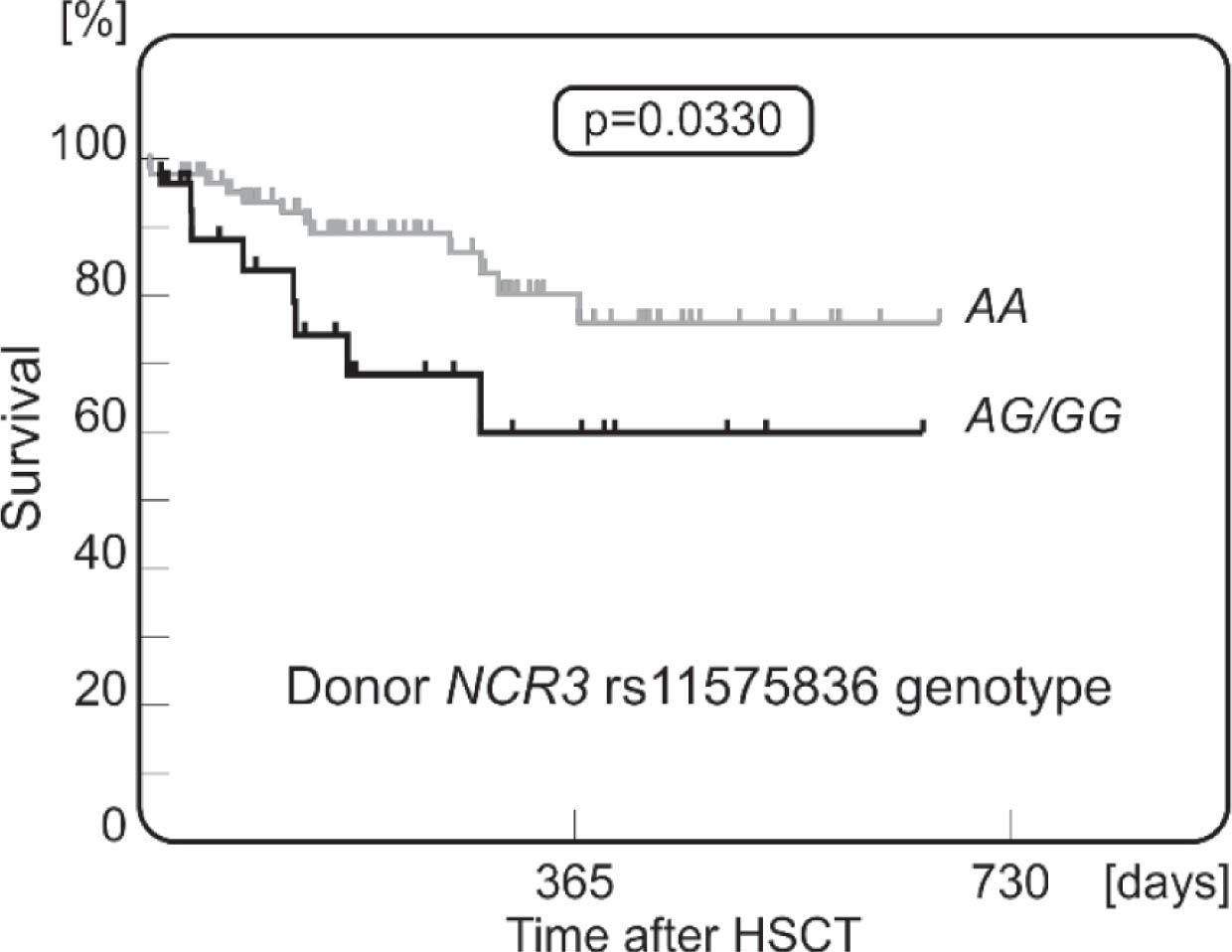
Fig 5.
Kaplan–Meier survival curves of patients post-HSCT stratified by donor NCR3 rs11575836 genotype. Patients transplanted from the NCR3 rs11575836 AA homozygous donors were characterized with better overall survival. HSCT, hematopoietic stem cell transplantation.
3.5. Polymorphisms of NCRs genes in CMV infection
An association was observed between polymorphic variants of the NCR1 and NCR3 genes and the occurrence of CMV infection. The observation regarding the NCR1 rs1433097 polymorphism suggests a trend for a protective role against the development of CMV for donor C allele, as this allele was more frequently found in patients without CMV infection compared to those who developed CMV. Conversely, the donor TT genotype appears to be associated with an increased risk of infection. However, this observation was not statistically significant (p = 0.0523) (Figure 6a). Moreover, an interesting finding related to the NCR3 rs11575836 polymorphism has been noted, where the AA genotype of the recipient is more commonly observed in the group of patients with CMV infection than in the group without infection (p = 0.0336) (Figure 6b). These insights highlight the potential impact of specific genetic variations in NCR receptor genes on the susceptibility to CMV infection following HSCT.
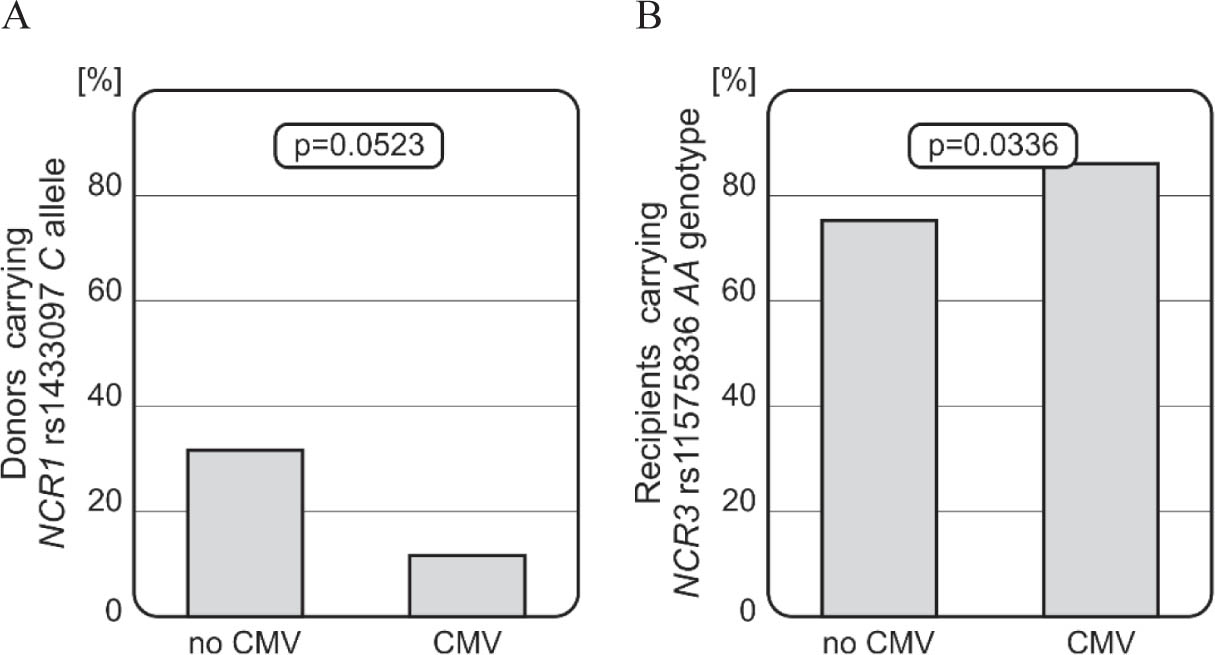
Fig 6.
Relationship between NCR1 rs1433097 donor genotype (A) and NCR3 rs11575836 recipient genotype (B) and risk of CMV infection after HSCT. CMV, cytomegalovirus; HSCT, hematopoietic stem cell transplantation.
To confirm that these genotypes are independent markers of CMV infection, we constructed linear regression models that included the following parameters: relevant genotype (donor NCR1 rs1433097 TT / recipient NCR3 rs11575836 AA), CMV serostatus, donor and recipient sex, and recipient age. Obtained results confirmed the analyzed genotypes: recipient NCR3 rs11575836 AA (OR [95% CI] = 2.65 [1.31–5.69], p = 0.0098) and donor NCR1 rs1433097 donor genotype TT (OR [95% CI] = 3.01 [1.14–8.99], p = 0.0337) as independent markers of CMV reactivation in HSCT recipients.
3.6. Recipient NCRs polymorphisms in other post-transplant complications
As an additional part of the study, associations between NCR gene polymorphism and other post-transplant complications were also tested. Associations between SNPs located in NCR genes and aGvHD incidence were identified for four out of the seven studied polymorphisms. Among the NCR1 SNPs, rs1433097 and rs34549987 in the recipient were found to have a detrimental effect on the development of aGvHD.
The presence of allele rs1433097 T was associated with a higher incidence of aGvHD (p = 0.0237) and more severe complications (p = 0.0305) compared to patients with the CC genotype. Similarly, the rs34549987 AA genotype was more frequently observed in patients who developed aGvHD. Another association was observed with the NCR2 rs9394782 polymorphism, where recipient genotype CC was linked to a lower incidence of aGvHD (p = 0.0046) and a milder disease course (p = 0.0077). A similar trend was noted with the rs2236369 polymorphism, where genotype CC also appears more frequently in individuals without aGvHD manifestation or with a milder form of the disease compared to carriers of allele T. However, in this latter case, the relationship is not statistically significant (p = 0.0593). No associations were found between the polymorphism in the NCR3 gene and aGvHD incidence.
4. Discussion
The current state of knowledge highlights that NCRs, which are expressed on NK cells and some T cell subpopulations, play a crucial role in immune surveillance due to their ability to modulate immune responses. This modulation occurs through NK cell activation, enhanced cytotoxicity, cytokine production, and interactions with other immune cells. Studies demonstrate that low NCR gene expression on NK cells is frequently observed in hematological malignancies (Costello et al. 2002). A weak NCR receptor phenotype, termed NCRdull, has been shown to facilitate leukemia progression, while receptor renewal, especially NCR1 and NCR3, can lead to disease remission (Fauriat et al. 2007). Considering that NK cells are among the first immune cells to reconstitute in the recipients after HSCT, they are critical in eliminating residual malignant cells and controlling infections in the immunocom-promised hosts. Efficient NK cell recovery post-transplantation is associated with a lower risk of CMV infections and disease relapse (Vela-Ojeda et al. 2006; Clausen et al. 2007; Minculescu et al. 2016). NCR receptors, as NK cell activators, are essential in protective functions, particularly as they can recognize viral and bacterial proteins, including hemagglutinins (Kruse et al. 2014).
Our research showed increased NCR1 and NCR3 gene expression on the mRNA level in patients post-HSCT who developed CMV infection compared to those without any complications, suggesting their involvement in response to the infection. RNA expression was assessed in PBMCs, whose lymphocyte component predominantly consists of NK cells early after HSCT (Ogonek et al. 2008; Storek et al. 2008), implying that these differences largely reflect NK cell expression, especially given that NCRs are expressed mostly on NK cells. Moreover, our findings indicate a correlation between NCR1 and NCR3 RNA expression levels and expression of IFN-γ, a critical cytokine released during viral infection, reflecting cellular immune activation (McNab et al. 2015). Elevated IFNG levels signify robust NK and T cell responses, crucial in viral replication control. Borst et al. 2020 demonstrated that murine Ncr1+ NK cells are essential for eliciting a protective IFN-γ immune response against the vaccinia virus (Borst et al. 2020).
NCR1 is recognized as the primary receptor responsible for NK cell cytotoxic activity (Sivori et al. 1999). However, during CMV infection, there is a notable downregulation of ligands for NCR1 on infected cells. Despite this, several hypotheses aim to explain the dominant role of NCR1 in the immune response to CMV. One such hypothesis suggests that conformational changes in the NCR1 ligand may occur during viral infection, potentially enhancing receptor activity (Magri et al. 2011). Another theory posits that the dominant role of NCR1 arises from the loss of inhibitory signals due to the downregulation of HLA expression on CMV-infected cells (Falk et al. 2002).
Our flow cytometry analysis did not find an increased proportion of NCR1+ NK cells in CMV-infected patients, particularly within the NKbright subset, which predominates in the early post-transplantation phase and exhibits cytolytic characteristics. Similar observations were reported by Gumá et al. (2004), who noted a lower percentage of NCR1+ and NCR3+ NK cells in CMV patients compared to healthy individuals. It is conceivable that the dominance of NCR1, as achieved through one of the mechanisms proposed in the aforementioned hypotheses, obviates the necessity for an increased proportion of NCR1+ NK cells to mount an effective response against CMV infection.
Studies in mice have shown that the murine equivalent of NCR1 is also a key receptor in combating influenza, with gene knockout being lethal in vitro (Gazit et al. 2006). The absence of NCR1 increases infection risk compared to mice with intact receptors, linked to interactions between NK cells and dendritic cells, which mutually activate each other (Koka et al. 2004; Vitale et al. 2005; Lucas et al. 2007). In contrast, CMV infections may disrupt this interplay (Andrews et al. 2001; Andoniou et al. 2005). In humans, NCR3 is considered the primary mediator in NK-dendritic cell crosstalk during antiviral responses (Arnon et al. 2006).
The lack of significant NCR2 expression differences in our study could result from its unique inhibitory domain (Cantoni et al. 1999) and its exclusive expression on activated cells (Vitale et al. 1998; Parodi et al. 2019), making it more relevant in later immune responses.
In the present study, we also observed associations between SNPs in NCR genes and susceptibility to CMV infection and aGvHD. NCR1 and NCR3 polymorphisms were significantly associated with CMV infection, while NCR1 and NCR2 SNPs influenced aGvHD risk. The associations of recipient genotypes with post-HSCT complications could potentially be explained by partial chimerism, where residual host cells persist post-transplantation, contributing to post-transplant complications (Faraci et al. 2018; Guidotti et al. 2022; Liu et al. 2022). We found hardly any publications regarding SNPs of our interest. Only one previous study on P. falciparum infection included NCR3 rs11575836 polymorphism, although it did not report any statistically significant relations (Delahaye et al. 2007). Due to this fact, to the best of our knowledge, we are the first to characterize these genetic polymorphisms, especially in the context of allogeneic HSCT and transplant-related complications.
In summary, our study shows the role of NCR activating receptor expression and genetic polymorphism in the context of post-transplant complications, with an emphasis on CMV infection and aGvHD. Our results underscore the pivotal role of NCR receptors on NK cells in post-transplant conditions. However, this topic remains ripe for exploration to try to elucidate the importance of NCRs and their exact mechanism of action in post-transplant complications, including CMV infection.
Statements and Declarations
[3] Financial disclosure Funding
This work was supported by a grant from the National Science Centre (Poland): 2018/31/B/NZ2/03065. The current study was conducted in collaboration with the Polish Adult Leukemia Group (PALG).
[4] Conflicts of interest Competing interests
The authors have no relevant financial or non-financial interests to disclose.
[5] Contributed by Author contributions
SB – Investigation, Formal analysis, Writing – original draft, Writing – review and editing; PŁ – Investigation, Formal analysis, Writing – review and editing; JS – Investigation, Formal analysis, Writing – review and editing; DS – Investigation; AS, MM, AC, MSK, WF, IS, BNA, PS, MB, AT, GWB, SG, TW – Resources, Data curation; KBK – Conceptualization, Formal analysis, Writing – original draft, Writing – review and editing, Supervision, Project administration, Funding acquisition. All authors approved the final version of the manuscript.