
1. Introduction
Exopolysaccharides (EPS) are high-molecular-weight polysaccharides secreted by a wide range of microorganisms, including bacteria, fungi, and algae (Ciszek-Lenda 2011; El-Mahdy et al. 2023; Carey et al. 2024; Li et al. 2024). These complex carbohydrate molecules play diverse biological roles, such as promoting biofilm formation, protecting microbes from environmental stresses, and facilitating immune evasion. In bacterial infections, EPS are particularly important due to their dual role in enhancing pathogenicity and modulating host immune responses (Pompilio et al. 2015; Vestby et al. 2020). In the context of bacterial surface structures, it is important to distinguish EPS from lipopolysaccharides (LPS), as both contribute to microbial pathogenicity yet differ substantially in composition, localization, and biological impact. EPS are secreted into the surrounding environment or associated with the outer cell surface, where they promote adhesion, protect bacteria from environmental stressors, and shape the biofilm matrix, thus supporting persistence and immune modulation. In contrast, LPS are structurally distinct glycolipids embedded in the outer membrane of Gram-negative bacteria; they consist of lipid A, an oligosaccharide core, and an O-antigen chain, and are essential for membrane stability, resistance to antimicrobial agents, and potent activation of innate immune receptors, such as TLR4. While both EPS and LPS influence immune interactions, their immunological signatures diverge greatly: EPS often contribute to chronic, biofilm-associated immune evasion, whereas LPS act as strong endotoxins capable of inducing robust cytokine release and, in severe circumstances, septic shock. Thus, EPS and LPS, despite sharing polysaccharide components, fulfill highly distinct and non-redundant roles in microbial ecology and host-pathogen interactions (Wang et al. 2023).
P. aeruginosa, an opportunistic pathogen, produces EPS, which are critical for its ability to establish chronic infections. These molecules contribute to biofilm formation, antibiotic resistance, and evasion of host defenses, rendering infections particularly challenging to treat. Furthermore, the hyperinflammatory properties of certain EPS exacerbate tissue damage by inducing excessive immune responses, often resulting in severe clinical outcomes in infections such as cystic fibrosis and chronic wound infections (Ciszek-Lenda et al. 2019; Chung et al. 2023). In our previous work, we showed that biofilm matrix components, like EPS, stimulate phagocytes to display strong proinflammatory secretory properties. These results may suggest that in vivo, high concentrations of biofilm components convert infiltrating phagocytes into cells responsible for tissue injury without direct contact with bacteria and phagocytosis. Hence, the interaction between biofilm and immune cells might favor chronic inflammation rather than effective killing of pathogens and resolution of inflammation (Ciszek-Lenda et al. 2023). On the contrary, emerging research highlights the potential to leverage immune training as a therapeutic strategy to combat infections. Macrophage training, a phenomenon where innate immune cells are “trained” to respond more effectively to subsequent infections, represents a promising avenue. It has been postulated that trained immunity involves epi-genetic and metabolic reprograming of macrophages, leading to enhanced cytokine production, phagocytosis, and pathogen clearance (Dagenais et al. 2023; Ochando et al. 2023). One of the promising agents in macrophage training is S. cerevisiae β-glucan (BG), which shows immunomodulatory potential (Murphy et al. 2020; Zhong et al. 2023). In our previous work, we have demonstrated that BG enhanced the ability of macrophages to mount robust responses against pathogen P. aeruginosa. (named PA57) For example, in the in vitro tests, trained macrophages increased their production of tumor necrosis factor (TNF)-α, interleukin (IL)-6, and prostaglandin E2 (PGE2), but reduced secretion of IL-10 after restimulation with whole PA57 cells. Thus, it is possible that training murine macrophages with S. cerevisiae BG before exposure to PA57 enhances their defense capabilities. Our in vivo studies, using the air pouch model of PA57 infection in mice, further confirmed this hypothesis (Ciszek-Lenda et al. 2024). Transferring BG-trained macrophages not only reduced local bacterial proliferation but also inhibited the formation of extensive biofilm. Notably, lower serum levels of serum amyloid A and a reduced number of PA57 colony-forming units in the spleens of mice receiving trained macrophages indicate their anti-inflammatory effects and their capacity to reduce or eliminate bacteremia. We believe the most significant finding of these studies is the substantial impact of trained macrophages on the progression of PA57 infection (Ciszek-Lenda et al. 2024).
The aim of this study is to evaluate the effect of S. cerevisiae BG training on the response of murine macrophages to EPS derived from PA57, the main component of the P. aeruginosa biofilm. Importantly, both autocrine and paracrine properties of trained macrophages were analyzed. Furthermore, this study highlights the potential of BG-induced macrophage training as a therapeutic strategy to modulate the immune response and improve outcomes in bacterial biofilm infections.
2. Materials and Methods
2.1. Reagents
BG isolated from S. cerevisiae (Merck KGaA, Darmstadt, Germany) was used in this study. BG is a major structural component of the yeast cell wall, consisting predominantly of a β-1,3-linked glucan backbone with a limited number of β-1,6-linked branches. β-1,3-glucans are widely recognized as potent inducers of trained immunity and are considered one of the most effective agents for training innate immune cells, including macrophages (Chen et al. 2023), and indomethacin (INDO; both Merck KGaA).
2.2. Bacteria
All experiments in this study were performed using P. aeruginosa strain coded as PA57. Bacteria were isolated from the sputum of a patient during an exacerbation of the advanced stage of cystic fibrosis. PA57 had strong biofilm production capacity and was isolated from the patient with a severe form of the disease (Majka et al. 2021). Isolated bacteria were cultured in tryptic soy broth (Oxoid/ThermoFisher Scientific, Fremont, USA) for 72 h at 37°C under aerobic conditions. After cultivation, bacteria were centrifuged for 10 min at 500 g and washed with 10 mL of phosphate-buffered saline (PBS; pH 7.4, Sigma-Aldrich, Steinheim, Germany), then used for in vivo tests. For in vitro tests with immune cells, bacteria were killed (see below).
2.3. Killing P. aeruginosa bacterial cells
Bacterial pellets originating from 72 h cultures were treated thrice with high temperature (121°C) at 0.3 bars in the ASVEELMI ESS-207 SMS steam sterilizer and in that form were used to stimulate immune cells (see below). The follow-up bacterial culture was verified to be sterile.
2.4. Exopolysaccharide (EPS57) isolation
EPS57 was isolated and purified as described by Górska et al. (2014). Briefly, polysaccharide was obtained by trichloroacetic acid extraction of bacterial mass, precipitated with ethanol, and purified by DNAse, RNAse, and protease. EPS57 was purified by ion-exchange chromatography. The fractions containing neutral EPS57 were pooled, desalted by dialysis against water at 4°C for 24 h, and lyophilized. Total saccharide concentration was measured by the phenol sulfuric acid method according to Dubois’s method (Dubois et al. 1956).
2.5. Mice
Inbred C57BL/6 mice (8–12 weeks of age, 18–22 g) were maintained at the Animal Breeding Unit of the Department of Immunology of Jagiellonian University Medical College (Poland). All mice were held in standard caging conditions with water and standard diet ad libitum.
2.6. Cell isolation
For in vitro assays, peritoneal mouse exudate cells were induced by an intraperitoneal injection of 1.5 mL of 3% thioglycolate (Sigma-Aldrich). After 96 h (macrophages), mice were euthanized by isoflurane vapors (Abbott Laboratories, Illinois, USA), and cervical dislocation was performed. Cells were then collected by washing out the peritoneal cavity with 5 mL of PBS (Lonza, Verviers, Belgium) containing 5 U heparin/mL (Polfa, Warsaw, Poland). Cells were centrifuged, and red blood cells were lysed. Osmolarity was restored by the addition of PBS. At least two mice were used as donors of peritoneal exudate cells for each experiment.
2.7. Cell viability
Cell viability was monitored by means of lactate dehydrogenase (LDH) activity using LDH assay kit (Thermo Fisher Scientific) according to manufacturer’s instructions. The viability of phagocytes was controlled in all experimental systems to avoid the cytotoxic effect of the tested agents.
2.8. Cell culture and treatment
Macrophages were cultured in 24-well flat-bottom cell culture plates at 5 × 10⁵/well in IMDM medium (Lonza) supplemented with 5% fetal bovine serum (FBS; Lonza), 2 mM stable L-glutamine (Lonza), and 50 mg/mL gentamicin (Krka, Poland) at 37°C in an atmosphere of 5% CO2. To train macrophages, cells were incubated for 24 h with 10 µg/mL of BG and then exposed to EPS57 (30 µg/mL) or/and selected bacteria (20:1 bacteria per cell). After 24 h of stimulation, culture supernatants were collected and frozen at −80°C until use. In some experiments, cells were preincubated with INDO (10 µM) for 30 min before BG was added.
2.9. Cytokine measurement
Cytokine levels in cell culture supernatants were measured by sandwich ELISA. Microtiter plates (Costar EIA/RIA plates, Corning, Inc., NY, USA) were coated with a cytokine-specific antibody. Expression levels of IL-6 and IL-10 were measured according to the manufacturer’s instructions (OptEIA Sets, BD Biosciences, San Diego, USA). TNF-α level was measured according to the manufacturer’s instructions (ELISA uncoated kits, Invitrogen, USA). In all cases, 10% FBS in PBS was used as a blocking solution. TMB substrate solution (Invitrogen, Waltham, USA) was used to develop a colorimetric reaction, which was stopped with 2 M sulfuric acid. Optical density was measured at 450 (570) nm using a microtiter plate reader (Power Wave X, Bio-Tek Instruments, Winooski, USA).
2.10. PGE2 immunoassay
PGE2 concentration in cell supernatants was determined by a PGE2 high-sensitivity ELISA kit (Enzo Life Sciences, Farmingdale, USA), according to the manufacturer’s protocol.
2.11. NO determination
Nitric oxide (NO) levels in culture supernatants of macrophages were quantified by the accumulation of nitrite as a stable end product, according to a modified Griess method (Ding et al. 1988). Cell culture supernatant (100 µL) was mixed with 14 mM 4,4′-diamino-diphenylsulphone (Dapsone, Sigma-Aldrich) in 2 M HCl (50 µL) and 0.1% N-1-naphtylenediamine dihydrochloride (50 µL) in deionized water. Absorbance of the tested culture supernatants at 550 nm was compared with a sodium nitrate standard (NaNO2) curve.
2.12. Proteomics
2.12.1. Sample preparation for LC-MS/MS analysis
Macrophages were lysed in 150 µL of lysis buffer (2% SDS, 50 mM DTT in 0.1 M Tris-HCl, pH 7.6), vortexed, incubated in 95°C for 5 min, and clarified by centrifugation at 14 000 g for 30 min before protein digestion. The total protein concentration in collected lysates was determined by the WF-assay (Wiśniewski and Gaugaz 2015). Then, a volume containing 70 µg of total protein was transferred to Microcon-30kDa centrifugal filter units (Merck), denatured with 8 M urea in 0.1 M Tris-HCl, pH 8.5, and digested to peptides with the use of filter-aided sample preparation (FASP) protocol (Wiśniewski et al. 2009). Briefly, proteins were alkylated with iodoacetamide and cleaved with LysC-trypsin mix (Thermo Scientific, Waltham, MA, USA) with the enzyme to protein ratio1:50. Digestions were carried out overnight in 50 mM Tris-HCl, pH 8.5, at 37°C. After digestion, the peptide yields were determined by WF-assay, and the aliquots containing equal amounts of total peptides were desalted on 96-Well MiniSpin C18 columns (Harvard Apparatus, Holliston, MA, USA). Samples were then concentrated to a volume of ~ 5 µL and stored at −80°C. For project-specific spectral libraries preparation, an equal number of peptides from 40 samples distributed across all experimental conditions were combined and subjected to a fractionation protocol. HpH-fractionation on C18 Micro SpinColumns (Harvard Apparatus) was performed in 50 mM ammonium formate buffer (pH 10) with 13 consecutive injections of the eluent buffer, comprising 5%, 10%, 12.5%, 15%, 17.5%, 20%, 22.5%, 25%, 27.5%, 30%, 35%, 50%, and 80% acetonitrile in 50 mM ammonium formate buffer (pH 10), collected by centrifugation (300 × g, 2 min) and dried in a speedvac concentrator (Eppendorf, Hamburg, Germany). In this way, peptides were distributed across 13 HpH fractions and analyzed by LC-MS/MS in DDA acquisition mode for library generation. Before the analysis, all samples and library peptide fractions were solubilized in 0.1% formic acid at a concentration of 0.5 µg/µL and spiked with the iRT peptide mix (Biognosys, Schlieren, Switzerland) for normalization of the retention time.
2.12.2. Liquid chromatography – tandem mass spectrometry
Peptides (1 µg) were injected onto a nanoEase M/Z Peptide BEH C18 75 µm i.d. × 25 cm column (Waters, Milford, MA, USA) via a trap column nanoEase M/Z Symmetry C18 180 µm i.d. × 2 cm column (Waters). For library generation, each peptide fraction was separated using a 98 min 1% to 40% B phase linear gradient (A phase: 0.1% FA; B phase: 80% ACN and 0.% FA) operating at a flow rate of 300 nL/min on an UltiMate 3000 HPLC system (Thermo Scientific) and applied to a TripleTOF 6600 + (Sciex, Framingham, MA, USA) mass spectrometer. The main working nanoelectrospray ion source (Optiflow, Sciex) parameters were as follows: ion spray voltage 3.2 kV, interface heater temperature 200°C, ion source gas 1 (GS1) 10, and curtain gas (CUR) 25. For DDA acquisition, spectra were collected in full scan mode (350–1400 Da), followed by 100 CID MS/MS scans of 100 most intense precursor ions from the preceding survey full scan exceeding 100 cps intensity under dynamic exclusion criteria. Samples analyzed in SWATH acquisition mode were separated using a 63 min 1%–40% B phase linear gradient at a flow rate of 300 nL/min. For SWATH acquisition, spectra were collected in full scan mode (400–1250 Da), followed by 100 SWATH MS/MS scans using a variable precursor isolation window approach, with m/z windows ranging 6–90 Da.
2.12.3. Mass spectrometric raw data analysis, spectral library generation, and SWATH quantitation
DDA data were searched against the murine UniProt database (release 2021_01_04, 17 056 entries) using the Pulsar search engine implemented in Spectronaut 18 software (Biognosys) (Bruderer et al. 2015) with default parameters (±40 ppm mass tolerance on MS1 and MS2 level, mutated decoy generation method, trypsin enzyme specificity). Deep Learning Assisted iRT Regression was set as the iRT reference strategy for RT to iRT calibration, with a minimum R2 set to 0.8. Peptide, protein, and Peptide-Spectrum Match/false discovery rate (FDR) were set to 1%. The library was generated using 3–6 fragment ions per precursor.
A project-specific library was then used to analyze the SWATH data in Spectronaut 18 (Biognosys). Data were filtered by 1% FDR on the peptide and protein level, while quantitation and interference correction were done on the MS2 level. Protein grouping was performed based on the ID picker algorithm (Zhang et al. 2007). Protein quantities were calculated by averaging the respective peptide intensities, while the latter were obtained as mean precursor quantities. The protein coefficients of variation were calculated based on the summed intensities of their respective peptides. Data were normalized using a global regression strategy, and statistical testing for differential protein abundance was performed using t-tests with multiple-testing correction as described by Storey (2002). Statistically significant differences (q value < 0.05) with a quantitative cut-off for an absolute 1.5-fold change were considered as differentially regulated. The details of differential protein abundances in comparisons between naïve controls, BG-trained, and EPS57-stimulated cells are collected in Tables S1–S3. The LC-MS data, library, and Spectronaut project have been deposited to the ProteomeXchange Consortium via the PRIDE partner repository (Perez-Riverol et al. 2024) with the dataset identifier PXD036521. Functional grouping and pathway annotations were performed using ClueGO (Bindea et al. 2009) under the Cytoscape 3.7.2 environment (Shannon et al. 2003) with the use of PINE software (Sundararaman et al. 2020). CORUM-3.0 (release 03.09.2018), KEGG (release 17.02.2020), REACTOME (release 17.02.2020), and WikiPathways (release 17.02.2020) pathway databases were used in the analysis. The enrichment results were validated by enrichment/depletion two-sided geometric statistical tests with the Benjamini-Hochberg p-value correction. The minimum and maximum GO levels were set at 3 and 8, respectively, with the cluster criterion of a minimum of three genes constituting a minimum of 4% of the GO term. The kappa score threshold was set to 0.4. The Partial Least Squares-Discriminant Analysis (PLS-DA) was performed in RStudio 2026.01.1 (Posit PBC, Boston, USA) (Build 403) using the mixOmics package (Rohart et al., 2017), and the heatmap was generated using the pheatmap package.
2.13. Phagocytosis assay
Macrophages were seeded on 96-well plates (2 × 10⁵ cells/well) and cultured in either regular medium or medium with BG (10 µg/mL). After 24 h, cells were washed twice with PBS, and a new medium was added to the respective groups: control medium, medium with EPS57, medium with PA57 (20:1 bacteria to macrophages ratio), or medium with both EPS57 and PA57. After another 24 h, cells were washed with PBS twice and then incubated for 90 min in 37°C without elevated CO2 upon addition of pHrodo Red Bioparticles Conjugate (Thermo Fisher Scientific) according to manufacturer’s instructions. Phagocytosis levels were evaluated using fluorescence measurements made with Tecan M200PRO plate reader (ex/em wavelengths of 560/585 nm, respectively).
2.14. Statistical analysis
Statistical significance of differences between groups was analyzed using one-way ANOVA, followed, if significant, by a Dunnett’s test or Tukey’s test for post hoc comparison. Results are expressed as mean ± SEM values. A p value < 0.05 was considered statistically significant. Analysis was performed using Graphpad Prism v. 5.01 (GraphPad Software, Inc., Boston, USA). The exact statistical analysis is named in the relevant figure’s caption.
3. Results
3.1. Impact of EPS57 on the proteome of trained with BG macrophages vs. naïve macrophages
To assess how BG training modulates macrophage responses, we employed BG derived from S. cerevisiae. Our previous study established 10 µg/mL as the effective stimulatory concentration, inducing a pro-inflammatory mediator profile without triggering nitric oxide (NO) production (Ciszek-Lenda et al. 2024). Macrophages were therefore trained with BG for 24 h, followed by medium replacement and a secondary 24 h stimulation with EPS isolated from the PA57 biofilm or with whole killed bacteria.
To identify the molecular mechanisms underlying BG-induced reprogramming, we performed quantitative proteomic profiling of EPS57-stimulated macrophages. Overall, BG-trained macrophages showed moderate yet distinct proteomic changes upon EPS57 activation, with 82 proteins differentially regulated compared with naïve controls (Figures 1a,b,c, Table S1). Nevertheless, the changes observed at the level of whole proteomes allow for a clear separation of replicates in the PLS-DA analysis (Figure 1b). Pathway enrichment analysis revealed that these proteins were functionally enriched in three interconnected modules: arginine biosynthesis, cholesterol metabolism, and arachidonic acid metabolism (Figures 2a and b), which has been described to regulate inducible nitric oxide synthase (iNOS) induction. Interestingly, proteins related to cholesterol transport and turnover are also regulated and evidence the induction of free cholesterol efflux machinery, as ATP binding cassette subfamily A member 1 (ABCA1) and LDL receptor related protein associated protein 1 are jointly upregulated (Figures 2a,b).
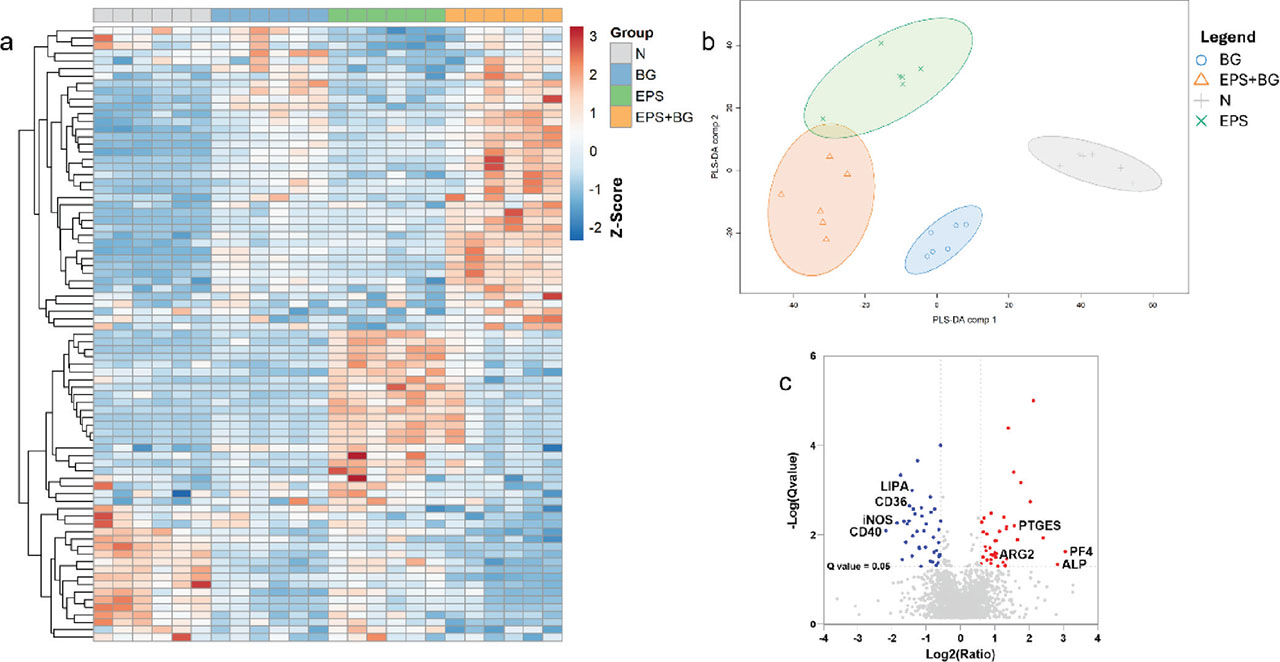
Fig 1.
An overview of the quantitative proteomics analyses. The regulated proteins exhibited marked differences in expression levels between naïve and BG-trained macrophages stimulated with EPS, as illustrated by the heatmap, which also includes unstimulated cells and those exposed to BG alone (a). Based on whole-proteome profiles, PLS-DA enabled clear class separation between naïve and BG-trained macrophages, as well as between EPS-activated cells, highlighting the effects induced by BG training in EPS-stimulated specimens (b). The volcano plot summarizes the quantitative differences between naïve and BG-trained macrophages stimulated with EPS and highlights proteins enriched in significantly altered pathways (c). ALP, antileukoproteinase; BG, β-glucan; EPS, Exopolysaccharide; iNOS, inducible nitric oxide synthase; PLS-DA: partial least squares-discriminant analysis.
Importantly, our data point to several proteins with chemokine/cytokine functions that were regulated in response to BG training. The chemoattractant platelet factor 4 (PF4) was the protein with the highest (over eight-fold) abundance difference between BG-trained and naïve macrophages activated with EPS57 (Figure 2b). PF4 induction is the result of BG pretreatment and remains constant in EPS57-activated cells. Likewise, antileukoproteinase (ALP) follows the same expression pattern with over seven-fold induction in BG-trained cells as compared to the naïve controls (Figure 2b). Moreover, BG-trained macrophages induce complement C1q subcomponent subunit C (C1QC) (Table S1) in response to EPS57.
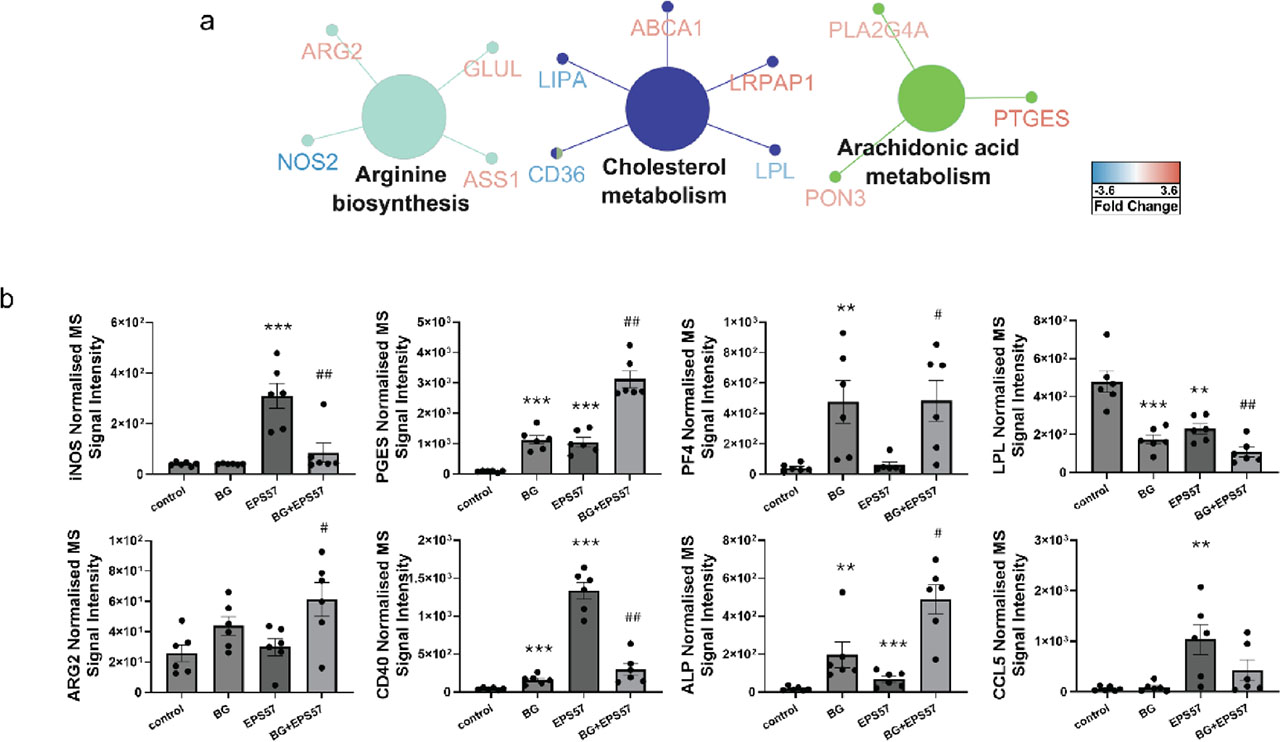
Fig 2.
Effect of BG training on EPS57-activated macrophages. Pathway enrichment analysis resulted in the identification of three functional modules in which the regulated proteins are engaged (a). The normalized MS intensities derived from SWATH data for selected proteins (b) are presented as mean ± SEM values of n = 6 biological replicates. ∗p < 0.05, ∗∗p < 0.01, ∗∗∗p < 0.001 indicate the significance of the difference observed with naïve controls; #p < 0.05, ##p < 0.01, ###p < 0.001 indicate BG-trained vs. BG-trained + EPS57. ALP, antileukoproteinase; BG, β-glucan.
3.2. Effect of BG training on macrophage response to the EPS57 priming
3.2.1. Effect on macrophage secretory properties
Since the proteomic dataset indicated induction of PGE2-associated enzymes (PLA2G4A and PTGES) and suppression of iNOS, we next examined whether these pathways are reflected in the secretory output of trained macrophages exposed to EPS57. Our experimental setup revealed that BG-trained macrophages displayed enhanced secretion of TNF-α, IL-6, and PGE2 (Figure 3a-c), while IL-10 levels were reduced (Figure 3d) upon restimulation with EPS57. These findings indicate that BG training reprogrammed macrophages toward a pro-inflammatory response when interacting with EPS57. Interestingly, this training also resulted in a significant decrease in NO production following EPS57 restimulation (Figure 3e). Given that our secretome and proteome analyzes (Figure 2) revealed an increased expression of PGE2 synthase and elevated PGE2 secretion, accompanied by a concomitant downregulation of iNOS expression and NO production in BG-trained macrophages, we aimed to investigate whether this effect might be mediated by a secondary autocrine action of PGE2. To test this hypothesis, cells were preincubated with INDO, a cyclooxygenase (COX)-2 inhibitor, before BG-training (Figures S1a,b). The results indicate that these effects are independent of COX-2 activity. INDO treatment did not significantly alter NO production in trained macrophages compared to cells subjected to BG-training alone (Figure S1b, blue bars vs. dark gray bars). These findings strongly suggest that the BG-induced reduction in iNOS expression is not mediated by COX-2-dependent PGE2 production. However, further studies are required to elucidate the underlying mechanisms responsible for this phenomenon.
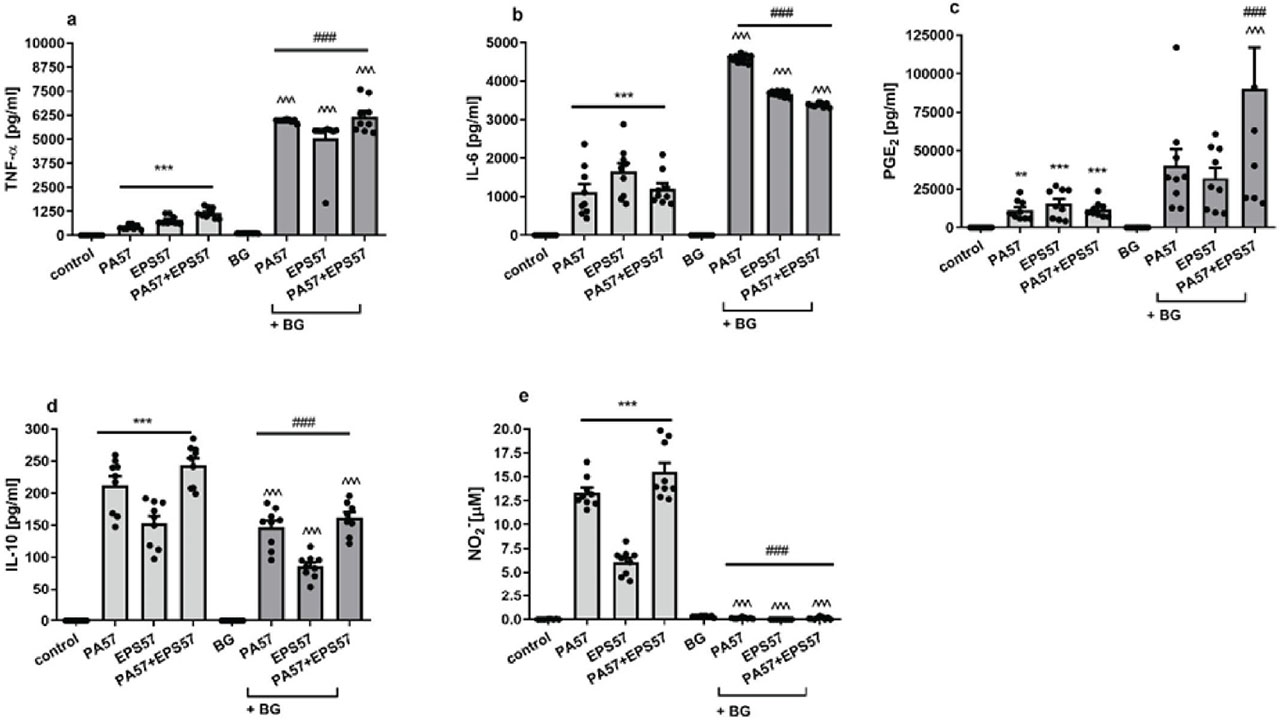
Fig 3.
Secretory properties of BG-trained macrophages exposed to EPS57. Levels of TNF-α (a), IL-6 (b), PGE2 (c), IL-10 (d), and NO (e) were analyzed by ELISA or Griess method, respectively, in supernatants collected 24 h after the restimulation of macrophages with EPS57/killed bacteria. Data are mean ± SEM values of three independent experiments (macrophages isolated from three mice and tested in three technical replicates, n = 9), ∗∗p < 0.01 and ∗∗∗p < 0.001 not trained vs. control; ###p < 0.001 trained vs. BG; ^^^p < 0.001 trained vs. not trained. BG, β-glucan; IL, interleukin; NO, nitric oxide; PGE2: prostaglandin E2; TNF-α, tumor necrosis factor-α.
3.2.2. Effect on phagocytic properties
Since several differentially regulated proteins (PF4, ALP, and C1QC) are linked to macrophage effector functions and inflammatory tone, and because PGE2/NO balance can influence phagocytic activity, we assessed whether BG-training affects the macrophage capacity to internalize particles. Evaluation of phagocytic activity of macrophages upon BG training and incubation with bacteria and/or biofilm components was based on comparison of fluorescence intensity of pH-sensitive fluorescently labeled zymosan particles. When macrophages were trained with BG before exposure to bacterial antigens (killed bacteria, purified), a statistically significant but modest (~10%) reduction in phagocytic capacity was observed (Figure S2). Given the small magnitude of this effect, we interpret this change as biologically limited rather than indicative of a strong functional impairment.
4. Discussion
Macrophages, the key effector cells of inflammation, exhibit remarkable phenotypic diversity, ranging from M1 (pro-inflammatory) to M2 (anti-inflammatory) phenotypes (Mills et al. 2000). Both functional types can play a dual role in innate immunity, beneficial as well as detrimental. Specifically, M1 macrophages are involved in pathogen killing and eradication but can also contribute to tissue damage (Gordon and Taylor 2005; Locati et al. 2020). In contrast, M2 macrophages participate in tissue repair, resolution of inflammation, and promotion of wound healing; however, as tumor-associated macrophages, they can also facilitate cancer progression (Mantovani 2014). Notably, biofilm-forming P. aeruginosa strains may evade phagocytosis and elimination while simultaneously inducing a hyperinflammatory macrophage phenotype, referred to as biofilm-associated macrophages (Strus et al. 2015; Ciszek-Lenda et al. 2019). These opposing properties arise from distinct macrophage microenvironments and diverse stimuli that lead to the production of different effector molecules.
Unlike classical M1/M2 polarization, trained macrophages arise through a process termed trained immunity, in which innate immune cells undergo long-term functional reprogramming following a primary stimulus, leading to enhanced responsiveness upon secondary challenge. This process does not involve antigen-specific memory but is driven by epigenetic and metabolic reprogramming. Stimuli, such as BG (derived from S. cerevisiae), the Bacillus Calmette-Guérin vaccine, or specific microbial components, can induce this state. Generally, trained macrophages exhibit heightened cytokine production (e.g., TNF-α, IL-6, and IL-1β) and increased phagocytic and antimicrobial activity upon restimulation, even against unrelated pathogens (Murphy et al. 2020; Chen et al. 2023).
In this study, we investigated the effects of BG-induced training on macrophages and their subsequent responses to EPS, the major inducers of detrimental and ineffective biofilm-associated macrophages (Ciszek-Lenda et al. 2023). We aimed to elucidate the potential autocrine and paracrine activities of BG-trained macrophages, particularly the mechanisms underlying the strong anti-biofilm effects previously observed in P. aeruginosa (PA57)-infected mice (Ciszek-Lenda et al. 2024).
Herein, in our experimental setting, BG stimulation markedly enhanced the production of proinflammatory mediators, including TNF-α, IL-1, IL-6, and PGE2. Unexpectedly, this response was accompanied by a profound suppression of NO synthesis and a reduction in phagocytic capacity in EPS57 restimulated macrophages. Furthermore, BG training resulted in significant downregulation of lipoprotein lipase (LPL). LPL plays a complex role in macrophage polarization, primarily through LPL-mediated lipid uptake and subsequent activation of peroxisome proliferator-activated receptors, which promote fatty acid oxidation and drive the development of anti-inflammatory phenotypes (Hiemstra et al. 1996). These findings suggest that BG-trained macrophages may acquire adverse or functionally disadvantageous properties, potentially impairing their effectiveness in host defense against bacterial biofilm infections. Proteomic analysis, however, revealed a concomitant upregulation of ALP, an enzyme with both antimicrobial and anti-proteolytic activities. In macrophages, ALP secretion contributes to both direct pathogen killing and modulating the inflammatory response to infection (Benoit et al. 2012). The N-terminal domain of ALP exerts direct antimicrobial effects, whereas the C-terminal domain inhibits proteases such as neutrophil elastase, which contribute to inflammatory tissue injury (Chang et al. 2019). This mechanism may partially compensate for the reduced NO production and the minor reduction in phagocytic capacity observed in BG-trained macrophages. Nevertheless, the most promising outcome of BG training appears to be the induction of mediators that enhance the paracrine activity of macrophages at sites of inflammation, including PF4, selected chemokines (e.g., Ccl5), C1QC, and PGE2. Specifically:
i) PF4 interacts with bacteria to augment host-defense functions and improve outcomes in severe bacterial infections, including sepsis. For example, PF4 has been reported to enhance bacterial capture by neutrophil extracellular traps and improve survival in murine LPS-induced endotoxemia (Ngo et al. 2023).
ii) C-C motif chemokine 5 (Ccl5, RANTES) plays a dual role in bacterial infections: it acts as a chemoattractant that recruits macrophages and neutrophils to infection sites and promotes paracrine, proinflammatory macrophage activity. However, excessive CCL5 production, particularly during viral-bacterial coinfections, may exacerbate inflammation and contribute to cytokine storm syndromes (Hwaiz et al. 2015).
iii) C1QC functions beyond complement activation and behaves as an anti-inflammatory cytokine-like mediator and promotes M2-like macrophage polarization, enhances apoptotic cell clearance, playing an important role in immune resolution and tissue homeostasis (Benoit et al. 2012).
iv) PGE2 is a major macrophage-derived eicosanoid that exerts both pro- and anti-inflammatory effects, depending on the cellular context and signaling milieu (Loynes et al. 2018). Notably, PGE2 has been shown to promote neutrophil apoptosis and efferocytosis processes associated with the resolution of inflammation (Schmid and Brüne 2021). However, the effect of PGE2 on neutrophil apoptosis can be beneficial or detrimental, depending on the infection phase.
Importantly, some chemotactic properties of these selected paracrine factors may explain the beneficial effects of BG–trained macrophages transferred into mice infected with P. aeruginosa (PA57), as it has been shown in our previous studies (Ciszek-Lenda et al. 2024). In those studies, we observed a significant reduction in bacterial proliferation and biofilm formation, accompanied by increased infiltration of endogenous neutrophils and macrophages (Ciszek-Lenda et al. 2023, 2024). These findings suggest that such trained macrophages facilitate the recruitment of naïve phagocytes to the site of inflammation.
Furthermore, the enhanced production of PGE2, accompanied by a marked reduction in NO generation, appears to be a hallmark of our trained macrophages (MϕhighPGE2/lowNO). Further investigation is required to determine whether this mediator profile exerts beneficial or detrimental effects during bacterial infection.
Notably, PGE2 and inducible iNOS are both critical regulators of macrophage function, but their interplay is complex and context dependent. PGE2 can either promote or inhibit iNOS expression and activity, depending on the cellular environment and nature of the activating stimuli (Posadas et al. 2000; Dahiya et al. 2010). Conversely, other studies have demonstrated that attenuation of iNOS expression in LPS-stimulated macrophages occurs independently of COX-2-derived PGE2 (Razzak et al. 2008). Our findings are consistent with this observation: the reduced NO production in trained macrophages treated with INDO was comparable to that in trained macrophages exhibiting elevated PGE2 levels. These results suggest that, at sites of inflammation, EPS-stimulated trained macrophages may secrete high levels of PGE2 without concomitant NO production. Whether this mediator profile offers an advantage compared to the simultaneous high PGE2 and NO production observed in non-trained macrophages remains an open question.
During the early stages of bacterial infection, PGE2 and NO often act synergistically to modulate vascular tone, enhance local blood flow, and promote immune cell recruitment to sites of infection, thereby facilitating pathogen clearance (Martínez-Colón and Moore 2018). However, when excessively produced, both mediators can suppress immune responses and contribute to bacterial persistence. Specifically, PGE2 inhibits Th1 cytokine production (e.g., IFN-γ, IL-12), thereby impairing bacterial clearance, while high levels of NO can inhibit T-cell proliferation and mitochondrial function and induce tissue damage via nitrosative stress (Allione et al. 1999). Additionally, premature neutrophil apoptosis may further compromise bacterial elimination. Excessive PGE2, as observed during certain infections, such as Mycobacterium tuberculosis, can suppress innate immune responses (Chen et al. 2008).
In contrast, during the later stages of infection or in recurrent bacterial infections, elevated PGE2 levels may facilitate macrophage and dendritic cell migration, tissue repair, and resolution of inflammation (Ortega-Gómez et al. 2013; Davis et al. 2020). PGE2-mediated apoptosis plays an essential role in controlling inflammation and promoting tissue repair by enhancing efferocytosis and driving anti-inflammatory macrophage polarization. For instance, in P. aeruginosa lung infection, PGE2 limits neutrophil lifespan, thereby reducing tissue damage. Consequently, BG-trained macrophages may exert beneficial effects in chronic biofilm-associated bacterial infections, including P. aeruginosa lung infections in cystic fibrosis (Table 1).
5. Conclusions
Proteomic analyzes collectively indicate that the phenotype of S. cerevisiae BG-induced macrophages exhibit a mixed pro- and anti-inflammatory profile initiated in response to EPS57 activation. Importantly, this study, together with previous reports, suggests that the final phenotype of trained macrophages can vary substantially depending on the specific induction conditions, ranging from an M1-like pro-inflammatory to an M2-like anti-inflammatory state.
Our findings further highlight the therapeutic potential of BG–trained macrophages characterized by elevated PGE2 secretion and markedly reduced NO production (Mϕ–highPGE2/lowNO). However, during acute bacterial infections accompanied by local inflammation, tissue-resident and infiltrating monocyte-derived macrophages play a critical role in pathogen clearance and the subsequent resolution of inflammation:
Early stages of acute infection – During pathogen adherence and the onset of acute inflammation, M1-like pro-inflammatory and microbicidal macrophages cooperate with neutrophils to eliminate planktonic bacteria.
Late stages of acute infection – During the resolution phase of infection and inflammation, M2-like anti-inflammatory and pro-resolving macrophages protect host tissues from excessive or chronic inflammation.
Chronic infection – Macrophages located in proximity to biofilms often exhibit impaired phagocytic activity and dysregulated cytokine production, thereby promoting persistent inflammation without effective bacterial clearance. Moreover, hyperinflammatory neutrophils and macrophages contribute to local tissue damage.
Therefore, during acute infections, the induction or administration of trained macrophages to further enhance innate immune responses appears inadvisable, as it may interfere with the natural progression of inflammation and pathogen elimination.
Table 1.
Roles of PGE2 and NO in the inflammatory functions of M1, M2, and trained macrophages
| Feature | M1 macrophages (classically activated) | M2 macrophages (alternatively activated) | Trained macrophages (highPGE2/lowNO) |
|---|---|---|---|
| Activation stimuli | LPS, IFN-γ, TNF-α | IL-4, IL-13, IL-10, glucocorticoids | S. cerevisiae BG |
| COX-2 expression/PGE2 secretion | High/High | Low-moderate/low | High/high |
| Functional role of PGE2 | Pro-inflammatory; promotes IL-6, IL-1β | Anti-inflammatory; promotes tissue repair, fibrosis | Promotes neutrophil apoptosis and efferocytosis. Tissue repair. |
| iNOS | Strongly induced | Weak or absent | Weak or absent |
| NO production | High (major molecule for pathogen killing) | Low (minimal cytotoxic activity) | Low (minimal cytotoxic activity) |
| Functional role of NO | Microbicidal; contributes to oxidative stress | Suppresses inflammation; promotes healing indirectly (low NO maintains tissue integrity) | Suppresses inflammation; promotes healing indirectly (low NO maintains tissue integrity) |
| Beneficial functions | Early stages of infection/inflammation. Cooperation with neutrophils in pathogen killing | Resolution of inflammation. Efferocytosis of apoptotic neutrophils | Late stages of infection/inflammation. Recruitment of naïve macrophages. Resolution of chronic inflammation. Reduction of hyperinflammatory response |
Conversely, in chronic or recurrent P. aeruginosa biofilm-associated infections—such as those occurring in cystic fibrosis lungs or non-healing wounds—where macrophage access to bacteria embedded within the biofilm matrix is restricted, therapeutic strategies should aim to mitigate tissue injury driven by hyperinflammation. Under such conditions, the use of trained macrophages with high PGE2 and low NO output (Mϕ–highPGE2/lowNO), exhibiting anti-inflammatory, proapoptotic, and chemotactic effects on resident naïve macrophages, represents a promising therapeutic approach. In these settings, indirect effects mediated through neighboring and infiltrating immune cells are likely to play a pivotal role.
Moreover, the prophylactic induction of trained immunity may prove beneficial in reducing susceptibility to infections, particularly those for which effective vaccines are not yet available. Nevertheless, further studies are required to establish optimized protocols for in vivo BG-induced macrophage training, including potential integration with probiotic administration. Notably, S. cerevisiae represents a unique microbial stimulus capable of bridging probiotic function and innate immune training, thereby offering promising opportunities for infection control and immunotherapy.
In conclusion, the development of novel strategies to enhance innate immunity through trained macrophages is essential for strengthening both individual and herd-trained immunity (Marcinkiewicz 2025). However, treatment with trained or engineered macrophages is not currently recommended as standard therapy. Although this approach represents a promising area of research, its application should be restricted to clinical trials until safety and efficacy are firmly established. Nevertheless, BG has already been administered in human medicine and has demonstrated beneficial effects in patients with impaired immunity, particularly those experiencing recurrent infections. However, these effects have largely lacked a clear mechanistic explanation (Horneck Johnston et al. 2024). Our findings may at least partially elucidate the beneficial role of BG by identifying it as a major driver of trained immunity.
Acknowledgments
The authors would like to thank Paulina Skalska for her skillful technical assistance.
Notes
[2] Financial disclosure Funding
This study was supported by the National Science Center, Poland (Grant no. 2017/27/B/NZ6/001772). The funders had no role in study design, data collection and analysis, decision to publish, or preparation of the manuscript.
[3] Statement of Ethics
This study was carried out in strict accordance with recommendations from the Guide for the Care and Use of Laboratory Animals of the Ministry of Science and Information of Poland. The protocol was approved by the Local Committee on the Ethics of Animal Experiments of Jagiellonian University (941/2024) and by the Local Bioethics Committee (decision number 1072.6120.252.2018).
[4] Conflicts of interest Conflict of Interest Statement
The authors declare no conflict of interest.
[5] Contributed by Authorship
JM, MCL, and GM conceived and designed experiments. BN, MCL, GM, MS, IS, ED, and SG performed the experiments. BN, MCL, GM, JM, and MS analyzed the results. JM, MCL, MS, and GM wrote the manuscript. RO and MStrus critically read the manuscript. All authors read and approved the final manuscript.
Notes
Supplementary Materials
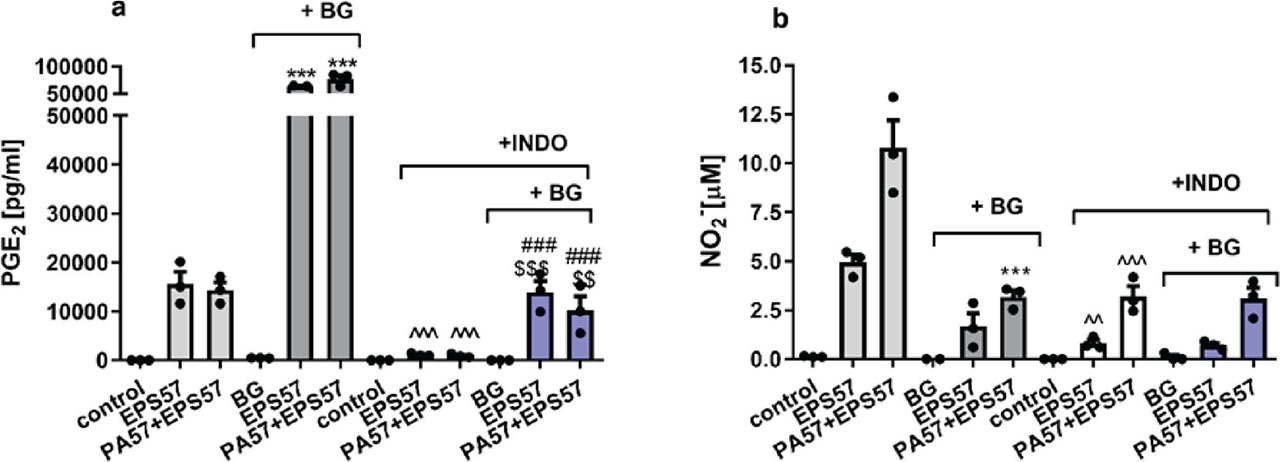
Fig S1.
Influence of indomethacin on PGE2 and NO secretion in BG-trained macrophages exposed to EPS57. Levels of PGE2 (a) and NO (b) were analyzed by ELISA or Griess method, respectively, in supernatants collected 24 h after the restimulation of macrophages with EPS57/killed bacteria in the presence or absence of indomethacin (10 µM). Data are mean ± SEM values of three independent technical replicates. ∗∗∗p < 0.001 not trained vs. trained; ###p < 0.001 trained vs. trained + INDO; ^^p < 0.01 and ^^^p < 0.001 not trained vs. not trained + INDO; $$p < 0.01 and $$$p < 0.001 not trained + INDO vs. trained + INDO. BG, β-glucan; NO, nitric oxide; PGE2, prostaglandin E2.
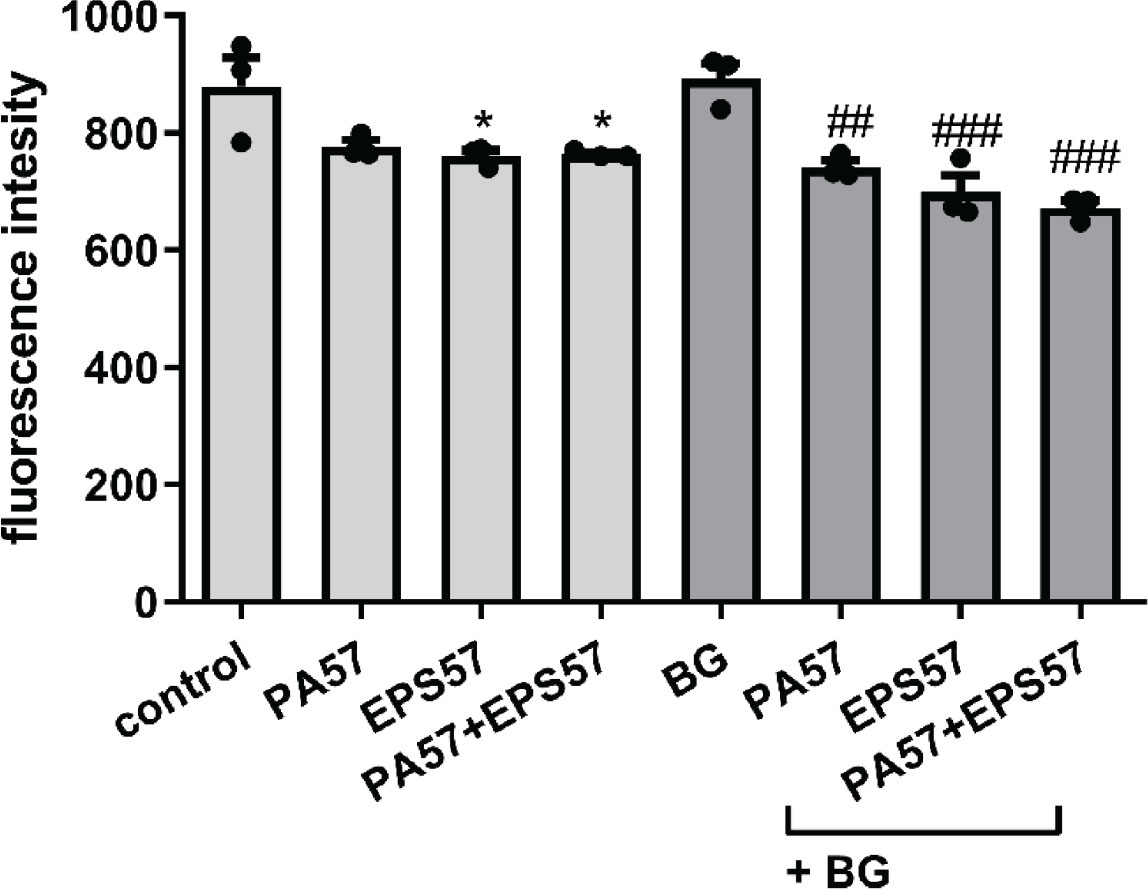
Fig S2.
Phagocytic properties of BG-trained macrophages exposed to EPS57 or killed bacteria. Intensity of fluorescence corresponding to phagocytic activity levels was assessed upon 90 min of incubation with fluorescently labeled zymosan particles. Data are mean ± SEM values of three independent experiments. Each group was run in four technical replicates. ∗p < 0.05 not trained vs. control; ##p < 0.01 ###p < 0.001 trained vs. BG. BG, β-glucan.
Supplementary Table S1. Differentially regulated proteins in β-glucan-treated and naïve macrophages activated with EPS57.
Supplementary Table S2. Differentially regulated proteins in β-glucan-treated and naïve macrophages.
Supplementary Table S3. Differentially regulated proteins in EPS57-activated macrophages and naïve controls.