
1. Introduction
Lung cancer, the leading cause of cancer-related mortality, is among the deadliest cancers worldwide (Deshpand et al. 2022). Smoking is the leading cause of lung cancer, but non-smoking cases have also been documented and attributed to factors such as single nucleotide polymorphisms, environmental exposures, genetic alterations, and air pollution. Non-small cell lung cancer (NSCLC), which accounts for approximately 85% of lung cancer cases, is the predominant subtype, and despite recent therapeutic advancements, the five-year survival rate for NSCLC patients remains <20%, with >60% of cases being diagnosed at an advanced stage (Nooreldeen and Bach 2021; Thai et al. 2021). The therapeutic efficacy of targeted therapies for NSCLC remains limited by both primary and acquired drug resistance despite early research efforts aimed at identifying more effective treatments. Thus, a thorough understanding of the tissue-specific characteristics and contributing factors of lung cancer in both smokers and non-smokers is crucial. In addition, variations in pathological and molecular features, along with the influence of different carcinogens, may provide potential pathways for the prevention and treatment of lung cancer (Pan et al. 2022). RING finger and WD repeat domain 3 (RFWD3) was recently identified as a substrate for ataxia telangiectasia mutated (ATM)/ATR phosphorylation and is involved in the DNA damage response pathway associated with the ATM/ATM-Rad3 signaling axis (Gallina et al. 2021). It has also been shown to play a role in the initiation and progression of colorectal cancer through its transcriptional regulation of BIRC5 via E2F1 (Xu et al. 2021). In hepatocellular carcinoma, RFWD3 has been found to regulate cell growth and metastasis through the Wnt/β-catenin signaling pathway (Liang et al. 2022). Moreover, RFWD3 knockdown has been shown to inhibit gastric cancer cell proliferation, block G2/M cell cycle progression, and enhance cell death, with potential involvement of the Slug, ERK/p38, and AKT pathways (Jia et al. 2020). In bladder cancer, RFWD3 downregulation significantly reduced colony formation, accelerated apoptosis, and inhibited cell migration (Jiang et al. 2023). Nevertheless, the role of RFWD3 in NSCLC is poorly understood.
In this study, we investigated the function and underlying mechanism of RFWD3 by examining apoptosis, proliferation, and invasion in NSCLC cells treated with siRNA against RFWD3 and observed that it enhanced apoptosis and inhibited migration and invasion of NSCLC cells by blocking the ERK/p38 signaling pathway.
2. Method
2.1. Cell culture
Human bronchial epithelial cells BEAS-2B and human NSCLC cell lines HCC-827, A549, NCI-H460, and H1975 were purchased from the Chinese Academy of Sciences Cell Bank (Shanghai, China) and cultured in RPMI-1640 medium (Hyclone Laboratories Inc., Logan, UT, USA), supplemented with 10% fetal bovine serum (FBS; Invitrogen, Carlsbad, CA, USA) and antibiotics (0.1 mg/mL streptomycin, 100 U/mL penicillin; Sigma-Aldrich, St. Louis, MO, USA). The cells were maintained in a 37°C incubator with 5% CO2, and the culture medium was changed every 3 days.
2.2. Transfection
The HiPerFect siRNA transfection reagent (QIAGEN, Hilden, Germany) was used to transfect the siRNA sequence against RFWD3 (5′-CAGAGAATGATGGCAACAT-3′). To perform the transfection, 3 × 10⁵ NSCLC cells were seeded in 6-well plates without FBS or antibiotics. When cells reached 60%–70% confluence, 12 µL of the transfection reagent was mixed with 5 nM siRNA and applied to the cells following the manufacturer’s instructions (QIAGEN).
2.3. Cell proliferation assays
To assess cell viability, 5 × 10³ cells were seeded into 96-well plates and cultured at 37°C. After 24 h, 10 µL of cell counting kit-8 (CCK-8; Beyotime, Shanghai, China) was added to each well, followed by 90 µL of culture medium. The mixture was incubated for 1 h at 37°C. Absorbance was measured at 450 nm to assess cell viability. Each experiment was performed in triplicate.
2.4. Cell apoptosis assay
Lentivirus-infected NSCLC cells were cultured in 6-well plates for 5 days. Apoptosis was assessed using 10 µL of Annexin V-APC (eBioscience, Thermo Fisher) for staining, followed by a 10–15 min incubation in the dark at room temperature. The apoptotic levels were analyzed using FACSCalibur (BD Biosciences, San Jose, CA, USA).
2.5. Cell invasion and migration assay
Invasion assays were conducted using Transwell 24-well plates. Briefly, the cells were diluted 1:6 in serum-free medium and suspended in 100 µL of Matrigel matrix, which was then seeded into the upper chamber of a 24-well insert with an 8 µm pore size (Corning, Tewksbury, MA, USA). After incubating for 30 min to hydrate the basement membrane, the upper compartment was filled with a 1 × 10⁵ cell suspension in 100 µL serum-free medium, while the lower compartment contained 500 µL of complete culture medium. The cells were incubated for 24 h, after which they were fixed in 4% paraformaldehyde for 30 min and stained with 0.1% crystal violet for 20 min. The number of invasive cells was counted in five randomly selected fields (100× magnification) under a microscope, and the average count was determined. Each experiment was repeated three times.
The migration assay was conducted using a similar procedure, except that 5000 cells were seeded in the upper chamber, and the Transwell chamber was not coated with Matrigel.
2.6. Western blotting
Protease and phosphatase inhibitors were added to the RIPA protein extraction reagent to lyse the cells, and total protein was extracted and quantified using the BCA protein assay. Then, loading buffer was added and the mixture was boiled for 5 min at 99°C. The proteins were separated using 10% sodium dodecyl sulfate-polyacrylamide gel electrophoresis (SDS-PAGE) and transferred onto polyvinylidene fluoride (PVDF) membranes. First, the membranes were blocked for 2 h at room temperature with 10% milk in Tris-buffered saline containing 0.1% Tween 20 (TBST). Next, the membranes were incubated with specific primary antibodies, after which immunoreactivity was detected using Bio-Rad’s ECL chromogenic substrate. The following antibodies were used: RFWD3 (ab138030), BAX (ab32503), BCL-2 (ab182858), cleaved-caspase-3 (ab32042), MMP-2 (ab92536), MMP-9 (ab76003), Erk (ab32537), p-Erk (ab192591), p38 (ab170099), p-p38 (ab178867), and GAPDH (ab6276), all purchased from Abcam (1:1000 dilution).
2.7. Statistical analysis
Statistical analysis was performed using GraphPad Prism version 7.0 software. Data are expressed as the mean ± standard deviation (SD). One-way analysis of variance (ANOVA) or Student’s t-test, as appropriate, was used for comparisons between groups. For non-parametric data, the Mann–Whitney or Kruskal–Wallis test was applied. P < 0.05 was considered statistically significant.
3. Result
3.1. RFWD3 is highly expressed in NSCLC
To investigate the expression pattern of RFWD3 in lung cancer, we analyzed data from the GEPIA database and found that RFWD3 is significantly expressed in lung squamous cell carcinoma (Figure 1a). In addition, RFWD3 protein was detected in four NSCLC cell lines and the normal BEAS-2B cell line. Compared with BEAS-2B cells, RFWD3 expression was notably higher in the HCC-827, A549, NCI-H460, and H1975 cell lines (Figure 1b). Due to their higher RFWD3 expression levels, the HCC-827 and NCI-H460 cells were selected for subsequent experiments.
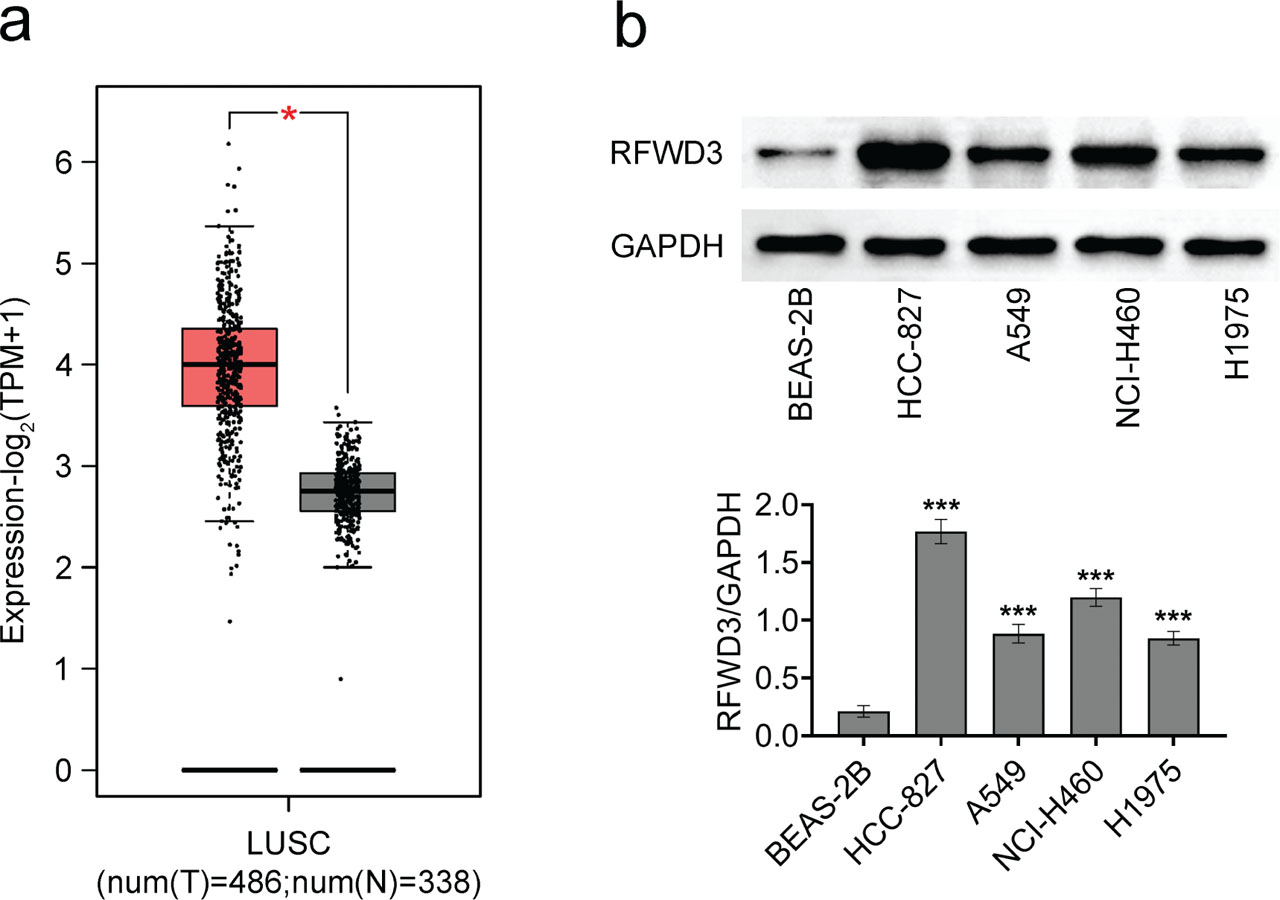
Fig 1.
RFWD3 is highly expressed in NSCLC. (a) The differential expression of RFWD3 in normal tissues and NSCLC tissues and analysis using the GEPIA database. (b) Expression levels of RFWD3 in BEAS-2B, HCC-827, A549, NCI–H460, and H1975 cell lines. Values are presented as mean ± SD. ***p < 0.001 vs. BEAS-2B group. n = 3. NSCLC, non-small cell lung cancer; RFWD3, RING finger and WD repeat domain 3; SD, standard deviation.
3.2. Knockdown of RFWD3 promotes apoptosis of NSCLC cells
To investigate the role of RFWD3 in the growth and progression of NSCLC, HCC-827 and NCI-H460 cells were transfected with either a negative control (NC) or si-RFWD3. Western blotting confirmed the successful knockdown of RFWD3 protein levels after si-RFWD3 transfection (Figure 2a). The effect of RFWD3 knockdown on cell proliferation was evaluated using the CCK-8 assay, which revealed a significant reduction in the viability of HCC-827 and NCIH460 cells (Figure 2b). Flow cytometry analysis showed that the apoptosis rate in the si-RFWD3 group was significantly higher than that in the si-NC group (Figure 2c). Additionally, the results of Western blot indicated a decrease in BCL-2 protein levels, while Bax and cleaved-caspase-3 protein levels were elevated in response to RFWD3 knockdown, consistent with the apoptosis data (Figures 2d and 2e).
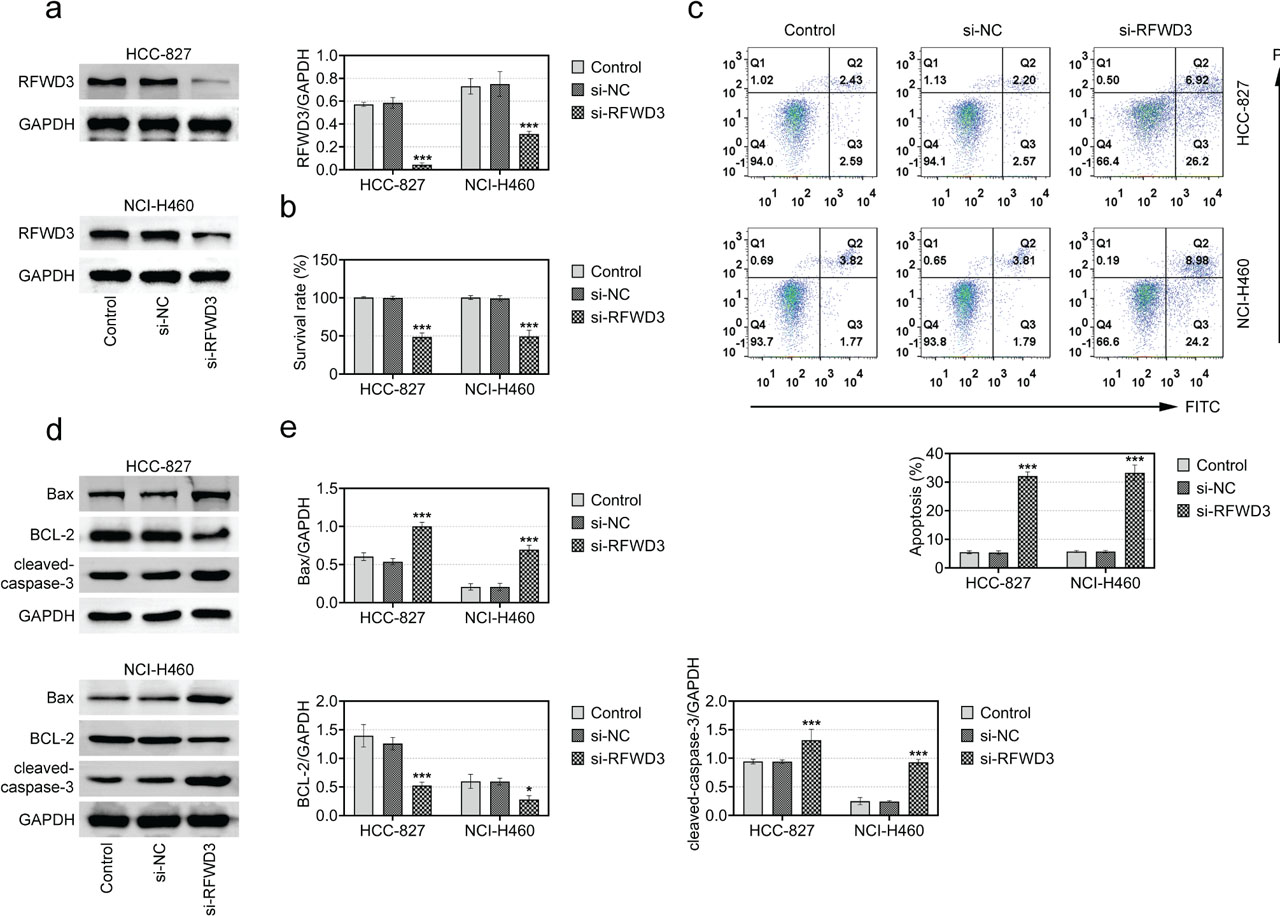
Fig 2.
Knockdown of RFWD3 promotes apoptosis in NSCLC cells. (a) Expression of RFWD3 in HCC-827 and NCI–H460 cells following RFWD3 knockdown. (b) Survival rate of HCC-827 and NCI–H460 cells after RFWD3 knockdown. (c) The apoptosis rate of HCC-827 and NCI–H460 cells after RFWD3 knockdown. (d, e) Protein expression levels of BAX, BCL-2, and cleaved-caspase-3 in HCC-827 and NCI–H460 cells following RFWD3 knockdown. Values are presented as mean ± SD. *p < 0.05, ***p < 0.001 vs. si-NC group. n = 3. NC, negative control; NSCLC, non-small cell lung cancer; RFWD3, RING finger and WD repeat domain 3; SD, standard deviation.
3.3. Knockdown of RFWD3 inhibits the migration and invasion of NSCLC cells
To evaluate the effects of RFWD3 knockdown on the migratory and invasive capabilities of NSCLC cells, Transwell chamber assays were performed. The results showed that silencing RFWD3 resulted in a significant reduction in both cell migration and invasion (Figure 3a). Furthermore, Western blot analysis revealed that the expression levels of MMP-2 and MMP-9 were downregulated following RFWD3 knockdown (Figure 3b). Taken together, these results suggest that RFWD3 knockdown impedes the migration and invasion of NSCLC cells.
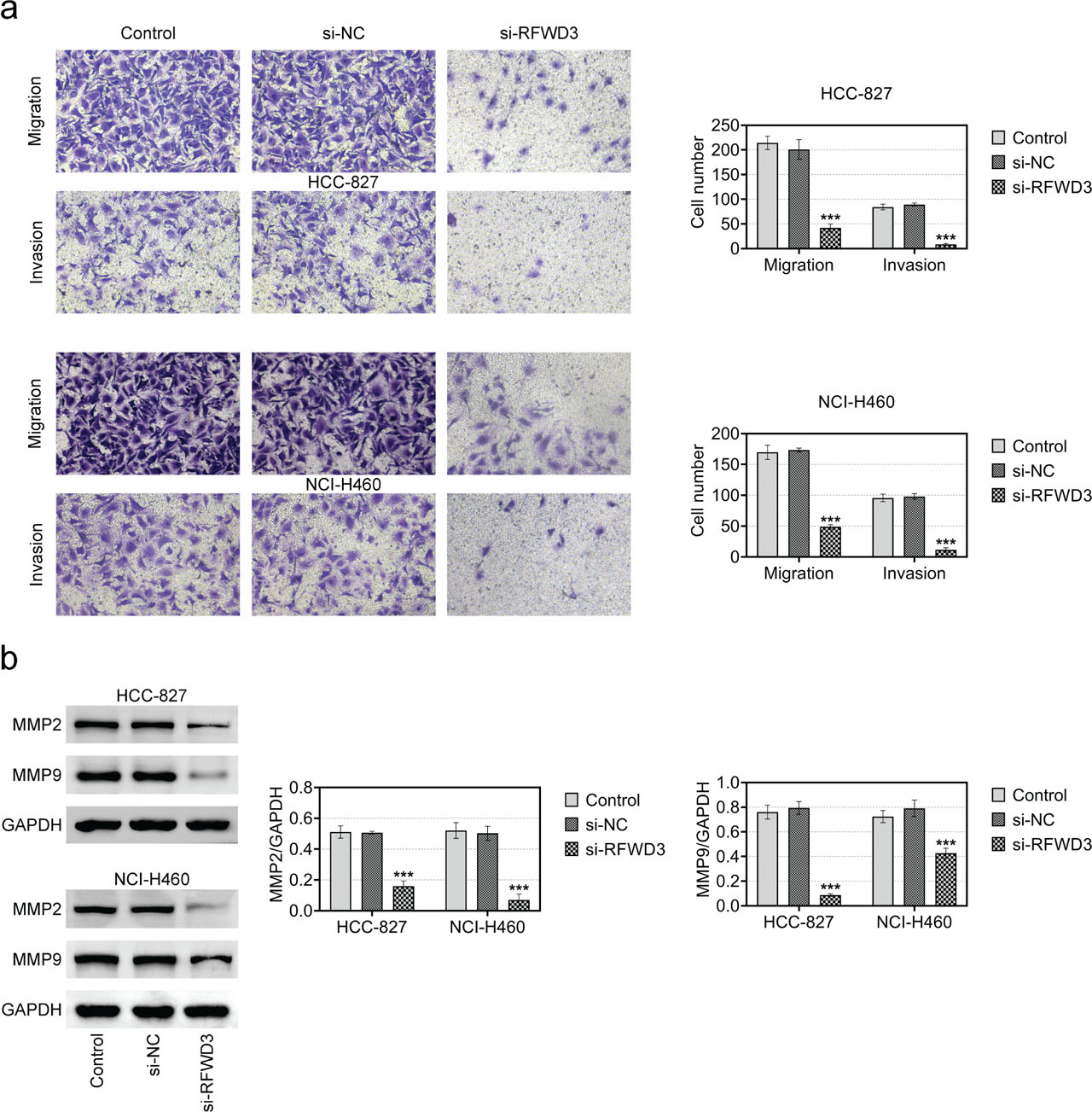
Fig 3.
Knockdown of RFWD3 inhibits the migration and invasion of NSCLC cells. (a) Migration and invasion cell numbers of HCC-827 and NCI–H460 cells after RFWD3 knockdown. (b) Protein expression levels of MMP-2 and MMP-9 in HCC-827 and NCI-H460 cells after RFWD3 knockdown. Values are presented as mean ± SD. ***p < 0.001 vs. si-NC group. n = 3. NC, negative control; NSCLC, non-small cell lung cancer; RFWD3, RING finger and WD repeat domain 3; SD, standard deviation.
3.4. Knockdown of RFWD3 inhibits the ERK/p38 signaling pathway
Given the association between tumor development and the ERK/p38 signaling pathway, we examined the expression of key proteins in this pathway following RFWD3 knockdown.
Western blot analysis demonstrated significantly reduced levels of phosphorylated Erk and phosphorylated p38 in NSCLC cells with RFWD3 silencing (Figure 4). Overall, these findings suggest that RFWD3 knockdown inhibits NSCLC cell development by blocking the ERK/p38 signaling pathway.
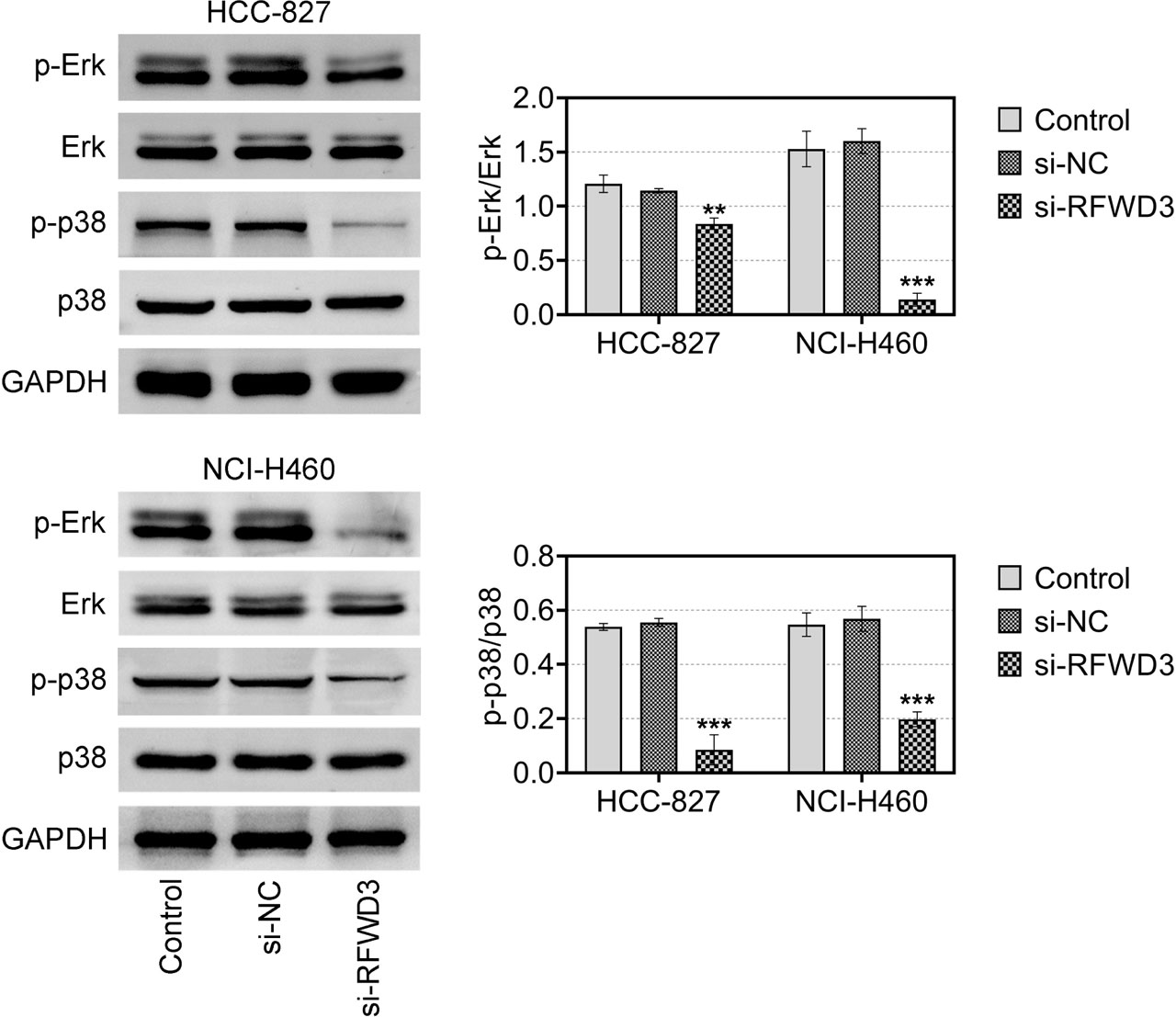
Fig 4.
Knockdown of RFWD3 inhibits the ERK/p38 signaling pathway. The protein expression levels of Erk, p-Erk, p38, and p-p38 in HCC-827 and NCI–H460 cells after RFWD3 knockdown. Values are presented as mean ± SD. **p < 0.01, ***p < 0.001 vs. si-NC group. n = 3. NC, negative control; RFWD3, RING finger and WD repeat domain 3; SD, standard deviation.
4. Discussion
Lung cancer is one of the leading causes of cancer-related deaths worldwide. Despite advancements in treatment, the overall five-year survival rate for lung cancer has not shown significant improvement in recent years (Petruzelka et al. 2021). RFWD3, a multifunctional protein, is aberrantly expressed in several cancer types. Previous studies have reported that RFWD3 accelerates the development of various human tumors, including ovarian, breast, and stomach cancers (Jia et al. 2020; Frick et al. 2024; Taylor et al. 2024). While research has linked RFWD3 to the growth of NSCLC cells, the precise mechanisms by which RFWD3 regulates NSCLC cell proliferation remain unclear (Zhang et al. 2020). Thus, this study aimed to explore the role of RFWD3 in NSCLC, and the findings of this study indicated that RFWD3 knockdown significantly reduced NSCLC cell growth, invasion, and migration, while simultaneously increasing apoptosis. Additionally, RFWD3 knockdown impaired the ERK/p38 signaling cascade. Overall, RFWD3 may emerge as a novel therapeutic target for the management of NSCLC in the future.
Apoptosis is a crucial cellular mechanism regulating cell death, and dysregulated apoptosis often leads to unchecked cell proliferation, which has been implicated in cancer development (Tong et al. 2022). In our investigation, we observed that RFWD3 knockdown markedly increased the number of early and late apoptotic cells. The pro-apoptotic proteins BAX and active caspase-3 were significantly overexpressed, whereas the anti-apoptotic protein BCL-2 was downregulated. Based on these findings, we hypothesize that RFWD3 knockdown inhibits NSCLC cell growth by promoting apoptosis.
This study also demonstrated that RFWD3 knockdown significantly reduced NSCLC cell migration and invasion, further emphasizing RFWD3’s carcinogenic role in NSCLC progression. Previous researches have shown that RFWD3 promotes migration and invasion in other cancers, such as gastric and hepatocellular carcinoma (Jia et al. 2020; Liang et al. 2022). Matrix metalloproteinases (MMPs), which are zinc-dependent endopeptidases, play a key role in degrading the extracellular matrix and modulating growth factors, adhesins, cytoskeletal proteins, chemokines, and cytokines (He et al. 2022). In this study, silencing RFWD3 in NSCLC cells resulted in decreased expression of MMP-2 and MMP-9, which may contribute to the reduced invasive capability of the cells.
Cell signaling alterations are widely recognized as central to the initiation and progression of many cancers (Liu et al. 2016). In particular, the MAPK signaling pathway has garnered significant attention due to its essential roles in tumor cell growth, metabolism, invasion, proliferation, and apoptosis (Kim and Choi 2010). In this study, we investigated the impact of RFWD3 on the ERK/p38 signaling pathway in NSCLC cells and found that RFWD3 knockdown inhibited the activation of the ERK/p38 pathway. Thus, we propose that the carcinogenic effects of RFWD3 may be mediated through the activation of the ERK/p38 signaling pathway.
In conclusion, RFWD3 gene knockdown may prevent NSCLC cell proliferation, migration, and invasion while also inducing apoptosis through the inhibition of the ERK/p38 signaling pathway, highlighting RFWD3 as a promising oncogene in NSCLC carcinogenesis and suggesting its potential as both a therapeutic target and a prognostic marker.
Acknowledgments
Not applicable.
Notes
[2] Ethics Approval
This article does not contain any studies with human participants or animals performed by any of the authors.
[3] Data Availability
The authors declare that all data supporting the findings of this study are available within the paper, and any raw data can be obtained from the corresponding author upon request.
[4] Contributed by Author Contribution
Ting Ma and Baolan Wang designed the study and carried them out; Ting Ma and Baolan Wang supervised the data collection; Ting Ma and Baolan Wang analyzed the data; Ting Ma and Baolan Wang interpreted the data; Ting Ma and Baolan Wang prepared the manuscript for publication and reviewed the draft of the manuscript. All authors have read and approved the manuscript.