
Table 1.
Clinical and laboratory characteristics of study and control groups
| Characteristic | Study group | Control group | p*value | |
|---|---|---|---|---|
| Gender | ||||
| Male (no.) | 17 | 17 | 1.0 | |
| Female (no.) | 17 | 17 | 1.0 | |
| Age (years) | 9.75 (±4.85) | 9.89 (±5.00) | 0.9 | |
| Disease subtype | ||||
| Oligoarticular (%) | 50 | n/a | ||
| Polyarticular seronegative (%) | 11.8 | n/a | ||
| Polyarticular seropositive (%) | 8.8 | n/a | ||
| ERA (%) | 23.6 | n/a | ||
| Psoriatic arthritis (%) | 5.8 | n/a | ||
| Median CRP value (mg/L) | 12.5 | 0.4 | <0.001 | |
| Median ESR value (mm/h) | 34 | 4 | <0.001 | |
| ANA positivity (%) | 88.21 | n/a | ||
| HLA-B27 positivity (%) | 35.23 | n/a | ||
| RF positivity (%) | 8.82 | n/a | ||
| Anti-CCP positivity (%) | 5.88 | n/a | ||
| Mean number of joints with active arthritis (no.) | 3.29 | n/a | ||
| Mean CHAQ value | 0.45 | n/a | ||
| Mean JADAS 71 value | 14.12 | n/a | ||
| Median/mean SEMA5A concentration (ng/mL) in all JIA | 2.04 | 1.34 | 0.002 | |
| In oligoarticular JIA | 1.76 (IQR 1.56) | 0.33 (IQR 1.33) | <0.001 | |
| In polyarticular seronegative JIA | 2.57 (±1.58) | 1.44 | 0.266 | |
| In polyarticular seropositive JIA | 7.57 (±5.26) | 1.61 (±0.54 ng/mL) | 0.123 | |
| In ERA JIA | 1.97 (IQR 1.67) | 1.45 (IQR 1.31) | 0.25 | |
| VEGF-A concentration (pg/mL) | 352.69 (IQR 454.64) | 163.13(IQR 154.54) | <0.01 | |
[i] ANA, antinuclear antibodies; anti-CCP, anti-cyclic citrullinated peptide; CHAQ, Childhood Health Assessment Questionnaire; CRP, C-reactive protein; ERA, enthesitis-related arthritis; ESR, erythrocyte sedimentation rate; HLA, human leukocyte antigen; IQR, interquartile range; JADAS, juvenile idiopathic arthritis disease activity score; JIA, juvenile idiopathic arthritis; n/a,, not applicable; RF, rheumatoid factor; SEMA5A, semaphorin 5A.
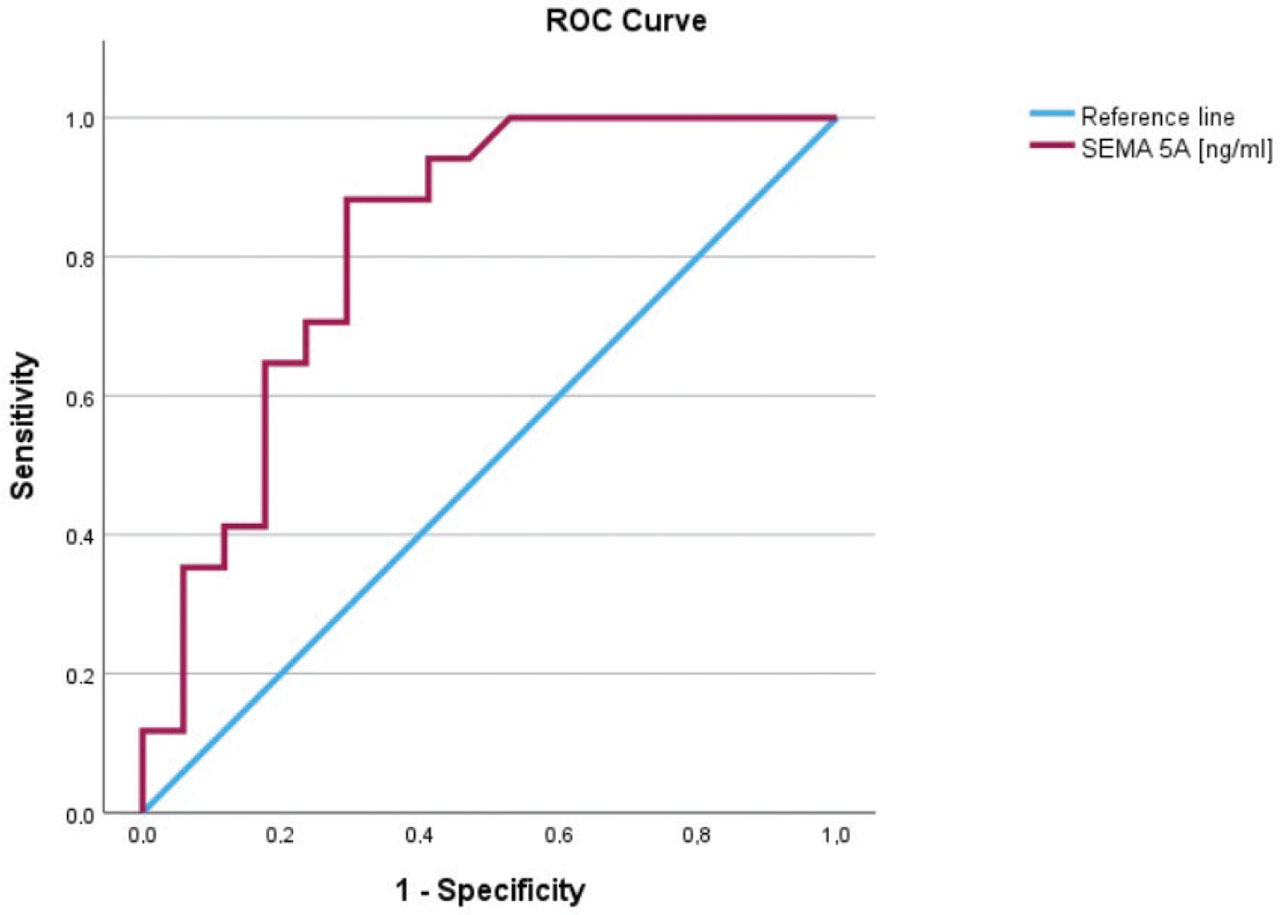
Fig 1.
Concentration of serum SEMA5A in JIA patients and healthy controls. JIA, juvenile idiopathic arthritis; SEMA5A, semaphorin 5A.
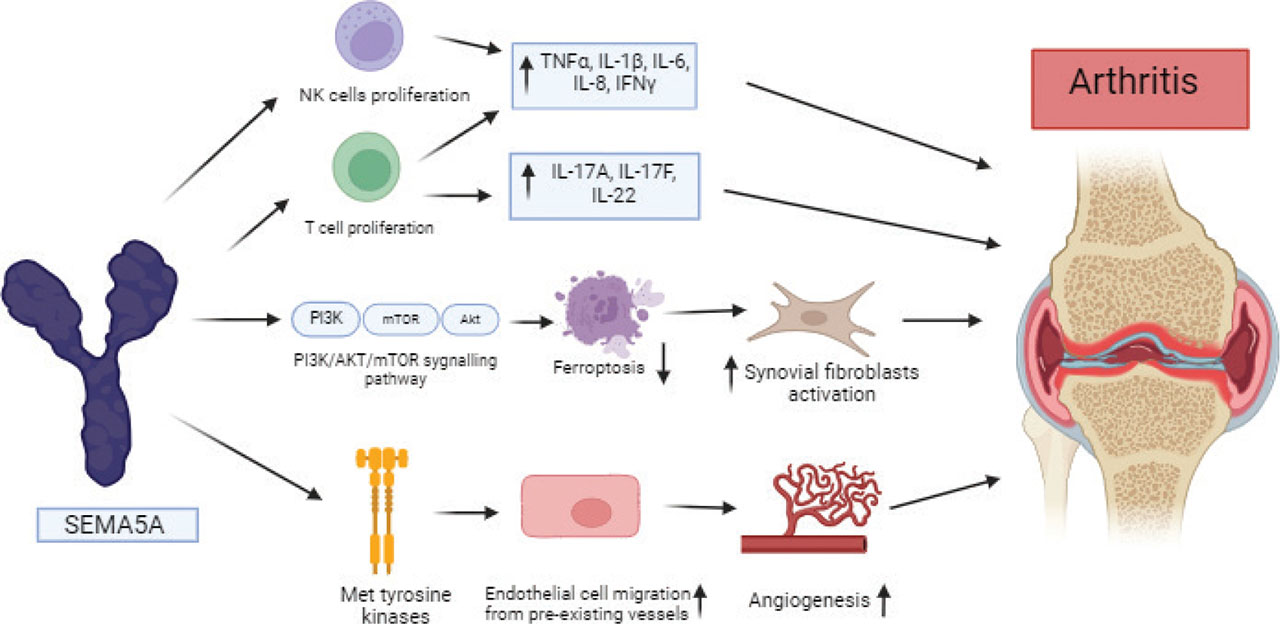
Fig 2.
SEMA5A promotes inflammation via different pathways. It increases the proliferation of T and NK cells, leading to higher secretion of proinflammatory cytokines. SEMA5A stimulation leads to activation of synovial fibroblasts by downregulating apoptosis via the PI3K/AKT/mTOR pathway. Moreover, it stimulates angiogenesis by increasing endothelial cell migration from preexisting vessels via activation of Met tyrosine kinases. Created using Biorender (www.biorender.com). AKT, protein kinase B; IFN, interferon; IL, interleukin; mTOR, mammalian target of rapamycin kinase; NK, natural killer; PI3K, phosphoinositide 3-kinase; SEMA5A, semaphorin 5A; TNF, tumor necrosis factor.
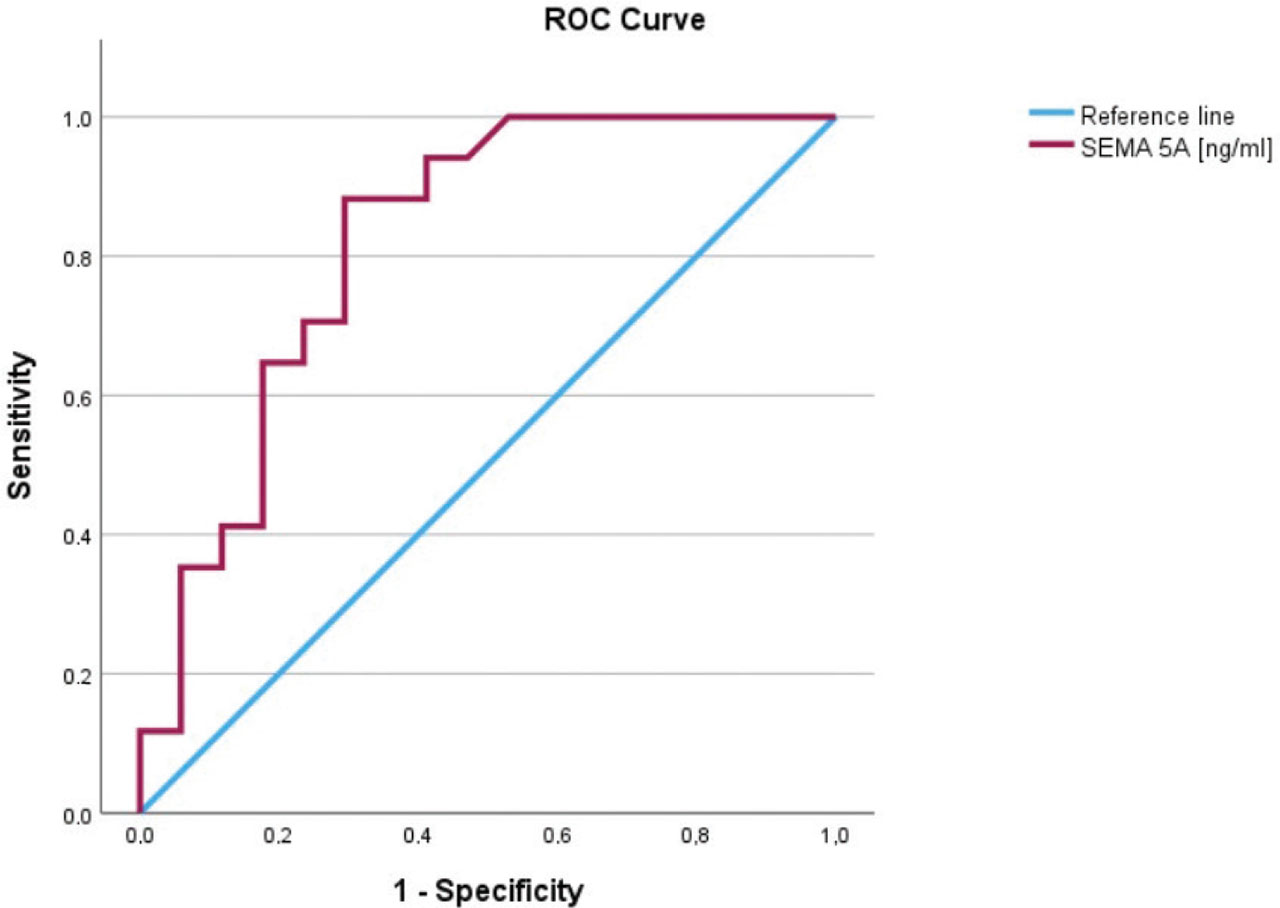
Fig S1.
ROC for SEMA5A as a JIA diagnostic biomarker. JIA, juvenile idiopathic arthritis; ROC, receiver operating characteristic curve; SEMA5A, semaphorin 5A.