
1. Introduction
Tremendous efforts have been made in the last five decades in the biomedical arena to develop next-generation therapeutic modalities to treat life-threatening diseases such as cancer, autoimmune diseases, and organ failure. Pharmaceutical drugs composed of different chemical entities can sometimes cause cytotoxic effects, resulting in side effects. Therefore, the quest for the development of new biocompatible therapeutic interventions continues. Advancements in molecular biology, genetic engineering, biochemistry, developmental biology, genome editing tools, and high-throughput analytical methods have accelerated the pace of cellular reprogramming-based therapy to circumvent the pitfalls of conventional drugs. Typically, cellular reprogramming-based therapy focuses on tailoring the cellular DNA sequence using zinc finger nucleases, transgenes, CRISPR/Cas9, and transcription activator-like effector nucleases (Smith et al. 2016). Cellular reprogramming involves converting cells into induced pluripotent stem cells (iPSCs), which are then converted into the desired reprogrammed cell lineage (Figure 1) (Takahashi et al. 2009). In this process, transcription factors (TFs) play a pivotal role in converting somatic cells into stem cells, which can divide and differentiate into different cell types. Takahashi and colleagues utilized a mixture of Oct4 (Pou5f1), Klf4, Sox2, and Myc TFs, known as OKSM, to reprogram murine and human fibroblasts into iPSC (Takahashi and Yamanaka 2006; Takahashi et al. 2007; Yu et al. 2007). The cell reprogramming technique holds great promise in tissue engineering, cancer therapy, drug discovery, and autoimmune disease treatment. However, there are several drawbacks associated with this process. Reprogramming cells into iPSCs is a cumbersome and lengthy process that enhances the cost of the whole method. Furthermore, several episodes of cancerous tumor formation were observed when the iPSCs did not attain the desired cell lineage (Cieślar-Pobuda et al. 2017). Several government regulatory bodies consider it a serious concern, which minimizes the clinical translation rate of cell reprogramming.
On the contrary, researchers developed another cell tissue engineering technique where one type of somatic cell is converted into another somatic cell type without attaining an iPSC state. This technique is known as direct cell reprogramming or transdifferentiation (Figure 1). As the iPSC state is not required in this method; therefore, it is safer, less time-consuming, and cost-effective compared to iPSC reprogramming (Grath and Dai 2019). On the other hand, sometimes, cells undergo intermediate states before transdifferentiation.
A previous study reported that during the reprogramming of B cells to macrophages, cells undergo an intermediate state where they express both genes of macrophages and B cells prior to the complete transdifferentiation process (Xie et al. 2004). The risk of mutations and tumor formation is less in transdifferentiation, as it does not require cell division or an intermediate iPS state. Therefore, transdifferentiation is more viable in clinical settings. For example, researchers have reprogrammed human skin-derived fibroblasts into neurons using a cocktail of small molecules ZPAK (Pyrintegrin 1 μM; ZM336372 0.175 μM; AZ960 0.1 μM; KC7F2 7.5 μM) that facilitated transdifferentiation process. This strategy, if adopted in regenerative medicine, could replace the damaged neurons to manage the repercussions of neurological disorders (Herdy et al. 2019). Vascular calcification enhances the chances of cardiovascular diseases, where osteogenic transdifferentiation of vascular smooth muscle cells leads to several episodes of acute coronary syndrome. In this whole process, receptor-interacting serine/threonine-protein kinase 1 (RIPK1) induces osteogenic transdifferentiation; therefore, sometimes, inhibition of the transdifferentiation process may help in disease management. In this regard, Necrostatin-1, a small molecule inhibitor, was used to impede the activity of RIPK1 kinase to minimize the osteogenic transdifferentiation process (Li et al. 2024).
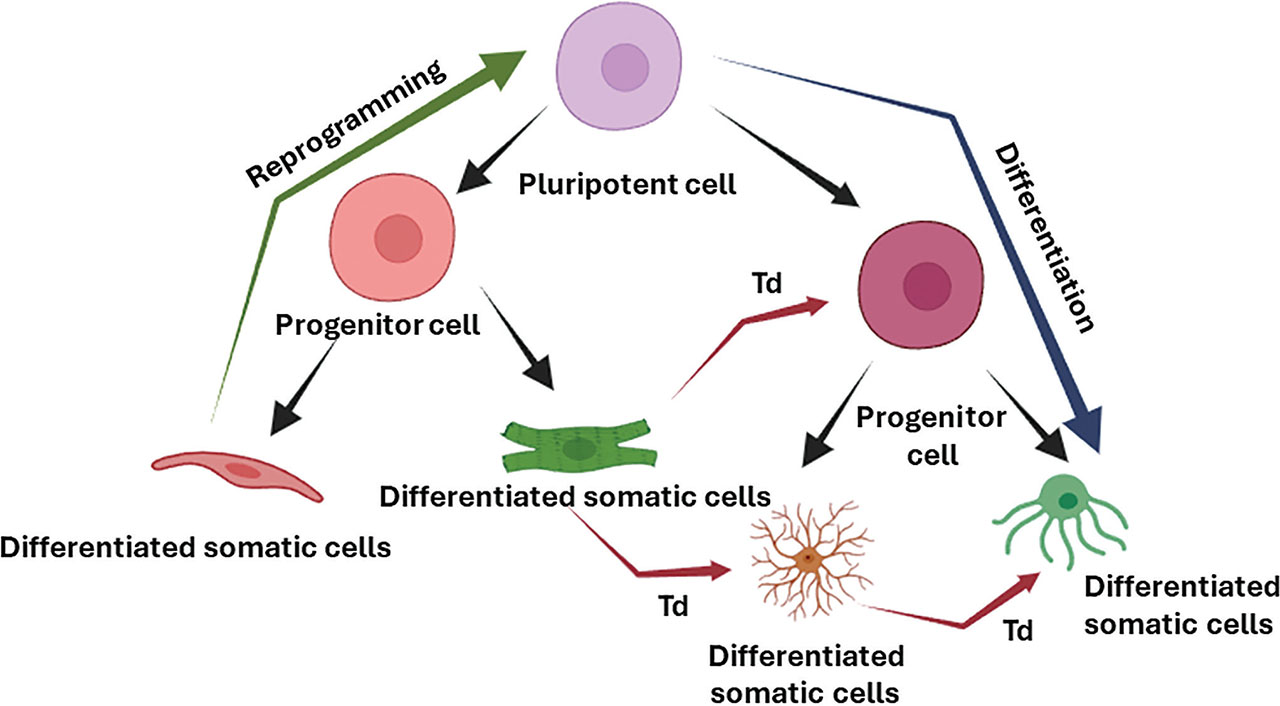
Fig 1.
Illustration of the processes of Td, differentiation, and reprogramming. The respective details could be found in the text below. Td, transdifferentiation.
Research groups have made significant efforts to achieve transdifferentiation by applying miRNAs, cell membrane permeable proteins, small molecules, gene delivery, and non-integrating vectors (Xie et al. 2017). All these strategies have their own advantages and pitfalls.
In this review, we discuss the transdifferentiation process, methods utilized for transdifferentiation, different states of transdifferentiation, and its potential applications in the healthcare setting.
2. Transdifferentiation
The history of transdifferentiation stretches back to 1895, when Wolff observed that pigment epithelial cells of newts transdifferentiated into crystalline lens cells during the crystalline lens regeneration process (Wolff and Wilhelm 1895). Furthermore, transdifferentiation was observed during the regeneration of the limbs and tails of newts and lizards, respectively (Wang et al. 2015). These are some classic examples of the natural transdifferentiation process. On the other hand, the artificial transdifferentiation process was programmed using experimental procedures. The first reported in vitro transdifferentiation process was performed using the MyoD TF to convert fibroblast cells into skeletal muscle cells (Davis et al. 1987). Later, several research groups performed transdifferentiation between numerous cell types, such as fibroblast to hepatocyte, pancreatic cell to hepatocytes, fibroblast to neurons, and fibroblast to cardiomyocyte (Wild and Tosh 2021). Cells used in the transdifferentiation process are matured cells, where transdifferentiation can be achieved in three major ways.
The first technique involves inducting an exogenous transgene into the cells to overexpress prime TFs that may start the transdifferentiation process. In this method, viral vectors are often utilized to introduce the foreign genetic material into the cells (Patel and Yang 2010; Ban et al. 2011; Morita et al. 2015). Lentiviral and retroviral vectors are broadly used in this process. Apart from this, non-integrating viruses are also exploited to achieve direct cell reprogramming or transdifferentiation; however, this protocol has lower efficiency and is time-consuming (Komuta et al. 2016; Lang et al. 2024). Adenoviruses and Sendai viruses were used as non-integrating viruses to achieve transdifferentiation. The whole aim of using viruses is to overexpress the exogenous TFs that govern the growth, cell division, differentiation, and migration of the cells (Guo et al. 2024b). Overexpression of TFs upregulates or downregulates particular gene expression, which plays a pivotal role in getting a differentiated cell type. Apart from viral vectors, transgenes can be inserted into the cells through electroporation (Christoffers et al. 2024) and various transient transfection (Shen et al. 2024) techniques, but the efficiency of these techniques is compromised due to the lower transduction efficiency.
Apart from delivering transgene and overexpressing a set of TFs, choosing suitable TFs for the transdifferentiation process is also crucial. Several web-based tools have been developed to help researchers choose TFs that induce direct cell reprogramming. For example, www.mogrify.net is a web interface where researchers need to feed the source and target cell types to obtain desired TFs for cell reprogramming purposes (Guerrero-Ramirez et al. 2018).
Similarly, Cahan et al. (2014) developed a web interface (https://cahanlab.github.io/singleCellNet/) termed as CellNet. By feeding the gene expression data of the source cell or target cell, the user could get three sets of outputs. In the first output, the input samples are classified based on their similarity to the target cells. This output helps to score the transcriptional regulators, which could play a critical role in improving the desired cell population. The second output shows how gene regulatory networks are established in the samples, which could ultimately determine the cell fate. The third output score provides the crucial transcriptional regulators, which are essential for cell reprogramming (Cahan et al. 2014). GarNet is among the other web-based tools that utilizes the RNA sequence and transposase-accessible chromatin with sequencing (ATAC-seq) to predict the essential TFs for the desired differentiation process (Hammelman et al. 2022). TF differential expression between source and target cells can be studied using the EBseq32 web-based tool (Hammelman et al. 2022). The DeepAccess tool available at (https://cgs.csail.mit.edu/deepaccess-package/interpret) is trained to take DNA sequence as input and predicts the binding of TFs that drive the cell differentiation (Hammelman and Gifford 2021; Patel et al. 2022b). Apart from these tools, researchers also use AME, HOMER, DREME, KMAC, and diffTF to determine the suitable TFs for transdifferentiation experiments (Hammelman et al. 2022).
The second process involves silencing and overexpressing the endogenous genes with CRISPR/Cas9 (derived from a bacterial defence system) (Arnan et al. 2022). CRISPR/Cas9 is used for gene manipulation/editing where a short DNA sequence is inserted into the desired site of the human genome (Chen et al. 2019). The CRISPR/Cas9 process depends on a guide RNA, which assists CRISPR/Cas9 to bind specifically to the DNA sequence that is complementary to the guide RNA sequence (Huang et al. 2023). This specific binding ability of CRISPR/Cas9 to the DNA sequence makes it a suitable candidate for achieving transdifferentiation. Although it is more precise, its efficiency is somehow lower than discussed above viral methods, esp. when compared to lentiviral vectors.
The CRISPR/Cas9 process silences the gene of interest by destroying the double-stranded DNA. However, mutant dCas9 (Gong et al. 2018) is also utilized in transdifferentiation, where it only binds to the DNA but does not break it. dCas9 is produced by deactivating the endonuclease domains of the Cas9 enzyme, where it can still bind the nucleotide sequences (Gong et al. 2018). The dCas9 strategy comes into play where the targeted differentiated cells can be produced by activating the naturally silenced genes with the help of fused trans-activator proteins (Huang et al. 2023). These proteins induce the gyration in the ultra-molecular structure of chromatin and employ transcription complexes to induce naturally silenced gene expression, resulting in direct reprogramming. The CRISPR/Cas9 process can aid in achieving the transdifferentiation process by silencing or upregulating the gene to produce disease-resistant knockout cells.
The third process involves the induction of pharmacological agents to achieve transdifferentiation. For example, the drug 5-azacytidine, which is used to treat myelodysplastic syndrome, myeloid leukemia, and juvenile myelomonocytic leukemia, in combination with valproic acid (VPA), has been found to interfere with the transdifferentiation of adipose tissue-derived mesenchymal stem cells into cardiac myoblasts, driven by bone morphogenetic protein-4 (BMP-4) (Hasani et al. 2020). The chemical structure of 5-azacytidine is similar to cytidine, which is a pyrimidine. When 5-azacytidine is incorporated into the cells, it integrates into DNA due to its binding ability with guanine. Due to molecular structure differences, it cannot get methylated and blocks DNA methylation, causing epigenetic changes leading to gene expression (Kaur et al. 2014). Cardiac cells exposed to 5-azacytidine showed properties similar to skeletal myocytes that form multinucleated myotubes (Kaur et al. 2014). Apart from this, DNA methylation can also be achieved using zebularine (Zhou et al. 2011). This molecule induces transdifferentiation of mesenchymal stem cells into cardiomyocytes. Researchers have also used a glucocorticoid, dexamethasone (Lardon et al. 2004), that binds to glucocorticoid receptors and promotes transdifferentiation (Lu et al. 2006).
Sometimes, lentiviral vectors used to deliver the genetic material may induce transdifferentiation through an innate immune signaling cascade. Viral genetic material activates Toll-like receptor 3 (TLR3), resulting in the downregulation of innate histone deacetylases and upregulation of histone acetyltransferases. An immunostimulant, polyinosinic: polycytidylic acid (Poly I: C), activated TLR3 of human foreskin fibroblasts to produce endothelial-like cells (Sayed et al. 2015; Meng et al. 2017).
In summary, the transdifferentiation process attempts to change the cell type, where the source cell can be terminally differentiated or adult stem cells. However, the resulting cell population must be different from the source cell type. Different strategies have been used to achieve transdifferentiation that focuses on changing the genetic expression of the source cell to achieve the target cell. The target cell type is determined by investigating the protein and gene expression. The reprogramming efficiency of these strategies may vary depending on the strategy and type of source and target cells. In the next section, we are going to discuss the advancement of different transdifferentiation strategies in detail.
3. Strategies used for Transdifferentiation
3.1. Transcription factors
TFs play a pivotal role in cell division, differentiation, and migration; therefore, efforts have been made to achieve transdifferentiation using TFs. The development of osteoblast-like phenotypes in valvular interstitial cells leads to calcific aortic valve stenosis. Here, activation of interferon (IFN)-γ plays a pivotal role by altering the transcription of interleukin (IL)-1β mRNA and promoting calcific aortic valve stenosis (Lu et al. 2024). It was reported that valvular interstitial cells treated with anti-IFN-γ antibodies reduce the transdifferentiation of interstitial cells into an osteoblast-like phenotype, which may lead to alleviating features of heart failure. Therefore, altering the overexpression of IFN-γ can be an effective strategy to block the transdifferentiation of interstitial cells into osteoblasts (Lu et al. 2024). Researchers utilized three TFs, TCF4, C/EBPδ, and ΔNp63α, to transdifferentiate human fibroblasts into the corneal epithelial lineage. This study showed that the cocktail of TFs and corneal epithelial culture medium was sufficient to transdifferentiate the fibroblasts. The transdifferentiated cells expressed the CK3 and CK12 markers, which are specific to corneal epithelial cell lineage (Table 1) (Cieślar-Pobuda et al. 2016).
This may help to design new modalities in cell therapy and precision medicine. Silicosis damages lung function due to the transdifferentiation of lung fibroblasts to myofibroblasts. The symptoms of silicosis can be managed by blocking the transdifferentiation process. It was observed that a TF named FOXF1 downregulated in this transdifferentiation process and activated the inflammatory signals to cause lung fibrosis (Nilsson and Kannius-Janson 2016). Therefore, researchers have overexpressed FOXF1 by adeno-associated virus to block the transdifferentiation of lung fibroblasts to myofibroblasts. Overexpression of FOXF1 TF downregulates SMAD2/3 and PSMAD2/3 pathways to retain the cellular features of lung fibroblasts (Hu et al. 2024). The neuroendocrine transdifferentiation process upregulates neuroendocrine-related proteins such as synaptophysin, neuron-specific enolase, and chromogranin A, which contribute to metabolic deregulation/reprogramming observed in various cancers (Dai et al. 2017; He et al. 2023).
Therefore, the identification of important upstream regulators responsible for neuroendocrine transdifferentiation can be useful in designing next-generation cancer medicines. Dysregulation of the SOX4 transcription pathway suppresses the neuroendocrine transdifferentiation, which may reduce the chances of castration-resistant prostate cancer. This study revealed that the pluripotent TF SOX4 increased aerobic glycolysis and promoted glucose intake. Furthermore, the upregulation of SOX4 also promoted lactate and pyruvic acid synthesis and upregulated the neuroendocrine-related marker genes (Jing et al. 2024). These findings suggested that targeting the SOX4/PCK2 signaling pathway could play a pivotal role in designing new therapeutic avenues for cancer treatments. Transdifferentiation of pericytes into smooth muscle cell-like structures by platelet-derived growth factor-BB, interleukin-6, and transforming growth factor (TGF)-β causes pulmonary arterial hypertension (PAH). This cell reprogramming can be regulated by a C-type natriuretic peptide hormone that attenuates pericyte transdifferentiation and manages the PAH (Dabral et al. 2024). Some of the examples of transdifferentiation using different TFs and other strategies are shown in Table 1.
Table 1.
Examples of transdifferentiation of different cell types using various approaches
| Source cell | Target cell | TF or transdifferentiation factor used | Observation | References |
|---|---|---|---|---|
| Adipocyte-derived stem cells | Osteoblasts | Streptomycin, penicillin, amphotericin B, and amphotericin B with Cu2+ | Exposure of amphotericin B induced the osteogenesis of stem cells | Skubis et al. 2017 |
| Astrocyte | iN | Ascl1, Myt1l, Brn2a | Efficacy 0.4%–5.9% | Torper et al. 2013 |
| Astrocyte NG2 cell | iN | NeuroD1 |
| Guo et al. 2014 |
| Cardiac fibroblast | Cardiomyocytes | Gata4, Mef2c, Tbx5 |
| Qian et al. 2012 |
| Cardiac fibroblast | Cardiomyocytes | Gata4, Mef2c, Tbx5 |
| Inagawa et al. 2012 |
| Cardiac fibroblast | Cardiomyocytes | microRNAs 1, 133, 208, and 499 |
| Jayawardena et al. 2015 |
| Fibroblasts | Neurons | VPA | Neurons generated by histone deacetylase inhibitor mechanism Glutamatergic neurons generated | Hu et al. 2015a |
| Fibroblasts | Neurons | ISX9 | Inhibition of the BET family protein induces the transdifferentiation process | Li et al. 2015 |
| Fibroblasts | Cardiomyocytes | LIF | Transdifferentiation occurs through an intermediate state | Fu et al. 2015 |
| Fibroblasts | Hepatocytes | HGF | Human hepatic progenitors proliferate for at least 10 passages without losing differentiation potential in vitro | Kim et al. 2019 |
| Fibroblast | Corneal epithelial | TCF4, C/EBPδ, ∆Np63α and Corneal specific medium | Infection with TCF4, C/EBPδ, and ∆Np63α TFs and exposure of medium induce transdifferentiation | Cieślar-Pobuda et al. 2016 |
3.2. MicroRNA (miRNA)
miRNAs have surfaced as a prime alternative in direct cell reprogramming as they govern essential processes such as DNA methylation, protein synthesis, cell differentiation, and cell cycle progression. miRNA can drive the differentiation of neuron stem cells into neuron cells by suppressing the expression of BAF53a. Repression of the BAF53a allows the expression of BAF53b, which is essential for dendritic growth and post-mitotic neural development (Yoo et al. 2009). Researchers have designed a combination of four miRNAs, called miRcombo (mmu-miR-1, mmu-miR-133a, mmu-miR-208a, and mmu-miR-499), to promote the conversion of mouse fibroblasts into induced cardiomyocytes (iCMs) (Jayawardena et al. 2012). Sometimes, miRNA, along with TFs, assists in direct cell reprogramming. For example, miR-124 with two TFs, BRN2 and MYT1L, converts human primary dermal fibroblasts into neurons (Ambasudhan et al. 2011). Overexpression of stem cell-specific miRNA and neuron-specific miRNA induces the transdifferentiation of fibroblasts into neurons. The stem cell-specific miRNA-302/367 cluster, along with neuron-specific miRNA-9/9* and miRNA-124, converts the human fibroblasts to neurons (Zhou et al. 2015). MicroRNA-based reprogramming strategies can be efficiently used in antiaging research. MiRNA-203 inhibits the Wnt and Notch signaling pathways to direct keratinocyte stem cells to epidermal differentiation. Therefore, miRNA-203 could be a potential target for keratinocyte stem cell reprogramming (Labarrade et al. 2022). Knockdown of proteins such as PTBP2 facilitates the conversion of human skin fibroblasts to neurons. Herein, achaete-scute homolog 1 (ASCL1), MIR9/9*-124, and p53 shRNA (AMp) are used to generate mostly γ-aminobutyric acid (GABA)-ergic neurons from human skin fibroblasts. PTBP2 attenuation favored the neuron-specific growth, which could be effectively utilized to study human brain-related diseases to mimic complex brain lesions (Figure 2) (Zhu et al. 2023). In silico studies also play a pivotal role in determining the cell fate. Researchers identified nine miRNA clusters that induce the transdifferentiation of fibroblasts to cardiomyocytes. Later, in vitro studies were performed by cloning miRNA into lentiviral vectors. Transfection and transdifferentiation studies showed that miRNA-2392 has a higher potency to reprogram the fibroblasts into cardiomyocytes. Polymerase chain reaction (PCR) and immunohistochemistry studies confirmed the expression of cardiomyocyte-related proteins and genes. Furthermore, miRNA-2392 was observed to have a direct link with the MAPK and Wnt signaling pathways that have a prominent role in cell growth and differentiation (Mahdi et al. 2023).
Functional loss of GABAergic interneurons causes severe neurological diseases such as epilepsy, autism, Alzheimer’s disease, and depression. Researchers transdifferentiated the human neonatal fibroblasts to GABAergic neuron-like cells using miR-124 and let-7 microRNAs along with some small molecules. Using this technique, relatively the same protocol can be achieved to generate GABAergic neuron-like cells with higher transdifferentiation efficiency (Gu et al. 2022). Scaffolds developed using nanotechnology emerged as a suitable modality for delivering the microRNA to induce transdifferentiation in cardiac fibroblasts. Generally, micro RNAs are delivered using viral vectors to transdifferentiate the cells. However, viral vectors possess low loading capacity, immunogenicity, and toxicity. In this regard, inorganic and organic nanomaterials might be used as effective miRNA delivery shuttles due to their high encapsulation efficacy and biocompatibility (Mishra et al. 2021, 2022, 2023; Chaudhary et al. 2024). Nanofiber scaffolds developed using poly-l-lactic acid (PLLA) polymers effectively delivered muscle-specific microRNAs (miR-1 and miR-133a) to directly reprogram adult human cardiac fibroblasts into cardiomyocyte-like cells (Muniyandi et al. 2021). Neurogenic TF ASCL1 and microRNA124 converted the human retinal pigmented epithelium cells to neurons with photoreceptor properties (Li et al. 2021). TGF-β signaling plays a prominent role in myocardial fibrosis and causes heart failure by reprogramming cardiac fibroblasts. In this regard, microRNA-101a overexpression reduces the TGF-β signaling pathway and suppresses the reprogramming of cardiac fibroblasts. Therefore, designing a therapeutic intervention that can overexpress microRNA 101a in fibrosis patients can be an excellent therapeutic alternative (Zhou et al. 2018).
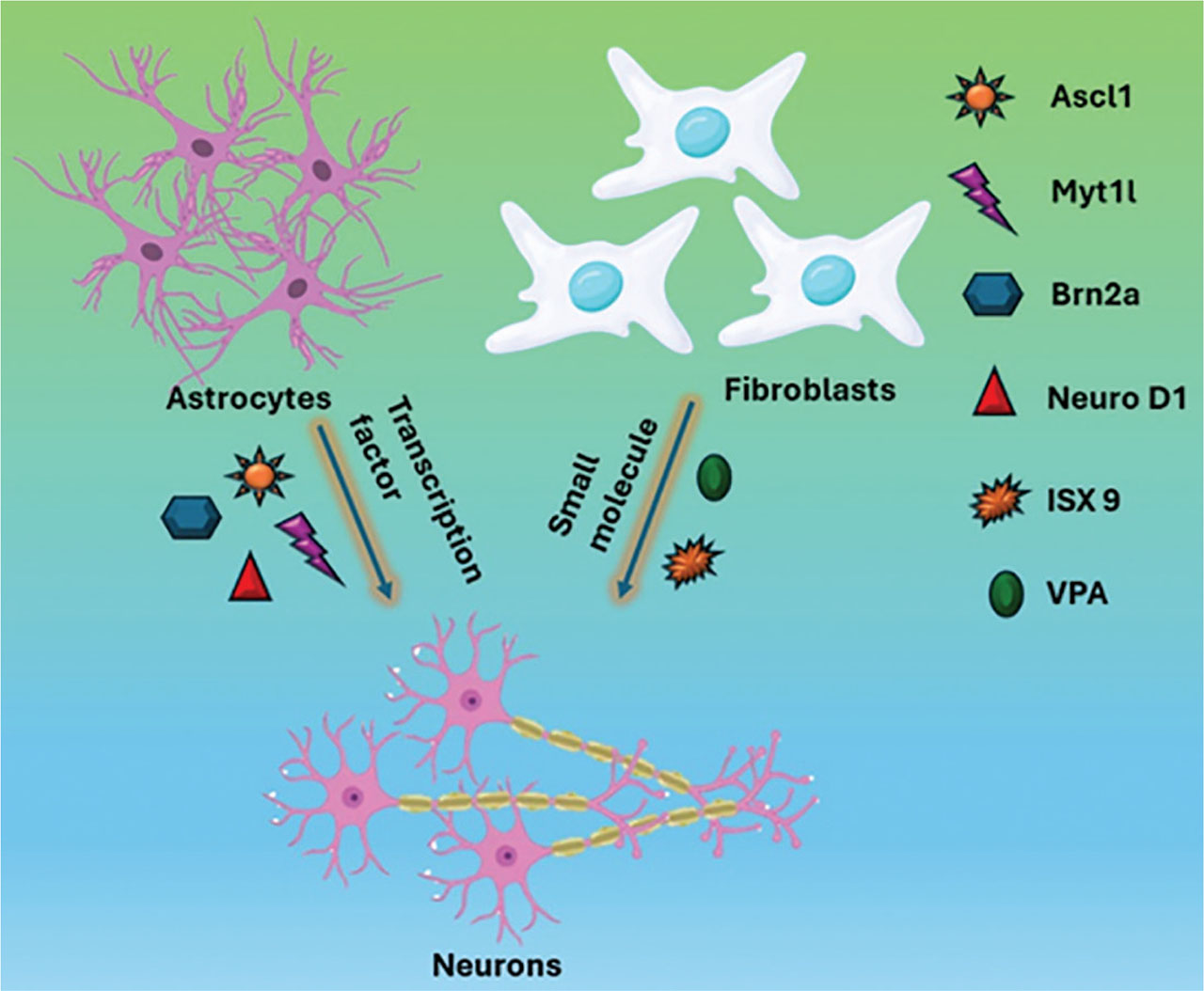
Fig 2.
Transdifferentiation of two different cells, astrocytes and fibroblasts cell, into neurons using two different methods. Astrocytes are transdifferentiated into neurons using different TFs (Ascl1, Myt1l, Brn2a, and Neuro D1), while fibroblasts transdifferentiated into neurons using small molecules (ISX9 and VPA). ASCL1: Achaete-scute homolog 1; ISX9, A neurogenesis-promoting small molecule; TFs, transcription factors; VPA, Valproic acid.
3.3. Pharmacological agents or small molecules
Ginsenoside Rg1, an active ingredient of a Chinese herb, Panax ginseng, was found to promote the transdifferentiation of reactive astrocytes into neuron-like cells. Ginsenoside Rg1 promoted the expression of neurological markers such as NEUROD1, Myt1l, TUJ1, MAP2, NeuN, and SYN1 and blocked the Notch/Stat3 signal pathway to convert the astrocytes into neuron-like cells (Shen et al. 2023). This therapeutic intervention may lead to the treatment of severe spinal cord injury (Shen et al. 2023). Human fibroblasts are turned into neuronal cells by exposing the source fibroblast cells to a mixture of seven small molecules named VCRFSGY (Hu et al. 2015a). This induction of small molecules bypasses the neural progenitor stage, which minimizes the chances of tumor formation. In this process the fibroblast-specific genes are being downregulated, while the gene expression of endogenous neurological TFs is upregulated. This study could help to develop patient-specific neurons to address neurological disorders. In another study, Hu et al. (2015b) transdifferentiated normal and Alzheimer’s disease-based human fibroblasts into neuronal cells using a combination of three molecules. Here, inhibitor of c-Jun N-terminal kinase (SP600125), pan-PKC inhibitor (GO6983), and rho-associated kinase inhibitor (Y-27632) small molecules were used to induce the transdifferentiation process. Taking these observations into account, it might be concluded that patient-specific neuronal cells could be generated to achieve cell replacement therapy with the help of chemical compounds.
Liu et al. (2021) established a protocol with high transdifferentiation efficiency to convert human cardiac fibroblasts into endothelial cells. Researchers used vascular endothelial growth factor, BMP-4, and basic fibroblast growth factor (bFGF) to convert the cardiac fibroblast cells to endothelial cells. Without utilizing exogenous TFs, the cells are directly reprogrammed into endothelial cells (Liu et al. 2021). Cheng et al. (2014) established two sets of small molecule cocktails that can produce the neural progenitor cells (ciNPCs) from mouse fibroblasts and human urinary cells by the transdifferentiation process. The first set of chemicals was Repsox (TGF-β inhibitor), VPA (HDAC inhibitor), and aminopyrimidine derivative (CHIR99021; GSK3 inhibitor). On the other hand, the second set of small molecules was found to be LiCl, sodium butyrate (NaB), and inhibitor of TGF-β type I receptor (SB431542); or TSA, Li2CO3, and Tranilast. The second cocktail set also inhibits HDAC, GSK3, and TGF-β pathways to produce ciNPCs (Cheng et al. 2014). A cocktail of six small molecules containing CHIR99021, isoxazole-9, Forskolin, Dorsomorphin, Y27632, and PU.1 transcription factor inhibitor (DB2313) was able to convert monocyte-derived macrophages into neurons to manage ischemic stroke. This combination was also found to be effective in ischemia animal models (Ninomiya et al. 2023). Two small molecules, named neurodazine and hedgehog pathway inhibitor 1, transdifferentiated human fibroblasts into neuron-like cells. In this study, a rapid protocol was developed to achieve transdifferentiation by upregulating LC3, ATG5, and ATG12 autophagy genes. The resulting cells showed the expression of neuron marker genes such as PAX6, TUJ, and SOX1, whereas a significant drop in fibrotic markers was monitored (Sorraksa et al. 2024).
In another study, researchers used the neuroprotective activity of l-borneol and d-borneol to initiate neurological transdifferentiation. In this study, astrocytes were transdifferentiated into neurons by regulating the Wnt/Notch pathway (Ma et al. 2023). In order to develop an effective treatment strategy for multiple sclerosis (MS), a cocktail of small molecules containing VPA, CHIR99021, Thiazovivin, Forskolin, Repsox, and BMP pathway inhibitor (LDN) was applied to transdifferentiate the astrocytes into oligodendrocyte progenitor cells. In this study, oligodendrocyte progenitor cell fate was achieved in 15 days (Sharifi-Kelishadi et al. 2024).
Millions of dollars are spent annually to treat bone disorders where artificial grafts are constructed to replace the damaged bone. Therefore, the development of alternative strategies that can induce bone regeneration by enhancing the osteoblast population is essential. Transdifferentiation induction using small molecules showed some promising results that can be replicated in the clinical setup in the near future. Researchers used SVAK-12 small molecule, which promoted the BMP-2 signaling to promote osteogenic transdifferentiation of muscle cells (Wong et al. 2013). Results obtained from bone fracture model confirmed groups treated with SVAK-12 have significantly higher radiographic healing scores. This study outlined that BMP-2 responsiveness for bone tissue regeneration can be promoted by the SVAK-12 molecule. Another study reported BMP-2 protein along with small molecule FK-506 promoted in vitro bone regeneration (Darcy et al. 2012). In this study, initially 5405 therapeutic compounds were screened, and 45 molecules were selected as they promoted the osteoblast commitment. Among those 45 compounds, FK-506 treatment facilitated transcription of Runx-2, Osx, and Smad-7, which are crucial for osteoblast differentiation. Additionally, antibiotics could also impact the differentiation of the stem cells; for example, amphotericin B could induce the differentiation of human adipose-derived mesenchymal stem cells (ADMS) into osteoblast. In this study, a combination of antibiotics such as streptomycin, penicillin, amphotericin B, and amphotericin B with Cu2+ was utilized to evaluate the differentiation-inducing potential in ADMS (Skubis et al. 2017). It was outlined that both amphotericin B and its analog with Cu2+ ions could induce osteogenesis in the presence of osteogenesis-inducing factors, such as β-glycerophosphate, dexamethasone, and L-ascorbic acid (Skubis et al. 2017). In the future natural polymer-based scaffolds integrated with amphotericin B, dexamethasone or β-glycerophosphate could be synthesized to induce the transdifferentiation of osteoblasts from stem cells or other differentiated somatic cells to develop alternative strategies for bone tissue engineering.
Diabetes causes significant health problems worldwide. While insulin treatment has significantly reduced the symptoms of this deadly disease, treatment strategies with fewer side effects are always encouraged. In this regard, transdifferentiation of fibroblasts into pancreatic β-like cells can be a game changer for the treatment of diabetes. In this regard, a small molecule cocktail containing NaB, Parnate (Par), non-nucleoside DNA methyltransferase inhibitor (RG108), CHIR99021, and 5′-N-ethylcarboxamidoadenosine could assist fibroblasts to express β-cell TFs, including PDX1, NKX6.1, NKX2.2, and NEUROD1 (Zhu et al. 2016). Apart from this, molecules such as bromodomain inhibitor (I-BET151), inhibitor of receptors ALK 4/5/7 (A83-01), and member of the TGF-β superfamily of growth factors (Activin A) were also used to transdifferentiate fibroblasts into hepatocytes, pancreatic beta cells, endothelial cells, neurons, and cardiomyocytes (Li et al. 2015; Zhang et al. 2023b). Direct cell reprogramming of α-cells to β-cells using small molecules could emerge as an alternative strategy for diabetes treatment. It was reported that small molecules such as liraglutide and sitagliptin transdifferentiate pancreatic α-cells into β-cells. Transdifferentiation was achieved by inducing β-cell differentiation and lowering β-cell apoptosis (Sarnobat et al. 2020).
A combination of TFs and small molecules is used to transdifferentiate the fibroblasts into iCMs. Transdifferentiation of fibroblasts is maximized when a combination of sodium butyrate, a small molecule inhibitor that targets Wnt/β-catenin pathway (ICG-001), and retinoic acid is combined with TFs Gata4, Mef2C, and Tbx5. Herein, retinoic acid and NaB acted as cardiac growth regulators and histone deacetylase inhibitors. This study identified the small molecule cocktail that induces TF-mediated direct reprogramming of fibroblasts into cardiac myocytes (Singh et al. 2020). This may pave the way for cardiac tissue engineering. The advantages and disadvantages of different strategies of transdifferentiation are summarized in Table 2.
Table 2.
Features and pitfalls of different strategies of transdifferentiation
| Strategy | Advantages | Disadvantages | References |
|---|---|---|---|
| TFs |
|
| Zhang et al. 2023b |
| MicroRNA |
|
| Shen et al., 2023; Singh et al., 2020 |
| Small molecules or pharmacological agents |
|
| Jayawardena et al. 2012; Zhang et al. 2023b |
| Extracellular vehicles and 3D culture |
|
| Zhang et al. 2023b |
4. Different States during Transdifferentiation
During the transdifferentiation process, cells pass through intermediate states, which so far have not been comprehensively studied (Figure 3). However, knowing the intermediate states during the cell reprogramming is crucial to achieve transdifferentiation with higher efficiency. Studying the intermediate states may curtail the chances of uncontrolled differentiation and proliferation of cells, which pose a risk to the patients. Transcriptome analysis of the donor cells helps in identifying the intermediate states and the barriers that block the transdifferentiation process. The nature of intermediate states depends upon donor and target cells as well as environmental niches. Different models of transdifferentiation are described in BOX 1.
BOX 1:
Two models of transdifferentiation
Generally two transdifferentiation models are accepted: In the first model, donor cell undergoes dedifferentiation to attain a pluripotent state and then differentiate into a particular phenotype that is targeted. In the second model, donor cell transits through an intermediate state to directly transdifferentiate into the desired cell type. In the transition state, relaxation of restricted chromatin occurs that allows the exogenous transcription factors resulting induction of transdifferentiation.
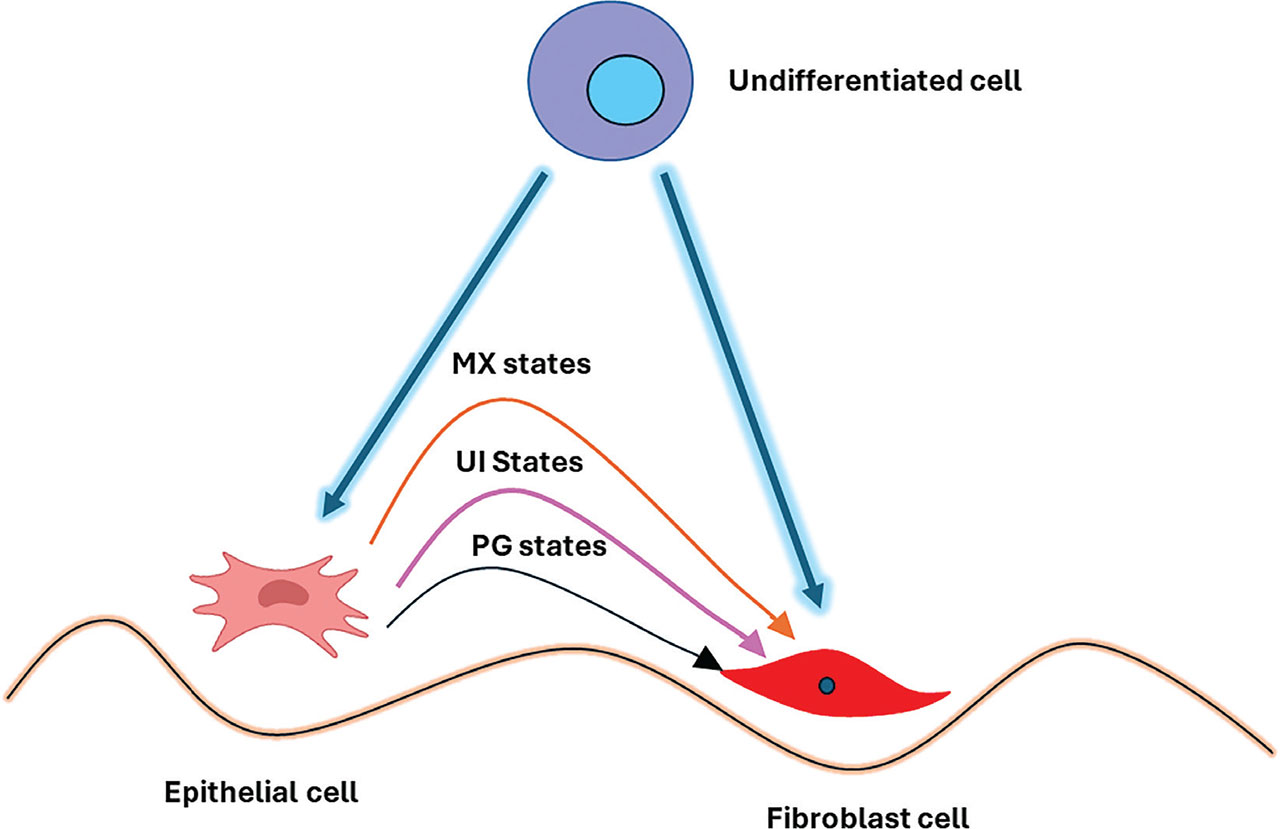
Fig 3.
Different intermediate states during the transdifferentiation. MX, UI, and PG denote the mix, unspecific, and progenitor intermediate states, respectively.
4.1. Mixed states
Mixed states are observed in the direct reprogramming where the simultaneous loss of donor cell fate and the gain of target cell fate occur (Figure 3). For example, transdifferentiation of mouse cardiac fibroblasts to iCMs takes place via several intermediate states, such as intermediate fibroblast, pre-iCMs, and iCMs. These data showed that pre-iCMs were in an unstable cell state that expressed cardiomyocyte and fibroblast markers (Liu et al. 2017). Another study showed adipogenic lineage cells transdifferentiated into osteogenic or chondrogenic cells by undergoing a dedifferentiation state. During the reprogramming of adipogenic lineage cells, qPCR, histology, immunohistochemistry, and single-cell analysis showed the mixed cultures of both osteogenic and adipogenic cell lineages (Ullah et al. 2014). Similar phenomena were observed when human fibroblast cells underwent direct cell reprogramming to achieve a neuron cell fate. During this transdifferentiation process, fibroblast cells achieved an intermediate state where neuron-specific genes were upregulated, and fibroblast-specific markers disappeared steadily (He et al. 2022). Another example showed that during the differentiation of hematopoietic stem cells, they undergo intermediate cell states where they express markers of both macrophages and B cells. This intermediate cell state plays a crucial role in deciding the resultant cell fate and transdifferentiation process (Zhang and Li 2021). In the mixed intermediate state, the donor cell might lose its original fate while the target cell fate is established. This phenomenon might occur as the target cell fate activates its transcription machinery to induce its marker gene expression (Reid and Tursun 2018).
4.2. Unspecific intermediate states
Sometimes, donor cells lose their original phenotype prior to becoming target cells during transdifferentiation. Herein, donor cells undergo an intermediate state where the cells neither possess features of donor cells nor target cells (Figure 3). Sometimes, these intermediate cells show stemness properties/markers but do not turn into stem cells. A single-cell genomics study delineated that smooth muscle cells acquired an unspecific intermediate state, where they converted into stem cells, endothelial cells, and monocytes. All these cells have multipotency, where they can differentiate into macrophage and fibrochondrocyte cells or turn back into smooth muscle cells (Pan et al. 2020). This whole process is influenced by retinoic acid. The phenotypic switching of smooth muscle cells in the walls of arteries causes atherosclerosis disease. In-depth studies focusing on cell fate changes during smooth muscle transdifferentiation might help design effective drug molecules for atherosclerosis treatment. The smooth muscle cell transdifferentiation process attains an intermediate state where it expresses the markers of mesenchymal stem cells and gives rise to osteoblasts, chondrocytes, adipocytes, and macrophages. This intermediate pluripotent stemness cell population is prone to aneurysms, which cause severe pathophysiological repercussions (Chen et al. 2020).
4.3. Progenitor-like states
Donor cells in transdifferentiation convert to a progenitor cell state with complete or partial pluripotency, where they dedifferentiate into the target cell during the reprogramming process (Figure 3). Transdifferentiation of peripheral blood mononuclear cell (PBMC) and the bipolar neuron (BN) was studied through the chromosome structural ensemble switching model, and interesting results were obtained. The data suggested transdifferentiation of PBMC and BN can be achieved by both direct and indirect transdifferentiation pathways. However, in the direct transdifferentiation pathway, the PBMC was converted into BN directly without undergoing an intermediate state. On the contrary, indirect transdifferentiation pathways have an intermediate state where donor cells attain a ciNPC state (Chu et al. 2022).
Life-threatening vascular diseases like atherosclerosis are caused by dysfunction in vascular endothelial cells. As the regeneration of vascular endothelial cells is a slow process, new strategies need to be developed to alleviate the complications of atherosclerosis (Raval and Losordo 2013). In this regard, the transdifferentiation of human vascular smooth muscle cells into endothelial fate would be of great interest, as both cells are of mesodermal origin. Using OCT4, SOX2, KLF4, and c-MYC TFs, researchers converted vascular smooth muscle cells into progenitor cell-like states in the intermediate state, which then differentiated into vascular endothelial cells (Hong et al. 2017). Interestingly, another study reported that by only applying OCT4 TFs, human fibroblasts can be converted into multilineage blood progenitors such as granulocytic, monocytic, megakaryocytic, and erythroid lineages. During this process, fibroblasts are reprogrammed to produce progenitor cells that later differentiate into hematopoietic cells (Szabo et al. 2010).
Single-cell RNA sequencing technology played a significant role in analyzing the intermediate states during the transdifferentiation process. Cells with identical phenotypes behave differently during their lifespan (Saliba et al. 2014). This alteration in cellular behavior occurs due to differences in the biomolecular composition of the cells. Single-cell RNA sequencing technology has readily been utilized to study the discrepancies in the transcriptomic landscape. This next-generation approach unlocks new opportunities to dissect the cross-talks between metabolic pathways, biological cascades, and biochemical stimuli that determine cell fate. However, at the same time, it has some challenges also. Single-cell RNA sequencing suffers from limited sensitivity, where it cannot distinguish between technical noise and biological variability for low-abundance (~10 copies/cell) transcripts, resulting in substantial damage of IFNormation from cellular transcriptomes (Islam et al. 2014). During short read-based sequencing, it is difficult to maintain strand specificity and detect isoform variants simultaneously. Sometimes, RNA loss rises up to 50%–60%, resulting in a lower number of transcripts (Deng et al. 2014). Addressing all these challenges could help to unravel complex biomolecular mechanisms of transdifferentiation to enable fully holistic approaches for disease modeling, tissue engineering, and drug design.
5. Clinical Applications of Transdifferentiation
5.1. Tissue engineering
Organs in the human body function in a collaborative manner. When an organ is terminally damaged, this may cause severe disability or even lead to death. Conventional treatment alternatives like drug therapy, surgery, laser treatment, allograft, and xenograft are used to treat terminally diseased organs. However, donor cell scarcity, chronic side effects, low regeneration potential, graft rejection, and potential complications hinder the therapeutic success of these conventional treatments. The transdifferentiation strategy could bypass the graft rejection problem, as the donor cells could be collected from the patients (Figure 4). Furthermore, as transdifferentiation converts one somatic differentiated cell into another terminally differentiated cell, it could address the scarcity of the cell population required for organ regeneration. Schwann cells have been extensively studied for peripheral nerve tissue engineering. However, the lack of abundant cell sources hinders its clinical translation. In this regard, transdifferentiation plays a vital role in nerve tissue engineering. Researchers utilized gelatin and polycaprolactone-based nanofibers functionalized with multi-walled carbon nanotubes as a scaffold that induces the transdifferentiation of bone marrow mesenchymal stem cells to Schwann cells. This study unraveled that the conductive properties of carbon nanotubes facilitated the transdifferentiation process (Hu et al. 2020). Similarly, polycaprolactone-based nanofibers conjugated with nerve growth factors induce the differentiation of mesenchymal stem cells into neuronal cell fate. The presence of neuronal differentiation markers like tubulin βIII, nestin, and map2 showed the potential of the transdifferentiation strategy in tissue engineering. Apart from TFs and scaffold treatment, metabolic engineering also induces transdifferentiation. Researchers directly reprogrammed adipose-derived stem cells into Schwann cells by metabolic glycoengineering, where the sugar analog Ac5ManNTProp (TProp) is seeded with the stem cells. Exposure to TProp reduced the transdifferentiation time from 14 days to 2 days and elevated Schwann cell protein expression (Du et al. 2023). Gelatin and polyvinyl alcohol (PVA)-based 3D scaffolds seeded with adipose tissue-derived stem cells transdifferentiated into neural fate when exposed to ascorbic acid and bFGF. This research is a classic example of the triad concept of tissue engineering strategy, where scaffolds, cells, and growth factors act as a team to induce the desired tissue (Martin et al. 2022). Biomaterials such as hydrogels, nanofibers, and composite materials promote differentiation due to their unique chemical properties, porosity, biocompatibility, and extracellular matrix (ECM)-mimicking capabilities. These physiochemical properties could be utilized for tissue engineering applications to promote transdifferentiation. Researchers cultured NIH/3T3 fibroblasts in stem cell medium to generate neurosphere-like cells. These spheres expressed markers of neural progenitors such as Sox2, nestin, Pax6, and Musashi-1. Furthermore, when these cells are cultured in differentiating media, they express the neuronal markers (Takahashi et al. 2007).
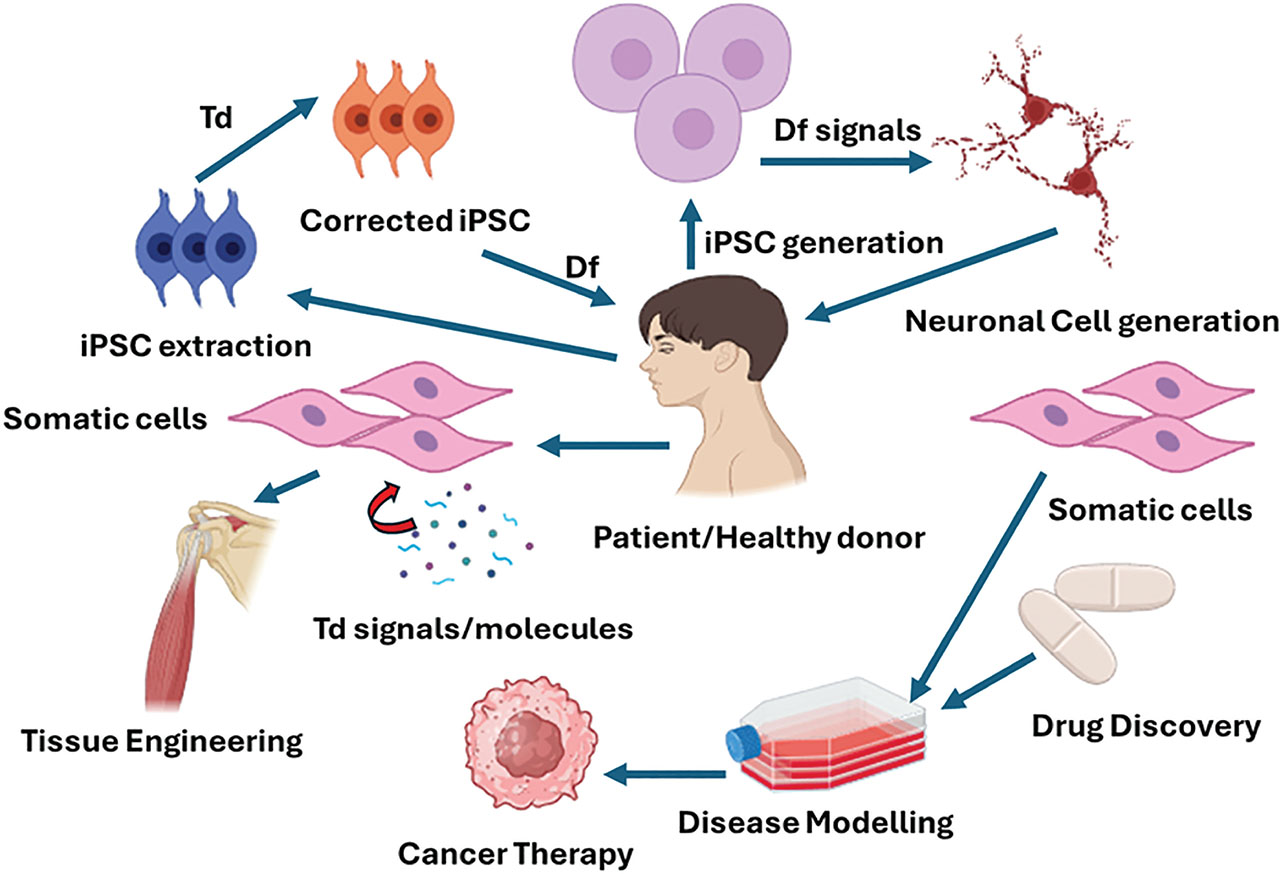
Fig 4.
Summary of different applications of transdifferentiation in tissue engineering, cellular therapy, disease modeling, and gene correction. Df, differentiation; iPSC, induced pluripotent stem cells; Td, transdifferentiation.
Dysfunction in retinal ganglion cells leads to irreversible visual damage and blindness. In this regard, stem cell replacement therapy could be a game changer to rejuvenate the retinal ganglion cells. Human adult periodontal ligament stem cells induced with retinal ganglion induction proteins and growth factors transdifferentiated the stem cells to retinal ganglion cells. During this process, cells expressed PAX6, atonal BHLH transcription factor 7 (ATOH7), POU4F2, and VSX2, demonstrating retinal cell fate (Ng et al. 2015).
Salivary gland hypofunction caused by radiation therapy results in several oral-related diseases. Salivary glands are made up of highly differentiated cells and therefore, lack high regeneration capacity once damaged. This problem has been addressed by transdifferentiating bone marrow-derived mesenchymal stem cells to salivary gland epithelial cell lineage. Herein, stem cells incubated with a submandibular gland extracellular matrix, induce the transdifferentiation of bone marrow-derived mesenchymal stem cells to salivary gland epithelial cells (Tran et al. 2022).
Endothelial cells transfected with OCT-4 and BMP-4 treatment produced bone tissue (Kim et al. 2020). Human foreskin acellular bioscaffolds treated with monophosphoryl lipid A and Lactobacillus casei induce the transdifferentiation of human umbilical cord mesenchymal stem cells to epidermal-like cells without any growth factor exposure (Jalili et al. 2024). Three-dimensional porous scaffolds conjugated with keratinocyte growth factor promote transdifferentiation of bone marrow-derived mesenchymal stem cells into keratinocytes. During this process, the target cells expressed skin-specific markers, such as protein present in basal layer of epidermis (Bnc1), Ck10, and Ck14 (Choudhury et al. 2024).
Patient-specific endothelial cells could be extremely valuable for managing cardiovascular disease. Researchers utilized ETV2 and SOX17 TFs to directly reprogram fibroblasts into endothelial cells (Grath and Dai 2024). In silico-based study confirmed myoblast determination protein 1 and electric pulse induced transdifferentiation of human-derived multipotent stem cells to skeletal muscle cells. Following this work, optimized protocols can be developed for skeletal muscle cell tissue engineering (Faustino et al. 2022). When human umbilical cord mesenchymal stem cells are IFNected with lentivirus-containing genes of FOXA3, HNF1α, HNF4α, and c-Myc, they transdifferentiated into hepatoblast-like cells (Deng et al. 2021). This research paved the way to develop alternative strategies for liver transplantation, which faces a huge challenge of donor scarcity. A combination of small molecules such as VPA, CHIR99021, Repsox, Forskolin, and Y-27632 and growth factors such as epidermal growth factor (EGF), BMP-4, and (8-Bromoadenosine 3′,5′-cyclic adenosine monophosphate (8-Br-cAMP) induced transdifferentiation of stem cells into endothelial cells. These small molecules played different roles during the reprogramming process; for example, Repsox was used as a TGF-β signaling inhibitor, whereas CHIR99021 was utilized for suppressing the characteristics of donor cells (Yi et al. 2021). MicroRNAs delivering PLLA scaffolds promote the transdifferentiation of fibroblasts into cardiomyocytes. These dual miRNA-based biomaterials proved to be an outstanding formulation since their topographic and pharmaceutical activities modulate the cell fate effectively (Muniyandi et al. 2021).
Osteochondral defects lead to osteoarthritis, causing severe lifestyle problems in patients. Articular cartilage tissue engineering may address this serious problem and save numerous lives worldwide. In this regard, thermoresponsive chitosan-based grafts seeded with endothelial progenitor cells directly reprogrammed into endothelial–mesenchymal stem cells later differentiated into chondrogenic fate when stimulated with TGF-β1. This approach could be utilized for osteochondral regeneration (Lin et al. 2024a). Limbal stem cell deficiency causes blindness and vision defects due to the loss of limbal stem cells. Mesenchymal stem cell intravenous injections emerged as an alternative technique to assist cell therapy for limbal stem cell deficiency. However, intravenous injections could deliver only up to 5% of cells intravenously. In this regard, researchers developed biological scaffolds that can promote the transdifferentiation of adipose mesenchymal stem cells into corneal epithelial lineage. Furthermore, these polymeric scaffolds promote cell attachment, biocompatibility, and cell–cell communication to promote epithelial tissue engineering (Venugopal et al. 2020).
Though tissue engineering and transdifferentiation technology have seen tremendous advancements in the last two decades, there are several things that need attention to translate into healthcare industries. Strategies involving stem cells in the therapy need to address the challenges of immune rejection and tumorigenicity. Another major challenge in the tissue engineering application is the difference in the regeneration and differentiation capacity of model organisms and humans. Therefore, a large amount of preclinical data are needed before testing the cell reprogramming techniques on the human volunteers for tissue engineering applications.
5.2. Cancer therapy
Surgery, radiation, and chemotherapy have been utilized for cancer treatment for several decades. However, these approaches face severe challenges due to severe side effects such as weight loss, vomiting, cancer recurrence, and toxicity. Transdifferentiation process can be applied to sensitize immune cells against the tumor cells. It could release tumor-associated antigens, activate, and recruit the T cells at the tumor site to enhance the more specific defense mechanisms. Therefore, advancements in transdifferentiation-based cancer therapy are necessary.
Colorectal cancer cells transfected with (OCT3/4, SOX2, GLIS1, KLF4, and c-MYC) RNAs transdifferentiated into cardiomyocyte-, neuron-, and adipocyte-like cells. In this study, it was evident that the transdifferentiation technique reduces the tumorigenicity of cancer cells. Data obtained from this study indicated that the reduced tumorigenicity could be caused by the downregulation of DNA replication, cell cycle gene expression, and ribosome production (Guo et al. 2024a).
Glioblastoma multiforme (GM) is an aggressive tumor form with a high mortality rate. The master TF ND1 can be used to induce the transdifferentiation of GM into post-mitotic neurons by modulating the Wnt/β-catenin pathway (Jiang et al. 2024). Graphene oxide integrated with silver nanoparticles downregulated the stemness of neuroblastoma cancer stem cells and enhanced the neurite outgrowth. Treatment of cancer stem cells with this nanoformulation reduced the expression of stem cell markers such as KLF4, OCT3, SOX2, and NANOG. Furthermore, the authors highlighted that these nanoparticles cause reactive oxygen species (ROS) generation in neuroblastoma cancer stem cells and drive neuronal differentiation (Gurunathan and Kim 2017).
In an attempt to study the target for intrahepatic cholangiocarcinoma, researchers performed transdifferentiation analysis in hepatocytes. It was outlined that in vitro inhibition of TNF receptor-related factor 3 (Traf3) induced transdifferentiation of hepatocytes into intrahepatic cholangiocarcinoma by NF-κB-inducing kinase (NIK) upregulation. Further, in vitro and in vivo xenograft analysis confirmed that NIK inhibition by gene silencing or small molecules can suppress intrahepatic cholangiocarcinoma. This study showed a molecular target of a poorly understood cancer type, which might be helpful in the future in designing alternative therapeutic modulation to combat this deadly disease (Shiode et al. 2023).
Chemoradiation therapeutic strategy used to treat malignant brain tumors fails to eradicate the diffused malignant cells. In this regard, tumoricidal neural stem cells are raised as an alternative treatment strategy due to their targeted therapeutic agent delivery capacity. Attempts have been made to transdifferentiate the fibroblast cells into powerful tumor-homing and tumoricidal-induced neural stem cells (iNSCs). These iNSCs produce exosomes loaded with TNF-related apoptosis-inducing ligand (TRAIL), which kills the cancer cells. TRAIL is a transmembrane protein of the TNF superfamily that activates the apoptotic pathway by prompting caspase-induced apoptosis only in malignant cells (Jiang et al. 2021; Zhang et al. 2024b). A similar strategy was applied to enhance the efficacy of the chimeric antigen receptor immunotherapy (CAR-T) cell therapy, where iNSCs released chemoattractants like CCL5 and IL-15 that promote T-cell proliferation and self-life. One of the major drawbacks of the CAR T-cell strategy is the short half-life of the T cells. Chemokines are administered systematically to enhance the half-life of T cells; however, sometimes they cause toxicity due to their immunomodulating properties. In this regard, iNSCs expressing CCL5 and IL-15 could enhance the half-life of the T cells to kill the brain cancer cells without causing significant toxicological effects (Woodell et al. 2023). Pancreatic ductal adenocarcinoma (PDAC) is one of the leading causes of death in cancer patients due to its resistance to chemotherapy. CAR-T cell therapy showed an alternative therapeutic intervention to treat PDAC; however, poor penetration in solid tumors and complex tumor microenvironments compromise its efficacy. Production of follicular helper T cells (Tfh) could modulate the holistic immune response against the cancer cells to reduce their growth and migration. Expression of BCL6 in CD4+ T cells induced the transdifferentiation of Tfh cells that recruited B cells and T cells, promoting anti-tumor activity (Lin et al. 2024b).
Sometimes, targeting transdifferentiation mediators assists in abrogating the repercussions of cancer. It was observed that anti-androgen therapy upregulates the cell surface receptor neurokinin-1 (NK1R), which activates the protein kinase C (PKC)/AURKA/N-Myc pathway and promotes neuroendocrine transdifferentiation, cell proliferation, and tumorigenicity in cancer cells. These transdifferentiated cells were found to be enzalutamide-resistant and highly invasive in nature. Therefore, NK1R antagonist drugs like taxane and aprepitant could be used to treat enzalutamide-resistant prostate cancer cells where NK1R is upregulated (Zhang et al. 2023a). Another study depicted neuroendocrine transdifferentiation found in prostate, lung, and gastrointestinal cancers, lowering the patient’s life span. Therefore, attempts have been made to inhibit the neuroendocrine transformation from managing tumor growth. Neuroendocrine transdifferentiation inactivates tumor suppressor genes such as tumor protein P53 and retinoblastoma transcriptional corepressor-1. Researchers have found that inhibition of cell division cycle-7 (CDC7) protein could be an alternative target to suppress neuroendocrine transdifferentiation. CDC7 protein plays a pivotal role in DNA replication and repair; therefore, it maintains the stemness in cancer cells. Furthermore, CDC7 expression stabilizes the MYC TF that induces lineage plasticity. Studies confirmed that CDC7 could be a novel target for lung, prostate, and gastrointestinal cancer treatment (Mendieta et al. 2021; Quintanal-Villalonga et al. 2024). Another study showed that neuroendocrine transdifferentiation promotes androgen receptor resistance by stabilizing functional enzymatic component which promotes embryonic development (EZH2) expression and upregulating Rac GTPase-activating protein 1 (RACGAP1) expression. Therefore, RACGAP1 could be an alternative target for the treatment of castration-resistant prostate cancer (Song et al. 2023).
COUP-TFII TF promotes the transdifferentiation of glioblastoma to endothelial-like cells to promote angiogenesis, resulting in cancer progression. Researchers have loaded COUP-TFII shRNA in the heparin–polyethyleneimine nanoparticles to inhibit the transdifferentiation process and regulate tumor progression (Wang et al. 2024). Another study unraveled that the transdifferentiation of glioblastoma to glioma-derived endothelial cells forms an immune cell barrier, which contributes to poor prognosis in patients. Herein, the transdifferentiation of glioblastoma was controlled by activating cyclic adenosine monophosphate (cAMP), which exerts oxidative stress to inhibit the transdifferentiation process (Qin et al. 2023).
Gut microbiota-produced trimethylamine N-oxide induces transdifferentiation of human aortic endothelial cells into innate immune cells. During this process, 24 genes of endothelial cells and adhesion molecules and 40 cytokines and chemokines were upregulated. Data obtained from this study could pave the way for determining new therapeutic targets for cancer, aging, cardiovascular diseases, and autoimmune diseases (Saaoud et al. 2023).
5.3. Autoimmune disease
Global healthcare spends billions of dollars to treat autoimmune diseases to alleviate the complications of patients. Conventional pharmaceutical agents have been the mainstay for autoimmune disease treatment. Low selectivity, poor pharmacokinetics, and chronic side effects are the major problems associated with conventional therapy. The transdifferentiation process can be applied to reprogram the immune cells that induce the inflammatory cascade to damage the tissues and organs (Figure 4).
MS is an autoimmune disease that affects the brain, spinal cord, and nervous systems that impair the mobility capacity of the patients. Clinicians are still struggling to develop a holistic approach for MS treatment. The pathophysiology of this disease showed that an imbalance between Th17 and immunosuppressive regulatory T-cells (Treg) promotes MS (Zhang et al. 2022). Enhanced Th17 IFNiltration in the central nervous system was observed in MS, which causes overwhelming inflammatory response. Curtailing of this enhanced inflammatory response by transdifferentiating Th17 cells into Treg cells could be an effective approach for MS management. Polymeric ROS-responsive nano-capsules containing (aminooxy)-acetic acid-induced transdifferentiation of Th17 cells into anti-inflammatory Treg cells. This study demonstrated (aminooxy)-acetic acid was released upon ROS generated by Th17 cells and resulted in the transdifferentiation to reduce the episodes of MS (Shi et al. 2023). The development of novel drug delivery systems that can penetrate into the blood–brain barrier to target IFNlammation-inducing ROS can be a game changer in the coming years to treat MS. Another study highlighted that Forkhead box O-1 (FoxO1), an effector molecule in PI3K/Akt signaling, induces the transdifferentiation of Th17 cells into encephalitogenic Th1-like cells and causes MS. Inhibition of the FoxO1 molecule by a small molecule, a selective FOXO1 inhibitor that reduces DNA binding and transactivation (AS1842856), promoted the population of Treg cells to manage the symptoms of MS (Kraus et al. 2021). Two-phase transdifferentiation of human mesenchymal stem cells into neuralized mesenchymal stem cells was effective in reducing the symptoms of MS. Researchers used bFGF and EGF to transdifferentiate human mesenchymal stem cells into neuralized mesenchymal stem cells. Later, cerebrospinal fluid was supplemented into flasks containing neuralized mesenchymal stem cells to produce neural cell lineages. Results obtained from in vivo autoimmune encephalomyelitis in the C57BL/6 mice model depicted that the mice transplanted with neuralized mesenchymal stem cells and differentiated neural cells had a 0% mortality rate, whereas untreated mice had a 40% mortality rate (Ben-Zwi et al. 2019).
Other studies highlighted that under inflammatory conditions, Treg cells transdifferentiate into Th17 and cause rheumatoid arthritis (RA), which harms bone mass density. Carnosol was used to inhibit the transdifferentiation of Treg cells into Th17 cells via limiting IL-6R (CD126) expression (Chen et al. 2023). A molecule named Catapol also has the same activity as Carnosol, as it inhibits the transdifferentiation of Treg cells into Th17 cells. Catapol exposure upregulated let-7g-5p and inhibited the STAT3 pathway to alleviate symptoms of RA (Di et al. 2022).
Previous studies showed that a disrupted balance between Treg and Th17 cells could cause Kawasaki disease, where Treg cells are transdifferentiated into Th17 cells. A clinical study confirmed that IL-35 administration stimulated the population of Treg cells in Kawasaki disease patients to control the IFNlammation. This strategy identified a molecule that can be used as a protective mechanism against Kawasaki disease (Li and Xing 2023).
Prolonged IFNlammation in autoimmune diseases like colitis promotes transdifferentiation of myeloid-derived suppressor cells into macrophage M2. In this process, exosomal miR-93–5 p is produced, which downregulates the STA3 pathway to promote M2 differentiation. Furthermore, it was observed that cross talks between IL-6 and STAT3 enhanced the M2 differentiation, which enhances the colitis to cancer transition. Early administration of IL-6 antibodies downregulates the IFNlammation and modulates the STAT3 signaling, which inhibits the colitis to cancer transformation (Wang et al. 2023).
Transdifferentiation of skin fibroblasts, adipocytes, epithelial cells, and endothelial cells into myofibroblasts is one of the key pathways that induce systemic sclerosis (SSc), a rarely occurring autoimmune disease with limited treatment strategy (Korman 2019). The transdifferentiation of adipocytes into myofibroblasts can be inhibited by Ginkgo biloba extract, which can ameliorate skin fibrosis. An in vivo study performed in a bleomycin-induced SSc mouse model suggested that Ginkgo biloba extract suppresses the TGF-β signaling to treat SSc (Korman 2019; Lee et al. 2024).
Loss of pancreatic β-cell mass due to type-I and -II diabetes leads to numerous pathophysiological complications in the patients. Therefore, tremendous research has been undertaken to regenerate β-cell to maintain the desired insulin level (Spezani et al. 2024; Zhang et al. 2024a). BioIFNormatics study performed by Farrim et al. (2024) showed that GABAergic pathway may modulate the transdifferentiation of α cells to β cells to restart insulin production. Consequences of autoimmune leads to depletion in β-cells in type-I diabetes. Researchers utilized combinations of melatonin and sitagliptin molecules to induce the transdifferentiation of α cells to β cells. In vitro studies confirmed the drug combination reduces β-cell apoptosis, induces transdifferentiation, and impedes blood glucose level (Patel et al. 2022a). Another strategy was reported where glucagon receptor antibody (anti-GcgR) treatment induced transdifferentiation of α cells to β cells, resulting in enhanced plasma insulin level and β-cell mass (Xi et al. 2022).
Table 3.
List of selected clinical trials involving iPSCs or iPSC reprogramming for treatment of various diseases
| NCT number | Title of study | Disease | Location of study |
|---|---|---|---|
| NCT04476225 | iPSCs for disease research | Hirschsprung disease | San Francisco, California, USA |
| NCT03883750 | iPSCs for Niemann–Pick disease | Niemann–Pick disease | Lahore, Pakistan |
| NCT02720939 | ASD-specific iPSCs for disease modeling | Autism spectrum disorder | Taipei, Taiwan |
| NCT02084407 | Induction of pluripotent stem cells from human fibroblasts of DM1 patients | Myotonic dystrophy | Paris, France |
| NCT05616338 | Modeling bronchial epithelium in severe asthma with human induced iPSC | Severe asthma | Montpellier, France |
| NCT01943383 | Pharmacogenomic evaluation of antihypertensive responses in iPSCs study | Hypertension | Gainesville, Florida, USA |
| NCT02193724 | Feasibility of generating pluripotent stem cells from patients with familial retinoblastoma | Retinoblastoma | Memphis, Tennessee, USA |
| NCT03872713 | Establishment of human cellular disease models for Morquio disease | Morquio disease | Lahore, Pakistan |
| NCT03867526 | Establishment of human cellular disease models for Wilson disease | Wilson disease | Lahore, Pakistan |
| NCT03696628 | Modeling and pharmacological targeting of genetic cardiomyopathy in children via cardiomyocytes derived from iPSCs | Cardiomyopathy, familial | Montpellier, Occitanie, France |
| NCT01808729 | CAUSE Trial: Patient specific-cellular characterization of fibromuscular dysplasia and high-risk atherosclerotic endothelium | Early onset CAD fibromuscular dysplasia | New York, New York, USA |
| NCT02162953 | Stem cell models of best disease and other retinal degenerative diseases | Adult onset vitelliform, macular dystrophy, autosomal dominant vitreoretinochoroidopathy, best vitelliform macular dystrophy, bestrophinopathy, retinal disease | Rochester, Minnesota, USA |
| NCT00953693 | Patient specific iPSCs | Eye disorders Hepatic disorders | Tehran, Iran, |
| NCT02464956 | Production of iPSC-derived (RPE) cells for transplantation in AMD | AMD | Location not provided |
| NCT03754088 | In vitro model of the cystic fibrosis bronchial epithelium via iPS technology | Cystic fibrosis |
6. Challenges Associated with Transdifferentiation
Extensive research has been performed to push the frontiers of transdifferentiation technology; however, there are significant challenges associated with it that compromise its clinical translation. One of the significant challenges associated with the transdifferentiation strategy is the non-availability of uniform regulatory provisions worldwide. This technology falls under the category of cell-based therapeutic products (CTPs), which can be used in a broad range of biomedical applications. As transdifferentiation technology involves living cells and uses various protocols and raw materials, its outcome could not be examined by conventional tests that are used for pharmaceutical products worldwide. Therefore, a case-by-case approach must be taken in order to scrutinize the outcome (Hirai et al. 2023). Till date, no international consensus is established that evaluates the safety, efficacy, and quality of CTPs. However, some of the attempts have been made to maintain the safety and integrity of CTPs by the USA, EU, UK, and Japan. For example, in the USA, CTPs are majorly divided into two major categories: cells containing more than minimal manipulation are categorized as biological products, whereas CTPs with substantially manipulated/processed cells are classified as advanced therapy medicinal products (Sato et al. 2019; Hirai et al. 2023). The outcome of the transdifferentiation process may vary with the category, complexity, and genetic makeup of the donor cells. Therefore, the risk profile of donor cells should be evaluated at the early stages of in vitro and preclinical studies. In transdifferentiation studies, it is crucial to evaluate the toxicological aspects of the molecules, which are secreted by the transdifferentiated cells (Hirai et al. 2023). Furthermore, if the transdifferentiation protocols produce any impurities and non-cellular components, their toxicity should be evaluated before proceeding to human trials. The efficacy of the transdifferentiated cell products may vary with their transplantation site due to differences in the microenvironments. This physiological change may affect cell migration, cell attachment, and communication. Therefore, complex in vitro experiments should be designed by considering site of administration, donor cell type, dosage concentration, and stage of differentiation. The majority of the CTPs target some rarely occurring diseases; therefore, it is cumbersome to get the desired number of patient volunteers for conducting the clinical trials (Hirai et al. 2023). We have outlined some clinical trials in Table 3, which used iPSC reprogramming or iPSC in the clinical studies. Variability in the transdifferentiation efficiency and reproducibility is one of the major challenges that is associated with this strategy (Kim et al. 2010; Zhang et al. 2023b). For example, when researchers use a combination of small molecules to achieve transdifferentiation, finding the optimized concentration ratio of small molecules is crucial to achieve optimum results. Some of the studies reported that researchers often select the key TFs overexpression for transdifferentiation process by learning from previously published results and web-based tools (Guerrero-Ramirez et al. 2018; Ouyang et al. 2019). Here, the specific TFs that play crucial roles in the differentiation process of target cell type development are preferred over the others. Therefore, sometimes, important TFs could miss out without getting a preference. Furthermore, transdifferentiation efficiency varies depending on the subtype of the donor and target cells (Bar-Nur et al. 2011). Insertional mutagenesis may occur with very low probability while using the lentiviral vectors, which integrate their genetic material with host or source cells (Grath and Dai 2019). This challenge is partially addressed with the use of non-integrating viral vectors.
Another challenge that compromises the effectiveness of transdifferentiation technology is the understanding of its molecular mechanisms. Researchers have studied the underlying mechanisms of transdifferentiation comprehensively; however, dissecting the underlying molecular metabolic pathway, which has been modified due to reprogramming, could have a significant impact on the outcomes (Richards et al. 2020). The application of polymeric scaffolds, nanomaterials, and 3D scaffolds has been studied to enhance the efficiency of the transdifferentiation strategy (Ma et al. 2024). These materials are integrated with certain proteins, growth factors, and small molecules to induce differentiation. However, sometimes, the ability to deliver the growth factor or the small molecule at the targeted site is a potential challenge. Furthermore, the rate of delivery of the transdifferentiation-inducing molecules also plays a crucial role in cell fate determination. Therefore, while designing a biomaterial for delivering a transdifferentiation-inducing agent, extensive care should be taken to tune its physiochemical properties. The toxicological properties of these biomaterials must be studied carefully before testing them on human volunteers (Kim et al. 2024).
Another obstacle is the long-term stability of the transdifferentiated cells, where there is a chance that differentiate cells could again dedifferentiated into the donor or source cell type due to changes in the cellular cross talks. Therefore, developing a universal optimized method that can generate a terminally differentiated cell line that does not return back to its source phenotype has emerged as one of the major challenges in this sophisticated field of biotechnology (Becker et al. 2016; Zhang et al. 2023b).
Scalability has always been a prime concern in transdifferentiation technology, which poses a great hurdle for its clinical implementation. Optimizing the large-scale production of transdifferentiated cells and quality control requires highly skilled manpower and laboratory setup (Zhang et al. 2023b). Clinical translation of this technology requires critical regulatory and toxicological approval at each stage of the research, which limits its bench-to-bedside applications.
7. Future Perspective and Conclusion
Transdifferentiation has seen substantial advancements in the last several decades; however, future research could focus on various aspects to enhance the outcomes. Suitable in vivo experiments are necessary to compare the results obtained from in vitro. Special care must be taken to evaluate the targeted delivery of transdifferentiating factors at specific organs or tissues. More studies must be designed to evaluate the genotoxicity of the transdifferentiated cells in the near future. The heterogeneous somatic cell population originating from transdifferentiation needs to be studied carefully to establish a logical relationship between the donor cell source and the efficiency of transdifferentiation. Emerging software tools and artificial intelligence could help determine the crosstalk between biomolecular niches and the environmental factors that govern transdifferentiation efficiency in the future.
Next-generation strategies must focus on evaluating the genetic stability of the transdifferentiated cell over a longer horizon. For example, if an osteoblast-like cell is generated from an adult somatic cell by overexpressing a phenotype-specifying TF, we should be able to evaluate whether the acquired lineage is permanent and self-sustaining or the cell traits of the donor cell are still in play.
Transdifferentiation has fascinated researchers as it could minimize the tumorigenesis risk associated with its counterpart, iPSCs-based cell reprogramming technique. It could generate patient-specific cells, which can be transplanted into the diseased tissue or organ to regain its function. Damaged organs due to autoimmunity can be treated, and the elevated IFNlammation can be managed without significant side effects. Cancer cells could be reprogrammed into healthy somatic cells without causing detrimental effects to the patients. Transdifferentiation efficiency, preclinical results and clinical translation efficiency should be taken into account before using it in patients. Transdifferentiation technology could be utilized in tissue engineering, cancer, and autoimmune therapy by applying interdisciplinary approaches in the coming future.
Abbreviations
- A83-01
inhibitor of receptors ALK 4/5/7
- Ac5ManNTProp
N-acetylmannosamine (ManNAc) analog
- Activin A
member of the TGF-β superfamily of growth factors
- AS1842856
a selective FOXO1 inhibitor that reduces DNA binding and transactivation
- Ascl1
achaete-scute homolog 1
- ATOH7
atonal BHLH transcription factor 7
- BAF53a
actin-related protein
- Bnc1
protein present in basal layer of epidermis
- CHIR99021
aminopyrimidine derivative
- DB2313
PU.1 transcription factor inhibitor
- EZH2
functional enzymatic component that promotes embryonic development
- GO6983
pan-PKC inhibitor
- I-BET151
bromodomain inhibitor
- ICG-001
a small molecule inhibitor that targets Wnt/β-catenin pathway
- IFN-γ
interferon gamma
- PKC
protein kinase C
- LDN
BMP pathway inhibitor
- BMP
bone morphogenetic protein
- miRNA
small, single-stranded, non-coding RNA molecules
- NK1R
neurokinin-1 receptor
- PCR
polymerase chain reaction
- PLLA
poly-l-lactic acid
- PVA
polyvinyl alcohol
- RACGAP1
Rac GTPase-activating protein 1
- RG108
non-nucleoside DNA methyltransferase inhibitor
- SB431542
inhibitor of TGF-β type I receptor
- SP600125
inhibitor of c-Jun N-terminal kinase
- Y-27632
rho-associated kinase inhibitor
Acknowledgement
Marek J Łos and Purusottam Mishra acknowledge support from the NCN-OPUS grant no. 2021/41/B/NZ7/04098. Jarosław Markowski acknowledges support from the Silesian University of Medicine in Katowice, grant #BNW-1-044/K/3/B. Figures 1 and 4 were created using Biorender.com.
Notes
[5] Contributed by Author Contribution
PM: Data curation, review of literature, manuscript writing, editing, and proof reading. IB: Manuscript writing, editing, and proof reading. PG: Editing and proof reading. SG: Editing and proofreading. JM: Editing and proofreading. MJL: Editing and proofreading. All authors read and approved the manuscript and resources.
[6] Conflicts of interest Competing Interests
The authors declare that they have no known competing financial interests or personal relationships that could have appeared to IFNluence the work reported in this paper.