
The coal industry has been one of the leading polluting human activities due to its sizable emissions of hazardous particles and gases (1–4). Regardless of the environmental costs, many nations depend on coal as a major source of energy due to its great abundance and low price. However, coal is a “dirty fuel” in terms of human health (5). Depending on various geological factors, coal can contain hazardous trace elements (HTEs), such as Hg, As, Cr, Ni, V, Pb, Se, and Cd, and their levels are even higher in coal combustion by-products (6–8).
Another class of contaminants found in coal are naturally occurring radionuclides, formed either by incomplete fossil fuel combustion or coal formation. Coal contains trace quantities of uranium, thorium, and 40K. According to the United Nations Scientific Committee on the Effects of Atomic Radiation (UNSCEAR) (9), mean natural radionuclide concentrations in coal are 35 Bq/kg (range 16–110) for 238U, 35 Bq/kg (range 17–60) for 226Ra, 30 Bq/kg (range 11–64) for 232Th, and 400 Bq/kg (range 40–850) for 40K.
Coal combustion by-products are fly ash (74 %), bottom ash (20 %), and boiler slag (6 %). Bottom ash consists of larger (heavier) particles collected at the bottom of the furnace. Fly ash is made of fine, airborne particles, most of whose content is recovered by stack emission control devices. The remainder is released into the atmosphere and later deposited on soil, contaminating it with HTEs (10–12) and radionuclides (13–21).
As the affected soils – particularly the ones of abandoned coal and ash waste sites – can be prone to erosion caused by winds and rain to release large amounts of coal and ash particles into the environment (8, 22), stringent environmental laws and efficient research and restoration strategies have been implemented to address these issues at legacy sites (23).
One such legacy site, Štrmac, is located near the town of Raša, which had the largest coal-mining company in Croatia in the 20th century, shut down since 1999 (24) (Figure 1). The site was used for the deposition of ash from the local foundries and heating plants, during which period they used domestic coal (anthracite from Istrian peninsula) with higher radionuclide amounts and higher radioactivity levels (25). Today, this legacy site is a 30-metre tall hill covered with vegetation (Figure 1c). The same coal was used by the Plomin coal- fired power plant but was never deposited at the site.
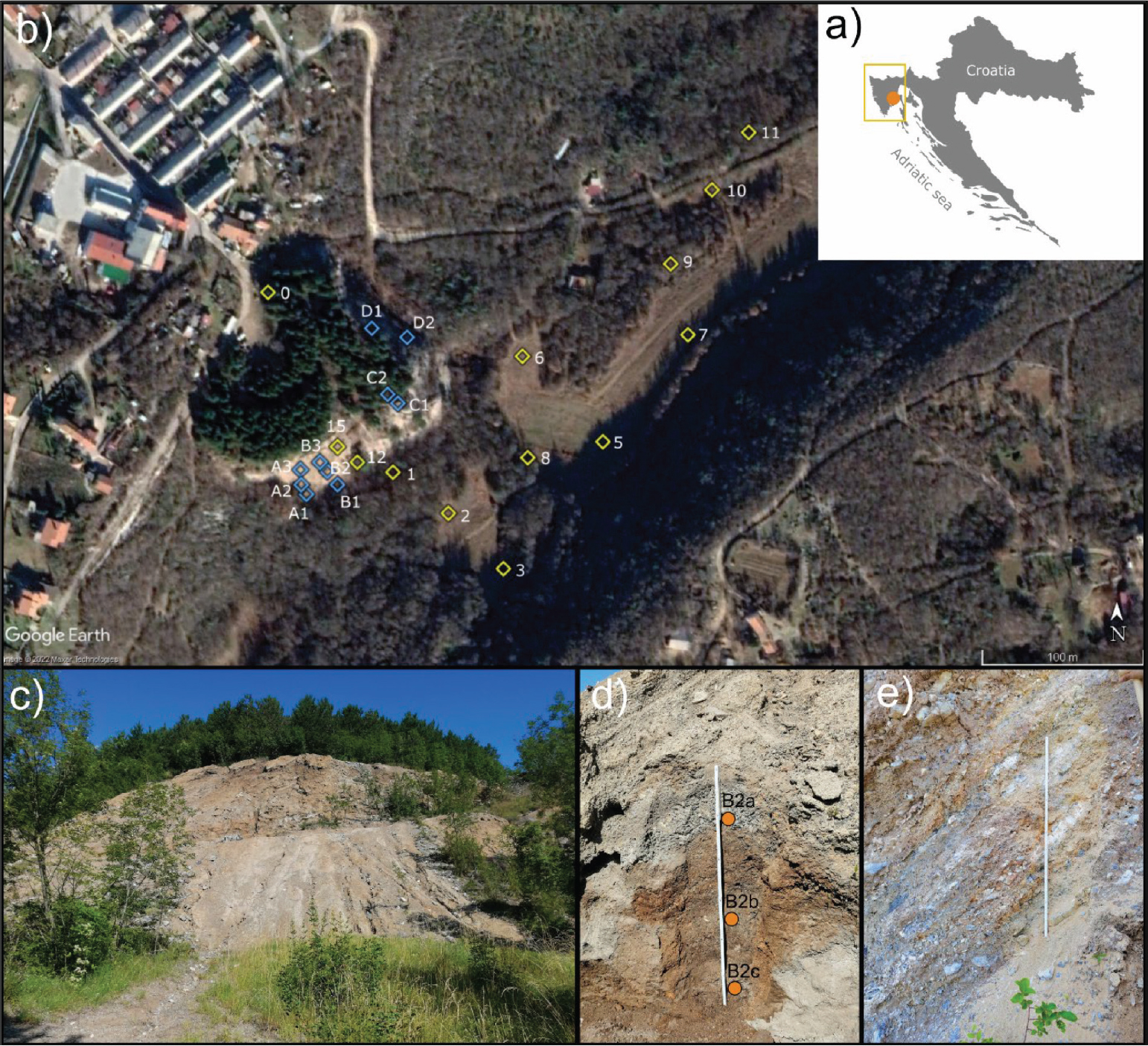
Figure 1
Overview of the research area. a) the geographical position of the Istrian Peninsula (North Adriatic Sea) and Štrmac settlement (orange circle); b) aerial view of the study area with marked sampling locations [yellow diamonds denote the first field campaign (May 2019) and blue diamonds the second (July 2019)]; c) the Štrmac coal burning waste disposal site; d) vertical B2 sampling profile with three subsamples – B2a, B2b, B2c; e) hill side with visible layers of progradation (the length of the vertical white line in d and e is 120 cm)
Previous environmental research (26–29) revealed the detrimental effects of coal combustion on all environmental compartments, mainly reflected in significantly increased levels of Se, V, and U in soil and biota. Moreover, Raša coal is known for its high content of organic sulphur (>14 %) (27, 28).
There are many coal fly ash legacy sites worldwide. However, measurements of radioactivity in fly ash at such sites are poorly reported. The reasons may be that most of the worldwide sites have been remediated or that most of the fly ash has been repurposed by construction industry. This, however, is not the case with the Štrmac site, and we believe it is important to characterise the site to obtain more information for possible solutions of remediation in the future.
The aim of our study was follow up on previous research by determining trace element and radionuclide levels at this legacy site and assess a potential impact on the surrounding soil and health of local residents.
METHODS
Study site and sampling
The Štrmac legacy site is situated on the Istrian peninsula to the NW of the former Adriatic carbonate platform (30) and is a part the Outer Dinarides (31). In the late Carboniferous, the Adriatic platform was located in the north of Gondwana and subsequently formed a distinct carbonate platform in the early Jurassic only to disintegrate in the Cretaceous (32). Considering its paleogeology, the majority of the Istrian bedrock consists of carbonates, most of which are Mezozoic and early Cenozoic limestone. The Istrian peninsula consists three distinct geological units: 1) the Jurassic- Cretaceous-Eocene carbonate plain in the south and west, 2) the Cretaceous-Eocene carbonate-clastic zone across the thrust structure in east and north-east, and 3) the Eocene flysch sediments in the central part (32).
The study site (Figure 1) is located in the Raša River basin containing deposits of bituminous Paleocene Kozina limestone (33, 34). The settlement of Štrmac is situated in the southeastern part of the Istrian peninsula on “terra rossa” cambic soil formed by insoluble residues of Eocene limestone with flysch sediments and loess (30). It is close to the Plomin bay, which is a part of the northern Adriatic Sea (about 5 km of air distance).
Two field campaigns were carried out, in May and July 2019. In the first field campaign, ash and soil samples were collected from 13 locations in the Štrmac area, while in the second field campaign only ash samples were collected from 10 sampling locations (Table 1), with subsamples of different horizons along the vertical profiles (Figure 1d and 1e).
Table 1
Sample labels and geographical coordinates
| 1st field campaign (May 2019) | |||
|---|---|---|---|
| Sample label | Sample type | Geographical coordinates | |
| 0 | Soil | 45° 7' 14.40"N | 14° 7' 36.86" E |
| 1 | 45° 7' 10.80"N | 14° 7' 40.40" E | |
| 2 | 45° 7' 9.98"N | 14° 7' 41.97" E | |
| 3 | 45° 7' 8.87" N | 14° 7' 43.53" E | |
| 5 | 45° 7' 11.41" N | 14° 7' 46.35" E | |
| 6 | 45° 7' 13.12" N | 14° 7' 44.07" E | |
| 7 | 45° 7' 13.55" N | 14° 7' 48.76" E | |
| 8 | 45° 7' 11.09" N | 14° 7' 44.22" E | |
| 9 | 45° 7' 14.97" N | 14° 7' 48.27" E | |
| 10 | 45° 7' 16.45" N | 14° 7' 49.44" E | |
| 11 | 45° 7' 17.60" N | 14° 7' 50.48" E | |
| 12 | Ash | 45° 7'10.88" N | 14° 7'39.14" E |
| 13 | |||
| 14 | 45° 7' 11.31" N | 14° 7' 38.83" E | |
| 15 | |||
| 2nd field campaign (July 2019) | ||||
|---|---|---|---|---|
| Sample | Subsample | Sample type | Geographical coordinates | |
| A1 | A1 | Ash | 45° 7' 10.36" N | 14° 7' 37.95" E |
| A2 | A2a | 45° 7' 10.55" N | 14° 7' 37.80" E | |
| A2b | ||||
| A3 | A3a | 45° 7' 10.85" N | 14° 7' 37.78" E | |
| A3b | ||||
| A3c | ||||
| B1 | B1a | 45° 7' 10.55" N | 14° 7' 38.83" E | |
| B1b | ||||
| B2 | B2a | 45° 7' 10.82" N | 14° 7' 38.54" E | |
| B2b | ||||
| B2c | ||||
| B3 | B3a | 45° 7' 11.00" N | 14° 7' 38.33" E | |
| B3b | ||||
| C1 | C1 | 45° 7' 12.18" N | 14° 7' 40.54" E | |
| C2 | C2 | 45° 7' 12.36"N | 14° 7' 40.25" E | |
| D1 | D1 | 45° 7' 13.68" N | 14° 7' 39.80" E | |
| D2 | D2 | 45° 7' 13.50" N | 14° 7' 40.80" E | |
The sampling locations were chosen randomly, depending on accessibility, with the aim to investigate the potential influence of atmospheric events on the surrounding environment. Previous investigations at the site showed potential cytotoxicity of soil (33). Additionally, during sampling, we noticed private vegetable gardens in the vicinity, owned by the local community.
Soil and ash samples were air-dried, crushed, sieved through a 1 mm sieve, and homogenised in an agate mortar for further analysis.
PIXE elemental analysis
Particle induced X-ray emission (PIXE) elemental analysis was performed at the Ruđer Bošković Institute Tandem Accelerator Facility with 2 MeV proton beam obtained from 1 MV Tandetron accelerator (HVE Tandetron 4110, High Voltage Engineering Europa B.V., Amersfoort, Netherlands). The beam spot size on the sample was 3 mm in diameter. Emitted characteristic X-ray lines were measured simultaneously with two X-ray detectors, while backscattered ions were measured with a surface barrier detector using Rutherford backscattering spectrometry (RBS). For low-energy X-rays we used a silicon drift detector (SDD) (Vitus H20, KETEK GmbH, Munich, Germany) with the active area of 10 mm2 and 8 μm thick Be window. It is placed at the distance of 110 mm from the sample at an angle of 150 ° to the incident beam. For energies above 3.5 keV we used a Si(Li) detector (SSL80165, Canberra, Meriden, CT, USA) with 30 mm2 active area and 25 μm thick Be window, positioned at the angle of 135 ° and covered with a Mylar filter (275 μm). For backscattered ions we used a surface-barrier detector (Ultra, Ortec, Oak Ridge, TN, USA), placed at the angle of 165 ° from the incident beam. The schematic of the standard chamber for PIXE/RBS experimental setup is shown in Figure 2.
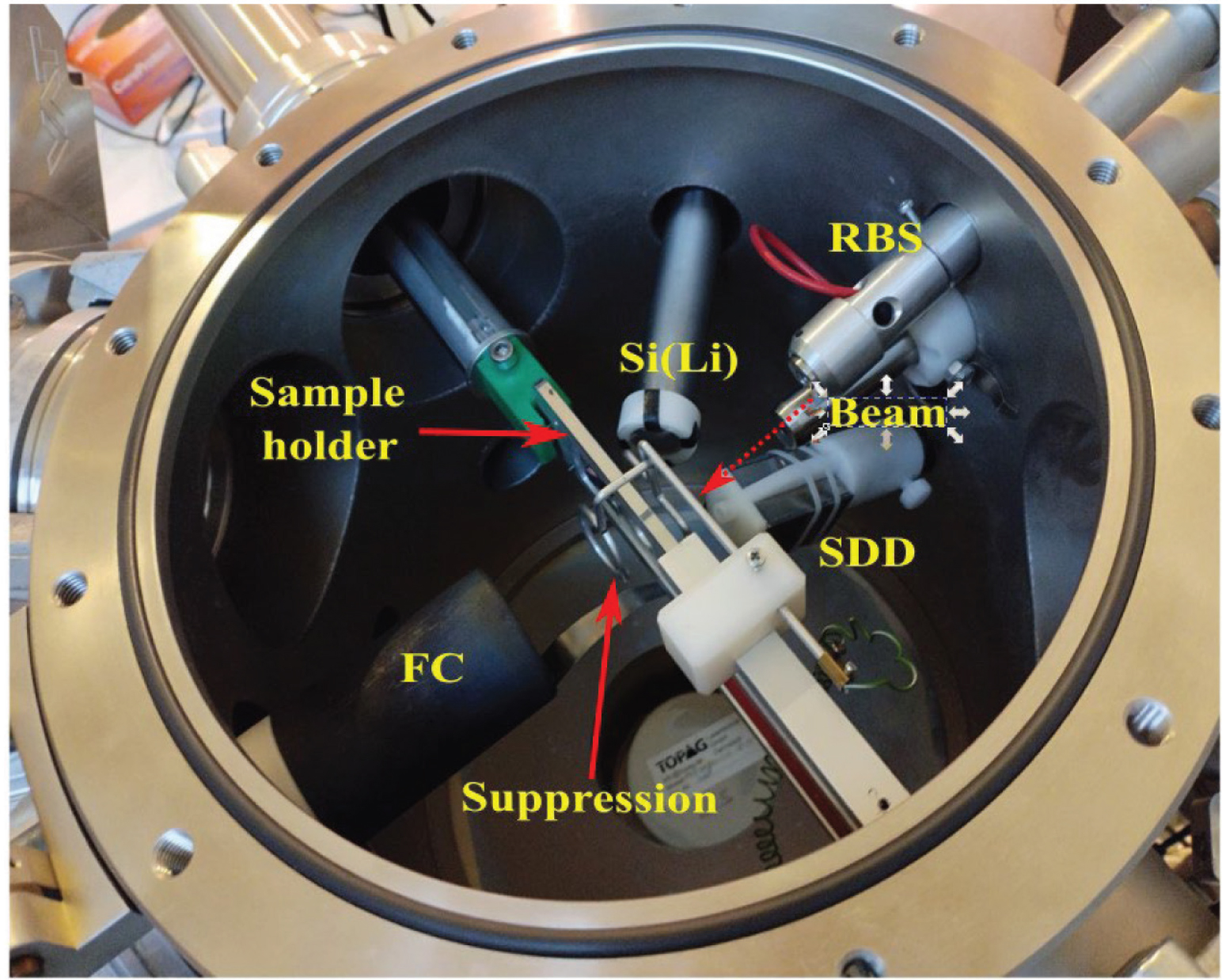
Figure 2
Standard IBA experimental chamber for PIXE and RBS measurements with marked positions of detectors, sample holder, suppression, Faraday cup, and incoming beam
The energy spectrum was determined using a multichannel analyser coupled with a homemade data acquisition system SPECTOR. Each sample was irradiated with 0.6 nA with a total charge of 0.6 μC. The PIXE experimental setup was calibrated with two standards: Standard Reference Material (SRM) 2710 Montana Soil and PTXRFIAEA08 Natural Soil, provided as a reference material from the International Atomic Energy Agency in 2014 (35). Samples were ground, and their powder pressed into pellets of 1 cm in diameter using a standard press with a pressure of 6.4 t/cm2 and then mounted on the sample holder with carbon tape.
Proton backscattered spectra were analysed with the SIMNRA simulation software (SIMNRA 7.0, Max Planck Institute for Plasma Physics, Garching, Germany) as described elsewhere (36) to determine the concentrations of major low Z elements (Z<10). For quantitative analysis of the obtained PIXE spectra we used the GUPIXWIN software (GUPIXWIN 2.2.0, University of Guelph, Guelph, ON, Canada) (37) with a fixed matrix solution approach on thick targets and input matrix composition taken from SIMNRA results.
The accuracy of PIXE analysis was checked using the Standard Reference Material (SRM) 2710 Montana Soil and PTXRFIAEA08 Natural Soil.
Radioactivity analysis
For radioactivity analyses, soil and ash samples were prepared as described elsewhere (38, 39). Briefly, the samples were sieved (maximum grain size of 2 mm), dried at 105 °C for three days, ashed at 400 °C, and packed in 200 mL sealed cylindrical containers.
Radionuclide activity in the obtained ash was determined from the activity of decay product with a shorter half-life (T½) under the assumption of a secular equilibrium between radionuclides. In undisturbed soil, the secular equilibrium between 238U and 234Th and between 232Th and 228Ac was established naturally. However, the loss of gaseous 222Rn from the surface layer of soil and during sample preparation resulted in a disequilibrium between 226Ra and 214Pb. In order to restore the equilibrium, sealed samples were left to rest for more than 30 days.
Radionuclide activity concentrations were measured using highresolution gamma-ray spectrometer with a high-purity germanium coaxial detector (Ortec GMX, Oak Ridge, TN, USA) at relative efficiency of 74.3 % and energy resolution of 2.23 keV, all at 60Co 1.33 MeV. The counting time was 80,000–250,000 seconds. Efficiency and energy were calibrated using certified standards (CBSS2 MIX, Eurostandard CZ, Czech Republic). The participating laboratory is accredited according to the ISO/IEC 17025 standard and the quality assurance was carried out by participation in proficiency testing provided by the IAEA and the European Commission’s Joint Research Centre (40).
The detailed procedure for the analysis of soil samples, peak analysis, and self-attenuation corrections has been described in detail elsewhere (41–44). The typical values of the detection limit (for measurements of 80,000 s) were 1 Bq/kg for 232Th and 226Ra, 2 Bq/kg for 40K, 3 Bq/kg for 210Pb, and 4 Bq/kg for 238U.
The radiological effects of the legacy site and the surrounding soil on the local population were assessed by calculating the radium equivalent index (Raeq), external absorbed dose rate (Ḋ), and annual effective dose (E). The Raeq is used to define a uniform value with respect to radiation exposure in case the ash from the waste site were to be used as building material and is calculated using Equation 1.
where ARa, ATh and AK are the activity concentrations of 226Ra, 232Th and 40K, respectively.The weights were based on the estimation that 370 Bq/kg of 226Ra, 259 Bq/kg of 232Th, and 4810 Bq/kg of 40K produce the same gamma-ray dose. If the Raeq values exceed the threshold value of 370 Bq/kg, the material will produce exposure higher than 1.5 mSv/year to local residents (45–47).
The UNSCEAR guidelines (9) provide the absorbed dose rates (Ḋ) in nGy/h due to gamma radiation in air at 1 m above the ground for uniform distribution of naturally occurring radionuclides (226Ra, 232Th, and 40K). The absorbed dose rates were calculated as follows:
The annual effective dose (E) in mSv was also calculated according to the UNSCEAR guidelines (9):
where 0.7 Sv/Gy is the conversion coefficient from the absorbed dose in air to the effective dose received by adults, while 0.2 is the outdoor occupancy factor assuming that adults spend 20 % of their time outdoors.Statistical analysis
Correlation between trace elements and Bonferroni correction were run on the PAST statistical software (PAST version 4.17, University of Oslo, Norway) assuming the significance level of P<0.05. For correlations between radionuclides 238U, 235U, 226Ra, 232Th, 40K, and trace elements we used Spearman’s rank correlation ran on IBM SPSS software (IBM SPSS Statistics for Windows, version 23.0, Armonk, NY, USA) also assuming the significance level of P<0.05.
RESULTS AND DISCUSSION
PIXE findings
Table 2 compares the values of major elements (given in %) and of minor and trace elements (given as mg/kg) measured in 12 soil samples with the SRM 2710 Montana Soil. Relative errors for most major elements are up to 10 %, while for some trace elements, errors are higher due to very low elemental concentrations that are around the PIXE limits of the detection.
Table 2
Comparison between measured and certified values for standard reference materials SRM 2710 and PTXRFIAEA08 Natural Soil*
| Element | SRM 2710 | Natural soil | ||||
|---|---|---|---|---|---|---|
| Mean±SD | Certified value ± error | Relative error (%) | Mean ± SD | Certified value ± error | Relative error (%) | |
| Mg | 0.8±0.2 | 0.853±0.04 | -6.3 | - | - | - |
| Al | 6.5±0.2 | 6.44±0.08 | 1.1 | 17.99±0.06 | 15.2±0.4 | 18.4 |
| Si | 27.0±0.3 | 29.0±0.2 | -6.8 | 17.68±0.06 | 18.7±0.4 | -5.4 |
| S | 0.26±0.01 | 0.240±0.006 | 8.1 | 0.109±0.05 | 0.071±0.004 | 54.5 |
| K | 2.03±0.04 | 2.1±0.1 | -3.7 | 0.023±0.003 | 0.034±0.002 | -33.1 |
| Ca | 1.12±0.02 | 1.25±0.03 | -10.3 | - | - | - |
| Fe | 3.28±0.03 | 3.4±0.1 | -3.1 | 8.82±0.03 | 9.0±0.3 | -2.2 |
| Na | 9000±400 | 11400±600 | -21.3 | - | - | - |
| P | 1400±200 | 1060±150 | 30.7 | - | - | - |
| Ti | 2670±60 | 2830±100 | -5.7 | 9200±100 | 9410±380 | -1.9 |
| V | 90±20 | 76.6±2.3 | 21.5 | 280±50 | 270±19 | 4.7 |
| Cr | 80±30 | 39 | 98.0 | 30±20 | 31±3 | 6.7 |
| Mn | 9700±200 | 10100±400 | -4.1 | 180±30 | 174±13 | 2.8 |
| Ni | 21±2 | 14.3±1 | 49.2 | - | - | - |
| Cu | 3150±40 | 2950±130 | 6.7 | 50±10 | 36±3.4 | 48.1 |
| Zn | 7100±100 | 6952±91 | 1.6 | 40±10 | 69±6 | -34.2 |
| Ga | - | - | - | 50±20 | 33±3 | 45.9 |
| As | 400±100 | 626±38 | -27.6 | - | - | - |
| Se | - | - | - | 60±40 | 2.3±0.3 | 2354.1 |
| Br | 250±50 | 15±2 | 1524.0 | - | - | - |
| Sr | - | - | - | 30±30 | 4.6±0.6 | 562.3 |
| Zr | - | - | - | 200±50 | 266±18 | -23.8 |
| Ba | 540±70 | 707±51 | -23.5 | - | - | - |
| Hg | 140±80 | 33±2 | 316.2 | - | - | - |
| Pb | 6800±200 | 5532±80 | 22.1 | - | - | - |
Figure 3 shows typical PIXE spectra collected with the SDD detector optimised for low energy X-rays (Figure 3a) and Si(Li) detector for higher X-ray energy (Figure 3b).
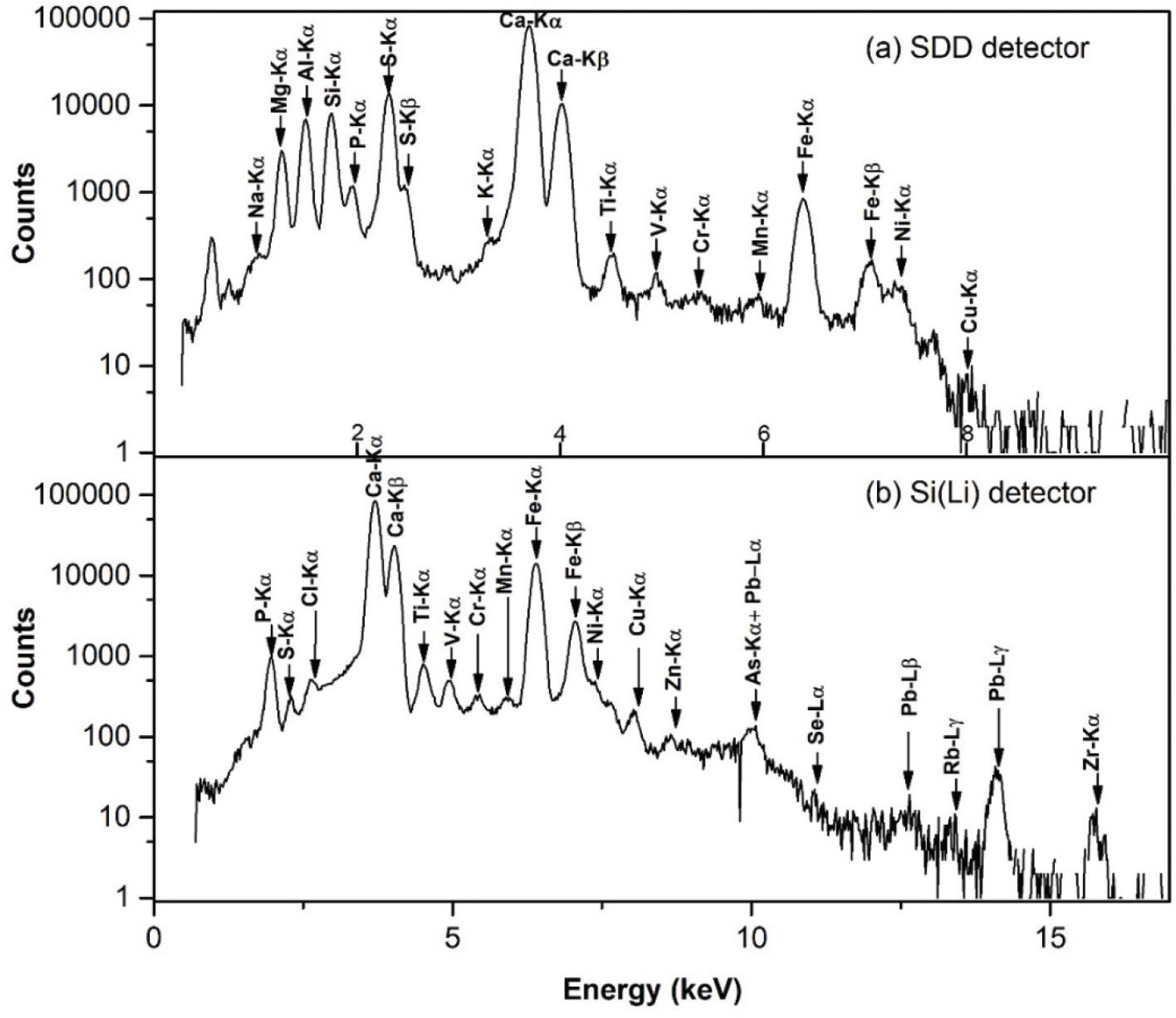
Figure 3
PIXE spectra of the soil sample taken with (a) SDD and (b) Si(Li) detector induced with 2 MeV protons
Mean concentrations and standard deviations of major, minor, and trace elements of the 12 studied soil samples are listed in Tables 3–5. Table 3 shows the concentrations of major elements in percentages, while Tables 4 and 5 show concentrations of minor and trace elements as mg/kg. The last row of each table shows average limits of detection (LOD) for each element.
Table 3
Major and minor element concentrations (in %) in measured soil samples with limits of detection (LOD) for each element
| Soil samples | Mg | Al | Si | S | K | Ca | Fe |
|---|---|---|---|---|---|---|---|
| 1 | 1.5±0.1 | 2.3±0.2 | 2.2±0.1 | 3.6±0.2 | 0.015±0.09 | 29±3 | 1.58±0.02 |
| 2 | 1.25±0.01 | 7.91±0.03 | 22.82±0.07 | 0.180±0.005 | 1.45±0.01 | 7.21±0.03 | 4.22±0.04 |
| 3 | 1.29±0.004 | 9.22±0.03 | 26±1 | 0.09±0.01 | 1.5±0.1 | 1.11±0.03 | 4.92±0.06 |
| 5 | 1.13±0.01 | 8.85±0.03 | 27.90±0.09 | 0.09±0.004 | 1.43±0.01 | 0.984±0.009 | 4.73±0.08 |
| 6 | 0.82±0.01 | 6.3±0.02 | 19.32±0.03 | 2.94±0.01 | 0.763±0.008 | 6.94±0.02 | 3.44±0.02 |
| 7 | 1.03±0.03 | 5.3±0.1 | 16±1 | 0.06±0.01 | 1.25±0.03 | 19.4±0.04 | 2.574±0.08 |
| 8 | 1.03±0.01 | 8.34±0.04 | 28.4±0.1 | 0.293±0.006 | 1.43±0.01 | 1.31±0.01 | 4.33±0.07 |
| 9 | 1±0.01 | 7.88±0.03 | 30.5±0.1 | 0.227±0.006 | 1.34±0.01 | 1.26±0.01 | 4.1±0.08 |
| 10 | 0.98±0.01 | 8.76±0.03 | 31.11±0.08 | 0.156±0.006 | 1.34±0.01 | 0.862±0.09 | 4.43±0.09 |
| 11 | 0.89±0.01 | 8.24±0.04 | 26.9±0.01 | 0.176±0.006 | 1.29±0.01 | 1.19±0.01 | 3.95±0.07 |
| 12 | 1.25±0.02 | 1.17±0.01 | 1.16±0.01 | 8.26±0.04 | -- | 26.2±0.1 | 0.93±0.01 |
| LOD | 0.01 | 0.007 | 0.006 | 0.007 | 0.005 | 0.01 | 0.002 |
Table 4
Minor and trace element concentrations (in mg/kg) in measured soil samples with limits of detection (LOD) for each element and comparison with trace element concentrations obtained with HR-ICP-MS in one sample taken close to location 1 reported by Petrović (48)
| Soil samples | Na | P | Cl | Ti | V | Cr | Mn | Co | Ni |
|---|---|---|---|---|---|---|---|---|---|
| 1 | -- | -- | -- | 1180±70 | 200±10 | 160±40 | 200±100 | -- | 20±10 |
| 2 | 1600±100 | 600±60 | 140±30 | 4170±70 | 150±20 | 450±40 | 1490±60 | -- | 140±10 |
| 3 | 2300±100 | 760±60 | 120±10 | 5030±80 | 150±20 | 300±100 | 1700±100 | -- | 159±6 |
| 5 | 2600±100 | 740±60 | 150±30 | 5390±70 | 140±20 | 350±30 | 2170±70 | 170± 30 | 144±9 |
| 6 | 2000±100 | 130±60 | 200±30 | 4510±70 | 210±20 | 320±40 | 1000±50 | -- | 104±8 |
| 7 | 1230±40 | 400±100 | 160±60 | 2600±200 | 90±10 | 400±200 | 500±40 | -- | 82±4 |
| 8 | 3300±100 | 1470±70 | 130±30 | 4850±70 | 200±20 | 380±30 | 1770±60 | -- | 100±10 |
| 9 | 2400±100 | 890±70 | 230±30 | 4740±70 | 150±20 | 270±30 | 1340±60 | -- | 126±8 |
| 10 | 4000±200 | 800±70 | 120±30 | 6070±80 | 140±20 | 570±40 | 1370±60 | -- | 110±8 |
| 11 | 3800±200 | 1350±80 | 400±40 | 5810±80 | 120±20 | 380±30 | 2180±70 | -- | 85±8 |
| 12 | -- | -- | 100±30 | 710±60 | 130±20 | 100±60 | 360±80 | -- | -- |
| Petrović (48) | -- | -- | -- | -- | 183 | 167 | -- | -- | 96.3 |
| LOD | 200 | 100 | 50 | 40 | 50 | 50 | 60 | 200 | 10 |
Table 5
Trace element concentrations (in mg/kg) in measured soil samples with limits of detection (LOD) for each element and comparison with trace element concentrations obtained with HR-ICP-MS in one sample taken close to location 1 reported by Petrović (48)
| Soil Samples | Cu | Zn | As | Se | Br | Rb | Sr | Y | Pb |
|---|---|---|---|---|---|---|---|---|---|
| 1 | 180±50 | 70±20 | 20±10 | 20±10 | 30±10 | -- | 550±20 | 60±20 | 70±40 |
| 2 | 73±9 | 120±10 | -- | -- | 30±30 | 210±40 | 250±30 | -- | 120±90 |
| 3 | 51±6 | 160±50 | -- | -- | -- | 360±50 | 70±50 | -- | 130±20 |
| 5 | 44±8 | 130±10 | -- | -- | 60±30 | 330±40 | 140±30 | -- | 200±100 |
| 6 | 86±8 | 130±10 | -- | -- | 40±20 | 130±30 | 210±30 | -- | 170±80 |
| 7 | 30±30 | 90±10 | -- | -- | 20±20 | 120±20 | 504±6 | -- | 90±60 |
| 8 | 39±8 | 110±10 | -- | 20±20 | 60±30 | 260±40 | 100±30 | -- | 200±100 |
| 9 | 37±7 | 120±10 | -- | -- | -- | 230±40 | 130±20 | -- | 110±90 |
| 10 | 24±8 | 100±10 | -- | 40±20 | 30±30 | 220±40 | 90±20 | -- | 100±100 |
| 11 | 41±7 | 100±10 | -- | 23±9 | -- | 180±30 | 130±20 | -- | 140±90 |
| 12 | 72±9 | 13±7 | 20±10 | -- | -- | -- | 580±40 | -- | -- |
| Petrović | 37.8 | 120 | 14.8 | 21.8 | -- | -- | 128 | -- | 48.2 |
| LOD | 10 | 20 | 20 | 30 | 40 | 50 | 30 | 20 | 90 |
Earlier, Petrović (48) reported soil elemental composition at Štrmac measured with high-resolution mass spectrometry with inductively coupled plasma (HR-ICP-MS) (Tables 4 and 5). Only one soil sample was taken near our sampling location 1. The reported concentration ranges mostly correspond to ours, save for Cu, Sr, and Pb, which are higher (Table 5). Differences in Pb concentrations are probably owed to differences in the measurement methods employed, as sample preparation for ICP-MS involves dissolving samples in acids, which may render Pb and Rb extraction from the soil incomplete. Even so, this comparison confirms that our PIXE method is satisfactorily accurate.
Compared to the values from the literature for world soils (Table 6), our measurements show much higher levels for Ni, Cr, P, and S. Higher P levels apply only to samples 7–12. Pb, Zn, and Ni levels are also elevated in almost all samples, but to a lesser extent. Similar findings were reported by previous studies (26–29). Moreover, the concentration of Se is extremely elevated, but since these measurements are around the PIXE’s LOD, it is difficult to draw definitive conclusions about soil contamination with Se at Štrmac. Previous measurement with ICP-MS (16, 26–29) clearly confirm that high Se levels are owed to its high content in Raša coal, which is also true for coal in general (49). According to the Geochemical Atlas of the Republic of Croatia (50), coastal Croatia has the highest concentrations of most potentially toxic elements (PTE) in Croatia and higher than the world/European average.
Table 6
Measured elements in this study (mg/kg) compared to world soils and Croatian legislation
| Element | This research (mg/kg) | Croatian legislation (51) (mg/kg) | World soils (52, 53) (mg/kg) | World soils (54) (mg/kg) | Topsoil Europe (54) (mg/kg) | Geochemical atlas (50) (mg/kg) |
|---|---|---|---|---|---|---|
| Al | 11700–92200 | 80000 | 78500 | |||
| As | 20 | 30 | 5 | 6.83 | 11.6 | 18 |
| Br | 20*–60 | 10 | 10 | |||
| Ca | 8620–290000 | 14000 | 13300 | |||
| Cl | 100–400 | 300 | 300 | |||
| Co | 170* | 60 | 10 | 11.3 | 10.4 | 18 |
| Cr | 100–570 | 120 | 80 | 59.5 | 94.8 | 121 |
| Cu | 24–180 | 120 | 25 | 38.9 | 17.3 | 35.5 |
| Fe | 9300–49200 | 35000 | 41800 | |||
| K | 150–10500 | 14000 | 12500 | |||
| Mg | 8900–15000 | 9000 | 6800 | |||
| Mn | 200–2180 | 530 | 488 | 524 | 1082 | |
| Na | 1230–4000 | 10000 | 3400 | |||
| Ni | 20–159 | 75 | 20 | 29 | 37 | 74.6 |
| P | 130–1470 | 750 | 650 | |||
| Pb | 70*–200 | 150 | 17 | 32 | 48.7 | |
| Rb | 120–360 | 65 | 68 | 87 | ||
| S | 600–82600 | 800 | ||||
| Se | 20*–40 | 0.3 | 0.44 | |||
| Si | 22000–311100 | 280000 | ||||
| Sr | 70–580 | 240 | 130 | 86 | ||
| Ti | 710–6070 | 4000 | 7038 | 6070 | 4300 | |
| V | 90–200 | 90 | 129 | 68 | 148 | |
| Y | 60 | 20 | 23 | 23 | 28 | |
| Zn | 13*–160 | 200 | 70 | 267 | 68.1 | 108 |
Spatial arrangement of S and V
S and V were chosen for spatial comparison because both elements are known to have elevated concentrations in Raša coal and ash (27), and their elevated concentrations in soil samples indicate soil contamination originating from the landfill. Although the comparison shows a rather weak correlation between S and V, their distribution by locations above and below the median mostly coincides (Table 7). The exceptions are location 12, with concentration above the median for S and below the median for V, and location 3, with concentration below the median for S and above the median for V. Generally, locations further away from the landfill have lower concentrations of either element, with the exception of locations 3 for S and 12 for V. This suggests that the source of soil pollution with S and V in Štrmac is ash from the landfill, but this connection is not unequivocal, as there are spatial variations in the distribution of elements.
Correlation and distribution of element levels
Previous research (26–28) showed positive and statistically significant (p<0.05) Kendall-Tau correlation between S, Se, and V in Raša coal and Raša coal ash samples. In this study we determined a positive (r>0.5) and statistically significant (p<0.05) correlation between S and As (r=0.58; p=0.013), and a negative (r<-0.5) and a statistically significant correlation between S and Al (r=-0.587; p=0.012) and S and Fe (r=-0.514 and p=0.0278).
The R value for the S-Se correlation is 0.0237 (p=0.919) and for S-V 0.443 (p=0.0581). We believe that the absence of significant correlation between S and Se is owed to the unreliability of the PIXE method in characterising Se in these samples. The S-V correlation is close to significance, and it is possible that the rounding of measurement figures had an influence on this outcome. However, the Bonferroni correction showed that only Al-Fe (p=0.021), Rb-Fe (p=0.049), and Na-Ti (p=0.049) correlations were statistically significant. This indicates that some of the other correlation coefficients could be falsely significant, probably due to heterogeneous composition of soil samples, and that the correlation between these elements is the most reliable.
Due to the limitations of the PIXE method, the levels of rare earth elements – Ce, Be, Sc, Ri, and Li – were not determined in this study. However, we did find a positive and statistically significant correlation between Al and Ti, Fe and Ni, and Fe and Mn. The Cu- Zn correlation was positive but not statistically significant (r=0.112; p=0.631). The results for the positive S-As correlation, which would normally indicate that As contamination at the landfill originated from Raša coal, are not reliable, as As was mostly below the detection limit. For the same reason, we found no correlations between Co and other elements.
Correlation between Al and Fe (Fe also correlates with Rb and K, Ni and Zn) stands out due to high correlation coefficients and small p-values (r=0.927, p=7.18*10-5). Considering the importance of Al, K, and Fe in the lithosphere and the formation of minerals, it is probably a natural correlation, but the additional correlation with Ni and Zn indicates a certain influence of the local foundry and/or heating plant in Štrmac.
Pollution indices
Pollution indices (PIs) are a simple way to assess the degree of pollution of soil, but they should be taken with reserve (55). The simplest of PIs, the single pollution index (SPI), is calculated by dividing a single heavy metal or PTE concentration in soil with “background geochemical values” or reference values such as those found in the Geochemical Atlas of Croatia (50). Other PIs for individual elements require additional data from different soil horizons or from a greater number of samples (56), which was out of our study’s scope.
If we apply pollution categorisation described by Kowalska et al. (56), the soil pollution at the Štrmac landfill is very strong for S, Se, Co, and Cu (Table 8). This is in line with reports of high soil pollution indices in the wider area of Labin, including Štrmac for Hg, Cd, V, Se, Pb, Cr, Zn, Cu, U, and S (26–28), in which S had the highest and V the lowest index. Those indices were based on corresponding background levels reported in the Geochemical Atlas of Croatia (50). Our study shows a similar result regarding the relationship of S and V with other elements.
Table 8
Pollution indices of selected elements in respect to reference values from Table 6 used in PI calculation*
| Variables | Croatian ordinance (51) | World soils (52, 53) | World soils (54) | Topsoil Europe (54) | Geochemical atlas of Croatia (50) |
|---|---|---|---|---|---|
| As | 0.67 | 4 | 2.93 | 1.72 | 1.11 |
| Co | 2.83 | 17 | 15.04 | 16.35 | 9.44 |
| Cu | 1.5 | 7.2 | 4.63 | 10.4 | 5.07 |
| Cr | 4.75 | 7.13 | 9.58 | 6.01 | 4.71 |
| Fe | 1.41 | 1.18 | |||
| Mn | 4.11 | 4.47 | 4.16 | 2.01 | |
| Ni | 2.12 | 7.95 | 5.48 | 4.3 | 2.13 |
| Pb | 0.93 | 8.24 | 4.38 | 2.87 | |
| S | 103.25 | ||||
| Se | 133.33 | 90.91 | |||
| Sr | 2.42 | 4.46 | 6.74 | ||
| V | 2.22 | 1.55 | 2.94 | 1.35 | |
| Zn | 0.8 | 2.29 | 0.6 | 2.35 | 1.48 |
The lowest PIs are those calculated with the reference background levels taken from Croatian legislation for agricultural land (51). This legislation focuses on a small number of PTEs that the legislator considers relevant and sets their pollution limits. Even in these terms, the pollution is high for Cr and moderate for Cu and Ni. In contrast, the PIs for As, Pb, and Zn are below these limits for the soil to be considered polluted.
Radioactivity findings
Tables 9 and 10 show activity concentrations on naturally occurring radionuclides 232Th, 238U, 226Ra, 210Pb, and 40K in soil and ash samples. Activity concentrations of 238U, 226Ra and 210Pb were higher in ash samples, while 232Th and 40K activity concentrations were higher in soil samples. These results are in line with previous reports (9, 10, 19). Furthermore, the ranges of 232Th, 238U, 226Ra, 210Pb, and 40K in soil samples (Table 10) are in good agreement with previous measurements of soil samples in this part of Croatia (43, 44).
Table 9
Activity concentrations (Bq/kg) of natural radionuclides in soil and ash samples from Štrmac
| Sample code | Sample type | 238U | 232Th | 226Ra | 210Pb | 40K | |
|---|---|---|---|---|---|---|---|
| Activity concentration ± relative uncertainty (Bq/kg) | |||||||
| 1st field campaign | |||||||
| 0 | Soil | 99±7 | 22±2 | 81±1 | 231±47 | 134±4 | |
| 2 | 58±6 | 44±2 | 44.1±0.9 | 52±47 | 433±10 | ||
| 6 | 62±8 | 57±2 | 58.9±0.8 | 160±31 | 446±10 | ||
| 7 | 50±4 | 20.8±0.9 | 23.2±0.6 | 171±33 | 354±9 | ||
| 9 | 72±6 | 51±2 | 75±1 | 219±37 | 453±11 | ||
| 11 | 138±9 | 67±3 | 81±1 | 238±37 | 464±12 | ||
| 14 | Ash | 458±10 | 17±2 | 349±3 | 288±29 | 302.6±0.9 | |
| 15 | 372±9 | 16±2 | 314±3 | 240±46 | 319±1 | ||
| 2nd field campaign | |||||||
| A1 | Ash | 605±13 | 44±2 | 295±2 | 306±24 | 188±4 | |
| A2a | 567±10 | 34±2 | 440±2 | 318±20 | 183±6 | ||
| A2b | 413±10 | 32±3 | 465±4 | 260±42 | 149±7 | ||
| A3a | 440±15 | 42±3 | 551±3 | 341±31 | 173±7 | ||
| A3b | 828±19 | 41±2 | 681±3 | 393±29 | 140±6 | ||
| A3c | 401±12 | 29±2 | 376±2 | 303±24 | 162±7 | ||
| B1a | 663±15 | 18±1 | 405±3 | 392±26 | 147±5 | ||
| B1b | 306±8 | 16±1 | 341±2 | 227±27 | 147±6 | ||
| B2a | 340±9 | 18±1 | 332±3 | 240±40 | 36±2 | ||
| B2b | 308±8 | 13±1 | 316±2 | 168±31 | 137±8 | ||
| B2c | 403±9 | 21±2 | 396±3 | 296±25 | 55±3 | ||
| B3a | 304±7 | 7±1 | 326±2 | 230±37 | 141±6 | ||
| B3b | 459±12 | 13±1 | 318±3 | 251±24 | 160±5 | ||
| C1 | 88±6 | 10±2 | 96±1 | 49±39 | 147±5 | ||
| C2 | 211±7 | 27±2 | 274±2 | 149±19 | 226±6 | ||
| D1 | 236±11 | 18±2 | 236±2 | 204±35 | 153±6 | ||
| D2 | 250±7 | 9±1 | 225±2 | 193±33 | 118±5 | ||
Table 10
Mean, minimum, and maximum activity concentrations (Bq/kg) of natural radionuclides in soil and ash samples from Štrmac
| Sample type | 238U | 232Th | 226Ra | 210Pb | 40K | |
|---|---|---|---|---|---|---|
| Activity concentration (Bq/kg) | ||||||
| Soil | Average±SD | 80±33 | 44±19 | 61±23 | 179±70 | 381±127 |
| Min | 50 | 21 | 23 | 52 | 134 | |
| Max | 138 | 67 | 81 | 239 | 464 | |
| Ash | Average±SD | 403±174 | 22±12 | 355±125 | 255±84 | 162±67 |
| Min | 88 | 7 | 96 | 49 | 36 | |
| Max | 828 | 44 | 681 | 393 | 319 | |
Table 11 summarises radium equivalent indices (Raeq), absorbed dose rates (D), and annual effective doses (E) in ash and soil calculated from activity concentrations of 226Ra, 232Th, and 40K. The Raeq in most ash samples exceeded the threshold of 370 Bq/kg. Its wide range (122–751 Bq/kg) is probably owed to the inhomogeneity of the mined coal used for heating. To make use of this ash, it should be mixed it with other non-radioactive materials in ratios that comply with Croatian legislation (57).
Table 11
Mean radium equivalent indices (Raeq), absorbed dose rates (Ḋ), and annual effective doses (E) in soil and ash samples at the Štrmac legacy site calculated from activity concentrations of activity concentration of 226Ra, 232Th, and 40K
| Sample type | Raeq (Bq/kg) | Ḋ (nGy/h) | E (mSv/year) |
|---|---|---|---|
| Ash (n=19) | 399 (122–751) | 184 (57–346) | 0.23 (0.07–0.42) |
| Soil (n=6) | 153 (80–213) | 71 (38–99) | 0.09 (0.05–0.12) |
The calculated absorbed dose rates originating from ash are higher than the background values for the Istrian region (70– 80 nGy/h) (44), considering that the mean rate is 184 nGy/h, and the maximum is 346 nGy/h, about four times higher than the background rates.
The mean annual effective doses range from 0.05 mSv in soil to 0.42 mSv in ash. For comparison, the worldwide mean dose in soil is 0.07 mSv and ranges from 0.3 to 0.6 mSv across countries (9).
Spearman’s rank correlation shows positive (r>0.9) and statistically significant (P<0.05) correlation between radionuclides 238U, 235U 226Ra, 232Th, 40K and trace elements Na, P, and Ti. Only Sr correlated negatively (r=-0.98; P=0.005) with 238U, 235U, 226Ra, and 40K. We did not find any correlations between 210Pb and any trace elements. However, due to a small number of soil samples, we cannot make solid conclusions on these correlations. In case of possible future remediation efforts, a more detailed investigation with a larger number of samples is required.
The future of the Štrmac legacy site is not known. Our findings, however, can inform remediation operations, should such decision be made. We already have positive precedents of remediation of coal fly ash deposition sites in Croatia (10, 58). Moreover, fly ash can be used in construction industry. In European countries (France, Denmark, Italy, Germany, and the Netherlands) 85–100 % of produced coal fly ash is used for the production of cement, concrete, and ceramics (59, 60). There is also potential to extract rare earth elements, which are highly concentrated in coal fly ash, for use in batteries, lightweight alloys, and medical equipment, amongst several other applications, as reported elsewhere (61).
CONCLUSIONS
This characterisation of an abandoned ash dump in Štrmac (Labin locality, Croatia) provides important knowledge on the impact of trace elements and radionuclides on the environment and local community as it can help design better cleaning systems at combustion plants and improve deposition sites in the future.
Our findings show that all of the observed elements (Hg, Cd, V, Se, Pb, Cr, Zn, Cu, U, and S) highly contaminate soil. Furthermore, they confirm that the PIXE method is an acceptable supplemental non-destructive method for soil analysis, especially for highly concentrated elements such as sulphur, but cannot be used as the only research method.
High activity concentrations of 238U, 226Ra, and 210Pb found in ash samples, radium equivalent indices exceeding the limit values, and the absorbed dose rates four times higher than background clearly highlight the need to remediate this legacy site.
We believe that our findings provide valuable information necessary for designing future deposition sites from the NORM industry and for remediating the current site or for using coal fly ash as raw material in the future.
Acknowledgment
The authors would like to thank Dražen Vratarić, Dalibor Kvaternik, and Mladen Bajramović for help and advice related to the fieldwork, to Jasminka Senčar for gamma-ray spectrometry measurements, to Professor Damir Bucković for help with literature.
This work has partly been funded by the Division of Radiation Protection of the Institute for Medical Research and Occupational Health and the European Union – Next Generation EU programme project EBDIZ (Contract of 8 December 2023, Class: 643–02/23– 01/00016, Reg. no. 533–03–23–0006). A part of the research was done at the facilities and with equipment funded by the European Regional Development Fund project KK.01.1.1.02.0007 “Research and Education Centre of Environmental Health and Radiation Protection – Reconstruction and Expansion of the Institute for Medical Research and Occupational Health”.
Notes
[9] Conflicts of interest Conflict of interests
None to declare.
LIST OF ABREVIATIONS:
- HR-ICP-MS
– high-resolution inductively coupled plasma mass spectrometry;
- HTE
– hazardous trace elements;
- IAEA
– International Atomic Energy Agency;
- LOD
– limit of detection;
- NORM
– naturally occurring radioactive materials;
- PIXE
– particle induced X-ray emission;
- PTE
– potentially toxic elements;
- RBS
– Rutherford backscattering spectrometry;
- SDD
– silicon drift detector