
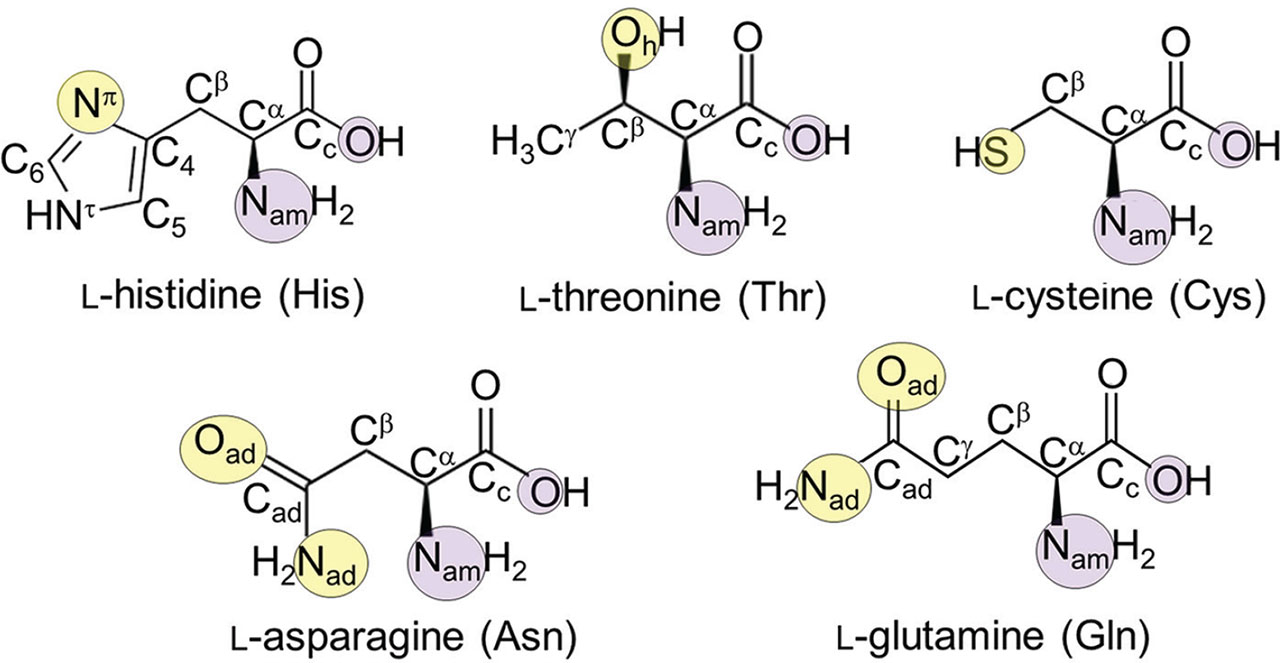
Figure 1
Schematic diagrams of five amino acids. Uncommon atom symbols: Cc – carboxylato group carbon; Cad – amido group carbon; Nam – amino group nitrogen; Nad – amido group nitrogen; Oad – amido group oxygen; Oh – hydroxyl group oxygen. Donor atoms for binding with metal ions are denoted by violet and yellow circles as follows: amino Nam and carboxylato O atoms common to all amino acids (violet), and side-chain atoms specific for each amino acid (yellow)
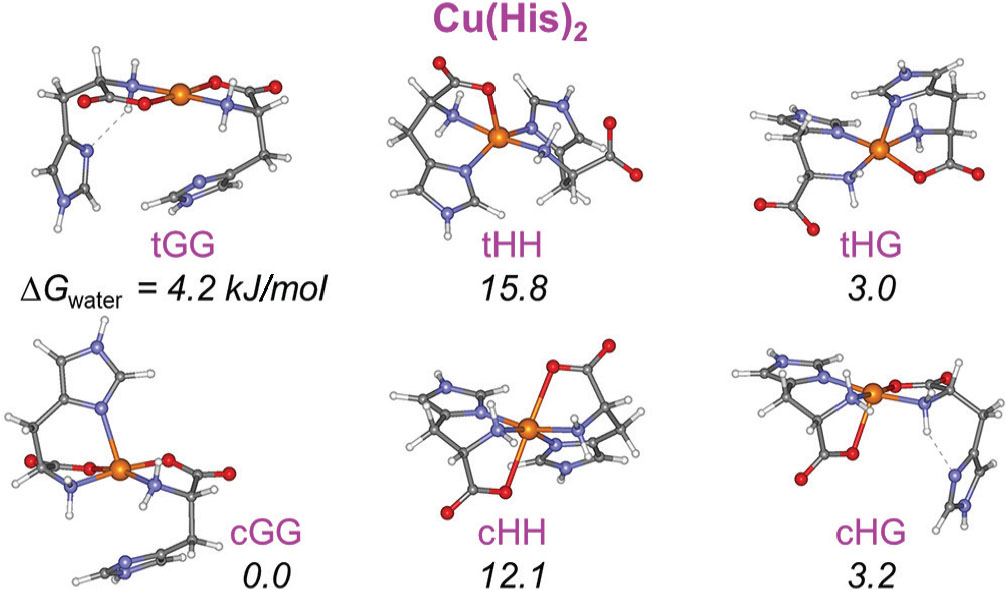
Figure 2
B3LYP-D3/6-311+G(3df,2p) prediction of aqueous Cu(His)2 conformers in the glycine- (G) and histamine-like (H) His coordination modes with a trans (t) or cis (c) configuration, along with their relative Gibbs free energies (∆Gwater, kJ/mol)
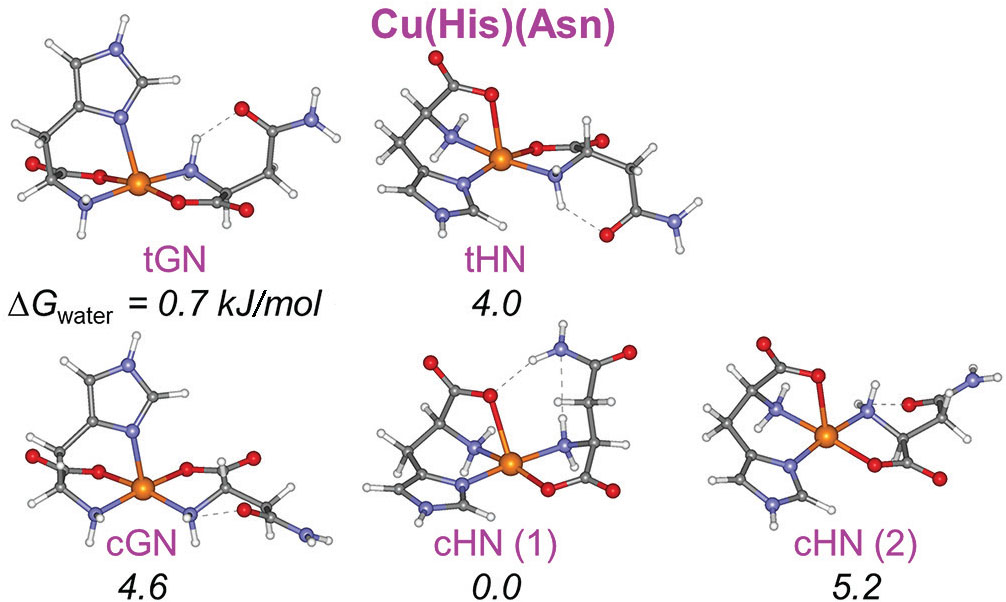
Figure 3
B3LYP-D3/6-311+G(3df,2p) prediction of aqueous Cu(His) (Asn) conformers with His in the glycine- (G) and histamine-like (H) coordination and Asn in the glycine-like mode (N) with a trans (t) or cis (c) configurations along with their relative Gibbs free energies (∆Gwater, kJ/mol)
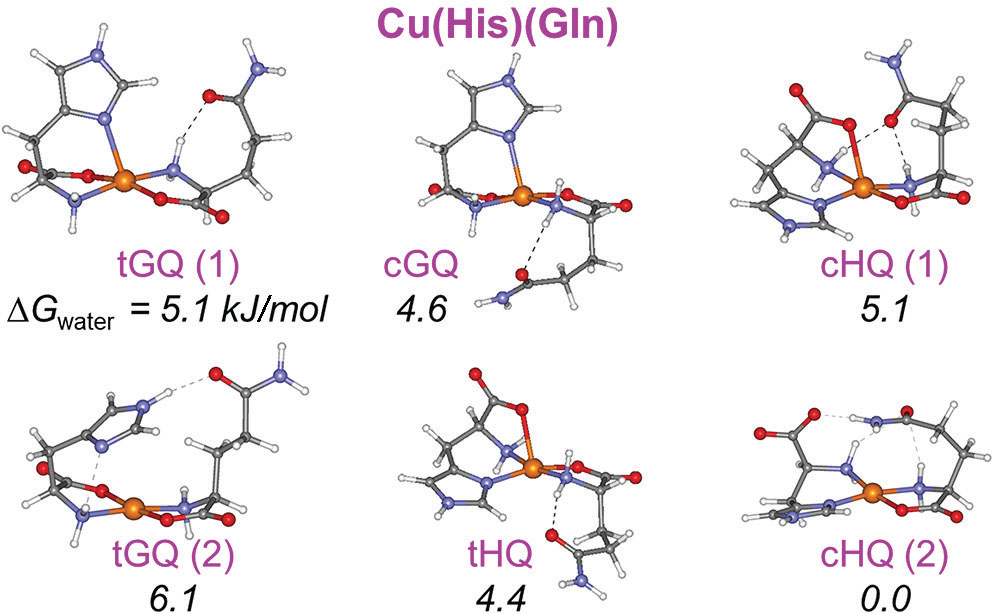
Figure 4
B3LYP-D3/6-311+G(3df,2p) prediction of aqueous Cu(His) (Gln) conformers with His in the glycine- (G) and histamine-like (H) modes and Gln in the glycine-like mode (Q) in a trans (t) or cis (c) configurations, along with their relative Gibbs free energies (∆Gwater, kJ/mol)
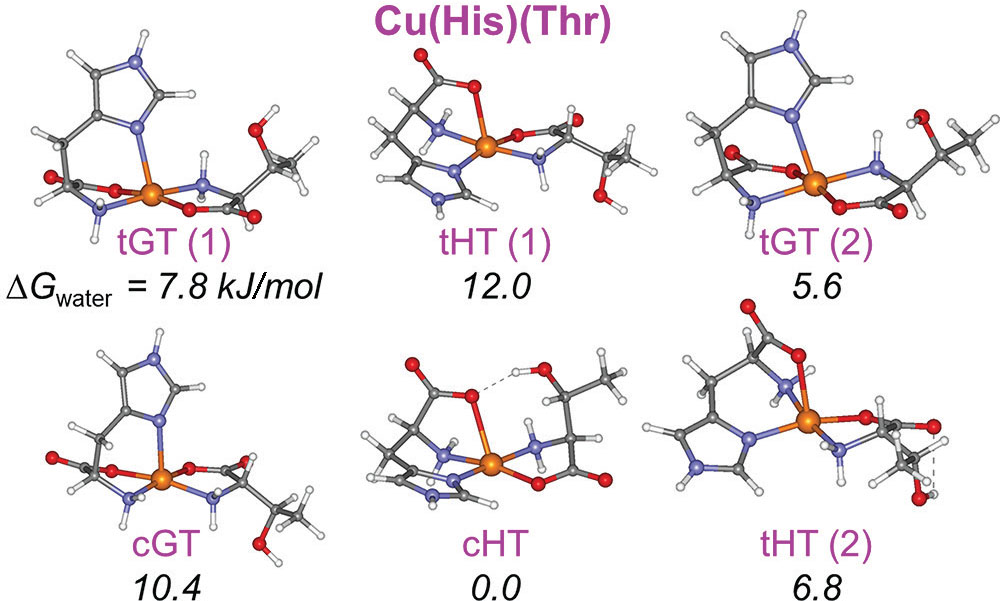
Figure 5
B3LYP-D3/6-311+G(3df,2p) prediction of aqueous Cu(His) (Thr) conformers with His in the glycine- (G) and histamine-like (H) modes and Thr in the glycinato mode (T) in a trans (t) or cis (c) configurations along with their relative Gibbs free energies (∆Gwater, kJ/mol)
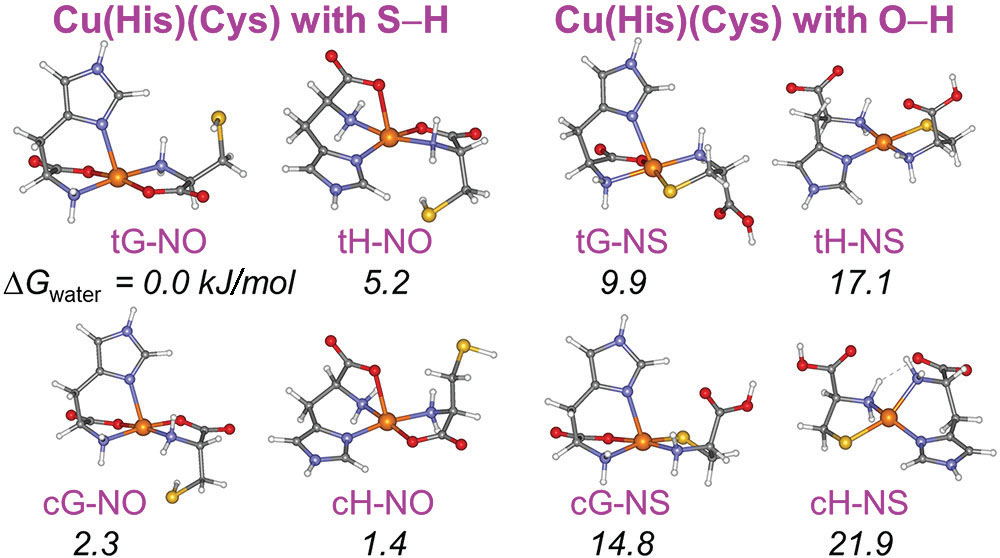
Figure 6
B3LYP-D3/6-311+G(3df,2p) prediction of aqueous Cu(His) (Cys) conformers in a trans (t) or cis (c) configurations with His in the glycinato (G) and histaminato (H) mode and with Cys in the glycinato (NO, left) and NS mode (right; Nam and S as the donor atoms), along with the relative Gibbs free energies (∆Gwater, kJ/mol)
Table 1
Experimentally determined stability constants (log β) of ternary and binary amino acidato copper(II) compounds determined potentiometrically (37 °C, 0.15 mol/L NaClO4)
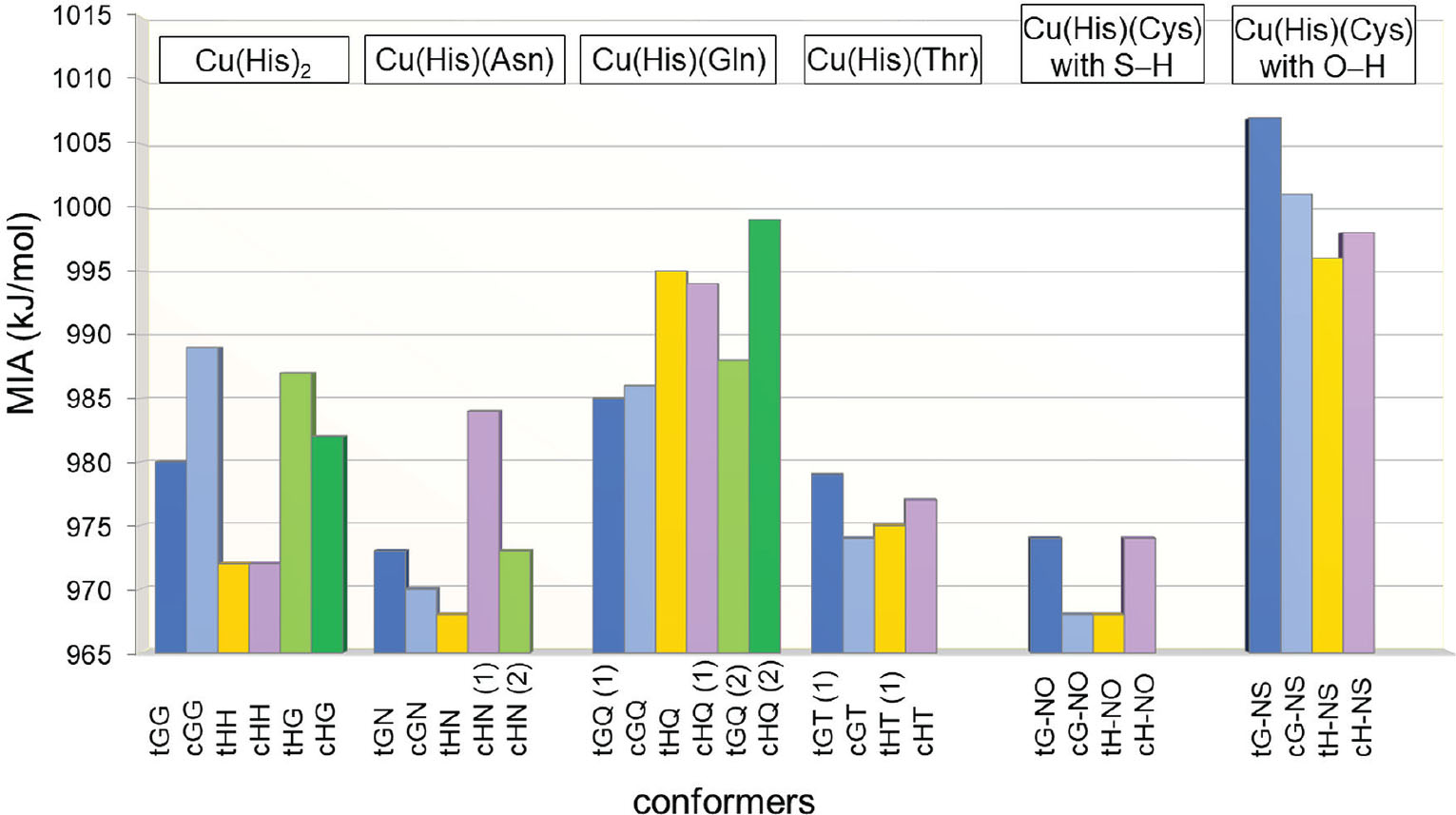
Figure 7
Metal ion affinity (MIA) values calculated for low-energy aqueous conformers of five Cu(aa)2 compounds obtained using the B3LYP-D3 functional and 6-311+G(3df,2p) basis set (see Table 2). [Cu(His)(Gln) and Cu(His) (Cys) values are based on two earlier reports (43, 44)]
Table 2
Enthalpies and metal ion affinities (MIA) for selected Cu(His)2, Cu(His)(Asn), and Cu(His)(Thr) conformers and their corresponding His−, Asn−, and Thr− minimum structures calculated using the B3LYP-D3 functional and 6-311+G(3df,2p) basis set in implicitly modelled aqueous solution using polarisable continuum model (PCM) at 298.15 K
| Conformer* | Enthalpy (a.u.) | MIA (kJ/mol) | ||
|---|---|---|---|---|
| Cu(His)2 | L1− (His−) | L2− (His−) | ||
| tGG | −2737.094653 | −548.382771 | −548.384674 | 979.6 |
| cGG | −2737.096348 | −548.382743 | −548.382719 | 989.3 |
| tHH | −2737.091682 | −548.382725 | −548.384669 | 971.9 |
| cHH | −2737.092565 | −548.383451 | −548.384666 | 972.4 |
| tHG | −2737.095356 | −548.382781 | −548.382751 | 986.5 |
| cHG | −2737.095784 | −548.382817 | −548.384681 | 982.4 |
| Cu(His)(Asn) | L1− (His−) | L2− (Asn−) | ||
| tGN | −2680.789917 | −548.382752 | −492.082518 | 972.9 |
| cGN | −2680.786351 | −548.382801 | −492.080036 | 969.9 |
| cHN (1) | −2680.792287 | −548.382750 | −492.080519 | 984.4 |
| cHN (2) | −2680.787487 | −548.382733 | −492.080062 | 973.0 |
| tHN | −2680.788118 | −548.382752 | −492.082536 | 968.1 |
| Cu(His)(Thr) | L1− (His−) | L2− (Thr−) | ||
| tGT (1) | −2626.583463 | −548.382793 | −437.873675 | 979.1 |
| tTG (2) | −2626.583989 | −548.382791 | −437.880005 | 963.8 |
| cGT | −2626.581558 | −548.382725 | −437.873662 | 974.3 |
| tHT (1) | −2626.581712 | −548.382770 | −437.873628 | 974.6 |
| tHT (2) | −2626.583521 | −548.382751 | −437.880002 | 962.7 |
| cHT | −2626.588520 | −548.382757 | −437.879386 | 977.4 |
a.u. – atomic unit (2625.5 kJ/mol). Metal ion affinities were calculated using Eq 1 (see text). The B3LYP-D3/6-311+G(3df,2p) enthalpy of aqueous Cu2+ H(Cu2+) = −1639.954092 a.u.
* Conformers are given in Figures 2–6. The L1− and L2− minimum structures were computed by using the B3LYP-D3/6-311+G(3df,2p) geometry optimisation of the respective ligand geometry in each of denoted Cu(L1)(L2) minimum structure