
Copper (Cu) is an essential trace element and transition metal, toxic if present in excessive amounts in the body (1, 2). In fact, both its excess and deficiency can harm most living organisms. In the oxidised Cu(II) or reduced Cu(I) form this metal participates as a cofactor in physiological redox reactions of numerous enzymes, such as superoxide dismutase (which catalyses superoxide anion dismutation to hydrogen peroxide), lysyl oxidase (which catalyses the formation of aldehydes from lysine residues in collagen and elastin precursors), cytochrome c oxidase (which is involved in the respiratory electron transport chain of cells), tyrosinase (which controls the production of melanin), and dopamine-beta-hydroxylase (which catalyses dopamine conversion to norepinephrine) (3).
Cu also participates in signalling pathways, such as those regulating lipolysis or promoting cell growth and proliferation (cuproplasia), or autophagy for cell survival and cell maintenance (4, 5). These processes are needed for iron metabolism, cardiovascular integrity, neuroendocrine functions, proper growth and development, lung elasticity, and neovascularisation. Tightly regulated Cu homeostasis and cuproplasia can be affected by exogenous exposure, Wilson’s disease, occipital horn syndrome, Menkes’ disease, neurodegenerative disorders related to Alzheimer’s, Parkinson’s, and Creutzfeldt Jakob’s diseases, idiopathic pulmonary fibrosis, diabetes, inflammation processes, or progression of several cancers (2, 4,5,6,7,8,9).
The last few decades have seen clinical trials of chelation therapy to lower excessive Cu levels in patients with acute or chronic occupational and/or environmental exposure to Cu or with hypercupraemia leading to Cu-related toxic effects (10,11,12,13). In recent years, Cu-triggered cell death, also known as cuproptosis, characterised by Cu accumulation and subsequent proteotoxic stress, has inspired the development of drugs targeting malignant tumour growth and neurodegenerative disorders (13,14,15,16). Lists of clinical trials investigating Cu ionophores and multifunctional chelators with their classification based on the therapeutic efficiency are given elsewhere (9, 12, 13).
Cancer patients have been reported significantly higher serum and tumour Cu levels than healthy persons (16, 17). Most (65–95 %) Cu in healthy plasma is bound to ceruloplasmin in a nonexchangeable manner, while exchangeable Cu(II), about 5–20 % of total Cu, is found in serum albumin. Up to 5 % of total serum Cu is bound by low-molecular weight (LMW) ligands, including amino acids (18, 19). Relying on experimentally determined dissociation constants and total blood l-histidine (His) and other free amino acid blood levels, Kirsipuu et al. (19) estimated that an average of 0.04 % and 0.20 % of total serum Cu is bound in bis(l-histidinato)Cu(II) [Cu(His)2] and ternary Cu(II)-His compounds with other l-amino acids [Cu(His)(aa)], respectively.
In 1967, electrically neutral Cu(II) complexes with two amino acids [Cu(aa)2] were first suggested as the physiological species in plasma (20, 21). Neumann and Sass-Kortsak (20) found in reconstituted serum in vitro that exchangeable Cu(II) in serum coordinated preferentially to His in the Cu(His)2 and the ternary Cu(His)(aa) compounds with l-glutamine (Gln), l-threonine (Thr) and l-asparagine (Asn). Using thin-layer chromatography, Sarkar and Kruck (21) isolated Cu(II)–l-amino acid coordination compounds from human serum and established the dominance of Cu(His)2 and mixed Cu(His)(aa) complexes.
The studies of Cu(II) binding with serum albumin and His suggest that Cu(II) exchange between Cu-albumin and a Cu(aa)2 complex is mediated by a ternary Cu(albumin)(His) complex and that His binding increases, while serum albumin complexation inhibits cell Cu uptake (22,23,24). This discovery of the essential role of Cu(His)2 in Cu transport encouraged its use in the treatment of Menkes’ disease in the form of intravenous Cu(II)-His supplementation (25, 26).
Human serum albumin binds Cu(II) at the NH2-terminus sequence of the Asp–Ala–His motif [which is commonly known as the amino terminal Cu(II)- and Ni(II)-binding (ATCUN) active site] by four nitrogen atoms in a plane and a carboxyl group at the axial site (27). The NH2-terminus coordination motif has no rigid structure and can adapt to bind Cu(II) and Ni(II) and release the metal with appropriate ligands (27, 28). A recent study of Cu(II)-binding affinities reports fast demetallation of Cu(II)-albumin by His (19). Besides, an in vitro kinetic study (29) of Cu(II) transport from plasma to rat liver cells suggests that by binding Cu(II) at physiological concentration albumin inhibits its cellular uptake. His, in turn, mobilises Cu(II) from serum albumin to form Cu(His)2, which then interacts with hepatic Cu transport protein, and this protein transports Cu ions to rat hepatocytes.
By measuring 64Cu accumulation in prostate cancer-derived cells, which typically accumulate more Cu than normal cells in the presence of His, Thr, l-methionine, and l-cysteine (Cys), another in vitro study (30) found that only Cys enhanced Cu accumulation by mediating changes in 64Cu intracellular transport or efflux.
However, experimental studies of physiological Cu(aa)2 structure in solutions are rare and mostly limited to the first Cu(II) coordination sphere (24, 31,32,33,34,35,36,37,38). To complement these experimental findings, our team computationally studied the structural properties of binary Cu(aa)2 compounds with His (39, 40), Thr (41), Asn (42), Gln (43), and Cys (44) and of ternary Cu(His)(aa) compounds (42,43,44,45). We performed conformational analyses of those compounds in the gas phase and in aqueous solution (modelled either implicitly or by adding explicit water molecules) using calculations which rely on the density functional theory (DFT) (46). The aim of these calculations was to characterise structural properties and the effects of intra- and intermolecular interactions on coordination and overall geometry of physiologically important Cu(aa)2 compounds to identify their pharmacological potential (39,40,41,42,43,44,45). In doing so we found that Cu(His)(aa) compounds are conformationally quite flexible (42,43,44,45) like the ATCUN binding site in human serum albumin (27), and that the conformational flexibility of Cu(His)(aa) may be related to Cu(II) exchange reactions in blood plasma and its physiological abundance. Similar flexibility has been reported for small multifunctional Cu(II)-binding drugs and metal-protein attenuating compounds (MPAC) containing several nitrogen and oxygen donor atoms that can bind Cu(II) (47, 48).
This paper summarises our main findings from the DFT computational studies (39,40,41,42,43,44,45) and focuses on the low-energy conformers of Cu(His)2 and Cu(His)(aa) compounds in aqueous solution at ambient temperature. Here we also complete a series of metal-ion affinity (MIA) calculations of binding free amino acid ligands with Cu2+ for Cu(His)2, Cu(His)(Thr), and Cu(His)(Asn) to Cu(His)(Gln) (43) and Cu(His)(Cys) (44).
EXPERIMENTAL AND COMPUTATIONAL (IN SILICO) DATA
Chemical speciation of LMW copper amino acid compounds in human plasma
Chemical speciation identifies and quantifies the distribution of different chemical species in a system (49). The distribution of LMW Cu(II) amino acid species in an electrolyte depends on many factors, such as the metal-ligand ratio, pH, temperature, electrolyte composition, intrinsic properties of the metal ion and the ligand, possible coordination numbers, geometries, oxidation states, and thermodynamic and kinetic characteristics that drive the chemical reaction. Since environmental concentrations of most metals are low (e.g. Cu2+ concentration in blood plasma is around 10−18 mol/L) and many LMW Cu(II) species cannot be measured directly, chemical speciation generally relies on experimental analytical methods in combination with computation models.
For a long time, computational simulations of the distribution of Cu-amino acid species in human blood plasma were based on solving simultaneous mass balance equations to determine the concentration of all specific compounds in a mixture (50,51,52,53,54,55,56,57). They relied on information about chemical reactions from experimental thermodynamic databases, including total concentrations of metal ions and complexing agents and relevant equilibrium constants (pKa and stability constants) measured in a solution of ionic strength, pH, and isotonicity corresponding to blood plasma at 37 °C. In 1971, Hallman et al. (50) thus predicted that 98 % of Cu(II) should bind with His and cystine, predominantly in the form of mixed-ligand complexes and their monoprotonated derivatives. In 1984, Berthon et. al. (51) reported that these complexes with His and cystine were not predominant. Instead, Brumas et al. (54) found that the most dominant species were Cu(His)2 and ternary Cu(His) (Thr) and Cu(His)(Gln) compounds of the modelled ultrafiltrable Cu fraction of normal blood plasma. That computational finding agreed with the experimental one obtained in reconstituted serum by Neumann and Sass-Kortsak (20).
Later, Tran-Ho et. al. (55) used stability constants for Cu(aa)2, and Cu(I) complexes with thioamino ligands and considered the redox potential of blood plasma in the chemical speciation simulation and showed that 97 % of total Cu was in LMW Cu(I) compounds, with 71 % of all Cu in blood plasma in the Cu(I) complex with one Cys ligand [CuICys]. Similar prediction was reported by Königsberger et al. (56), with 65 % of total Cu in CuICys, and 5 % of total Cu in Cu(His)(Gln) (3 %), Cu(His)2 (1 %), and Cu (His)(Thr) (1 %). The stability constants for Cu(II) complexes with Cys zwitterions, like neutral Cu(Cys)2, that could be used in the distribution simulations have not been determined, because Cys reduces Cu(II) to Cu(I) and changes to disulphide cross-linked cystine (58). Depending on the Cu(I) or Cu(II) to Cys ratios, Cu(II) ion can oxidise the CuICys complex to cystine and produce aqueous Cu(I) ion, which in strictly anaerobic conditions at pH 7 undergoes dismutation to regenerate Cu(II) (59).
Considering that Cu(Cys)2 has not been experimentally detected, however, in an experiment using voltammetry and ultraviolet-visible spectroscopy Mlakar et al. (60) reported the stability constant of the ternary Cu(His)(Cys) compound. They obtained Cu(His)(Cys) upon gradually adding either Cys to the Cu(His)2 solution or His to CuICys in aqueous solution (60). Stable ternary Cu(II)-Cys complexes in aqueous solution were also determined with aspartic or glutamic acids (61).
The speciation distribution modelling by May in 2015 (57), which included an extensive set of experimental reaction thermodynamic parameters, total concentrations of LMW ligands and free metal ions at 25 °C, pH 7.4, ionic strength I=0.15 mol/L, and standard redox potential of −83 mV, predicted Cu(II) distribution as follows: 25 % in Cu(His)(Gln), 14 % in Cu(His)2, and 9 % in Cu(His)(Thr).
Obviously, the disagreements between these simulation studies are greatly owed to the complexity of blood plasma as a multicomponent equilibrium system and the completeness and accuracy of experimental thermodynamic databases used. Even so, they gave an excellent insight into the distribution of Cu(II) in His-containing LMW species of neutral charge.
Besides plasma, Cu(II) distribution was investigated in phloem sap with speciation modelling of LMW compounds with several trace transition metals, which identified that 60 % was present in the neutral ternary Cu(His)(aa) species (62) as follows: 12 % with Asn, 9.6 % with Gln, and 7.8 % with l-serine (Ser). The remaining 40 % was bound to nicotianamine. Since sap Asn, Gln, and Ser concentrations were high (≈ 104 µmol/L), and the range of input Cu(His)(aa) stability constants (log β) narrow (16.7–17.0, the simulation suggested that the relative concentrations of Cu(His)(aa) complexes in the phloem model primarily depended on variations in amino-acid concentrations, rather than on variations in stability constants (62). For comparison, Gln concentration in the plasma (500–800 µmol/L) is 10- to 100-fold that of any other amino acids (63), which implies that the concentration of this most abundant amino acid has some role in the dominancy of Cu(His)(Gln) in the plasma.
Coordination modes
Amino acids His, Thr, Asn, Gln, and Cys have three functional groups with donor atoms as potential binding sites for metal ions (Figure 1): the carboxylate group (oxygen atom O is the donor atom), the α-amino group (nitrogen atom Nam is the donor atom), and a side-chain group specific for each amino acid, namely imidazole in His, hydroxyl −OH in Thr, amido −CONH2 in Asn and Gln, and the thiol (or sulphhydryl) group −SH in Cys.
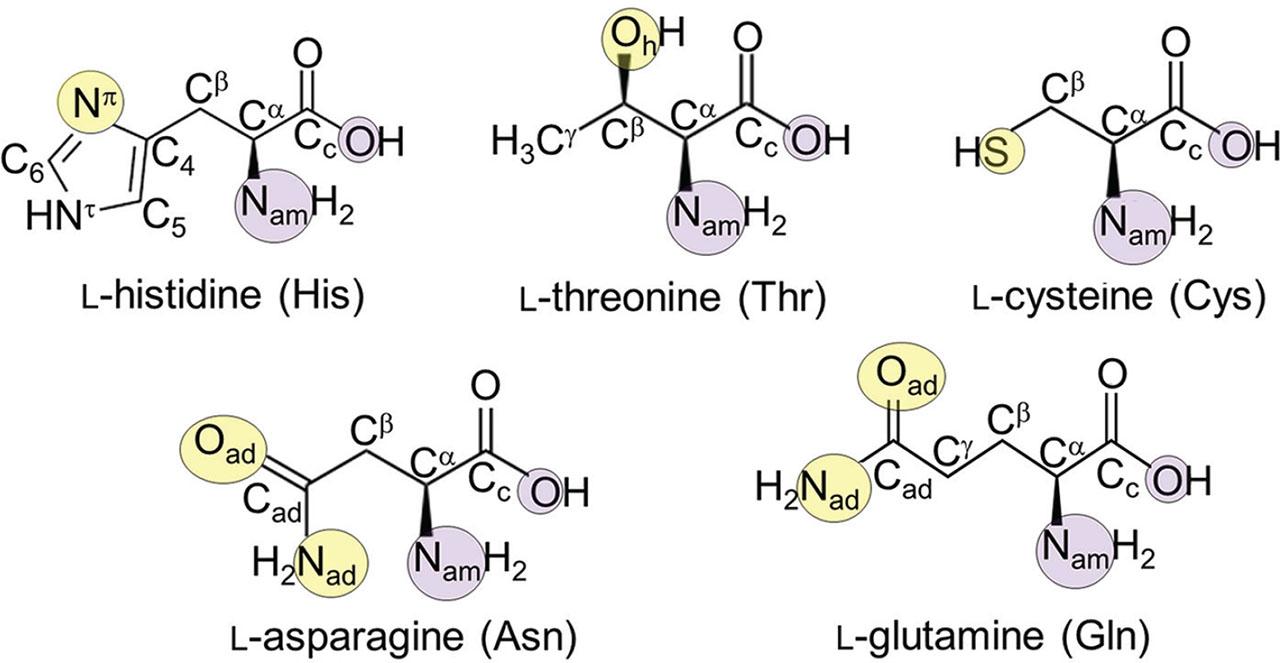
Figure 1
Schematic diagrams of five amino acids. Uncommon atom symbols: Cc – carboxylato group carbon; Cad – amido group carbon; Nam – amino group nitrogen; Nad – amido group nitrogen; Oad – amido group oxygen; Oh – hydroxyl group oxygen. Donor atoms for binding with metal ions are denoted by violet and yellow circles as follows: amino Nam and carboxylato O atoms common to all amino acids (violet), and side-chain atoms specific for each amino acid (yellow)
However, in proteins and LMW Cu(aa)2 compounds amino acids bind Cu(II) differently. In proteins, the most common Cu-binding amino acids are His and Cys (64, 65). His usually binds Cu with a nitrogen atom of its imidazole ring, and Cys coordinates Cu with the sulphur atom of the thiol group. Oxygen atoms of carboxyl groups are less common but still widespread donors that bind Cu ions in proteins. Bonds between Cu and N, O, and S donor atoms differ with their electronic properties, strength, energy, and stability (65). In LMW Cu(aa)2 compounds, two coordinating groups per amino acid bind Cu(II) in-plane.
Usually, in electrically neutral LMW Cu(aa)2 compounds, Cu(II) prefers planar coordination of four nearby donor atoms (66, 67). One or two donor atoms may be in an apical position at a larger distance owing to the Jahn-Teller effect (68). Amino acids with three functional groups can therefore bind a metal and from a chelate ring in Cu(aa)2 compounds in many ways by combining two coordinating groups per amino acid in a plane (a bidentate binding), whereas the remaining functional group may coordinate axially to complete a tridentate binding. Amino acids in the equatorial plane take a cis or trans configuration relative to each other.
Experimental studies and DFT predictions, however, show but several of the many possible coordination modes in aqueous solutions. Experimental studies of physiological Cu(aa)2 compounds in solutions suggest the Cu(II) coordination geometry but do not specify overall complete geometries (24, 31,32,33,34,35,36,37,38), as solutions introduce different complexing species, coordination numbers, conformations, and cis-trans isomerism, which render structure determination rather complicated. The same is true for structural determination of LMW Cu(aa)2 coordination compounds in solutions using computational methods.
In the biologically significant pH range of 6–7, the His imidazole ring is neutral, i.e., only one imidazole nitrogen atom, either Nπ or Nτ (Figure 1) is protonated. One study (69) suggests that in an l-histidyl-Cu(II)-proton system only Nπ is available for bonding with the Cu(II) ion. Although His usually binds to the Cu ion in proteins with an unprotonated Nπ or Nτatom (65), there are three modes in which it can coordinate bidentately to Cu(II) in LMW Cu(aa)2 complexes: the glycine-like mode (G), with Nam and O as donor atoms, the histamine-like mode (H), involving donor atoms Nam and Nπ, and the imidazole-propionic acid-like mode (I), involving donor atoms O and Nπ. The G, H, and I binding modes form a five-, six-, and seven-member chelate ring, respectively.
The Cu(II)/His system in solutions has extensively been studied over the years using electrochemical and spectroscopic techniques (31,32,33,34,35,36) [they are reviewed elsewhere (24, 39)]. Since different experimental techniques require specific measuring conditions regarding metal:ligand ratios, electrolyte ionic strength, and pH ranges to get reliable results, their outcomes may suggest different coordination modes to be prevalent at physiological pH. For instance, electron-spin-echo envelope modulation spectroscopy (32) suggests an H mode of both His ligands coordinated to Cu(II) in the equatorial plane and two solvent molecules at the axial positions in frozen D2O solution at pD 7.3. One study using nuclear magnetic resonance (NMR) spectroscopy at pH 7 and 25 °C (33) suggests an HH (24 %) and HG (76 %) mode mixture. An electron spin resonance (ESR) study of the 63Cu(II)-His system in aqueous solution with metal:ligand concentration ratios of 1:2, 1:4, and 1:20 at pH 5–9 and 22 °C (34) revealed three and four nitrogen atoms in the Cu(II) equatorial (eq) plane in Cu(His)2 with 70 % 4Neq (HH mode) and 30 % 3Neq (HG mode) coordination. Another ESR study of the system with a 1:2.5 63Cu(II):His ratio measured in D2O solution at pD 8.64 and 22 °C (35) suggested a 21 % 3Neq (cis HG mode) and 70 % 4Neq coordination (trans or cis HH mode) and a 9 % 3Neq plus one N atom coordination in an axial position (trans or cis HG mode).
We computationally studied conformers in the modes that suited experimental evidence, that is, in the cis and trans HH and HG modes and in a trans GG mode (because it was the most stable in the gas phase) surrounded by up to 22 water molecules (39). We made the selection of conformers instead of examining all possible ones, since the inclusion of explicit water molecules around a conformer is very time consuming for geometry optimisation to get an equilibrium structure.
In two studies (39, 40) we used DFT to calculate the vibration wavenumbers of four Cu(His)2×20H2O structures with the conformers in the trans GG, trans HH, cis HG, and cis HH modes for the Raman spectra. The high peaks in the Raman spectra yielded by the cis HG and especially by cis HH conformers corresponded particularly well with the experimental Raman spectrum of Cu(His)2 in aqueous solution at pH 8 reported by Mesu et al. (31), while the predicted spectra of the trans mode conformers did not reproduce the experimental peaks. Thus the DFT finding revealed Cu(His)2 to be dominantly in the cis HH mode and also indicated its conformation in aqueous solution at pH 8 (39, 40).
Asn and Gln amino acids, in addition to the Nam and O donor atoms, have the side-chain amido group −CadOadNadH2, which may coordinate Cu(II) by the amidic nitrogen (Nad) or oxygen (Oad) atom (Figure 1). Experimental studies of Cu(II)-Asn systems in aqueous solutions [potentiometric, calorimetric, and polarographic are reviewed in (58), ESR (37, 70)] suggest that the coordination mode of Asn to Cu(II) at pH <9 is the glycine-like one (named “N” for Asn furteron) and that the side-chain amido group is not involved. However, the available experimental findings are indecisive regarding the amido group binding in the Cu(II) equatorial plane. Our DFT analysis of Cu(Asn)2 conformers in 30 possible binding modes (15 unique in-plane coordination-mode combinations in a trans or cis configuration) revealed the N mode of both Asn ligands as the most stable one, and therefore only the N mode of Asn was included in the DFT conformational analysis of Cu(His)(Asn) (42).
When Gln acts as a bidentate ligand, the in-plane glycinato-like binding mode via Nam and O atoms (named “Q” for Gln) (Figure 1) forms a five-member chelate ring, and, according to calorimetric measurements of the Cu(II)-Gln system in the pH range ≈3.0–11.5 (58, 71), is the only one possible mode for Gln in Cu(Gln)2 in aqueous solutions. This finding is understandable, considering that coordination via the side-chain amido group Nad and Oad atoms (Figure 1) with either Nam and Oad or O and Nad would form unfavourable, sterically hindered seven-member and eight-member chelate rings, respectively. For Cu(His)(Gln), the only known experimental structural evidence is from the ESR spectra obtained from a 50 % v/v glycerol-water frozen solution at pH 7 (38). It shows that Cu(II) has an elongated axial geometry with an equatorial N3O coordination, which points to His in the H mode and Gln in the Q mode. This is why we incorporated only the Q mode into our DFT conformational analysis of Cu(His)(Gln) (43).
As for Thr, it can bind to Cu(II) in the equatorial plane of Cu(His)(Thr) as follows (Figure 1): via Nam and O (that is, via the glycinato mode, denoted “T” henceforth), via Nam and Oh, or via O and Oh. Our DFT conformational analysis of all possible coordination modes in Cu(Thr)2 showed that glycinato-mode conformers were the most stable both in the gas phase and in aqueous solution (41). Experimental evidence has confirmed this mode as the only possible for the electrically neutral Cu(Thr)2 in aqueous solution at physiological pH (72). In our later DFT analysis of Cu(His)(Thr) in aqueous solution (45), we therefore assumed that Thr binds in the T mode, whereas the hydroxyl group remains intact.
When Cys acts as a bidentate ligand (Figure 1), three in-plane coordination modes are possible: (i) the glycinato mode involving Nam and O atoms (NO mode), (ii) the mode involving Nam and S atoms (NS mode), and (iii) the mode involving O and S atoms (OS mode). The NO and NS modes lead to the formation of a five-member chelate ring, while the OS mode makes a six-member chelate ring. To the best of our knowledge, there are no experimental data in the literature about the geometries of electrically neutral Cu(His)(Cys). Therefore, DFT predictions of low energy conformers have been the only source of information on their coordination modes and conformations in aqueous solution (44). They predict Cys chelation of the Cu(II) atom in the following coordination modes: the NO mode, if there is a deprotonated carboxylate group, and the NS mode, energetically preferred if the thiol S–H group is deprotonated, rather than intact.
Having investigated the thermodynamic properties of Cu(II)-His compounds with either Thr or Asn in aqueous solutions, which may indicate bond strengths, ring strains, and configurations, Baxter and Williams (73) suggested bidentate bonding for l-Thr, tridentate for l-His, and a mixture of bi- and tridentate for l-Asn. They also gave an advantage to Nad over Oad for transient coordination in an extended axial position. This is in line with our DFT prediction showing bidentate bonding for Thr and tridentate for His (45). In a later study analysing apical Cu–donor distances in DFT low-energy aqueous Cu(His)(Asn) conformers (42), we also found binding with Asn was mostly bi- and tridentate, whereas with His it was mostly tridentate. Predictions from the same study assuming an apical Asn oxygen donor atom (intramolecular or from a water molecule) confirmed the experimental ESR data reported by Cocetta et al. (37), while those with an apical Nad did not.
Experimental studies generally find that tridentate His binding takes only the H mode, with an axially placed carboxylate O atom in the ternary Cu(His)(aa) compounds. Such His coordination has been observed in the X-ray crystal structures of Cu(l-His)2·1.5H2O, which crystallised at pH 7.3 (74). The same coordination mode pattern has been reported in the X-ray crystal structure of Cu(His) (Thr) (75) and Cu(His)(Asn) (76). However, with three donor groups which may take a unique axial position, His can have two more tridentate binding modes: with an apical Nπ in G-mode conformers and with an apical Nam in I-mode conformers. In fact, our DFT analysis of Cu(His)(Thr) (45), Cu(His)(Asn) (42), Cu(His)(Gln) (43), and Cu(His)(Cys) (44) in aqueous surroundings found that all three axial coordination types are possible. It also showed that low-energy trans and cis conformers which might coexist in aqueous solution at room temperature are those with His in the G and H modes, with Thr, Asn, and Gln in the glycinato mode (42, 43, 45), while the preferred coordination mode with Cys would depend on whether the S–H group were intact or deprotonated (44) (Figures 2–6).
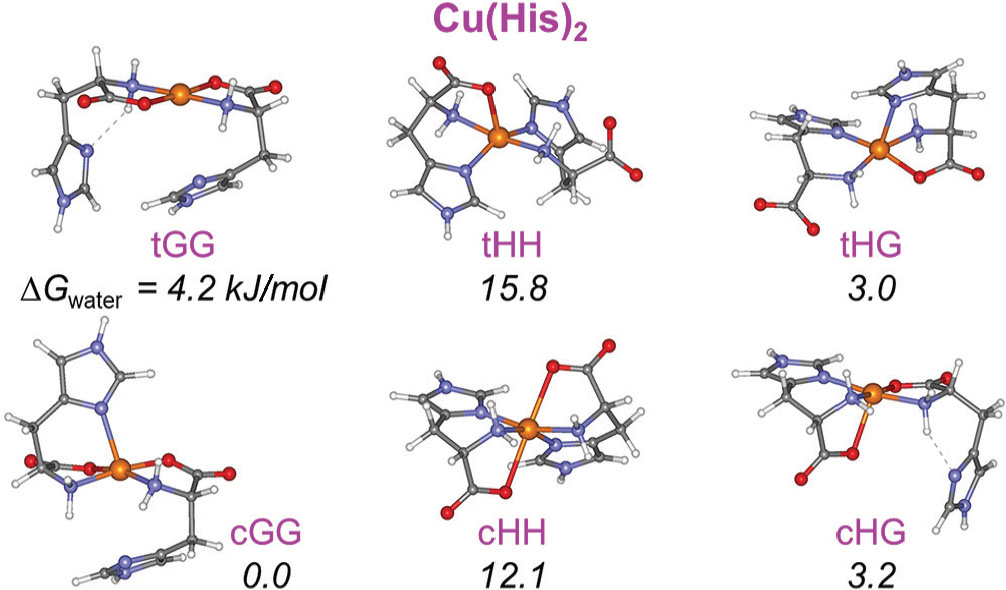
Figure 2
B3LYP-D3/6-311+G(3df,2p) prediction of aqueous Cu(His)2 conformers in the glycine- (G) and histamine-like (H) His coordination modes with a trans (t) or cis (c) configuration, along with their relative Gibbs free energies (∆Gwater, kJ/mol)
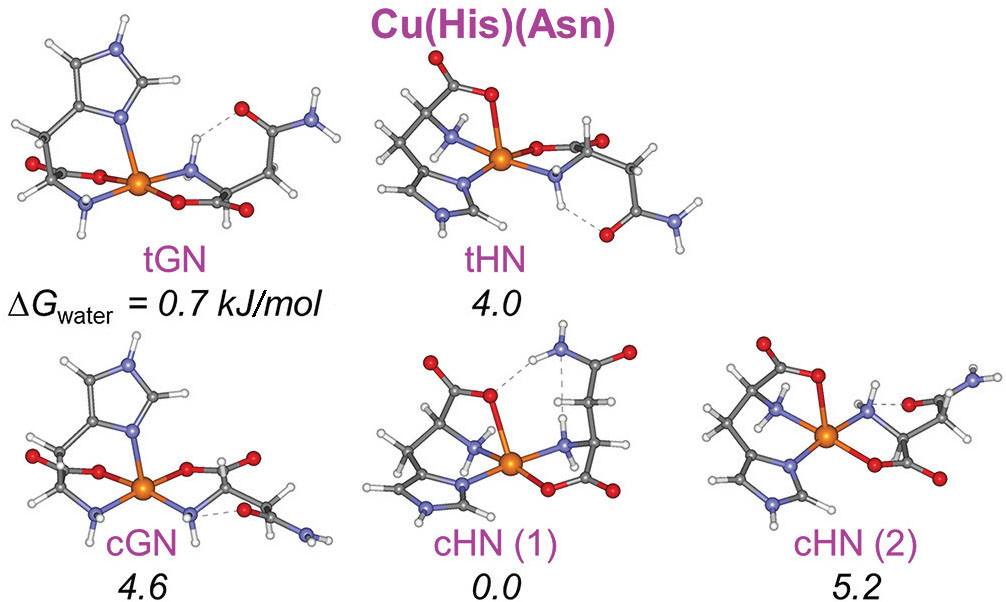
Figure 3
B3LYP-D3/6-311+G(3df,2p) prediction of aqueous Cu(His) (Asn) conformers with His in the glycine- (G) and histamine-like (H) coordination and Asn in the glycine-like mode (N) with a trans (t) or cis (c) configurations along with their relative Gibbs free energies (∆Gwater, kJ/mol)
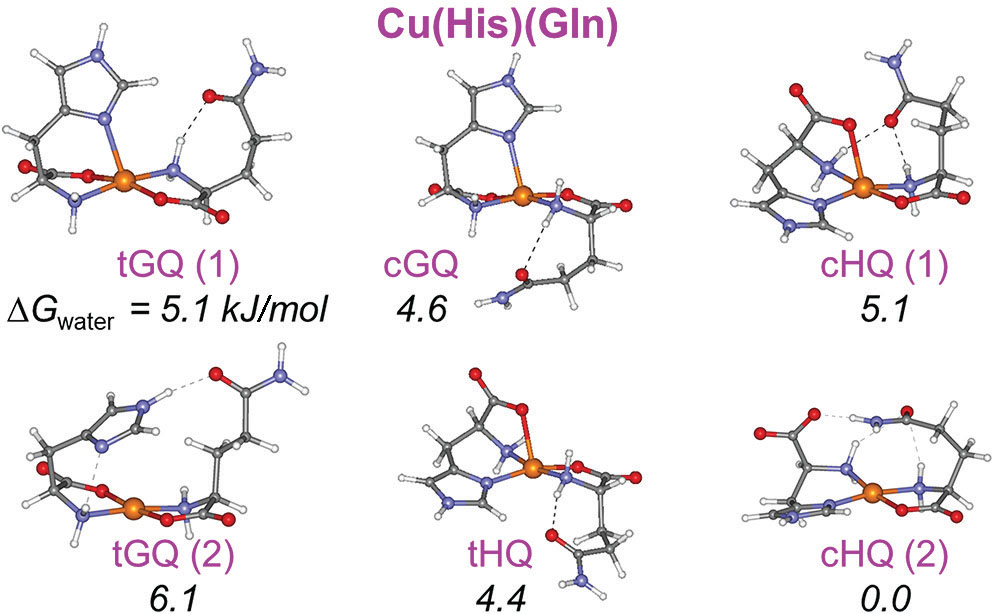
Figure 4
B3LYP-D3/6-311+G(3df,2p) prediction of aqueous Cu(His) (Gln) conformers with His in the glycine- (G) and histamine-like (H) modes and Gln in the glycine-like mode (Q) in a trans (t) or cis (c) configurations, along with their relative Gibbs free energies (∆Gwater, kJ/mol)
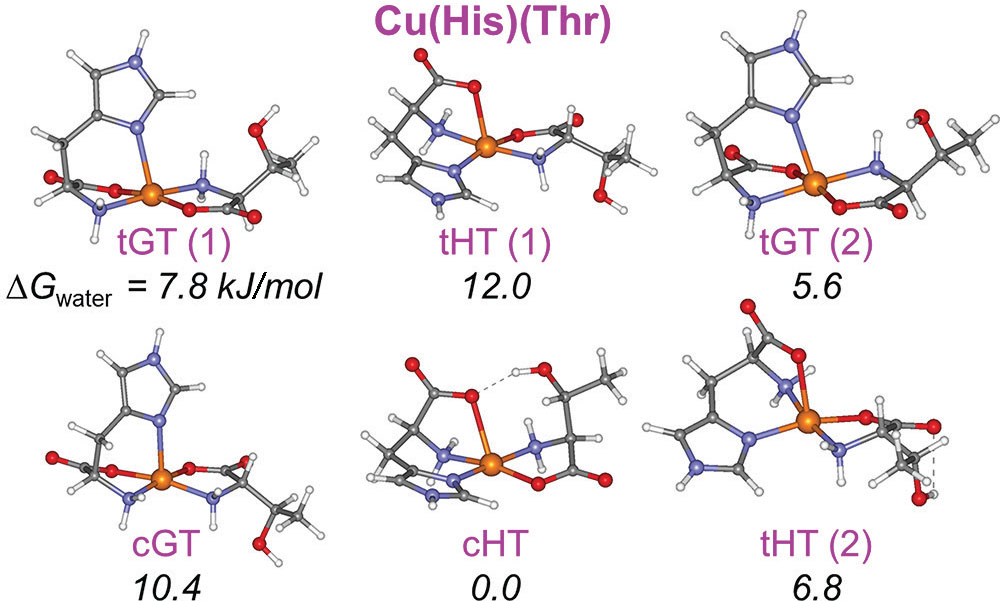
Figure 5
B3LYP-D3/6-311+G(3df,2p) prediction of aqueous Cu(His) (Thr) conformers with His in the glycine- (G) and histamine-like (H) modes and Thr in the glycinato mode (T) in a trans (t) or cis (c) configurations along with their relative Gibbs free energies (∆Gwater, kJ/mol)
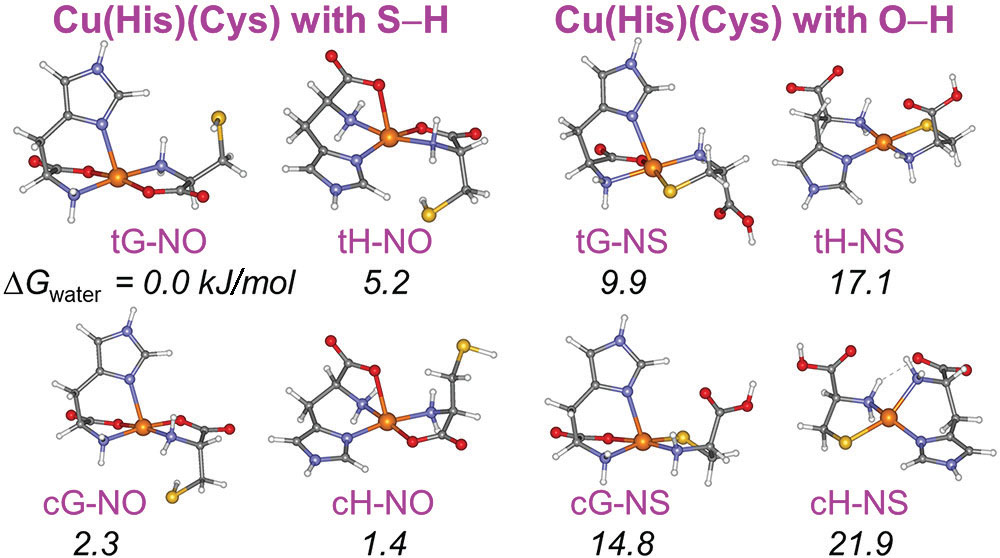
Figure 6
B3LYP-D3/6-311+G(3df,2p) prediction of aqueous Cu(His) (Cys) conformers in a trans (t) or cis (c) configurations with His in the glycinato (G) and histaminato (H) mode and with Cys in the glycinato (NO, left) and NS mode (right; Nam and S as the donor atoms), along with the relative Gibbs free energies (∆Gwater, kJ/mol)
Stability constants and conformational flexibility
Table 1 summarises stability constants (log β) of ternary Cu(His) (aa) and their parent binary compounds Cu(His)2, Cu(Thr)2, Cu(Asn)2, and Cu(Gln)2 determined potentiometrically under blood plasma conditions (temperature and ionic strength) in an unreactive NaClO4 electrolyte. Generally, the stability constants of the ternary compounds are higher than those statistically estimated by means of the experimental stability constants of their parent binary compounds (58, 77).
Table 1
Experimentally determined stability constants (log β) of ternary and binary amino acidato copper(II) compounds determined potentiometrically (37 °C, 0.15 mol/L NaClO4)
| Ternary compounds | log β | Reference |
|---|---|---|
| Cu(His)(Gln) | 16.703 | 53 |
| Cu(His)(Thr) | 17.030 | 51 |
| Cu(His)(Asn) | 16.756 | 53 |
| Cu(His)(Cys)* | 16.9 | 60 |
| Binary compounds | log β | Reference |
|---|---|---|
| Cu(His)2 | 17.498 | 78 |
| Cu(Gln)2 | 13.586 | 78 |
| Cu(Thr)2 | 14.299 | 78 |
| Cu(Asn)2 | 14.210 | 53 |
There are several explanations as to what enhances the stability of the ternary complexes. Kruck and Sarkar (79) suggested that the asymmetry around the central Cu(II) atom in Cu(His)(aa) contributed thermodynamically to system entropy and increase in stability constant. Yamauchi et al. (80), in turn, hypothesised that the reason was inter-ligand hydrogen bonding between polar amino-acid side groups in physiological Cu(His)(aa) species, which would additionally stabilise the compound, but found no confirmation in the stability constants for that, as little difference was revealed in log β between Cu(His)(aa) species with amino acids having either polar or nonpolar side chains (log β of 17.0–17.1).
Baxter and Williams (73) compared experimental thermodynamic parameters (the Gibbs free-energy change, ∆G, and corresponding contributions of enthalpy, H, and entropy, S) for the formation of ternary Cu(His)(Thr) and Cu(His)(Asn) with their statistically calculated values by means of the stability constants of their parent binary complexes (∆G=−RT ln 10 log β, where R is the gas constant, and T is temperature) and also found higher stability of the ternary compounds. They suggested that lower enthalpy and higher than expected entropy changes in ternary complexes could be due to changes in the Cu(II) solvation sphere rather than to intramolecular strain. A case in point is that greater Gibbs free energy (−∆G) released during the formation of Cu(His)(aa) is owed to more liberated water molecules from the Cu(II) solvation sphere, which increases ∆S but decreases −∆H (because more aquation bonds are ruptured) while the intramolecular strain lowers both ∆S and −∆H.
Our DFT conformational analyses of binary Cu(His)2, Cu(Thr)2, Cu(Asn)2, Cu(Gln)2, Cu(Cys)2 and ternary Cu(His)(Thr), Cu(His) (Asn), Cu(His)(Gln), and Cu(His)(Cys) provide insights into how ligand-ligand interactions between His and another amino acid in a ternary compound could change the available conformational space relative to the parent binary compounds (39,40,41,42,43,44,45). We analysed hydrogen bonds, apical bonding, and low-energy conformer numbers (39, 41,42,43,44,45) to find that both intra- and inter-ligand hydrogen bonds could be the stabilising factor and that ternary compounds have greater conformational flexibility than their parent binary compounds. Greater conformational flexibility arises from greater ability of Thr, Asn, Gln, and Cys to meet steric requirements in more conformations when interacting with His in a ternary Cu(His)(aa) than in a binary Cu(aa)2 compound (42,43,44,45). Cu(aa)2 compounds have numerous acceptor-donor sites available for intramolecular and intermolecular hydrogen bonding, as follows: O, Oc, Nam−H, Nτ−H in His; O, Oc, Nam−H, and Oh−H in Thr; O, Oc, Nam−H, Oad, Nad−H in Asn and Gln; and O (or O−H when S is unprotonated), S–H, Oc, Nam−H in Cys. The Cys thiol group has a lower hydrogen-bond strength than the Thr −OH and Asn or Gln −CONH2 side-chain groups due to lower electronegativity of S relative to N and O atoms.
Our analyses of aqueous conformers showed that Thr conformations were restricted to Oh−H···O and Oh−H···Oc bonds in Cu(Thr)2 (41). Conversely, the Thr conformational space was less restricted by hydrogen bonding in Cu(His)(Thr) (45). An intermolecular hydrogen bond between Oh−H and a water molecule was formed in five of the eight studied Cu(His)(Thr)×20H2O systems.
In Cu(His)(Asn), our analysis of hydrogen bonds (42) revealed a high tendency for forming an intra-ligand Nam–H···Oad in the Asn ligand. This tendency may stereochemically restrict intra- and intermolecular hydrogen bonding of the −NadH2 group. The Thr hydroxyl group turned out to be superior to the Asn amido group in adapting to changes in local aqueous surroundings.
Since Gln has a longer side chain than Asn (Figure 1), there is more room for variation to form energetically favoured conformations. Our analysis of intra- and inter-ligand hydrogen bonds of aqueous low-energy Cu(His)(Gln) conformers (43) suggests that the intra-residual restraint owed to the formation of Nam–H···Oad bonds is much less pronounced in Cu(His)(Gln) than Cu(His)(Asn).
Since a prediction of Cu(II) distribution in normal blood plasma using chemical speciation modelling (57) yielded a much larger Cu(II) percentage in Cu(His)(Gln) and Cu(His)(Thr) than in Cu(His)(Asn), we hypothesised that the physiological abundance of the ternary Cu(His)(aa) compounds and their role in Cu(II) exchange reactions in blood plasma may be related to their conformational flexibility (42, 43).
Probably thanks to this flexibility, small multifunctional Cu(II) binding drugs and MPACs (9, 12) can form neutral bis-Cu(II) and ternary compounds with His in solutions, in which CuN2O2 or CuN3O are in the equatorial plane (48). One such experimental drug for the treatment of Alzheimer’s disease is 5,7-dichloro-2-[(dimethylamino)methyl]quinolin-8-ol (PBT2) (48). Just like the studied Cu(His)(aa) compounds, PBT2 has the flexibility to form a tridentate or bidentate chelate with several Cu(II)-binding groups (47).
DFT-PREDICTED METAL ION AFFINITIES
The potential of Cu2+ to bind to amino acid ligands in Cu(His)2 and Cu(His)(aa) in aqueous solution can be assessed with the so called metal ion affinity (MIA), as follows:
where ∆H is the negative value of the enthalpy change of the reaction Cu2+ + L1− + L2− → Cu(L1)(L2), and L1− and L2− are free amino-acid ligands.In the gas phase, some amino acid affinities were determined experimentally (81) and in silico (using quantum chemical calculations) only for Cu(I) (82) and Cu(II) (83) monoligand compounds. To the best of our knowledge, no experimental data have been reported for their affinities for Cu(II) in Cu(aa)2 compounds. In one study (44), we therefore calculated the MIA values for Cu2+ binding to Cys− and His− ligands in Cu(His)(Cys) with and without explicit water molecules in implicitly modelled aqueous solution using the B3LYP density functional with Grimme’s dispersion correction as part of the DFT-D3 scheme (B3LYP-D3) (84) and the 6-311+G(3df,2p) basis set. Since the approaches with and without explicit water molecules yielded generally the same MIA trend, we opted for the approach without explicit water molecules to evaluate MIA in Cu(His)(Gln) (43). Such approach treats equally and consistently all conformers regardless of the Cu(II) coordination number and possible water molecule positions. The issues related to the equilibrium structures of Cu(aa)2 surrounded by explicit water molecules are detailed elsewhere (39, 42,43,44,45, 67).
To complete the MIA scale for all studied Cu(His)(aa) and Cu(His)2, we optimised the geometry of the selected Cu(His)(Thr), Cu(His)(Asn), and Cu(His)2 conformers using B3LYP-D3 and the basis set 6-311+G(3df,2p) in implicitly modelled aqueous surroundings. The selected trans and cis conformers are with His in the H and G modes, as they were dominant in previously characterised low-energy minima (39, 40, 42, 45). Implicit solvent effects were modelled with the integral equation formalism of polarisable continuum model (PCM) (85) which is integrated in the Gaussian 16 suite of programs (86). The minimum L1− and L2− conformations were obtained by geometry optimisation of their geometries taken from the corresponding Cu(L1)(L2) conformers. Thermal corrections to the enthalpy, entropy, and Gibbs free energy values were calculated at 25 °C (298.15 K) in the standard way.
Figures 2–6 show the B3LYP-D3/6-311+G(3df,2p) equilibrium geometries for Cu(His)2, Cu(His)(Asn), Cu(His)(Gln), Cu(His)(Thr), and Cu(His)(Cys) and corresponding relative Gibbs free energies (∆G). Table 2 shows His− and either Asn− or Thr− affinities for Cu2+ binding in Cu(His)2, Cu(His)(Asn), or Cu(His)(Thr) in aqueous solution at room temperature, the B3LYP-D3/6-311+G(3df,2p) enthalpies of the aqueous Cu2+ ion, complex, and ligand conformers. The enthalpies of the Cu(His)(Gln) and Cu(His)(Cys) conformers are given elsewhere (43, 44). Figure 7 presents in one place the calculated MIA values for the conformers of the five Cu(aa)2 compounds.
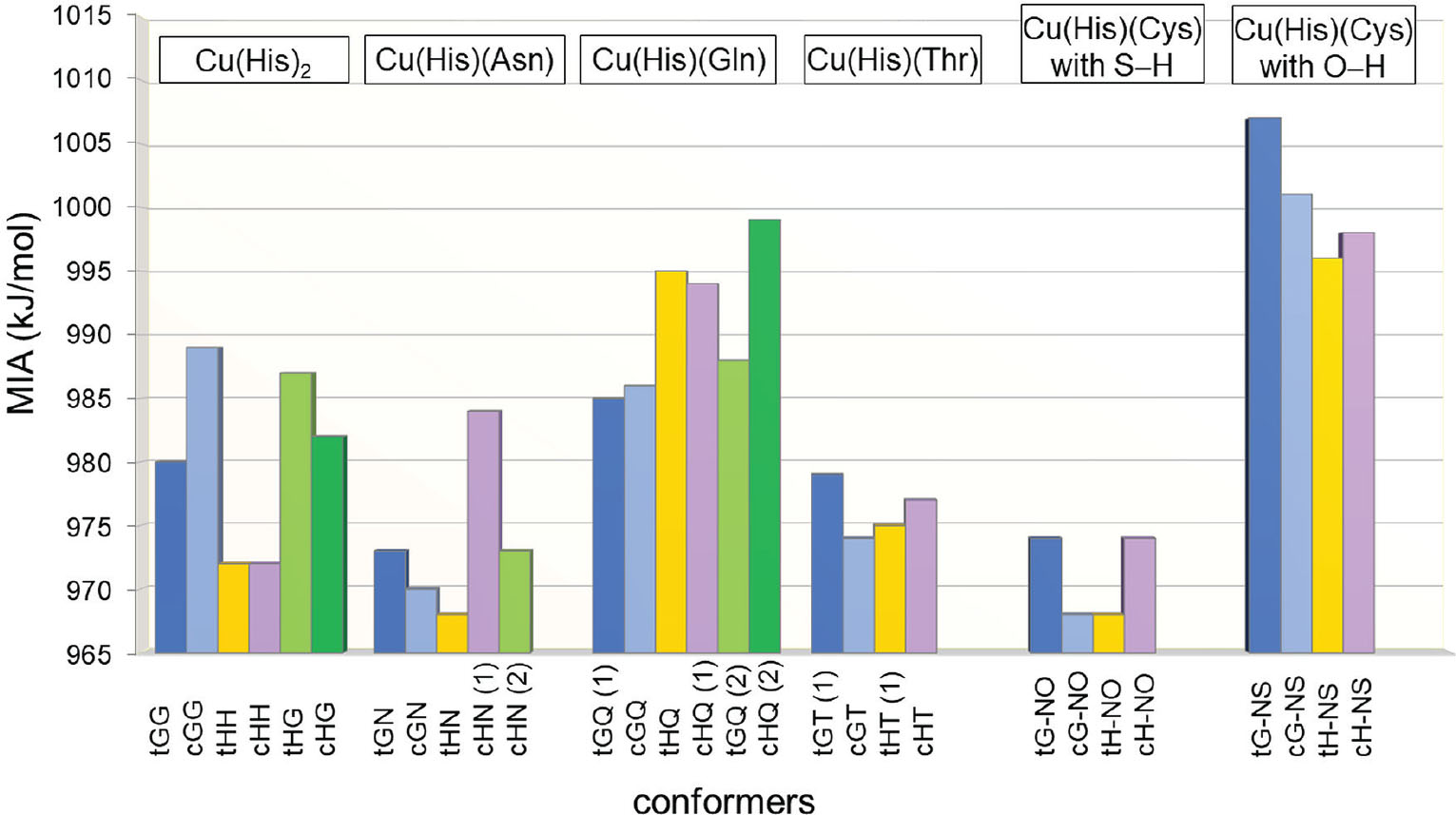
Figure 7
Metal ion affinity (MIA) values calculated for low-energy aqueous conformers of five Cu(aa)2 compounds obtained using the B3LYP-D3 functional and 6-311+G(3df,2p) basis set (see Table 2). [Cu(His)(Gln) and Cu(His) (Cys) values are based on two earlier reports (43, 44)]
Table 2
Enthalpies and metal ion affinities (MIA) for selected Cu(His)2, Cu(His)(Asn), and Cu(His)(Thr) conformers and their corresponding His−, Asn−, and Thr− minimum structures calculated using the B3LYP-D3 functional and 6-311+G(3df,2p) basis set in implicitly modelled aqueous solution using polarisable continuum model (PCM) at 298.15 K
| Conformer* | Enthalpy (a.u.) | MIA (kJ/mol) | ||
|---|---|---|---|---|
| Cu(His)2 | L1− (His−) | L2− (His−) | ||
| tGG | −2737.094653 | −548.382771 | −548.384674 | 979.6 |
| cGG | −2737.096348 | −548.382743 | −548.382719 | 989.3 |
| tHH | −2737.091682 | −548.382725 | −548.384669 | 971.9 |
| cHH | −2737.092565 | −548.383451 | −548.384666 | 972.4 |
| tHG | −2737.095356 | −548.382781 | −548.382751 | 986.5 |
| cHG | −2737.095784 | −548.382817 | −548.384681 | 982.4 |
| Cu(His)(Asn) | L1− (His−) | L2− (Asn−) | ||
| tGN | −2680.789917 | −548.382752 | −492.082518 | 972.9 |
| cGN | −2680.786351 | −548.382801 | −492.080036 | 969.9 |
| cHN (1) | −2680.792287 | −548.382750 | −492.080519 | 984.4 |
| cHN (2) | −2680.787487 | −548.382733 | −492.080062 | 973.0 |
| tHN | −2680.788118 | −548.382752 | −492.082536 | 968.1 |
| Cu(His)(Thr) | L1− (His−) | L2− (Thr−) | ||
| tGT (1) | −2626.583463 | −548.382793 | −437.873675 | 979.1 |
| tTG (2) | −2626.583989 | −548.382791 | −437.880005 | 963.8 |
| cGT | −2626.581558 | −548.382725 | −437.873662 | 974.3 |
| tHT (1) | −2626.581712 | −548.382770 | −437.873628 | 974.6 |
| tHT (2) | −2626.583521 | −548.382751 | −437.880002 | 962.7 |
| cHT | −2626.588520 | −548.382757 | −437.879386 | 977.4 |
a.u. – atomic unit (2625.5 kJ/mol). Metal ion affinities were calculated using Eq 1 (see text). The B3LYP-D3/6-311+G(3df,2p) enthalpy of aqueous Cu2+ H(Cu2+) = −1639.954092 a.u.
* Conformers are given in Figures 2–6. The L1− and L2− minimum structures were computed by using the B3LYP-D3/6-311+G(3df,2p) geometry optimisation of the respective ligand geometry in each of denoted Cu(L1)(L2) minimum structure
Most conformers shown in Figures 2–6 can be considered low-energy, since their ∆G values are up to 15.8 kJ/mol. The exception are Cu(His)(Cys) NS conformers, with ∆G up to 21.9 kJ/mol (Figure 6), which also exhibit the highest MIA values (Figure 7). While entropy contributions to the Gibbs free energy at 298.15 K are the same for all Cys− conformations (0.4 kJ/mol per K) (44), conformations with the thiol S–H group have much lower enthalpies than the thiolate conformers with the O–H group (by 45 kJ/mol). These findings are in line with an earlier computational study (87) reporting that the Cys unconventional zwitterion with deprotonated sulphur [−S–CH2–CH(NH3+) − COOH] had significantly greater energy than the neutral [HS–CH2–CH(NH2)–COOH] and conventional zwitterion [HS–CH2–CH(NH3+)–COO−] tautomers. Our analysis of electron density distribution among the nuclear centres of Cu–S bonds (44) suggests a more covalent character in Cu–S(thiolate), where sulphur is deprotonated, than in Cu–S(thiol), where it is protonated. In Cu(His)(Cys) higher affinity of Cu(II) for binding Cys− conformations with protonated carboxylato groups and Cu–S(thiolate) is explained by higher covalence and different ionic contributions due to different charges of Cu(II) and S in the thiol vs. thiolate systems.
The MIA trend predictions for the five Cu(aa)2 compounds (Figure 7) can be compared with chemical speciation of LMW compounds in blood plasma. As already mentioned, the most recent chemical speciation study predicted the distribution of Cu(II) to be 25 % in Cu(His)(Gln), 14 % in Cu(His)2, 9 % in Cu(His)(Thr), and <1 % in Cu(His)(Asn) (57). The fact that Cu(His)(Cys) is not among LMW compounds in the blood plasma model may be explained by the fact that the Cu(His)(Cys) stability constant has been unknown until recently (60), and has thus not been included into the database for speciation modelling.
Besides Cu(His)(Cys) with the NS mode, Cu(His)(Gln) conformers have the largest MIA value, followed by Cu(His)2 conformers (Figure 7). Not only has Gln the highest concentration in blood plasma (63), but the MIA shows its relatively high affinity for binding with Cu(II)-His in aqueous solution.
Although experimental studies and our previous B3LYP predictions suggest high prevalence of the Cu(His)2 cHH and cHG modes in aqueous solutions (39, 40), higher MIA values are predicted for the GG and HG than HH conformers (Table 1, Figure 7). Similarly, Shtyrlin et al. (35) report a slightly larger energy preference (by 2.9 kJ/mol) to a cHG over a cHH conformer by DFT calculations. These findings may point to the importance of including many explicit water molecules in DFT calculations, which, of course requires greater computing power in the future, as such simulations are still quite time-consuming.
The MIA of the Cu(His)(Asn) cHN conformer with an inter-ligand hydrogen bond (Figure 3) is slightly higher than that of the Cu(His)(Thr) conformers, even cHT (Figure 5) with the inter-ligand bonding (984.4 vs. 977.4 kJ/mol, respectively, Figure 7, Table 2). This prediction does not fully match May’s prediction (57) that Cu(His)(Thr) is considerably preferred to Cu(His)(Asn), but, overall, our MIA trend supports May’s chemical speciation ranking that Cu(His)(Gln) and Cu(His)2 are predominant Cu(aa)2 species with N and O donor atoms.
CONCLUDING REMARKS
DFT structural predictions of physiologically important, neutral LMW Cu(His)2 and Cu(His)(aa) species (aa stands for Asn, Gln, Thr, and Cys) have provided an insight into the conformers and coordination modes that can coexist in aqueous solutions at room temperature. These data have still to be checked experimentally. The predicted structures and analyses of the intra- and inter-ligand hydrogen bonds add new information that can help explain what causes higher stability of ternary Cu(His)(aa) compounds relative to their parent binary complexes in aqueous solutions under physiological conditions. An insight into the intra- and inter-ligand hydrogen-bond interactions may also help to understand how amino-acid side chain interactions affect Cu binding sites in proteins, but we leave this topic for another time.
Cu(His)(Cys) and Cu(His)(Gln) are the compounds with the highest MIA values. Cu(His)(Gln) is also the most abundant Cu(aa)2 compound in blood plasma, at least according to chemical speciation predictions. Bearing in mind the experimental difficulties of obtaining Cu(His)(Cys), the Cu(His)(Gln) species may be a likely candidate for future pharmacological studies.
Acknowledgements
I thank Martina Piasek, MD, PhD, for critical reading and expert help in preparing the manuscript for publication and my collaborators, especially Professor Michael Ramek, for the joint adventure of researching the title compounds. This work was funded by the European Union – Next Generation EU Programme (contract of 8 December 2023, Class: 643-02/23-01/00016, Reg. no. 533-03-23-0006). Computational resources were provided by the Supercomputer Supek with High Performance Computing (HPC) infrastructure at the Zagreb University Computing Centre.