Have a personal or library account? Click to login
A follow-up on the hesperetin issue in modelling the first electrochemical oxidation potential and antioxidant activity of flavonoids Cover

A follow-up on the hesperetin issue in modelling the first electrochemical oxidation potential and antioxidant activity of flavonoids

Open Access
|Mar 2024

Figures & Tables

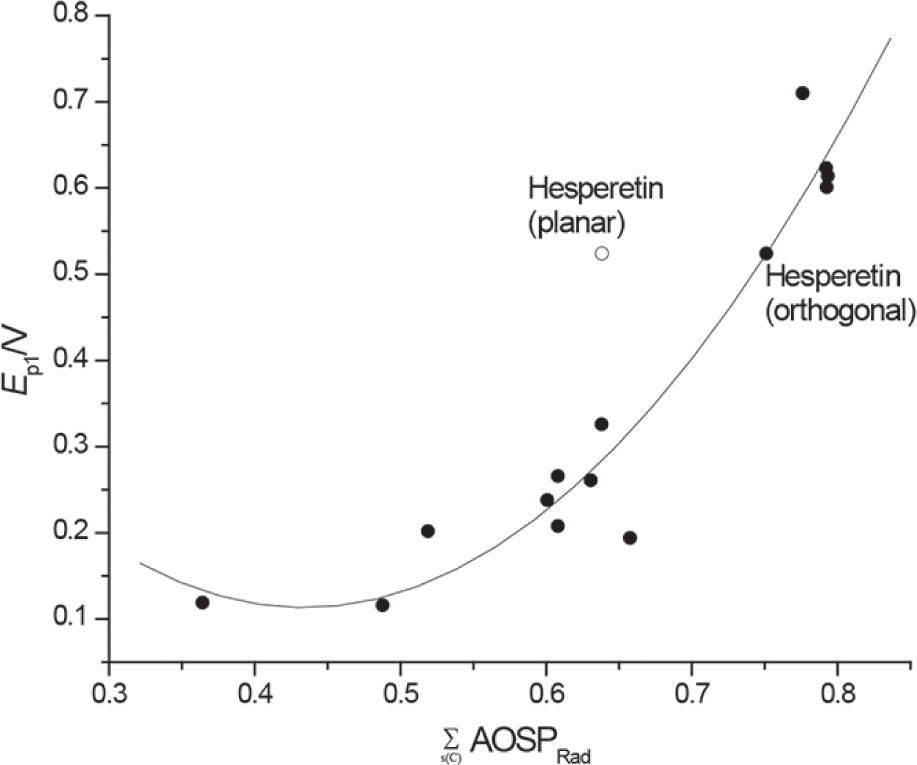
Figure 1

The dependence of experimental Ep1 (pH = 7) on s(C)AOSPRad , calculated using the PM6 method, for 14 flavonoids from (1). Empty circle represents s(C)AOSPRad of hesperetin calculated using methoxy group planar with the B ring plane [as in (1)]. When the methoxy group was set orthogonally to the B ring plane (filled circle), the s(C)AOSPRad of hesperetin fit the regression model, yielding R2=0.930, SE=0.053, and SEcv=0.069
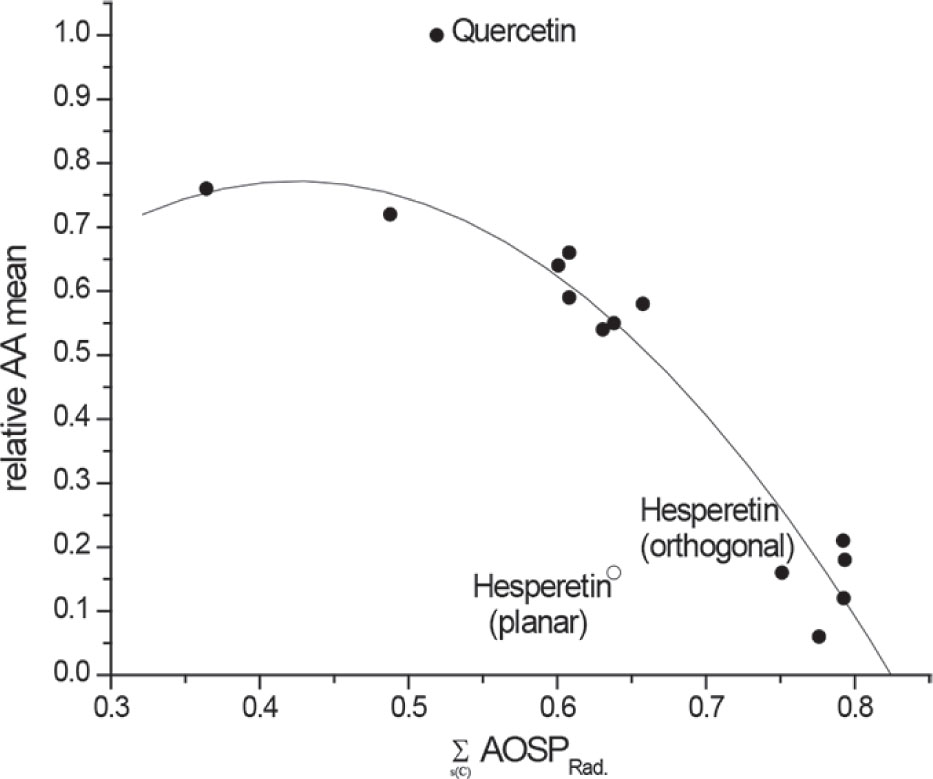
Figure 2

The dependence of experimental relative AA mean on s(C)AOSPRad , calculated using the PM6 method for the set of 14 flavonoids from (1). Empty circle represents s(C)AOSPRad of hesperetin calculated using methoxy group planar with the B ring plane [as in (1)]. When the methoxy group was set orthogonally to the B ring plane (filled circle), the s(C)AOSPRad of hesperetin fit the regression model well, yielding R2=0.942, SE=0.059, and SEcv=0.073 (after exclusion of quercetin)

DOI: https://doi.org/10.2478/aiht-2024-75-3823 | Journal eISSN: 1848-6312 (formerly 0004-1254) | Journal ISSN: 0004-1254
Language: English, Croatian
Page range: 85 - 86
Published on: Mar 29, 2024
Published by: Institute for Medical Research and Occupational Health
In partnership with: Paradigm Publishing Services

© 2024 Ante Miličević, published by Institute for Medical Research and Occupational Health
This work is licensed under the Creative Commons Attribution 4.0 License.