
Dear Editor,
In Volume 70 (pages 134–139) of Arhiv za higijenu rada i toksikologiju – Archives of Industrial Hygiene and Toxicology, I published a paper entitled “The relationship between antioxidant activity, first electrochemical oxidation potential, and spin population of flavonoid radicals” (1). The paper detected a problem with hesperetin, a flavonoid (flavanone) with 4′-methoxy and 3′-hydroxyl groups on the B ring. That problem was later resolved in a paper published in the Journal of Molecular Liquids (2021;335:116223) on a set of 29 flavonoids (2), which I believe is worth reporting as a follow-up to my aforementioned article published in the Archives.
More precisely, in my paper (1), I detected hesperetin as an outlier in regression models for the estimation of both oxidation potential (Ep1) and antioxidant activities (AA), on a set of 14 flavonoids. The models [Models 2 and 7, Figures 2 and 3 in (1)] were based on the sum of atomic orbital spin populations over the carbon atoms in the skeleton of a flavonoid radical, , calculated using semiepirical PM6 method. Later, in our paper on Ep1 models for 29 flavonoids (2), we succeeded in resolving a problem with hesperetin and its glycosides, hesperidin and neohesperidin, thanks to studies on the electron donation potential of the ortho-methoxy group in quinones (3, 4). When we fixed the methoxy group, placing it outside of the plane (orthogonally to the B ring) during optimization, the calculated for hesperetin, hesperidin, and neohesperidin fit into the model perfectly, Figure 1 in (2) [see more details about approaching certain flavonoids, like flavanones, isoflavones, and flavonoids with O-glycosyl, galloyl and methoxy substituents, as well as a new models that we introduced in (2, 5, 6)].
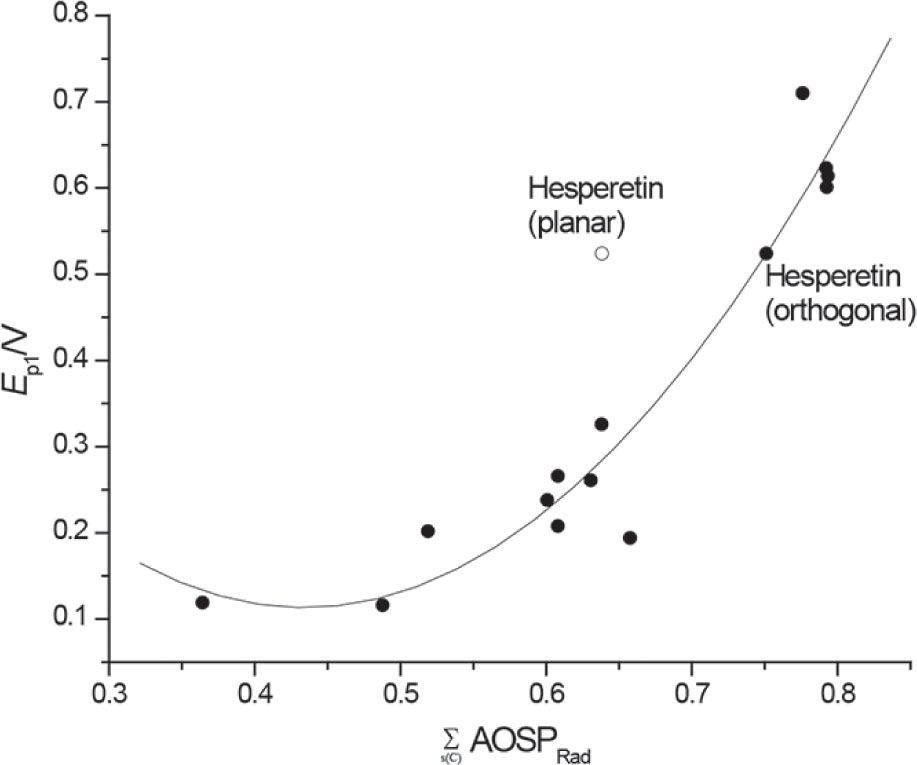
Figure 1
The dependence of experimental Ep1 (pH = 7) on , calculated using the PM6 method, for 14 flavonoids from (1). Empty circle represents of hesperetin calculated using methoxy group planar with the B ring plane [as in (1)]. When the methoxy group was set orthogonally to the B ring plane (filled circle), the of hesperetin fit the regression model, yielding R2=0.930, SE=0.053, and SEcv=0.069
Figures 1 and 2 show that values for hesperetin calculated in this way fit the quadratic regression models in (1).
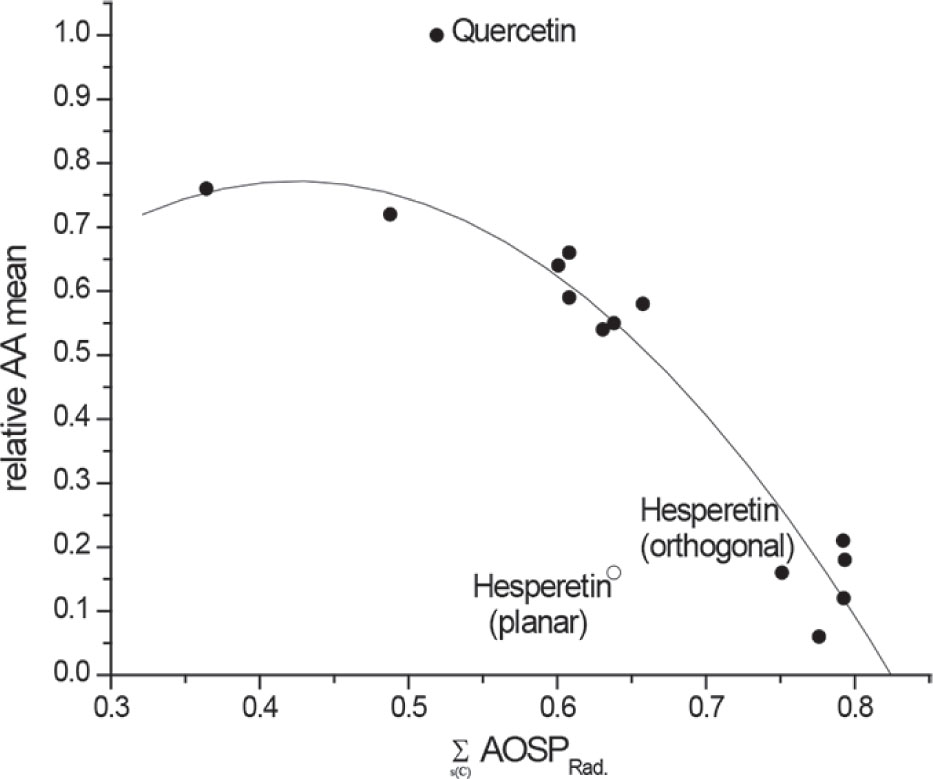
Figure 2
The dependence of experimental relative AA mean on , calculated using the PM6 method for the set of 14 flavonoids from (1). Empty circle represents of hesperetin calculated using methoxy group planar with the B ring plane [as in (1)]. When the methoxy group was set orthogonally to the B ring plane (filled circle), the of hesperetin fit the regression model well, yielding R2=0.942, SE=0.059, and SEcv=0.073 (after exclusion of quercetin)
Acknowledgement
Funded by the European Union – Next Generation EU [Interactions between Human and Environmental Health: Determinants of Health Preservation (HumEnHealth) under Program Contract of 8 December 2023, Class: 643-02/23-01/00016, Reg. no. 533-03-23-0006].