Have a personal or library account? Click to login
Ozone disinfection efficiency against airborne microorganisms in hospital environment: a case study Cover

Ozone disinfection efficiency against airborne microorganisms in hospital environment: a case study

Open Access
|Dec 2022

Figures & Tables

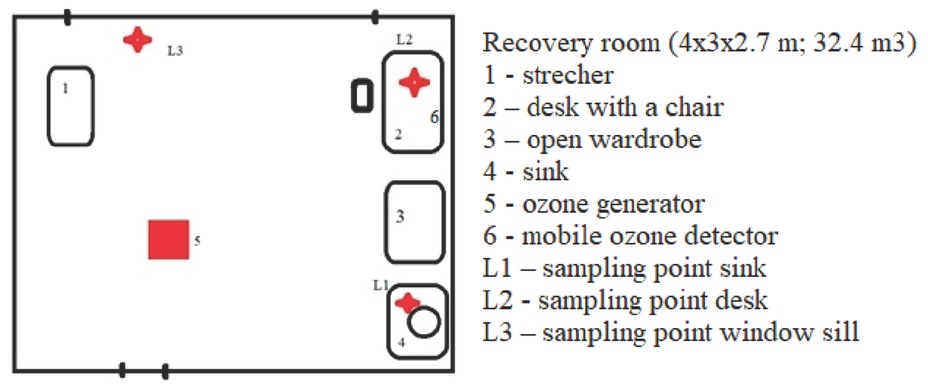
Figure 1

Recovery room layout
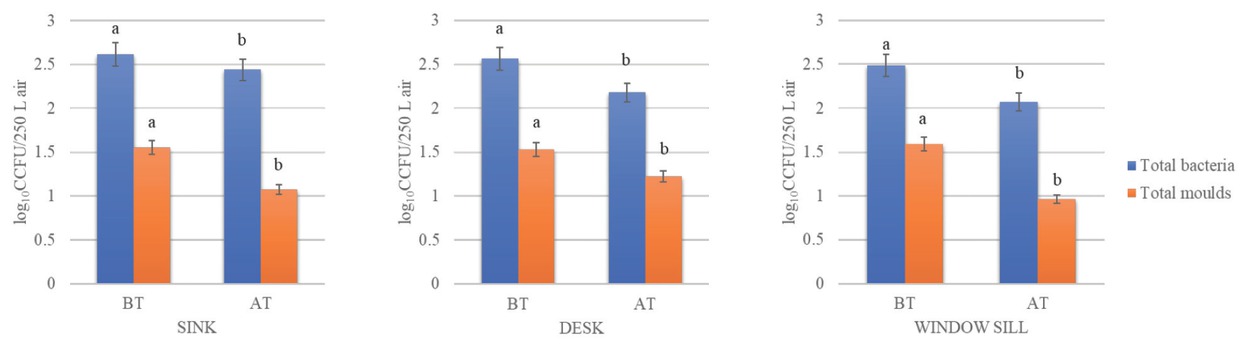
Figure 2

Total bacterial and mould counts before (BT) and after (AT) 1-hour treatment with ozone at the concentration of 15.71 mg/m3. Different letters denote significant differences between groups (p<0.05; nonparametric Wilcoxon rank-sum test)
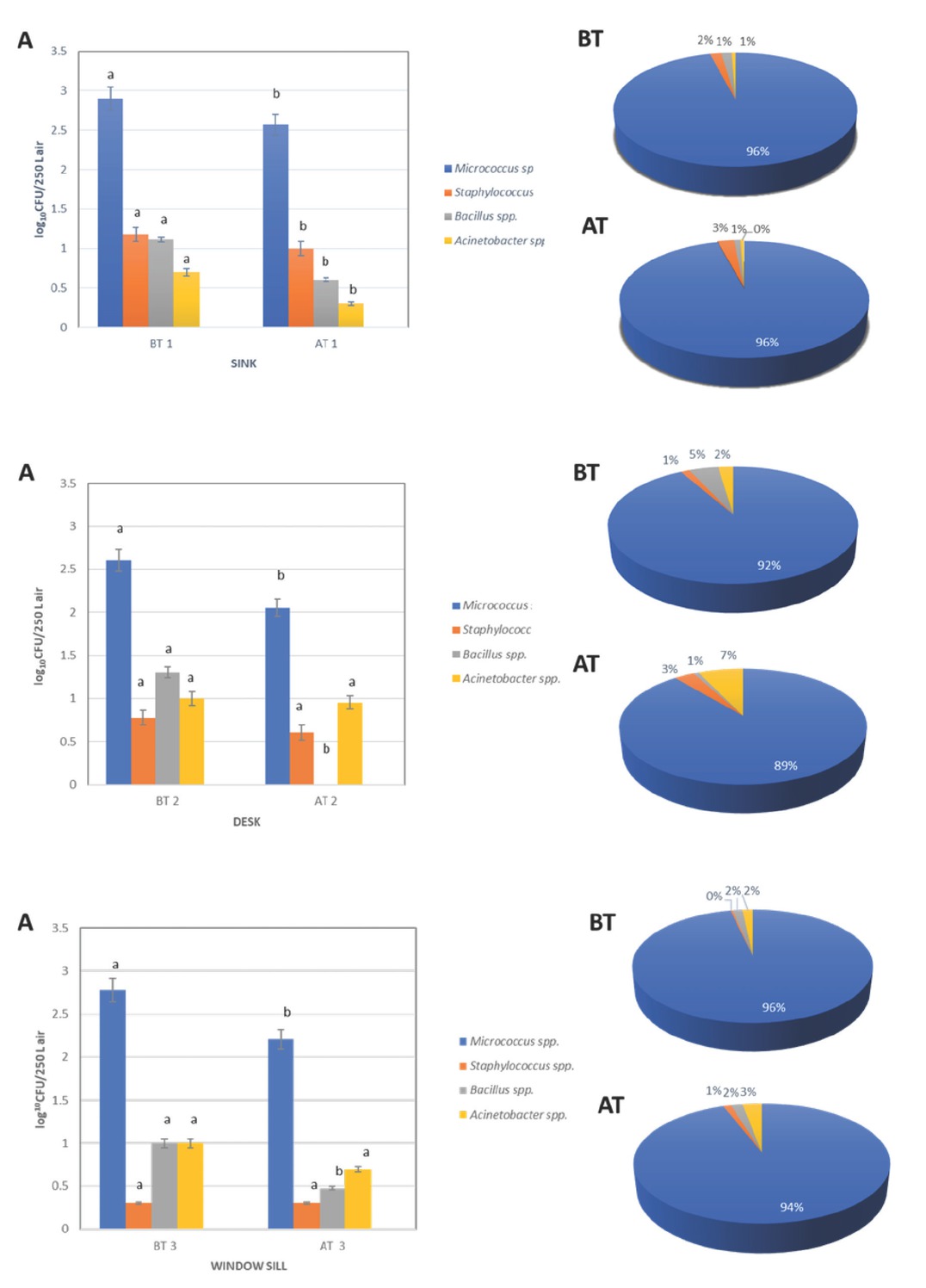
Figure 3

Changes in bacterial counts and prevalence (%) by identified genera before (BT) and after (AT) ozone treatment (15.71 mg/m3) at the three sampling points. Different letters denote significant differences between groups (p<0.05; nonparametric Wilcoxon rank-sum test).

Table 1

Inhibition rates of total bacteria counts at the three sampling points

rPrrPr
L3 – window sill30959111814061

[i] Pr – probable (statistical) total bacterial count; r – number of counted colonies

Table 2

Inhibition rates by identified bacteria at the three sampling points.

rPrrPrrPrrPrrPrrPr
Acinetobacter spp.5522601010555010109910

[i] Pr – probable (statistical) total bacterial count; r – number of counted colonies

DOI: https://doi.org/10.2478/aiht-2022-73-3651 | Journal eISSN: 1848-6312 (formerly 0004-1254) | Journal ISSN: 0004-1254
Language: English, Croatian
Page range: 270 - 276
Submitted on: Apr 1, 2022
Accepted on: Dec 1, 2022
Published on: Dec 30, 2022
Published by: Institute for Medical Research and Occupational Health
In partnership with: Paradigm Publishing Services

© 2022 Kaća Piletić, Dijana Tomić Linšak, Bruno Kovač, Silvestar Mežnarić, Marin Repustić, Martina Radmanović-Skrbić, Ivana Gobin, published by Institute for Medical Research and Occupational Health
This work is licensed under the Creative Commons Attribution-NonCommercial-NoDerivatives 4.0 License.