Have a personal or library account? Click to login
Whey protein protects liver mitochondrial function against oxidative stress in rats exposed to acrolein Cover

Whey protein protects liver mitochondrial function against oxidative stress in rats exposed to acrolein

Open Access
|Sep 2022

Figures & Tables

Figure 1

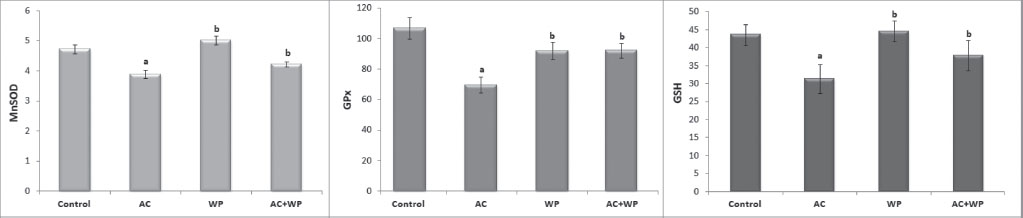
The effects of acrolein (AC) and/or whey protein (WP) on MnSOD (U/mg protein), GPx (nmol of NADPH oxidised/min/mg protein) and GSH (nmol/mg protein) levels. Values are expressed as means ± SD (n=6). (a) significant vs control and (b) significant vs AC (p<0.05). GPx – glutathione peroxidase; GSH – glutathione; MnSOD – mitochondrial super oxide dismutase
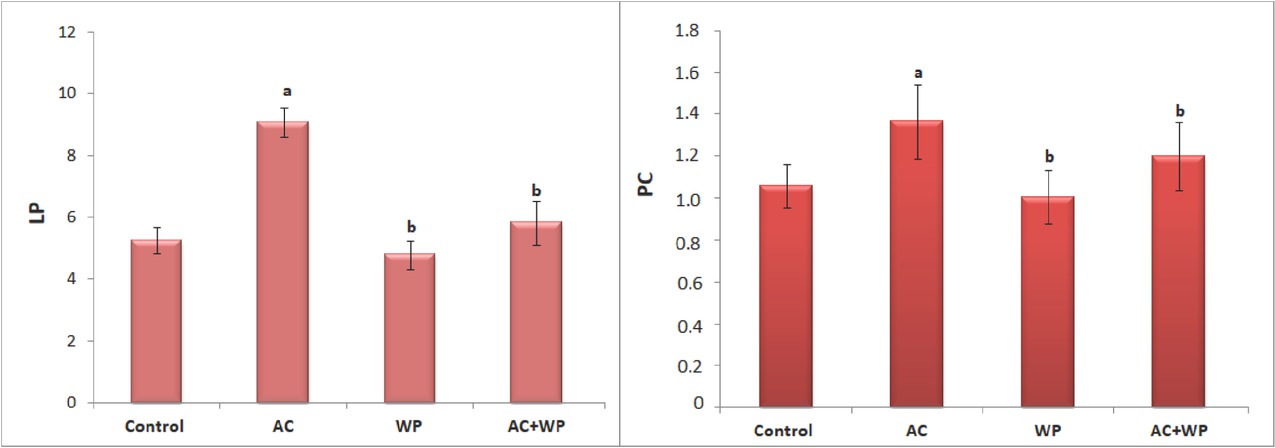

Figure 2

The effects of acrolein (AC) and/or whey protein (WP) on LP (nmol equivalents of malonedialdehyde/mg protein) and PC (nmol DNPH incorporated/mg protein) levels. Values are mean±SD (n=6). Data analysed by one-way analysis of variance (ANOVA) followed by Tukey’s test for comparison of means. (a) significant against 0.9 % NaCl control and (b) significant against AC at p<0.05. LP – lipid peroxidation; PC – protein carbonyl
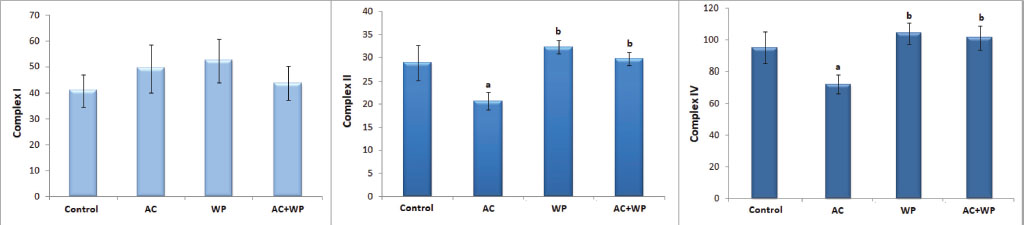

Figure 3

The effects of acrolein (AC) and/or whey protein (WP) on complex I (mmol DCPIP reduced/min/mg protein), complex II (mmol DCPIP reduced/min/mg protein), complex IV (mmol cytochrome c oxidised/min/mg protein) levels. Values are mean±SD (n=6). Data analysed by one-way analysis of variance (ANOVA) followed by Tukey’s test for comparison of means. (a) significant against 0.9 % NaCl control and (b) significant against AC at p<0.05. Complex I – NADH-coenzyme Q oxidoreductase; Complex II – succinate dehydrogenase-coenzyme Q oxidoreductase; Complex IV – cytochrome c oxidase
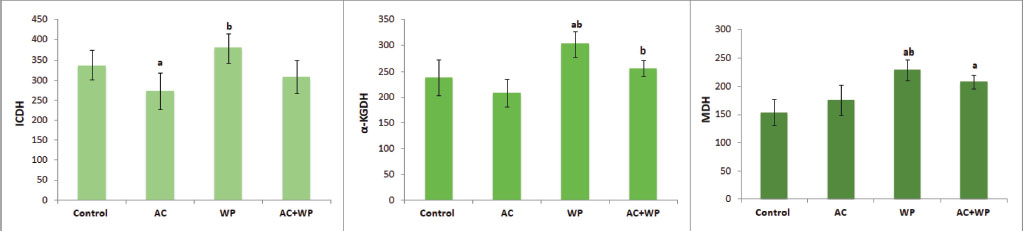

Figure 4

The effects of acrolein (AC) and/or whey protein (WP) on ICDH (mmol NADP+ reduced/min/mg protein), α-KGDH (mmol NAD+ reduced/min/mg protein), MDH (mmol NAD+ reduced/min/mg protein) levels. Values are mean±SD (n=6). Data analysed by one-way analysis of variance (ANOVA) followed by Tukey’s test for comparison of means. (a) significant against 0.9 % NaCl control and (b) significant against AC at p<0.05. α-KGDH – α-ketoglutarate dehydrogenase; ICDH – isocitrate dehydrogenase; MDH – malate dehydrogenase
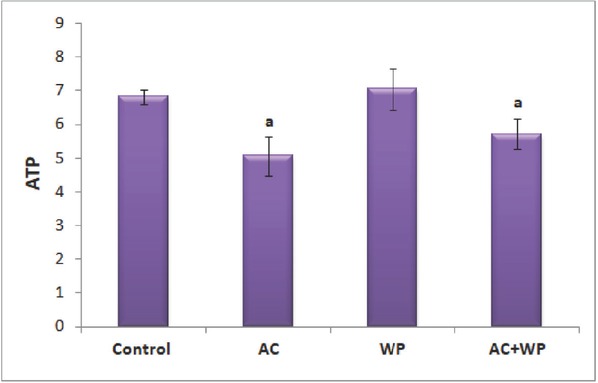

Figure 5

The effects of acrolein (AC) and/or whey protein (WP) on ATP (nmol/mg protein) level. Values are mean±SD (n=6). Data analysed by one-way analysis of variance (ANOVA) followed by Tukey’s test for comparison of means. (a) significant against 0.9 % NaCl control and (b) significant against AC at p<0.05. ATP – adenosine triphosphate
DOI: https://doi.org/10.2478/aiht-2022-73-3640 | Journal eISSN: 1848-6312 | Journal ISSN: 0004-1254
Language: English, Croatian, Slovenian
Page range: 200 - 206
Submitted on: Mar 1, 2022
Accepted on: Aug 1, 2022
Published on: Sep 30, 2022
Published by: Institute for Medical Research and Occupational Health
In partnership with: Paradigm Publishing Services
Publication frequency: 4 issues per year

© 2022 Birsen Aydın, Ali Oğuz, Vedat Şekeroğlu, Zülal Atlı Şekeroğlu, published by Institute for Medical Research and Occupational Health
This work is licensed under the Creative Commons Attribution-NonCommercial-NoDerivatives 4.0 License.