
Table 1
Comparison of major novel scoring systems for gastric cancer screening
| Scoring system name | Core components/variables | Risk stratification | Performance (Sensitivity/Specificity) | Target population | Key characteristics regarding missed diagnosis risk |
|---|---|---|---|---|---|
| NGCS | Age, Sex, H. pylori antibody, Pepsinogen I/II, Gastrin-17 | Low, Intermediate, High | AUC ∼0.79 | Chinese population in high-risk regions | A small but non-negligible proportion 0.94% of gastric cancers are detected in the low-risk group |
| New ABC method | H. pylori antibody, Pepsinogen I/II ratio | Groups A, B, C, D | High Negative Predictive Value (NPV >97%) | Multi-ethnic populations | The missed diagnosis rate in the low-risk group (Group A) is very low but not zero |
| GC-RSS | Age, BMI, Smoking, Dietary habits, Family history, etc. (Questionnaire-based) | Risk Score/Percentile | AUC >0.70 | Urban residents | Relies on subjective recall; susceptible to missing occult lesions in individuals with atypical presentations |
| OLGA/OLGIM staging | Histological staging of atrophy (OLGA) and intestinal metaplasia (OLGIM) | Stages 0–IV | Correlates with cancer risk | Patients undergoing endoscopy with biopsy | The ‘low-risk’ stages (0–II) still carry a potential, albeit lower, risk of progression. Risk is dependent on biopsy sampling quality and interpretation |
Table 2
Key contributing factors to the risk of missed diagnosis in low-risk populations
| Factor category | Specific mechanisms | Representative references |
|---|---|---|
| Scoring system design flaws |
| [11,48,50] |
| Occult biological characteristics of GC |
| [24,26,28,32,35] |
| Insufficient sensitivity of biomarkers |
| [38,39,42,44] |
| Limitations in clinical screening practices |
| [52,53,55,59,60,61] |
| Deficiencies in screening strategy and system |
| [22,63,64,71] |
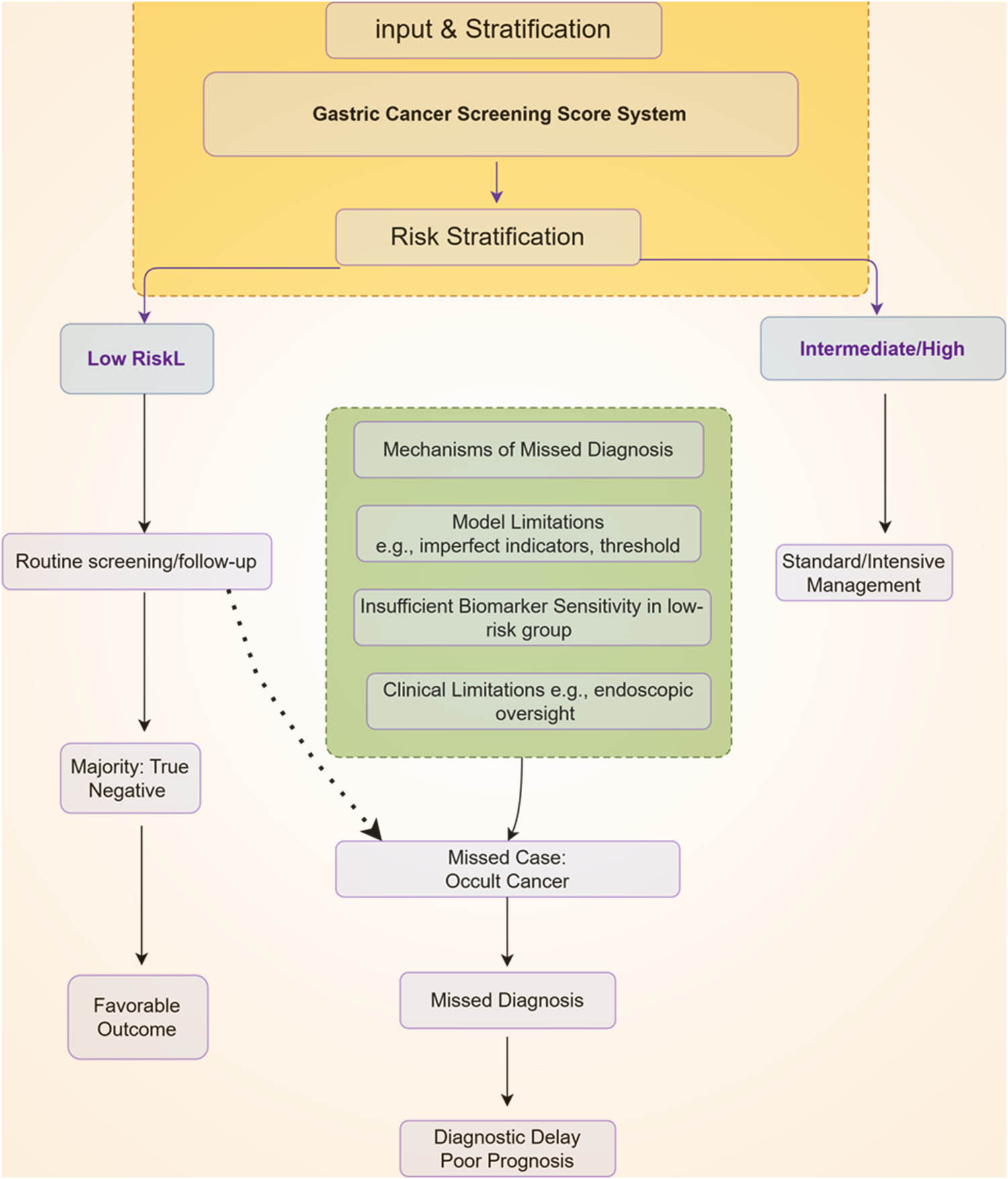
Figure 1
This schematic illustrates the application workflow of novel gastric cancer screening score systems and the risk mechanisms underlying missed diagnoses in low-risk populations. Following stratification by the scoring system, individuals assigned to the low-risk group undergo routine follow-up, among whom the vast majority are true negatives with favorable outcomes. However, due to multiple interconnected mechanisms – including inherent model design flaws, the occult biological characteristics of certain gastric cancers, insufficient sensitivity of biomarkers in this population, and limitations in clinical practice (delineated in the right panel) – a subset of occult cancers is misclassified into the low-risk group. This ultimately results in missed diagnosis, diagnostic delay, and worsened prognosis
Table 3
Future strategies and technological directions for mitigating missed diagnosis
| Strategic direction | Specific approaches/Technologies | Anticipated benefits/Outcomes |
|---|---|---|
| Optimization of scoring systems |
| Enhanced precision in identifying high-risk individuals within broadly classified low-risk cohorts |
| Integration of multimodal screening |
| Increased sensitivity for detecting early and occult lesions, leading to a higher early detection rate |
| Development of personalized screening pathways |
| Improved cost-effectiveness and resource allocation; reduced unnecessary procedures for true low-risk individuals |
| Implementation of multidisciplinary collaboration (MDT) |
| Improved diagnostic accuracy for borderline or complex cases through comprehensive review |
| Standardization of training and quality control |
| Minimization of operator-dependent errors and improvement in the overall quality and consistency of screening |
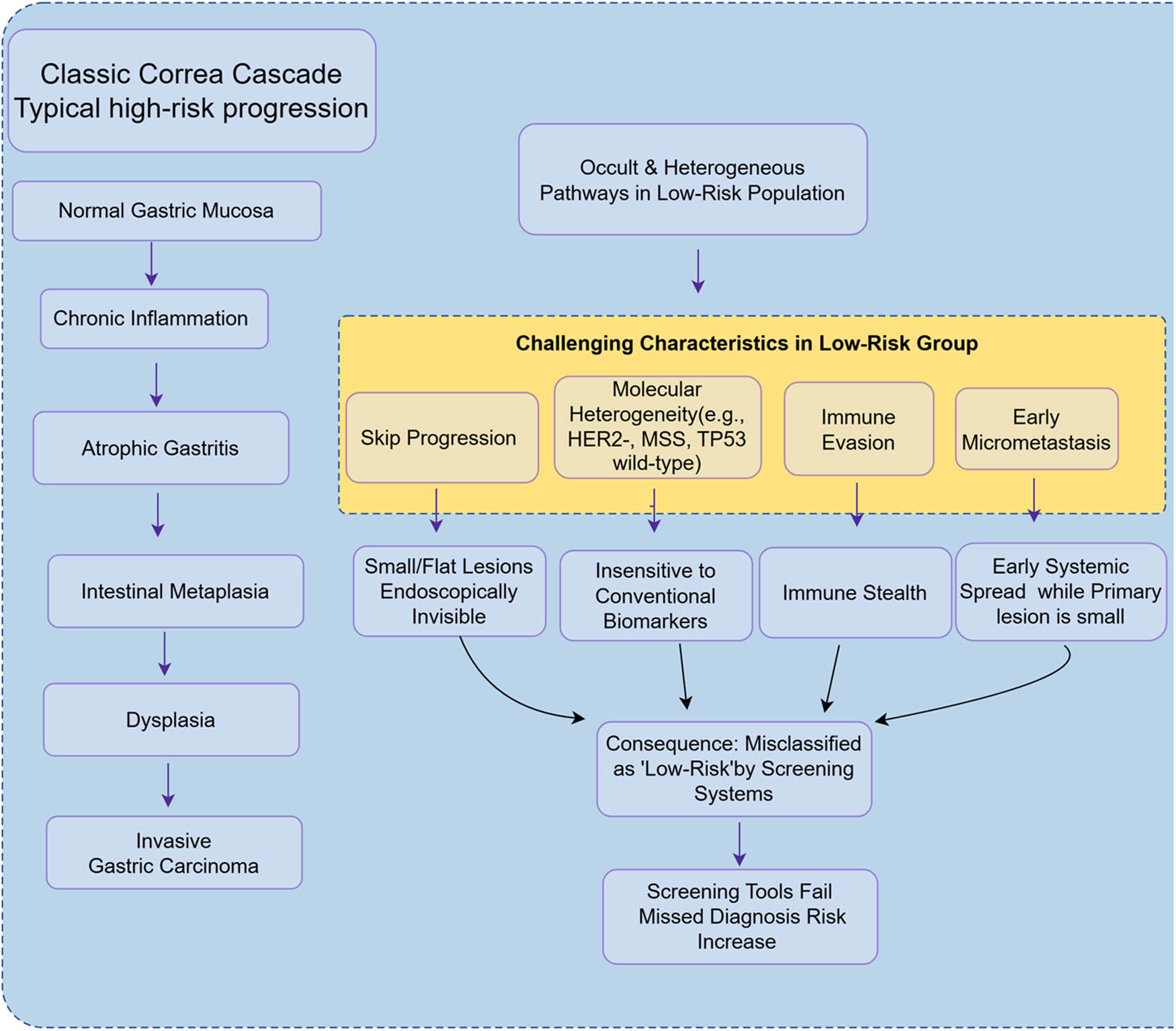
Figure 2
The occult biological characteristics of gastric cancer in low-risk populations and their challenges to screening. This figure contrasts the classic Correa cascade of gastric carcinogenesis (left) with the occult biological features observed in low-risk populations (right). In these individuals, gastric cancer may develop through atypical pathways, including skip progression, distinct molecular heterogeneity (e.g., HER2-negative, microsatellite stable [MSS], TP53 wild-type status), immune evasion, and early micrometastasis. These characteristics result in tumors that are endoscopically inconspicuous and exhibit low sensitivity to conventional serological biomarkers. Consequently, they are prone to being misclassified as ‘low-risk’ by existing screening score systems, significantly increasing the risk of missed diagnosis
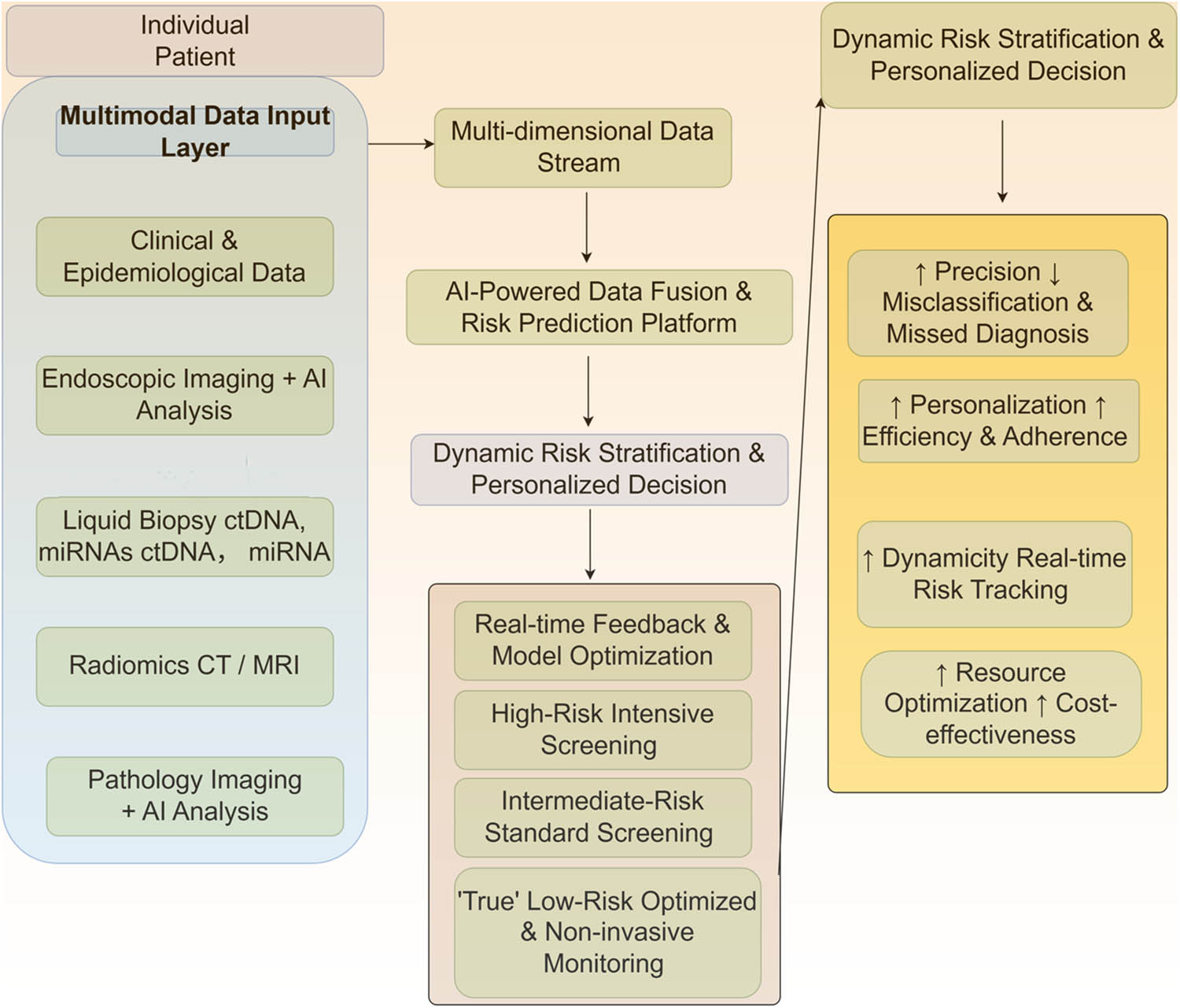
Figure 3
A paradigm for precision gastric cancer screening integrating multimodal data and artificial intelligence. Schematic illustration of a proposed future paradigm for precision gastric cancer screening, leveraging multimodal data integration and AI. This framework involves the comprehensive collection of multidimensional data, including clinical and epidemiological information, endoscopic imaging with AI-assisted analysis, liquid biopsy (e.g., ctDNA, miRNAs), radiomics from CT/MRI, and pathological imaging with AI diagnostics. These data streams are fused and analyzed by an AI-powered platform to generate a dynamic and individualized risk stratification. This enables personalized screening decisions: individuals at high risk are directed to intensive screening protocols, those at intermediate risk receive standard screening, and those confirmed as “true” low-risk through multimodal validation are assigned to optimized, non-invasive monitoring strategies. This closed-loop, intelligent system facilitates real-time feedback and model refinement, aiming to enhance screening precision and efficiency, optimize healthcare resource allocation, and systematically reduce the risk of missed diagnoses