
Table 1.
Comparative Features of Centralized vs. Decentralized Tuberculosis (TB) Diagnostic Models
| Dimension | Centralized Testing | Decentralized Testing |
|---|---|---|
| Test Location | National or regional central laboratories | Primary care settings or point-of-care (POC) sites |
| Turnaround Time | Days to weeks | Minutes to hours |
| Infrastructure | High-complexity set-up with biosafety and cold chain | Low-resource adaptable, portable platforms |
| Sample Logistics | Requires long-distance transport, cold chain | On-site testing, minimal logistics |
| Human Resources | Requires highly-trained laboratory specialists | Operable by general health workers with minimal training |
| Diagnostic Access | Limited in rural and remote areas | High accessibility across decentralized regions |
| Operational Cost | High fixed and variable costs | Lower marginal cost after implementation |
| Scalability | Limited by central lab capacity | Highly scalable across diverse health system levels |
| Patient Perspective | Indirect; limited engagement | Higher satisfaction, reduced travel costs, better adherence |
| Socio-cultural adaptability | Low (standardized protocols, limited cultural tailoring) | High (adaptable to local context, community involvement) |
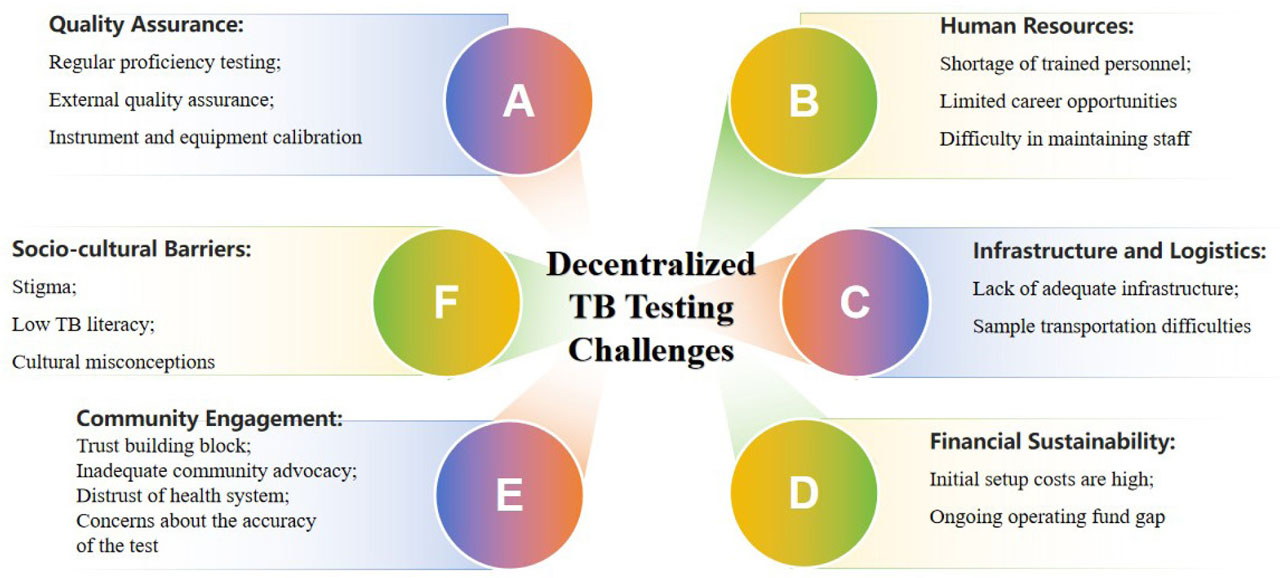
Figure 1.
Six-Domain Challenges in Decentralized TB Diagnostic Implementation
Note: The implementation of decentralized tuberculosis (TB) diagnostic testing is hindered by interconnected challenges spanning six critical domains (A–F): A. Quality Assurance: Requires regular proficiency testing, external quality assurance, and instrument/equipment calibration to ensure diagnostic accuracy [13,25,35]; B. Human Resources: Includes shortages of trained personnel, limited career development opportunities, and difficulties in retaining staff [14,24]; C. Infrastructure and Logistics: Encompasses inadequate infrastructure, sample transportation difficulties, and operational logistics challenges [1,7]; D. Financial Sustainability: Entails high initial setup costs, gaps in ongoing operational funding, and long-term sustainability concerns [19,23]; E. Community Engagement: Involves trust-building barriers, insufficient community advocacy, and concerns regarding test accuracy [16,18]; F. Socio-Cultural Barriers: Encompasses social stigma, low health literacy, and cultural misconceptions that limit service uptake [18,24,29]
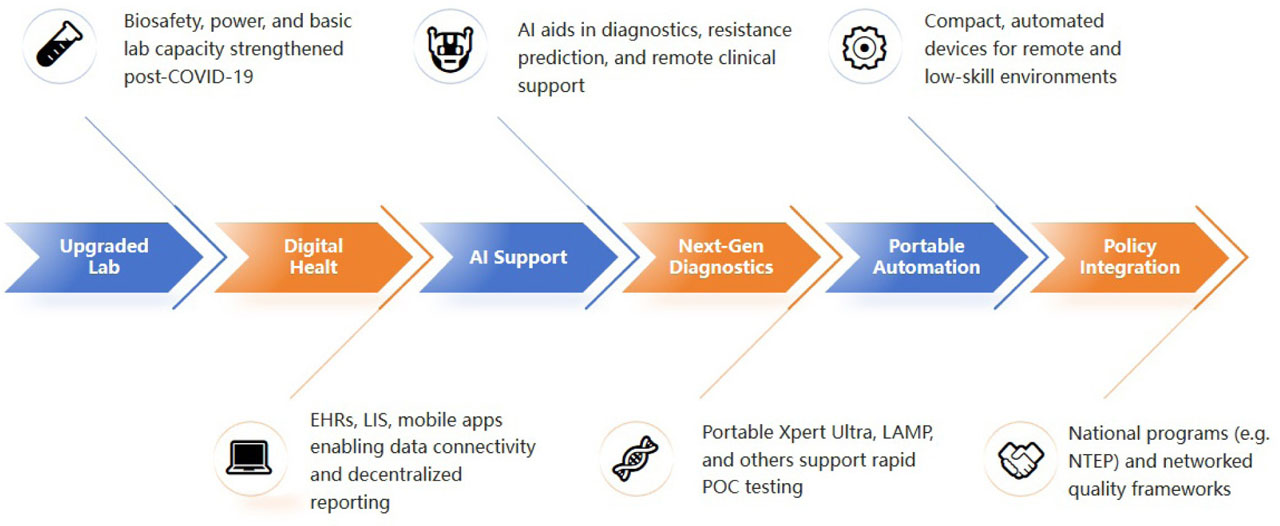
Figure 2.
Strategic enablers of decentralized TB diagnostics in the post-pandemic context. Six domains are facilitating the transition from centralized to decentralized TB diagnostic models: enhanced laboratory infrastructure, digital connectivity, artificial intelligence, portable molecular platforms, miniaturized automation, and policy-driven diagnostic networks. These enablers work synergistically to promote accessibility, accuracy, and sustainability in TB testing
Abbreviations: EHRs: Electronic Health Records; LIS: Laboratory Information Systems; AI: Artificial Intelligence; LAMP: Loop-mediated Isothermal Amplification; NTEP: National Tuberculosis Elimination Program
Table 2.
Policy and Action Matrix for Decentralized TB Diagnostic Implementation
| Future Direction | Policy Focus | Implementation Level |
|---|---|---|
| Institutionalization in NTPs | Health Policy | National |
| Regulatory & Quality Frameworks | Regulation & Standards | National |
| Sustainable Financing | Health Economics | National/International |
| Capacity Building for Workforce | Human Resources | Regional/National |
| Integration of Digital & AI Tools | Digital Health | National/Facility |
| Community-Centered Models | Public Engagement | Local/Community |
| Global Collaboration | Global Health | Regional/Global |
| Evidence quality and research | Promote high-quality RCTs, prospective studies | National/International |
| Patient-centered design | Incorporate patient feedback and satisfaction measures | Local/Community |
| Regional adaptation | Tailor strategies to local context | National/Regional |