
Table 1.
The Composition of MEGs and Gs.
| Component | MEG1 (%) | G1 (%) | MEG2 (%) | G2 (%) | MEG3 (%) | G3 (%) |
|---|---|---|---|---|---|---|
| Polysorbate® 80 | 35.54 | 35.53 | - | - | - | - |
| Transcutol® | 17.72 | 17.72 | - | - | - | - |
| Oleic acid | 17.72 | - | - | - | 5.00 | - |
| Purified water | 29.02 | 45.75 | 37.74 | 46.53 | - | 5.00 |
| Isopropyl myristate | - | - | 8.79 | - | - | - |
| Cremophor® RH40 | - | - | 44.03 | 44.03 | - | - |
| Ethanol (96%) | - | - | 9.44 | 9.44 | 25.00 | 25.00 |
| Poloxamer® 188 | - | - | - | - | 25.00 | 25.00 |
| Poloxamer® 407 (20% aqueous solution) | - | - | - | - | 45.00 | 44.00 |
| Carbopol® | - | 1.00 | - | - | - | 1.00 |
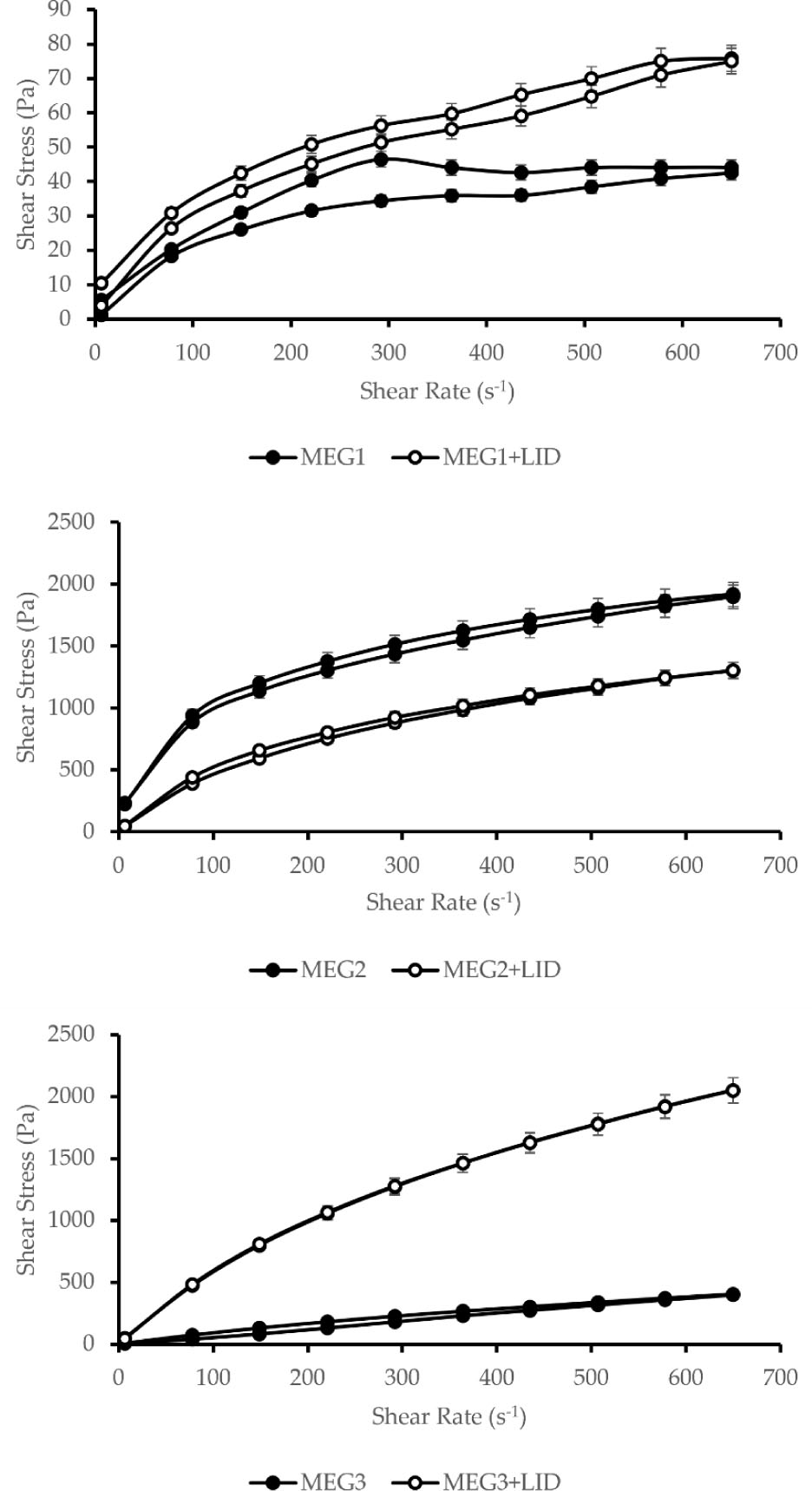
Figure 1.
Rheological behavior changes induced by LID incorporation.
LID: lidocaine hydrochloride, MEG: microemulsion gel
Table 2.
Indicators of the rheological behavior of the MEGs influenced by LID.
| Formulation | n+ | n− | Hysteresis loop area (Pa s−1) |
|---|---|---|---|
| MEG1 | 0.466 | 0.736 | 4351.71 |
| MEG1 + LID | 0.435 | 0.623 | 3371.33 |
| MEG2 | 0.459 | 0.449 | 42,887.42 |
| MEG2 + LID | 0.727 | 0.711 | 21,012.35 |
| MEG3 | 0.924 | 0.796 | 22,167.66 |
| MEG3 + LID | 0.808 | 0.834 | 3447.42 |
Table 3.
The main texture characteristics.
| Sample | Adhesiveness (g s) | Cohesiveness | Compressibility (g s) | Strength (mN) |
|---|---|---|---|---|
| MEG1 | 0.098 | 0.04 | 0.097 | 61.7 |
| MEG1 + LID | 0.104 | 0.04 | 0.050 | 57.3 |
| MEG2 | 0.102 | 1.00 | 0.042 | 48.3 |
| MEG2 + LID | 0.108 | 1.00 | 0.044 | 50.6 |
| MEG3 | 0.098 | 0.12 | 0.059 | 62.5 |
| MEG3 + LID | 0.098 | 0.10 | 0.048 | 52.1 |
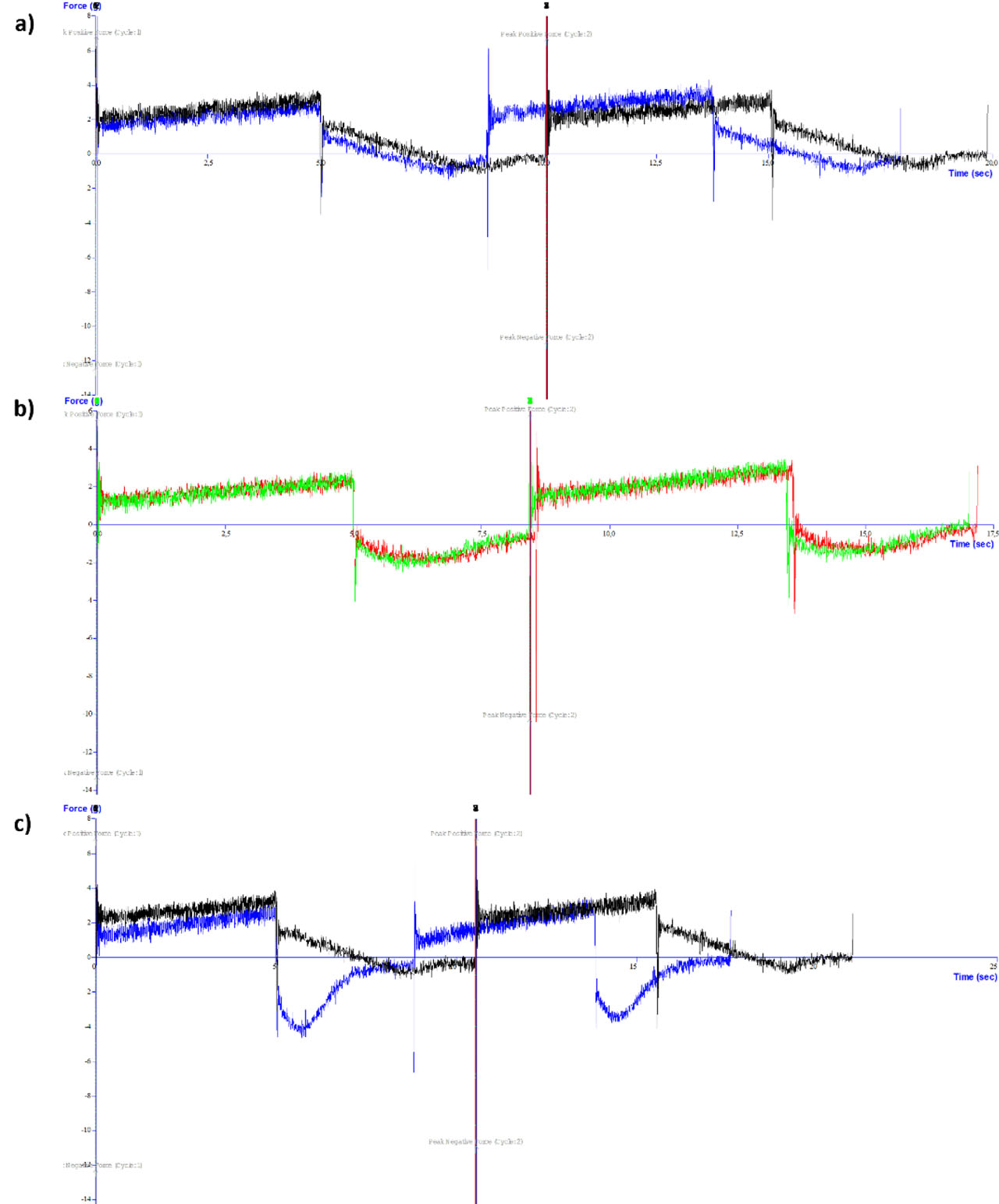
Figure 2.
Comparison of texture profiles: a) MEG1 (black) versus MEG1 with lidocaine hydrochloride (blue); b) MEG2 (red) versus MEG2 with lidocaine hydrochloride (green); c) MEG3 (black) versus MEG3 with lidocaine hydrochloride (blue).
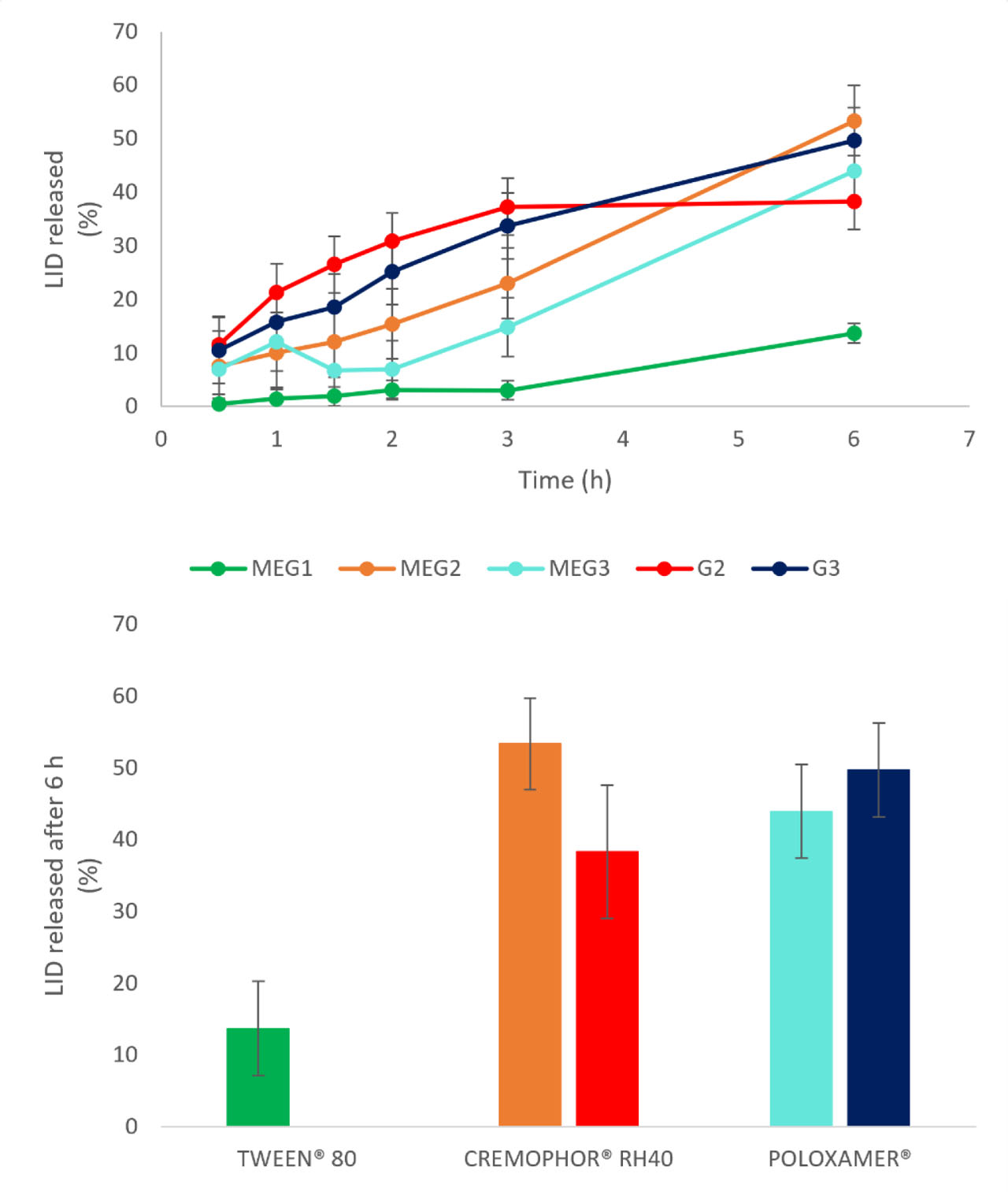
Figure 3.
In vitro liberation profiles of LID from MEGs and Gs and total drug released (%) after 6 h.
Gs: reference gels, LID: lidocaine hydrochloride, MEGs: microemulsion gels