
INTRODUCTION
Neck pain is a prevalent and debilitating condition worldwide, significantly impacting the quality of life. Globally, it ranks fourth among causes of disability-adjusted life years, with a point prevalence ranging from 30% to 50% in the general population and showing a rising incidence1,2. In Brazil, approximately 20% of adults are affected3. Neck pain can manifest as either acute or chronic, with untreated acute cases often progressing to chronicity, presenting a significant societal challenge2. Psychological (e.g., long-term stress, anxiety), biological (e.g., neuromusculoskeletal disorders or autoimmune diseases) and demographic factors (e.g., age, sex) are recognised as important risk factors3. Cross-sectional4,5,6,7,8 and longitudinal observational9,10,11 studies do not support an association between body (or particularly craniocervical) posture and neck pain intensity or disability. Research is still recommended to investigate the relationship between head posture and neck pain, if any12. Nevertheless, beliefs about ‘good,’ ‘bad,’ or ‘ideal’ postures persist13,14,15 and biomedical considerations about neck pain (e.g., the severity of tissue damage determines the intensity of pain) dominate the classification systems for the clinical management of this population16. Despite the lack of consensus on posture, patient education on body posture remains relevant to physiotherapists17.
Visual inspection is a common method for assessing body posture in clinical settings12,18. The reliability of visual inspection compared to computerised photogrammetry can be low12,18,19, allegedly due to a non-systematic tracking of the body alignments and angles characterising the body posture in different anatomic planes. Computerised photogrammetry remains largely confined to the research environment. It also lacks consensus on software selection and angle standardisation/selection for postural assessment20 and errors in identifying anatomical landmarks through palpation7,21,22,23,24,25. Interestingly, we found that physiotherapists can differentiate between individuals with and without neck pain using sets of photogrammetry variables, with considerable variability among these sets. Conversely, computerised photogrammetry does not distinguish between them6.
In fact, little is known about the perceptual-cognitive processes that guide clinicians’ judgements. Contemporary models of clinical reasoning emphasise the integration of sensory input, prior beliefs and pattern recognition when therapists interpret patient presentations26. However, the behaviour (i.e., attention, focus and perception) of physiotherapists performing visual inspection remains largely uninvestigated. Yet, no study has directly examined how these cognitive elements manifest during postural assessment. Particularly, the effects of the presence of musculoskeletal (e.g., neck) pain and attitudes and beliefs (e.g., biomedical or psychosocial) towards pain on postural visual assessment are unknown. Provided differences in behaviour exist, such knowledge may systematically guide training of visual inspection to improve patient care.
Eye-tracking technology offers a unique opportunity to operationalise these processes by mapping where clinicians allocate attention and how they visually scan postural information27,28. Eye-tracking technology precisely records eye position and movements, enabling the measurement of eye movements and positions relative to the head. It facilitates the identification and monitoring of visual attention during various tasks through camera-based tracking28,29,30. By capturing eye movements, events such as gaze fixation, saccades and blinks are detected, thus contributing to a deeper understanding of human behaviour28,29,30. This technology finds applications across diverse fields, including medicine31, human movement science28 and engineering29 but in the rehabilitation field27,32, it remains scarce.
Previous research has relied mainly on self-report or postural measures, which do not capture the moment-to-moment perceptual processes guiding visual inspection. As a result, the attentional strategies physiotherapists use during posture evaluation remain unknown. Therefore, this paper aims to investigate the effects of physiotherapists’ attitudes and beliefs on postural visual assessment of people with neck pain using eye-tracking analysis. Specifically, through eye-tracking technology, we explored how these factors may impact the behaviour of physiotherapists during visual inspection of body posture. We hypothesised that physiotherapists with predominant biomedical attitudes and beliefs show behaviour during visual inspection characterised by more attention and focus on body posture.
MATERIALS AND METHODS
Ethics
The research protocol was approved by the Centro Universitário Augusto Motta Institutional Review Board following Resolution 466/2012 [approval date: 30 August 2023; CAAE 73656323.2.0000.5235] before commencing the study. Informed written consent was obtained from all participants after they were briefed on the study’s design and protocol.
Setting and participants
A sample size of 30 participants was determined based on a systematic review across several professional domains26. Because no previous postural assessment studies had examined eye-tracking behaviour, there were no established parameters to inform a priori power analysis. For this reason (and consistent with recommendations for early phase eye-tracking research26) the present study was framed as an exploratory investigation aimed at estimating effect sizes for future confirmatory studies.
Recruitment occurred through personal outreach, posters on the campus of the proposing institution and messages via a mobile application. Participants were recruited through convenience sampling from the institution’s staff. Inclusion criteria comprised professionals holding a degree in Physiotherapy with a minimum of 12 months of training and availability to partake in postural assessments. Exclusion criteria encompassed participants with conjunctivitis during the data collection period or any condition that might affect their visual assessment (e.g., self-reported uncorrected astigmatism, dyslexia)29.
Sample characterisation
Physiotherapists completed a sample characterisation questionnaire to gather personal information such as age, gender, specialisation, years of experience and professional practice setting. Additionally, they responded to the Portuguese-Brazil version of the pain attitudes and beliefs scale (PABS-PT), a self-report questionnaire designed to assess healthcare professionals’ beliefs and attitudes towards pain. Widely utilised as a valid measure, the PABS-PT yields a therapeutic orientation score33,34. The scale comprises two subscales, distinguishing between a biomedical and a biopsychosocial treatment orientation. Participants rate their agreement with each item on a 6-point Likert scale (1 = strongly disagree, 6 = strongly agree), with higher scores indicating a stronger treatment orientation. We employed a modified Norwegian version of the Rasch model for the PABS-PT, featuring two strictly unidimensional subscales. Each subscale comprises seven items arranged hierarchically and invariantly. Person location scores in the Rasch model range from 7 to 40 for the biomedical subscale and from 7 to 32 for the biopsychosocial subscale34. Although treatment beliefs exist on a continuum, physiotherapists were categorised as predominantly ‘biomedical’ or ‘biopsychosocial’ based on the higher score percentage of the subscales. Even so, this approach is acknowledged as a pragmatic simplification rather than a definitive representation of clinicians’ beliefs.
Eye-tracking setup
This study followed the Minimal Reporting Guideline for Research Involving Eye Tracking (2023 edition)30. The eye-tracking system utilised for data collection was the EyeLink® 1000 Plus (SR Research, Ottawa, Canada) with firmware version EYELINK II CL v5.15 (24 January 2018). The system consists of two computers - the host PC dedicated to data collection and a display PC used for presenting stimuli to a participant. These computers are connected via an Ethernet link that allows the sharing of critical information from the host PC to the display PC. The system featured a high-speed camera (Eyelink GL Version 1.2 Sensor AH7) adaptable to a flexible support arm, which secured the EyeLink 1000 Plus beneath an LCD monitor so that the entire eye-tracking apparatus and screen could be easily moved into place in front of the viewer whose eyes are to be tracked. During the task, the participant’s head was supported on a chin rest. The sampling frequency was set to 500 Hz, recording the eye’s movements in monocular mode. Recorded parameters encompassed gaze position on the LCD screen, sized 1024 × 768 pixels (top-left = 0). The room’s lighting was controlled, with lights turned off during calibration and data collection. Calibration was performed at each trial using the 9-point monocular built-in calibration sequence; calibration was performed for each eye by fixating a small white dot (0.3 diameter) presented on a black background and validated using a 9-point validation procedure. Average and maximum errors across all measurements were deemed low (0.3 ± 0.1 and 0.8 ± 0.2, respectively). Data loss due to blinking averaged 5.1 ± 6.3% across all trials.
Eye-tracking dataset: participants with/without neck pain
This study utilised a secondary dataset derived from the image database established by Vieira et al.6 to explore the photogrammetry variables identified by physiotherapists during visual inspection of static body posture that differentiate adults with and without neck pain. The comprehensive protocol for this dataset is detailed elsewhere. Briefly, 60 participants (30 with neck pain, 30 without neck pain) underwent photogrammetry using standardised postural assessment software30,35. Anatomical landmarks were marked using Styrofoam spheres, and participants were photographed for postural evaluation. Pain intensity was reported using a visual analogue scale (0–100 mm)36, while pain chronicity was determined based on responses to questions adapted from previous studies regarding the duration and persistence of neck pain: ‘Has your neck been painful at any time in the previous month?’ (A6) and ‘Has your neck pain ever lasted for more than 3 months?’ (A7)37. Participants were categorised as experiencing acute (yes to the first and no to the second question) or chronic (yes to both questions) neck pain accordingly. Additionally, the risk of prolonged sick leave and disability due to psychosocial factors was assessed using the Portuguese-Brazil version of the Orebro Musculoskeletal Pain Screening Questionnaire (score >50)38. Functional capacity was evaluated using the percentage score derived from the Portuguese-Brazil version of the Neck Disability Questionnaire Index, ranging from 0% (no disability) to 100% (total disability)39.
The dataset included 60 images derived from the aforementioned study. Each image depicted anterior, lateral and posterior views (left, center and right side of the screen) of each patient in this study. These images were randomly distributed across six videos (i.e., 10 images per video), with a 1:1 ratio of patients with and without neck pain. The videos were generated using the online graphic design platform Canva (https://www.canva.com). Within videos, each image was displayed for 45 seconds. A black screen with a central white dot was inserted for 5 seconds before, between and after each image, ensuring all physiotherapists began and concluded the task from the same point. Each video lasted approximately 8.5 minutes, resulting in a total task duration of about 1 hour.
Eye-tracking task: postural assessment by visual inspection
Figure 1 shows the setup for data collection. Physiotherapists were briefed on potential obstacles to data collection, such as makeup, multifocal or fogged glasses and calibration challenges. Instructions were provided to mitigate these issues, including makeup removal, lens cleaning, or avoiding glasses during the session. Participants were then guided through the initial tasks required for device calibration and eye capture. The camera setup automatically optimised vision by adjusting pupil and corneal reflection detection thresholds, with manual fine-tuning conducted by the investigator if necessary. Seated comfortably, physiotherapists were positioned 60 cm from the eye-tracking screen and instructed to position their faces in a head support aligned with the monitor. The eye-tracking task consisted of observing the videos. Physiotherapists’ eye movements were recorded by the eye-tracking software while they evaluated each video separately (i.e., trial).
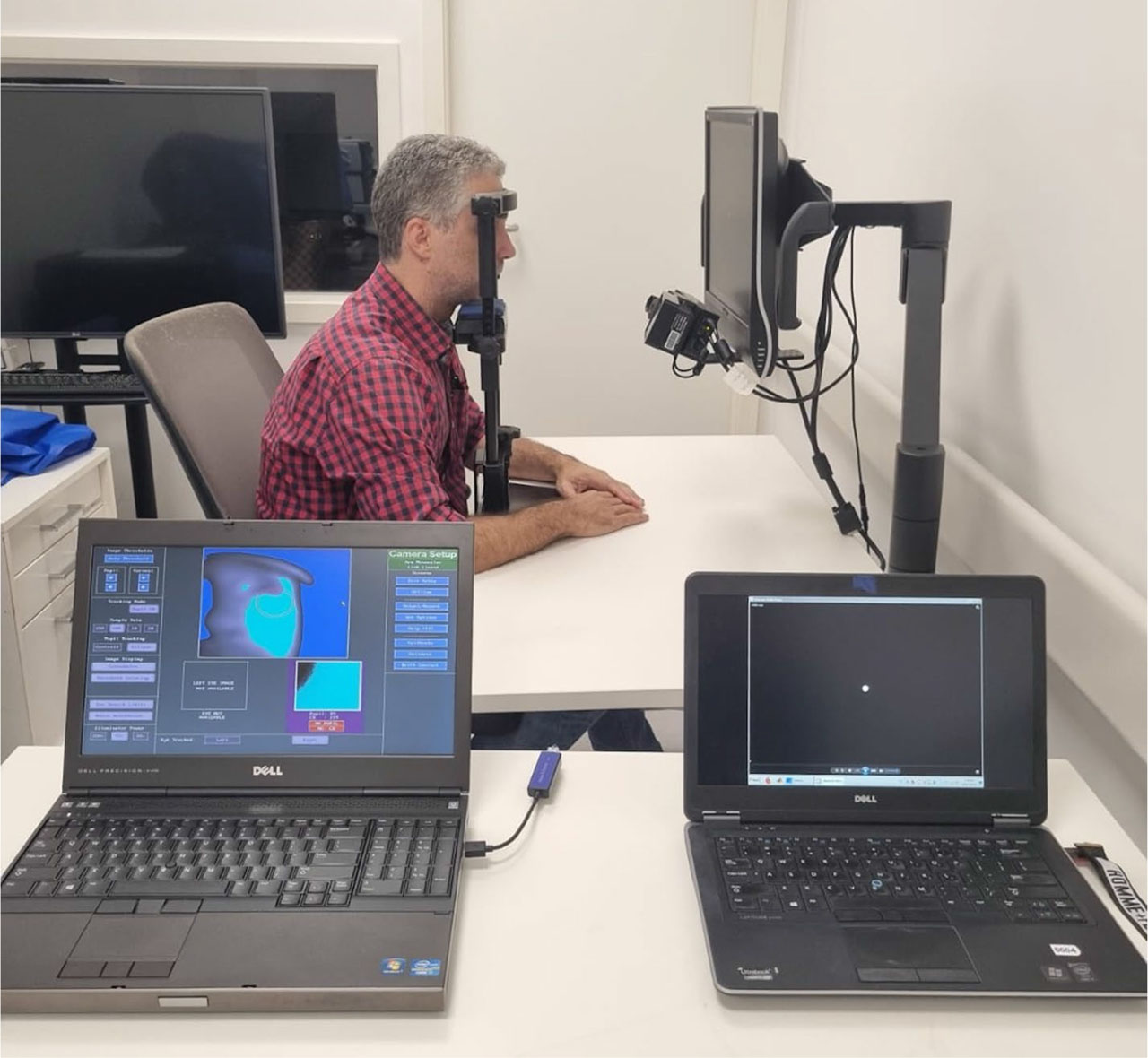
Figure 1.
Experimental setup for data collection. Seated comfortably, physiotherapists were positioned 60 cm from the eye-tracking screen and instructed to position their face in a head support aligned with the monitor
Eye-tracking data: signal processing and outcome variables
Custom-built scripts in R version 4.5.1 (https://www.r-project.org) were developed for processing EDF files and conducting statistical analyses. The ‘eyelinkReader’40 package was employed to extract blink, fixation and saccade events from EDF files separately. Participant data were imported from an electronic spreadsheet generated during the signal processing step. Statistical analyses utilised the ‘lme4’41 and ‘markovchain’42 packages. Table generation and exportation to DOCX format were performed using the ‘officer’43, ‘Table 1’44, ‘gtsummary’45 and ‘flextable’46 packages.
Table 1.
Descriptive statistics of the sample of physiotherapists, split by the main score on the Pain Attitudes and Beliefs Scale for Physiotherapists (PABS-PT)
| Variables | Overall n = 30a | Biomedical group n = 15a | Biopsychosocial group n = 15a | Cohen’s d [95%CI] | p-valueb |
|---|---|---|---|---|---|
| Age, years | 38.2 (±11.4) | 42.7 (±13.1) | 33.7 (±7.3) | 0.85 [0.09, 1.6] | 0.029 |
| Gender | >0.999 | ||||
| Women | 20 (67%) | 10 (67%) | 10 (67%) | ||
| Men | 10 (33%) | 5 (33%) | 5 (33%) | ||
| Professional training, years | 7.8 (±8.8) | 9.0 (±10.6) | 6.5 (±6.5) | 0.28 [0.45, 0.99] | 0.457 |
| Professional experience, years | 6.8 (±7.5) | 7.2 (±8.8) | 6.3 (±6.4) | 0.12 [−0.60, 0.83] | 0.750 |
| Workplace setting | 0.492 | ||||
| Home/clinic | 13 (43%) | 7 (47%) | 6 (40%) | ||
| Home | 9 (30%) | 6 (40%) | 3 (20%) | ||
| Home/Ambulatory | 4 (13%) | 1 (7%) | 3 (20%) | ||
| Hospital | 3 (10%) | 1 (7%) | 2 (13%) | ||
| Clinic | 1 (3%) | 0 (0%) | 1 (7%) | ||
| Glasses | 5 (17%) | 2 (13%) | 3 (20%) | >0.999 | |
| PABS-PT, points | |||||
| Biomedical subscore | 27.9 (±7.2) | 31.4 (±7.4) | 24.5 (±5.2) | 1.1 [0.31, 1.8] | NT |
| Biopsychosocial subscore | 21.2 (±5.6) | 17.0 (±3.5) | 25.3 (±4.0) | −2.2 [−3.1, −1.3] | NT |
| PABS-PT,% | |||||
| Biomedical subscore | 69.8 (±18.0) | 78.5 (±18.5) | 61.2 (±12.9) | 1.1 [0.31, 1.8] | NT |
| Biopsychosocial subscore | 66.1 (±17.5) | 53.1 (±10.8) | 79.2 (±12.5) | −2.2 [−3.1, −1.3] | NT |
| Average error, ∘ | 0.3 (±0.1) | 0.3 (±0.1) | 0.3 (±0.1) | 0.03 [−0.69, 0.74] | 0.938 |
| Maximum error, ∘ | 0.8 (±0.2) | 0.8 (±0.2) | 0.8 (±0.2) | 0.04 [−0.67, 0.76] | 0.905 |
For each physiotherapist (n = 30), the script reads all files containing the physiotherapists’ trials and splits each trial data into individual participant data for assessment (n = 60). Based on the horizontal coordinates of gaze/saccade data on the screen, time series data of events were further evenly split into non-overlapping, equally sized areas of interest (AOI)29: anterior (0 to 1/3 screen width), lateral (1/3 to 2/3 screen width) and posterior (2/3 to 1 screen width) AOI. The following eye-tracking variables were computed:
First-order data:
Eye blinks (n): The number of blinks observed over a specified period, often associated with cognitive workload. A low blink frequency typically indicates higher attention levels. Blink rates also decrease with intense concentration29.
Blink duration (s): The total time spent blinking during a task. Longer blink durations are positively correlated with mind wandering and can impair performance in cognitive tasks47.
Second-order data:
Eye blink, fixation and saccade events were identified from raw data using the standard configuration setup of the EyeLink system48, including parameters such as fixation update interval, fixation update accumulate, saccade motion threshold, saccade velocity threshold, saccade acceleration threshold and saccade pursuit fixup.
Third-order data:
Fixation count (n): The total number of fixations observed within a designated AOI29, indicating the AOI that attracts more attention. It also reflects the frequency of shifts in visual attention28.
Average fixation duration (s): Calculated by dividing the total duration of fixations within a specific AOI by the total number of fixations observed across the same AOI [29]. Longer durations suggest more extensive cognitive processing28.
Saccade count (n): The total number of saccades observed within a designated AOI. Lower saccade counts are associated with engaged visual attention on stationary stimuli49.
Fourth-order data:
Transition matrix probability: A table illustrating the probability of transitions between AOIs (anterior/lateral/posterior views) derived from discrete-time Markov chains. Higher spatial density (i.e., the number of non-zeroed cells) suggests a more thorough search with less efficient scanning29.
Mean first-time passage: For each potential initial postural view state, it indicates the number of gaze steps needed to reach the desired destination state, based on the probabilities outlined in the transition matrix50.
Mean recurrence time: The average number of fixation events required for the Markov chain in a current view state to return to the same view state50.
A gaze plot was generated to provide a static view of the time sequence of looking using the locations, orders and duration of fixations. Each fixation is represented as a circle, whereas its size is proportional to the duration of the fixation29.
Statistical analysis
Numeric variables were presented as mean ± SD (standard deviation), while categorical variables were expressed as absolute frequency (%), both in the text and tables. Plots show subject means and marginal means with 95% confidence interval. To compare the characteristics of numeric, categorical and dichotomous variables of the physiotherapists split by belief group (i.e., ‘biomedical’ or ‘biopsychosocial’), the Welch two-sample t-test, Pearson’s χ2 test and Fisher’s exact test were employed. Effect sizes (Cohen’s d) and P-values were reported, and a significance level of p < 0.05 (two-tailed) was adopted. Fixation event series were modelled as first-order discrete-time Markov chains. We assumed transition probabilities of events to be independent of time. With three views, nine possible transition probabilities were calculated row by row, where each row’s probabilities sum up to one. Linear mixed models analysed the interaction and main effects for ‘Physiotherapist group’ (levels: biomedical vs. biopsychosocial attitudes and beliefs towards pain) and ‘Patient group’ (levels: with vs. without neck pain) as fixed effects on eye-tracking outcomes. Random intercepts were modelled as varying among both factors. Effect sizes (mean differences or transition probabilities) were calculated with a 95% confidence interval. The data that support the findings of this study are openly available in Mendeley Data at http://doi.org/10.17632/7cbwm57pcd.4.
RESULTS
Table 1 presents the characteristics of the sample of physiotherapists (n = 30). The participants were middle-aged (38.2 ± 11.4), predominantly female (n = 20.67%), with an average of 7.8 ± 8.8 years of professional training in physiotherapy. They primarily worked in home-based or private clinic settings (n = 13.43%). A minority (n = 5.17%) required glasses for the tasks. The PABST-PT yielded scores of 27.9 ± 7.2 and 21.2 ± 5.6 points for the Biomedical and Biopsychosocial subscales, respectively. The sample, divided by main PABST-PT subscale scores, consisted of n = 15 (50%) physiotherapists each for the Biomedical and Biopsychosocial domains. No statistically significant differences were found between groups for most characteristics, except for PABST-PT Biomedical (Biomedical: 31.4 ± 7.4 vs. Biopsychosocial: 24.5 ± 5.2, p = 0.006) and Biopsychosocial (Biomedical: 17.0 ± 3.5 vs. Biopsychosocial: 25.3 ± 4.0, p < 0.001) subscale points. Average and maximum errors across all measurements did not exhibit significant differences between groups (p = 0.938 and p = 0.905, respectively).
Table 2 presents the characteristics of the sample of participants with and without neck pain (n = 60 split into groups of n = 30/30). When comparing individuals with and without neck pain, it was observed that patients with neck pain exhibited similar age (overall 28.2 ± 7.1 years) and gender distribution (overall proportion of women to men: 83:17%). However, those with neck pain displayed higher scores in the Nordic Musculoskeletal Questionnaire for chronic conditions (0% vs. 93%; p < 0.001), the Örebro Musculoskeletal Pain Questionnaire (16.9 ± 10.7 vs. 47.6 ± 11.4, p < 0.001), indicating a high risk of chronicity (0% vs. 47%, p < 0.001), and the Neck Disability Index (4.1 ± 4.1 vs. 21.6 ± 7.8, p < 0.001), suggesting moderate disability (0% vs. 20%, p < 0.001).
Table 2.
Descriptive statistics of the sample of patients split by group with/without neck pain
| Variables | Overall n = 60a | Asymptomatic group n = 30a | Neck pain group n = 30a | Cohen’s d [95%CI] | p-valueb |
|---|---|---|---|---|---|
| Age, years | 28.2 (±7.1) | 27.1 (±7.0) | 29.3 (±7.1) | −0.31 [−0.82, 0.20] | 0.238 |
| Gender | 0.299 | ||||
| Women | 50 (83%) | 23 (77%) | 27 (90%) | ||
| Men | 10 (17%) | 7 (23%) | 3 (10%) | ||
| Neck pain intensity, mm | - | - | 38.2 (±19.9) | - | NT |
| Nordic Musculoskeletal Questionnaire, score | <0.001 | ||||
| Not applicable | 26 (43%) | 26 (87%) | 0 (0%) | ||
| Acute | 6 (10%) | 4 (13%) | 2 (7%) | ||
| Chronic | 28 (47%) | 0 (0%) | 28 (93%) | ||
| Örebro Musculoskeletal Pain Questionnaire, score | 32.2 (±19.0) | 16.9 (±10.7) | 47.6 (±11.4) | −2.8 [−3.5, −2.1] | <0.001 |
| Örebro Musculoskeletal Pain Questionnaire, risk | <0.001 | ||||
| Low risk | 46 (77%) | 30 (100%) | 16 (53%) | ||
| High risk | 14 (23%) | 0 (0%) | 14 (47%) | ||
| Neck disability index, score | 12.8 (±10.8) | 4.1 (±4.1) | 21.6 (±7.8) | −2.8 [−3.5, −2.1] | <0.001 |
| Neck disability index, classification | <0.001 | ||||
| Nodisability | 27 (45%) | 26 (87%) | 1 (3%) | ||
| Mild disability | 27 (45%) | 4 (13%) | 23 (77%) | ||
| Moderate disability | 6 (10%) | 0 (0%) | 6 (20%) |
Figure 2 shows a gaze graph illustrating a schematic representation of a participant’s images for postural assessment, including anterior, lateral and posterior views (left, centre and right side of the screen) being analysed by a physiotherapist. The eye-tracking pattern following the behaviour can be noticed through the trace, indicating where the person fixed his attention at each moment during the visual exploration, corresponding to the number and duration of fixations and the saccadic events in each area of interest.
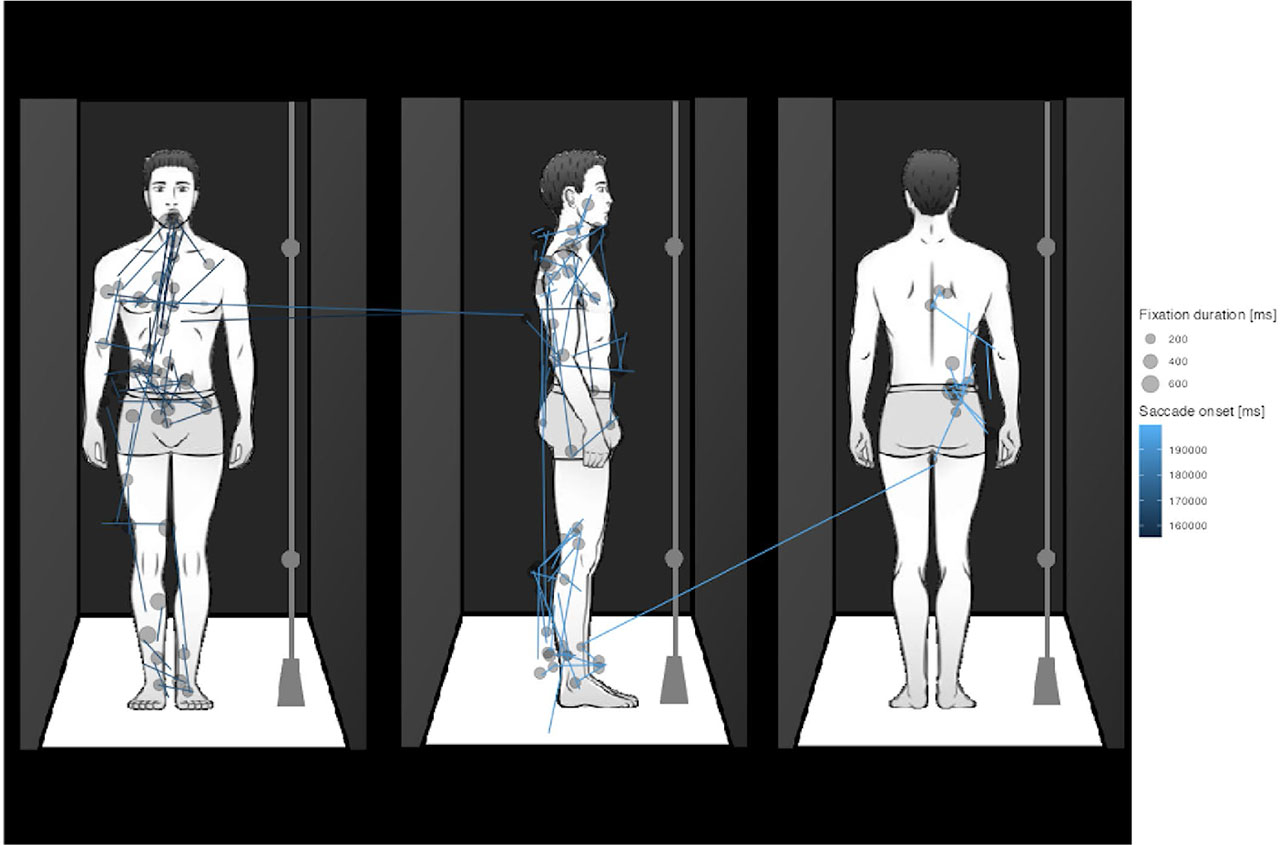
Figure 2.
Gaze plot in a schematic representation of a participant’s images for postural assessment in anterior, lateral and posterior (left, centre and right side of the screen) views. Notice the number of fixations and saccade events in each area of interest
Figures 3 and 4 shows summary statistics for all oculomotor metrics across Patient Group and Physiotherapist Group. Detailed model outputs are presented in full in Tables S1–S3 (Supplementary Files 1–3) to provide a complete description of eye-tracking behaviour across multiple hierarchical metrics.
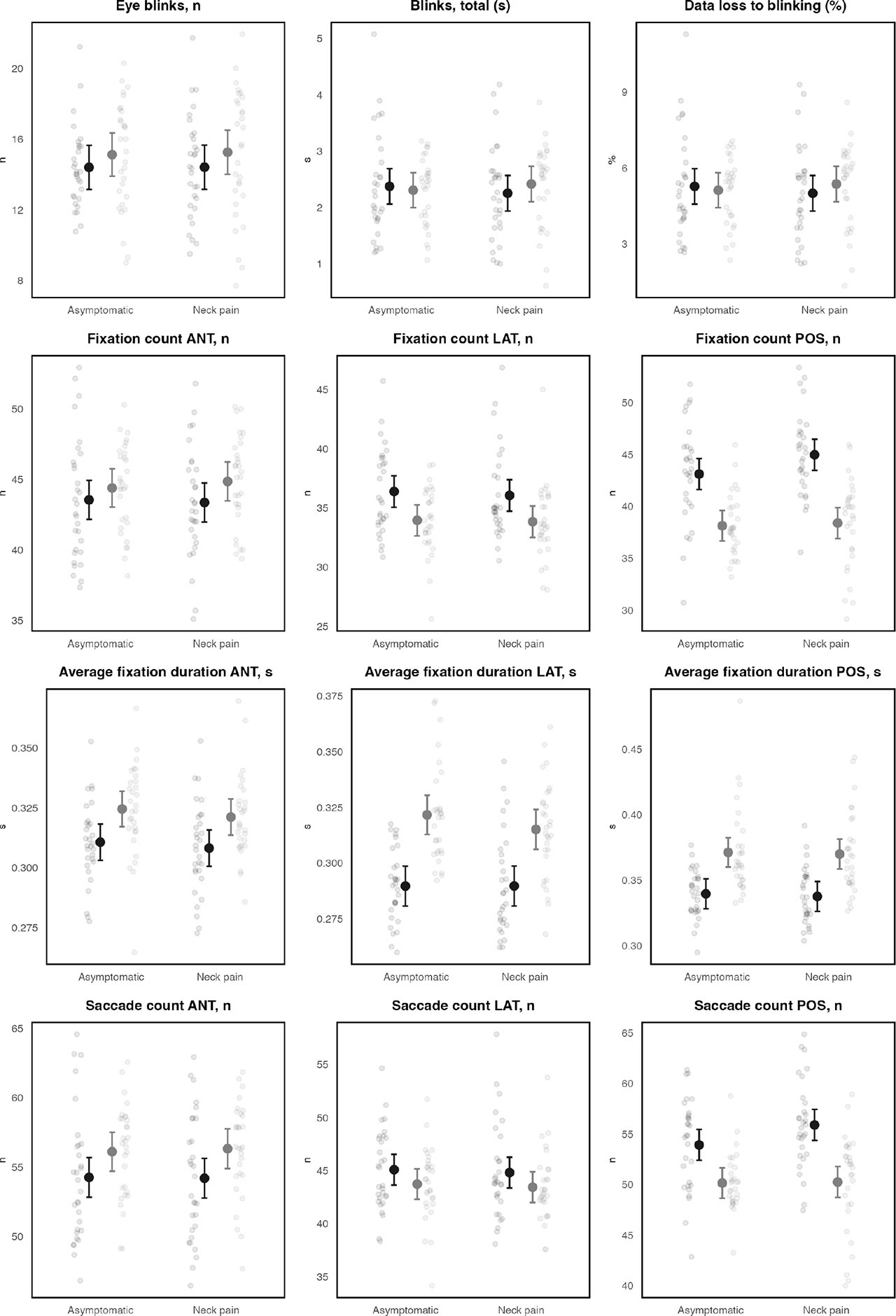
Figure 3.
Interaction plots for first- and third-order oculomotor metrics across Patient Group (asymptomatic vs. symptomatic) and Physiotherapist Group (biomedical [black] vs. biopsychosocial [grey]). Points show subject-level means; larger markers and 95% CIs show estimated marginal means from mixed-effects models
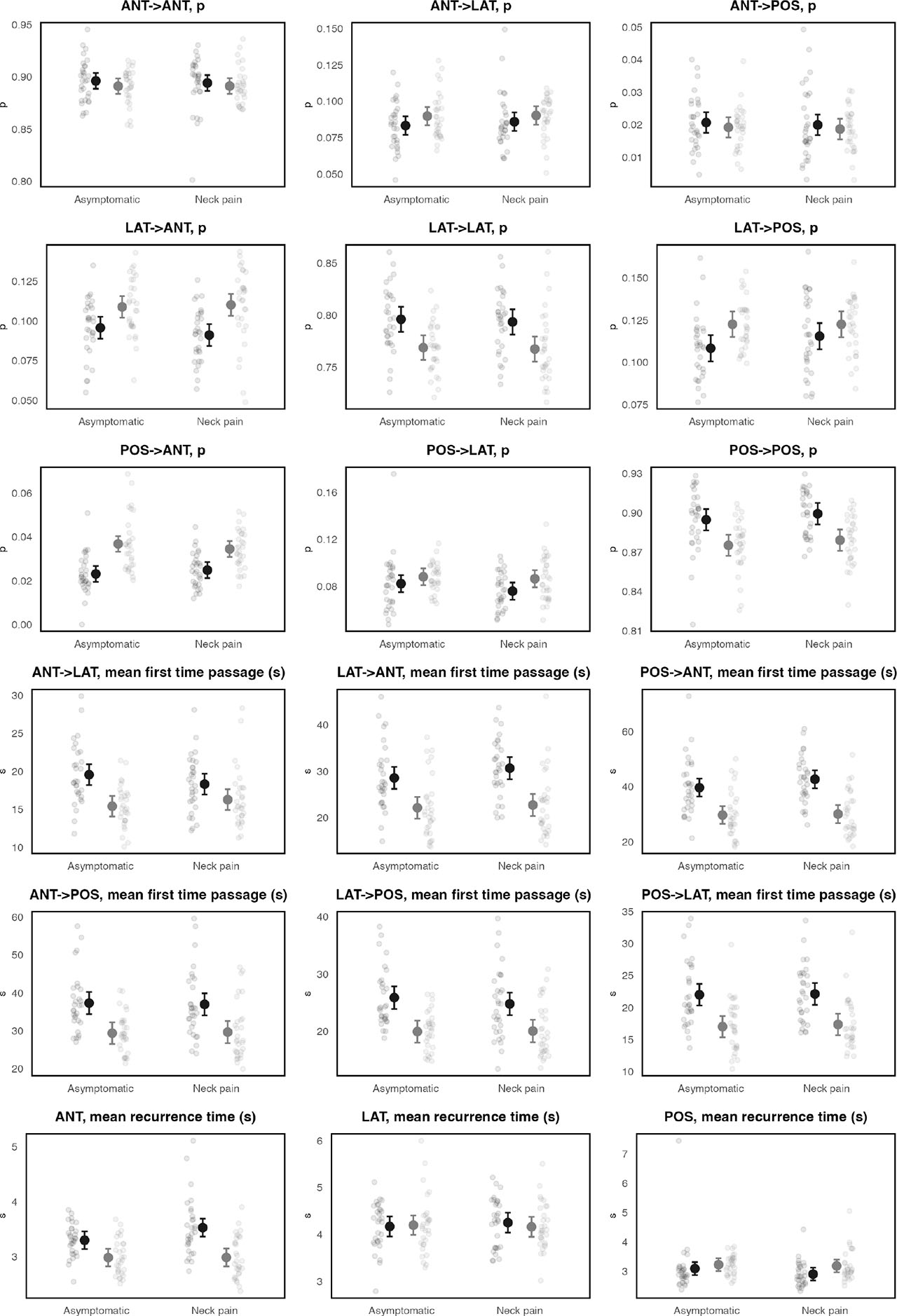
Figure 4.
Interaction plots for fourth-order gaze-dynamics metrics across Patient Group (asymptomatic vs. symptomatic) and Physiotherapist Group (biomedical [black] vs. biopsychosocial [grey]). Panels display transition probabilities, mean first-passage times and recurrence times for ANT, LAT and POS views. Points represent subject means; larger markers and 95% CIs represent estimated marginal means from mixed-effects models. ANT - anterior, POS - posterior, LAT - lateral
No statistical evidence of interaction effects for any variable was observed, thus prompting separate interpretations of the main effects.
Significant main effects were noted for the ‘Physiotherapist group’ across third- and fourth-order outcomes. Overall, compared with physiotherapists in the Biomedical group, those in the Biopsychosocial group exhibited (mean [95%CI]) fewer fixation counts in lateral (−2.29 [−3.80; −0.78] n) and posterior views (−5.84 [−7.62; −4.06] n), lower saccade counts in the posterior view (−4.51 [−6.46; −2.56] n), and shorter mean first-time passage on all transitions (ranging from −4.08 [−6.28; −1.88] to −14.09 [−18.64; −9.54] n).
Conversely, physiotherapists in the Biopsychosocial group demonstrated longer average fixation durations in all views (anterior: 0.02 [0.01; 0.03] seconds, lateral 0.04 [0.02; 0.05] seconds and posterior 0.04 [0.03; 0.06] seconds). Almost all transition probabilities were different between physiotherapist groups, with specific positive or negative effects observed across transitions.
A significant main effect for the ‘Patient group’ was solely detected in the mean recurrent time in the anterior view, with higher values in patients with neck pain (0.23 [0.00; 0.46] events). Mean recurrent time was also lower in physiotherapists with Biopsychosocial orientation (−0.30 [−0.53; −0.08] events).
DISCUSSION
This paper used eye-tracking analysis to investigate the effects of physiotherapists’ attitudes and beliefs towards pain treatment orientation on postural visual assessment of people with neck pain. We found data to support the idea that the attitudes and beliefs of physiotherapists can influence visual postural assessment, but not to support our hypothesis that visual inspection is affected by the presence of neck pain. These findings highlight the interplay between physiotherapists’ cognitive processes, patient characteristics and visual attention dynamics during postural assessment, emphasising the need for tailored approaches in clinical practice to optimise diagnostic accuracy and treatment efficacy. Beyond methodological innovation, our findings provide theoretical insights into how clinicians integrate beliefs, perceptual cues and evaluative strategies during musculoskeletal assessment.
Clinical reasoning frameworks propose that therapists rely on both analytical and intuitive processes when interpreting patient presentations26. The distinct gaze behaviours observed between biopsychosocial- and biomedical-oriented physiotherapists suggest that treatment beliefs may act as perceptual filters that influence the initial observation and interpretation of postural information. Similar associations between experience, beliefs and visual search behaviour have been reported in movement analysis and gait rehabilitation27,32. These findings imply that clinicians’ orientations may shape not only downstream decision making but also the early stages of perceptual processing. Such evidence supports educational models advocating explicit training of visual attention and reflective awareness of professional beliefs as components of physiotherapy training.
Eye-tracking technology has not yet been extensively applied to gain knowledge about human movement science, particularly in the rehabilitation field. A previous study used eye-tracking technology to map eye gaze behaviour of both students and physiotherapists during movement analysis27. The authors reported that physiotherapists made more fixations of shorter duration than students. Another study investigated the gaze behaviour of physiotherapists during gait rehabilitation to quantify tacit knowledge of gait32. To the best of our knowledge, this is the first study to investigate visual postural assessment using eye-tracking technology, and therefore, comparisons with other studies are herein limited to a physiologic interpretation of the eye-tracking behaviour.
Physiotherapists with a biopsychosocial treatment orientation exhibited distinct eye movement patterns compared to their counterparts with a biomedical orientation. Specifically, reduced fixation counts28,29 in the lateral and posterior views suggest heightened visual engagement and cognitive focus among psychosocial-oriented physiotherapists. Moreover, their shorter mean first-time passage durations across various transitions imply efficient processing and decision-making during postural assessment50, possibly indicative of a more global evaluation approach. Conversely, biopsychosocial-oriented physiotherapists demonstrated longer average fixation durations in all views, suggesting deeper cognitive processing or contemplation in these views28,29. Furthermore, the main effect observed for the patient group offers insights into the interaction dynamics between physiotherapists and individuals with neck pain. A longer mean recurrent time indicates prolonged fixation or attention allocation to specific aspects of the anterior view50, potentially reflecting the complexity or perceived significance of postural features in individuals with neck pain. Overall, the differences suggest that biopsychosocial physiotherapists give less importance (attention) to posture for this population. However, interpretation of fixation metrics warrants caution. For instance, reduced fixation frequency may reflect lower cognitive load, fewer perceived postural discrepancies, or greater familiarity with interpreting static images. Conversely, longer fixation durations may indicate deeper cognitive processing, uncertainty, or increased attentional demand rather than strictly holistic evaluation28,29,50. To avoid overinterpreting fixation-based metrics, these findings should be considered preliminary and hypothesis-generating rather than conclusive evidence of specific reasoning styles. By tempering these interpretations, we aim to preserve theoretical rigour and encourage future research to test these competing explanations using complementary behavioural or qualitative measures.
Interestingly, we did not observe significant interaction effects between physiotherapist treatment orientation and patient neck pain status for any eye-tracking variable. These null results suggest that although clinicians’ beliefs influenced their overall gaze patterns, the presence of neck pain in the images did not differentially modify their visual attention. In exploratory research, such null findings are informative, helping delimit which perceptual processes are belief-driven and which appear stable across patient presentations. Future studies with larger samples and ecological, real-patient assessments may help clarify whether subtle interactions exist but were undetectable here.
LIMITATIONS
We acknowledge several limitations in this study. Firstly, although the sample size was deemed sufficient for exploratory analysis26, future studies with larger sample sizes are warranted to enhance statistical power. Secondly, the identification of blink, fixation and saccade events relied on standard software settings48, which may not necessarily represent the optimal choices for visual postural assessment. Further research investigating the selection of optimal thresholds is warranted. Third, physiotherapists were recruited through convenience sampling from a single institution, which limits the generalisability of the findings. Fourth, the classification of physiotherapists into ‘biomedical’ versus ‘biopsychosocial’ groups based on relative subscale dominance inevitably simplifies a continuum of beliefs. Although this approach is consistent with the Rasch-modelled structure of the PABS-PT, it may not capture the full nuance of individual therapeutic orientations. We also acknowledge that although the Rasch-modified version offers improved measurement properties, it has not undergone full validation in Brazilian Portuguese physiotherapists. Fifth, although real-patient interaction would provide ecological validity, the use of static standardised images is consistent with early-phase eye-tracking studies because it allows precise control of visual stimuli and minimises uncontrolled variability in movement, expression and body positioning. Finally, because secondary postural images were used, we could not fully control for potential confounders such as body morphology, asymmetries unrelated to pain, or subtle photographic variations. These factors were minimised through the original study’s highly standardised imaging protocol, but they nonetheless represent a methodological constraint.
This study has the following strengths. Firstly, internal validity was considered high due to the block randomisation of participants with/without neck pain, minimising order effect bias29. Secondly, a valid and reliable eye-tracking system was utilised for data collection, reducing instrument bias28,29. Thirdly, there was no interaction between experimenters and physiotherapists during trials, minimising experimenter bias. Additionally, by not disclosing the specific aims and measured outcomes of the study to physiotherapists, we aimed to enhance construct validity. Finally, calibration was performed per participant and trial, further bolstering the validity of the conclusions drawn29.
From a clinical and educational standpoint, these results highlight the relevance of perceptual-cognitive training in physiotherapy. Eye-tracking revealed that therapists’ treatment orientations subtly shape how they visually explore postural information, suggesting that beliefs may influence not only clinical decision-making but also the earliest stages of observation. Educators may therefore benefit from incorporating training strategies that (i) promote reflective awareness of therapeutic beliefs, (ii) explicitly teach how attentional focus influences interpretation and (iii) use visual exemplars or feedback tools – including eye-tracking outputs – during training in postural assessment. Such approaches may help students and clinicians develop more adaptable and evidence-informed visual assessment strategies, improving diagnostic reasoning and reducing overreliance on postural ‘fault-finding’ frameworks.
CONCLUSIONS
Physiotherapists with a biopsychosocial orientation towards pain treatment exhibited distinct patterns in eye movement during postural assessment, with faster transitions between anterior-lateral-posterior views and lower recurrent times compared to those with a biomedical orientation, potentially reflecting a more dynamic and holistic approach to evaluating patients. Further research is warranted to explore the implications of these findings in clinical practice and to improve visual postural assessment techniques.
Notes
[5] FUNDING
This study was financed by the Fundação Carlos Chagas Filho de Amparo à Pesquisa do Estado do Rio de Janeiro [grant number E-26/211.104/2021] and the Coordenação de Aperfeiçoamento de Pessoal de Nível Superior [grant numbers Finance Code 001; 88881.708719/2022-01; No. 88887.708718/2022-00].
Notes
Table S1.
Results of the linear mixed models for the main and interaction effects of patients’ and physiotherapists’ groups on first-order eye-tracking output variables
| Variable | Neck pain Biomedical | Neck pain Biopsychosocial | Asymptomatic Biomedical | Asymptomatic Biopsychosocial | Main effect ‘Patient group’ | Main effect ‘Physiotherapist group’ | Interaction effect |
|---|---|---|---|---|---|---|---|
| Eye blinks, n | 14.29 (10.75) | 14.89 (12.15) | 14.19 (9.98) | 14.75 (11.87) | 0.10 (−1.53; 1.74) | 0.56 (−0.89; 2.01) | 0.04 (−2.02; 2.09) |
| Blinks, total (seconds) | 2.22 (2.71) | 2.36 (3.01) | 2.26 (2.78) | 2.27 (2.85) | −0.03 (−0.45; 0.38) | 0.01 (−0.36; 0.38) | 0.13 (−0.39; 0.65) |
Table S2.
Results of the linear mixed models for the main and interaction effects of patients’ and physiotherapists’ groups on third-order eye-tracking output variables
| Variable | Neck pain Biomedical | Neck pain Biopsychosocial | Asymptomatic Biomedical | Asymptomatic Biopsychosocial | Main effect ‘Patient group’ | Main effect ‘Physiotherapist group’ | Interaction effect |
|---|---|---|---|---|---|---|---|
| Fixation count, n | |||||||
| Anterior | 43.26 (14.22) | 43.92 (12.75) | 43.12 (13.97) | 43.64 (12.58) | 0.13 (−1.70; 1.96) | 0.51 (−1.23; 2.26) | 0.15 (−2.32; 2.62) |
| Lateral | 35.20 (12.07) | 33.09 (11.45) | 35.46 (12.16) | 33.18 (11.13) | −0.26 (−2.04; 1.51) | −2.29a (−3.80; −0.78) | 0.18 (−1.96; 2.32) |
| Posterior | 44.35 (15.44) | 37.42 (12.89) | 43.32 (13.53) | 37.48 (12.94) | 1.03 (−0.95; 3.01) | −5.84a (−7.62; −4.06) | −1.09 (−3.61; 1.43) |
| Average fixation duration, seconds | |||||||
| Anterior | 0.31 (0.07) | 0.33 (0.09) | 0.31 (0.07) | 0.33 (0.08) | 0.00 (−0.01; 0.01) | 0.02a (0.01; 0.03) | 0.00 (−0.01; 0.01) |
| Lateral | 0.30 (0.08) | 0.33 (0.11) | 0.30 (0.08) | 0.33 (0.12) | 0.00 (−0.01; 0.01) | 0.04a (0.02; 0.05) | 0.00 (−0.02; 0.02) |
| Posterior | 0.34 (0.08) | 0.38 (0.15) | 0.34 (0.08) | 0.39 (0.15) | 0.00 (−0.02; 0.01) | 0.04a (0.03; 0.06) | 0.00 (−0.03; 0.02) |
| Saccade count, n | |||||||
| Anterior | 53.11 (15.19) | 54.43 (14.53) | 52.91 (15.12) | 54.66 (14.64) | 0.20 (−1.74; 2.14) | 1.75 (−0.19; 3.69) | −0.43 (−3.17; 2.32) |
| Lateral | 43.21 (13.89) | 41.92 (13.09) | 43.44 (13.50) | 42.38 (13.14) | −0.24 (−2.18; 1.71) | −1.07 (−2.81; 0.67) | −0.22 (−2.68; 2.23) |
| Posterior | 54.47 (16.14) | 48.36 (14.86) | 53.34 (14.40) | 48.82 (14.42) | 1.14 (−0.91; 3.18) | −4.51a (−6.46; −2.56) | −1.60 (−4.36; 1.15) |
Table S3.
Results of the linear mixed models for the main and interaction effects of patients’ and physiotherapists’ groups on forth-order eye-tracking output variables
| Variable | Neck pain Biomedical | Neck pain Biopsychosocial | Asymptomatic Biomedical | Asymptomatic Biopsychosocial | Main effect ‘Patient group’ | Main effect ‘Physiotherapist group’ | Interaction effect |
|---|---|---|---|---|---|---|---|
| Transition matrix, probability | |||||||
| ANT-->ANT | 0.90 (0.08) | 0.90 (0.06) | 0.90 (0.07) | 0.90 (0.06) | 0.00 (−0.01; 0.01) | −0.01 (−0.02; 0.00) | 0.00 (−0.01; 0.02) |
| ANT-->LAT | 0.08 (0.07) | 0.08 (0.06) | 0.08 (0.06) | 0.09 (0.05) | 0.00 (−0.01; 0.01) | 0.01a (0.00; 0.02) | 0.00 (−0.01; 0.01) |
| ANT-->POS | 0.02 (0.03) | 0.02 (0.02) | 0.02 (0.03) | 0.02 (0.03) | 0.00 (0.00; 0.00) | 0.00 (0.00; 0.00) | 0.00 (−0.01; 0.00) |
| LAT-->ANT | 0.09 (0.07) | 0.10 (0.07) | 0.09 (0.07) | 0.10 (0.07) | 0.00 (−0.01; 0.01) | 0.02a (0.01; 0.02) | 0.00 (−0.01; 0.01) |
| LAT-->LAT | 0.81 (0.12) | 0.78 (0.13) | 0.81 (0.12) | 0.78 (0.12) | 0.00 (−0.02; 0.01) | −0.03a (−0.05; −0.02) | 0.01 (−0.02; 0.03) |
| LAT-->POS | 0.11 (0.08) | 0.11 (0.07) | 0.10 (0.08) | 0.12 (0.07) | 0.00 (−0.01; 0.02) | 0.02a (0.01; 0.03) | −0.01 (−0.02; 0.01) |
| POS-->ANT | 0.02 (0.03) | 0.03 (0.04) | 0.02 (0.03) | 0.03 (0.04) | 0.00 (0.00; 0.01) | 0.01a (0.01; 0.02) | 0.00 (−0.01; 0.00) |
| POS-->LAT | 0.07 (0.06) | 0.08 (0.07) | 0.07 (0.08) | 0.08 (0.07) | −0.01 (−0.02; 0.00) | 0.01a (0.00; 0.02) | 0.00 (−0.01; 0.01) |
| POS-->POS | 0.90 (0.12) | 0.88 (0.10) | 0.90 (0.10) | 0.88 (0.09) | 0.00 (−0.02; 0.01) | −0.02a (−0.04; −0.01) | 0.01 (−0.01; 0.02) |
| Mean first time passage, events | |||||||
| ANT-->LAT | 19.06 (12.81) | 17.22 (12.05) | 20.16 (15.47) | 16.00 (10.14) | −1.10 (−2.91; 0.71) | −4.17a (−5.82; −2.51) | 2.32 (−0.02; 4.66) |
| ANT-->POS | 37.68 (29.66) | 31.09 (20.68) | 38.81 (31.54) | 30.49 (21.35) | −1.13 (−4.89; 2.64) | −8.32a (−11.73; −4.92) | 1.73 (−3.09; 6.54) |
| LAT-->ANT | 35.10 (28.85) | 25.73 (23.69) | 34.23 (30.12) | 24.24 (21.56) | 0.87 (−2.56; 4.30) | −9.99a (−13.42; −6.56) | 0.62 (−4.23; 5.48) |
| LAT-->POS | 24.79 (21.80) | 20.52 (13.48) | 26.15 (22.68) | 20.26 (15.12) | −1.36 (−3.90; 1.19) | −5.89a (−8.32; −3.45) | 1.61 (−1.84; 5.06) |
| POS-->ANT | 47.46 (38.13) | 34.17 (32.05) | 46.17 (39.29) | 32.08 (28.88) | 1.29 (−3.26; 5.84) | −14.09a (−18.64; −9.54) | 0.81 (−5.63; 7.24) |
| POS-->LAT | 22.23 (17.37) | 18.38 (15.06) | 22.38 (19.46) | 18.30 (15.24) | −0.15 (−2.45; 2.14) | −4.08a (−6.28; −1.88) | 0.23 (−2.88; 3.34) |
| Mean recurrence time, events | |||||||
| ANT | 3.51 (2.26) | 2.97 (1.32) | 3.28 (1.52) | 2.98 (1.30) | 0.23a (0.00; 0.46) | −0.30a (−0.53; −0.08) | −0.23 (−0.55; 0.09) |
| LAT | 4.24 (1.88) | 4.13 (1.88) | 4.16 (1.91) | 4.17 (2.52) | 0.07 (−0.22; 0.37) | 0.01 (−0.27; 0.29) | −0.11 (−0.51; 0.29) |
| POS | 2.69 (1.40) | 2.95 (1.39) | 2.85 (2.99) | 3.07 (1.43) | −0.17 (−0.45; 0.12) | 0.21 (−0.04; 0.46) | 0.05 (−0.30; 0.41) |