
Introduction
At the beginning of the 1950s, as the Cold War globalised with the onset of the Korean War, two Atlantic institutions, the Organisation for European Economic Co-operation (OEEC) and the North Atlantic Treaty Organisation (NATO), converged and nearly merged over the issues of economic co-operation and rearmament. The story of how the OEEC Secretariat, with Secretary-General Robert Marjolin at the helm, managed to keep the organisation from being absorbed by the military alliance, and in turn how it injected the NATO Secretariat with its bureaucratic procedures and economic competences, is important for several reasons. First, it highlights the importance of a small group of actors that belonged to a new generation of Atlantic Economic Men. These entrepreneurs of multilateral economic diplomacy were longstanding colleagues, and some became close friends, with a shared perspective on the importance of safeguarding the Atlantic community (although they often disagreed on how this could be done). Second, it shows that institutional negotiations, that is, the definition of the links, boundaries, location, and tasks of international organisations, were fundamental to the eventual policies pursued and the long-term trajectories of Atlantic multilateralism. Third, looking at the set-up and work of the so-called Temporary Council Committee (TCC), which was tasked with drawing up a report on how economic co-operation and rearmament could be balanced, we may trace the underappreciated link between French economic planning, key French officials and what would become the NATO Secretariat’s most important task in the early and mid-1950s, the ›Annual Review‹. Lastly, more generally, following this process from the perspective of the OEEC and NATO administrations highlights the agency of international officials in shaping IOs (International Organisations).
While the Marshall Plan and early European integration in the context of the Cold War have received ample attention in the historiography, the institutional side of the OEEC remains underexplored.1
Earlier studies of the OEEC focused primarily on its contributions to European reconstruction, liberalisation, and technical co-operation, with some inroads into its organisational history.2 More recently, Matthieu Leimgruber and Matthias Schmelzer, together with a larger group of scholars, have offered important analyses of the OEEC’s transformation from a Western European organisation to an Atlantic and eventually triadic (Euro-Atlantic-Pacific) capitalist think tank.3 Nevertheless, in the field of IO history, the OEEC/OECD (Organisation for Economic Co-operation and Development) and particularly its bureaucratic development remain comparatively understudied.4 NATO, meanwhile, has a central role in early Cold War historiography, with several monographs and volumes connecting its organisational development to pressing issues of American strategic designs, Western politics, decolonisation, contestation with the Soviet Union, and European integration.5 Still, notwithstanding a few studies of the leadership of the NATO Secretariat, its institutional history relies heavily on older first-hand works and contemporary political science studies.6
Drawing on sources from Robert Marjolin’s archives at the Fondation Jean Monnet pour l’Europe (JFM), the OEEC records at the Historical Archives of the European Union (HAEU), as well as from the OECD Archives in Paris and NATO Archives in Brussels, this article seeks to tell a connected history of the institutional trajectories of the early OEEC and NATO Secretariats. Historians like Alan S. Milward7 and Till Geiger8 have shown, from the perspectives of economic and political history, that the complicated partial amalgamation of the two IOs in the early 1950s was the product of much larger choices of how to connect rearmament and continued economic recovery. We argue that this story is incomplete without a much deeper appreciation of the organisational choices made from within the IOs. Supplementing our sources with a prosopographical approach alongside a more biographical analysis of key figures, the article thus explores the convergence and divergence between the OEEC and NATO in terms of expertise, working methods, bureaucratic structures, and personnel. These choices, we argue, cemented the role, autonomy and capacities of the NATO and OEEC Secretariats for the next several years.
The article is structured in five parts. First, it provides an overview of the context in which the OEEC and NATO were conceived, outlining the landscape in which their respective actors operated. Second, it examines the connections among the key protagonists of the TCC, highlighting their close working relationships and shared outlooks. The third and fourth parts focus on the efforts by Secretary-General Robert Marjolin and his colleagues to preserve the OEEC’s autonomy while transferring its methods and staff to NATO, thus facilitating the development of NATO’s own Secretariat. Ultimately, the article examines the long-term implications of the close collaboration between these two IOs.
Establishing Institutions of Atlanticism
In early 1947, Will Clayton, the U.S. Under Secretary of State for Economic Affairs, returned from Europe with a report highlighting the urgent need to assist the devastated European economies. Responding swiftly, a team comprising Clayton, George Marshall (Secretary of State), Dean Acheson (Under Secretary of State), Averell Harriman (Secretary of Commerce), and George Kennan (Director of Political Affairs at the State Department) collaboratively crafted a proposal – the future European Recovery Programme (ERP).
On 5 June 1947, Marshall delivered his landmark speech at Harvard, outlining the longer-term US aid contingent upon effective European co-operation and presenting the framework for a European recovery programme.9 The novelty of this proposal lay in the direct amalgamation of aid and co-operation elements.10 This initiative resulted in a specific programme, accompanied by an organisational structure for European co-operation to implement it.11 To distribute US aid among Western European nations, the ERP adopted a dual structure: a European entity, the OEEC, overseen by its American counterpart, the Economic Co-operation Administration (ECA).
On the European side, from 1948 to 1952, member states evaluated their needs through the mechanism of the newly established OEEC. The Americans opted for a collective approach, rather than pursuing bilateral negotiations with each participant.12 In response to Marshall’s call, Ernest Bevin, the British Secretary of State for Foreign Affairs, and Georges Bidault, the French Foreign Minister, convened a conference in Paris in July 1947, inviting representatives from sixteen European nations. The conference established a Committee for European Economic Co-operation (CEEC) tasked with producing a report on Europe’s recovery needs.13 The General Report was adopted in September 1947 and subsequently presented to the US Administration in October 1947. The objective was to garner support from the US Congress for the financial assistance provided by the ERP, to be administered by the ECA. This strategic move aimed to secure the necessary approvals and funding to kickstart the recovery efforts outlined in the CEEC’s comprehensive report.
Meanwhile, on the US side, two weeks after Marshall’s speech, US President Harry S. Truman established a committee chaired by Averell Harriman, commonly referred to as the Harriman Committee. Its primary goal was to bring together influential US corporate leaders, labour officials, and academics to assess European needs and US capacities to address them.
At the same time, Lincoln Gordon, a consultant to the US Department of State working on the Marshall Plan, assumed the responsibility of designing the organisational structure for the ERP.14 Collaborating with Miriam Camp, a State Department official, Gordon formulated the ECA, the main organisational framework for the Marshall Plan on the American side.15 From 1948 to 1950, Paul Hoffman led the American side of the ERP based in Washington, while Harriman served as its representative in Paris, coordinating the ERP activities among the member states.16
In early January 1948, responding to persistent urging from the United States, the European governments had to establish a permanent organisation. Initial discussions were led by a Franco-British delegation, headed by Robert Marjolin, Deputy Director of the French delegation and de facto Secretary-General, along with Eric Berthoud, a civil servant at the Foreign Office, who travelled to various European capitals for consultations.17 Following these initial discussions, the CEEC reconvened in March 1948 for a second meeting. During this session, a Working Party was established with the task of formulating the constitution of a permanent organisation and defining its structure and function.18 Simultaneously, after several months of deliberation, the US Congress finally approved the Economic Co-operation Bill on 3 April 1948.19 On 16 April 1948, the Convention of the OEEC was signed by the Ministers of the sixteen participating countries and the Commanders-in-Chief of the Western Zones of Germany.20
The OEEC was entrusted with a triple mandate: to enhance economic co-operation among participating countries, to facilitate and supervise the implementation of members’ commitments and national programmes, and to assist the United States government in executing its aid programme to Europe.21 The OEEC featured a Council as its decision-making body, supported by an Executive Bureau and technical committees that served as study bodies. Drawing inspiration from the CEEC, the OEEC established numerous ›vertical committees‹ dedicated to specific commodities or industry sectors. In addition, the OEEC had ›horizontal committees‹ addressing areas such as Balance of Payments, Intra-European Payments, Manpower, Programmes, and Trade.‹22 All these entities included representatives from national delegations. On the administrative side, the OEEC housed the Secretariat General, led by the Secretary-General and two Deputy Secretaries-General. The Secretariat’s responsibilities were distributed among various Directorates and branches.23
On Great Britain’s insistence, the organisation became an intergovernmental entity, requiring unanimous decisions. The French, for their part, proposed incorporating a supranational element into the system, suggesting, for instance, that the Secretary-General be granted the authority to make certain decisions. The Americans took this idea a step further, advocating for the organisation to have the ability to make majority decisions in specific cases. However, they did not want to push too strongly and appear as if they were dictating the terms to the Europeans.24 In the end, London’s view prevailed, but Paris became the organisation’s headquarters. A French civil servant, Robert Marjolin (1948-1955), served as its head, while an Englishman, Sir Edmund Hall-Patch (1948-1952), led the Executive Committee. Unsurprisingly, the early years of the OEEC were characterised by a Secretariat comprised predominantly of English and French civil servants.25 This Franco-British dominance had a profound influence on the subsequent TCC experience.
The American commitment to Western Europe went via its identification of the Soviet Union as an existential threat to a US-led free world. George Kennan’s famous ›long telegram‹ in 1946, pleading for the containment of Soviet expansionist ambitions, set in motion the development of a more consistent policy towards the USSR. It was followed, soon thereafter, by the Truman Doctrine (March 12, 1947), which promised US military support to nations threatened by a Communist takeover, and then the Marshall Plan (1948–1953).‹26 All this, of course, to stiffen the spine of its European allies in meeting the Soviet threat, not least at the ballot boxes in battered or newly re-established democracies (such as France and Italy).27
Ernest Bevin, who was deeply involved in the creation of the OEEC, was also a key promoter of what eventually became NATO.28 He was alarmed by the Soviets’ brutally efficient incorporation of Eastern Europe into their sphere of influence in 1946 and 1947, and the complete breakdown of the Council of Foreign Ministers as a forum of cooperation.29 There was a need, Bevin argued, to create a defensive treaty that could invite the Americans in, providing the military assurances necessary to sustain economic recovery, which in turn was essential for the democratic resilience of Western Europe. On this, his French counterpart, Bidault, was in complete agreement. However, for France, it was equally important to ensure that the Germans were kept pacified. This initiated a sustained effort by the British, French and the Benelux countries to convince the Americans to join in a peacetime military alliance.30
By March 1948, Britain, France, and the Benelux countries agreed to create a defensive alliance and military organisation, the Brussels Pact, setting up the Western Union, as the early skeleton which they hoped the Americans would eventually put some flesh on. Again, the aim was not only to entice the Americans to join and thus create a credible deterrence against the Soviet Union, but, particularly for France, to create a bulwark against possible German aggression (expanding upon the Treaty of Dunkirk between France and Britain from the previous year). Meanwhile, the State Department and Senator Arthur Vandenberg prepared a congressional resolution to put the US President on the course towards associating the US to a collective arrangement. Serious discussions between Britain, Canada, and the US focused on the security of the North Atlantic ensued. The Americans were clear that this was a necessary show of coherence, but distinctly unclear as to what it meant in military and organisational practice. The European counterparts, however, wanted formalised and long-lasting commitments, to ensure a protection that would remain despite the whims of coming Presidents or Congresses. With these interests in mind, the US, Canada, Britain, France, the Netherlands, and Belgium established a working group of officials to create a report which would serve as a basis of conversation with each government.31 After several months of deliberate foot-dragging to get past the US presidential elections, during which Truman was elected, the work picked up speed in November 1948.
Eventually, the North Atlantic Treaty was signed in April 1949, with Belgium, Canada, Denmark, France, the Netherlands, Iceland, Italy, Luxembourg, Norway, Portugal, Britain, and the United States as its founding members. The ratification process, however, revealed tensions. Particularly, the American process was arduous – it was an unprecedented commitment in peacetime. In France, the concerns were also significant. The biggest fear was that the Atlantic alliance, with American support, would result in German rearmament. Britain’s government, under Winston Churchill and parliament, were overwhelmingly in favour. In the Low Countries and Scandinavia, the resistance was relatively muted.32 The North Atlantic Treaty was signed on 4 April and ratified in August 1949.
NATO was provided with a Council, which was empowered to establish any subsidiary body it deemed necessary. Towards the end of 1949, NATO established a Military Committee, comprising the chiefs of staff from each member state, tasked with planning the defence of Europe, North America, and the Atlantic. Soon came several bodies geared towards the military investments required, such as the Defence Financial and Economic Committee (DFEC) and the Military Production and Supply Board. Due to its increasing commitments and tasks, a Council of Deputies was established in May 1950, under the leadership of US delegate Charles Spofford, with the aim of meeting more regularly and representing the foreign ministers.33 The Soviet Union’s first successful weapon test of the atomic bomb, in August 1949, only underlined the need for comprehensive military planning and the need to rapidly integrate West Germany in the so-called forward strategy‹; but it was the Korean War, erupting in June 1950, that created the step-change in NATO’s military investments and planning, and brought the ›O‹ into NATO.34
By 1950, then, two pivotal institutions of the Atlantic order were in operation. The OEEC was at that point a well-established organisation, with a functional Secretariat, and delegates from eighteen countries, including the neutrals, headquartered in Paris. NATO, by contrast, had no proper Secretariat, as it was primarily an alliance with delegates from twelve countries (including Canada and the US), and was headquartered (predominantly) in London. The Korean War immediately redirected American attention from European recovery to Atlantic rearmament, triggering a geopolitical, institutional, and diplomatic struggle between a more Atlantic and a more Continental framing of the response. Before we examine how these dynamics united the purposes of NATO and the OEEC, we must outline the positions and working relationships among a small cohort of Atlantic ›homo economicus‹ that were crucial to the eventual outcome.
Atlantic Economic Men
To understand how the OEEC Secretariat came to play such a significant role in the work of the TCC’s efforts to link economic and military planning and, subsequently, on the establishment and direction of the NATO Secretariat, it is important to sketch briefly the lasting relationships between a small group of French, British, and American actors. These Atlantic Economic Men, as we call them, had previously collaborated during the Second World War and the immediate post-war period. As leading policymakers, diplomats, international civil servants, businesspeople, and academics, they belonged to the generation that built the infrastructure of postwar multilateral diplomacy, redirecting the attention of national ministries of foreign affairs to the importance of economic planning, technocratic governance and new intergovernmental organisations.35 From this perspective, the OEEC and NATO Secretariats were laboratories of economic and military governance connected and animated by a tight-knit group of men in key positions.
Among these men, the six members of the TCC, supported by leading figures in the OEEC, were of particular importance. On the French side, there was Jean Monnet (1888–1979), his deputy Etienne Hirsch (1901–1994) and the Secretary-General of the OEEC, Robert Marjolin (1911–1986). All three collaborated closely during the war and subsequently as part of the Planning Commission led by Monnet. Heir to the J.G. Monnet brandy firm, Jean Monnet first got to know Britain and Canada through his business trips, learning English to cultivate potential customers. Against the backdrop of the First World War, he served in London as a member of the Civil Supplies Service. In 1919, he became the Deputy Secretary-General of the newly established League of Nations, playing an important role in setting up its economic and technical work. However, he resigned from this position two years later to support his father in managing the family business. During the Second World War, Monnet assumed the role of chairman for the Franco-British Committee for Economic Co-ordination. As France fell, Winston Churchill appointed him to collaborate with the head of the British Purchasing Commission in the United States. In this role, Monnet gained influence within the US administration.36 After the war, Monnet encountered Etienne Hirsch, who, operating under his London code name ›Commandant Bernard‹, had already gained a reputation for adeptly navigating and simplifying the most intricate challenges. Monnet held a deep regard for this civil engineer, recognising his demonstrated »moral strength and legendary calm«.37 Within the TCC, it was Hirsch who compiled the data. Hirsch noted that Monnet displayed limited interest in the OEEC, considering it a ›simply technical machinery‹ that had outlived its relevance after the Marshall Plan.‹38 This viewpoint starkly differed from that of Robert Marjolin, who served as the Deputy Planning Commissioner under Monnet and was subsequently appointed Secretary-General of the OEEC. At this juncture, Etienne Hirsch took over Marjolin’s role at the Planning Commission.39
The brilliant young Robert Marjolin was appointed as a statistician to the Franco-British Economic Co-ordination Committee in 1940, which Monnet chaired. From 1941 to 1944, Marjolin assumed various administrative roles within the Comite frangais de liberation nationale in both London and Washington, D.C. In these capacities, he aided Monnet, whom General de Gaulle, despite deep distrust of Monnet’s Atlanticism, had entrusted with the responsibility of planning France’s post-war supply of food and raw materials.40 The experience brought Marjolin into close contact with English and American economists, helping him establish an important network of acquaintances across the Atlantic.41 When sixteen European countries created the CEEC, aimed at developing a shared European recovery programme, Marjolin was part of the French delegation as Deputy Director. As we shall see later, the path leading to the creation of the TCC was challenging for Marjolin and the OEEC, yet it is undeniable that without his leadership, the outcome would have been very different.42
On the American side, William Averell Harriman (1891–1986) was particularly influential, eventually becoming the head of the TCC. A banker by profession, Harriman served as U.S. Ambassador to the Soviet Union (1943–1946) and later as U.S. Ambassador to the United Kingdom (1946). In the early fifties, Harriman served as the American representative to the OEEC in Paris. On 16 June 1950, the White House announced that Harriman would return home in early August to assume the role of Special Assistant to the President. During this period, his focus shifted from Europe’s economic recovery to its military security. His primary concern became to enhance the military preparedness of the newly formed NATO. Consequently, Harriman became the crucial link between Truman and the NATO command.43 Moreover, between 1949 and 1950, Harriman spearheaded a campaign to merge the OEEC into the Alliance, which probably contributed to the animosity between him and Marjolin.44 In his memoirs, Marjolin noted that their relationship was cordial but distant, as Harriman preferred to engage with established politicians rather than a young man like himself.45 Tensions arose between them when Marjolin delineated clear boundaries between the ERP and the OEEC and sought to enhance the organisation’s autonomy from both the US and the member states.46
The Korean War served as the catalyst for the US Congress to redirect Marshall Plan assistance towards defence purposes. As part of this endeavour, Harriman enlisted Lincoln Gordon (1913–2009) as his economic adviser and key aide on Western European affairs. Harriman tasked him with initiating plans for NATO force levels, estimating costs for various European nations, and devising strategies to eliminate barriers to the flow of military assistance. When the TCC was formed, Harriman asked Gordon to be his deputy.47
Gordon’s background was as a teacher at the Harvard Business School. After Secretary Marshall’s speech at Harvard, he was called upon by C. Tyler Wood, deputy to the Assistant Secretary of State (1947–1948). Gordon and Wood knew each other from the War Production Board Adjustment Committee, which the former chaired, and became friends. Wood asked Gordon to come to Europe, where Gordon became an active representative of the US in the OEEC and soon became a close collaborator of Marjolin.48 During the preparation of the Marshall Plan, his most significant assignment was to devise the organisational structure of the ERP. In 1948, he held the position of director of the programme division in Washington, D.C., overseeing one of the ECA’s major units. Later that summer, he relocated to Paris at Harriman’s request to be one of the three US liaisons working with the OEEC in negotiations between participating nations of the ECA. His analytical abilities and economic advice quickly positioned him as the leader of the American team.49
On the British side, Edwin Plowden (1907–2001), a civil servant at the Ministry of Aircraft Production during the war (1940–1946), was appointed as the second ›Wise Man‹ of the TCC (together with Harriman and Monnet). While he did not participate in the Paris discussions of the CEEC, Plowden served as Chairman of the Economic Planning Board and Chief Planning Officer, in charge of the Planning Staff, from 1947 to 1953.50 Plowden first met Jean Monnet in the early autumn of 1947. As Monnet assumed the role of Planning Commissioner, he collaborated closely with Plowden over six years. A strong friendship developed between the two men, and they would regularly meet whenever either was in Paris or London.51
In 1949, a series of British-French discussions took place, foreshadowing the development of the European Coal and Steel Community in 1950. After Britain and France had submitted their Long-Term Programmes, the French delegation to the OEEC in Paris proposed a series of bilateral talks to integrate the two countries’ plans for 1950–1952. In this context, Plowden also encountered one of Jean Monnet’s principal assistants, Etienne Hirsch.52 Plowden and Harriman became acquainted during the latter’s tenure as the US Special Representative in Europe for the ERP from 1948 to 1950. While Plowden’s interactions with French officials and his deputy, Eric Roll, were close and friendly, his relationship with the US side of the TCC was professional, yet with a certain distance.53
The diverse expertise of Eric Roll (1907–2005) as an economist, academic, and banker significantly contributed to the strategic formulation of policies that guided the continent’s recovery and reconstruction efforts. He became actively involved in European affairs during the Second World War while based in Washington, D.C. He initially served as a temporary British civil servant, with a primary focus on food and supplies. In this role, Roll engaged with representatives from exiled governments of continental Europe, forging particularly close ties with the French delegation led by Jean Monnet. This connection was strengthened due to Monnet’s responsibilities in the British Supply Council and British Purchasing Mission, which he continued to manage post-war. In June 1947, Roll joined the British delegation to the CEEC, which was tasked with formulating Europe’s collective response to the ERP. Here, he played a crucial role in facilitating the economic recovery of war-torn Europe. In the summer of 1947, Roll transferred from the Ministry of Food to the Central Economic Staff under the direction of Plowden.54 After the establishment of OEEC in the spring of 1948, Roll was appointed to represent the UK on the OEEC’s Programmes Committee and was entrusted with the role of chairman. In this capacity, he became one of the ›wise men‹ involved in the first allocation of Marshall Aid in 1948. This group included Marjolin, Guillaume Guindey (Chairman of the Balance of Payments Committee), Dirk Spierenburg (Chairman of the Trade Committee) and Giovanni Malagodi, (Vice-Chairman of the Payments Committee). During this period, a deep and lasting friendship characterised by mutual admiration developed between Roll and Marjolin. Simultaneously, in April 1948, as Roll assumed his responsibilities in the Central Economic Planning Staff, he formed a close bond with Plowden, under whom he worked.55 In his autobiography, Roll recounted his relocation to Paris to work for the OEEC, describing it as an ›attractive‹ prospect. He attributed this attractiveness to the presence of a considerable number of individuals whom he had come to know well. Among these individuals were Etienne Hirsch, Averell Harriman, and Lincoln Gordon.56 Roll was involved in NATO, too. In 1949, following the signing of the North Atlantic Treaty, he assumed the role of Deputy Head of the British delegation to NATO.57 Subsequently, he assumed the role of chairman of NATO’s ›Committee of Twelve‹ – a significant economic and financial committee operating under the supervision of the Deputies of the Foreign Ministers.58
As Jean Monnet later reflected: »In the end, I wonder which is more striking – the succession of different people who appear in these pages, or the fact that the same names so often recur again and again«. 59 Those involved in the TCC negotiations, while having divergent responsibilities and loyalties, were part of the same group of economically minded men, socialised in thinking multilaterally and across the Atlantic. Without these pre-existing relationships and mental predispositions, it would have been infinitely more challenging to find solutions to the questions of productivity and rearmament across two major international organisations.
Connecting the OEEC & NATO
Between the start of the Korean War (June 1950) and the establishment of the TCC (September 1951), protracted yet significant internal negotiations took place between delegates and key officials. The Secretary-General of the OEEC, Robert Marjolin, played a crucial role, and through his and others’ careful diplomatic leadership, the overall economic responsibilities of the OEEC were closely aligned with the rearmament efforts of NATO. This would lay the foundations for the work of the TCC and, perhaps more importantly, safeguard the institutional autonomy of the OEEC and provide the recipe for one of the key tasks of the soon-to-be established NATO Secretariat: its ›Annual Review‹.
As was quickly realised, the outbreak of the Korean War placed rapid and coordinated European rearmament at the top of NATO’s agenda. This, in turn, made issues such as military economic planning, trade liberalisation, labour mobility, price stabilisation, and increased growth and productivity in key industries and raw materials sectors of existential importance. Though this is not the focus of this article, it also raised the fundamental issue of West German rearmament and military integration into the Atlantic fold (which eventually only happened in 1955).60 An internal memo entitled »O.E.E.C. AND REARMAMENT« noted that this raised »immediately extremely important questions both of policy and organisation« for the OEEC and NATO. The memo, likely penned by the British Deputy Secretary-General of the OEEC Henry J. B. Lintott, foresaw that the NATO member states, »would for period of at least three years be involved in a major effort of armament« and »that the increased military expenditure will demand from all members of the Atlantic Pact the diversion of at least 10% of the national income to armament«. Any such development would affect:
immediately the liberation of trade, proposals for the integration of Europe and proposals for an expanding economy. It will have immediate effects on the balance of payments of members of OEEC though, to the extent that the inflationary tendencies of the military effort are resisted, these effects on the balance of payments will not in all cases be adverse.61
Since matters of defence and rearmament now had to be given ›absolute priority‹, a careful balance had to be struck between military capacities, on the one hand, and longer-term economic interests, on the other. In organisational terms, this meant that a balance between OEEC’s priorities and those of NATO needed to be found. Lintott called for the »development of a common economic secretariat« to serve the Atlantic Pact, which would require »a considerable staff«. Two options seemed available: one was to create an economic organisation of the NATO countries separately from the OEEC. The second was that the OEEC, with its well-established secretariat, did the economic work of the Atlantic Pact.62
The first solution had considerable merits. Provided it was implemented quickly, it would »ensure a concentration in one place of the interests of defence«. On the other hand, it would considerably reduce the OEEC’s significance. It was not really a conceivable option to simply close shop, and therefore the OEEC would be a »waste of manpower« and create »a general sense of frustration and the destruction by attrition of an efficient machine«. The most serious objection to the first option, however, was the danger of directing all economic attention towards immediate and short-term defence goals. »The long-term needs remain the same«, Lintott counselled, »and we should aim, where possible, to organise the defence measures in such a way as to foster but not hinder those ultimate needs«. Considering that no new organisation, that genuinely pursued both objectives, was on the horizon, Lintott was certain that moving economic planning to a NATO organisation would dilute the long-term objectives. »Fine words about coordination never correct basic errors in organisation«, he warned. 63
There was, therefore, »a very strong case for using [the] OEEC to do the job«.64 Here, the delegations were in place, and the secretariat was prepared to undertake new tasks. The major obstacles were, firstly, that the membership was ›wrong‹, with neutrals such as Sweden and Switzerland complicating matters.65 Secondly, in light of the diverse membership of the OEEC, there would be a need for a strong steering group, composed, for instance, of the United States, the United Kingdom, and France, to direct attention to defence matters. Thirdly, the OEEC’s security measures would need to be significantly strengthened. And fourthly, there was the thorny issue of location: Should the secretariat, or parts of it, move to London? Or should a new NATO organisation, or parts of it, be established in Paris? Proximity was important, particularly keeping in mind the limited ›human resources‹ at the disposal of each member state (and particularly the small ones).66
The recommendation was clear: on balance, the best option was to have the OEEC do the ›military economic‹ job and to keep its activities in Paris. Should it be decided to set up another organisation, then the OEEC should:
either be immediately liquidated or be cut down to a comparatively inconsequential level of activity in order to release the maximum number of officials for other work, both from delegations and the Secretariat.67
From an organisational point of view, the two options could not be further apart.68
By late August 1950, the situation was no less uncertain. Lintott wrote to OEEC Secretary-General Robert Marjolin that quite a few significant figures, such as Dirk Stikker, Lincoln Gordon and Edmund Hall-Patch, were in favour of setting up a ›parallel organisation‹ to the OEEC, which would include only members which were also part of the Atlantic Treaty. Time was of the essence, and Stikker and Lintott feared that NATO would simply push ahead and establish its own organisation without due consideration for the OEEC – an outcome they regarded as the »worst of all worlds«.69 To avoid this, Stikker – who had the distinct advantage of being both the Chairman of the OEEC and a member of the NATO Council – would bring the matter up, with a memo prepared by Lintott and commented upon by Marjolin, at the next North Atlantic Council meeting (set for September 1950).70 »For the time being«, Marjolin reflected, »it would be better for us to keep quiet and let Stikker handle the matter«.71
Before Stikker attended the upcoming NATO Council Meeting, Marjolin, on Lintott’s suggestion, organised an informal lunch with the Swiss and Swedish delegates to allow them to express their views on the issue. Delegates from France, Britain, and the Netherlands were also present, as well as Stikker himself. This type of discussion should be viewed in the context of a broader debate and renegotiation, which was underway, regarding the division of labour among various Western postwar international organisations, including the Council of Europe.72 The neutrals’ most emphatic wish was not to be presented with a fait accompli, which would cause considerable political problems domestically. Another concern was that the NATO members of the OEEC would »create an organisation within the Organisation«. Marjolin emphasised to the delegates the importance of bringing economic problems arising from rearmament measures before the OEEC from the outset, not waiting for this organisational solution or the other. The impact of trade liberalisation and the European Payments Union would be felt either way.73 Stikker promised that »we would press for approval of a procedure whereby the purely economic issues of rearmament became the responsibility of OEEC«, at the upcoming NATO Council Meeting.74
Alongside Lintott’s note, Marjolin also sent Stikker his reflections, as well as a more detailed note developed within the Secretariat on how rearmament would affect the raw material markets.75 In his follow-up to Lintott’s note, Marjolin analysed the situation by asking the fundamental question:
What methods and forms of organisation would make it possible to resolve, as quickly and with the greatest possible economy of effort, the vital and urgent economic questions facing the Western world today?76
Fundamentally, Marjolin did not believe that ›military‹ economic considerations could be separated from broader questions of financial and economic priorities. Broader economic coordination was, in fact, the sine qua non of any successful collective rearmament effort. His first practical suggestion was that the delegations in Paris of the twelve NATO members could hold separate meetings, drawing upon the OEEC’s Secretariat capacities. Additionally, one could create a liaison between the ›Group of Twelve‹ (NATO members) in Paris and the appropriate machinery in NATO. The aim would be to »establish close co-ordination between the activities of their delegations in London and Paris, with easy and rapid communications«.‹77 If these practical arrangements were not implemented promptly, NATO would create its institutional set-up »without sufficient attention being paid to the possibility of using the facilities offered by the OEEC«.78 In contrast, under Marjolin’s proposals, the ›Group of Twelve‹ in Paris would be ready to respond to any question from NATO regarding the economic and financial implications of proposals, take the initiative in drawing the attention of governments to the consequences of envisaged military programmes, and carry out practical tasks stemming from decisions taken in London or Paris.‹79 Turning to the economic problems themselves, Marjolin explained to Stikker that:
the economic problem arises from the fact that the resources (raw materials, energy, industrial capacity, manpower, etc.) available to the Western world are limited, while demand is constantly increasing under the direct and indirect impetus of the military programme. If, as is to be hoped, rearmament proceeds rapidly, the Western world will find itself in a very short time (if it is not already there) faced with a very serious danger of inflation, similar to that which it had to face during the war.80
Several countries were already facing significant difficulties in securing supplies of raw materials and equipment essential to their economies. The overriding task, therefore, was to increase available resources as much as possible, and as quickly as possible. »Increased production is the response par excellence to the threat of inflation«, he proclaimed.81 Without delay, it was paramount to conduct a rapid examination of the sectors where shortages had already emerged or were likely to emerge and to take ›all necessary measures‹ to increase production. To avoid spreading efforts too thinly, it would likely be necessary to concentrate on a limited number of key sectors. For instance, it would be essential to accelerate the implementation of hydroelectric projects and to give these projects the highest priority in the investment programmes of various countries.
However rapidly the OEEC member states would increase production in the critical sectors, this increase would require time during which the danger of inflation would be acute. To prevent the upheaval of only recently stabilised national economies and the thwarting of intra-European trade and production, ›conservatory measures‹ were required – namely, the allocation of scarce resources to where they were most needed. In other words: Planning. »In this respect«, Marjolin cautioned:
it should be stressed that the military programme is in direct competition with other categories of needs: consumption, investment and public services. Whatever the priority given to the military programme, civilian requirements cannot, in practical terms, be reduced below a certain level.82
This was the real balancing act.
Drawing on wartime and post-war experiences in compiling such a ›balance sheet‹ of essential resources, Marjolin was confident that the challenge was surmountable. Indeed, rearmament efforts should continue at full speed, just as the multilateral coordination of resources and push towards increased productivity should commence without delay.83 Here, the French planning approach developed by Jean Monnet was pivotal. It had not only influenced the methods adopted by the OEEC since 1948 but also shaped the practices of the TCC and would later be embraced by NATO.
From an organisational point of view, Marjolin proposed that the Committees of the OEEC which focussed on products that would be pressured by rearmament, should meet as soon as possible to study the current supply and demand of these products as well as future prospects. The United States and Canada would naturally take part in this work »on a basis of practical equality and will provide all necessary information«.84 The only restriction was that the Committees should avoid any discussions involving the disclosure of secret military information. At the same time, the relevant horizontal committees, assisted by the Secretariat, would use the discussions of the vertical committees and draw up an initial overall assessment of the economic situation. The aim was to have both an empirical knowledge base and a series of possible proposals to combat inflation and resource bottlenecks, and to stabilise the effect on the dollar balance and intra-European payments. The twelve NATO countries of the OEEC would then use this work in discussions of the necessary military effort for the next two to three years.85
In September 1950, Marjolin continued his ›diplomatic groundwork‹ at an informal dinner attended by Dirk Stikker, Paul Hoffman, Milton Katz, Paul van Zeeland, Giuseppe Pella, Dag Hammarskjold, the Swiss Minister, Hugh Gaitskell and Rene Charpentier. The first questions discussed were practical: how and what should the Deputies to the Council at NATO share, and what kind of information and data should the OEEC work with; and what about the problem of having two sets of experts, in London and Paris, at the same time? The solution, US Special Representative in Europe Milton Katz argued, was for NATO to utilise OEEC documents, in particular the responses to OEEC questionnaires. NATO, he suggested, should avoid issuing its own questionnaires, except on a few supplementary points. There was consensus, he maintained, that the technical staff required by the OEEC and NATO were essentially the same; that the delegations of the member countries in Paris should not be weakened; and that the likely solution was to give the experts ›two hats‹: one for OEEC, and one for NATO. There also seemed to be agreement on the principle that these experts should be based in Paris. UK Minister of Economic Affairs Hugh Gaitskell (just days before he became the Chancellor of the Exchequer) readily agreed.
The discussion quickly turned to more politically charged matters, like the division of aid. Gaitskell raised the issue by stating that, in his opinion, the economic part of the military aid from the US should be divided by NATO. Katz explained that the Washington Administration had not yet decided how to present the request for aid for 1951–1952 to Congress. Gaitskell pointed out that it was difficult for the Atlantic Council to decide on the division of the military burden as long as it did not know the amount and form of American aid.
Paul Hoffman, who had recently stepped down as administrator of the ECA, pointed out that it was largely a matter of presentation: all American aid (aside from arms and munitions deliveries) was »fundamentally the same, whatever label you put on the dollars«.86 Katz nuanced this view, claiming (rightly) that it was unlikely that there would be Marshall Aid in the future – that is, aid to offset balance of payments deficits. Aid for a few ›marginal countries‹, such as Greece and Austria, might continue, but US aid would now essentially take the form of rearmament support. Hoffman and Katz essentially represented »two trends of American opinion regarding American Aid for 1951–1952 and the years to follow«.87
In November 1950, the plans for a Paris-based OEEC-NATO interface were materialising. A NATO Working Party was established in Paris to work closely with the OEEC Secretariat on coordinating economic planning and rearmament efforts. Two main types of activities were anticipated: compiling supplementary directives and questionnaires for NATO’s use, and examining and analysing submissions from NATO countries. It was agreed that the most desirable approach from the financial and manpower point of view would be that of a ›sub-contracting‹, where the OEEC would release »one or two experts at a time for service with NATO«.88 Marjolin suggested that once relations were formalised, it might be desirable to have an OEEC official as a permanent liaison to the NATO Working Party.89
Nonetheless, there were strong forces, notably the British, still pushing for an alternative solution. At a dinner with Hugh Gaitskell, Eric Roll, UK Parliamentary Under-Secretary of State for Foreign Affairs Ernest Davies, and the UK’s Assistant Under-Secretary in the Foreign Office Eric Berthoud, among others, Marjolin encountered the argument that:
under present circumstances, it was more sensible to build up the economic side of NATO, notforgetting that NATO was in itself inadequate in terms of global war and that the Commonwealth countries, for example, must be associated as soon as possible.90
In the dinner memo, Marjolin marked a thick line and a row of double Xs along this statement. Furthermore, it was argued that Britain needed to show »willingness to permit Germany to enter the NATO economic field also«. The integration of OEEC economic work into NATO, therefore, did not pose any long-term difficulties regarding Germany. As for Switzerland and Sweden, it was felt that an association with NATO could be worked out because of »prior frank discussions, but not by a process of attrition«. The proposal envisioned an »amalgamation in some form with [the] OEEC«, embedding economic planning within an Atlantic framework, with either a »seat of economic action« in Washington, or at least »very strong links« to the US administration.91
Responding diplomatically to these proposals, Marjolin stated that he accepted, in principle, the legitimacy of a rearmament policy, that maintaining American interests in Europe was essential, and that the Atlantic Community was the best overarching framework. Yet, while he could »tone down hostility in OEEC towards NATO«92, he had to speak for all his member states, including the neutral countries, and he felt an obligation:
to ensure that his staff were not left in an unfair position by having their work emptied of substance as would follow from a policy of nominal support of OEEC but transfer of basic issues, such as raw materials, to NATO. In this respect it was agreed that the staff of OEEC were a positive asset to be safeguarded and that serious delays would be involved in any efforts to build up anything similar in NATO.93
By January 1951, frustrated by the situation, Marjolin requested that NATO inform him as soon as possible whether it intended to make use of the OEEC Secretariat staff and services for its economic work (both the matter of enhanced security and the question of using non-NATO member countries staff of the OEEC in NATO work remained unresolved). He demanded »a definite answer« and »did not wish to be faced with a sudden request«.94
By March, the situation remained deadlocked. The transfer of NATO to Paris, Katz reported in a conversation with Hall-Patch, Roll and Marjolin, was, for the time being at least, ruled out. Another attempt by the Americans to persuade the British in favour of the transfer was anticipated, but under the given circumstances, the success of such an effort seemed doubtful.
In the absence of a viable solution to the question of OEEC-NATO relations, Katz continued, it would be necessary to settle for a formula which, »while not entirely satisfactory«95, would both enable countries to deal usefully with pressing economic problems, and safeguard relations between the group of Twelve and the group of Eighteen (the full OEEC). Katz was convinced that if things were left to run their course, the inevitable result would be the establishment of a series of bilateral arrangements with the United States and »a total disintegration of the spirit of collaboration in Europe«.96 The proposal, which the US Chair of the Council of Deputies at NATO, Spofford, contemplated, was to establish, within NATO, a financial and economic board composed, at the national level, of senior officials from the delegations to the OEEC, along with an American representative. As for the secretariat, it would consist, aside from a few American and Canadian members, of selected OEEC Secretariat personnel seconded to the new board. If an appropriate legal formula could be found, the Secretary-General of the OEEC could, while retaining his present functions, assume the functions of Head of the Secretariat of this new commission. Hall-Patch and Roll warned that setting up such a board in London would »inevitably lead to a suspension of OEEC activities«.97 The best experts from the Delegations and the Secretariat would be transferred to London, and governments would subsequently refuse to address major issues within the OEEC framework. Furthermore, such a move would exclude the Germans, who, primarily due to French resistance, could only engage in discussions on the economics of rearmament within the framework of the OEEC. Roll added that, since a transfer of NATO to Paris was still a possibility, it seemed preferable not to precipitate a collapse of the OEEC. He recalled that for several months already, a formula had been suggested by Lintott whereby the group of Twelve, based in Paris, could entrust certain work to the OEEC Secretariat on a contractual basis. This arrangement would allow Secretariat staff working for NATO to remain under the authority of the Secretary-General and the OEEC Council, while being required to comply with specific security provisions. After considerable debate, his arrangement had been accepted by the neutral countries. However, Roll fretted, »it was never implemented because at some point the Americans changed their minds and returned to the idea of the OEEC Secretariat making some of its experts available to NATO«.98 At the end of the meeting, it was agreed that Spofford would present his proposal to the Council of Deputies without mentioning the geographical issue or elaborating on the secretariat of the financial and economic board, and that he would ask his colleagues to report back to their governments to discuss the proposals later.99
The Temporary Council Committee
At the London Meeting of the North Atlantic Council in May 1951, the plan was finally executed. Eric Roll initiated a meeting attended predominantly by delegates from the neutral countries by announcing that the Council of Deputies had the day before approved the creation of the Financial and Economic Board (FEB), intended to bring together the various previous economic planning bodies of NATO. The functions of the DFEC and the Working Group of Twelve, as well as those of the Advisory Board on Raw Materials, were consolidated into a newly formed FEB.100 This Board was established in Paris with the specific purpose of proximity to the OEEC, allowing member countries to leverage the economic expertise of their OEEC delegations in FEB representation. Consequently, the delegations to the two organisations formed a non-duplicating ›inner and outer circle‹ of members. The FEB established a compact economic Secretariat, comprising former members of the OEEC Secretariat and experts borrowed from both the OEEC Secretariat and the national delegations to the OEEC. This Secretariat operated independently of the OEEC, with coordination facilitated by the informal ›two-hat capacity‹ of many national delegates.
By the end of 1951, NATO had a permanent, continuously-sitting organ in the Council of Deputies, with its unified secretariat (which we will return to later), and three major operating agencies: the Defence Production Board (based in London), the Military Representatives Committee and Standing Group (both in Washington D.C.) and FEB (based in Paris). »This structure«, Roll concludes, »remained essentially unchanged throughout Lord Ismay’s tenure of office«.101
However, by late July, the FEB was overwhelmed by the lack of a sufficiently large Secretariat. Before the FEB recruited on a massive scale, the OEEC was approached to see whether its Secretariat could release a ›tranche‹ of its staff (up to 80 staff members) from top to bottom of the hierarchical ladder. The FEB would have to recruit some of its staff from outside the OEEC, but the core of the FEB Secretariat would comprise existing personnel. The staff in question would be transferred ›full time‹, with NATO reimbursing the salaries to the OEEC. This system would give the FEB access to experienced staff. Such a massive transfer of staff would, Marjolin rightly assessed, require prior arrangements with the OEEC delegations and an agreement to shut down certain activities of the organisation. On the other hand, he believed that, as an immediate stopgap measure, the existing arrangements could be extended and expanded. This would still involve a limited number of officials and staff, and their availability to the FEB could extend to six months, he suggested. To this came the system of so-called ›consultants‹ from the OEEC to NATO, and from the US to both organisations, which was a way of getting ›staff ‹ which were not officially employed or working ›inside‹ any of the two.102 The focus of FEB’s work, as outlined in its September 1951 Report, centred on measuring economic contributions to defence, while leaving other multilateral economic issues to be handled by the OEEC.
In September 1951, during the Ottawa Conference of the North Atlantic Council, the TCC was established. Its purpose was to reconcile the military buildup plan with the politico-economic capabilities of the member countries, based on the FEB report and the Report of the Military Committee.103 During the Conference, it was quickly agreed that members of the Committee should be individuals with close ties to, or positions within, NATO member countries. The size of the Committee became a contentious issue, with intense debates arising. Smaller nations sought direct representation, while British delegates preferred a smaller Committee to ensure efficient and swift operations. To reassure the smaller NATO nations, British representatives proposed the establishment of an Executive Bureau comprising an American, a French, and a British member. This Executive Bureau would handle most of the work, but its reports would be issued through a twelve-member ›TCC‹, representing all NATO countries.104
There is a direct lineage between the methods developed in the OEEC and those of NATO. The convergence between the two international organisations is evident in both their practices and the individuals who developed them, as both were directly influenced by the work of Jean Monnet and his team at the Planning Commission. The TCC operated in Paris, working closely with SHAPE and the OEEC. Harriman enlisted the assistance of Marjolin to support the Executive Bureau, which included Harriman, Gordon, Plowden, Roll, Monnet, and Hirsh. The Executive Bureau was the main operating agency for the TCC. Marjolin headed the staff, comprised of key members from his OEEC Secretariat and a select few from the FEB staff.105 As Gordon later observed, this reflected the Council Deputies’ recognition that the OEEC had successfully coordinated the intercountry allocation of the Marshall Plan. They therefore hoped that similar principles could be applied to the distribution of NATO defence burdens.106 Moreover, it shows the ERP’s contribution, channelled through the OEEC, to »the creation of institutions (not only organisationally but through the development of practices and attitudes) that had a most important influence in strengthening the cohesion of the West.«107 This civilian Secretariat played a pivotal role in evaluating the politico-economic capacities of NATO countries as part of the TCC’s work.108 The Executive Bureau mirrored the role of the wise men who initially allocated aid under the Marshall Plan. Although not exclusively a European concern, it played a significant role in addressing the European political, economic, and social issues of that period. In terms of technique, purpose and substance, it closely resembled the procedures and goals of the Marshall Plan, aligning with the broader objectives of the Marshall Plan initiatives.109 The fact that the NATO effort did not result in more serious economic problems is, in part, a testament to the success of the ERP and the vitality of European economic co-operation through the OEEC.110 Furthermore, the NATO effort adopted a method using questionnaires that was directly influenced by the ERP process, which was itself strongly influenced by the French method. During the division of the ERP, no other European country had a plan equivalent to the French one. The French plan not only served as the foundation for France’s responses to American inquiries but also played a role as a model for the questionnaire itself.111 A significant portion of the OEEC’s thinking, and possibly even more so among individual member countries in their domestic economic policies, was shaped by the knowledge they gained from the French planning method.112
On the economic side, the ›Wise Man Exercise‹ commenced on October 9, 1951, in Paris, building upon the groundwork laid in the earlier burden sharing discussions. The NATO resolution on the ›Wise Man Exercise‹ called for an immediate analysis to reconcile the requirements of external security, specifically a militarily acceptable NATO defence plan for Western Europe, with the realistic politico-economic capabilities of member countries.113 The Executive Bureau had to be aware of the actual strengths, in terms of active and reserve forces, that NATO member states planned to establish, the training status of these troops, the types of equipment countries would have for their armament production, and how they intended to utilise them. It asked other questions regarding the cost of their defence programmes, the impact of these programmes on all sectors of the economy, as well as the measures intended to address them. Finally, it requested suggestions on additional measures that member countries could take jointly to strengthen their national economies.114
The TCC’s procedure unfolded in three phases. First, the defence costs of NATO member countries’ ongoing rearmament programmes were scrutinised individually and collectively. This encompassed the evaluation of expenses related to forces, infrastructure, and materials for an updated version of the US-backed Medium-Term Defence Plan for NATO. Second, on the military side, General Joseph T. McNarney of the US Air Force led the Screening and Costing Committee, a specially appointed committee for this task. McNarney and his team were tasked with thoroughly reviewing military inventories and estimates provided by NATO Commands to streamline them as much as possible. Additionally, they scrutinised each nation’s overall military production programme.115 The committee’s findings were forwarded to the Executive Bureau for analysis and subsequent joint discussions with representatives from each NATO country, both at official and ministerial levels. In this phase, each country submitted a memorandum detailing the political and economic implications of both their existing and proposed expanded programmes. These memoranda underwent examination by a Temporary Economic Analysis Staff, comprising officials borrowed from the NATO staff and the OEEC secretariat. The findings of this staff were further discussed by the ›Wise Men‹ with official and ministerial representatives from each individual NATO country. In the third and final stage, the Executive Bureau drafted a report aimed at reconciling the military, economic, and political factors influencing each country.‹116 The objective was to present NATO with a programme that was not only militarily balanced and effective but also politically and economically feasible. Subsequently, the draft report underwent detailed discussions within the entire TCC, and amendments were made based on the comments and feedback received during these discussions.117
However, by 10 November 1951, the Executive Bureau had reviewed the programmes of only three countries. Disagreements within the Bureau further compounded delays. Monnet remained aloof or outright negative towards the exercise, mostly handing over his duties to his deputy, Hirsch. One aspect was the uncertainty of the Soviet threat, the inability of military planners to produce plans of this scale, and the uncertainty surrounding the extent and duration of American economic assistance. More profoundly, he did not have much faith in the OEEC or NATO, as he did not see them as instruments of European integration. In this regard, he was more focused on the ECSC and the European Defence Community. Conversely, Harriman and Plowden advocated for a comprehensive and detailed three-year plan.118
The Interim Report of the TCC was finalised on 18 December 1951. The project was structured into four components: a preamble providing an overview of the project; a general discussion of military and economic challenges and proposed goals (with a primary focus on 1952); a detailed breakdown of each nation’s Position within NATO; and finally, a set of proposals for reorganising NATO.119 It outlined a provisional plan for the buildup of forces to defend the North Atlantic Area, providing a comprehensive overview of the national defence expenditures needed for this purpose up until mid-1954.120 It highlighted economic issues and offered recommendations for economic policies to NATO Governments. Most of its conclusions were based on the work carried out in 1951 by the OEEC’s staff and committees.121 The TCC Interim Report included several recommendations to enhance the organisation of NATO, aiming to increase cohesion and effectiveness. These proposals encompassed the introduction of universal standards of readiness, measures to bolster NATO logistics and supply channels, the establishment of an annual review of defence plans like the ›Wise Man Exercise‹, and the appointment of a Secretary-General.122
The Finance Ministers gathered at the TCC’s December meeting agreed to transmit the interim report to their respective governments, despite several countries expressing dissatisfaction with it. They opted not to register official reactions immediately. None of the ministers were prepared to fully accept the new burdens outlined in the annexes without reservations. They agreed to reconvene in January 1952 to draft a supplementary report for the Council meeting in Lisbon, incorporating feedback from governments and NATO agencies on the completed report. At the pre-Lisbon meeting of the TCC in January 1952, several NATO countries submitted supplementary replies. The TCC gradually revised downward the earlier estimates of defence spending and compiled a supplementary report to accompany the Interim Report.123 Moreover, in anticipation of the upcoming NATO Council meeting in Lisbon on 20 February 1952, the Secretariat drafted a resolution proposing the acceptance of the TCC Report, subject to the reservations of specific countries.124
The main agenda item was the coordinated review of NATO’s defence plans. Among other actions, the NATO Council adopted the military objectives proposed in the report.125 Notably, based on a report by the Deputies and suggestions from the TCC, it was decided to radically restructure NATO’s civilian bodies. Henceforth, the Council would meet permanently in Paris, supported by a Secretary-General and an international staff, which would consolidate all existing civilian organisations.126 Following the Lisbon Conference, the new international NATO Staff was established under the leadership of Lord Hastings Lionel Ismay. The choice of Paris was influenced in part by its proximity to SHAPE and the OEEC. The staff of the FEB was integrated into the NATO Secretariat under Rene Sergent, Assistant Director for Economics and Finance, and future Secretary-General of the OEEC from 1955 to 1960.127 Its first task was the ›Annual Review‹.128
The Institutional Repercussions of Convergence
As we have seen, the working methods of the TCC were deeply inspired by and dependent upon the OEEC’s methods and expertise, which in turn had been built, to a significant extent, on Monnet’s French economic planning in the immediate post-war years. The working methods of the TCC, therefore, became the model for NATO’s Annual Reviews. In short, the OEEC managed to remain autonomous; however, its expertise became vital for the newly established NATO Secretariat’s work, particularly in long-term military investment and production planning.
The Annual Review was a central task for the NATO Secretariat, occupying its time, personnel, and resources throughout the working year. Each year, the drafting of the Questionnaire by the Secretariat began between January and March, based on previous experiences and established procedures, which was then sent to all member states. From March to July, Supreme Commanders provided planning guidance, and special military teams visited each capital to assist member governments in completing the Questionnaire. Between July and October, the Secretariat analysed and discussed national programmes, culminating in the drafting of the final report. In November, the report was reviewed by each government, and a Council meeting at the Ministerial level was held to adopt force goals. This process, with the Questionnaire and visits to each member state, mirrored the OEEC’s procedure and was initially scheduled right after the OEEC’s annual assessments to ensure that they worked in tandem. This coordination led to significant bureaucratic challenges but underscored the crucial connection between economic growth and rearmament.129
During the period between 1952 and 1966, completing the Annual Review remained one of the NATO Secretariat’s primary responsibilities. The process developed and became one of the pillars constituting the Alliance’s foundation for the development of its defence – it pinpointed what was possible in the short term, what was necessary in the intermediate term, and what was desirable in the long term, to keep the Alliance relevant as a deterring force, without breaking the economic backs of the member states. Equally significant, as Secretary-General Lord Ismay would later write:
its novelty lies in the fact that for the first time in history it is being conducted on an international basis. It is also remarkable because the character and extent of information exchanged by the fourteen member governments on the details of their national military, production and fiscal programmes is more complete than allies have ever before exchanged either in war or in peace. (…) This has required the formulation of agreed NATO definitions covering categories of forces, and methods of listing expenditure and costs for various aspects of the national defence programmes.130
In other words, the Annual Review was more than a tool for planning, coordination, and strategic investment; it was fundamentally a bureaucratic process for building trust. In this sense, the ›Organisation‹ in NATO was crucial for maintaining the ›Community‹ in the Atlantic Community.
Both the importance of the Annual Review and its strong links to the OEEC and particularly French economists and planners are reflected in the structure and composition of the NATO Secretariat. Within the Secretariat, the Economic and Financial Division was strongly and persistently overrepresented by French officials, with its head, Assistant Secretary-General René Sergent taking over as Secretary-General for the OEEC, after Marjolin’s departure, in 1955 (Fig.1). During the Second World War, until December 1944, Sergent held various positions in the Ministry of Finance, including roles in foreign trade. Following that, from January 1945 to December 1947, he served as President of the French Economic and Financial Delegation to the Control Council in Berlin. Finally, in 1947, he became the Financial Attache at the French Embassy in London.131 His appointment as Secretary-General of the OEEC solidified the links between NATO and the OEEC, reflecting the strengthened alliance between military and economic organisations in the Western bloc of the Cold War conflict. Moreover, as may be seen from the organigram and prosopographical statistics from 1955 – which is indeed entirely indicative of the period 1952-1959 – the Economic and Finance Division was the second-largest entity of the Secretariat, only surpassed by the Production and Logistics Division (which also played a significant role in the same Annual Review).
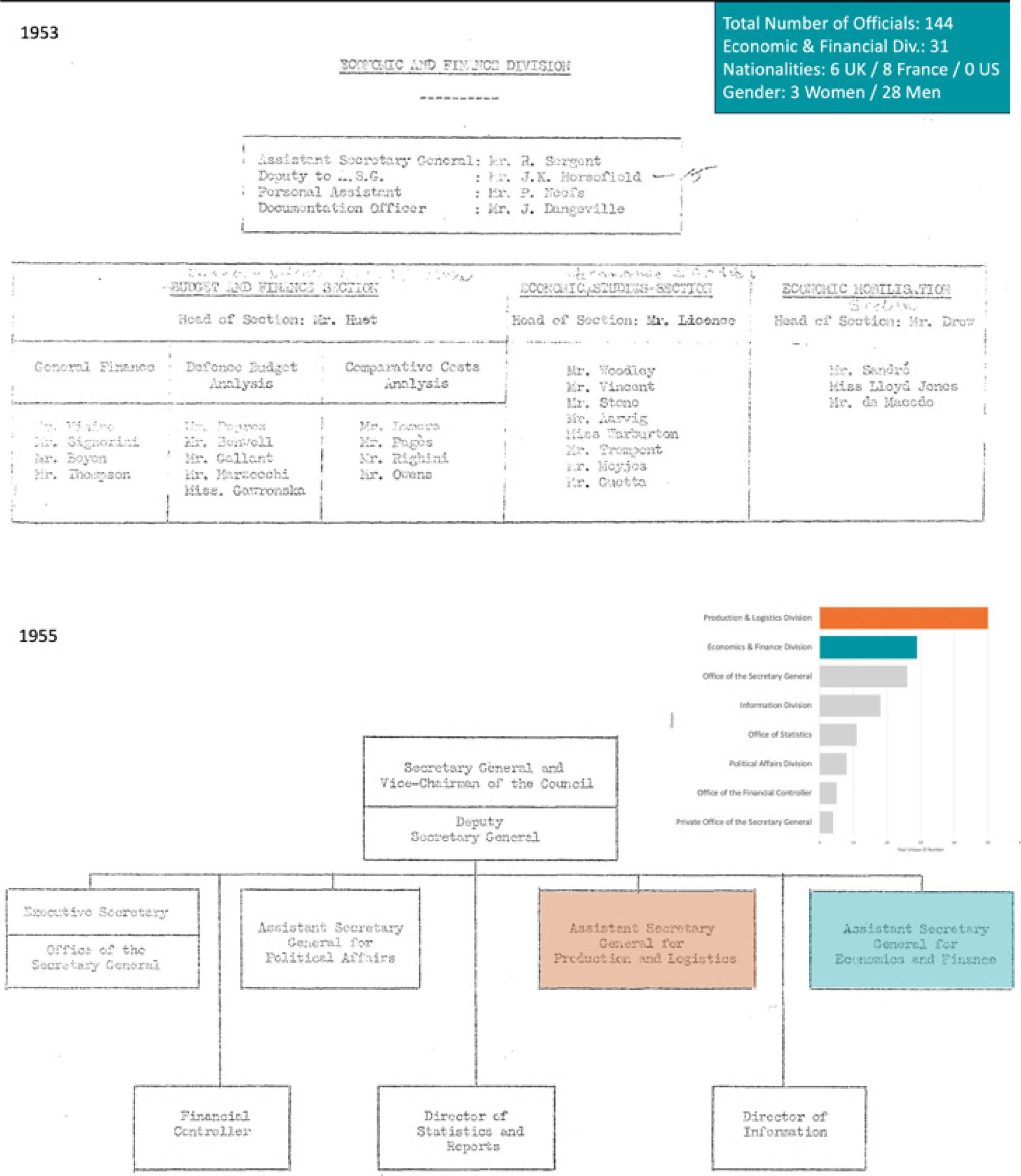
Figure 1:
The Economic and Financial Division (1953) and the Secretariat (1955) (Sources: NATO Archives: ISM(53)45-E, »Organization of International Staff and Standing Group Liaison Office«, 5 October 1953; ISM(55)15-E, »Organization of International Staff and Standing Group Liaison Office«, 12 September 1955)
By the early 1960s, the procedures of the Annual Review had become cumbersome and overly detailed, and no longer corresponded to the new atomic strategy at the heart of NATO.132 As the organisation itself openly reflects today:
It proved inadequate as a means of pressure in the case of serious divergence between the requirements of NATO military authorities and the actualforce contributions of member states. Beginning in 1959, the nations began to question its effectiveness.133
Meanwhile, the TCC exercise played a crucial role in resolving the OEEC’s first institutional crisis. It allowed the organisation to become the ›economic arm‹ of NATO, aligning its work more closely with the Atlantic military alliance. The OEEC strengthened the activities of the European Payments Union and ventured into new areas of activity. In the following years, however, the OEEC faced challenges in establishing a Western European free trade zone without quotas or tariffs. The six members of the European Coal and Steel Community (ECSC) began pushing for a customs union and a common market, creating a discriminatory bloc within the OEEC that could impede trade with other OEEC countries. Therefore, from 1956 until its transformation into the OECD,134 the OEEC struggled in an unsuccessful attempt to establish a pan-European free trade area as an alternative to a restrictive customs union. The standoff between two rival blocs of member countries – one of which eventually established the European Free Trade Association (EFTA) in 1960 – paralysed its work. The creation of the EEC in 1957 further intensified tensions within the OEEC and the broader Atlantic Community.135
The OEEC’s trajectory also suffered a setback with the departure of Robert Marjolin in 1955. By 1952, Marjolin was uncertain about what the OEEC could still contribute to Europe. Rather than staunchly defending the OEEC’s existing structure, Marjolin prioritised European unity, deeming it more crucial than the mere existence of the OEEC. After three more years, Marjolin chose to leave the organisation. His departure marked a significant change in the leadership and direction of the OEEC during a critical period of its evolution.136 In 1955, René Sergent succeeded Marjolin. Like Marjolin, he was a high-ranking French civil servant. Before his appointment, Sergent served as NATO Assistant Secretary-General (1952–1955), focusing on economic and financial issues.137 However, due to his inability to resolve internal disputes among the delegations, and his shortcomings in leading the OEEC effectively, Sergent’s tenure is generally regarded as a failure.138
By the late 1950s, the new dynamics of the Cold War – intertwined with the decolonisation of the global South – positioned the OECD as a vehicle of global American and Western ambitions, a role NATO could not fulfil. Despite including major trading nations and having the potential to counter the Soviet economic offensive, NATO was ill-suited to managing development aid. Most countries in the global South preferred to remain non-aligned in the Cold War and avoided direct association with a collective military defence organisation such as NATO. The US political and military associations with NATO were too explicit, preventing its use as an instrument for development aid.139 Nonetheless, the selection of the Secretary-General subtly maintained the OECD’s close link to NATO. In 1961, Thorkil Kristensen became Secretary-General of the OECD. Hailing from Denmark, Kristensen was already well established in European and Atlantic circles before 1960.140 As Minister of Finance between 1950 and 1953, he represented Denmark at OEEC ministerial meetings, and the Danish Ministry of Defence and the Ministry of Finance at NATO. Indeed, when the NATO Council decided to establish the TCC to address the defence architecture in Europe, Kristensen represented Denmark in this committee.141 He later recalled that his appointment as Secretary-General of the OECD was attributed to the Americans »in recognition of my participation in NATO ministerial meetings in the years 1950-1953«.142 While being very much a ›compromise candidate‹, he, just like Sergent, belonged to the small group of Atlantic Economic Men that connected the OEEC/OECD and NATO.143
Conclusions
The impact of international organisations’ considerations in finding a balance between European economic co-operation and Atlantic rearmament in the early 1950s was significant. The OEEC’s independent and, later, transfused methods were crucial in the establishment of NATO’s Secretariat and in fulfilling one of its primary tasks in the 1950s. This, in turn, highlights the – perhaps slightly underappreciated – significance of French modes of economic planning, bureaucratic leadership, knowledge and personnel in the connection between rearmament and economic co-operation. French officials within both organisations, and French officials who traversed the two, were one of the clearest examples of how the two IOs never functioned in isolation. Meanwhile, the OEEC, though experiencing major challenges in finding a new role for itself in the latter half of the 1950s, remained crucially connected to both the administration of NATO and the broader thinking about the Atlantic division of multilateral labour going into the 1960s. More speculatively, the organisational stability of the NATO Secretariat’s military-economic work was found in this procedural transfer but might also have been the kernel of what later became a kind of bureaucratic inertia. In the driver’s seat of these institutional developments was a relatively small group of Atlantic Economic Men, with the leading TCC officials at the centre. These belonged to a wider generation of politicians, experts, international civil servants, and diplomats who managed the Atlantic convergence and divergence on the questions of economic cooperation and rearmament in the 1950s.
Acknowledgement
This article is part of the project ›Autonomy and Expertise in International Administrations 1940s-1970s‹. This work is supported by the Independent Research Fund Denmark, Research Project 1, under Grant 1024-0054B.
About the Authors
Haakon A. Ikonomou is a historian of international organisations, internationalism, global governance, international bureaucracy, and diplomacy, inspired by digital, global, prosopographical, biographical, institutional, social, and oral history approaches. Ikonomou is PI of the IRFD-funded collective project Autonomy and Expertise in International Administrations, 1940s–1970s (2022–2025) and the ERC Consolidator Project INNER_LEAGUE – A social-bureaucratic history of the League of Nations Secretariat (2025–2030). He is the director of HUM:Global (University of Copenhagen), co-director of the Centre for History, Strategy and International Order (CHIOS) (Helmut-Schmidt-University / University of Copenhagen) and co-director of META-UN (4EU+ Alliance).
Marine Pierre is a historian specialising in European integration, diplomacy, and international organisations. She holds a PhD in Modern History from the University of Geneva and Paris 1 Panthéon-Sorbonne, with a dissertation on religion and politics in European Parliament–Turkey relations (1979–2009). Her postdoctoral research, conducted at the Saxo Institute, University of Copenhagen (2023–2024), within the project Autonomy and Expertise in International Administrations, 1940s–1970s, examines the socio-administrative history of the OEEC/OECD. In 2025, she was awarded a Simone Veil Short-Term Fellowship at Project House Europe, Ludwig-Maximilians-Universität München for her work on the organisation and its relations with other international bodies.