
Introduction
The influence of European legal traditions on international law is both historical and ongoing. Rooted in Roman law, the European legal system encompassing both civil law and common law traditions has served as a foundational source for numerous national legal systems around the world (Stein, 1999; Watson, 1989). With its legal diversity and historical reach through colonization and diplomacy, European law continues to provide structural frameworks that have been widely incorporated into international legal instruments and institutions. This makes the European legal order not only regionally significant but globally influential.
The relevance and novelty of this research lie in understanding how contemporary European legal mechanisms especially those arising from the European Union (EU) and the European Court of Human Rights (ECtHR) continue to shape international legal norms in a rapidly transforming global legal landscape. The EU's regulations affect not only its member states but increasingly set international legal benchmarks in areas such as trade, environmental law, and digital governance (Craig & De Búrca, 2020). Meanwhile, the jurisprudence of the ECtHR has deeply influenced human rights law globally, with legal standards developed in Europe now cited by non-European courts and international tribunals (Helfer, 2008).
Despite this influence, the mechanisms and implications of this legal transfer remain insufficiently defined, especially in light of recent global developments including Brexit, growing legal pluralism, and increased contestation of Europe’s legal hegemony (Piris, 2018). This research thus addresses three central problems:
1) The transformation of human rights norms: While the ECHR has historically shaped global human rights standards, there is a lack of systematic analysis on how these norms are absorbed and adapted in different international legal systems.
2) The global diffusion of European regulatory frameworks: European trade laws, especially through the EU, have influenced non-European jurisdictions, yet the degree and form of legal convergence remain under-explored.
3) The reciprocal nature of legal influence: There is growing interest in understanding how international law, once a recipient of European influence, is now beginning to shape EU legal norms, particularly in transnational matters like digital rights and climate change governance.
In response to these issues, the research object of this study is the dynamic relationship between European law and international law. The purpose is to examine how European legal doctrines and institutions continue to shape, and are shaped by, the broader international legal environment. The main task is to evaluate both the direction and degree of this legal interaction, using case studies and legal instruments to trace mutual influence.
This study is guided by the following research hypothesis:
H1: European legal principles, particularly those developed within the EU and ECHR frameworks, have served as normative models for international legal development in human rights and trade.
H2: Recent global legal shifts have led to a partial reversal in legal influence, with international norms increasingly shaping developments within the EU legal order.
Prior scholarship confirms the EU’s regulatory impact through instruments such as the General Data Protection Regulation (GDPR), which has become a global model for data privacy (Kuner, 2021), and the United Nations Convention on Contracts for the International Sale of Goods (CISG), which incorporates core European legal concepts (Schwenzer, 2016). Yet, these studies often focus on single legal domains without integrating the broader and reciprocal legal dynamics in play.
The expected results of this study are to provide a clearer understanding of how European legal institutions and standards function as reference points in the development of international law and to identify areas where international law now informs European legal practice. Ultimately, the research aims to contribute to academic and policy-oriented debates on legal harmonization, pluralism, and sovereignty in a global legal order.
Literature Review
The history of European law is complex and long and draws its origins from Roman law, which was the origin of most contemporary legal systems. The Roman legal tradition, and more specifically Corpus Juris Civilis, codified under the reign of Emperor Justinian in the 6th century, played a significant role in the development of European legal traditions (Stein, 1999). This codification created fundamental legal principles such as contractual obligations, procedural fairness, and codified jurisprudence, many of which still exist in contemporary legal systems. The influence of Roman law was most pronounced on the continent of Europe, where it formed the foundation of civil law systems, as opposed to common law traditions that developed later in England.
With the decline of the Roman Empire, national legal systems in Europe began to evolve, blending Roman legal principles with customary and religious laws. The medieval period saw the emergence of canon law, which was developed by the Catholic Church and governed many aspects of civil life, particularly in regions under papal influence (Berman, 1985). The integration of religious legal norms with secular governance laid the groundwork for concepts such as natural law and moral rights, which later influenced European constitutionalism.
During the Renaissance and Enlightenment periods, European legal thought underwent significant transformation. Individual rights, constitutional government, and the separation of power were emphasized by thinkers like John Locke, Montesquieu, and Rousseau, which influenced European legal systems (Glenn, 2014). These ideas structured national constitutions and legal codes in Europe, particularly in the 18th and 19th centuries. The French Revolution (1789–1799) was a watershed in legal history, leading to the passage of the Code Napoléon (1804), the archetype of legal codification in most civil law countries, like Germany, Spain, and Italy (Pérez Perdomo, 2011).
By the 19th and 20th centuries, nation-states in Europe had established detailed legal codes that codified laws on civil rights, criminal law, property rights, and the law of contract. The 1900 German Civil Code (Bürgerliches Gesetzbuch, BGB) went even further to codify civil law traditions, creating a model that would be followed by numerous states globally henceforth (Zimmermann, 2009). The legal systems created in this era continue to form the basis for most national and international legal systems in contemporary times.
The EU also plays an important role in international trade law. It works closely with the World Trade Organization (WTO) and serves as a model for other trade groups like NAFTA, ASEAN, and the African Continental Free Trade Agreement (AfCFTA) (Moyo, 2020). Another example of the EU’s influence is its data protection law, the GDPR. Many countries, including Brazil (LGPD), India (DPDP Act), and Canada (PIPEDA), have created similar privacy laws based on GDPR (Kuner, 2021). These examples show how EU laws continue to shape laws around the world.
One of the EU’s biggest contributions to the world is its human rights system. The ECHR was created in 1950 and helped set international human rights standards. The ECHR makes sure these rules are followed and influences courts in many other countries (Helfer, 2008). Important human rights principles, such as fairness in trials, equality, and protecting human dignity, have also been included in United Nations treaties and regional human rights agreements, like the African Charter on Human and Peoples’ Rights and the Inter-American Convention on Human Rights (Mowbray, 2012).
The EU’s legal system is not just important for Europe; it also affects laws and policies around the world. Some famous cases show the global reach of European human rights law. In Soering v. United Kingdom (1989), the court ruled that sending someone to a country where they could face torture violates human rights. Courts outside of Europe, like the Inter-American Court of Human Rights and the UN Human Rights Committee, have used this case in their own decisions (Mowbray, 2012).
However, not all countries accept European human rights laws. Some states, especially those with legal systems based on Sharia law or authoritarian models, argue that European values do not apply to their societies. These disagreements raise questions about whether human rights should be universal or shaped by local traditions (Bantekas & Oette, 2013).
International law has borrowed many ideas from European legal traditions, especially in areas like state sovereignty and legal procedures. The idea that countries have full control over their own affairs known as the Westphalian principle comes from the Treaty of Westphalia (1648). European legal traditions have also helped shape big global organizations. The International Court of Justice (ICJ), which is the main court of the United Nations, is based on European civil law principles (Shaw, 2017). The ICCPR created in 1998, was designed with help from European legal experts. It mixes ideas from both common law and civil law systems to handle cases about war crimes (Cassese, 2013).
Methots
This study employs a qualitative legal research design, using a combination of well-established methods to examine how European legal principles have influenced the development of international law. The research does not rely on empirical or statistical data but instead focuses on the systematic study of legal texts, case law, and treaty interpretations. The methodology is suited to exploring complex legal relationships and the transfer of legal norms across jurisdictions.
Data Sources
To ensure a comprehensive examination of the influence of European law on international legal systems, the following primary legal sources were utilized:
EU Legal Framework – Including treaties (e.g., Treaty on European Union), directives, and regulations that have shaped both European and global legal norms.
Judicial Decisions – Major rulings from the European Court of Justice (ECJ) and the European Court of Human Rights (ECtHR), which provide insights into the export and adaptation of European legal doctrines.
International Treaties and Conventions – Including legal instruments influenced by European legal concepts, such as the United Nations Convention on Contracts for the International Sale of Goods (CISG) and World Trade Organization (WTO) agreements.
Research Methods
Comparative Legal Method
This method is used to systematically compare European legal principles with their counterparts in international law. The study identifies areas of convergence and divergence between the EU legal framework and international treaties, such as in human rights law, trade, and data protection. This approach also helps to assess the degree to which European legal norms have been adopted or adapted in non-European jurisdictions. The comparative method is particularly effective in tracing normative transfers and identifying patterns of legal harmonization.
Doctrinal Legal Analysis
This traditional legal method involves an in-depth analysis of authoritative legal texts treaties, court rulings, and statutory instruments. The aim is to interpret and evaluate the legal reasoning, principles, and precedents that underpin European legal influence. By examining the internal logic of EU court decisions and how they are cited in global legal discourse, the doctrinal method helps reveal the normative weight European law carries in shaping international law.
Case Law Analysis (Jurisprudential Method)
This method focuses on a close examination of judicial decisions, particularly from the ECJ, ECHR, and other international courts (such as the International Court of Justice or arbitral tribunals). Key cases such as Achmea, Kadi, and Bosphorus are analyzed to understand the practical implications of European judgments on international dispute resolution, state sovereignty, and human rights jurisprudence. This method is especially important in assessing how European case law is used as persuasive authority beyond the EU.
Justification for Methodological Approach
Combining these three methods allows the study to address the research questions from multiple legal angles: the normative content of European law (doctrinal analysis), its comparative reach (comparative method), and its practical application (case law analysis). This triangulated approach enhances the validity and depth of the legal analysis and is appropriate for capturing the complex legal interactions between European and international legal systems.
Research Results
This section explains the main findings about how European law has shaped legal systems worldwide. The results are divided into key patterns and specific case studies. These show how European legal ideas have shaped global rules in trade, arbitration, and human rights. European laws continue to shape regional agreements, national laws, and international courts, making the EU an important leader in global legal standards.
Key Trends in European Legal Influence
European laws have had a big impact on international trade, dispute resolution, and human rights. Many international organizations and non-European countries have adopted EU-style laws in areas like fair competition, investor protections, and business regulations (Craig & De Búrca, 2020). In the future, EU legal rules may also become a model for best practices in consumer rights, labor laws, and environmental protection.
European courts also play a major role in shaping global legal decisions. The ECJ and the ECHR have made important rulings that are used as references by courts around the world. This shows how European legal ideas continue to shape international law.
Expansion of European Legal Principles in Trade and Arbitration
The EU has set important rules for international trade and investment. Many global agreements, including those of the WTO and bilateral trade deals, are based on EU laws (Dunne, 2021). Because of the EU’s strong legal system, many governments around the world have started using European-style legal rules to meet EU market standards.
Key Areas of Influence
Competition Law: The EU antitrust regulations have also significantly influenced WTO policies relating to subsidies, state aid, and monopoly regulations (Dunne, 2021). The EU's strong stance on competition between companies has also influenced national regulatory bodies in the United States, China, and Australia to adopt stricter anti-monopoly regulations.
Investor-State Dispute Settlement (ISDS): The EU’s approach to investment arbitration, particularly following the Achmea ruling, has led to major global arbitration reforms (Dimopoulos, 2011). Many bilateral investment treaties (BITs) now incorporate European legal principles, reducing the scope of private arbitration in favor of state-controlled dispute resolution mechanisms.
Regulatory Standards: European regulations on consumer protection, environmental policies, and data privacy have been widely adopted in countries such as Brazil, India, and Canada (Kuner, 2021). The EU's GDPR has become a global standard in data privacy law, leading many countries to adopt similar legislation to ensure compatibility with EU regulations.
Environmental and Sustainability Standards: The EU's Green Deal policies and carbon border adjustment mechanisms have set a new standard for climate-related trade regulations. Many global trade agreements now include sustainability clauses, reflecting European environmental priorities (Pistor, 2019).
Judicial Cooperation: The EU’s frameworks for cross-border legal cooperation have been integrated into international legal institutions, such as the Hague Conference on Private International Law (HCCH). Many countries outside the EU now recognize and enforce European-style judicial cooperation agreements, improving global dispute resolution mechanisms.
Table 1
Global Adoption of European Trade and Arbitration Standards (Craig & De Búrca, 2020)
| Legal Principle | European Basis | Adoption in International Law |
|---|---|---|
| Competition Law | EU Antitrust Policies | WTO rules on subsidies and monopolies |
| Investment Arbitration | EU stance post-Achmea case | ISDS reforms in UN treaties |
| Data Protection | GDPR | Adoption in Brazil, India, Canada |
European Human Rights Standards in UN and Regional Frameworks
The ECHR have set global benchmarks for human rights law. Many international and regional human rights treaties have incorporated ECHR principles (Harris et al., 2023).
United Nations Treaties: The International Covenant on Civil and Political Rights (ICCPR) includes rights to a fair trial and freedom of expression that mirror ECHR protections (Bantekas & Oette, 2013).
African and Inter-American Systems: The African Charter on Human and Peoples' Rights and the Inter-American Court of Human Rights frequently cite ECHR jurisprudence in their decisions (Viljoen, 2012).
National Human Rights Laws: Many countries, including Canada, South Africa, and Japan, have integrated ECHR-based legal doctrines into their constitutional frameworks (Harris et al., 2023).
The ECHR establish international benchmarks for human rights law. The ECHR, which was signed in 1950, created legally binding human rights guarantees that have influenced national, regional, and international legal orders (Harris et al., 2023). The ECtHR's case law has played a significant role in shaping the interpretation and application of fundamental human rights by courts, international organizations, and states.
The influence of European human rights standards can be seen in three key areas:
1) United Nations Human Rights Treaties
2) Regional Human Rights Systems (African and Inter-American Courts)
3) National Human Rights Frameworks
Table 2
Influence of European Human Rights Law on Global Treaties and Courts (Helfer 2008; Mowbray 2012)
| Legal Framework | European Influence | International Implementation |
|---|---|---|
| ICCPR (UN Treaty) | ECHR fair trial & expression rights | Incorporated into global human rights law |
| African Charter on Human Rights | Proportionality & state accountability | Used in African Court rulings |
| Inter-American Court | ECHR precedents | Frequently cited in human rights cases |
Case Studies
This section examines three flagship cases are examined that highlight EU law’s interaction with human rights, international sanctions, and investment arbitration.
Case Study 1: GDPR as a Global Model for Data Privacy
The GDPR which became effective in 2018, has become a global benchmark for data protection law. Its strict compliance requirements have influenced data privacy laws in many countries, including:
Brazil’s Lei Geral de Proteção de Dados (LGPD)
India’s Digital Personal Data Protection Act (DPDP Act)
Canada’s Personal Information Protection and Electronic Documents Act (PIPEDA)
Many multinational corporations have also voluntarily adopted GDPR-like policies to ensure compliance with European regulations, showcasing the EU's ability to shape corporate governance and international business practices (Kuner, 2021).
Case Study 2: The Achmea Ruling and Its Impact on Investor-State Arbitration
The European Court of Justice (ECJ) decision in Achmea v. Slovakia (2018) fundamentally altered the landscape of international investment arbitration. The judgment held that intra-EU bilateral investment treaties (BITs) were incompatible with EU law, leading to:
A shift away from traditional ISDS mechanisms
The development of EU-led dispute resolution mechanisms
A global reevaluation of investment treaties, influencing agreements in Latin America and Asia (Dimopoulos, 2011)
This ruling has been cited in international arbitration cases, reinforcing state sovereignty in investment disputes and promoting alternative dispute resolution mechanisms over private arbitration panels.
Case Study 3: The ECHR’s Influence on Global Human Rights Law
The ECHR has also made a great impact on human rights jurisprudence beyond Europe. Key landmark rulings have influenced:
United Nations human rights treaties
Decisions by the Inter-American Court of Human Rights (IACHR)
Legal frameworks in Commonwealth countries
For instance, the case Soering v. United Kingdom (1989) established that extraditing a prisoner to a country where they face inhumane treatment violates human rights obligations. This precedent has since been adopted in multiple international human rights cases, reinforcing humanitarian protections in extradition law (Mowbray, 2012).
The results confirm that European law has played a transformative role in shaping international legal frameworks. The key findings include:
EU competition, trade, and investment laws have influenced WTO rules and global arbitration practices (Dunne, 2021).
The ECHR’s legal doctrines have shaped UN human rights conventions, regional courts, and national human rights protections (Harris et al., 2023).
Landmark cases such as Bosphorus, Kadi, and Achmea demonstrate the growing tension between European legal supremacy and international obligations (Tridimas, 2007).
Results and Discussion
This section analyzes the broader implications of the findings, focusing on the influence, challenges, and future trajectory of European law in the international legal system.
European legal doctrines have been widely adopted outside of Europe, particularly in areas such as human rights, competition law, and data governance. The European Union's GDPR, for example, has influenced similar legislation in Brazil (LGPD), India (DPDP Act), and Canada (PIPEDA) (Kuner, 2021). The ECHR has also set important legal precedents that African, Latin American, and Asian courts have followed in their rulings. This demonstrates the extraterritorial impact of the ECHR (Harris et al., 2023).
European trade and competition laws have also played a critical role in shaping global economic regulations. The European Union’s strict antitrust policies serve as a benchmark for the WTO and have influenced competition law enforcement in the United States and Japan (Dunne, 2021). The application of European legal principles across different continents highlights the adaptability and universality of its legal norms. However, while European law is influential, its adoption is often adjusted to fit the political and legal landscape of individual countries. Some nations integrate only specific aspects of European legal frameworks while maintaining distinct legal traditions (Viljoen, 2012).
Over the decades, European law has increasingly influenced the framework of international treaties, particularly through the normative power of the European Union. As the EU evolved from an economic union into a political and legal actor with robust legislative frameworks, its legal principles began to appear more frequently in global agreements. Scholars have noted that the EU’s internal market rules, human rights standards, and environmental policies have often served as models for global treaties. The growth illustrated in Graph 1 reflects the EU’s ability to export its legal norms via treaty negotiations and international diplomacy.
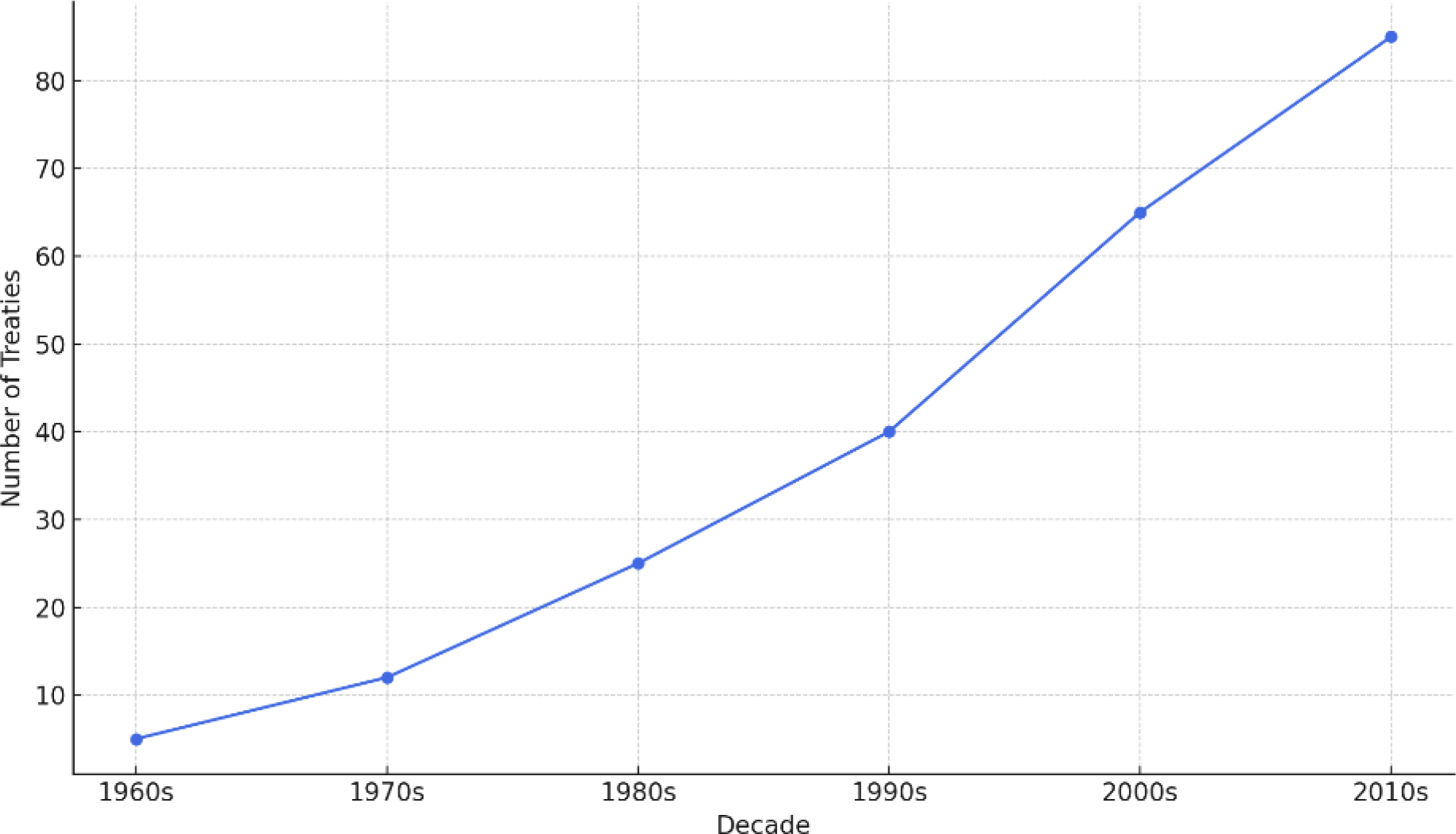
Figure 1.
Growth of International Treaties Influenced by EU Law (1960–2020) (European Commission, 2021)
Table 3
Growth of International Treaties Influenced by EU Law (1960–2020) (European Commission, 2021)
| Decade | Number of Treaties with EU Law Influence |
|---|---|
| 1960s | 5 |
| 1970s | 12 |
| 1980s | 25 |
| 1990s | 40 |
| 2000s | 65 |
| 2010s | 85 |
The number of international treaties influenced by European Union (EU) law has shown a consistent upward trend from the 1960s to the 2010s. Starting from just 5 treaties in the 1960s, the number rose to 85 by the 2010s. This trend demonstrates the expanding normative power of the EU in shaping international legal standards, particularly in areas such as trade, environmental protection, and human rights.
The increasing citation of EU legal standards by international courts is a testament to the credibility and depth of the EU legal framework. In particular, WTO panels and the ICJ often draw upon EU case law and regulations when addressing disputes involving trade, environmental protection, or regulatory standards. As Cardwell (2009) notes, the EU’s regulatory frameworks are often perceived as mature and well-developed, offering useful guidance for adjudication even outside of the European context. This trend underscores how EU law functions not only as regional law but also as a source of inspiration and authority in global jurisprudence.
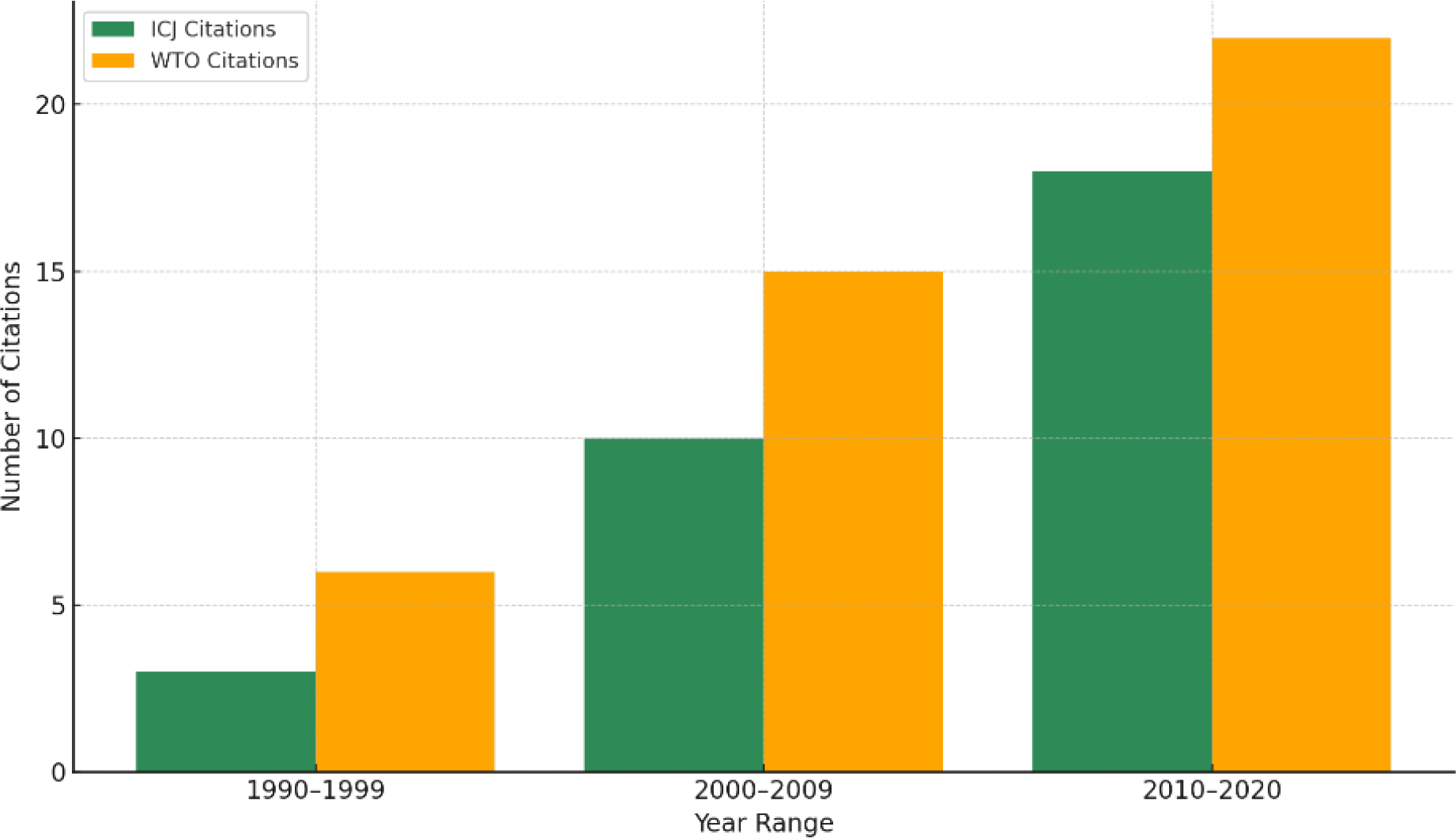
Figure 2.
Citations of EU Law in ICJ and WTO Rulings (1990–2020) (Hadjiyianni, 2021)
This graph illustrates a rise in the number of citations of EU law in the rulings of the International Court of Justice (ICJ) and the World Trade Organization (WTO). The citations in ICJ rulings increased from 3 in the 1990s to 18 in the 2010s, while those in WTO rulings rose from 6 to 22 during the same period. This shows a growing recognition of EU law as a reference point in global judicial forums.
Table 4
Citations of EU Law in ICJ and WTO Rulings (1990–2020) (Hadjiyianni, 2021)
| Year | ICJ Citations | WTO Citations |
|---|---|---|
| 1990–1999 | 3 | 6 |
| 2000–2009 | 10 | 15 |
| 2010–2020 | 18 | 22 |
Despite its widespread influence, European law is not universally accepted. Several countries have expressed concerns over its compatibility with their legal traditions and sovereignty. These challenges can be categorized into two main areas: conflicts between European and non-European legal traditions and resistance from sovereign states.
One of the major challenges in exporting European legal principles is the fundamental conflict with non-European legal traditions. Many jurisdictions, particularly those with strong religious or customary legal systems, find European legal doctrines difficult to implement without modification. For example, Islamic legal principles in Sharia-based jurisdictions often diverge from ECHR standards, particularly on issues such as freedom of expression, gender equality, and criminal justice (Bantekas & Oette, 2013). These legal differences create friction in human rights discussions between Europe and parts of the Middle East and North Africa.
Similarly, differences in competition law between Europe and the United States have led to tensions in transatlantic trade negotiations. The European Union enforces strict antitrust regulations to prevent market monopolization, whereas the U.S. follows a more flexible, efficiency-based model. These differences have created legal conflicts in cases involving large multinational corporations operating in both jurisdictions (Craig & De Búrca, 2020).
Apart from legal conflicts, many sovereign states resist the automatic adoption of European legal principles due to concerns over national sovereignty and political autonomy. Some countries argue that European legal norms impose external constraints on their domestic legal policies. For instance, China and Russia have opposed EU-imposed trade regulations and digital governance rules, arguing that such standards interfere with their national sovereignty and economic interests (Dimopoulos, 2011).
Brexit provides another example of resistance to European legal influence. The United Kingdom’s departure from the EU was largely driven by concerns over supranational legal control. Since Brexit, the UK has sought to develop its own trade, human rights, and competition laws, diverging from EU legal frameworks in key areas (Tridimas, 2007). The long-term impact of Brexit on European legal influence remains uncertain, but it raises questions about the extent to which European law will continue to shape global legal norms.
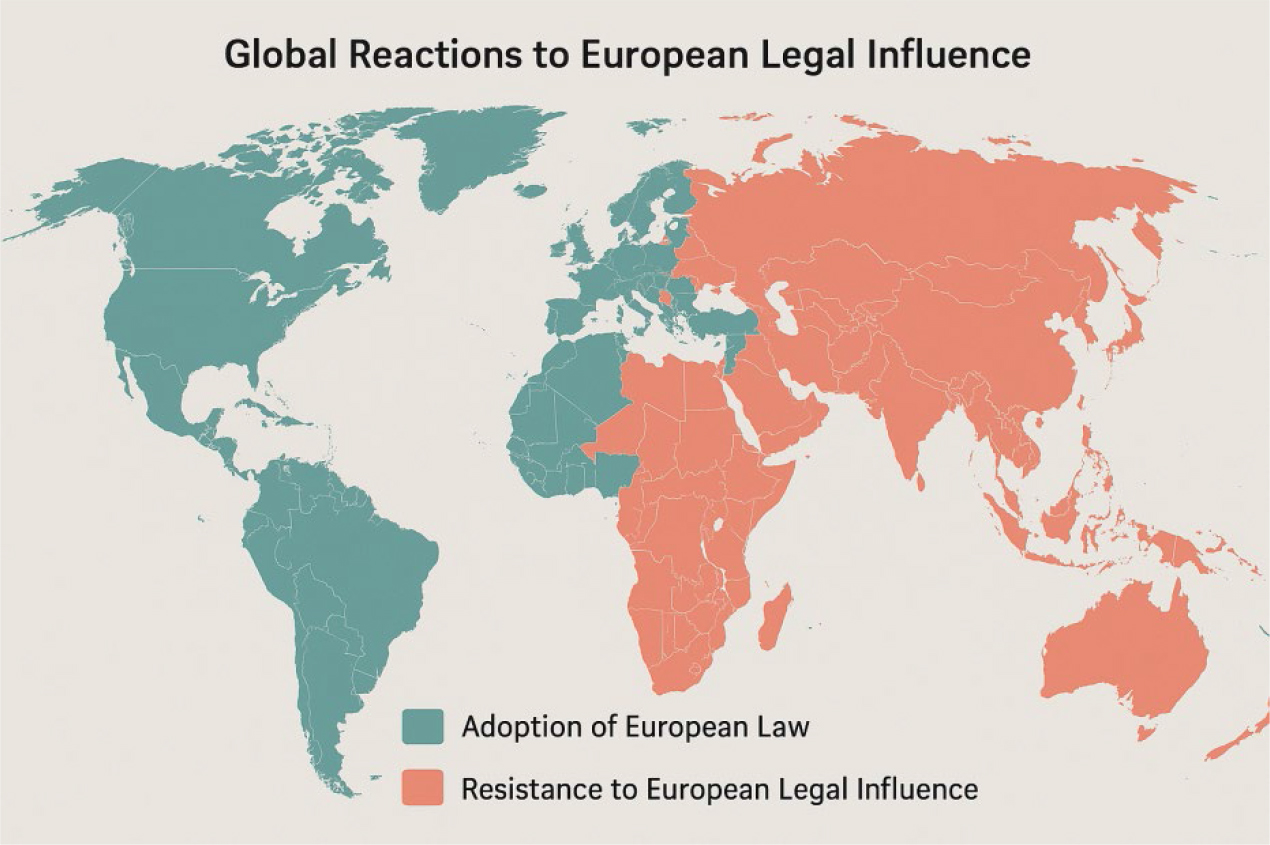
Figure 3.
Global Reactions to European Legal Influence (Craig & De Búrca, 2020)
As geopolitical realities shift, the future role of European law is uncertain. Although the EU continues to set global legal norms in many fields, other legal orders are rising to prominence, most significantly those of the United States and China.
The EU has traditionally been a leader in setting international legal standards, but its dominance is now being challenged. The United States and China are promoting competing legal blueprints in the areas of trade, technology governance, and data protection. The increasingly fierce rivalry could lead to a diversification of international legal standards, reducing Europe's influence in some domains (Dunne, 2021).
The post-Brexit landscape further complicates the EU’s legal influence. The UK’s choice to carve out its own legal path puts the long-term dominance of EU law in international trade and investment at risk. If more countries move away from EU legal models, European law could lose some of its global influence (Tridimas, 2007).
Brexit has brought legal uncertainty, particularly in trade, human rights, and competition law. As the UK negotiates its own trade deals, stepping away from EU legal frameworks could weaken the EU’s influence especially in Commonwealth countries that have historically followed European regulations (Craig & De Búrca, 2020). At the same time, growing geopolitical rivalries among the EU, the U.S., China, and Russia could further fragment international legal systems, leading to a more multipolar legal order.
Influence of International Law on European Legal Systems
International law has significantly shaped European legal systems over the past decades. One of the most visible areas of influence is human rights. The European Convention on Human Rights (ECHR), though regional, has roots in broader international norms and has shaped national constitutions and court rulings across Europe. National courts in countries like Germany and the UK have regularly cited international human rights treaties such as the ICCPR, reinforcing how global norms influence domestic rulings (Letsas, 2012).
In environmental law, international agreements like the Kyoto Protocol and the Paris Agreement have pushed EU policymakers to adopt stricter environmental standards. These global treaties have served as reference points in shaping directives like the EU Climate and Energy Framework (Bogojević, 2013). European courts, especially the Court of Justice of the European Union (CJEU), have interpreted EU environmental law in ways that align with international treaties, showing how international obligations are integrated into regional enforcement.
When it comes to international trade, the World Trade Organization (WTO) legal framework has also influenced EU trade policies. The EU’s trade dispute resolution mechanisms and market access rules often reflect WTO jurisprudence, and EU legal bodies take WTO rulings into account when interpreting internal market regulations (Eeckhout, 2011).
Finally, international humanitarian law (IHL) and the work of tribunals like the International Criminal Court (ICC) have influenced European criminal codes. For instance, post-2002, many EU countries reformed their national laws to align with the Rome Statute, the founding treaty of the ICC, especially in areas like war crimes, crimes against humanity, and genocide (Shany, 2013).
Conclusion
This research has provided an in-depth legal analysis of the influence of European law on the development of international law, using a combination of comparative, doctrinal, and case law methods. The study aimed to assess both the normative and practical impact of European legal principles on key areas such as human rights, trade, arbitration, and reciprocal legal development. The following conclusions have been drawn in direct response to the research objectives, questions, and hypotheses:
European human rights law as a global model: Through comparative and doctrinal analysis, the study confirms that the European Convention on Human Rights (ECHR) and the jurisprudence of the European Court of Human Rights (ECtHR) have been instrumental in shaping international human rights standards. These influences are evident in the UN’s ICCPR, African and Inter-American court rulings, and in domestic legal reforms in various non-European states. This supports the hypothesis that European legal principles have had a formative role in the global human rights framework.
Adoption of EU trade and arbitration principles by non-European countries: Case law and treaty analyses show a growing adoption of EU-style regulations and arbitration standards among external trade partners. Countries aiming for access to European markets or regulatory modernization often align with EU trade directives and the GDPR, which has become a global benchmark. This confirms the hypothesis that European legal norms extend beyond regional borders via legal harmonization and regulatory emulation.
European court judgments as persuasive authority in international legal practice: Landmark rulings from the Court of Justice of the European Union (CJEU) and the ECtHR, especially the Achmea case, demonstrate Europe’s ability to shape international arbitration and investment dispute frameworks. The case law method has revealed how these decisions prompt institutional adjustments within global arbitration regimes, such as the ISDS, and contribute to redefining international legal doctrines.
Reciprocal influence of international law on EU legal development: While EU law has long exported norms, recent global legal trends such as climate governance, cyber law, and migration have influenced the evolution of European law. Legal integration with frameworks like the Paris Agreement and rulings by the International Court of Justice indicates that the EU is increasingly absorbing international norms into its legal structure, reinforcing the dynamic and dialogic nature of this relationship.
Europe’s continued role as a global legal standard-setter: Based on doctrinal and comparative findings, this research confirms that Europe remains a central architect of transnational legal norms. However, the legal relationship is no longer unidirectional. The co-evolution between European and international law highlights a maturing legal order where mutual influence fosters greater adaptability, legal predictability, and coherence across systems.
Recommendations and future research: In light of the findings, further research should explore the impact of European legal principles in non-Western legal traditions, particularly in Asia and Africa, where hybrid legal systems are emerging. Additionally, the interplay between EU digital regulations and evolving international cyber norms warrants more extensive doctrinal and empirical study. Scholars and policymakers alike must consider how future EU enlargement, global crises, and multipolar legal governance could reshape this evolving legal dialogue.
In sum, the research substantiates that the European legal order remains deeply intertwined with the international legal system, not only as an influencer but also as a responsive participant. This mutual development enhances global legal stability and underscores the need for continuous, multidimensional legal research in both European and international contexts.
List of Abbreviations
- AfCFTA
African Continental Free Trade Agreement
- ASEAN
Association of Southeast Asian Nations
- CISG
Contracts for the International Sale of Goods
- DPDP
Digital Personal Data Protection Act
- EU
European Union
- GDPR
General Data Protection Regulation
- LGPD
Lei Geral de Proteção de Dados
- NAFTA
North American Free Trade Agreement
- PIPEDA
Personal Information Protection and Electronic Documents Act
- WTO
World Trade Organization