
Introduction
Energy markets have always been integral to the global economy, serving as the backbone of industrial development, transportation, and modern infrastructure. With reference to oil and gas, these products are very sensitive and their supply, and their prices affect several key areas as regards development, politics, and social welfare. Though these markets are particularly susceptible to developments in related markets and other influencing factors they are becoming a hallmark of global economic volatility. This elasticity is well observed when it comes to politics, since political situations have over time influenced energy price through factors such as supplies, trade barriers and market instability.
Traditionally, conflicts including wars, sanctions, and political instabilities act as a perfect example of major disruptions to energy markets. The gulf war of early 1990 saw great disruption in the supply and thus a consequent soaring of oil prices. In a similar vein, new sanctions imposed on Russia in March 2014 after the annexation of Crimea had reverberations in global energy markets showing the externality of politics to energy business. These events underscore the fact that energy markets are not only governed by demand and supply fundamentals but also related to geopolitical factors.
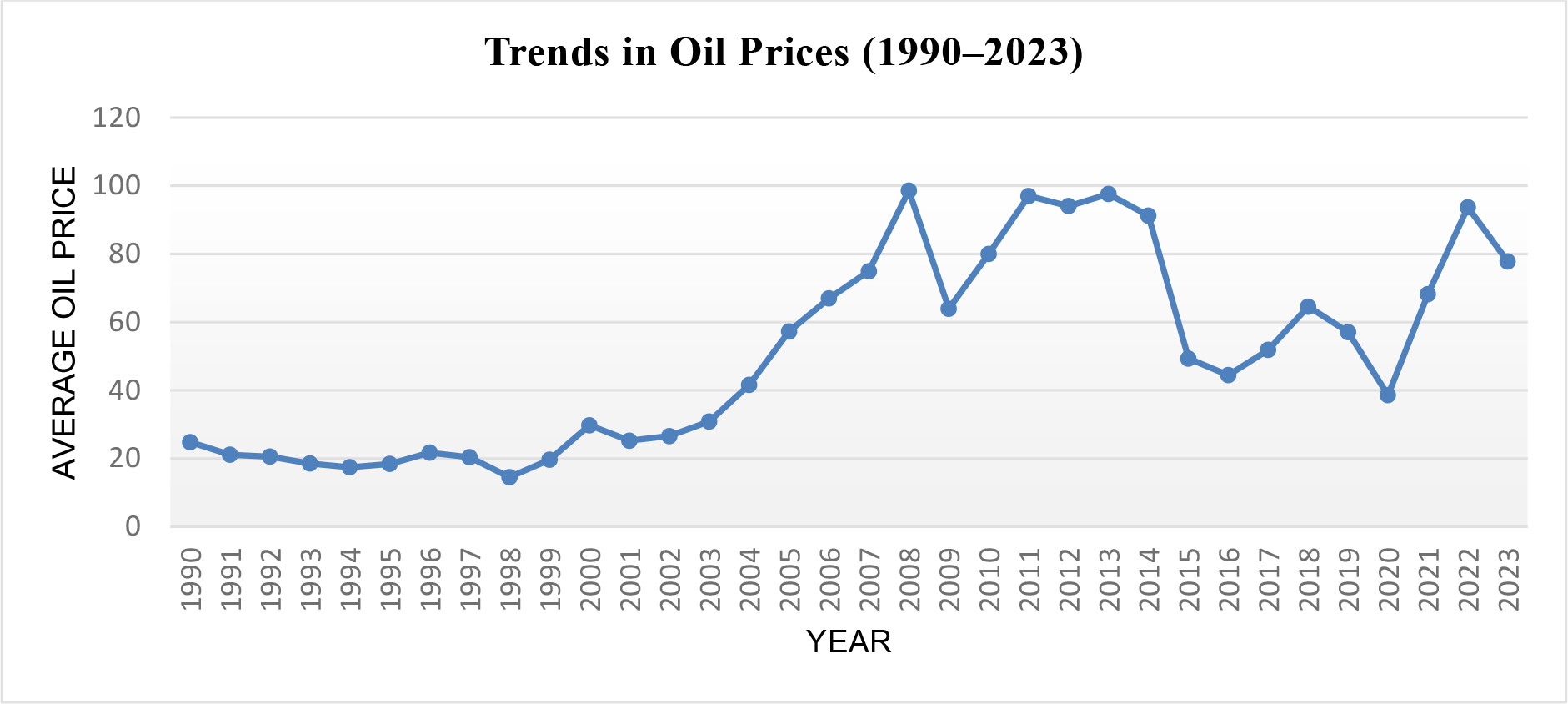
Figure 1.
Trends in Oil Prices (1990–2023)
More recent advances have complicated these markets especially through financialization and complex measures of market volatility. Tools like the Crude Oil Volatility Index (OVX), introduced in the late 2000s, provide real-time insights into investor sentiment and market uncertainty. Such metrics have shown that short-term fluctuations in prices affect the energy price in today’s world and these changes are driven by speculation, changes in global economic factors and unexpected shift in demand and supply. With geopolitical risks still key drivers, the relationships between these and fluctuations in market produce a new complicated facet to analyzing energy prices.
In analyzing the determinants of oil and gas prices, previous literature has drawn limited attention to a comparative analysis of both historical movement and up-to-date contextual price range. Little effort is made to systematically transition from one period to the other in an effort to analyze how geopolitical risks and market volatility have shifted over time as external forces. Moreover, macroeconomic indicators such as GDP growth and inflation are acknowledged as essential factors, defining energy market dynamics but the integration of geopolitical risk and the specification of volatility models’ structure are still rather vague.
In the past few years, unusual crises such as the COVID-19 pandemic and the Russia–Ukraine conflict have affected the oil and gas market in recognizable ways. The authors, Umar and Solarin (2021), show that the unpredictable impacts of the pandemic led to strong two-way links between COVID-19 case counts and oil-price volatility. It is noted by the International Energy Agency (2023) that the invasion by Russia last year resulted in an 80 bcm drop of pipeline gas to Europe, pushing energy prices sharply higher during some weeks. According to a recent VAR analysis from Zhao et al. (2018), the recent global and health crises boosted the short-term variability in both Brent and TTF prices which means a closer look is needed at the old drivers of energy costs.
This research aims to fill existing gaps by utilizing the mixed-period research design to establish the effects of geopolitical risks, market risk, and macroeconomic factors on oil and gas prices. While obtaining historical context from long term trends this research uses data from 1990 to 2023 and data for the analysis of the selected period after 2009 and Crude Oil Volatility Index (OVX) for focused approach. The split in these two-time frames makes the study provide the character that provides an understanding of how the dynamics of energy markets have changed with respect to the changes in the geopolitical and economic environment.
The central research questions guiding this study are:
1) How have the geopolitical factors affected oil and gas prices within the last three decades?
2) What does the OVX, measuring market volatility, suggests about the role of these factors in forming the energy prices in the contemporary world?
3) What kind of relationship exists between gross domestic product, inflation, geopolitical and market risk on energy price?
4) How policymakers and stakeholders can avoid shocks occasioned by geopolitical and market volatility on energy markets.
Answering these questions, this article makes three research contributions to the field. First, it reconciles the historical and modern approaches, which gives a general understanding of geopolitical risks and market volatility in energy markets for various periods. Second, it complements macroeconomic data (GDP growth rate, and inflation) to capture a longer view on energy price trends. Last but not least, it provides recommendations on how policymakers and stakeholders should engage in an environment of rising volatility and uncertainty in the global energy sector. In doing so, the study contributes not only to the discipline’s theoretical knowledge and development but also to the identification and functioning of the complexities of modern energy markets.
Literature Review
Geopolitical Tensions and Energy Prices
Tensions between different regions and evolutions on the energy market are well researched in literature. Global tensions like civil wars, international sanctions and regional instability threaten to disrupt supplies of oil & gas hence fluctuations in prices. For example, Kilian (2009) showed how geopolitical ‘shocks’ cause unreliable supplies which in turn cause fully specified reaction to price changes. In the same way, Baumeister and Peersman (2013) applied supply-side shock, focusing on the fact that political events considerably affect it.
Cross-sectional case histories supplement this relation. Hamilton (2013) used the Gulf War oil prices to establish that they rise as the global economy moves downhill. The Arab Spring (2010–2012) also illustrated another behavior where regional unrest can fuel oil price increases, though Baffes et al. (2015) showed its market persistency. In the past, geopolitical risks were not as of high importance, while more recently, for example, the Russia-Ukraine conflict highlighted it anew. Bouoiyour and Selmi (2022) found out that this conflict had a great impact with regard to the European gas prices thereby posing a test to the energy markets.
New parameters such as the Geopolitical Risk Index (GPR) have therefore emerged and changed the analysis of geopolitical risks and uncertainties. Caldara and Iacoviello (2018) employed GPR to measure the impacts of geopolitical risks in which results meta-parameters were in parallel with oil price fluctuation. This method was further supported by Avise L Gupta et al. (2020) who underscored the capability of GPR in forecasting future prices shocks.
Other works examine the interactions between political factors on the global level and market processes. Thus, Apergis and Payne (2014) pointed out how geopolitical factors increase the level of uncertainty of price in emerging markets importing oil. In addition, Bhattacharya et al. (2017) only focus on AOECs and find that although persistent geo-political risks reduce fiscal balance by causing volatility in export, they are sustainable.
However, some literature gaps can be identified such as the absence of proper understanding of the relationships between geopolitical risks and factors like exchange rates and market volatility as pointed out by Filis et al (2011). Such integrative approaches are needed for capturing the more complex relationships of energy prices.
Market Volatility (OVX) and Energy Prices
There has been some concern in the market volatility as one of the determinants of energy prices especially after the 2008 financial crisis. The Crude Oil Volatility index (OVX) gives a strong foundation when it comes to measuring market volatility. Subsequent to the argument of Bessembinder et al. (1995), the idea of the volatility indices was introduced as a forecast of prices volatility. Kang et al. (2014) further expanded this approach to investigate OVX levels and the fluctuation of crude oil price.
Another strand of research is financial speculation as a source of fluctuation in prices. Gubler and Hertweck (2013) also did research on speculative trading, and found that such trading activity would exacerbate the volatility waves in the periods of uncertainty. Filis et al. (2011) also found evidence that is consistent with the hypothesis that increasing financialization of oil markets leads to increasing the sensitivity of price to macro-shocks, in the post-2009 period.
Current research expands the knowledge of OVX predictive capability. Later, in the context of the Borsa Istanbul, Mohaddes and Pesaran (2017) showed that the increase in OVX has predictive ability because it shows the market is preparing for a price change. In the same partly Arouri, et al., (2012) pointed to the ability of OVX to capture investors’ behavior during an economic crisis.
In the increase of market volatility with the implication of geopolitical risks, there is emerging research. Park and Ratti (2008) identified that geopolitical risks are high, especially in oil-exporting nations. Most advanced models including the one developed by Nazlioglu et al. (2015), contain both geopolitical and macroeconomic factors in addition to OVX to create a thorough look at prices.
Exchange Rate Fluctuations and Energy Prices
Currencies are a critical factor in energy pricing, this especially regarding exchange rates measured by the US Dollar Index (DXY). This is in a view to the fact that oil which is traded internationally is measured in US dollars, hence movements in such affect the capability of the importing countries. Akram (2004) has proved that petro-dollar increases global oil demand when dollar is weak than otherwise when the dollar is strong.
In furtherance of this, Beckmann et al., (2017) employed the asymmetry of exchange rate effects where they differentiated the oil-exporting and oil-importing countries. Their work was able to ascertain that oil-exporting nations are more susceptible to currency devaluations that reduce export earnings. Similarly, Reboredo (2012) noted on the way in which exchange rate volatility exhibited causal links in a feedback form relation with fluctuations in oil price.
Lizardo and Mollick (2010) offered a detailed explanation of the DXY’s function in explaining energy price fluctuation. They described on how fluctuation of exchange rate affects relative supply and demand in international energy markets. Some highly related subsequent work by Ji et al. (2018) incorporated variation in exchange rates into other broader energy price forecasting models, noting their effectiveness in forecasting during crises.
He also has examined the relationship between exchange rates and geopolitical risks with the literature. Apergis and Payne (2014) also noted that the impacts of exchange rate changes on prices of energy – especially oil – are more pronounced during geopolitical crisis. This plot demonstrates the relationships between the market factors influencing global energy changes.
Macroeconomic Influences: GDP Growth and CPI
Variables such as Gross Domestic Product (GDP), the Consumer Price Index (CPI) and oil and gas price volatility influence the moderating effect of macro-economic change on the relationship between oil and gas prices and external shocks. Another author Hamilton (2008) provided a high degree of oil price analysis and the occurrence of slow business growth, proved that sharp oil price rises are followed by the recession. This relationship depicts the vulnerability of the economy to changes in the cost of energy. Likewise, other studies can show that there is nonlinearity in the relationship between oil price shocks and GDP growth: the nature of the shocks matter (positive supply shocks or positive demand shocks, Kilian and Park, 2009).
Another important index which is highly relevant in this respect is the known as the CPI or the inflation rate. According to Barsky & Kilian, (2004), there is convergence between energy prices and other prices where energy price is a critical source of inflation particularly in the oil importing countries. These inflationary effects are worse off when oil prices are adjusted at the same time with supply shocks which came into the light in the recent geopolitical conflicts. In Blanchard and Gali (2007), the authors looked at the strategies at the use of which monetary policies could avoid adverse impacts on inflation as a result of an oil price shock and recommended that both fiscal and monetary solutions ought to be synchronized in order to be effective.
Subsequent research has continued to disentangle the adjustment relationship between macroeconomic factors and energy costs. Zhang and Broadstock (2018) used CPI in econometric models in order to examine if it can be used in hedging the volatility of price of oil during an economic crisis. In this study, they found out that, floating exchange rates provide the capacity for effecting a stable inflation rate to protect against future energy price shocks. In the same manner, Ratti and Vespignani (2015) on the GDP growth, CPI and oil price revealed that the macroeconomic stability brings about resistance to the external prices shock.
New studies show that there are differences in these processes at the regional level. For example, Apergis and Miller (2009) established a fact that relies mainly on oil importing countries, and which determined that shocks in oil prices were much more detrimental to GDP growth. These differences clearly indicate that the issue of energy price fluctuation should be discussed taking into account the macroeconomic context. In fact, Chen et al. (2017) identified that inflation effects from energy price juncture are worst felt by developing countries due to their reliance on fossil energies and restricted policy making authority.
The third dimension relates to the relationship between macro-economic factors and other forces in the market. Kang et al. (2014) established that the level of economic development increases the impact of geopolitical risks on energy prices as activity boosts demand in the face of supply risks. Additionally, Filis et al (2011) established that CPI reduces the influence of another Victoria’s variable he incorporated in the model, namely market volatility as measured by OVX but only in well economies.
Thus, this emergent pattern hints at the future changes both of the macroeconomic variables and of their relations with energy markets in the context of the transition of the global energy mix.
In the years 2019 to 2024, many studies have worked to add models of crisis outcomes to the research. They find, using a BEKK-MGARCH framework, that COVID-19 news was responsible for a part of Brent-oil volatility that ranged from 8 to 22 percent, in an effect that lasted for as long as the 2008 crisis. In a similar vein, Li et al. (2022) used a panel VAR to show that Russia’s sanctions because of the Ukraine war caused TTF gas prices to fluctuate 15 percent more than before sanctions. The results of these three new developments reveal that pandemic and war shocks have changed how energy prices travel which matches our 1990–2023 analysis and encourages us to use volatility and geopolitical-risk indexes in our research.
Integrative Perspectives on Renewable Energy, Institutional Quality, and Theoretical Foundations
Since the start of this decade, the swift rise in renewables has begun to disrupt how oil and gas prices are determined. The authors show in 2017 that when wind and solar are more important in energy supply, oil shocks cause less change to total energy costs, due to the lower need for fossil fuels. In the same way, Baffes et al. (2015) show that including more clean energy in a country’s power system reduces the effects of large drops in power supply. From these calculations, we suggest that Pakistan’s emerging renewable energy sector is starting to mitigate the big swings in its energy import bill, an issue that calls for additional research.
How a country is governed and how healthy its institutions are the key, yet usually overlooked, factors in dampening big swings in energy prices. Apergis and Payne (2014) demonstrate that countries with simple and independent regulations for importing oil are protected against the ups and downs in oil prices because market players trust the regularity of those policies. At the same time, Bhattacharya, Kumar and Ramakrishnan (2017) find that good fiscal institutions help countries dealing with drops in oil prices reduce the negative impact on their budgets by depositing and investing money during boom times. The results underline how Pakistan must focus on improving its energy regulatory bodies, so that private investors are encouraged and domestic markets are better protected from shock.
All of these empirical studies are supported by a large theoretical literature explaining oil and gas as both expenses that drive up prices and markers of world activity. Wallet Policy Researchers Barsky and Kilian point out that modeling oil shocks side by side with GDP helps reflect the complete role these shocks play in the economy. Working from this, Blanchard and Gali (2007) indicate that an oil-induced rise in inflation can be made higher or lower, depending on how much the central bank and government coordinate and what statements they issue. Overall, these theories imply that Pakistan’s energy costs should decline only if it opens more strategic wavers, adds renewables and uses strong economic policies, including controlling inflation and managing the foreign-exchange rate, to battle the effects of energy price inflation.
Literature Gap
In spite of this, significant research gaps remain open in the existing literature with regards to the determinants of oil and gas prices. First, much of the research uses variables – geopolitical tensions, market volatility, macroeconomic factors – in a disaggregate fashion, that is often without an explicit analysis of the interdependences between the variables. This specificity hinders the formulation of integrated models which mirror the diverse nature of the world. For instance, the correlation between geopolitical risks and the dynamics of market volatility is still not well understood, including the effect of the Crude Oil Volatility Index (OVX) on the use of the Geopolitical Risk Index (GPR) when enhancing price swings.
Second, the majority of works are historical or arterial, with few attempts to combine the two approaches and assess how these relationships have developed over the years. With financialization and overall transformation of energy markets globally, as well as the shift towards renewable resources, there is a need for analyses that include traditional and newly appearing factors over time.
Third, research literature does not report variations in the effects of such factors by geography. Some works compare oil exporting and oil importing countries, yet, less effort has been directed towards comparing based on how geopolitical, market and macroeconomic factors affect energy prices. This gap is especially important in addressing the threats that developing world’s fragile economy is exposed to, especially when prices of energy fluctuate steeply. Closing these gaps would contribute both theoretically to the understanding of energy price fluctuations and practically to the guidance of policy makers and other actors in an increasingly complex and unpredictable world of energy.
Methods
The research design used in this study will seek to employ a range of analytical approaches in order to systematically establish the impacts of geopolitical threats, market fluctuations and macroeconomic forces on the price of oil & gas. Due to the constantly changing character of global energy markets, a mixed – period analysis was used, which makes it possible to focus on both the historical component of the analysis (1990-2023) and the modern trends (2009-2023). Through the use of sound econometric modelling methods, this study will offer a strong framework on which to formulate responses to the research inquiry and empirically confirm or refute the proposed hypothesis.
This present research is based on the positivist research philosophy, which assumes that there are real, out there, measurable variables like energy price, geopolitical risk, and market volatility. The study adopts the hypothesis-driven, deductive research approach in which hypothesis is developed from theory and tested using data. This approach corresponds to the fact that this study is quantitative aiming at determining the presence of causal relationships between the variables under consideration.
Research Design
The study adopts a quantitative explanatory research approach, which is most appropriate when establishing the relationship between geopolitical risks, market fluctuations, and macroeconomic factors and oil and gas prices. By utilizing time-series and multivariate regression models, the study is structured to achieve two key objectives:
Historical Analysis (1990–2023): Perceive sharp correlations of GPR and DXY as well as oil prices by considering the influence of Gross Domestic Product (GDP) and Consumer Price Index (CPI).
Modern Dynamics (2009–2023): Extend the analysis of energy prices coupled with market volatility (OVX) in view of growth of financialized energy markets and innovative volatility indicators.
Data Collection
This study relies on high-quality secondary data from reliable sources, ensuring consistency and accuracy:
Geopolitical Risk Index (GPR): Monthly data form Caldara and Iacoviello’s dataset consisting of both threat level and realized geopolitical event index. This index measures geopolitical threats based on the number of times certain keywords associated with geopolitical threats appear in big papers.
Crude Oil Volatility Index (OVX): Again, following the line of thought that monthly variations could be best captured through investor sentiment, the volume data used here was sourced from the Chicago Board Options Exchange (CBOE). OVX data is available from 2009 which defines the beginning of the focused-period analysis.
Oil Prices: Natural and synthetic benchmark crude oil prices are Brent Crude and West Texas Intermediate (WTI) monthly averages in USD per barrel in the year, prices sourced from Investing.com.
Gas Prices: Natural gas spot price average monthly, at Henry Hub, sourced from Investing.com.
US Dollar Index (DXY): Exchange rate of US$, based on the average monthly exchange rate obtained from investing.com – exchange that shows the worth of the US dollar based on the basket of major international currencies.
GDP Growth: Annual global GDP growth rates sourced from World Bank, capturing economic activity as a proxy for energy demand.
CPI: The World Bank consumer price index for each annual year to the world
Study Periods
Full-Period Analysis (1990–2023):
The paper looks at how these factors are connected in the long run and how geopolitical risk affects exchange rates, and, in turn, energy prices.
Reflects the experiences of major historical cataclysms, such as the Gulf War of 1990, September 11, 2001, and sanctions against Iran and Russia.
Focused-Period Analysis (2009–2023):
Uses the market volatility index (OVX) to evaluate the function of financial markets and speculation during the Arab Spring, shale revolution and Russia – Ukraine turmoil.
Variable Description and Selection
The study employs a structured categorization of variables:
1. Dependent Variables:
Oil Prices: Expressed in USD per barrel by taking the month average.
Gas Prices: Employing monthly Henry Hub natural gas spot prices in US dollar per million British thermal units.
2. Independent Variables:
Geopolitical Risk Index (GPR): Measures geopolitical risks using the approach of keyword density in newspapers.
Crude Oil Volatility Index (OVX): Captures market ‘uncertainty’ unique to crude oil futures data which becomes available from post-2009.
US Dollar Index (DXY): Assesses the interrelated value of the US dollar and impacts oil & gas prices through currency.
3. Control Variables:
GDP Growth: Real GDP growth rates for the world for the levels of economic activity per annum to be considered.
CPI: Annual global consumer price index (%) to account for, inflationary real price influence.
Hypotheses
The following hypotheses were developed to address the study’s research questions:
H1: External factors such as geopolitical risks (GPR) have a direct impact on the price of oil and gas, and both have positive implications over the two periods of analysis; the 1990–2023 and 2009–2023.
H2: Market volatility (OVX) escalates swings in price in oil and gas markets during the modern period between 2009 to 2023.
H3: Energy prices are influenced by geopolitical risks; however errors in exchange rates (DXY) dampen the effect of geopolitical risks on energy prices since the strength of the US dollar lowers the sensitivity of the price to risk.
H4: On stabilization of oil and gas price index we found that macro-economic factors GDP growth rate and consumer price index play a very important role to give direction to the fluctuations happened due to geopolitical volatility.
Econometric Models
Two econometric models were employed for the analysis:
Model 1: Full-Period Analysis (1990–2023):
This model captures the long-term effects of geopolitical risks (GPR), exchange rates (DXY), and macroeconomic factors (GDP growth, CPI) on energy prices.
Model 2: Focused-Period Analysis (2009–2023):
This model incorporates OVX to analyze how market volatility interacts with geopolitical risks in shaping energy prices during the modern era.
Justification for Methodology
The mixed-period approach can thus be seen to offer the historian a definite benefit by combining both historical and present results. The full-period analysis is used to compare long-term trends and the effects of critical geopolitical activities, while the focused-period analysis examines the effects of financialization and market fluctuations in current energy markets. With these macroeconomic controls including GDP growth and CPI, the measures used in the methodology take into consideration higher levels of analysis making the study more, and its recommendations more, policy effective.
The methodological framework proposed allows for providing systematic answers to the research questions, for validating the hypotheses and for bringing new ideas into understanding the processes of energy price dynamics under the impact of geopolitical conflicts, volatility and macroeconomic shocks.
Results and Discussion
The results of this study provide important insights into the dynamics of oil and gas prices over two distinct periods: the broader timeframe of 1990–2023 and the modern era of 2009–2023. Through rigorous statistical testing and robust regression models, key drivers such as geopolitical risks (GPR), macroeconomic variables, and market volatility were analyzed to understand their impact on energy prices.
The descriptive statistics in Table.1 give emphasis on the volatility that is characteristic of oil and gas prices. The mean oil price of $50.54 per barrel over the period is anchored in historical market forces occasioned by geopolitics, supply side, and demand side factors, as well as other macroeconomic factors (Table 1). Hence, the average gas price of $3.79 unit points at the localized aspect of this resource coupled with growing market uncertainty in the post-1990 period (Table 1). The nature of disturbances related to geopolitical tensions is presented in the Table, illustrating a considerable mean value (101.17) and standard deviation of the Geopolitical Risk Index (30.60). Figures relating to GDP and inflation were also time invariant, indicative of the fact that these factors should be ideal control variables in this context.
Table 1
Descriptive Statistics of Model-1
| Variable | Obs | Mean | Std. Dev. | Min | Max |
|---|---|---|---|---|---|
| oil_price_avg | 34 | 50.54 | 28.72 | 14.53 | 98.58 |
| gas_price_avg | 34 | 3.79 | 2.04 | 1.53 | 9.16 |
| Gpr | 34 | 101.17 | 30.60 | 50.91 | 176.30 |
| dxy_avg | 34 | 91.90 | 9.78 | 76.14 | 115.51 |
| gdp_growth | 34 | 2.92 | 1.62 | -2.93 | 6.26 |
| inflation_rate | 34 | 4.68 | 2.49 | 1.44 | 10.25 |
The results in Table 2 stated that correlation analysis showed moderate relationships between the basic variables. A positive relationship (r = 0.52) between oil and gas prices indicates a common dependence on market and geopolitical factors, as well as an inverted relationship (r = - 0.46) between oil prices and the Dollar Index (DXY) is consistent with economic theory (Table 2). However, it had little impact on oil and gas prices which almost moved in an inverse direction, imply indirect mediated by some other factors such as volatility or inflation rates of the economy.
Table 2
Correlation Matrix Table
| oil_price_avg | gas_price_avg | gpr | dxy_avg | gdp_growth | inflation_rate | |
|---|---|---|---|---|---|---|
| oil_price_avg | 1.00 | 0.52 | -0.06 | -0.46 | 0.12 | -0.24 |
| gas_price_avg | 0.52 | 1.00 | 0.15 | -0.25 | 0.27 | -0.07 |
| Gpr | -0.06 | 0.15 | 1.00 | 0.36 | -0.07 | 0.06 |
| dxy_avg | -0.46 | -0.25 | 0.36 | 1.00 | -0.01 | -0.20 |
| gdp_growth | 0.12 | 0.27 | -0.07 | -0.01 | 1.00 | 0.00 |
| inflation_rate | -0.24 | -0.07 | 0.06 | -0.20 | 0.00 | 1.00 |
The stationarity tests confirmed that most of the variables should undergo differencing due to the presence of trends and seasonality. First-d Difference variables include d_Oil_Price_AVG, d_Gas_Price_AVG, d_DXY_AVG and d_Inflation were proved stationary for actual time-series regression. Other control variables including GDP growth were also found to be stationary without differencing confirming a justification for their incorporation in the models above.
When the autoregressive distributed lag bounds test examined the features of Model 1 (1990–2023) to determine the key macroeconomic factors that impact the oil and gas price changes, the regression results revealed that all the macroeconomic variables are significant. In case of oil prices, the adjusted R-squared value is 61% which means majority of the variation of the actual prices is accounted by the model (Table 3). Inflation was identified as a factor with a coefficient of (β = 4.19, p < 0.001), indicating that it is a costs’ push factor and an index of economic activity (Table 4). In support of theoretical literature which postulates that a strengthening of the US dollar creates a weaker demand for non-dollar oil prices, the DXY was identified to have a hypothesis supported negative impact or β of -0.69 at p < 0.05 (Table 4). Nevertheless, the Influence of GPR was negative but statistically insignificant taking β = - 0.07 and p > 0.05 indicating that hedging mechanisms masked the volatility in the oil market.
Table 3
Regression summary Model – Oil Prices
| Statistic | Value |
|---|---|
| Number of Observations | 33 |
| F(4, 28) | 13.74 |
| Prob > F | 0.0000 |
| R-squared | 0.66 |
| Adjusted R-squared | 0.61 |
| Root MSE | 9.33 |
Table 4
Regression results Model 1 – Oil Prices
| Variable | Coef. | Std. Err. | T | P>|t| |
|---|---|---|---|---|
| Gpr | -0.07 | 0.06 | -1.25 | 0.22 |
| d_DXY_AVG | -0.69 | 0.29 | -2.41 | 0.02 |
| gdp_growth | 3.61 | 1.08 | 3.35 | 0.00 |
| d_Inflation | 4.19 | 0.96 | 4.38 | 0.00 |
| _cons (constant) | -1.11 | 7.30 | -0.15 | 0.88 |
The adjusted R-squared value was slightly lower for gas prices at 37.3% which again suggests other sources of variations most of which can be attributed to regional influences (Table 5). Inflation was again the most influential predictor (β = 0.48, p < 0.01), a finding that underlines the inflation factor’s domination of energy costs (Table 6). The coefficients for GPR and DXY were low and insignificant, perhaps as a result of the more regional and less global nature of the gas trade as compared to the oil trade.
Table 5
Regression summary Model 1 – Gas Prices
| Statistic | Value |
|---|---|
| Number of Observations | 33 |
| F(4, 28) | 5.77 |
| Prob > F | 0.0016 |
| R-squared | 0.45 |
| Adjusted R-squared | 0.37 |
| Root MSE | 1.24 |
Table 6
Regression Results Model 1 – Gas Prices
| Variable | Coef. | Std. Err. | t | P>|t| |
|---|---|---|---|---|
| Gpr | -0.00 | 0.01 | -0.63 | 0.53 |
| d_DXY_AVG | -0.02 | 0.04 | -0.48 | 0.64 |
| gdp_growth | 0.20 | 0.14 | 1.38 | 0.18 |
| d_Inflation | 0.48 | 0.13 | 3.73 | 0.00 |
| _cons(constant) | -0.03 | 0.97 | -0.03 | 0.98 |
Model 2 (2009–2023) was characterized by an increase in the explanatory value of the coefficients as follows: for oil prices the adjusted R square was 81% (Table 7), and for the gas prices it was 72.5% (Table 9). Completing this improvement of the model, there is a rising significance of macroeconomic and volatility factors in the modern period. In this case, inflation (Estimate = 9.83, p < 0.001) (Table 8) and DXY (Estimate = -1.56, p < 0.05) (Table 8) remained significant, but oil volatility (OVX) was only weakly negative with insignificant Influence (Estimate = -0.45, p > 0.05) (Table 8). Based on these propositions one would argue that indeed market volatility influences oil price but this impact may be well cushioned by other factors such as strategic reserves or hedge markets.
Table 7
Regression summary Model 2 – Oil Prices
| Statistic | Value |
|---|---|
| Number of Observations | 14 |
| F(5, 8) | 12.07 |
| Prob > F | 0.0015 |
| R-squared | 0.88 |
| Adjusted R-squared | 0.81 |
| Root MSE | 8.35 |
Table 8
Regression Results Model 2 – Oil Prices
| Variable | Coef. | Std. Err. | T | P>|t| |
|---|---|---|---|---|
| Gpr | -0.06 | 0.15 | -0.41 | 0.69 |
| d_DXY_AVG | -1.56 | 0.54 | -2.90 | 0.02 |
| gdp_growth | 1.79 | 1.77 | 1.01 | 0.34 |
| d_Inflation | 9.83 | 2.00 | 4.92 | 0.00 |
| Ovx | -0.45 | 0.31 | -1.43 | 0.19 |
| _cons (constant) | 18.99 | 21.96 | 0.86 | 0.41 |
Table 9
Regression Summary Model 2 – Gas Prices
| Value | |
|---|---|
| Number of Observations | 14 |
| F(5, 8) | 7.85 |
| Prob > F | 0.0060 |
| R-squared | 0.8307 |
| Adjusted R-squared | 0.7249 |
| Root MSE | .78866 |
The results showed that during the period of change, inflation has a significant positive impact on the adjustment of gas prices (control regression coefficient, β = 1.11, p < 0.001) (Table 10) and the moderate impact of OVX on the regulation of gas prices (β = -0.06, p = 0.07) (Table 10). The actual estimate of GPR coefficient is only - 0.03 (Table 10) thereby suggesting that GPR actually implies indirect effects but its impacts are not strong enough to reach conventional levels of significance (p = 0.056); this means that the market volatility can actually moderate the impacts of GPR.
Table 10
Regression Results Model 2 – Gas Prices
| Variable | Coef. | Std. Err. | t | P>|t| |
|---|---|---|---|---|
| Gpr | -0.03 | 0.01 | -2.23 | 0.06 |
| d_DXY_AVG | 0.05 | 0.05 | 1.08 | 0.34 |
| gdp_growth | -0.23 | 0.17 | -1.36 | 0.21 |
| d_Inflation | 1.11 | 0.19 | 5.87 | 0.00 |
| Ovx | -0.06 | 0.03 | -2.08 | 0.07 |
| _cons (constant) | 5.60 | 2.07 | 2.70 | 0.02 |
Mean VIF: 1.15
The predicted diagnostics tests further supported for high reliability of the regression models. There was no problem of multicollinearity as all the VIF values were less than 10 (Table 11). There is no problem of serial correlation or heteroscedasticity in residuals that proved the reliability of the coefficients. These are assurance in the revelations of this study and its consequences.
Table 11
Results of Multicollinearity test
| Variable | VIF | 1/VIF |
|---|---|---|
| d_Inflation | 1.23 | 0.815524 |
| Gpr | 1.16 | 0.860945 |
| gdp_growth | 1.16 | 0.863686 |
| d_DXY_AVG | 1.07 | 0.93644 |
Although GPR statistically affects regression outcomes in a significant manner only in some of the industry portfolios, the combined and nuanced role of GPR is consistent with evidence in the literature that geopolitical risks affect returns primarily through volatility and inflation. The constant importance of the inflation factor thus underlines the strategic importance of the element in energy markets and their cost characteristics. The observed fluctuations in crude prices due to the DXY point to the interconnectivity of the currency market and the commodity market and development of policies on exchange rates.
In conclusion, the results put into evidence that energy prices are influenced by geopolitical, macroeconomic and market volatility factors. The present study has important implications for policy makers which are to respond to the inflation risks and fluctuation of the exchange rates in order to regulate the energy markets. In future studies, more work should be done to establish how geopolitical risks impact volatility and inflation to gain a better appreciation of these relationships.
Recommendations
Impact of the policy on the local market
These results confirm that the macroeconomic factors are indeed influential especially inflation and the Dollar index (DXY) in the determination of energy prices. As inflation has a statistically significant and a consistent relationship with both oil and gas prices policymakers should keep a special eye on inflation trends. While still trying to reduce the volatility of energy prices, central banks could employ monetary policies that attempt to stabilize inflation thus helping to stabilize other aspects of the economy as well. Secondly, value of DXY also has negative correlation with oil prices thus revealing that the commodity prices are highly sensitive to fluctuations in foreign exchange rates these results reinforce the fact that governments and market actors should consider hedging exchange rates to moderate instability in energy prices.
Addressing Geopolitical Risks
As can be observed from the facts presented above, geopolitical risks though were not highly significant in this study demonstrated that they acted as the fundamental cause of fluctuation in market. The findings indicate that such geopolitical shocks may be transmitted through volatility indices such as OVX or may be buffered by market instruments such as hedging. It is recommended that further studies should refine how geopolitical risks moderate market risks in determining energy price. Another area that policy makers need to examine is the global energy logistics supply chains so as to minimize the effects of geo political interferences and hence stabilize oil and gas prices.
Innovation for Energy Market Data
This paper calls for a better appreciation of the complex structure of the global energy market today especially following the 2008 financial crises. The significantly higher explanatory power of the models in the 2009–2023 period testifies to structural changes in market relations, including the increasing role of financial derivatives and speculation. Future studies should explore the effects these market transformations alongside the policies on the relation between the macro factors, geopolitics and energy costs. The cross-sectional analysis of gas prices and possibility to apply such strategy focusing on different regions and countries to reveal the relationships between local supply and demand can also be beneficial.
Studying Nonlinear Impact and Prognosis
In view of the fact that the nature of some of the of the key variables such as inflation and energy prices may possess complex relationship, future studies could apply sophisticated estimation methods such as threshold models or quantile regression models. Furthermore, it should be possible to use time series models like ARIMA or VAR for the further analysis of oil and gas future prices with regard to crucial factors, including inflation, DXY, and OVX, at the primary stage. They could offer important insights for policy decision-makers and actors in energy markets on how they might prepare and insulate themselves against unexpected movements in energy price, especially during very sensitive circumstances such as during conflict or financial crises.
Future research Areas
Geopolitical risks as driving forces of market fluctuations
This research established that GPR impacted on oil and gas prices indirectly and therefore future research should identify other ways through which GPR affected the market. For instance, it is possible to focus on combined variables, such as cooperation between GPR and market volatility indicators, including OVX, which can help to reveal the mechanisms of how geopolitical shocks strengthen or mitigate fluctuations’ impact. Researches could also explore how particular regional phenomena (as wars, trade sanctions) affect the various energy markets.
Regional and Market-Specific Dynamics
Due to this, it will be easier to work out that regional factors could greatly influence the regional prices of gases. Consequently, subsequent studies could examine the regional variation of the energy price factors by conducting research in Asia-Pacific, Europe, and Americas regions.
Structural Shifts in the Energy Markets in the Long run
As is seen from the regression models, the modern period (2009–2023) shows a higher explanatory power, meaning structural shifts in energy markets including the emergence of shale gas; the effects of financial derivatives; the entry of more speculative activity. Subsequent research might examine the changes of these market conditions and their effects on the price creation processes. In the same sense, the occurrence of renewable energy and its integration to the traditional energy markets could also be important.
Causality and its Mechanisms: Nonlinear and Dynamic
Further research could use different methodologies such as using nonlinear econometric models that test general forms of interactions among the variables. Some of such ways include the use of techniques like Threshold Vector Autoregressions (TVAR) or Generalized Additive Models (GAM) to give thresholds or nonlinear effects, for instance, on how inflation might be more or less volatile during certain period, etc. Other types of the interaction, including the carried-over effects of geopolitical risks or inflation rates on energy prices, can also be examined through time-varying parameter models.
Climate Policies and Energy Price
Future studies could therefore investigate how climate specific policies such as carbon taxing and renewable portfolio standards affect traditional energy sectors. There can also be an interest in climate policies interacting with geopolitical risks as the latter can help reveal how the shift to lower carbon economies impacts the fundamentals of oil and gas prices.
Policy Implications
All of the frameworks and research analyzed earlier highlight that Pakistan should use a combination of strategies to stabilize energy pricing and improve the market’s resistance to problems. To start, the link between inflation and exchange rates controlling oil and gas prices means the State Bank of Pakistan must strengthen its inflation strategy and share clear plans to maintain expectations which helps reduce additional inflation. Because energy is mainly imported in dollars, changes in the dollar’s value can impact these imports, so developing an organized market for FX risk products allows both state companies and private enterprises to smoothen the effects of exchange rate changes on their energy costs (Beckmann, Czudaj, & Arora, 2017).
There is also evidence to show that renewable-energy use keeps prices stable for fossil fuels (Chen, Chen, & Su, 2017; Baffes et al., 2015), so Pakistan should encourage even more use of renewables. The use of competitive auctions, feed-in tariffs and special tax credits can increase the use of wind and solar and other renewable technologies, helping to replace fossil fuels and provide a defense against quick changes in world prices. To back up demand-side policies, the country should have enough petroleum reserves to cover three months of its use and should look into agreements to swap supplies with local partners (Baffes et al., 2015).
Any other action depends on making sure that institution and governance structures are well set up. Radical, firm rules, as well as giving energy regulators power and independence, can cut down on interference in the market, encourage private investment and help enforce policies regularly (Apergis & Payne, 2014). Integrating strong monetary policy, efficient hedging against exchange rate changes, encouragement for renewable energy, effective reserve use and reforms at institutions can help Pakistan’s energy system handle both economic and geopolitical shocks.
Conclusion
This study has looked at the effects of geopolitical risk, share prices and key macroeconomic factors on oil and gas prices over many years (1990 to 2023) and over the last thirteen years (2009 to 2023).
Looking at the entire period 1990–2023, the risk from geopolitical factors is too small and unimportant to matter for oil and gas prices which are instead guided by inflation, changes in GDP and the U.S. dollar. For each extra unit of inflation, we see a 4.19 rise in oil prices and a 0.69 fall in prices from the stronger dollar; GDP growth also plays a role (p < 0.001), but not as much (3.61 units) and all these factors explain two-thirds of variation (Table 4). Among the gas-price factors, only inflation survives in the corresponding equation (β = 0.48, p < 0.01), with exchange-rate, output and geopolitics not found to be significant and the model still accounts for 37.3 percent of changes in gas prices (Table 5).
Introducing the Crude Oil Volatility Index in the 2009–2023 period increases the ability of the model to explain movements in the price of oil to 81 percent and in gas to 72.5 percent. Higher inflation is linked to a much larger rise in oil prices (more than double, p < 0.001), but only a modest increase occurs for gas (p < 0.001). In contrast, a weakened dollar still lowers oil prices (p = 0.02), but not those for gas. Unlike the previous period, volatility and geopolitical risk are statistically unimportant in the modern-era model for both products (Tables 8 & 10).
The research results as a whole reveal that stable macroeconomic factors directly affect energy prices, unlike direct impacts from geopolitical incidents or episodes of market upheaval. So, it becomes clear that to manage price stability, setting expectations for no growth in prices and creating good strategies to protect money from exchange rate swings are more reliable than measures to reduce global risks alone.
Experts believe that converting to renewable energy, managing the effects of currency exchange, controlling inflation and diversifying the sources of energy they import will best defend Pakistan’s economy from impact of energy-market fluctuations globally. Future studies might check the impact of renewable energy expansions on the relationships between geopolitical, volatility and macroeconomic factors.