

1. Introduction
The term “social capital” gained considerable attention during the 1990s as it was popularized across different disciplines. Along with its prominence, it became one of the most debated and ambiguous concepts in social science, with various authors defining and applying it from divergent theoretical perspectives. A major source of ambiguity is that these definitions are not anchored in a unified theory about the role that social capital plays in society. Following James Coleman’s seminal work (1990), social capital is often seen as reducing transaction costs for collective action in social networks based on trust and reciprocity. Robert Putnam further emphasized the positive effects of social capital, describing it as a “lubricant and facilitator of social relations,” as a promoter of cooperation and cohesion between members of a group or society, and as a factor that solves collective problems (1993; 2000). Despite this predominantly positive view, other scholars have noted that the same properties of social capital that yield benefits can also produce negative externalities. As Graeff argues, “in order to understand the forces driving social capital relationships and to get a more complete picture, negative implications of the social processes deserve attention as well… Negative consequences are inherently part of special social bonds” (2009: 143). In other words, the same strong ties that enable some individuals to obtain privileged access to resources may bar others from accessing those resources. Particularistic benefits granted to members of a family or clique typically come at the expense of the universalistic rights of others (Portes, Landolt 2000: 532–533).
In light of these debates, this study sets out to address the darker side of social capital. We use the term dark social capital to describe those informal networks/relationships that individuals exploit to pursue private gains by subverting/violating the established universalistic rules. The research objective is to investigate how specific social-structural conditions – particularly the prevalence of particularistic norms, strong in-group ties, low generalized trust, and public tolerance of corrupt practices – influence the generation of dark social capital. Our central argument is that if particularistic norms and values prevail in a society, interpersonal trust is low, and a significant segment of the population justifies corrupt behavior, then individuals will find it easier to invoke their informal connections to achieve personal goals at the expense of universalistic rules of the state. Under such conditions, the very pattern of social relations provides fertile ground for people to “get things done” through informal means that violate established (universalistic) rules. This article develops a theoretical framework to explain how dark social capital arises from those societal conditions and why it inherently entails violating universalistic rules. To illustrate the theory, we present the case of Albania, linking the framework’s expectations with observable patterns in that society.
The literature discusses similar phenomena under labels such as the “downsides,” “negative consequences,” or “dark side” of social capital. In this article, we use the expression dark use of social capital to emphasize that the “darkness” refers to how network resources/relationships are mobilized to secure private goals through universalistic rule-bending or rule violation. For brevity, we retain dark social capital as shorthand for this dark use in the following sections of the article.
Although the negative externalities of social relations have long been recognized in the social capital literature, the terminology used to describe them has varied substantially. Seminal studies have emphasized that the same social mechanisms that generate benefits can also generate public “bads,” including exclusion of outsiders, pressures for conformity, and the facilitation of rule-violating behavior for private gain (see Putnam 2000; Portes, Landolt 2000; Graeff 2009). Building on this “dark side” tradition, we use the label dark social capital as a mechanism-level concept: it refers to the mobilized capacity of individuals to draw on informal ties and networks to secure private advantages through bending or violating universalistic formal rules. In this sense, the “rule violating” component is constitutive of the concept itself rather than a downstream effect. Dark social capital is related to, but also analytically distinct from, (i) corruption conceived as abuse of public office for private gain and (ii) clientelism as a contingent exchange of private benefits for political support. Instead, we treat dark social capital as an underlying networked resource and practice that can facilitate a range of particularistic outcomes (including – but not limited to – corrupt exchanges, favoritism, and patronage). Our contribution is therefore not to “discover” social capital’s downsides, but to theorize the proximate societal conditions under which the mobilization of informal ties becomes more likely to take this dark form.
2. Definition of ‘dark social capital’ and some methodological issues related to it
Although there is a broad consensus that social capital refers to “the ability of actors to secure benefits by virtue of membership in social networks or other social structures” (Portes 1998: 6), there is substantial debate about how the term should be conceptualized and what its social consequences are. Moreover, as James Coleman has pointed out, social capital differs from physical and human capital in its degree of tangibility: it is “located in the relations among persons” (1988: 100–101). As such, social capital – being a concept that is based essentially and primarily on relationships between people and not at all a tangible phenomenon – is hardly measurable in itself and easy to conflate with its causes or consequences.
The negative externalities of social capital are not a new observation. Classic discussions stress that dense networks and strong in-group ties can produce exclusion of outsiders, particularistic favoritism, and other outcomes detrimental to universalistic norms/rules (see, e.g., Portes 1998; Portes, Landolt 2000). Robert Putnam’s distinction between bonding and bridging social capital implies that strong bonding ties reinforce exclusive identities and in-group loyalty, whereas bridging ties support broader reciprocity and generalized trust (2000: 20–22). Accordingly, the “dark side” of social capital is most often associated with strong bonding ties that foster in-group solidarity and out-group exclusion (Putnam 2000: 21). In the Handbook of Social Capital, Graeff explicitly discusses what he calls the “dark side” of social capital, emphasizing that certain social relationships and norms can facilitate goal attainment for some at the expense of universalistic rules and the common good (2009: 152–153). Accordingly, the term “dark social capital” is not a standardized concept, but it is commonly used as shorthand for this broader “dark side” tradition.
In this article, we deliberately reformulate the concept as a dark use of social capital. Our contribution here is not to “discover” that social ties can have negative consequences, but to clarify (i) what we mean by the dark variant and (ii) which proximate societal conditions make such dark uses more likely in a given society.
By dark social capital, we refer to a dark use of social capital: when people mobilize/use social relationships, informal networks, and personal connections to accomplish their goals at the expense of universalistic rules. In this approach, social capital is treated as an individual resource, consisting of the stock of relationships, networks, and connections to which individuals have potential access and can invoke instrumentally. The “dark” adjective indicates that their use violates/bends the universalistic rules and therefore entails negative externalities – undermining fairness, impartiality, distorting allocation of opportunities, and weakening compliance with the established universalistic rules. It is important to stress that the component “at the expense of universalistic rules” is constitutive of the definition and not an additional downstream effect.
It is important to distinguish dark social capital from adjacent notions such as particularism, clientelism, and corruption. Particularism, as used in this article, refers to a normative orientation in which social obligations and evaluative standards are contingent upon specific social relationships, such that loyalty to in-group members may override impersonal standards or universalistic rules (Parsons 1951; Mungiu-Pippidi 2005); it is one of the societal conditions theorized in this article to generate dark social capital. Clientelism is a contingent exchange (often political), in which patrons distribute targeted benefits in return for political support, typically through an explicit quid pro quo arrangement (Stokes et al. 2013). Corruption is commonly defined as the abuse of public office for private benefit, for example, through bribes or favoritism. While clientelism and corruption are outcomes that frequently also rely on personal connections, dark social capital is analytically broader: it foregrounds the informal network resources and the normative expectations (trust, reciprocity, mutual obligations) that make the strategies of rule violations feasible and socially tolerable across domains/relationships between members of a society. In other words, dark social capital describes a mechanism and practice that can facilitate a range of particularistic outcomes, including clientelistic and corrupt transactions (see Mungiu-Pippidi 2006). This is because dark social capital refers to the wider stock of networked resources and reciprocal norms that can sustain – and normalize – both kinds of outcomes across settings.
Consistent with views of Bourdieu and other researchers, we emphasize that social capital resides in recurring relationships and can be accumulated through ongoing exchanges and investments in relationships aimed at future gain (Rose 1998; Martikke 2017). We therefore conceptualize dark social capital as an individual-level resource and practice (a private good), rather than as a societal asset that can be aggregated. Accordingly, the purpose of this article is not to directly measure individuals’ dark social capital, but to develop a theoretical framework that explains why, under certain socio-structural conditions, individuals are more likely to mobilize/use informal relationships in rule-violating ways.
Given classic cautions about aggregation, we avoid treating dark social capital as a single societal statistic. As Rose has stressed in this regard: “because of variability of networks and users from one situation to another, social capital cannot be reduced to a single unit of account and aggregated into a summary statistic characterizing the whole society” (1998: 4). Similarly, Fukuyama expressed that “producing anything like a believable census of a society’s stock of social capital is a nearly impossible task, since it involves multiplying numbers that are either subjectively estimated or simply nonexistent” (2001: 15). Instead, the empirical section proceeds in two steps. First, we document indicators of the three societal conditions derived from Section 3: (i) prevalence of particularistic norms, (ii) low generalized interpersonal trust with reliance on particularized trust, and (iii) social justification of corrupt practices. We rely on these indicators as measures of societal conditions (norms, values, and beliefs) that shape how people interact. These conditions increase the likelihood that individuals will mobilize informal ties in rule-violating ways, without implying that dark social capital can be summed into a single societal statistic. Second, we present a limited set of illustrative manifestations of dark social capital in the case of Albania – observable patterns consistent with the theorized mechanism (e.g., weak rule enforcement, perceived nonmeritocratic access to opportunities, unfair social mobility, and bribery experiences). Because the evidence spans across multiple sources and time points, we present them as descriptive, nonsynchronous snapshots documenting manifestations of dark social capital in Albania.
3. Dark social capital as an aspect generated by the social structure of society and its norms
In this section, drawing on theoretical contributions by authors such as Coleman, Bourdieu, Graeff, Nahapiet, and Ghoshal, the role of norms and social structure of society is emphasized as essential for the generation of the type of social capital that its members have potential access and invoke in their relationships.
To build the theoretical framework, we take as a starting point several propositions advanced by Coleman. Coleman adopts an intermediate position between the functionalist perspective, which views social action as conditioned by social structure, and rational choice theory, which conceptualizes actors as pursuing utility-maximizing self-interest (Coleman 1988: S95). Because social capital refers to those aspects of social structure that are valuable to social actors as resources, Coleman defines it by its function: it facilitates certain actions of actors within the structure (1988: S98; 1990: 302). Accordingly, Coleman conceives social capital as a set of socio-structural resources, characterized in situational and instrumental terms (since it can be used by individuals to obtain private benefits). Although the notion of “social structure” requires contextual clarification, referring to the criterion of action facilitation implies that the benefit of social capital lies in its function – namely, the achievement of particular aims that would not be attainable otherwise (Graeff 2009: 144). In this sense, social capital and the different forms in which it can appear in society are aspects of its social structure (situational or context-related), and it is also productive for the individuals who have potential access to it, as they can achieve particular aims or private gains that would have been difficult otherwise (the instrumental purpose).
By social structure, we refer to the pattern of typical social relationships that the members of a society have toward each other. As such, they constitute a relatively orderly and stable set of relationships that members of a society have in their interactions, best analyzed as recurrent social practices (Loyal 2003: 75). In this sense, social structure is conceived similarly to the functionalist understanding of patterned and enduring social relations that perform specific functions for societal members according to contextual needs. Given that Coleman conceptualizes social capital in situational and instrumental terms, he also implies that it represents an endogenous feature of social relations. This is reflected in his assertion that the sources of social capital are “embodied in the relations among persons” (Coleman 1990: 315). In this way, social capital – being a personal resource [consisting of the network of relationships that individuals have potential access to] which inheres in the social structure of a society – means that the characteristic pattern of relationships and behaviors of a society’s members must be understood in order to determine the forms of social capital generated in its setting. Therefore, to understand what type of social capital is likely to be mobilized, we must analyze the typical structure of social relationships and the norms that govern interaction within that structure. Thus, if the social structure and typical pattern of social relationships embodied in a given society are predominantly of a particularistic type (e.g., clientelistic or favoring reciprocity and quid pro quo exchanges) and weakly oppose corruption norms, this creates a greater likelihood that dark forms of social capital will be generated and mobilized in interactions among its members. Conversely, if the prevailing (typical) pattern of social relations in a society is rule-bound, universalistic, and based on broad interpersonal trust, then the social capital generated by such a social structure would have positive consequences (e.g., facilitating cooperation towards common goals). (see Sqapi 2021).
Norms are central in this account. As Coleman notes, norms “adhere to the social structure; they are not a property of the actors themselves” (1990: 243). As such, norms set “a behavioral frame in advance that involves social ties or obligations” (Graeff 2009: 151) and define what is appropriate behavior in a given social setting. The social structure of society, including the social norms to which its members adhere, provide the context for their social interactions and relations. They influence individual behavior and set the tone for social interactions between group members by facilitating or blocking certain actions of those integrated into it (Coleman 1990: 315). In a similar vein, Nahapiet and Ghoshal (1998), in their discussion of the relational aspect of social capital, argue that norms have a significant influence on the exchange process in social action – opening up access to actors for exchange and ensuring the motivation to engage in such actions.
Bourdieu’s concept of habitus – a “socially constituted system of cognitive and motivating structures” (Bourdieu 1977: 76) – also shows how a society’s structural features and norms shape behavior. “Habitus determines what seems appropriate and normal in any given setting and thus amounts to a system of behavioral patterns that transcend individual behavior and reproduce the existing social order rather than question it” (Martikke 2017: 7–8). These norms can be so powerful in conditioning behavior that they become taken-for-granted common sense, shaping the ways individuals mobilize resources and social ties either beneficially or to the detriment of others. They guide how individuals mobilize resources and social ties, often benefiting some while disadvantaging others. Hence, the forms of social capital people invoke within a society are contingent upon its social structure – the typical patterns of social relations – and in compliance with norms that its members mostly emphasize. When certain norms dominate, they open opportunities or incentives for specific behaviors and shape expectations of interactions.
Many factors may affect whether informal networks can substitute for universalistic rule compliance by citizens (e.g., state capacity, impartiality of public administration, inequality). The framework developed in this article focuses on three proximate societal conditions because they are closest to the everyday interactional mechanism of generating dark social capital in a given setting and also channel to a certain extent the impact of other factors. These conditions are (1) the predominance of particularistic norms, (2) low interpersonal trust, and (3) the social justification of corrupt practices. These conditions directly shape everyday behavior in ways that favor violation of universalistic rules. When particularistic norms predominate, loyalties to family and friends override impartial rules and relationship-based obligations are prioritized over abstract, context-independent rules. This means that in-group favoritism is legitimized and seen as normal, making personal connections the expected way to “get things done.” At the same time, when generalized trust is low, people do not trust formal institutions or others; they rely exclusively on their close ties for any support. Likewise, if corrupt practices are widely justified (i.e., morally or socially acceptable), this would reduce costs for individuals to use any means available – including their informal networks – to get what they want, regardless of formal rules. In combination, these three factors raise the odds of dark social capital in a given setting but are neither individually necessary nor sufficient. We therefore treat them as probabilistic, mutually reinforcing enablers. None of these conditions is individually necessary or sufficient on its own; instead, they work together to increase the likelihood that individuals in a given society will use personal/informal relationships to get their things done. To put it simply, these proximate norms and trust patterns are the immediate triggers that generate and mobilize the use of dark social capital in a given society, also channeling the impact of distal factors (such as state capacity, impartiality of public administration, inequality) in enabling informal favoritism in daily life.
As part of society’s cultural system of norms, particularistic norms enable members to pursue personal gain or narrow in-group interests at the expense of universalistic rules sanctioned in laws, statutes, or procedures. Particularistic norms provide social approval (or at least acceptance) for favoring one’s family, friends, or in-group in ways that conflict with impartial (universalistic) rules. Graeff stresses this when he notes that such norms can facilitate the action of group members “at the expense of universal statutes” (2009: 152–153). In a society dominated by particularistic norms and values, individuals would more easily break formal rules to serve their narrow goals. That is because particularistic norms provide the [social] framework context for the behaviors and the tendencies of individuals to mobilize their informal relationships/networks capital in accomplishing their narrow personalistic goals. In practice, this means that formal procedures and merit-based criteria are often bypassed: securing a public-sector job, civil service appointment, or obtaining a license from a state agency depends more on a network of informal acquaintances and connections to which an individual has potential access (who you know?) than on the observance of established rules or a person’s level of qualification/education. And in a society where “universalistic norms do not prevail over particularistic ones, people cannot be prevented from realizing their private gain at the expense of society as a whole” (Graeff 2009: 152). Dark social capital, seen as a product of the dominance of particularistic norms in society, is considered a mechanism that facilitates the achievement of personal goals/interests by individuals who have potential access to informal networks/connections.
Regarding the second dimension – the coexistence of low interpersonal trust and the prevalence of particularized trust confined to close networks – we treat this configuration as a key societal condition contributing to the generation of dark social capital. In social contexts characterized by low levels of interpersonal trust, individuals are less inclined to pursue collective interests or mutual benefits as public goods through social interaction. Rather, they depend more and more on close-knit networks – typically family, kinship, or trusted acquaintances – to “get things done.” As Uslaner emphasizes, “corruption thrives on particularized trust, where people have faith only in their own kind. Particularized trusters strongly distrust others” (2009: 134). This form of trust orients social action toward personalized exchanges/links with specific actors capable of facilitating private gain, rather than toward abstract notions of the common good. This form of trust orients social action toward personalized relations/exchanges with specific actors capable of facilitating private gain, rather than toward abstract notions of the common good. Gambetta similarly notes that in an untrustworthy environment, favoritism displaces justice and merit, and only personal relations – where distrust is less threatening – count as the only means of advancement (1988: 163). A high degree of closure in tight networks to which individuals have potential access makes opportunism easier: individuals use their informal relationships to circumvent or violate universalistic rules and secure favors. Sajo (2003: 185) similarly emphasizes that private trust systems and the absence of established public trust are central for the normalization and institutionalization of corruption in underperforming transitional settings. In such contexts, reliance on informal ties becomes rational and widespread.
The third condition is the widespread justification of corrupt practices among members of society. In a society where corruption is pervasive and accepted as a fact of life (or even implicitly condoned), individuals have strong incentives to use any means – including their informal networks – to achieve personal ends, disregarding formal rules. When people have little faith in the fairness of the legal system, there are few incentives to obey the law (Uslaner 2009: 127–131). Graeff stresses that corruption norms legitimize acting in one’s own interest at the expense of the public (2009: 152). This means that individuals who have a stock of informal relationships and networks would use them much easier to distort/bend the rules of games or the basic institutions of fairness in a society. “Established corruption norms also suggest that corruption has become the normal state of a society. In return, the actual state of a society sets the frame of the people’s expectation about how life will be” (Graeff 2009: 156). The social and cultural context of a society in this regard informs the social action of members within it and the type of social capital generated and to which individuals resort to. In those societies where corruption is prevalent at prominent levels and accepted as a social fact among its members, individuals within it will increasingly rely on the forms of dark social capital to which they have potential access to achieve narrow personalistic benefits. Learning and internalizing these widespread corruption norms/practices among members of society can also implicate in them the belief that “dishonesty is the only way to get things done” (Gambetta 2002: 55), which further encourages reliance on informal ties as an effective way to accomplish personalistic goals.
In combination, these conditions create an environment in which informal ties become the effective infrastructure for allocating opportunities and solving problems. Dark social capital should therefore be understood as generated by, and reproduced within, this normative and relational environment. Section 4 illustrates this framework through the case of Albania.
4. Generation of dark social capital from societal conditions: The case of Albania
The case of Albanian society serves as the empirical illustration through which the theoretical framework of this study is applied. Albania provides a compelling context to observe dark social capital because the societal conditions highlighted by our theoretical framework (in Section 3) are strongly present. Rather than attempting a rigorous causal test or cross-country comparison, we use Albania in this study to descriptively illustrate the proposed mechanism in action. Thus, the purpose of this case is primarily illustrative: Albania is used to demonstrate how the theorized mechanism of dark social capital generation can plausibly operate under identifiable societal conditions, and how the framework may be operationalized through observable indicators.
Albania is a suitable/pertinent case because its history places it among the former communist states that have undergone a post-1991 democratic transition, while its location in the Balkans also makes it relevant to a broader regional class of societies marked by comparable institutional legacies and societal norms and structures. Referring to particularism as a mode of organizing social relations in the Balkans, Mungiu-Pippidi (2005) conducted a notable study on the ambiguous role that social capital plays in these societies in “getting things done,” subverting the rule of law, and shaping opportunities for social mobility. In the same vein, we maintain that Albania’s case serves the aims of studying the dark social capital phenomenon, as it shares many similarities with other Balkan or postcommunist countries. Albania has consistently exhibited a pronounced and persistent profile on certain indicators related to particularism as a form of organization of (patterns of) social relations and where the particularistic norms are largely emphasized. The case of Albania, thus, it is used as an illustrative setting in which the theorized mechanism – linking particularistic norms and patterns of social relations, low generalized trust, and the justification of corruption norms to the generation and invoking of dark social capital – can plausibly be observed.
As argued earlier, we avoid directly measuring dark social capital as a single aggregate societal quantity, given the conceptual and practical difficulty of aggregating individual network resources (Rose 1998; Fukuyama 2001). Instead, in this section, we proceed in two steps. First, we present indicators of the three societal conditions theorized to generate dark social capital: (i) emphasis on particularistic norms, (ii) low generalized interpersonal trust combined with reliance on particularized trust, and (iii) social justification of corrupt practices. Second, we present a set of illustrative manifestations – observable patterns that are consistent with the proposed mechanism. These include: weak rule of law, dissatisfaction with merit-based opportunities for professional development and promotion, unfair social mobility, and reported bribery in contact with institutions. These manifestations are not treated as direct “proxies” for dark social capital itself, but as empirical patterns compatible with a social environment in which informal relations/networks are more likely to be mobilized at the expense of universalistic rules. Although the descriptive indicators employed in this study are drawn from different sources and reference different time periods, this reflects a data-related limitation rather than an assumption of temporal synchronization. However, given that these indicators capture structural and normative characteristics of society that tend to change only gradually over time, they are used collectively to construct a coherent empirical picture consistent with the theoretical mechanism advanced in this study.
Drawing on the theoretical framework outlined in Section 3, this section proceeds from the following theoretical expectation: in societies where particularistic norms and values prevail, interpersonal trust remains low, and a significant share of the population justifies corrupt behaviors and practices, individuals will find it easier to mobilize informal networks/relationships to pursue personalistic goals and obtain private gains at the expense of universalistic state rules.
The Albanian case is introduced as a context in which the social structure and dominant patterns of social relations can be characterized as markedly particularistic – shaped by reciprocity and quid pro quo expectations – and where a considerable segment of the population does not strongly oppose corruption. In such a context, the dark social capital generated and invoked in social relationships constitutes a feature of this social structure.
Before presenting the measurement strategy for the three key societal conditions theorized to generate dark social capital, it is useful to briefly contextualize Albania’s post-1991 transition. As Albania moved toward democracy – whose functioning remains problematic – and a market economy implemented in a largely chaotic, shock-therapy–like manner, citizens faced heightened uncertainty and insecurity. In this context, the state proved too weak to guarantee social protection, while its bureaucratic organizations remained largely inefficient and highly politicized. Opportunities for social mobility were constrained, leaving many citizens few alternatives besides relying on trusted informal networks and personal connections. As Sajo (2003) observes, in transitioning political and economic systems where control mechanisms and legal enforcement structures are weak or still under construction, opportunities to engage in corruption and achieve aims through informal/illegal means expand. Accordingly, one of the most effective strategies for social mobility consisted precisely in mobilizing informal relationships/networks to circumvent/violate state’s universalistic rules. To better illustrate this idea, two very common concepts in Albanian society – which aptly describe these tactics and particularistic behaviors in social relations (the portfolio of dark social capital networks) – are as follows: “the friend” and “the coffee”. “The friend” (in Albanian: “miku”) refers to possessing influential connections that can be used as interventions to secure personalized advantages otherwise inaccessible (e.g., securing privileged access to be employed in the state administration; to get a good grade; inclusion in social assistance schemes). “The coffee” [in Albanian: “kafja”] denotes informal meetings through which individuals explore/use personal connections or those of acquaintances in search of “opportunities” to “solve problems” or “get things done,” (e.g., to get “privileged” information on how things can be achieved) (Sqapi 2021: 106). All these practices are generally enacted through the mobilization of informal networks/connections rooted in society’s particularistic norms and values, expressed in mutual obligations, personal favors, and particularized trust, alongside the tendency to tolerate/justify corrupt behavior. The activation of such personalized connections – whose effectiveness depends on individuals’ potential access to dark social capital – is therefore widely perceived as the most efficient means of “getting things done” in Albanian society.
To operationalize the three dimensions characterizing the socio-structural conditions of a society and its norms that generate different forms of social capital (in this case, the dark form in Albanian society), we rely on the following indicators. For the first dimension – the strong emphasis on particularistic norms – we employ three indicators: the item “Norm of respect for parents” measured by the World Values Survey; and the items “Important to be loyal to friends and devote to people close” and “Most of the time people try to be helpful or they are mostly looking out for themselves,” measured by the European Social Survey. These indicators are appropriate for depicting a society where members have a strong tendency toward particularistic norms since individuals’ behavior in such groups is guided by affection, loyalty, respect, and mutual help within close groups rather than by universalistic values. As Rotondi and Stanca have pointed out, “universalism implies that the correct behavior is defined independent of the context, while particularism implies that the relationships come ahead of abstract social codes, so that norms and appropriate behavior are context-dependent” (2015: 2–3).
In this regard, concerning the indicator “respect for parents,” Graeff notes that this item “depicts the situation when family values do not depend on actual events or experiences, for example, the assessment of the parents is not oriented to universalistic values of the society. The right to have their own assessments of their parents is not held by the children. This norm has a clear particularistic character” (2009: 154). In Graeff’s measurement discussion, this unconditional deference is what gives the item a “clear particularistic character” and makes it a plausible indicator of susceptibility to situations in which private obligations may “get in the way” of universalistic rules (even if the norm does not necessarily imply illegality and can also capture family piety). In this logic, when universalistic procedures conflict with kin duties, the same norm can supply a socially acceptable justification for rule bending/violation on behalf of family or relatives – consistent with Graeff’s claim that family norms can “get in the way of universalistic rules” and that the norm of respect for parents has a clear particularistic character with potential to “jeopardize universalistic norms” (2009: 154).
Similar reasoning applies to “loyalty to friends and devotion to close people”, who form a circle adjacent to the family. They are often a source of support for an individual, and the norms of interaction, reciprocity, and focalized trust cultivated within these groups tend to develop on a particularistic basis. In the same vein, in an European Social Survey operationalization, Rotondi and Stanca explicitly define particularism through the trade-off between “loyal to friends” and “follow rules,” using the relative prioritization of close-tie loyalty over rule-following to capture the very idea that [close] relationships come ahead of abstract social codes or following rules (2015: 12–14). In this sense, this indicator is consistent with in-group informal favoritism as a manifestation of particularism.
The third indicator – whether people are mostly helpful or mostly look out for themselves – it also captures a tendency toward narrow interest orientation, consistent with particularistic value patterns. This item is constructed in contrast to altruistic helpfulness and thus functions as an indirect indicator of narrow self-interest expectations in everyday social interaction. Societies scoring toward “people mostly look out for themselves” are plausibly those in which generalized reciprocity is not presumed – an environment that aligns with particularism’s reliance on “strong, cohesive group ties” for protection and private achievements when dealing beyond the in-group. In such societies, where individuals primarily pursue personal/familial interests and assume that others do the same, the dark social capital to which they have potential access is more readily mobilized. Together, these indicators capture a relational-priority orientation (strong obligations to close ties and expectations of narrow self-interest) that, in the theoretical framework, can support rule bending/violation through informal connections. Figure 1 illustrates the values of these three indicators regarding the mass emphasis on particularistic norms in Albania.
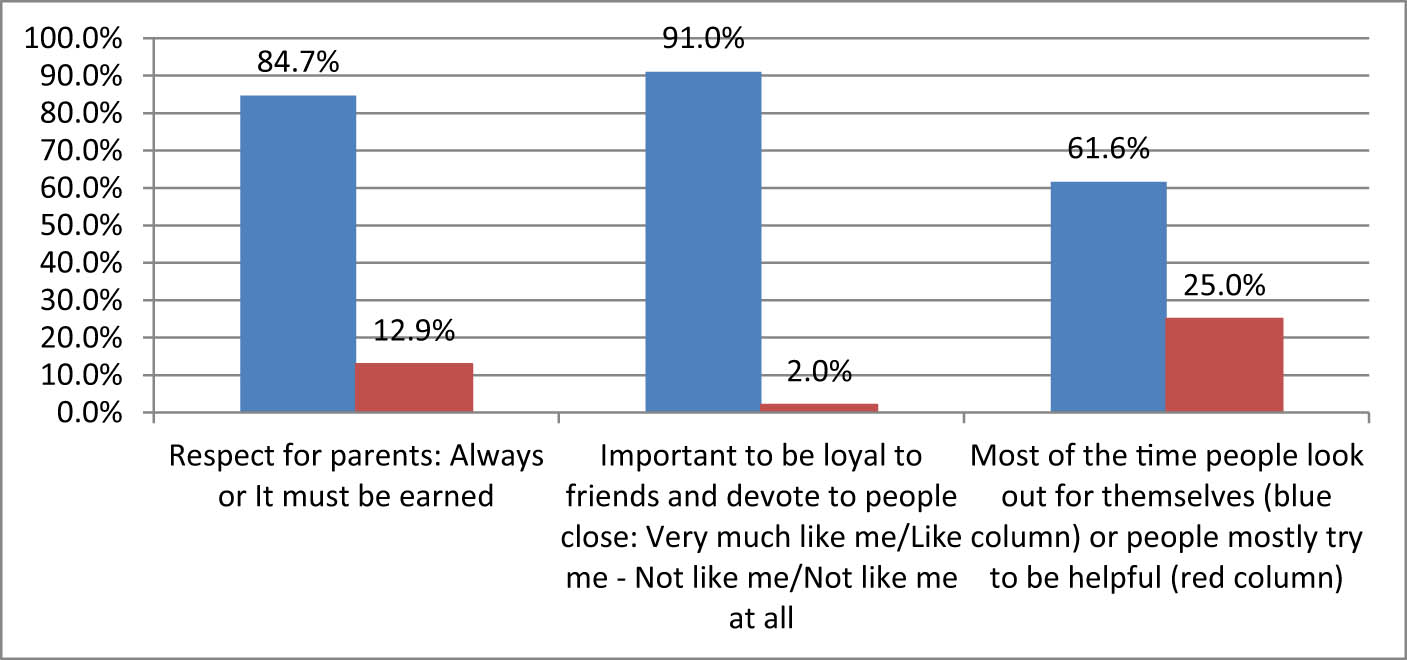
Figure 1
Indicators of the emphasis on particularistic norms in Albania. For the first indicator: Respect for the parents: Always 84.7% – It must be earned 12.9%, we are based in the item (v13): “norm of respect for parents” The data for Albania for this variable (v13) is taken from the fourth wave of the World Values Survey, Fourth Wave. For the second indicator: Important to be loyal to friends and devote to people close, the results are: Very much like me/Like me 91% – Not like me/Not like me at all 2%. Other answers available to the respondents (Somewhat like me and A little like me) can be considered neutral, thus their percentages were excluded from the data presented for this indicator. Source: European Social Survey. Round 6, 2012. For the third indicator: Most of the time people look out for themselves (61.6%) or people mostly try to be helpful (25%). Here the answers were on a scale from 0 to 10. The data were adjusted on a binary scale, respectively, responses with scores from 0-4 reflect the answers “Most of the time people look out for themselves", and those from 6-10 reflect the answers "people mostly try to be helpful". Those with a rating of 5, as they are in the middle and can be interpreted as neutral responses, have been eliminated from the data presented. Source: European Social Survey. Round 6, 2012.
Source: World Values Survey. Wave 4: 2000-2004 WORLD VALUES SURVEY (2014) & European Social Survey – Round 6 Data (2012).
As the percentages show, all three indicators register relatively high values, indicating a pronounced emphasis on particularistic norms. The norm of respect for parents remains strong among Albanians, with over 90% of respondents affirming that it should always be observed by children, even in the later European Social Values survey (2010, dataset ZA4783). As such orientations are not grounded in universalistic values but instead emphasize loyalty-based and relational obligations that privilege in-group members, they sustain a moral order in which particularistic norms may undermine universalistic ones. Consequently, as argued in this study, these norms function as generators of dark social capital, facilitating the mobilization of informal networks/relationships in pursuit of personal gains.
The second societal condition contributing to the generation of dark social capital is low generalized interpersonal trust. In environments characterized by relatively low generalized trust, individuals are less inclined to act in pursuit of the common good through impersonal cooperation. Instead, interactions become structured around personalized expectations and reciprocal favors, often at the expense of universalistic state rules. Consequently, lower levels of generalized trust – and higher reliance on particularized trust within closed networks – increase individuals’ propensity to invoke informal relationships/networks for private gain. To operationalize this condition, we use the European Social Survey generalized trust items (0–10 scales), adjusted on a binary scale, with responses ranging from 0 to 4 reflecting distrust toward others and those from 6 to 10, indicating the tendency to trust others (Figure 2).
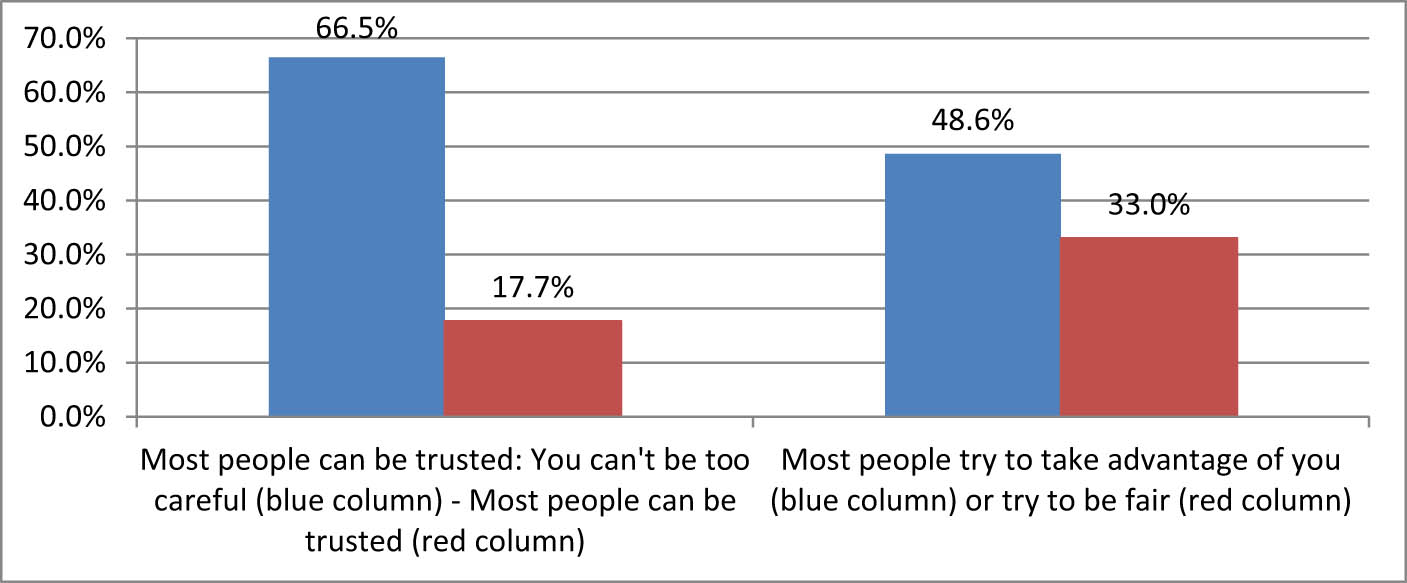
Figure 2
Indicators regarding the low interpersonal trust in Albania. For the first indicator, we rely on the measurement (A3) of the European Social Survey (Round 6), 2012: Would you say that most people can be trusted, or that you can't be too careful in dealing with people? Here, the answer ‘Can’t be too careful’ translates to: that need to be wary or always somewhat suspicious in dealing with other people, which means a low interpersonal trust in social relations between members of society. Here too, the answers of the Albanian respondents were on a scale from 0 to 10. We have adjusted the data on a binary scale, respectively, responses with scores from 0-4 reflect the answers (66.5% of them) "You can’t be too careful", and those from 6-10 reflect the answers (17.7%) of those who think "Most people can be trusted". As for the other (second) indicator here, we are based on item (A4) of European Social Survey (Round 6): “Most people try to take advantage of you if they got the chance, or would they try to be fair? Here, the answer "take advantage" means exploit or cheat that people think others could take against them, which is again an indication of low interpersonal trust among members of society. The answers were on a scale from 0 to 10, and we have adjusted them on a binary scale, specifically the responses with scores from 0-4 reflect 48.6% of those who think “Most people try to take advantage of you”; and those from 6-10 reflect the answers of 33% of those who think "Most people would try to be fair?".
Source: European Social Survey—Round 6 Data (2012).
Taken together, these indicators point to persistently low levels of interpersonal trust among Albanians. But if the same data are computed using the dichotomous response categories “Most people can be trusted” versus “Need to be very careful”, the data reveal an even wider gap, with Albania exhibiting very low levels of interpersonal trust. In the European Social Survey – Round 6 Data (2012), only 3.3% of Albanian respondents reported that most people can be trusted, while in the World Values Survey (Wave 7:2017–2022) WORLD VALUES SURVEY (2023), this share declined to 2.8%, with the overwhelming majority indicating that people need to be very careful when trusting others. This pattern is consistent with the mechanism proposed in Section 3: when generalized trust is low, reliance on close ties and informal networks becomes the safer and more effective strategy in everyday problem-solving.
The third societal condition concerns the extent to which corrupt practices are accepted or justified. As Graeff (2009: 155) stressed, “corruption norms are considered as mechanisms which facilitate achieving goals that are not attainable otherwise.” Accordingly, a prominent willingness to accept or justify corrupt norms and practices among society’s members creates stronger incentives for individuals to pursue private gains at the expense of the universalistic rules. In contexts where corruption is perceived as widespread and socially acceptable to varying degrees, the informal networks/relationships to which individuals have potential access would be easier mobilized for personal gains.
As shown in Figure 3, almost half of respondents (46.5%) justify, to varying degrees, a person accepting a bribe, compared to a slight majority (52.5%) stating that bribery is never justifiable. Additional evidence suggests that tolerance has remained substantial: in 2021, more than half of respondents (53%) stated that they would take bribes if they were public officials or would give bribes if asked when facing a major problem (SELDI, ACER 2021: 15). Such internalized beliefs and norms – shaped through long-term social learning under specific structural conditions and recurring patterns of social interactions – set the expectation frame for individuals’ behavior and interaction – including how they believe they can accomplish what they strive for. In such a context, individuals are more likely to mobilize informal relationships/networks to “get things done” and are correspondingly less constrained – both morally and legally – when invoking dark social capital to which they have potential access to make private gain at the expense of universalistic rules.
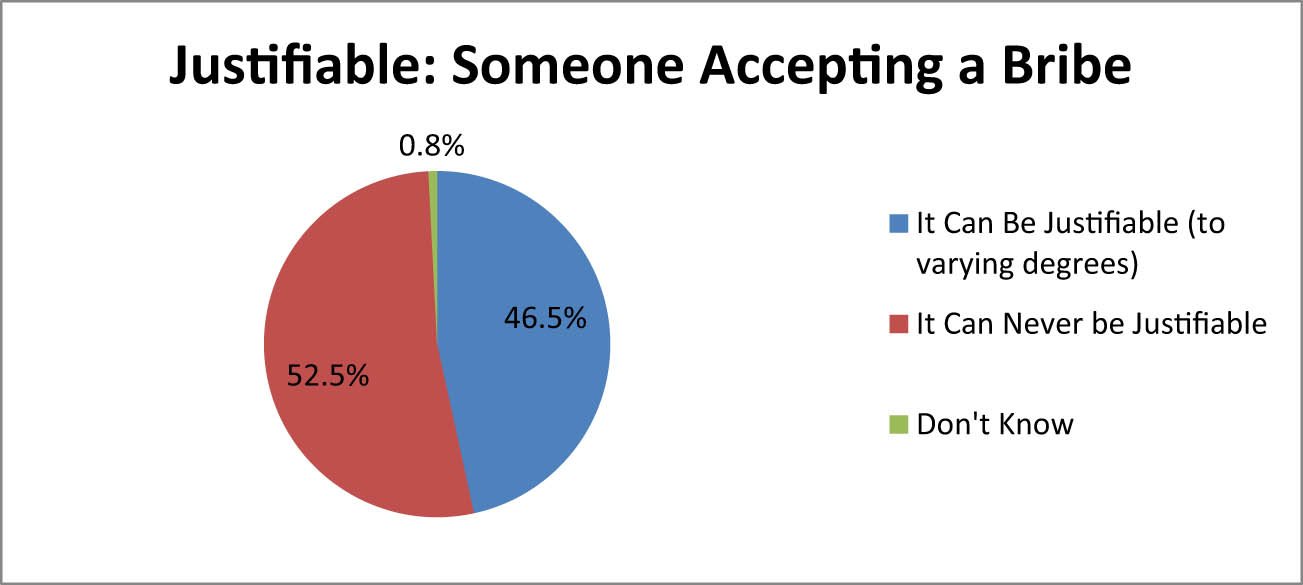
Figure 3
Justifiability of someone accepting a bribe in Albania. For Albania, this dimension is represented using a World Values Survey item “Someone accepting a bribe in the course of their duties,” which captures the extent to which corrupt behaviors are considered as justifiable (to varying degrees) versus never justifiable.
Source: World Values Survey Wave 4:2000–2004.
Having presented the three societal conditions, the analysis now shifts to patterns that are consistent with the societal manifestation of dark social capital. We focus on four illustrative manifestations: weakness of the rule of law; dissatisfaction with opportunities for professional development and promotion; prevalence of unfair social mobility (especially meritless employment in public administration); and relatively high levels of bribery reported by citizens in contact with institutions.
To assess weak rule of law, we rely on the Regulatory Enforcement indicator from the World Justice Project’s Rule of Law Index, which measures the extent to which regulations are fairly and effectively enforced1.
As shown in Figure 4, Albania scores well below the global average on Regulatory Enforcement, ranking 107th out of 139 countries (World Justice Project 2021). Weak and inconsistent enforcement of laws and regulations is consistent with a context in which formal rules can be circumvented/violated through informal interventions. In the theoretical framework, such enforcement weakness lowers the expected costs of rule-bending and makes informal, relationship-based strategies more attractive.
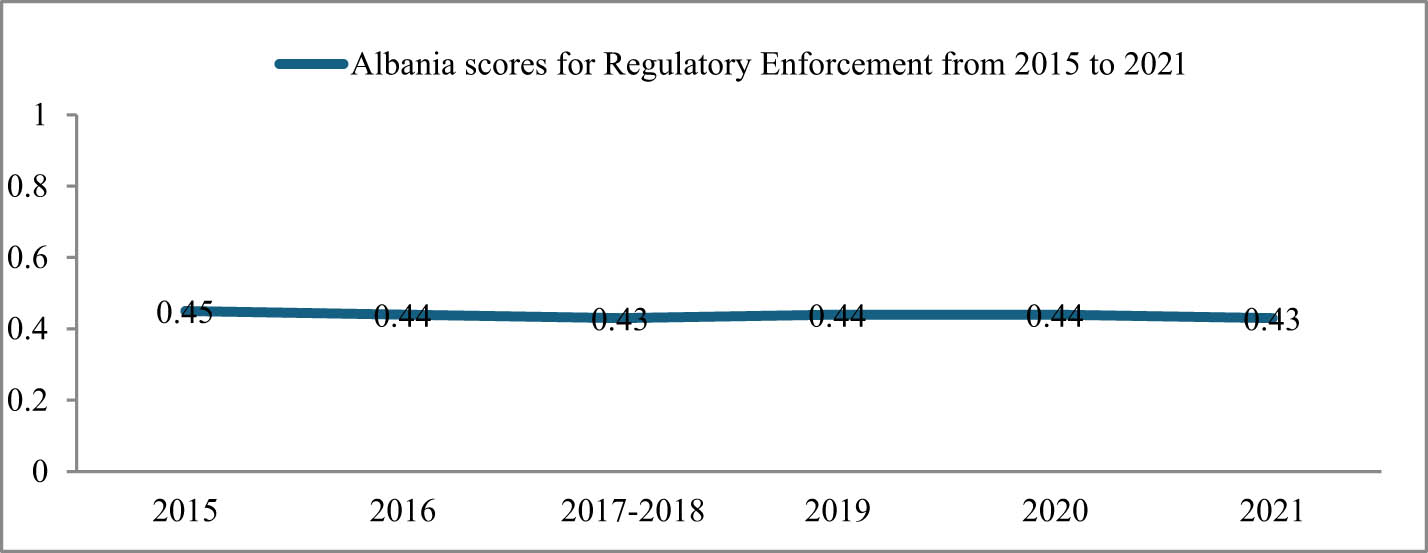
Figure 4
Regulatory Enforcement (of Rule of Law) for Albania.
Source: World Justice Project, Rule of Law Index (2021)
Dissatisfaction with opportunities for professional development and promotion is used as a second illustrative manifestation of dark social capital in Albania. World Values Survey data (Wave 7: 2017–2022) show a majority of negative assessments among Albanian respondents: 48.8% state that they are dissatisfied with opportunities for professional development and promotion in their current primary job, compared to 40.2% who declare that they are fairly/strongly satisfied (Figure 5).
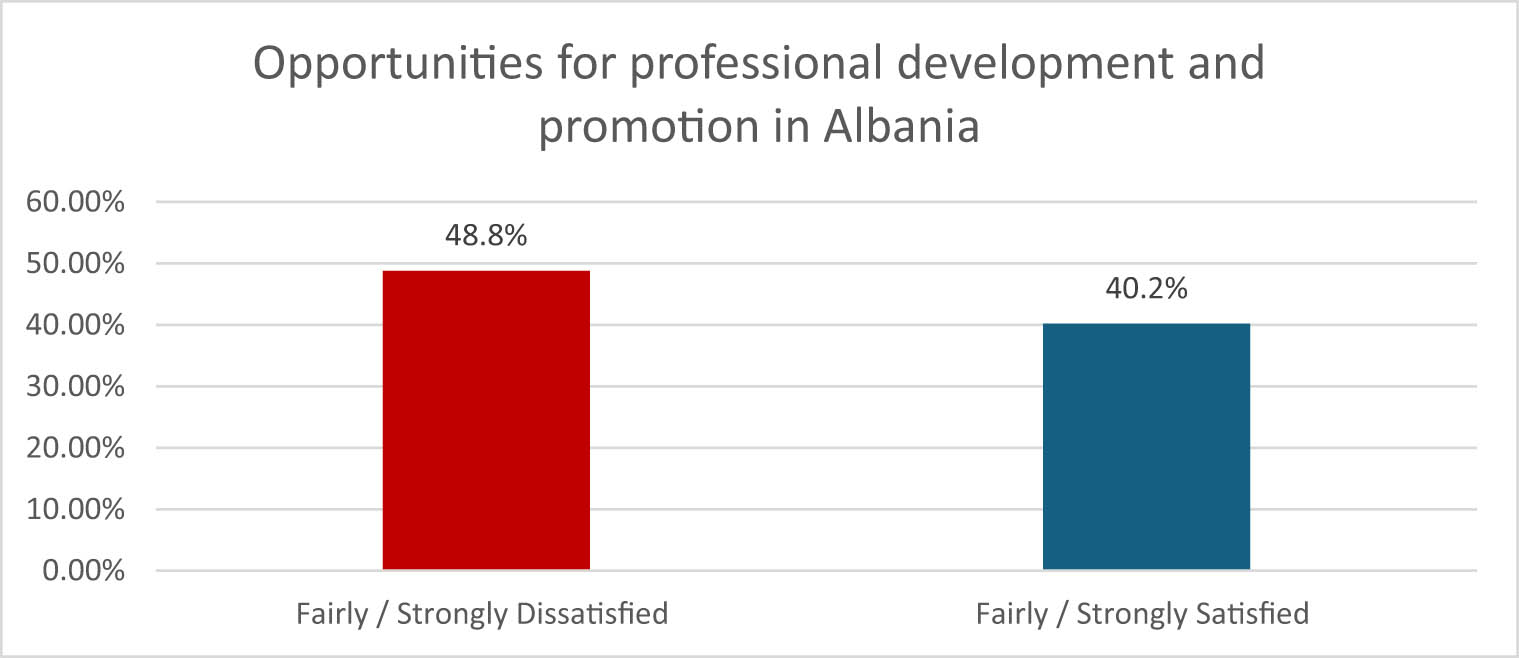
Figure 5
Dissatisfaction/satisfactions with opportunities for professional development and promotion in Albania.
Source: World Values Survey (Wave 7: 2017–2022)
According to the data for this indicator, the majority of respondents in Albania perceive opportunities for professional advancement not based on meritocratic criteria, but likely to depend on informal relationships/networks and personal favors. Such reliance reinforces the very mechanisms associated with the manifestation of dark social capital, where access to opportunities is shaped less by fairness and merit, and much more by potential access to these informal networks/relationships.
The prevalence of unfair social mobility – particularly meritless employment in public administration – is used here as a third illustrative manifestation. In the Albanian case, the relationship between individuals’ prospects for social mobility and their ability to invoke informal networks is reflected in the high numbers of individuals being employed in infraction to legal dispositions in public administration. A report published by the Commissioner for the Supervision of the Civil Service in Albania concluded that 30% of all inspected cases involved employment by “director’s order” and outside the law’s procedures (Erebara 2018). In this context, possessing the “right connections” proves far more consequential than formal qualifications in shaping access to employment in Albanian public institutions and, more broadly, for individuals’ prospects for social mobility.
A final illustrative manifestation concerns bribery reported by citizens in contact with institutions. The occurrence of corruption at elevated levels represents an important signal of the presence of dark use of social capital, as corrupt exchanges are inherently grounded in particularized trust and personalized relationships between individuals. Empirical evidence from a 2017 survey indicates this dynamic among Albanian citizens: 33% of respondents who accessed services at central government institutions reported paying a bribe, and a similar share (32%) did so for services provided at the local level (Figure 6).
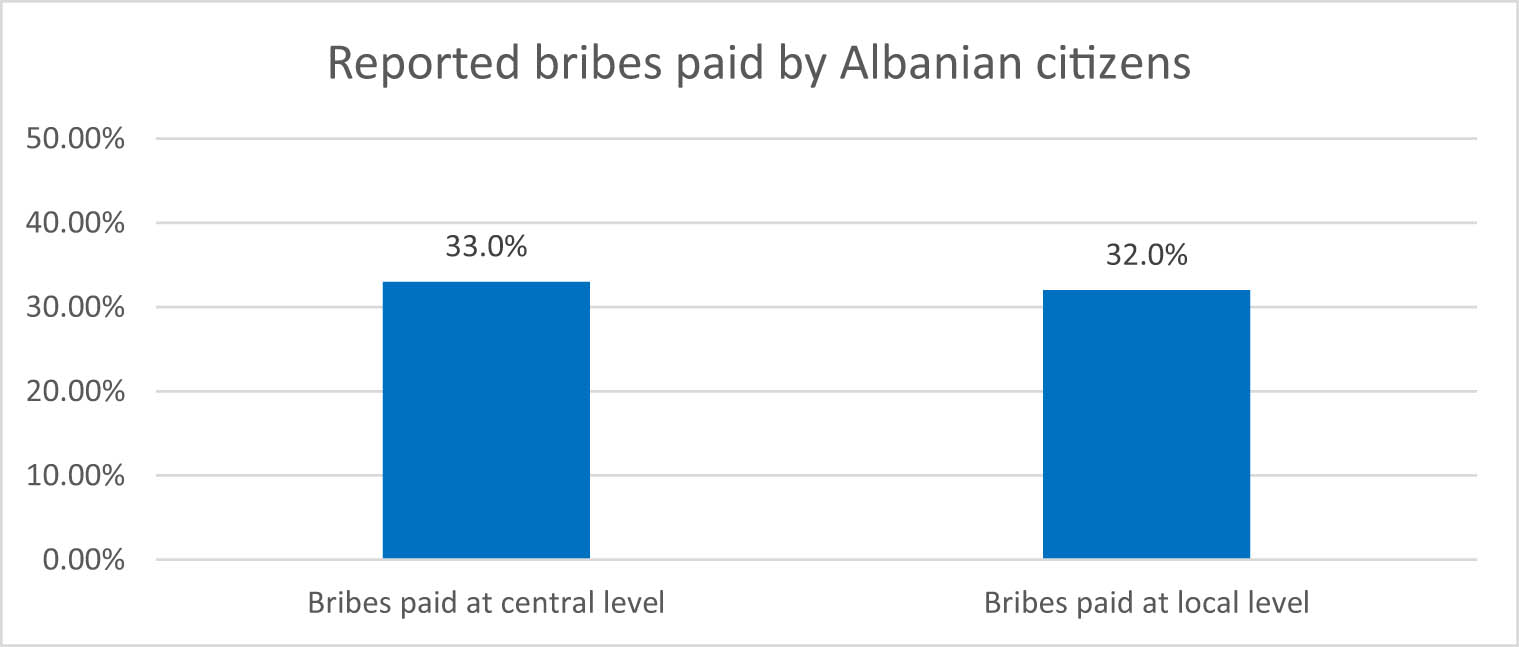
Figure 6
Reported bribes paid by citizens in Albania in contact with institutions.
Source: IDM and UNDP 2018: 37–38.
These relatively high levels of corrupt exchanges indicate a pronounced readiness among a substantial share of Albanian citizens to engage in corruption behaviors by personalizing their interactions with state bureaucrats to obtain services or desired outcomes, even when such practices entail the deliberate violation of established universalistic rules.
5. Conclusions
The aim of this article is to develop a theoretical framework for explaining the generation of dark social capital from societal conditions related to social structure and the norms and beliefs to which individuals predominantly adhere. To clarify the conceptual contribution, we treated dark social capital as shorthand for a dark use of social capital: the mobilization of informal ties and networks to accomplish private goals at the expense of universalistic rules. On the basis of the framework, we argued that when particularistic norms and values prevail, generalized interpersonal trust is low (with reliance on particularized trust), and a substantial share of the population justifies corrupt practices, individuals are more likely to mobilize informal connections to “get things done” at the expense of universalistic rules. It is the pattern of social relations, particularistic norms and values, particularized trust, and normative tolerance toward corruption that provides the contextual framework for individuals’ propensity to rely on informal networks for making private gain. The illustrative case of Albania demonstrated how this mechanism can operate in practice. The empirical patterns observed – strong emphasis on particularistic norms, low interpersonal trust, and the justification of corruption at prominent levels – are consistent with expectations from the theoretical framework and in explaining how dark social capital is generated by societal conditions. These conditions co-occur with patterns consistent with the mechanism described in the framework – weak rule of law, perceived nonmeritocratic advancement opportunities, prevalence of unfair social mobility, and reported bribery in contact with institutions. Read as an illustration rather than a causal test, these patterns support the plausibility of the proposed mechanism in a high-salience postcommunist setting.
The principal contribution of the framework developed in this article lies in its analytical potential: it offers a basis for future research, including quantitative and comparative studies not pursued here, to further examine the societal conditions under which different forms of social capital emerge and the consequences they generate. In this sense, the framework should be understood as a step forward within a broader hermeneutical process of inquiry, providing structured access to the empirical reality of dark use of social capital rather than a final or exhaustive explanation of the phenomenon.
Funding information
Authors state no funding involved.
Author contributions
Gerti Sqapi developed the research concept and theoretical framework, conducted the main analysis, and wrote the original manuscript. Evis Shurdha contributed to the literature review and reviewed and edited the manuscript. Both authors read and approved the final version.
Conflict of interest statement
Authors state no conflict of interest.