

1. Introduction
A range of concerns dominates the debate on the relationship between democracy and artificial intelligence (AI) (Gilardi et al. 2024), spanning from the replacement of democratic decision-making with algorithms (Sætra 2020) to more immediate issues such as discrimination, surveillance, a political economy of AI characterized by the concentration of power in a few actors’ hands, and support for authoritarian regimes (Neff 2024). At the same time, recent years have also seen the emergence of a parallel discussion that emphasizes the democratic potential of AI: its capacity to improve the efficiency of public services, to provide new tools for collecting and processing citizens’ opinions, and to democratize specific societal domains (Nasi, 2025). Within this landscape, we find AI-based applications for civic participation, which are increasingly adopted by public administrations and organizations to renew democratic practices and institutions (Tsai et al. 2024; OECD 2025). While digital democracy refers to the relationship between digital technologies and democratic politics, civic participation focuses more specifically on citizens’ involvement in shaping public decisions and, more broadly, influencing society.
Compared with earlier technological tools developed for democratic participation (commonly referred to as “civic tech” (Gordon, Lopez 2019; Schrock 2019), which emerged during the first decade of the 2000s, this new form of AI-powered civic technology introduces capabilities that were previously unavailable. These include enhanced access to data and forms of knowledge, the ability to collect and process vast amounts of citizen-generated information, and facilitation within deliberative assemblies (Beacock et al. 2025). The best-known example in this field is the machine-learning platform Pol.is, developed by the Computational Democracy Project and implemented in Taiwan and other countries on different occasions. Its use enabled thousands of citizens to express their views on issues such as the regulation of Uber and ethical guidelines for artificial intelligence, helping to identify specific areas of consensus that subsequently contributed to shaping legislation (Tseng 2022; Moats, Tseng 2024).
Studying these tools is important to provide a comprehensive assessment of the relationship between artificial intelligence and democracy. While some empirical studies have emerged, a systematic mapping of AI applications explicitly designed for civic participation is still lacking. Such a mapping is crucial for shedding light on the directions in which AI is evolving in relation to democratic practices and on how this technology may contribute to reshaping democracy itself.
To understand how these tools may support democratic practices, it is necessary to address some preliminary questions that are often taken for granted in existing research (Karppinen et al. 2025): what conception of democracy do these tools embody? How does AI operationalize democratic participation across different democratic models? Different conceptions of democracy, particularly in how they understand the role of political conflict (whether through a more unitary and conflict-averse perspective or through an agonistic approach that recognizes and institutionalizes contestation), generate different democratic affordances (Deseriis 2021). For example, a unitary democracy tool designed to foster more constructive public dialogue may be effective in facilitating consensus among competing viewpoints, yet less capable of addressing other dimensions of the democratic crises, such as the decline of intermediary organizations. Conversely, an agonistic democracy tool intended to support activists or political party members may improve the efficiency and coordination of associations and civic groups, while doing little to promote a more deliberative public sphere grounded in reasoned debate.
This article argues that AI tools for civic participation are not politically neutral. They are strongly oriented toward a consensus-based, anti-agonistic model of democracy, in which conflict and contestation are marginalized. This orientation emerges from multiple factors, including the deliberative hegemony in the field of democratic innovations, the unitary “script” of AI systems, and the growing marketization of the field of civic participation.
To develop this argument, the article is structured as follows. The next section provides a brief review of the literature and introduces Dahlberg’s (2011) theoretical framework for understanding different positions of democracy in the digital sphere. Section three outlines the methodology, presenting the mapping approach adopted in this study, which combines desk research with expert interviews. Section four summarizes the main findings of the mapping and presents the key empirical patterns that inform the analysis. Section five examines the anti-agonistic orientation of contemporary AI democracy and explores the factors underlying this tendency. Finally, the conclusion reflects on the implications of an anti-agonistic approach to democracy.
2. AI, civic participation, and different positions of digital democracy
Many contributions in the field of AI for civic participation seek to outline the broad range of potential applications of AI in democratic contexts. Campagnucci et al. (2025) identify four functions of AI in civic participation: visualizing realities and future scenarios, understanding complex issues and public opinions, facilitating discussion and deliberation, and broadening participation and inclusion. Goldberg and colleagues (Goldberg et al. 2024) identify four areas where organizations may apply generative AI tools: deliberation and collective dialogue systems; bridging systems designed to foster cooperation rather than antagonism on social media; community-driven moderation approaches that enable bottom-up content regulation; and “proof of humanity” mechanisms to distinguish between human- and AI-generated contributions. Turan, Mckenzie (2024) suggest that large language models (LLMs) are particularly effective at summarizing extensive discussions, identifying both expected and emergent themes, and producing reports that preserve nuance and context, making complex deliberative processes more accessible to external audiences.
Other studies have focused on the emerging role of AI in strengthening the work of local governments (Large et al. 2025), non-profit organizations (Chappell, Rosenkrans 2025), and social movements (Chenoweth 2025; Karanja, Musili 2026). Scholars also turned their attention to the normative dimension, articulating the principles that should orient the development and deployment of these technologies in democratic contexts, such as preserving human autonomy and augmenting, rather than substituting, active forms of citizenship (Tsai et al. 2024; Bono Rossello et al. 2025). Sieber et al. (2025) identify some key themes in the literature on AI and civic participation. They argue that participation is often treated as an inherent outcome of government automation, while AI-enabled participation is quantified and framed as a mechanism for strengthening trust in both AI systems and public institutions.
The use of AI in deliberative settings has received more scholarly attention than any other area in the field, to the point that discussions of AI and democracy often become, in practice, discussions on AI-supported deliberation. Early empirical studies show that machine learning can help address common challenges of participatory platforms, such as managing large-scale input, clustering opinions, and moderating discussions (Arana-Catania et al. 2021; Landemore 2024). Mckinney (2024) suggests that AI integration into citizens' assemblies can enhance democratic quality and institutional capacity. However, this requires proceeding cautiously, navigating challenging trade-offs, and addressing key concerns related to AI integration. Empirical studies showed that AI may facilitate deliberation, providing statements that are more informative, clear, and unbiased than those written by human mediators (Tessler et al. 2024), and that it may promote depolarization, factual alignment, concern about complex issues, and lasting impacts on voting (Fishkin et al. 2025). Other studies are less optimistic about the prospects for implementing AI for deliberation. Citizens evaluate AI-written statements as lower quality than human-led formats, and the adoption of these technologies may exacerbate a digital divide in democratic participation between AI supporters and AI critics (Jungherr, Rauchfleisch 2025). Adopting a critical lens, Oleart and Palomo (2025) suggest that current work on AI and deliberation is affected by a “technosolutionist bias” that reinforces depoliticization and disintermediation, leaving the political economy of AI unquestioned.
This literature, which remains in an emerging phase, presents theoretical frameworks and early empirical studies that highlight both the limitations and the potential of AI in participatory processes. However, several important questions remain to be explored: how many applications exist, how widely they are used, what specific functions they perform, who develops them, what models of democracy they embody, and, consequently, what forms of participation they enable. Existing research tends to focus on individual tools without providing an overarching overview. Furthermore, the over-representation of deliberation in the AI and democracy debate speaks volumes about the necessity to integrate a wider range of views on democracy, as emphasized in the research question.
To properly account for the plurality of democracies Gagnon and Abrams (2025) used Dahlberg’s four positions of digital democracy. In a 2011 paper, Dahlberg (2011) distinguished four positions of digital democracy according to the specific democratic affordances digital tools provide: aggregative, deliberative, contestationary, and commons. As Section 5 will explain more extensively, the latter two positions can be linked to a unitary approach to democracy (Mansbridge 1980), while the former two positions are more coherent with agonistic democracy (Mouffe 2013). Taken together, these four models provide a more comprehensive framework for understanding the different forms that digital democracy may assume: from parliamentary democracy to protest movements, from deliberative dialogue to alternative forms of political organization beyond state and market.
2.1. Aggregative democracy
This liberal-individualist conception of democracy emphasizes the role of digital media in facilitating the transmission of information and preferences between citizens and representative institutions. Tools such as e-voting, online polls, petitions, and digital feedback systems exemplify this approach, enabling individuals to access political information, evaluate options, and register their preferences. Here, democracy centers on the expression and aggregation of individual wills, with the democratic subject conceived as a rational, self-interested individual. Specific affordances include aggregating, calculating, choosing, competing, expressing, fundraising, informing, petitioning, registering, transacting, transmitting, and voting.
2.2. Deliberative democracy
The deliberative perspective sees democracy as emerging from collective reasoning rather than from mere preference aggregation. Digital platforms (forums, consultations, and structured deliberative projects) can foster rational-critical discussion. Individuals become publicly oriented citizens whose critically informed opinions guide decision-making. Democracy is thus shaped through reasoned consensus rather than simple preference aggregation. Among deliberative affordances, we find agreeing, arguing, deliberating, disagreeing, informing, meeting, opinion-forming, publicizing, and reflecting.
2.3. Contestationary democracy
This perspective emphasizes digital media’s role in enabling activism, political group formation, and the contestation of dominant discourses. Democracy is understood through struggles for inclusion and resistance to systemic injustice, with democratic subjects emerging from engagement in affective and counter-discursive practices. Agonistic contestation, rather than consensus, drives this type of democracy. The affordances of this position of democracy are articulating, associating, campaigning, contesting, forming groups, identifying, organizing, protesting, and resisting.
2.4. Commons democracy
Finally, this autonomist-Marxist perspective envisions digital networks enabling self-organized, decentralized, and inclusive participation that bypasses state and capitalist structures. Democracy unfolds through collaborative, peer-to-peer practices within a “commons,” aiming to reform institutions and establish a fundamentally new sociopolitical order based on collective ownership and self-management. Commons democracy affordances are collaborating, cooperating, distributing, exchanging, giving, networking, participating, and sharing.
3. Methods: Mapping AI tools for civic participation
This study mapped AI tools for civic participation to address the research question, followed by a qualitative analysis of their websites to identify their main features. Mapping has previously been employed to investigate digital participation tools, but not yet specifically those based on artificial intelligence (Saldivar et al. 2019; Shin et al., 2024). Building on and seeking to expand the approach of Shin et al. (2024), mapping was conducted through a five-step strategy. First, the scope of inquiry was defined. Second, desk research was carried out across major online repositories. Third, findings were triangulated from the desk research through interviews with experts. Fourth, the search was periodically updated to capture newly emerging cases. Fifth, a qualitative analysis of the tools’ websites was conducted to find their main features.
The mapping of cases first required delineating the scope of inquiry. As noted earlier, the focus is on artificial intelligence tools developed for civic participation. The term civic participation is used because it is the internationally recognized term for describing a broad set of democratic practices, both institutional and bottom-up, aimed at deepening citizens’ participation in the political field (OECD 2025). Civic participation is strictly related to civic tech, namely the use of digital technologies to strengthen democracy by keeping the public informed, fostering participation in decision-making and policymaking, and enhancing government responsiveness and accountability (OECD 2024). Civic participation encompasses democratic innovations, defined as “institutions that have been specifically designed to increase and deepen citizen participation in the political decision-making process” (Smith 2009, p. 1). These include participatory budgets, deliberative assemblies, referenda, stakeholder engagement processes, etc. The notion of civic participation also extends to more traditional forms of political participation, described as “a set of repertoires of political action spanning across face-to-face and digitally enabled activities and aiming to exercise influence on politically relevant outcomes” (Vaccari, Valeriani 2021, p. 66). These activities include voting in elections, participating in protests, contacting elected officials to advocate for specific causes, signing petitions, providing financial support to political parties, and using social media for political purposes.
Using the broader frame of civic participation rather than only deliberative democracy is critical. As I highlighted in the previous section, many works currently focus on using AI for deliberative democracy, following a trend established at the international level of a so-called “deliberative wave” (Goldberg, Bächtiger 2023). However, it would be reductive to equate democratic innovation exclusively with deliberative tools. While deliberation has become a hegemonic paradigm in scholarship and practice, it is neither without limitations nor the only model for fostering democratic participation. Alongside deliberative approaches, participatory and more informational forms of engagement are crucial in expanding the repertoire of democratic practices (Escobar, Bua 2026).
To ensure the inclusion of relevant and active tools, the mapping was based on the following criteria: each tool had to be an application of artificial intelligence developed and used for civic participation, demonstrate public impact and reach, and be currently in active use. Consequently, I excluded betas, experimental projects, proposals, or non-publicly accessible initiatives. Based on this, some potentially interesting projects were excluded as they did not meet the criteria adopted for this study. For instance, projects no longer operational, such as Citibeats, were not considered. Similarly, projects still in beta and unavailable, including those developed within a recent OECD project like On Record, ParticipApp, and ConsultationAI, were excluded. Moreover, AI tools with potential socio-political applications were excluded unless they explicitly referenced civic participation, as in the case of Psi and Remesh.
Once I defined the scope of inquiry, the primary research method consisted of consulting existing repositories on digital democracy: the Democracy Technologies website, the Civic Tech Field Guide, Participedia, the 2024 and 2025 People Powered ratings for Digital Participation Tools, There’s an AI for That, and the Solonian Democracy Institute Digital Democracy Report. Triangulating across multiple databases allowed the research to be more comprehensive and validated. I conducted keyword searches in the case of bigger platforms such as There’s an AI for That, Participedia, and the Civic Tech Field Guide, using terms such as “artificial intelligence,” “AI,” “genAI,” “generative AI,” “machine learning,” “ML,” “civic participation,” “civic engagement,” “democratic participation,” “participation,” “citizen engagement,” and “deliberation.” For smaller repositories, such as the Solonian Digital Democracy Report and the People Powered ratings, all listed tools are reviewed directly. Given the rapidly evolving nature of the field, the searches are periodically updated to ensure inclusion of new cases.
Alongside desk research, 15 semi-structured interviews were conducted with experts in AI and civic participation, including academics, developers, practitioners, journalists, activists, and representatives of non-profit organizations. Participants were recruited through snowball sampling, beginning with individuals holding prominent positions in the field (Parker et al. 2019), such as editors of Democracy Technologies and members of civic tech projects, including Consul Democracy and Decidim. Initial participants were then asked to recommend additional interviewees. Recruitment continued until thematic saturation was reached, at which point new interviews yielded largely recurring perspectives and no substantially new insights.
The sample was intentionally heterogeneous to capture a range of perspectives and enable the triangulation of experiences across different professional communities. Overall, the interviewees included five developers, four scholars, three representatives of non-profit organizations developing AI-enabled civic technologies, two activists (who also worked as authors or academics), and one journalist. In terms of gender representation, men remained overrepresented (9 men and 6 women), likely reflecting a broader imbalance across the field. Figure 1 provides an overview of the interviewees’ profiles:
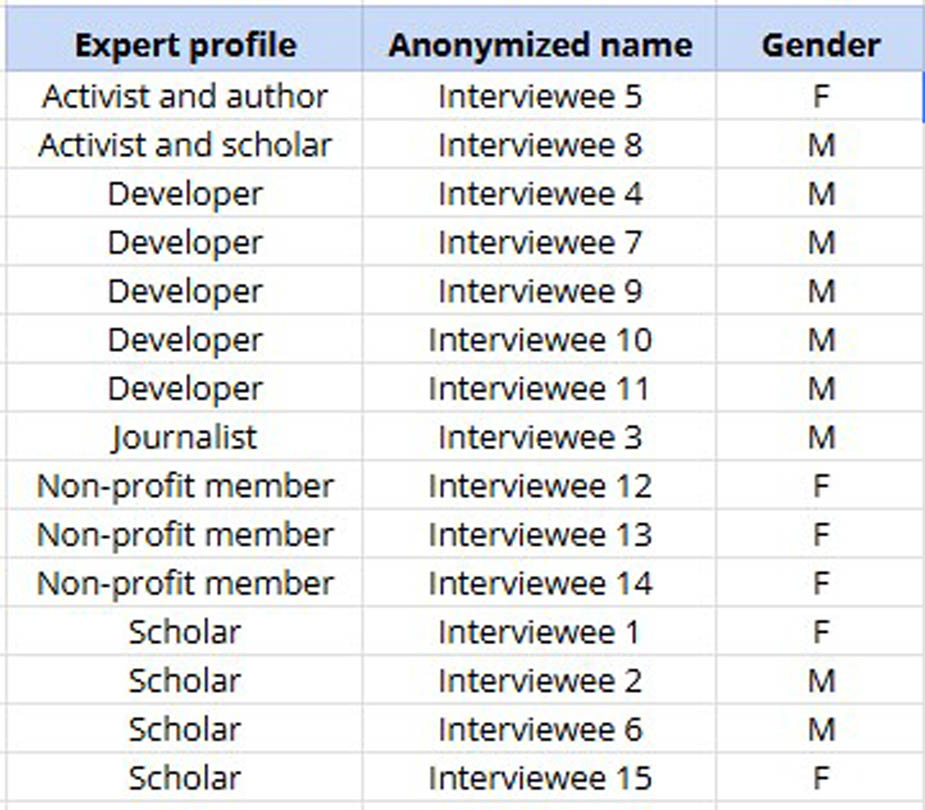
Figure 1
Interviewees profile.
Source: Author’s contribution.
The semi-structured interviews (Brinkmann, Kvale, 2015) were conducted focused on three issues: the potential of AI to support democratic participation, its risks and limitations, and the prospects for its future development and adoption. Participants were also invited to identify relevant initiatives, tools, and actors, and to recommend additional interviewees. Interviews played an important role in mapping the emerging AI-for-democracy ecosystem and indicating existing repositories and studies for my desk research. Furthermore, they were an authoritative source to validate the results of the mapping. However, their usefulness was limited in developing the argument presented in Section 5, which rests largely on the findings of the desk research. As noted above, the interviews focused on different issues. Themes such as agonism, unitary democracy, and the marketization of the field (which constitute the core of the findings) emerged only during the data analysis and were therefore not part of the initial interview design or data collection.
After identifying the cases, the websites and social media profiles of AI applications were analyzed for civic participation to detail their main characteristics. For each case, I recorded the following attributes: “name,” “year of creation,” “developer,” “type of organization,” “brief description,” “website,” “country,” “use of generative AI” (yes/no), “features,” and “type of democracy.” Given the research question, I paid particular attention to the “type of democracy” category.
To classify each tool, I examined its democratic affordances (Deseriis 2021), assigning it to different democratic models based on the functions and purposes described on its website. For instance, tools emphasizing agreement, argumentation, discussion, or deliberation were classified as deliberative, whereas those oriented toward campaigning, collective action, mobilization, protest, resistance, or group formation were categorized as contestationary. This classification is necessarily interpretive. As Nagy and Neff (2015) argue, affordances are not inherent properties of technologies but are socially imagined and constructed through the relationship between users, designers, and technological artifacts. Consequently, the boundaries between categories are often ambiguous. The distinction between aggregative and deliberative tools, in particular, proved challenging. To provide clear, guiding criteria, applications were classified as deliberative only when they enabled direct interaction among participants, reflecting Dahlberg’s conception of deliberation as a process in which preferences and interests are not fixed in advance but are expected to emerge and evolve through dialogue. Following this rationale, the classification of some prominent AI-enabled civic technologies departs from their common characterization in the literature. For example, Pol.is is frequently described as a deliberative platform, yet its core functionality does not require participants to engage directly with one another. Instead, it aggregates individual statements and opinions through machine learning, identifying patterns of consensus and disagreement without facilitating dialogue between participants. Other renowned platforms, such as Your Priorities, were classified as deliberative because they explicitly support interaction and discussion among participants, even if they do not fully meet the normative criteria of Habermasian deliberative democracy.
Before presenting the results, it is important to acknowledge some limitations of this mapping. First, this approach does not allow for an in-depth assessment of how individual applications operate or of their actual capacity to empower citizens. Second, the level of abstraction adopted does not capture differences in the relative importance, influence, or impact of the mapped tools. More generally, robust methods for assessing the salience of AI civic tech remain underdeveloped, despite an insightful body of research on the evaluation of democratic innovations more broadly (Jacquet et al., 2023). Third, this field is rapidly evolving. As new AI tools for civic participation continue to emerge, some of these findings may become partially outdated. Fourthly and finally, this study presents certain biases stemming from my positionality as an academic within the Anglophone and Western sphere (Darwin Holmes 2020). As has been widely observed, such biases also tend to be reproduced within the very search engines (academic and otherwise) employed in this kind of research (Mowshowitz, Kawaguchi 2005). Therefore, this mapping, while attempting to be global and including cases from the Global South, tends to be skewed towards the Global North. Despite these limitations, the work remains significant as it provides an initial exploration of a field that future research could examine in greater depth.
4. Results overview
The table below summarizes the 77 tools identified through desk research and expert interviews. Descriptions of the individual projects are reported in Appendix 1 rather than in the main table to preserve clarity in the presentation of results. Appendix 2 presents the description of the different functions (Figure 2).
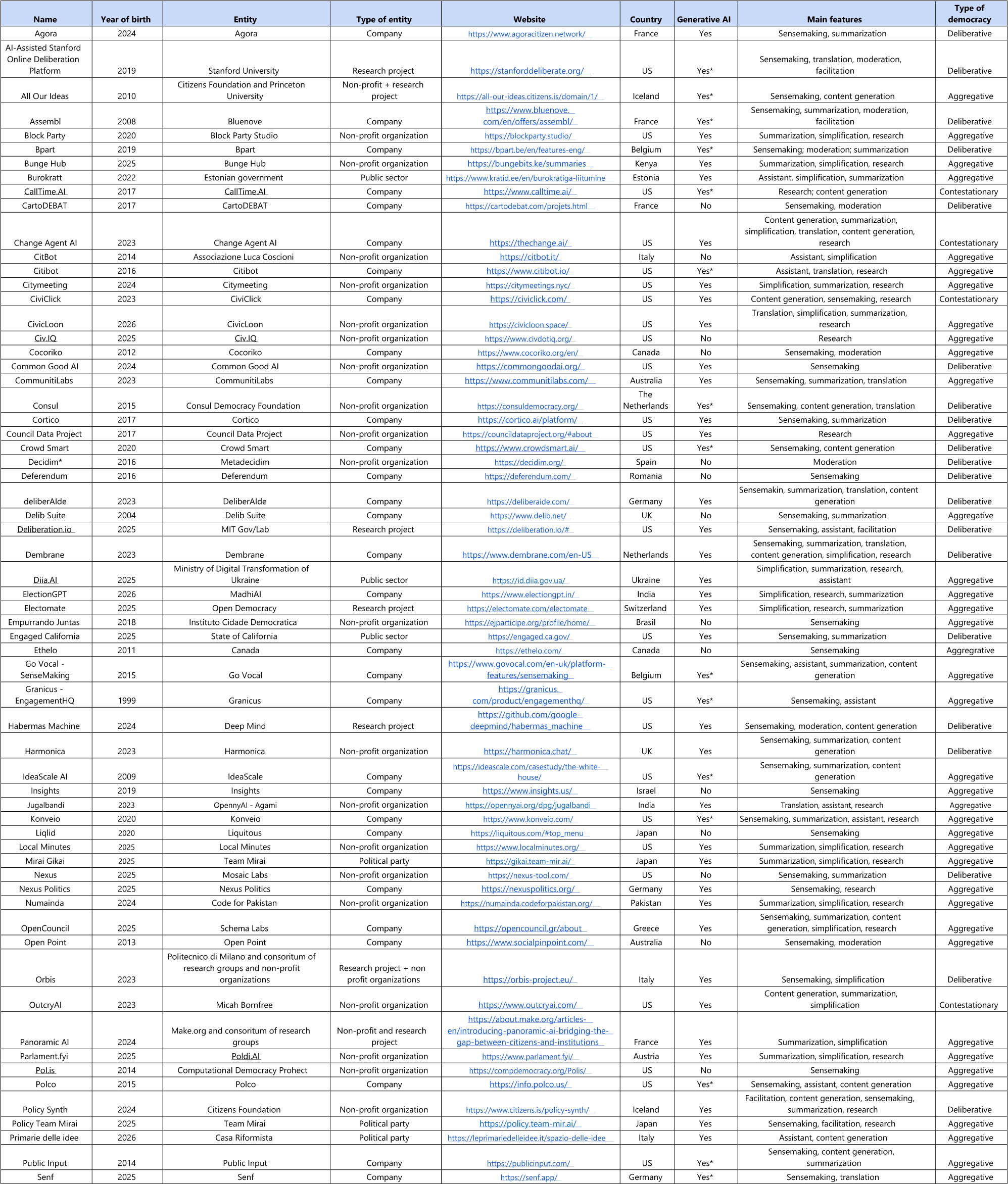
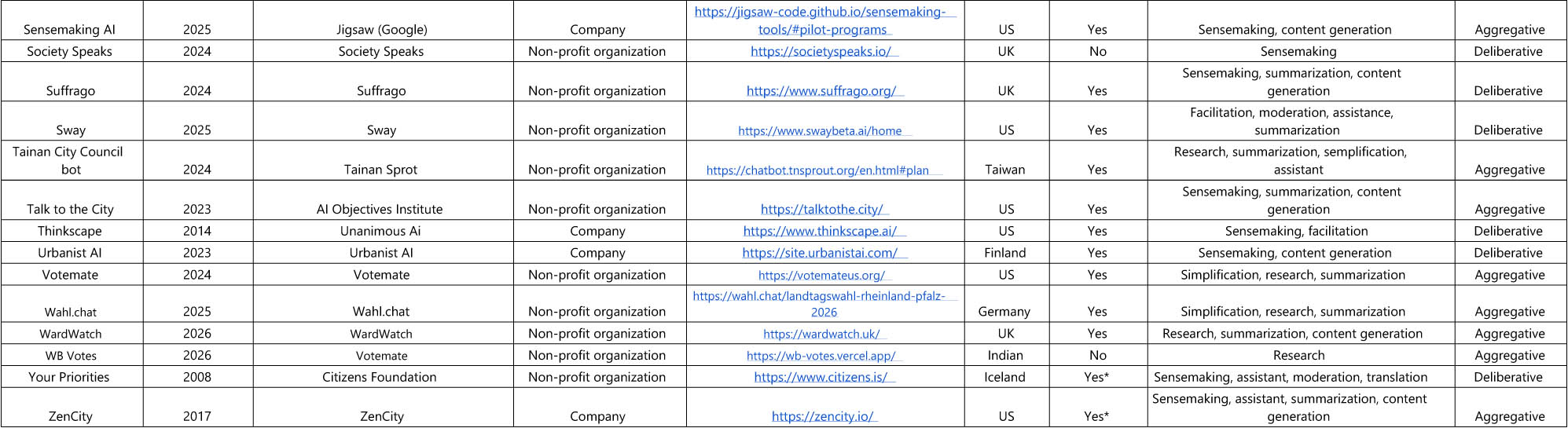
Figure 2
Mapping of AI tools for civic participation (last update: June 2026).
Source: Author’s contribution.
The distribution of the seventy-seven tools across Dahlberg’s models of democracy highlights important trends. A majority (forty-seven) align with aggregative democracy, followed by twenty-six adopting a deliberative orientation, four corresponding to contestationary democracy, and none reflecting a commons perspective. The organizational nature of these initiatives also reveals noteworthy patterns. Thirty-four were developed by private companies and thirty by non-profit organizations. Five projects originated within academic institutions or research groups, while two represent collaboration between non-profits and research teams. Three projects were advanced by the public sector (in particular, national or state governments), and three other projects by political parties (Figure 3).
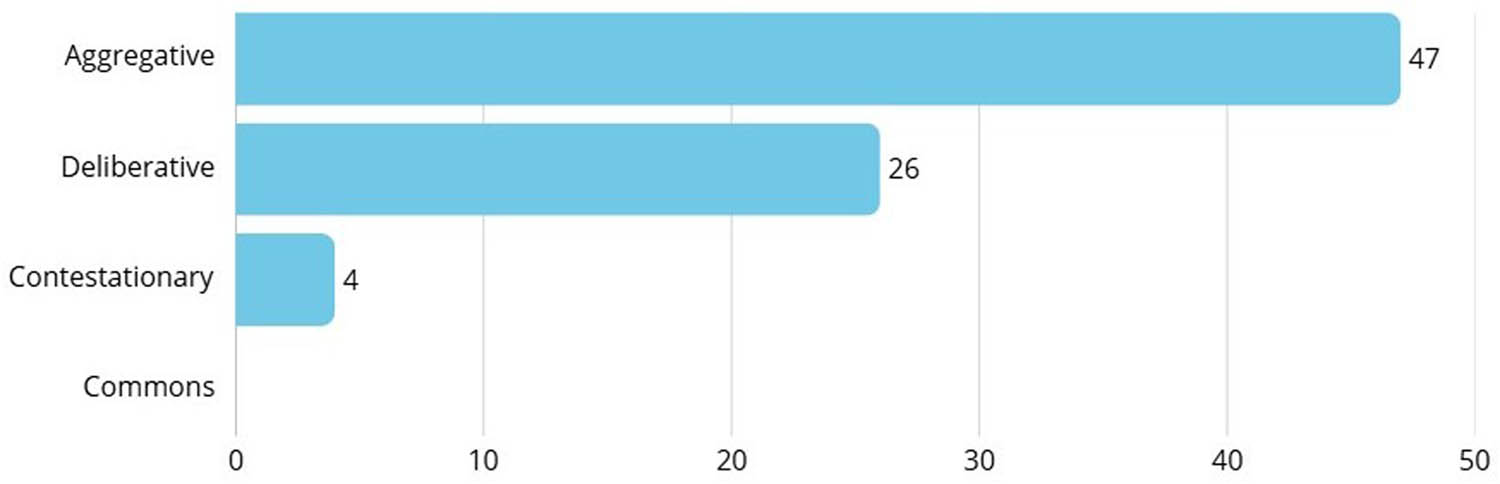
Figure 3
Types of democracy of AI tools for civic participation.
Source: Author’s contribution.
Turning to functionalities, a significant majority of the tools examined (forty-eight) identify “sensemaking” as their primary function. By this, I mean features for analysing data and citizen input to identify specific subthemes, locate areas of consensus and disagreement, and conduct clustering or thematic analysis. In both deliberative and aggregative models of democracy, AI thus primarily operates as a “sensemaker,” processing participant feedback and constructing meaning from it. Hand in hand with sensemaking, we find “summarization” in forty applications. “Research” is present in twenty-nine applications, while “content generation” (a generation that goes beyond the mere production of summaries and simplified versions of text, including more creative and “freer” uses) is in twenty-five, and “simplification” is in twenty-two. Functions more closely associated with deliberative democracy, such as AI acting as a “facilitator” (e.g., managing speaking turns or suggesting and refining arguments) or in a “moderation” function (e.g., flagging inappropriate language and ensuring conversations remain productive) appear in seven and ten cases, respectively. Finally, eleven tools highlight “translation” as a distinctive feature, typically enabling real-time translation of speech or recordings rather than simple text translation, which is now widely available (Figure 4).
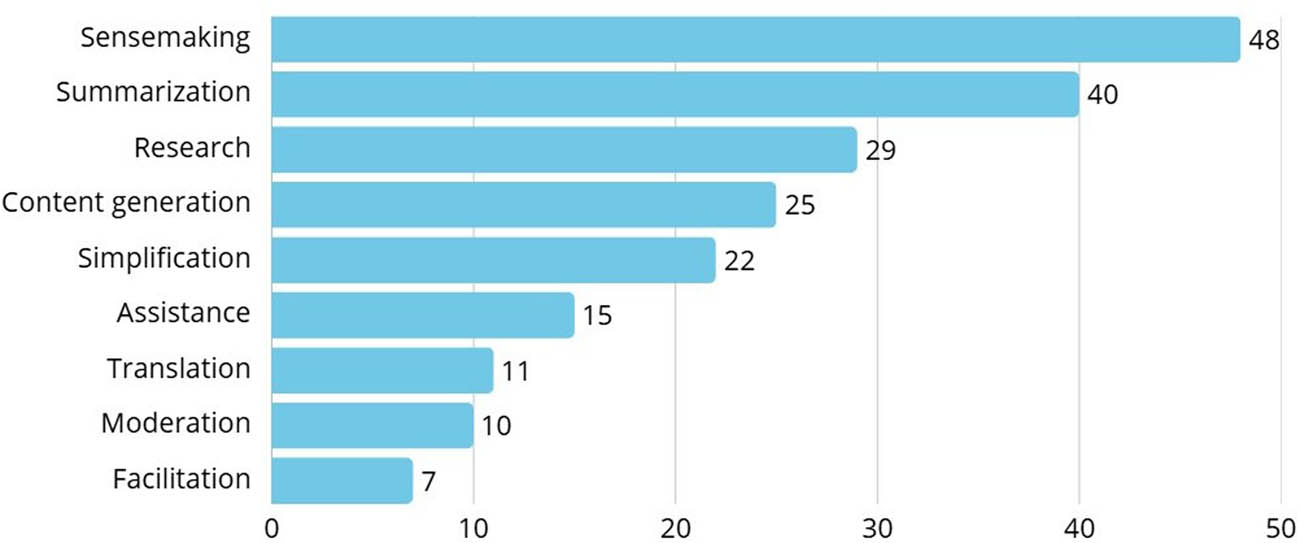
Figure 4
Main functions of AI tools for civic participation.
Source: Author’s contribution.
The geographic distribution of these tools shows an intense concentration in Western contexts, particularly in the United States, where thirty-one tools were developed. Following the US, major European countries are the most represented: five cases in the UK, four in France and Germany, and three in Italy. Three cases also for Iceland, which has an important tradition of digital democracy despite its limited size. Several countries feature one case each, including Belgium, Ukraine, Switzerland, Finland, Estonia, and others. Non-Western countries are underrepresented but still present, with three cases in Japan and India and one case each in Pakistan, Kenya, Taiwan, and Brazil. Generally, countries from the Global South are underrepresented. This pattern is hardly unexpected: although global AI value chains depend heavily on labour and infrastructural resources situated in the Global South, the development and deployment of AI technologies, as well as the benefits they generate, continue to be concentrated predominantly in higher-income countries, which possess greater technical expertise and institutional resources (Regilme 2024).
5. Towards an anti-agonistic AI democracy
The most salient finding emerging from the mapping is that AI tools predominantly support either aggregative or deliberative models of democracy. Both approaches presuppose the existence of optimal solutions that can be derived through the aggregation, analysis, or discussion of individual preferences. This logic falls within a unitary conception of democracy.
In a seminal contribution, Mansbridge (1980) distinguished between adversary and unitary democracy. Adversary democracy fundamentally “assumes that the interests of the citizens conflict” against each other (Mansbridge 1990, p. 20). Accordingly, democracy becomes a matter of finding arrangements that allow competing interests to coexist peacefully, even if some must prevail over others. On the contrary, in a unitary democracy, there is no assumption of conflict: interests may converge, and individuals may pursue shared goals. Within this framework, “citizens reason together until they arrive at a policy that meets their needs” (Mansbridge 1990, p. 21). It reflects the everyday experience of collective decision-making, discussing within a group what to do, or engaging in political deliberation without resorting to a vote, which may signal deep divisions within a community.
There is nothing inherently problematic in a unitary, consensus-oriented understanding of democracy. However, it is important to recognize that this represents only one dimension of democratic life. Privileging this model alone may marginalize other conceptions of democracy. In particular, it risks sidelining the agonistic dimension of democracy, which Chantal Mouffe identifies as central to the political sphere (Mouffe 2013), and that is clearly more represented by contestationary and commons AI tools.
Mouffe grounds agonistic democracy in an ontological dimension of “radical negativity.” She argues that “because of the existence of a form of negativity that cannot be overcome dialectically, full objectivity can never be reached, and antagonism remains an ever-present possibility” (2013, p. 8). In other words, not everything can be reconciled. Certain differences cannot be resolved consensually because human life is intrinsically plural. Mouffe frames this condition as “the political”: the fact that social realities, communities, and human organization can always take multiple, alternative forms constitutes the radical negativity and politicization of human existence. Agonistic democracy does not seek to depoliticize or suppress this conflict but rather to recognize it and provide it with democratic space and legitimacy. Within this framework, as she further explains in The Democratic Paradox (Mouffe 2005), the aim of democratic politics is not to eliminate conflict but to establish institutions that allow this radical negativity to manifest constructively rather than violently. Here, the hallmark of democracy is not consensus or voting but “the confrontation between conflicting hegemonic projects, a confrontation with no possibility of final reconciliation” (Mouffe 2013, p. 24).
AI applications for civic participation overwhelmingly support an anti-agonistic approach to democracy. These platforms enable the sharing and analysis of opinions, but they offer little possibility for immediate political action. They aim to bridge divides and reduce polarization by appealing to common ground in order to reach a “best solution.” Even the platform of the Japanese political party Team Mirai (despite belonging to a party and thus being, in a sense, intrinsically partisan and agonistic) rests on a technocratic, post-political vision of democracy (Malý et al., 2026).
The slogans adopted by many AI-enabled civic tech provide a useful indication of their underlying democratic models. Rather than emphasizing disagreement, contestation, or political conflict, they consistently foreground consensus and efficient information processing. For example, Agora claims to help people “overcome disagreement and find consensus” to enable “more democratic and efficient decision-making.” Similarly, ECHO emphasizes “aligning and moving forward,” “building shared commitment,” “coordinating action,” and “creating shared direction,” while Common Good AI promises to “build common ground for the common good.” Alternatively, participation is frequently framed as providing feedback to governments. CITBOT describes its mission as “Empowering Government. Serving Residents,” Engage California invites citizens to “tell your government how you feel about pressing issues,” Zencity promises to support “the work of government with community voices.” Communitilabs advertises the ability to “hear every voice, decide with evidence, [and] move with confidence.” In this way, AI for civic participation tends to prioritize efficiency and information processing over the democratic legitimacy of differing positions, sidelining disagreement and contestation.
As it emerges from the mapping, only four tools align with a contestationary model of democracy, taking explicit political, agonistic stances, such as in the case of LLMs developed for the social sector and for supporting causes and campaigns. These projects, however, have achieved limited public reach, particularly compared to more established aggregative and deliberative applications that dominate the most prominent platforms, such as Pol.is, Go Vocal, the Habermas Machine, the Stanford deliberative project, and numerous US Gov Tech initiatives. Most notably, there appear to be no tools that reflect a commons democracy approach.
At least three factors help explain the anti-agonistic orientation of these tools. The first has already been discussed: the field of democratic innovations and civic participation is currently dominated by deliberative approaches to democracy (Escobar, Bua 2026). This orientation has shaped research agendas, funding priorities, and institutional attention, making deliberative initiatives (and, consequently, AI applications designed to support them) the primary focus of investment and development.
A second explanation concerns the technology itself. In Science and Technology Studies (STS), the concept of script refers to how technologies embody assumptions about users, expected behaviors, social relations, and appropriate forms of action (Akrich 1992). Although AI can, in principle, be deployed in support of different democratic models, its current script appears more compatible with unitary conceptions of democracy than with agonistic ones.
At its core, an AI system is an algorithm, a set of procedures designed to transform inputs into outputs by identifying patterns, processing information, and generating ordered and coherent results. This operational logic aligns closely with an informational conception of democracy. As Eubanks (2025) argues, discussions of digital democracy often reduce democratic politics to a problem of information processing, as if democracy consisted primarily of aggregating preferences and identifying optimal solutions. By design, AI is particularly well-suited to these tasks. As one developer of an AI-enabled aggregative democracy platform explained: “We’ve really developed a tool according to what AI does best: it takes a huge amount of data and summarizes it in a clear and effective and in a reliable manner.” (IN 12). It is therefore unsurprising that both aggregative and deliberative models of democracy, which rely on organizing and interpreting citizens’ inputs, appear more compatible with AI systems. The mapping conducted in this study reinforces this interpretation. The dominant functionalities of AI applications for civic participation involve processing and reframing information through tasks such as sensemaking, summarization, simplification, and research. In contrast, more open-ended capabilities, such as content generation, play a comparatively minor role.
On the other hand, agonistic democracy cannot be reduced to the management of information. In Dahlberg’s framework, contestationary and commons-oriented models are characterized by affordances such as articulating claims, organizing, contesting, resisting, collaborating, exchanging, and building collective forms of action. These practices are fundamentally relational and political. While they involve communication, they depend on forms of collective organization and conflict that AI, on its own, does not readily provide. This does not mean that AI is inherently incompatible with agonistic democracy. The point is that in its current socio-technical configuration, including the dominant design paradigms of AI and the political economy of Big Tech (Crawford 2021; Hao 2025), AI exhibits a stronger affinity with unitary models of democracy than with agonistic ones.
A third element that fosters the non-agonistic character of AI applications for civic participation is the importance of market logics. One finding of the mapping is that most of the AI tools for civic participation are developed by companies or non-profits that must market and sell their products. Access to these tools comes at a cost. Unlike the basic versions of mainstream large language models, they are not freely available to all users. The marketization of civic participation is also evident in the way each of these products seeks to carve out its own share of the market by constructing a distinct brand identity through logos, color schemes, and slogans that encapsulate the “high concept” of each tool, as one can easily see on their websites.
The marketization of this field reflects a broader trend toward the professionalization of public participation (Bherer et al. 2017). As Mazeaud and Nonjon (2018) argue, participatory initiatives are increasingly designed and managed by professional consultants and organizations rather than grassroots activists. As a result, participation has itself become a service to be delivered and promoted, contributing to the growth of a broader market for participatory democracy. This marketing dimension likely stems from the pursuit of visibility and recognition, objectives that play a crucial role in promoting broader democratization, since they are indispensable for reaching a wider audience and not being limited to mere experiments in participatory democracy.
The adoption of AI can itself become a marketing strategy, helping organizations gain visibility and attract funding, as interviewee 3 explains:
“[…] it’s good marketing to be using AI at the moment. It’s actually easier to sell a tool if you can say we have the latest AI capacities built into our system and the open-source ones don’t have that. Not only does that make it more attractive, it can also make it eligible for different types of funding.” (IN 3)
It is perhaps unsurprising that, in a rapidly evolving field such as AI, private companies are the first to invest time and resources in this domain. Unlike public institutions, they face fewer regulatory constraints and procedural requirements, allowing them to innovate more rapidly. The more interesting question, though, is how this pattern of innovation is associated with particular democratic imaginaries and orientations.
The market logic underpinning AI civic tech further moves its affordance towards unitary democracy. This is because, for companies developing these tools, democratic empowerment must first be economically viable, and unitary democracy is much more sellable than agonistic democracy. As one expert told me:
“You start a company because you think that this will allow you to access funding opportunities and grants. But then, instead of focusing on the problems you originally wanted to address (for example, those related to participation) you end up having to deal with the problems of running a startup.” (IN 10)
The “problems of running a startup” are mostly related to securing revenues. So, the question becomes: who would buy my democratic products? And why? As the mapping and interviews suggest, the main purchasers of these tools are public administrations, municipalities, and large non-profit organizations. These actors typically seek technologies that inform policymaking, facilitate deliberation, and identify consensus to support their activities, like listening to citizens and stakeholders for defining a policy proposal or a project. Deliberative and aggregative applications can meet this demand, but tools designed to support protest or political mobilization do not fall within this category, simply because they are outside the interest of those who may buy AI for civic participation. Furthermore, organizations more likely to benefit from or promote forms of contestationary and commons democracy (such as social movements or advocacy groups) often have fewer financial resources compared to municipalities and big organizations, and therefore less capacity to invest in AI systems for participation. In this way, market demand favors unitary democracy over agonistic participation.
The development of AI applications for civic participation depends on the existence of sufficiently large and professionalized markets willing to invest in them. Not by chance, the few contestationary tools present in my mapping are all based in the United States. This is likely related not only to the fact that the US is, at a broader level, one of the most innovative countries for AI, but also to the existence of a more developed ecosystem of progressive advocacy organizations and non-profits that has created a viable niche (and consequently a market demand) for these types of applications. Existing studies show how the non-profit sector in the United States is highly professionalized (Hwang, Powell 2009) compared to other countries. The non-profit sector is more marketized and managerialized because it operates in a weaker welfare-state environment and relies more on private fundraising, fees, and competitive contracting. By contrast, many Western European countries (especially corporatist ones like Germany) often integrate nonprofits more directly into public welfare systems (Fitzpatrick 2015).
6. Conclusion
This article has mapped the emerging landscape of AI tools for civic participation, showing how these technologies embody particular understandings of democracy. The analysis reveals a central pattern: contemporary AI applications for civic participation tend to reflect an anti-agonistic, unitary conception of democracy. As Crawford (2016) argues, algorithms are agonistic because they embed particular assumptions and visions of the world; they are not neutral entities but materialize specific forms of knowledge and power relations. This insight applies equally to AI tools for civic participation, which are agonistic in a paradoxical sense: not because they facilitate political contestation, but because they embody and reproduce a vision of democracy that tends to minimize conflict and disagreement.
This does not imply that aggregative or deliberative tools lack democratic value, nor does it question the important contribution that private companies and civic technology organizations can make to expanding democratic participation. The anti-agonistic tendency identified here does not imply that these technologies are inherently undemocratic or detrimental to democratic life. However, it is essential to recognize what such an approach leaves out, and to critically assess whether those excluded dimensions may also be democratically valuable. In particular, an exclusively unitary understanding of democracy risks marginalizing more conflictual and political dimensions of participation, those concerned with power, contestation, and social transformation, which may be precisely the dimensions most needed in contemporary politics.
Deliberative democracy has long been criticized for its neglect of power relations (Mouffe 1999; Young 2002; Blue, Dale 2016). More recently, Escobar and Bua (2026) have argued that the dominance of deliberative approaches in democratic innovation has prioritized procedural legitimacy over transformative capacity. While deliberative processes can strengthen inclusion and improve the quality of participation, their impact on policy outcomes, power relations, and broader processes of social change may remain limited. Other scholars have challenged this critique (Mansbridge et al. 2010). Curatoet al. (2019), for example, reject the idea that deliberation is an idealistic practice detached from political realities. Drawing on the concept of noumenal power (Forst 2015), they show that deliberation can challenge coercion, enable emancipation, and reshape the conditions under which reasons and claims become politically recognized, while also acknowledging its potential to reproduce domination and epistemic injustice.
At a theoretical level, therefore, deliberative democracy can incorporate questions of power and inequality. However, the focus here is not on deliberative democracy as an abstract model, but on existing AI applications for civic participation. The majority of these tools remain closer to aggregative approaches, primarily serving to streamline institutions’ information-gathering. These are valuable contributions: listening to citizens and providing channels for feedback are important democratic functions. Yet they represent a relatively limited form of democratic empowerment. Similarly, deliberative AI tools seem more oriented toward facilitating communication and reaching understanding than toward questioning or transforming underlying power relations.
The key question we need to ask is: do AI applications for civic participation have the potential to challenge the status quo, or do they merely reproduce existing political systems? Many current AI applications for civic participation appear closer to the lower and intermediate levels of Arnstein’s (Arnstein 1969) participation ladder than to its highest levels of citizen power. They may facilitate consultation and inclusion, but they rarely provide mechanisms for citizens to influence, contest, or redistribute decision-making authority directly. The challenge for future developments in civic AI, therefore, is not simply to make participation more efficient or inclusive, but to explore how these technologies might also support conflict, collective organization, and meaningful shifts in political power. A challenge that, given the highly asymmetric power relations surrounding the development and deployment of AI (Nasi 2026), appears particularly urgent from a democratic perspective.
Funding information
Author states no funding involved.
Author contributions
Francesco Nasi: conceptualization; development of the research design and methodology; literature review; data collection and management; conducting and analyzing interviews; data analysis and interpretation; development of the theoretical framework; writing of the original draft; review and editing; preparation of the final manuscript; and project coordination.
Conflict of interest statement
Author states no conflict of interest.
Data availability statement
Part of the data collected for this study (the mapping of AI tools for civic participation) is inserted into the paper. The interviews' transcripts are available from the corresponding author upon reasonable requests.
Appendices
Appendix A
Appendix 1 – Description of AI tools for civic participation
A.1. Agora
Agora Citizen Network is an open-source digital deliberation platform designed to support large-scale participatory processes. Drawing on methods inspired by Pol.is, it combines opinion mapping, consensus detection, proposal prioritization, and AI-assisted summarization to help participants identify shared priorities and areas of disagreement.
A.2. Stanford online deliberation platform
The Online Deliberation Platform is a browser-based video discussion tool for small groups (8–15 people) designed to promote structured, equitable conversations. Participants follow a set agenda with timed turns (45 seconds each), view balanced arguments, and vote to move through topics. The system manages speaking turns, encourages quieter voices, and detects toxic behavior. It requires no installation (works in Chrome/Firefox on desktop and Android) and is in limited alpha testing.
A.3. All our ideas
All Our Ideas is used for large-scale online engagements to produce a rank-ordered list of public input. This "Wiki Survey" tool combines survey research with crowdsourcing and artificial intelligence to enable rapid feedback.
A.4. Assembl
Assembl is a platform designed to facilitate transparent, realistic, and content-rich conversations. It uses a modular, Design Thinking-based interface to support the evolving nature of debates. AI and machine learning assist in categorizing and processing content, but human input remains central to analysis and synthesis.
A.5. Block party
Block Party is a civic data platform that processes and structures local government meeting data, particularly community board transcripts, into summaries and simplified texts. It uses automated text processing to make municipal discourse more accessible and searchable,
A.6. Bpart
Bpart is a digital participation platform designed for public authorities to manage and structure citizen engagement processes such as consultations, participatory budgeting, and surveys. It provides modular tools for collecting, organizing, and analysing citizen input, enabling administrators to process large volumes of contributions and communicate aggregated results to decision-makers.
A.7. Bunge Hub
Bunge Bits is an AI-powered platform that provides concise summaries of proceedings from the Kenyan National Assembly and Senate, making legislative information easier to access and understand.
A.8. CallTime.AI
Calltime.ai is an AI-powered political fundraising platform that supports campaign outreach by integrating donor database enrichment, machine-learning-based scoring, and automated call-list generation. The system assists users in prioritizing contacts and determining optimal donation requests by leveraging aggregated public data and predictive models.
A.9. CartoDEBAT
CartoDEBAT is a digital deliberation platform that enables the organization and analysis of public debates through a thematic graph-based interface. It supports the annotation, classification, and synthesis of large volumes of citizen contributions, facilitating the production of structured restitutions for decision-making processes.
A.10. Change agent
Change Agent is an AI technology platform specifically designed for the social sector. It was created to address the sector's unique challenges by providing an alternative to mainstream AI tools. Change Agent LLM aims to be a specialized AI tool that aligns with the values and operational requirements of organizations working in social change.
A.11. CitBot
CITbot is an AI-powered civic information assistant developed by the Associazione Luca Coscioni to provide citizens with accessible information on civil rights and related legal issues. Through a conversational interface, the system answers users' questions and guides them toward relevant information contained in curated knowledge bases.
A.12. Citibot
Citibot is an AI-powered resident engagement platform used by local governments to provide information and public services through conversational interfaces across web, SMS, voice, and messaging channels. Built on a retrieval-based architecture that draws exclusively from approved governmental sources, it functions primarily as a virtual assistant that supports information access, service requests, and citizen-government communication.
A.13. Citymeeting
CityMeetings.nyc is an AI-powered civic transparency platform that transforms public governmental proceedings into searchable and navigable records through automated transcription, thematic segmentation, and AI-generated summaries.
A.14. CiviClick
CiviClick is a software platform designed to support grassroots advocacy and public affairs campaigns. It provides organizations with tools to mobilize stakeholders and communicate with policymakers through multiple channels, including email, text, phone, video, and social media.
A.15. Civicloon
Civicloon.space is a digital civic participation platform that supports large-scale citizen engagement. It enables users to contribute ideas and participate in structured discussions, while employing AI-assisted techniques to aggregate and cluster citizens inputs.
A.16. Civ.IQ
CIV.IQ is a web-based tool that enables users in the United States to explore and understand information about their elected representatives at the federal and state level. It uses official government data, including voting records, campaign finance disclosures, and sponsored legislation, to present structured profiles of political actors.
A.17. Cocoriko
Cocoriko is a digital public consultation platform that enables governments and organizations to design, manage, and analyze citizen participation processes through structured tools such as surveys, idea boards, interactive maps, and consultation spaces.
A.18. Common Good AI
Common Good AI is a platform designed to facilitate large-scale, participatory consultation for organizations. It relies on the CrowdSmart algorithm. The platform is structured to create a two-way dialogue among participants, with the goal of fostering consensus and mutual understanding on various topics.
A.19. CommunitiLabs
Communiti Labs is a platform that supports community engagement by providing tools for communication between communities and local authorities. It enables the collection and analysis of feedback in a structured way.
A.20. Consul
CONSUL Democracy is an open-source e-participation platform that enables public institutions to implement structured digital democracy processes, including citizen proposals, participatory budgeting, debates, voting, and collaborative policy drafting
A.21. Converlens
Converlens is a platform that provides a set of tools to support different stages of community engagement. It allows users to collect, manage, and analyze survey and consultation data, publish project pages and reports, carry out qualitative and structured data analysis, and manage communication with stakeholders and community members.
A.22. Council data project
The Council Data Project is an open-source civic data infrastructure that collects, processes, and republishes municipal government information such as meeting transcripts, voting records, and legislation. It uses speech-to-text and natural language processing techniques to structure and make this data searchable, enabling analysis of local governance.
A.23. Cortico
Cortico is a platform that facilitates community conversations and analysis. It begins with small group discussions where participants share personal experiences, which are recorded and automatically transcribed. Patterns are then identified through a combined process of participant reflection and AI support. The resulting insights are communicated using participants’ own words to inform decision-making and outcomes.
A.24. CrowdSmart
CrowdSmart is a platform that supports collaborative decision-making by combining participant contributions with AI analysis. A challenge is defined by a leader, and participants are invited to submit ideas anonymously, supported by data and expert input. Participants can then evaluate and build on each other’s ideas. The platform’s AI analyses the input to highlight key themes and develops a predictive model of group thinking, providing insights to support decisions and solutions.
A.25. Decidim
Decidim is an open-source digital democracy platform that enables public institutions and organizations to design and manage participatory processes such as consultations, participatory budgeting, assemblies, initiatives, and collaborative policy drafting. Built on a modular architecture, it provides structured tools for citizen participation, deliberation, and decision-tracking, with a strong emphasis on transparency and accountability.
A.26. Deferendum
Deferendum is a mobile application for collaborative decision-making. It allows groups to prioritize issues, propose solutions, and vote on decisions in a structured format. The platform is designed to support participation, collaboration, and consensus-building.
A.27. deliberAIde
deliberAIde is an “AI co-worker for structured dialogue”. It supports every phase of collective dialogues and deliberative processes. The system uses machine learning and generative AI to synthesize conversational data into structured outputs such as summaries, thematic analyses, and policy-oriented reports.
A.28. Delib Suite
Delib Suite is a digital democracy and civic engagement company providing open participation infrastructure for public sector organizations. Its platform suite supports consultation processes, citizen feedback collection, participatory planning, and structured public dialogue through tools such as Citizen Space, Dialogue, and Simulator.
A.29. Deliberation.io
Deliberation.io is a platform designed to support structured discussions at scale. It combines facilitation methods with AI-based analysis to help identify areas of agreement, support discussion, and synthesize participant contributions.
A.30. Dembrane
Dembrane is a platform for stakeholder engagement that transforms unstructured dialogue into structured outputs to inform decisions and policies. It captures input from spoken and written sources, both live and asynchronous, across multiple languages, without requiring an app. The platform provides real-time synthesis and traceable connections from input to outcome through a user-friendly dashboard.
A.31. Diia.AI
Diia.AI is a government assistant integrated into Ukraine's Diia digital government platform. It provides conversational guidance on public services, recommends services based on users' circumstances, and enables selected administrative procedures to be completed directly within the chat interface.
A.32. ElectionGPT
ElectionGPT is a RAG-based (Retrieval-Augmented Generation) chatbot designed to help users explore and compare parties and candidates in the 2026 Tamil Nadu Legislative Assembly elections. Its responses are grounded in official sources, including party manifestos and candidate affidavits, which are retrieved and used as context before generating an answer.
A.33. Electomate
Electomate supports users in exploring and comparing political parties and candidates through questionnaires, chat-based interactions, and retrieval of party programme data. It aims to improve accessibility to electoral information and reduce informational complexity in voter decision-making processes.
A.34. Empurrando Juntas
An opinion-gathering platform that uses artificial intelligence techniques to group participants based on their opinions. Grouping is done through personas, which allows us to discover new nuances and groups that would not be identifiable otherwise.
A.35. Engaged California
Engaged California is a state-run digital deliberation platform that enables residents to participate in structured, time-bound online discussions on selected policy issues. Users opt into engagement topics, contribute anonymized input, and receive aggregated results intended to inform state-level decision-making.
A.36. Ethelo
Ethelo is a digital collective decision-making platform that enables public institutions and organizations to run structured participatory processes. It allows participants to evaluate options, express preferences, and explore trade-offs across multiple criteria, while a decision engine aggregates responses to identify outcomes with broad support and reduced polarization.
A.37. Go Vocal – SenseMaking
Go Vocal is a platform for organizing and analysing community input. It offers advanced tagging options and automatically summarizes large datasets. Input sources are tracked for transparency and human review, ensuring accurate summaries. The platform identifies patterns across groups and highlights links between demographics, experiences, and priorities. Its AI assistant produces summaries in a clear, policy-relevant format, which can be reused to create reports.
A.38. Granicus – EngagementHQ
Granicus is a platform that supports civic engagement by connecting government agencies with citizens. It provides tools for digital communication, website and content management, public meetings, and service digitization to improve efficiency and community interaction.
A.39. Habermas machine
Google DeepMind’s Habermas Machine is an AI tool that supports inclusive dialogue and consensus-building in group discussions. Using the Chinchilla language model, it integrates diverse viewpoints and has shown effectiveness in experimental settings, with potential applications in public policy, conflict resolution, and corporate decision-making.
A.40. Harmonica
Harmonica is a platform for gathering and analysing group input. Users create a session by specifying the topic of interest, then share it with a group to collect responses. The platform provides in-depth reports and AI-generated insights based on the collected input.
A.41. IdeaScale AI
IdeaScale helps organizations crowdsource, evaluate, and implement ideas. It is widely used by enterprises, government agencies, and educational institutions to foster collaboration and innovation within their ecosystems.
A.42. Insights
Civic engagement platform that uses algorithms to support decision-making. Insights enables organizations to gather input from their stakeholders more effectively. The platform applies AI to collect, analyze, and respond to feedback, helping reduce the time typically required for interviews and meetings.
A.43. Jugalbandi
Jugalbandi Manager allows users to access and interact with public information in their native language through conversational interfaces such as WhatsApp. It enables users to ask questions about policies, laws, and public services, receive responses in text or voice, and carry out actions such as booking appointments or initiating administrative processes within the same interface.
A.44. Konvelo
Konveio is a public consultation platform that enables users to comment directly on planning and policy materials and allows institutions to collect structured feedback. It includes AI-assisted tools for querying documents, summarising content, and processing consultation inputs.
A.45. Liqlid
Liqlid is a web-based citizen participation platform designed to support structured discussion and consensus-building, based on the principle “discuss thoroughly and decide firmly.” It provides a channel for communication between citizens and public institutions, allowing users to contribute feedback on policy proposals and engage in collaborative refinement processes.
A.46. Local minutes
Local Minutes uses large language model (LLM) technology to help Vermont residents access information about local government and community activities more easily. It aims to reduce barriers to civic engagement by making local administrative information more accessible and understandable.
A.47. Mirai Gikai
Mirai Gikai aims to increase accessibility to legislative content by transforming formal policy documents. It is an AI-assisted civic participation platform that enables users to engage with legislative proposals, search, and simplify complex topics.
A.48. Nexus
Nexus is a platform for group deliberation. It explores the use of large language models to support mutual understanding within groups and to surface insights and solutions that may not emerge through conventional discussion processes.
A.49. Nexus politics
Nexus Politics is a civic engagement platform that connects citizens with political representatives and enables users to submit concerns, track responses, and access structured political information within a unified interface.
A.50. Numainda
Numainda is an AI-assisted civic information platform developed by Code for Pakistan that enables users to interact with constitutional and legislative content. The system is designed to simplify and explain complex legal information, supporting public access to constitutional knowledge through conversational AI.
A.51. OpenCouncil
OpenCouncil is an AI-powered participatory governance platform aimed at local municipalities. Its goal is to make local council proceedings more transparent, accessible, and usable for citizens, and to equip municipalities with tools to improve efficiency in their democratic processes.
A.52. Orbis
ORBIS is an international research project that developed and applied a set of AI-powered tools (Polis Orbis, Democratic Reflections and Because) designed to strengthen and expand deliberative democracy. These tools aim to improve the accessibility, clarity, and overall quality of deliberative processes, helping broaden participation and enhance understanding of public perspectives and policy discussions.
A.53. Outcry AI
Outcry is an AI platform designed to explore activist theory, unconventional strategies, and reflective practice inspired by Micah Bornfree. Outcry helps organizers develop innovative campaigns, broaden collective thinking, and strengthen movements to achieve long-term impact.
A.54. Open Point
Open Point is a digital public participation platform that enables governments and other organizations to conduct consultations through surveys, interactive maps, discussion forums, and other engagement tools, supporting institutions in community engagement initiatives.
A.55. Panoramic AI
Panoramic AI aims to make complex, political topics easier to understand. It provides clear, verified and accessible information for a wide range of users, including citizens, civil society organizations, journalists, and public officials. The platform can be applied in different contexts, such as local, regional, national, or international assemblies, citizen panels, and major events.
A.56. Parlament.fyi
Parlament.fyi uses AI to summarize resolutions and speeches from the National Council and provides concise analyses of language patterns and party arguments. This makes political outcomes more accessible and transparent for everyone.
A.57. Pol.is
Pol.is is a platform designed to facilitate large-scale participatory deliberation by using AI and statistical algorithms to analyze opinions and identify patterns in public feedback. Organizers can see consensus areas (statements most participants agree on) and divergent areas (statements that split participants into distinct clusters). This helps stakeholders understand the range and intensity of opinions and target policies or discussions accordingly.
A.58. Polco
Polco is a civic engagement platform for local governments. It integrates public participation tools with AI-assisted analysis. Its AI suite supports administrative workflows by retrieving and analysing community data, results, generating reports and grant applications, and answering questions over both public and organization-specific datasets.
A.59. Policy Synth
Policy Synth is an AI-supported policy development system that transforms large-scale citizen input and supporting data into structured policy options. Using multi-agent AI workflows, it clusters and analyses contributions, generates draft solutions, and supports comparative evaluation of policy alternatives.
A.60. Policy Team Mirai
Policy Team Mirai is a platform that allows citizens to engage directly with political proposals through conversational interfaces, submit policy suggestions, and provide feedback on draft manifesto sections. By combining large-scale citizen input with AI-based summarization and clustering of contributions, the platform supports an iterative process of policy development.
A.61. Primarie delle idee
Primarie delle Idee is an Italian civic participation platform that enables users to propose, discuss, and vote on political ideas within a structured deliberative environment. It integrates an AI assistant (“Aidea”) to support users in drafting and structuring proposals, while also using automated classification and ranking mechanisms to organize content.
A.62. Public input
PublicInput is a platform for collecting public feedback and analysing community sentiment. As an all-in-one engagement and communications tool, it helps government agencies connect with the communities they serve, supporting participation and the collection of data.
A.63. Senf.app
Senf.app is a platform for digital participation in planning projects. It provides GIS visualizations, project configuration options, map-based surveys, and data analysis. The company also offers services such as module setup, process design, moderation, and analysis.
A.64. Sensemaking AI
Sensemaking is an open-source platform developed by Jigsaw (a Google division) to analyze large-scale online conversations. Using Google’s Gemini language models, it identifies and organizes topics, groups related statements, and produces summaries that highlight areas of agreement and disagreement.
A.64. Society speaks
Society Speaks is a public discussion platform that enables users to create and participate in Pol.is-based discussions on topics of public interest. It allows participants to express their views, explore areas of agreement and disagreement, and identify shared perspectives through structured online deliberation.
A.65. Sway
Sway is an AI-supported conversational platform designed to scaffold structured disagreement between users, primarily in educational contexts. It pairs participants into one-on-one discussions and embeds an AI “Guide” that facilitates dialogue by prompting clarification, encouraging engagement with opposing views, and moderating language.
A.66. Suffrago
Suffrago is a platform that transforms user statements into survey questions designed to reflect the opinions and perspectives expressed. Other users can then vote on these questions, allowing the voice of participants to be represented. It relies on AI functions for user assistance, data analysis, and report generation.
A.67. Tainan city council bot
It is an AI-powered civic information assistant that enables citizens to access information about public services and administrative procedures through natural-language conversations. Built on a retrieval-based architecture, it combines large language models with organization-specific knowledge bases to provide contextual responses and multilingual support
A.68. Talk to the city
Talk to the City is an open-source language model interface designed to support collective deliberation and decision-making. It processes qualitative input, aggregates responses, and organizes similar arguments into clusters for easier analysis, eventually producing a report of the discussion participants had.
A.69. Thinkscape
Thinkscape is a platform that enables large groups, of up to 400 participants, to engage in real-time conversations designed to improve collective insights and decision-making. It uses Swarm AI and Hyperchat AI technologies.
A.70. UrbanistAI
UrbanistAI is a multi-platform tool for co-design workshops, public campaigns, and map-based ideation. It applies AI to support participatory processes related to urban planning and community development, generating pictures of possible urban solutions and analysing participants’ feedbacks.
A.71. Votemate
VoteMate is a platform that provides voters with personalized ballot information through a conversational interface. By combining official electoral datasets with retrieval-augmented generation, the system generates accessible explanations of candidates and ballot measures in natural language.
A.72. Wahl.chat
Wahl.chat is a German AI tool designed to provide information on political parties’ positions and programmes. Users can ask questions on a range of political topics, and the system generates responses based on parties’ election manifestos and related publications.
A.73. WardWatch
WardWatch is a civic information platform that generates structured reports on the performance of UK local councilors. It aggregates publicly available political data, including council minutes and local news, and uses AI to summarize and standardize this information into comparative performance evaluations.
A.74. Your priorities
Your Priorities is an open-source civic engagement platform that supports structured public participation through idea submission, deliberation, voting, and participatory budgeting. It integrates AI components for translation, moderation, recommendation, and analysis of citizen input.
A.75. Zencity
Zencity is an AI-powered community insights platform tailored for local governments. It synthesizes data from public feedback – through surveys, media listening, and collaborative engagement hubs – and delivers accessible dashboards and alerts. Its tools enable government leaders to monitor sentiment, drive inclusive participation, generate communications, and make evidence-based decisions that reflect the needs of their communities more broadly and effectively.
Appendix B
Appendix 2 – Description of the main functions of AI tools for civic participation
Assistant: Functions designed to support citizens, users, or participants in completing specific tasks. Examples include chatbots that provide guidance, suggest revisions to texts, recommend relevant information, answer questions, or assist users in navigating digital platforms and participatory processes.
Content generation: Functions that produce new content, including text, images, code, and other media. Generated outputs may serve a variety of purposes, such as drafting policy proposals, preparing reports, creating web content, generating communication materials, or supporting software development, beyond the mere production of summaries or simplified versions of text.
Facilitation. Functions that support dialogues like human facilitators: enforcing discussion rules, facilitating turn-taking, contributing to maintaining a constructive and inclusive participation environment.
Moderation: Functions that monitor and regulate interactions by identifying and addressing inappropriate, harmful, or disruptive content and behavior.
Research: Functions that support the retrieval, exploration, and organization of information from large volumes of data, also working as a data management system. AI acts as an enhancement of traditional search capabilities, facilitating the identification of relevant information across sources.
Sensemaking: Functions concerned with the analysis and interpretation of data and citizen inputs. These include identifying patterns, areas of consensus or disagreement, thematic clustering, finding common ground, and other forms of collective input analysis that help transform large volumes of contributions into actionable insights.
Summarization: Functions dedicated to condensing and synthesizing textual content. Unlike sensemaking, summarization does not necessarily involve data analysis, thematic categorization, or the identification of patterns, but focuses on producing concise representations of existing texts.
Simplification: A more specific form of summarization aimed at making complex information more accessible and understandable. Beyond reducing the length of a text, simplification involves adapting content to different levels of expertise or literacy. This function is particularly relevant for complex materials such as legislative proposals, policy documents, or minutes of city councils.
Translation: Functions that enable the real-time translation of content across languages, which can be particularly valuable in multilingual contexts where linguistic diversity constitutes a barrier to democratic participation.