
1. Introduction
The revitalization of urban areas, especially those with high historical and architectural value, requires not only spatial or design interventions but also social and educational activities. Understanding revitalization processes and the ability to interpret heritage are an important part of building spatial awareness among residents and users of the city. Urban games, by combining narrative, field tasks, and teamwork, can function as a tool to support this process. Despite the growing number of urban games, there is still a noticeable shortage of studies analyzing them from the perspective of architecture and urban planning, particularly empirical research examining whether and how game mechanisms support learning to interpret architecture and urban space. Existing guides and practical descriptions are primarily practice oriented and do not offer a consistent methodology for designing architectural games or evaluating their educational effects. The aim of this article is to examine original urban games as educational tools for learning to interpret heritage and understand urban space revitalization. The article presents an original urban game concept and research results based on pre- and postgame questionnaires, used to assess changes in participants’ awareness of architectural details, ability to interpret cultural heritage, and knowledge of the history of the studied place.
2. State-of-the-art
Urban games related to architecture and urban planning are discussed in the literature across several research areas. This article addresses the issue of urban games as a tool supporting the process of learning to interpret cultural heritage and the mechanisms of its revitalization in urban space (in situ). Among the urban games implemented in areas undergoing revitalization, examples can be found in cities such as Żyrardów [1], Kraków [2,3], Marki [4], or Ruda Śląska [5,6]. These games were designed to encourage active exploration of urban space through narrative, movement, and direct contact with the city’s tangible heritage and history.
Another group consists of urban games based on historical narratives and cultural heritage. Their content focuses on the history of a place, historical events, local traditions, legends, or other elements of cultural heritage. Examples include games implemented in Starachowice [7], Białystok [8], Rybnik [9], Trzebiel [10], and Ustrzyki Dolne [11]. These games focus primarily on the exploration of urban space, while their main aim is to communicate historical and cultural information relating to specific locations.
Urban games are also used as tools for exploring and presenting cities, particularly in the context of tourism. Warcholik [12,13] discusses urban games as a form of presenting and exploring the city and as innovative tourism products, emphasizing their role in encouraging active exploration of urban space. Examples of such games include the quest in Warsaw [14], the field game in Sułkowice [15], and the field game at the Kłodzko Fortress [16]. These examples demonstrate that urban games can combine the exploration of specific locations with the transmission of information about their cultural and spatial characteristics.
An analysis of the available literature also indicates the presence of methodological guides that briefly describe the stages of designing urban games [17,18,19]. However, most of these publications are primarily practice oriented and are not directly embedded within the disciplinary framework of architecture and urban planning. As a result, they rarely address issues related to spatial structure, architectural form, or urban processes in a systematic and analytical manner. Consequently, these publications provide practical guidance on the organization and design of urban games, but do not provide a methodological framework for empirically assessing their educational effects. This study addresses this gap by empirically assessing changes in participants’ awareness of architectural details, interpretation of cultural heritage, and knowledge of the history of the studied place following participation in an urban game.
3. Game concepts and methodology
This section presents the concept of the educational urban games employed in the research and outlines the methodological framework of their design process. The games were developed as narrative interventions in urban space, with the design process constituting an integral part of the “research by design” approach.
Within the research by the design approach, the development of the games was used to formulate and operationalize research assumptions concerning the role of urban games in heritage interpretation and the perception of urban space. The designed games subsequently served as spatial interventions through which these assumptions could be examined in practice.
A key element of the design process was the formulation of design assumptions for the urban game [Figure 1], which were subsequently examined as research assumptions. These assumptions concerned the potential of the game to support the recognition of architectural details, interpretation of cultural heritage, and understanding of the history of the studied place. Their examination was carried out through the implementation of the urban games as spatial experiments and the use of pre- and postgame tests to assess changes in participants’ awareness of architectural details, their ability to interpret cultural heritage, and their knowledge of the history of the studied place.
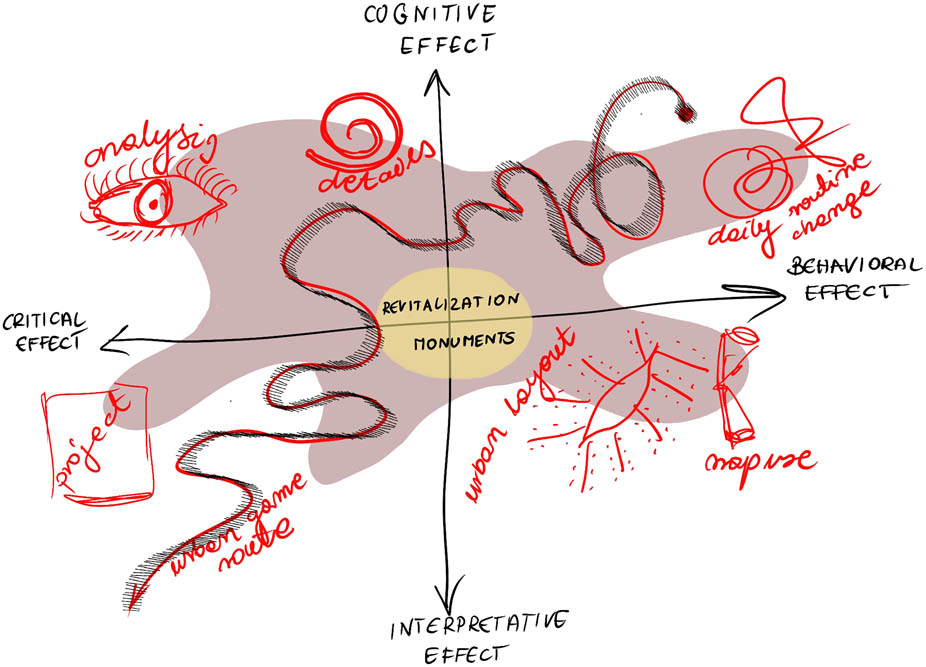
Figure 1
Game concept diagram. Elaborated by author.
Source: Author’s contribution.
3.1. Methodology for creating an urban game
3.1.1. Analytical phase
a) Identification of the group: Analysis of the profile of participants as users of urban space, taking into the account their cultural competence, level of knowledge of the area, and potential for participation;
b) Determination of the time and area framework of the game: Defining the duration of the game in relation to the rhythm of the city and the intensity of the spatial experience. Determining the area of the game and preliminary design of the route as a series of spatial experiences resulting from the urban structure of the studied area;
c) Map analysis of the potential game area.
3.1.2. Interpretation and research phase
a) Analysis of historical materials and content selection: Review of historical and archival sources to identify content with high narrative and educational potential that can be translated into a spatial experience;
b) Field research to identify unusual elements that cannot be identified in online sources (hidden elements, details, tables, inscription, etc.);
c) Architectural analysis and identification of game points: Examination of the existing architectural and urban fabric to identify objects, details, and fragments of space that could serve as task points and places for heritage interpretation.
3.1.3. Conceptual and design phase
a) Selection of the narrative and historical context of the game: Defining the narrative framework of the game, which serves as a tool for interpreting space and mediating between heritage and contemporary city users. Designing fictional characters: Selection of historical or fictional characters who act as mediators of spatial experience and support the reception of the narrative;
b) Developing the structure and mechanics of the game: Designing sequences of tasks and rules for interacting with space, treated as tools for activating urban perception;
c) Development of a complete game scenario: Development of task content in the game card and scenario for fictional characters appropriate to the game narrative;
d) Verification of the game scenario by the author;
e) Verification of the game scenario by a group of independent experts;
f) Correction of any comments submitted by the expert team.
3.1.4. Preparation phase
a) Graphic design of game cards: Development of a consistent visual identity and supporting materials that serve as an interface between the participant and the urban space, adapted to the game’s narrative;
b) Development of game rules: Formulation of organizational and safety rules to enable the controlled implementation of the game as a spatial experiment;
c) Game organization: staff, animators, working materials;
d) Marketing and promotion of the game;
e) Game implementation: Coordination of the game in the field and supervision of its implementation.
3.2. Assumptions of the planned urban game
Cognitive effect: The cognitive effect is achieved by activating the perception of urban space and consciously directing participants’ attention to architectural elements and spatial relationships that may remain unnoticed during everyday use of the city.
Assumption: The urban game leads from passive use of urban space toward its conscious observation.
Expected effect: Participants pay greater attention to the urban structure, architectural details, historical buildings, and spatial relationships between objects.
Interpretative effect: As a result of participating in the urban game, urban space is presented not only as a collection of physical objects but also as a carrier of historical and cultural narratives that participants can interpret. This effect involves a transition from the recognition of individual spatial elements toward their interpretation in relation to the history and heritage of the place.
Assumption: The game is designed to reveal layers of heritage that remain invisible or illegible in everyday use of the city.
Expected effect: Participants identify: architectural relics, forgotten spaces, fragments of former urban layouts.
Assumption: The game is designed to reveal layers of heritage that may remain invisible or illegible in everyday use of the city.
Expected effect: Participants slow down, stop at places they have previously overlooked, and initiate discussion in the space.
Critical effect: The critical effect consists in encouraging reflection on the current condition, functioning, and future of urban space and its heritage, going beyond the recognition of individual heritage elements.
Assumption: The game is designed not only to reconstruct the past but also to encourage reflection on the current condition and future of the studied area.
Expected effect: Participants develop greater awareness of heritage protection and urban regeneration issues and become able to formulate their own observations concerning the condition and future of the studied area.
4. Case study – game implementation
The design assumptions for the urban game were verified twice through the implementation of full-scale urban field games. Both games were conducted as part of public events organized by the author in cooperation with the local TURuda association, operating at the Local Tradition Center in the Franciszek Shaft in Ruda Śląska. The games were historical and spatial in nature and were conceived as narrative interventions in urban space, with a particular focus on the interpretation of architectural and urban heritage. Their design was based on the direct use of existing urban fabric, in which buildings, spatial relations, and historical traces constituted both the setting and the core content of the gameplay. In both cases, a diversified set of task types was employed as interpretative tools, aimed at activating participants’ perception, analytical skills, and spatial awareness. These tasks served to guide participants through the process of observing, analyzing, and interpreting architectural and urban heritage directly within the urban environment. The task typology applied in the games is presented below. The routes of both urban games are presented in Figure 2.
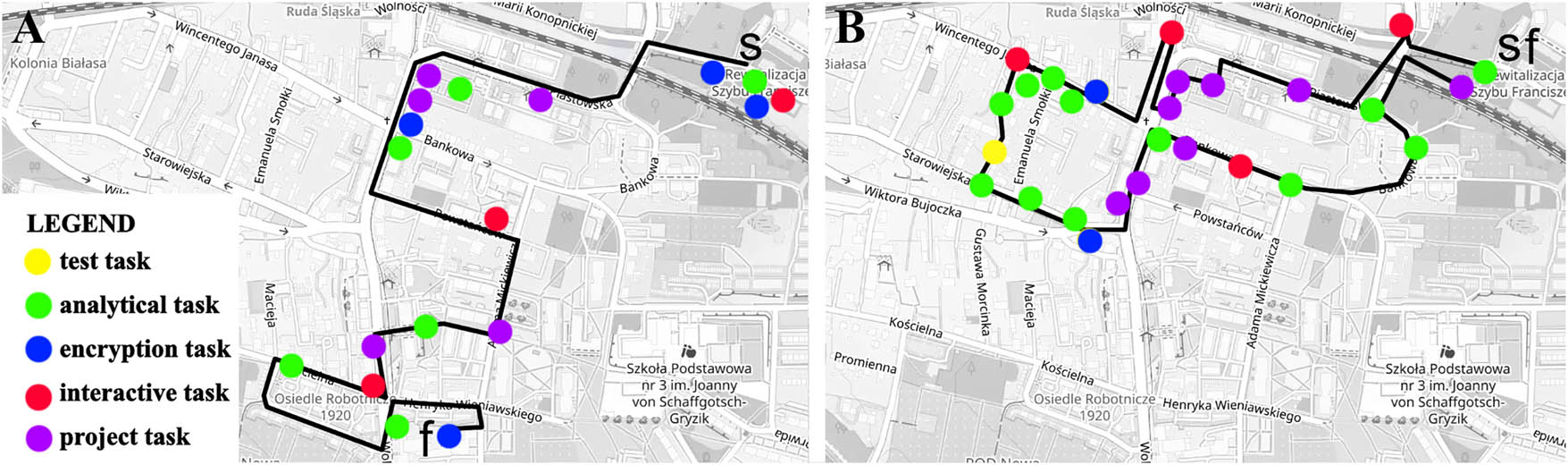
Figure 2
Field game route diagrams, game (a) “Stories of coal, brick, and stone”, game (b) “In the traces of old trade and crafts, field game.” Elaborated by author.
Source: Author’s contribution.
Test tasks: Tasks based on selecting or identifying the correct answer using information available in situ (within the game space or in the materials provided to participants), not requiring any prior factual knowledge.
Analytical tasks: Tasks requiring comparison, classification, or matching of spatial elements (e.g., buildings, architectural details, or pieces of information) based on direct observation and logical reasoning during gameplay.
Encryption tasks: Tasks based on recognizing patterns, symbols, or codes present in the urban environment and on the game materials, where the solution results from careful observation of the surroundings and task analysis (e.g., crosswords, substitution ciphers, anagrams).
Interactive tasks (with narrative characters): Tasks involving direct interaction with characters introduced into the game narrative, whose role is to convey information or clues through dialogue and experiential engagement. These tasks function as milestones within the gameplay structure.
Project tasks: Tasks engaging participants in the graphic or conceptual representation of observed spatial elements, enabling the interpretation of a place through sketches, diagrams, or simplified design proposals, without requiring prior specialist preparation.
4.1. Urban game “Stories of coal, brick, and stone”
The game was conducted on 7 September 2025 in the urban space of Ruda Śląska as part of the industrial heritage festival, Dig Where You Stand 2” (original title: Kop gdzie stoisz 2). A total of 25 teams participated in the event, each consisting of two to five players, which allowed for the observation of diverse patterns of movement through the urban space as well as different modes of interpreting the designed narrative. The length of the route was approximately 2 km, and participants had three hours to complete the game. Each team received and submitted one game card.
The game concept was based on a historical-spatial narrative in which participants assumed the role of assistants to a mining engineer, who guided them through successive stages of the development of the former village of Ruda. The game scenario [Figure 3] employed existing elements of the city’s urban structure and architecture as narrative carriers of its industrial and settlement heritage. The locations of the tasks were selected in a way that prevented players from finding answers using map based or online sources, thereby requiring them to conduct their own on-site interpretations of the space. Inspiration for the historical events and built heritage presented in the game was drawn from local newspapers and historical studies [20,21,22].
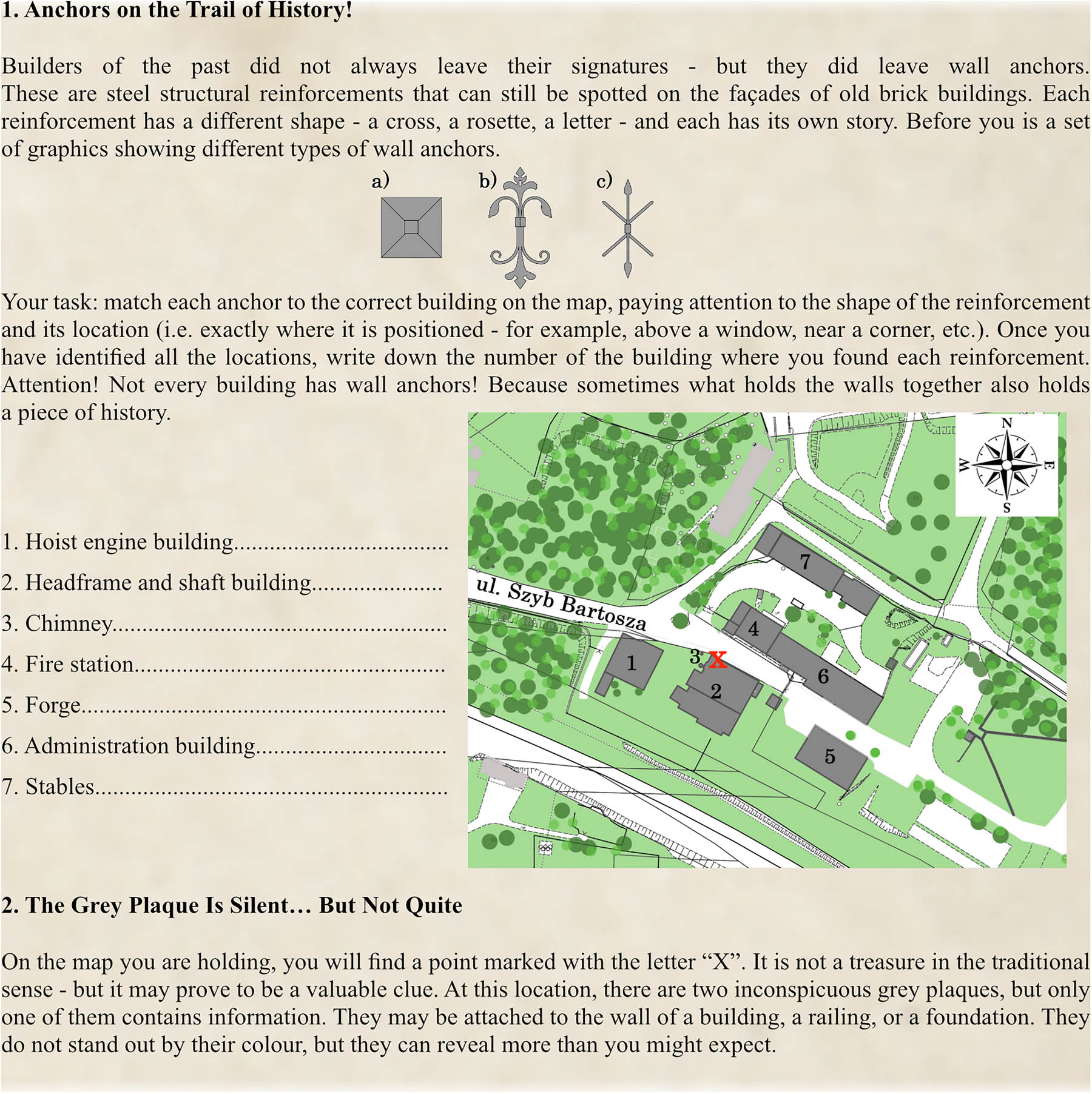
Figure 3
Game scenario – example of tasks. Elaboration by author.
Source: Author’s contribution.
The fictional characters were historical engineers Franz Pieler and Hans von Poellnitz, who were involved in the industrialization and spatial development of the Ruda district, played by actors from the “Lufcik na korbkę” theater. The biographies and professional activities of the historical characters served as a reference point for the game’s narrative, allowing participants to interpret the city space through the prism of technical, investment, and urban planning decisions made in the past. The tasks in the first game included analytical, encryption, interactive, and project tasks. The analytical tasks required participants to closely examine elements of the existing urban fabric and extract information directly from the site. For example, one task directed participants to locate two inconspicuous grey plaques and accurately record the inscription found on one of them. The encryption tasks introduced coded information that had to be deciphered to determine the location of the next stage. In one example, participants had to decode a street name using a numerical code, with a digit obtained in a previous task serving as the building number. The interactive tasks involved direct encounters with elements or actors introduced into the game narrative. For instance, participants had to find a person dressed as a miner, address him using the traditional greeting „God bless, Mine Foreman!” (org. Szczęść Boże, Sztygarze!), and answer questions concerning the mine and its history to obtain a digit required for a subsequent task. The project tasks required participants to analyze selected architectural elements through direct observation and graphical representation. One task involved counting and sketching arched window openings on the facade of a historic industrial building.
4.2. Urban game “In the traces of old trade and crafts, field game”
The game was conducted on October 25, 2025 as part of the postfestival event “Dig Where You Stand 2 1/2” (original title: Kop gdzie stoisz 2 1/2). Eight teams participated in the event, each consisting of two to five players. Some of the teams took part in both of the analyzed field games, which enabled comparative observations of repeated participation. The length of the route was approximately 2.3 km, and participants had 3 h to complete the game. Each team received and submitted one game card.
The game concept was based on introducing participants to a narrative related to the celebrations of the Week of Polish Crafts Promotion. The inspiration for this narrative was drawn from historical studies on trade and craftsmanship in the 1930s and 1940s in the area of today’s Ruda district [23]. The main objective for the participants was to locate elements of guild banners, whose symbolic representations were embedded in the urban space. The game concluded with an attempt to reconstruct the banner designs, which additionally reinforced the architectural elements encountered during the gameplay. The route led participants through locations historically associated with trade and craftsmanship, following former streets of a commercial character.
Two actors from the “Lufcik na korbkę” theatre portrayed fictional narrative characters – a butcher and a tailor – who engaged in direct interaction with the players. Narrative tasks functioned as milestones within the game structure and simultaneously served as checkpoints along the route.
The second game employed five types of tasks: test, analytical, encryption, interactive, and project tasks. The test tasks required participants to identify and distinguish specific elements of the existing built environment through direct observation. For example, participants had to examine a brick wall and identify the steel elements protruding from it, distinguishing them from other construction elements such as nails. The analytical tasks required participants to interpret information found in the urban environment and use it to identify a particular place. One task involved locating a historic shop window and using its architectural, graphic, or photographic content to determine the former location of the Barbara drugstore. The encryption tasks combined historical information with a coded message that participants had to decipher. In one example, participants decoded the surname of a former butcher associated with Janasa Street and then used the information to continue along the route. The interactive tasks introduced direct interaction with people or objects connected with the narrative of the game. For example, participants had to find a local trader, answer his questions, and obtain clues and an object required for a subsequent stage of the game. The project tasks focused on the observation and reproduction of architectural details. In one task, participants used the lettering of the historic “Wawelska Drugstore” sign as a model for reproducing an inscription associated with the local tailors’ guild.
5. Results
In this study, the presurvey and postsurvey methods (questionnaire surveys) were employed to assess the impact of an architectural and urban-themed urban game on the learning process related to heritage interpretation and the understanding of urban regeneration processes. The use of a presurvey made it possible to determine the participants’ initial level of spatial and architectural awareness prior to taking part in the game, while the post-survey enabled the identification of changes resulting from participation in the designed intervention. The adoption of this research framework allows not only for the evaluation of the effectiveness of the urban game as a tool but also for the analysis of its potential as an educational method in the field of architectural and urban interpretation and heritage-led regeneration [Figure 4].
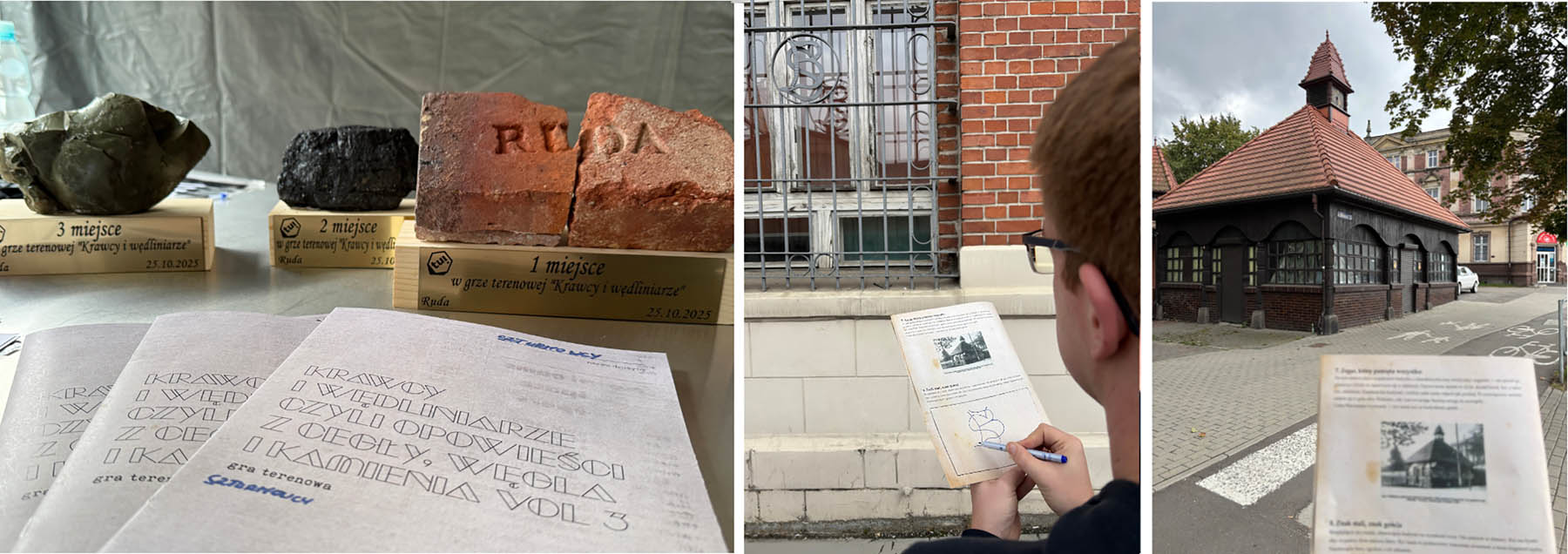
Figure 4
Game organization. Elaboration by the author.
Source: Author’s contribution.
5.1. Presurvey results
Pretests were carried out among a subgroup of participants in two urban games. A total of 54 participants completed the test and were included in the analysis. Analysis of the preliminary survey results indicates that 35 of 54 participants (64.8%) demonstrated a low level of conscious awareness of the urban environment, particularly with regard to its architectural, historical, and urban planning features. Although 42 participants (77.8%) stated that they were familiar with the study area, 38 participants (70.4%) reported paying limited attention to its architectural details and historical features. These results suggest that familiarity with the area did not necessarily correspond to a deeper awareness of its architectural and historical value, and that these spaces are primarily used as transit routes in everyday life.
5.2. Postsurvey results
The postsurvey results indicate an increase in participants’ awareness of the architectural and historical characteristics of the studied area. Among the 54 participants included in the analysis, 48 participants (88.9%) declared good or very good familiarity with the Ruda district, compared with 42 participants (77.8%) in the presurvey. The proportion of participants declaring good or very good knowledge of historical buildings and industrial heritage sites increased from 19 participants (35.2%) to 47 participants (87.0%). Similarly, the proportion declaring good or very good ability to recognize and identify architectural details increased from 16 participants (29.6%) to 46 participants (85.2%).
Particularly important are the results of questions related to the perception of space and heritage, which demonstrate that the designed game route and sequence of tasks:
a) Directed participants’ attention toward architectural details and elements of the urban structure that had previously been ignored or remained unconscious;
b) Enabled the reading of historical layers of the city directly in situ, rather than exclusively through textual or museum-based narratives;
c) Initiated reflection on the current condition and future of the studied areas, as indicated by numerous questions raised by participants regarding the further fate of the heritage;
d) Introduced historical and professional terminology, such as the names of architectural details;
e) Facilitated familiarity with historical figures associated with the development of the area;
f) Allowed participants to adopt the perspective of an “architect-urban planner” through the inclusion of drawing-based and design-oriented tasks.
A comparison of the pre- and postsurvey results clearly indicates that, without the designed intervention in the form of an urban game, the studied area remained cognitively “inactive” for participants despite the presence of informational boards at key heritage sites. This suggests that the educational and participatory potential of urban space does not activate spontaneously, even in areas of high historical or urban value.
5.3. Evaluation of participants’ playing cards
The highest level of correct responses was recorded for test and encryption tasks, which proved to be the easiest for participants, with an average success rate of approximately 99%. Interactive tasks were characterized by a moderate level of difficulty and were completed correctly in approximately 96% of cases; however, this result should be interpreted with caution due to the possibility of obtaining hints during task completion.
The lowest level of effectiveness was observed for project and analytical tasks, which posed the greatest challenge for participants. The average rate of correct completion for these tasks was approximately 91%, indicating a higher level of difficulty associated with spatial analysis and the interpretation of architectural details. The obtained results confirm the validity of gradating task difficulty and demonstrate that the most demanding tasks were simultaneously those that most effectively fulfilled the educational objectives of the game [Figure 5].
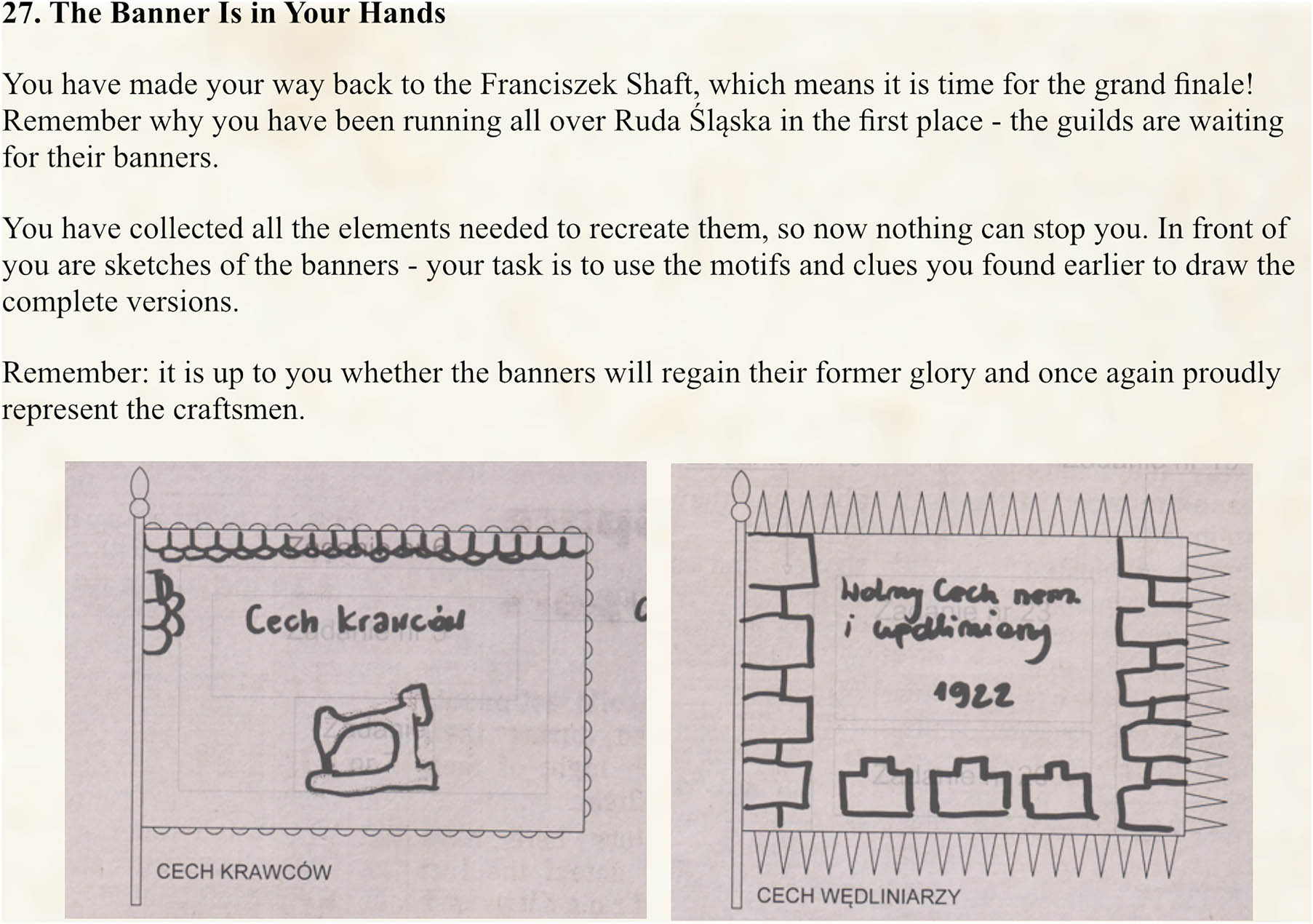
Figure 5
Example of a completed game card showing a solved project task. Elaborated by the author.
Source: Author’s contribution.
6. Conclusions
The following conclusions summarize the research conducted on the use of urban games as educational tools in the process of learning heritage interpretation and understanding issues related to urban revitalization. They include application-oriented, didactic, and research outcomes, as well as indicating possible directions for further work.
The application-oriented outcome of the study is the development and implementation of two architectural and urban-themed urban games, together with a structured set of tasks and research tools in the form postsurveys. These materials may be used both in future educational activities and in initiatives aimed at disseminating knowledge about heritage and urban regeneration processes.
The didactic outcome of the research is the confirmation of the effectiveness of urban games as tools supporting the learning process of heritage interpretation and the understanding of basic mechanisms of urban regeneration. The analysis of results revealed a clear differentiation in the level of difficulty among individual task types: the highest scores were achieved in test and encryption tasks, while the lowest scores were recorded for project and analytical tasks, which require competencies characteristic of architectural and urban practice.
The research outcome consists of the acquisition of quantitative and qualitative data concerning the effectiveness of different task formats used in urban games and their impact on the process of knowledge acquisition. These findings contribute to the development of research on the use of urban games as educational tools in the fields of architecture, urban planning, and heritage-led revitalization.
The study indicates the need for further research and methodological refinement, particularly through the development of tools for assessing participants’ spatial competencies and the continued improvement of analytical task structures. This will enable the formulation of a more universal methodology for designing architectural urban games, applicable across diverse revitalization, and interpretative contexts within architecture and urban planning.
Funding information
This research received no external funding.
Author contributions
The author was responsible for the conceptualization, methodology, design and implementation of the urban games, data collection, analysis and interpretation of the results, and preparation of the manuscript.
Conflict of interest statement
Authors state no conflict of interest.