
1. INTRODUCTION
In recent years, energy storage has been becoming much more prevalent in discussions related to the European energy transition. As of 2024, renewable energy sources make up almost 30% of the Polish energy sector [1], which is over half of what coal-powered processes accounted for in that year (55% [1]). This is a significant milestone, but one that does, however, call for caution. A defining characteristic of RES is that they are completely dependent on atmospheric conditions, thereby not possessing the ability to adjust their energy output to accommodate for the demand in the network. This, in turn, renders them incapable of operating independently while being integrated into the energy system at a large scale. It is for this reason that methods of energy storage are essential in the proper functioning of RES within the energy sector [2].
Technologies developed to date have predominantly focused on the storage of electrical energy [3, 4]. However, a key challenge associated with electrical energy accumulation is the limitation of the capacity of the national grid [2]. Given Poland’s declared intention to pursue near total electrification of its energy system [5], the total energy demand, including both electrical devices and thermal appliances, will increasingly rely on the power grid. This is exemplified by technologies such as heat pumps, which convert electricity into heat.
A significant concern is that, when accounting for the replacement of fossil fuels such as natural gas and petroleum as part of the energy transition [5][6], the existing grid infrastructure lacks sufficient capacity to transfer the required energy during peak demand periods [2, 6]. Even with the deployment of electrical energy storage (EES) systems, which themselves consume grid capacity, these dilemmas remain unresolved.
To mitigate this issue, thermal energy storage (TES) systems can be utilised. Such systems allow excess electrical energy originating, for example, from renewable sources like wind farms, to be converted into and stored as heat [7, 8]. This heat can then be integrated into existing thermal infrastructure, thereby reducing the load on the electrical grid and limiting the need for grid expansion.
Analyses of heat accumulation endeavour to develop an effective solution to retain a portion of the energy that would otherwise have been left without a purpose. Several mediums are capable of storing a large amount of thermal energy, like water tanks [9], however, few of these can accumulate this amount of energy within a smaller volume. This is due to the specific parameters needed to accommodate such high temperatures. In this domain, the most viable and versatile heat accumulation medium takes the form of phase-change materials (PCMs), which are a type of latent heat storage medium [10]. These are characterized by their ability to absorb a significant amount of energy during their phase change. Moreover, there are many different types of PCMs, each being able to function in different temperatures due to their various melting points, as shown below in Fig. 1.
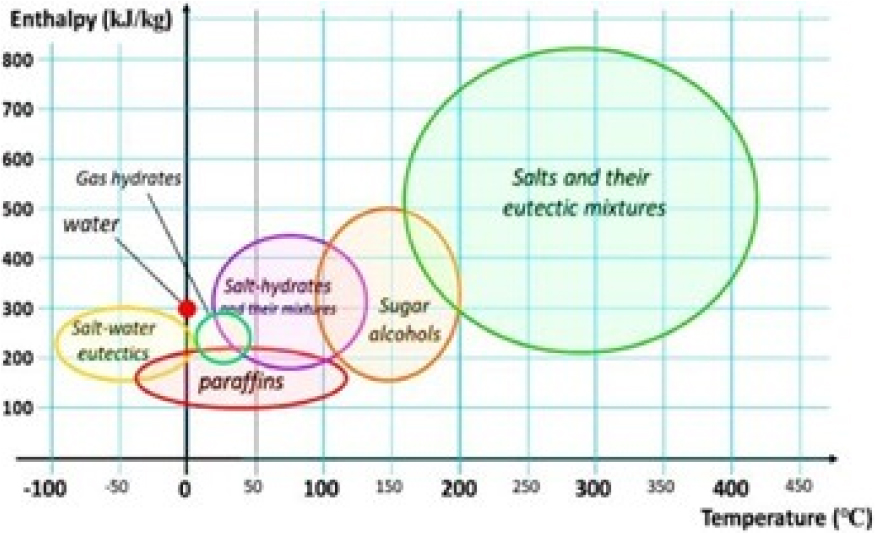
Figure 1.
Phase change material types by melting temperature [11]
One such PCM, which is being explored as a potential heat accumulation medium within large-scale systems, is molten salt. These also can have different parameters based on their chemical composition, with their melting points ranging from -120-1000°C [12].
The analysis in the paper herein aims to simulate the behaviour of a phase change material that would be designed to work in an environment where the temperature exceeds the boiling point of water. For this purpose, a numerical model was designed.
Due to its specific properties, such as its high liquidus temperature, which is suiting for the chosen parameters of this analysis, magnesium chloride hexahydrate was chosen as the PCM for this analysis. It is also a good candidate for a thermal energy storage material due to its relatively high thermal conductivity [13], and reasonable cost, that being about €40 for 1kg [13].
This work presents a numerical analysis of heat accumulation in magnesium chloride hexahydrate under adiabatic conditions, with the goal of evaluating its viability as a medium-temperature phase change material. Unlike prior studies that focus mainly on low-temperature PCMs like paraffins, this analysis targets the 100–130°C range, which is significant because it enables more energy to be stored without reaching the high-temperature range, which increases system complexity and cost. The study quantifies the total heat stored during the phase change process and assesses whether the energy density is sufficient to power practical applications. This contributes to the understanding of MgCl2·6H2O as a candidate PCM by establishing performance benchmarks under idealized thermal isolation, providing a basis for future system-level integration and efficiency assessments.
2. NUMERICAL MODEL SETUP
A numerical model was developed in Ansys Fluent software and has taken inspiration from the test stand used by Zaynetdinov et. al. [14]. The model geometry, shown in Fig. 2 represents a shell-and-tube test stand, as shown below. The water enters the pipe from the bottom of the test stand. This in an alteration made in order to speed up the phase change process through the introduction of buoyant forces within the liquid PCM. Analogously, the top was designated to be a pressure outlet. Because the water within the pipe must be at a temperature above its boiling point, the pressure within the pipe was set to 500 kPa.
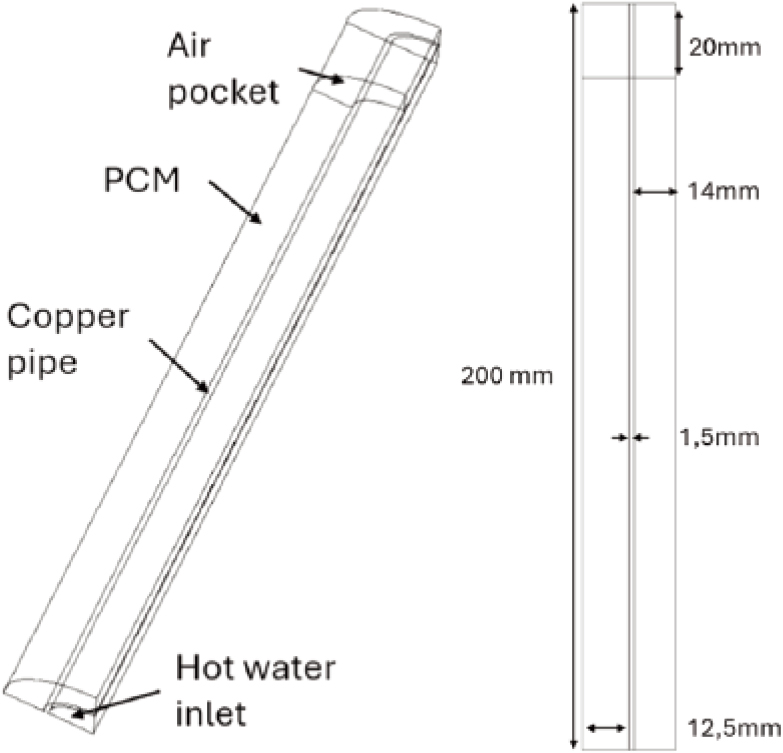
Figure 2.
Numerical model geometry
The whole geometry was bound by the PCM and had a radius of 50 mm and a height of 200 mm. The smaller dimensions were chosen for the purpose of saving computational resources and speeding up the simulation.
An air pocket was patched into the top section of the model in the PCM section. This was done with the aim of accounting for the thermal expansion of the material as it heats up and undergoes a phase change. It allowed for avoiding pressure increase caused by change of the PCM’s specific volume during its phase change.
The geometry was also constrained with a periodic boundary, repeating once every 90 degrees. The purpose of this was to decrease the numerical domain and speed up the calculations.
A numerical mesh was constructed in ICEM CFD, and after a mesh independent study that involved the temperature distributions, one with 137,46 elements and 127,740 nodes was chosen. The results of the mesh independent study are presented below in Fig. 3, in the form of the difference in temperature from the chosen mesh.
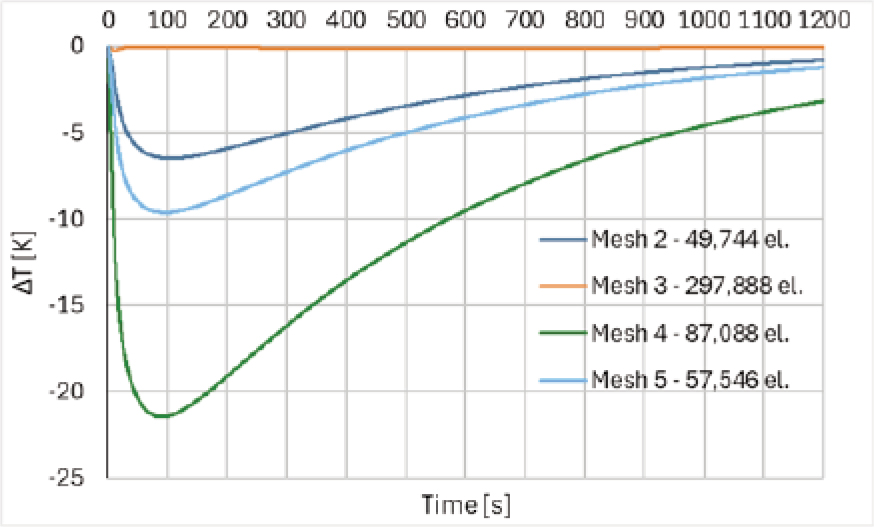
Figure 3.
Mesh independent study results
Due to the negligible differences between the chosen mesh (mesh 1) and the densest mesh analysed (mesh 3), despite the latter being over twice as dense, it was decided that mesh 1 will be used for further calculations. Furthermore, when compared to the significant differences in results from the other analysed meshes, it was concluded that further mesh studies would not yield results of sufficient significance to justify their execution.
Furthermore, monitor points were placed throughout the numerical model, at three different depths within the PCM and four different heights, with the purpose of outputting a temperature curve throughout the whole process. The locations of the monitor points that will be further analysed throughout this article are shown in Fig. 4.
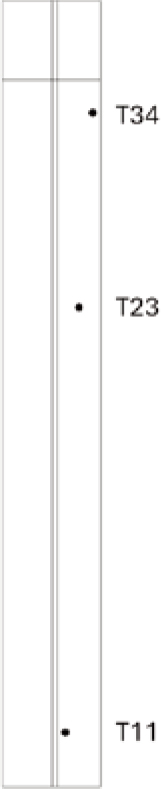
Figure 4.
Locations of the monitor points in the numerical model
Other important parameters that had to be taken into consideration in the analysis, were the material properties. These parameters are shown in Tab. 1 and Tab. 2.
Table 1.
| Parameter type | Value (water) | Value (copper) |
|---|---|---|
| Density [kg/m3] | 998.2 | 8978 |
| Specific heat [J/kgK] | 4182 | 381 |
| Thermal conductivity [W/mK] | 0.6 | 387.6 |
| Viscosity [kg/ms] | 0.001003 | - |
| Latent heat [J/kg] | 2263073 | - |
| Vaporization temperature [K] | 284 | - |
| Boiling point [K] | 373 | - |
Table 2.
Physical properties of magnesium chloride hexahydrate
| Parameter type | Value/function | Source |
|---|---|---|
| Density [kg/m3] | 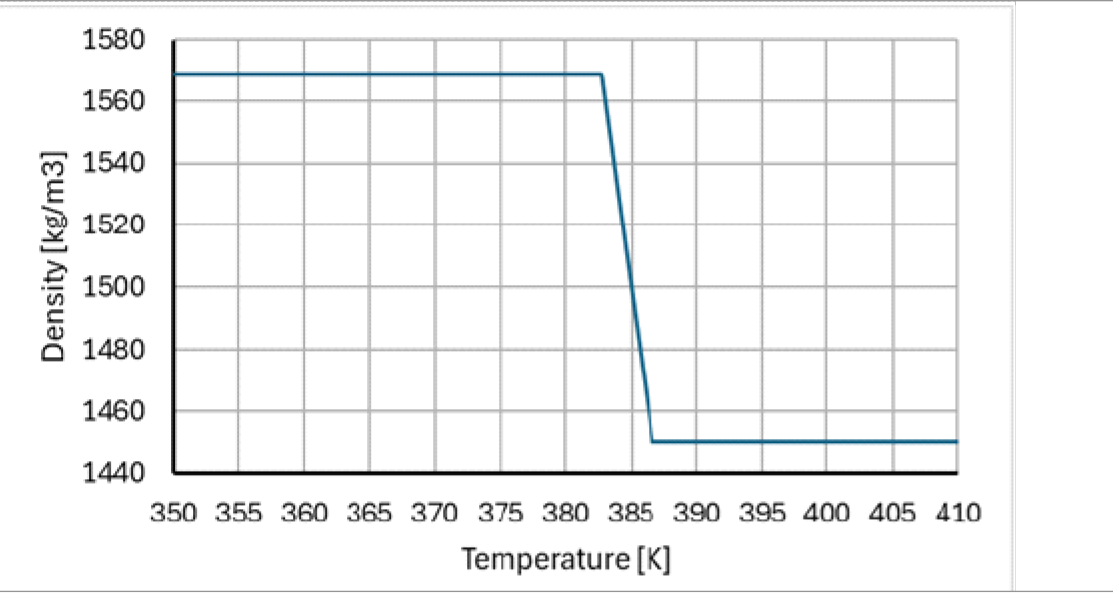 | [17] |
| Specific heat [J/kgK] | 1489.13 | [18] |
| Thermal conductivity [W/mK] | 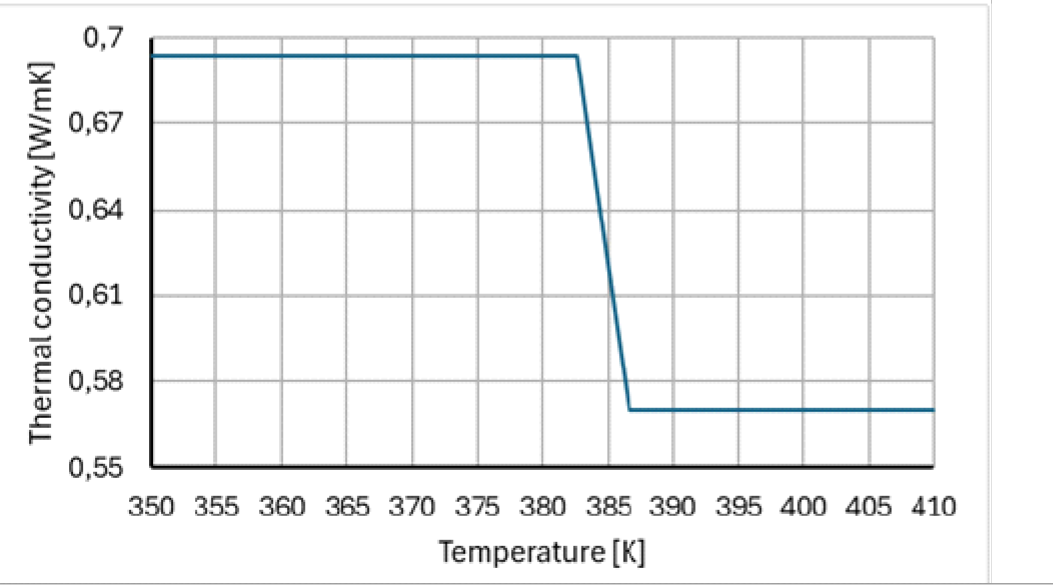 | [17] |
| Pure solvent melting heat [J/kg] | 155110 | [17] |
| Viscosity [kg/ms] | 0.09 | [19] |
| Solidus temperature [K] | 380 | [*] |
| Liquidus temperature [K] | 384.65 | [17] |
* [*] – based on liquidus temp. from [15], decreased for calculation stability
The physical parameters of magnesium chloride hexahydrate are shown in Tab. 2.
For parameters such as density and thermal conductivity, their values were defined to decrease linearly within a temperature range of ± 2K in the vicinity of the melting point.
To constrain the model in a manner that adequately reflects the expected physical phenomena, several adjustments were necessary. To capture the effects of buoyancy, gravity was defined to act axially and in the opposite direction of the fluid flow. Furthermore, to ensure an accurate representation of fluid behaviour, a turbulence model was implemented. The model was based on Reynolds-averaged Navier-Stokes equations, due to the incompressible and relatively low-velocity nature of the fluid flow. These conditions did not warrant the use of more sophisticated modelling approaches.
The calculations were performed on a pressure based transient simulation using the simple solver scheme, second order spatial discretization with a 0.1 second time-step and 10−5 residual convergence criteria.
Furthermore, the model was also assumed to be adiabatic, implying no exchange of energy or mass with the surrounding environment. This simplification was introduced in order to reduce the calculation domain and the number of variables.
Prior to the initialisation of hot water flow, the temperature was initialised at 360K in the model domain. Given the assumption of no heat loss, initialising the system at ambient temperature and allowing it to heat up was deemed unnecessary.
3. RESULTS AND DISCUSSION
The temperature curves (Fig. 5) registered at the monitor points shown in Fig. 4 exhibit a tendency to oscillate in close proximity to the phase-change boundary of 384.65K (where T11 is the bottom point closest to the innermost part of the PCM, T34 is the top and outermost part of the PCM and T23 denotes a representative midpoint). This is especially noticeable in point T11, which is closest to the pipe wall. This oscillation is caused by buoyancy forces acting in this area. These are a direct result of density changes induced by the increasing temperature of the material and acting gravitational forces. Because the material in the vicinity of the monitor point is there for a limited time before getting displaced by hotter, and therefore less dense material, the resulting temperature characteristic displays the visible oscillations. Furthermore, because the monitor point is located close to the copper pipe, the changes in temperature occur more quickly, and therefore the induced convection current is more turbulent than in other areas within the test stand.
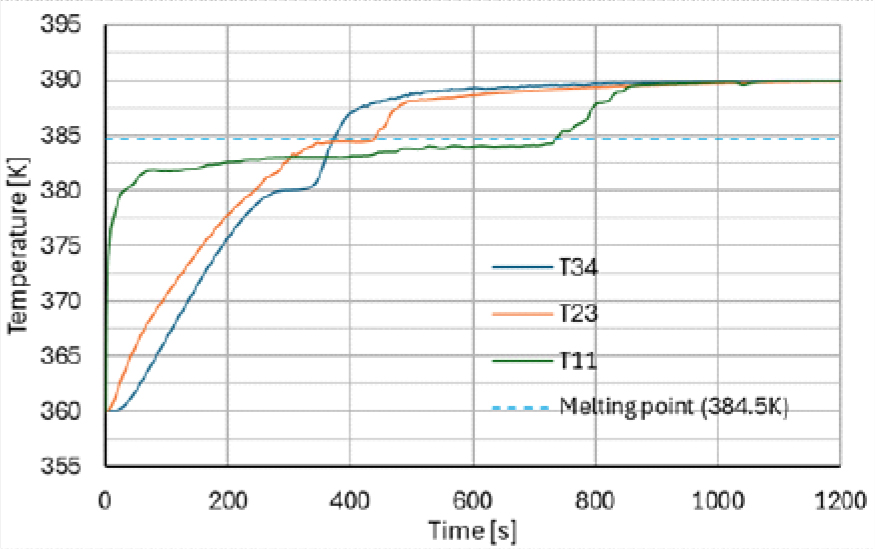
Figure 5.
Temperature curves within the PCM with respect to time
Curve T34 exhibits fewer and less pronounced oscillations compared to the other measurement points. It also begins to melt at a slightly lower temperature than the others – right at the solid-state boundary between the solidus and liquidus temperatures. The reason for this could be related to the stability of the flow of liquid PCM at the top of the numerical model.
The melting process can also be visualised by showing the mass fraction within the PCM at different times in the simulation, as illustrated in Fig. 6 for t = 300 s, 450 s, and 750 s. These time points correspond to the sections of the temperature curves that indicate a phase change.
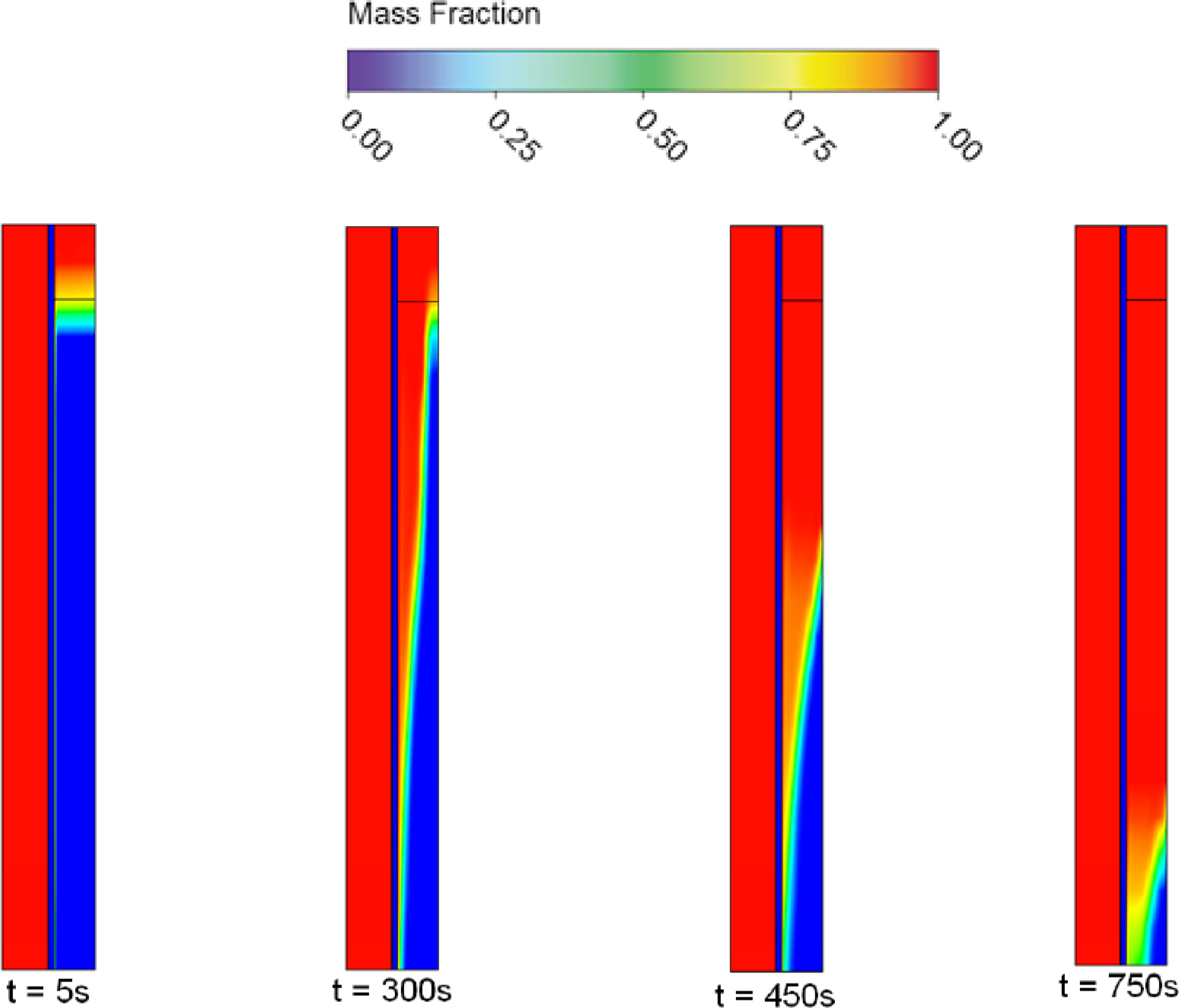
Figure 6.
Mass fraction within the heat storage
The mass fraction contours in Fig. 6 illustrate how the PCM melts with respect to time. The melting process begins at the interior wall, progressing in an upward and outward direction. This is caused by buoyant forces carrying hotter material upward. This results in a rapid melting process, considering the material’s thermal properties (Tab. 2).
Furthermore, at t = 750s, the mass fraction gradient in the vicinity of the T11 monitor point is not uniform. Since the majority of the hot material is being displaced upwards, the lowest part of the model is the most difficult to heat. These displacements are responsible for the oscillations illustrated in curve T11 in Fig. 5 after it exceeds the melting point.
Additionally, the convection current within the liquid phase change material can be analysed with the help of velocity contours as illustrated in Fig. 7.
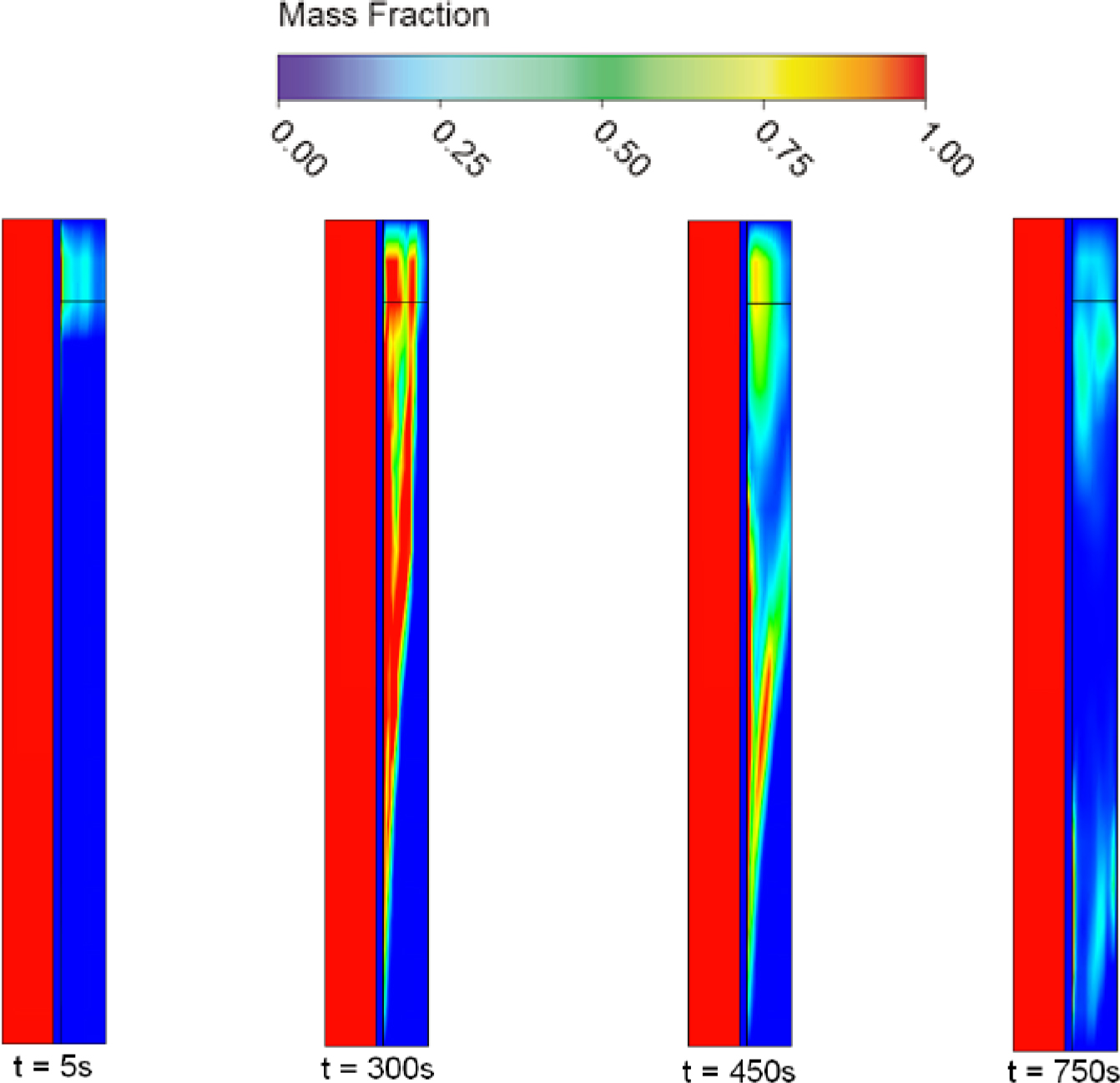
Figure 7.
Velocity contours
The velocity contours signify the presence of a convection current in the domain of the PCM as well as in the air pocket located above it. Here, convection starts occurring at the beginning of the simulation, since the air is already in its fluid form. Moreover, the velocity contours within the PCM directly correlate with the liquid fraction contours in Fig. 6. As the temperature starts to plateau in the liquid fraction, the velocity dynamism also starts to decrease, since there are no longer any significant divergences in density and therefore no noticeable buoyant forces.
The amount of heat accumulated increases at a linear rate throughout the majority of the simulation (Fig. 8). Initially, a significant amount of heat flux is observed, which is most likely due to the high water inlet temperature (390K). Once the phase-change begins (from t = 150s), the heat flux in the PCM stabilizes. Subsequently, the heat flux exhibits a linear decline at a rate proportional to the decrease in the PCM heat accumulation gradient. The heat storage potential after the material melts takes the form of sensible heat storage. Since this is less effective than utilizing the material’s latent heat storage, the simulation is concluded once the material has fully melted.
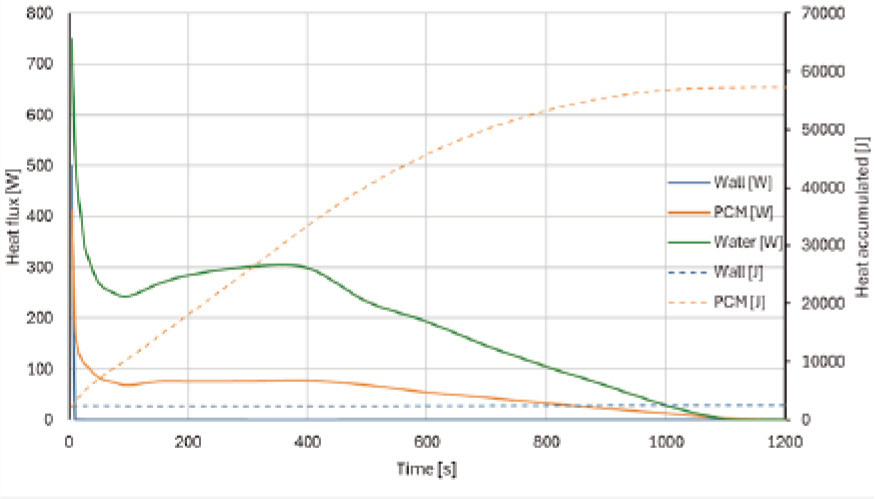
Figure 8.
Heat flux [W] and heat accumulated [J] within the system with respect to time
Fig. 8 Heat flux [W] and heat accumulated [J] within the system with respect to time
Overall, the PCM accumulated circa 57 kJ of energy. Given the volume utilised in this analysis, (9.7x10⁻⁴ m3), the total capacity of magnesium chloride hexahydrate under these circumstances, is 58.7 MJ of heat per cubic metre, which makes it an effective heat storage medium under these boundary conditions.
4. SUMMARY
The article aimed to explore the possibility of utilising a phase-change material – magnesium chloride hexahydrate – as a heat accumulation medium within a small-scale shell-and-tube energy storage.
The results yielded by the numerical analysis showed that the material melts in the direction opposite to the flow of the heat transfer medium. This was due to a convection current forming within the tube as the hotter, less dense material got displaced upward, against gravity by its buoyant forces, therefore forcing the less dense, colder material downward.
Altogether, the PCM melted in just over 800 seconds, which is not much more than two minutes after reaching the melting point. This is likely due to the small size of the analysed geometry, a high initialisation temperature, as well as a high water inlet temperature (390K).
5. CONCLUSIONS
This type of system can be implemented in decentralised storage for district heating networks in urban areas. Due to the nature of MgCl2·6H2O, these storages can have a significant capacity without taking up a large area, which makes them viable for large-scale urban applications. Furthermore, they can also be used in smart grids and renewable energy integration as a result of its energy storage potential. Because MgCl2·6H2O is a medium-temperature PCM, it can store more energy than low-temperature alternatives, allowing it to heat water to the desired temperature for longer periods. It is also easier to charge than high-temperature PCMs, making it a safe and practical middle-ground solution.
In addition to this, PCMs can be utilised in the scope of residential, single-household storages equipped with a standard, not electric, heating system. Their small dimensions are also a significant factor in this domain.
MgCl2·6H2O is limited, like most PCMs, by its low thermal conductivity and volume change during phase transition. The first causes slow melting, leading to the necessity to add thermal conductivity enhancers in the form of graphite/metal foams, while the latter can cause pressure buildup and thus stress container materials and potentially cause cracks or leaks in long-term operation.
In future research it is planned to construct a model for a larger unit, which should be more adequately suited to industrial implementations, by way of it being able to absorb substantially more energy in a single tube. Moreover, it is also planned to build a laboratory stand in order to experimentally analyse this process and compare it with the numerical model.