
Table 1.
Fire Risk Analysis According to BYKHY (checklist) (Created by the author based on study data)
| Precaution Taken | Adequate | Not Adequate | Precaution Taken | Adequate | Not Adequate | |
|---|---|---|---|---|---|---|
| Building location, access | + | Non-slip material | + | |||
| Fire compartment | + | Railing balustrade | + | |||
| At least half of the exits to be within the compartment | + | RAMPS | ||||
| Floorings | + | Accessibility | + | |||
| Suspended ceiling | + | Non-slip material | + | |||
| Installation insulation | + | Gradient | + | |||
| Facade insulation | + | Landing | + | |||
| Facade characteristics | + | ACTIVE SYSTEMS | ||||
| Roof covering | + | Detection system | + | |||
| ESCAPE ROUTES | Warning system | + | ||||
| Uninterrupted escape route | + | Extinguishing system | + | |||
| Easily accessible | + | Periodic maintenance and testing | + | |||
| Number, capacity, and distance of escape routes | Fixed hose and fire cabinet | + | ||||
| Escape distance | + | Water intake installation | + | |||
| Escape route widths | + | Hydrant | + | |||
| Exit widths | + | Hydrant distance | + | |||
| DOORS | Number of portable extinguishing devices | + | ||||
| Door widths | + | Smoke control system | ||||
| Opening direction | + | HVAC installation | + | |||
| Fire resistance feature | + | Staircase shaft pressurization | + | |||
| Self-closing | + | Width of circulation areas in theater halls | + | |||
| ESCAPE ROUTE COMPONENTS | Emergency lighting on steps in case of power failure | + | ||||
| Inner escape route width | + | Number of seat rows | + | |||
| Selection of fire-resistant materials | + | Seat widths | + | |||
| STAIRS | Wall coverings | + | ||||
| Number of stairs | + | Plumbing works | + | |||
| Do half of them open outward? | + | Fire safety landing | + | |||
| Distance to exit | + | Fire protection of stairs | + | |||
| Number of steps | + | Panic device on escape doors along the escape route | + | |||
| Landing width | + | Preservation of original materials in renovations of historical buildings | + | |||
| Headroom height | + | |||||
| Fire safety landing | + |
Table 2.
Fire Safety Evaluation System with Risk Analysis Table (Referenced from NFPA 101)
| Security parameter | Parameter value | |||||||
|---|---|---|---|---|---|---|---|---|
| 1. Construction | Non combustible material | Combustible material | ||||||
| NFPA220/building construction type/height | Type 1(442 or 332) Type 2 | Type 2(111) | Type 2(000) | Type3 211 200 | Type4 (2HH) | Type5 | ||
| 1-2 floor | 0 | 0 | 0 | 0 -1 | 0 | 0 -1 | ||
| 3 floor | 2 | 2 | -6 | 0 -6 | 0 | 0 -12 | ||
| 4-5 floor ≤22,8m | 2 | 2 | -10 | 0 -12 | 0 | -3 -12 | ||
| >5 floor 22,8m | 2 | 2 | NV | 0 NV | 0 | -6 NV | ||
| >22,8m <45,72m | 2 | -1 | NV | 0 NV | 0 | NV NV | ||
| 45,72 | 2 | NV | NV | 0 NV | 0 | NV NV | ||
| 2. Classification of risks | Unprotected escape route | separate from escape routes | complete | |||||
| 2 missing | 1 missing | 2 missing | 1 missing | 0 | ||||
| -7 | -4 | -4 | 0 | |||||
| 3. Vertical shaft | Open (or incomplete protection) | Close | ||||||
| 5 or more floor | 4 floor | 3 floor | 2 floor | <30 min. | 30 min. -1 hour | >1 hourg | ||
| -10 | -7 | -4 | -2 | -2 | -1 | 0 | ||
| 4. Sprinkler | None | Corridor | except corridors and lobbies | Whole building | ||||
| Standart | Speed | Standard | Speed | |||||
| 0 | 0 | 4 | 6 | 10 | 12 | |||
| 5. Fire alarm | None | without notification | notification | |||||
| Without voice command | With voice command | Without voice command | With voice command | |||||
| 0(-2)k | 1(0)k(-1)p | 2(0)p | 2(1)k(-1)p | 4(2)p | ||||
| 6. Smoke detection | None | Corridor | Rooms | Whole building | ||||
| 0 | 1 | 2 | 4 | |||||
| 7. Entrance Exit | No exit corridor | Alternative exit corridor>15,24m | ||||||
| > 22,8m ≤ 30,4m | > 15,24(6,09)h ≤ 22,86 | > 60,96m ≤121,92m | ≥ 60,96mc | ≤ 15,24 m 30,48 | ≤ 15,24m | |||
| -2 | -1 | -1 | 0 | 1 | 3 | |||
| 10. Escape rote | One | Multiple rote | Direct exit | |||||
| inadequate | adequate | Smoke resistant area | ||||||
| -6(0)i | -2 | 0 | 3 | 5 | ||||
| 11. Corridor/separate room (compartment) | allocated exits and protection level | Compartment | ||||||
| incomplete | Smoke resistance | ≥ 1/2 hour c | ≥ 1 hour c | |||||
| No smoke resistant door | smoke resistant door | No smoke resistant door | smoke resistant door | smoke resistant door | ||||
| -6/0 | 0 | 1(2)f | 1 | 2(3)f | 3(4)f | 3 | ||
| 12. Training and drills | Number of drills conducted in 1 year | |||||||
| 0 | 1-2 | >2 | ||||||
| -2(-3)m | 0(1)n | 1(2)n | ||||||
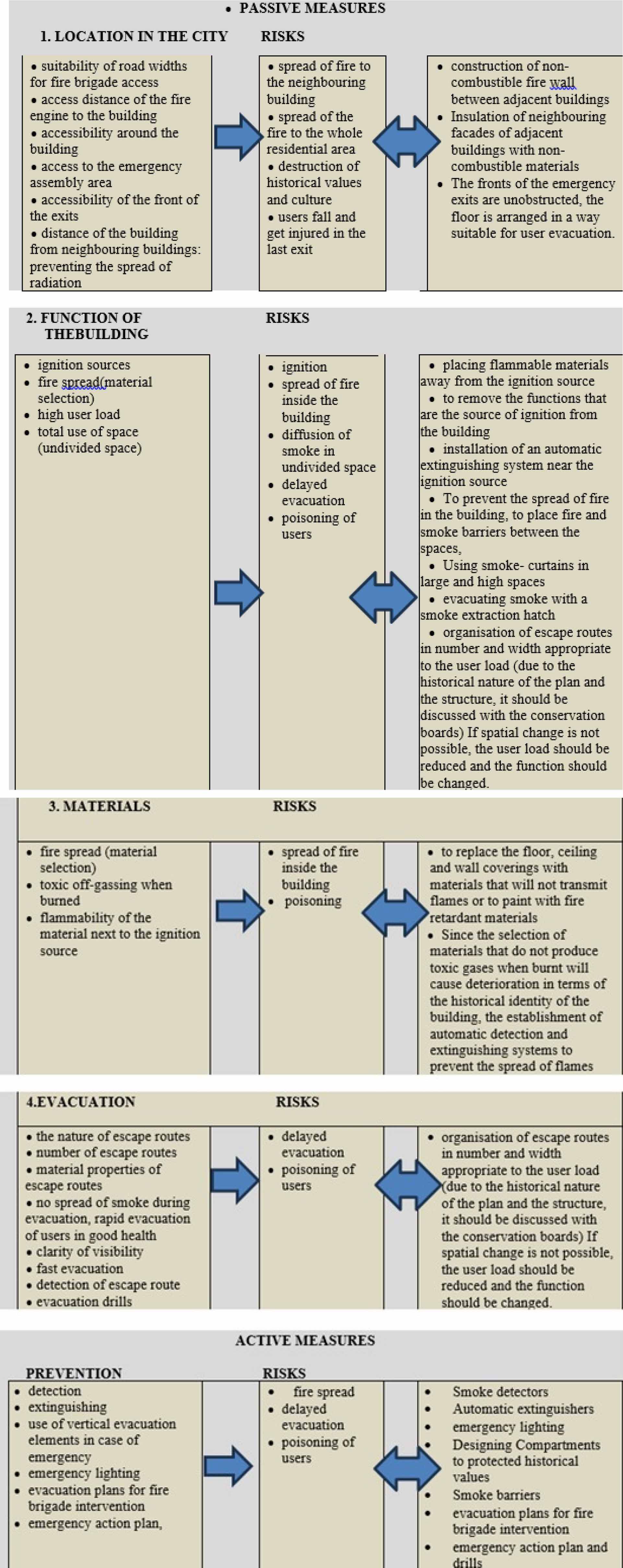
Figure 1.
Fire risk assessment stage (Created by the author based on study data)
Table 4.
Fire Risk Assessment Dependent on Spaces (Created by the author based on study data)
| Spaces | Fire Compt | Evacuation Safety | Overall Fire Safety |
|---|---|---|---|
| 2nd basement floor State Theatre Directorate | |||
| 2nd basement floor Choir Directorate | |||
| Dede Efendi Theatre Hall | |||
| 1st basement floor State Theatre Directorate | |||
| 1st basement floor Choir Directorate | |||
| Ground floor State Theatre Directorate | |||
| Ground floor Fine Arts Gallery | |||
| Main Hall (Theatre Hall) | |||
| 1st floor | |||
| 2nd floor State Theatre Directorate | |||
| 2nd floor theatre committee section | |||
| 2nd floor Choir and Symph. Orch. Directorate |
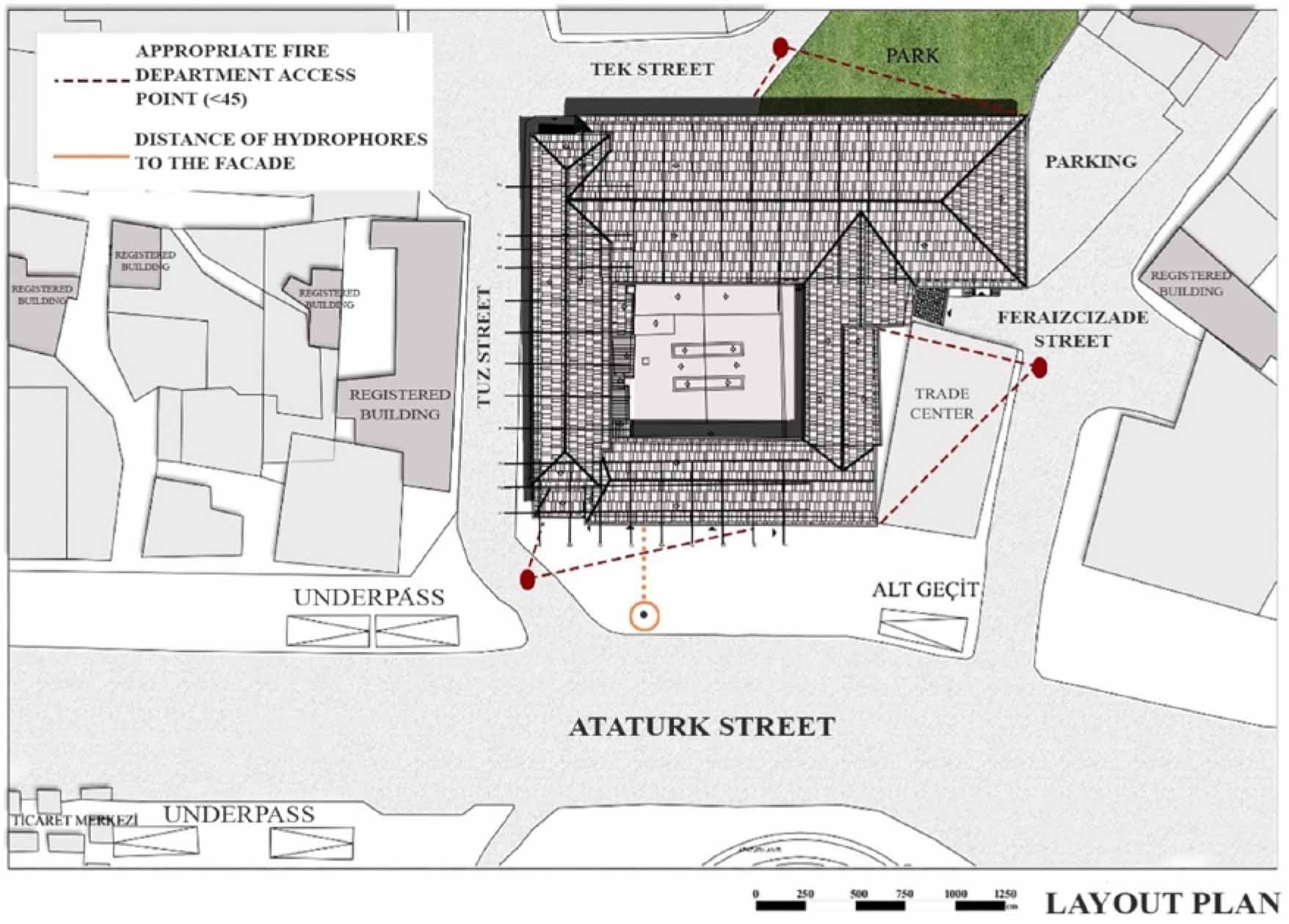
Figure 2.
Examination of the Layout of the Theatre Building According to BYKHY Articles. (Created by the author)
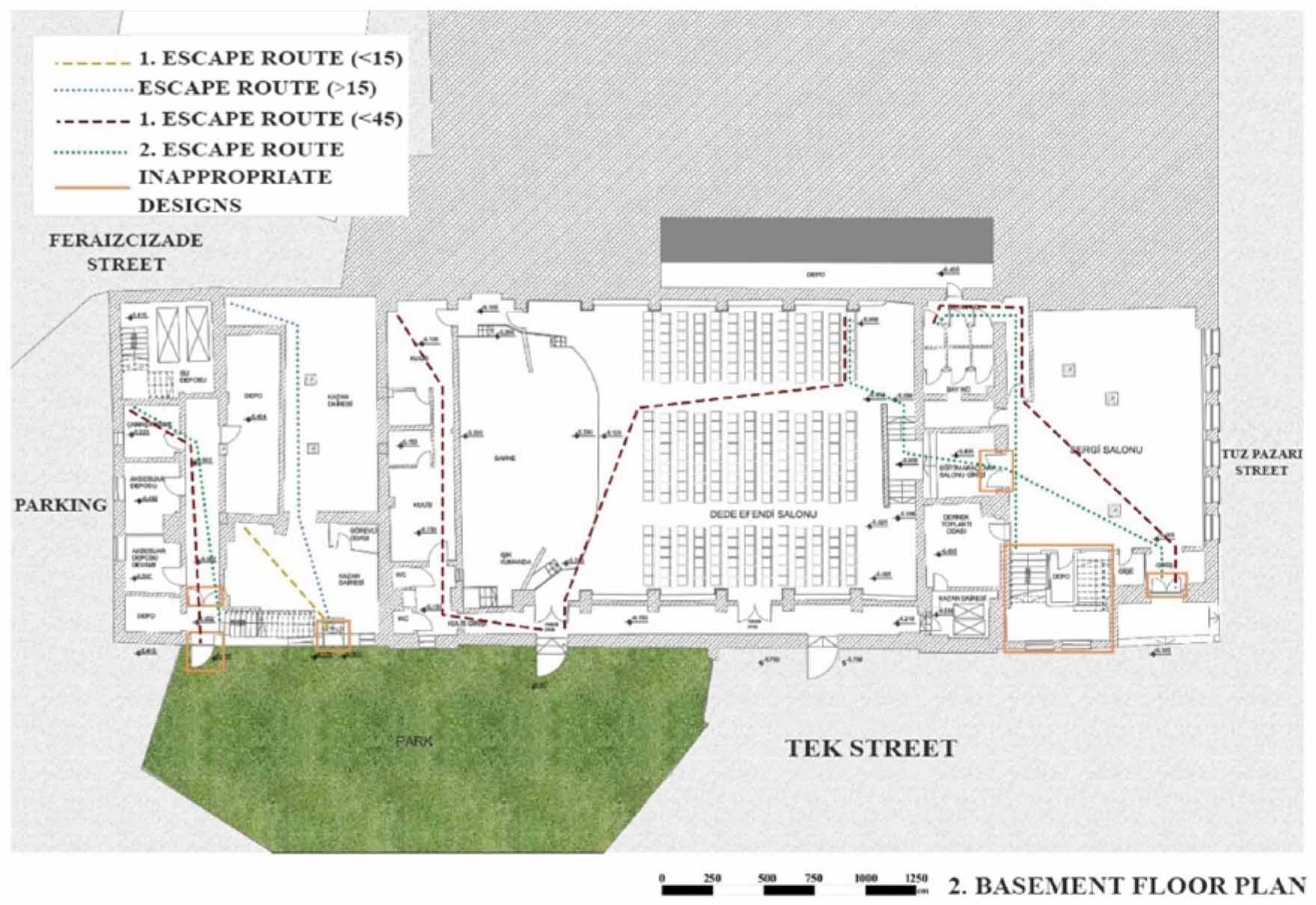
Figure 3.
Analysis of Escape Routes in the Existing Second Basement Floor Plan (yellow line; single escape distance suitable according to BYKHY, blue line; unsuitable escape distances, maroon line; suitable double escape distance, green line; alternative escape, orange line; represents unsuitable designs). (Created by the author)
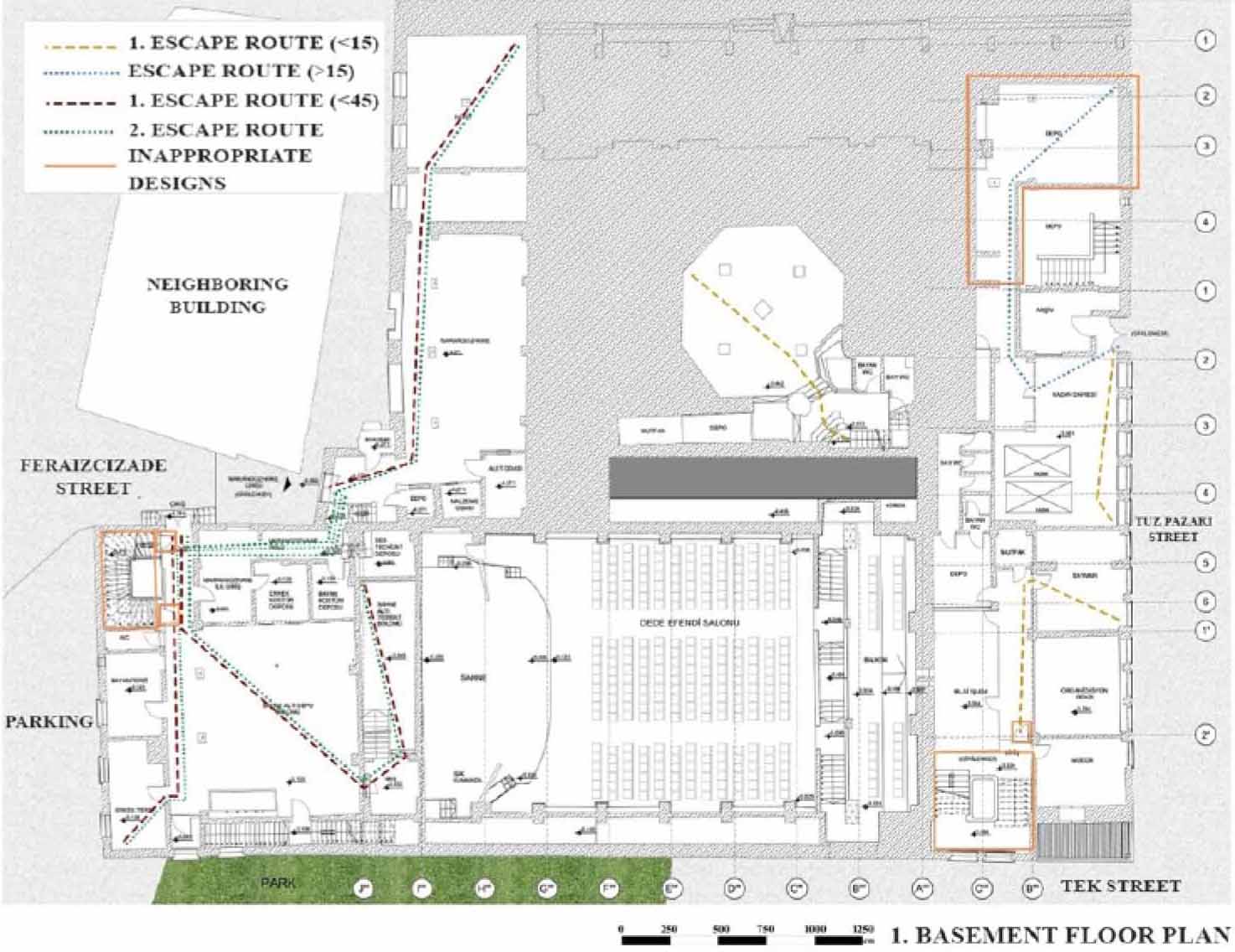
Figure 4.
Analysis of Escape Routes in the First Basement Floor Plan. (Created by the author)
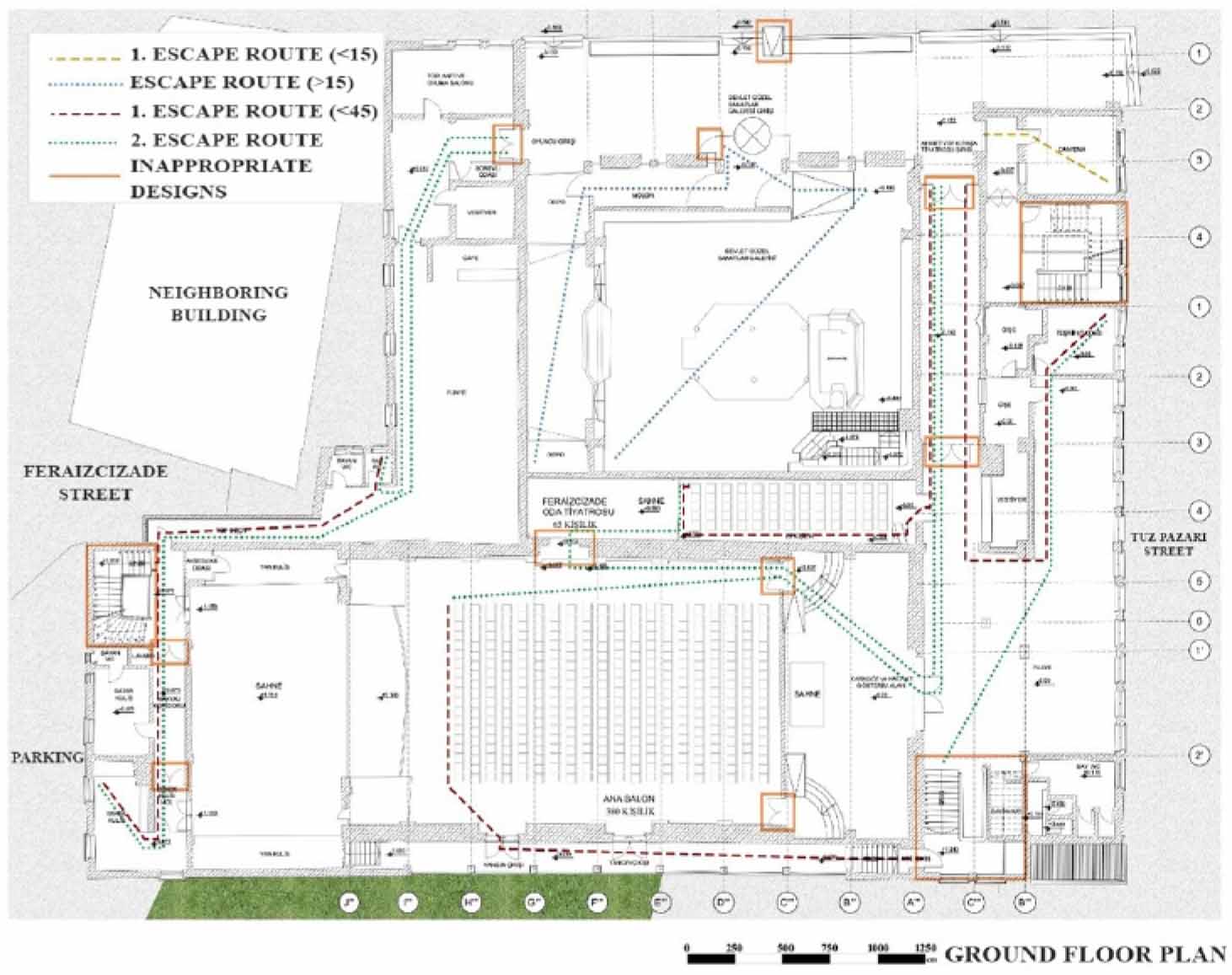
Figure 5.
Analysis of Escape Routes in the Ground Floor Plan (Created by the author)
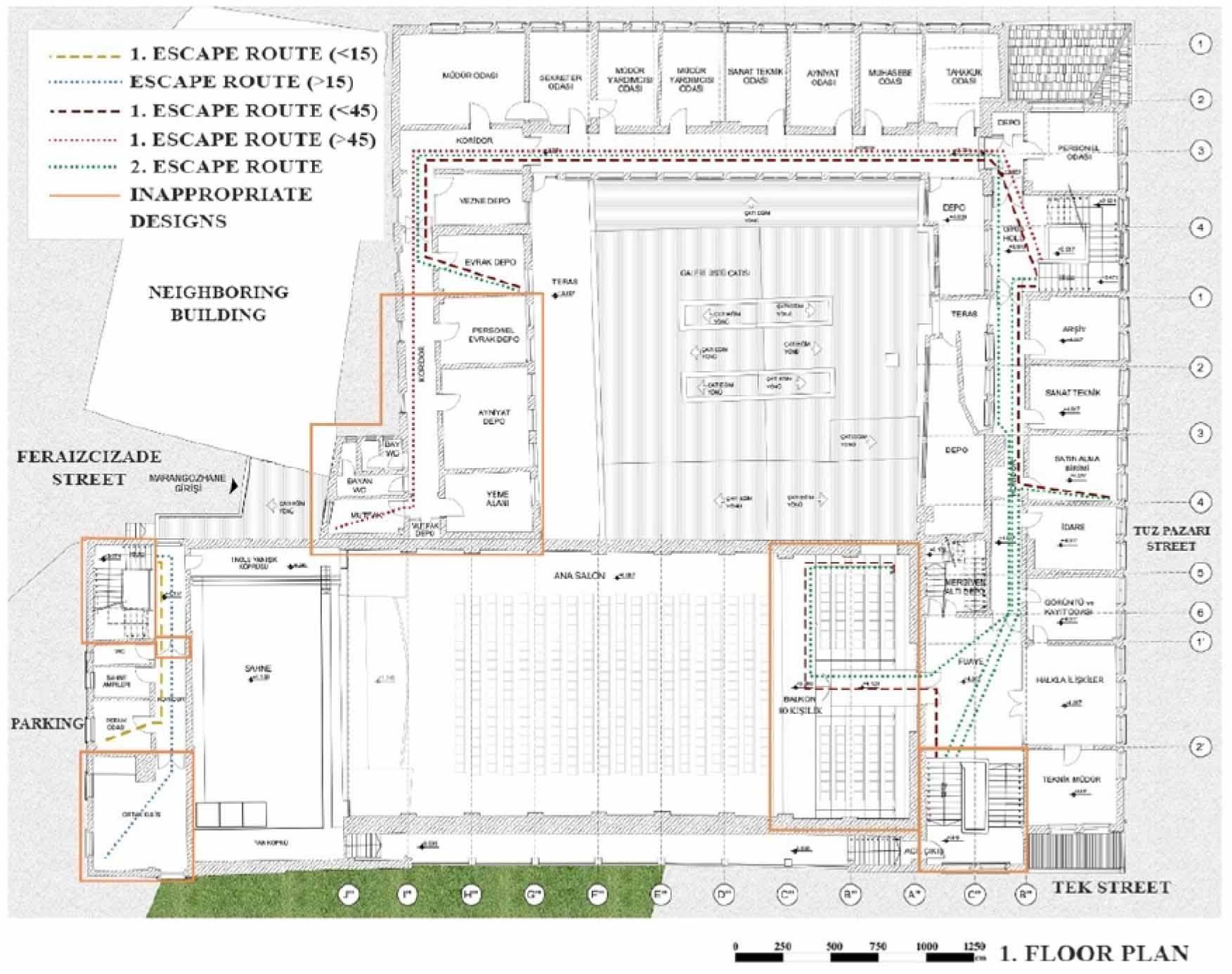
Figure 6.
Analysis of Escape Routes in the First Floor Plan. (Created by the author)
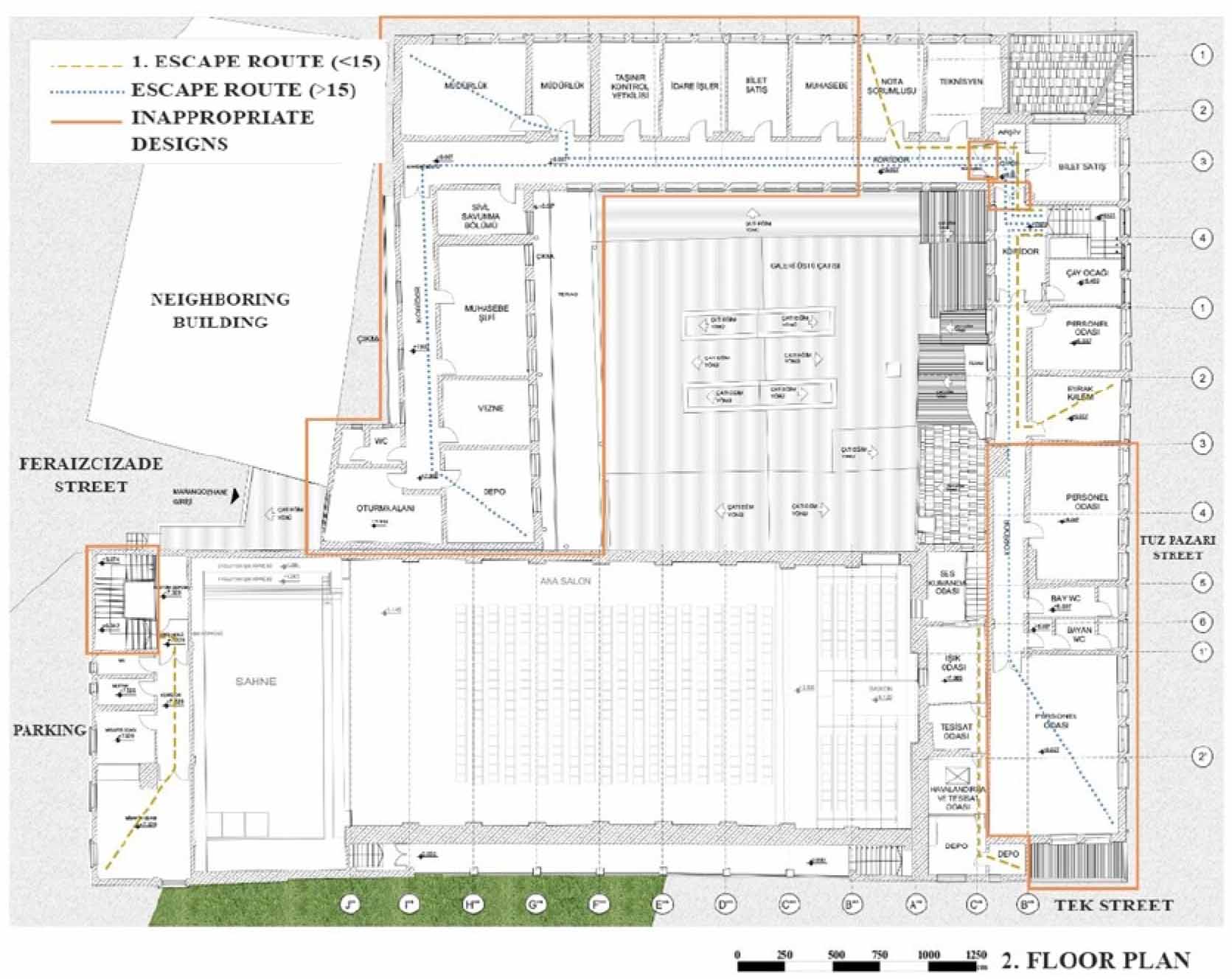
Figure 7.
Proposed Escape Routes in the Second Floor Plan. (Created by the author)
Table 4.
Examination of Fire Safety Measures Specifically for Historical Buildings. (Created by the author)
| Fire Risk | Location of the Measure | Measures to be Taken | Intervention on the Historical Building |
|---|---|---|---|
| Inappropriate escape distance | Basement level 1 storage room | A second exit must be created | There is an intervention on the originality of the building. The relevant institution should be consulted. |
| Exit door width less than the calculated exit width | State Fine Arts Gallery ground floor | The existing door should be replaced with a door that matches the calculated width | Expanding the door opening involves intervention in the originality of the building. The relevant institution should be consulted. |
| Escape doors opening inward in areas with more than 50 users | Main Hall | The doors should be oriented in the escape direction | Since there is no need to change the existing doors, there will be no alteration. |
| Single exit in areas with more than 50 users | Feraizcizade Hall | The number of seats should be reduced to fewer than 50 users | It is considered that there will be no change in the historical value of the building. |
| Single escape in areas with more than 50 users | Main Hall balcony on the 1st floor | The number of seats should be reduced by 30 to fewer than 50 users in the area with 80 users | Although there will be a visual change, it is considered that there will be no change in the historical value of the building. |
| Single escape distance longer than 15 meters | 2nd floor | A second escape route should be provided with an additional staircase | It will cause a change in the building. The relevant institution should be consulted. |
| Lack of sprinkler system | All floors | A sprinkler system should be installed | It will significantly alter the historical appearance. The relevant institution should be consulted. |
| Inappropriate corridor width in the circulation area | Hall | The number of rows should be reduced so that the circulation area has a minimum width of 110 cm | It is considered that there will be no change in the historical value of the building as a result of reducing the number of seats. |
| Slippery escape stair treads | Stairs serving the floors | Fluorescent non-slip strips should be applied to the treads | There is an intervention on the originality of the building due to material change. The relevant institution should be consulted. |
| Flammable material storage area located in open space | Basement level 1 under stage storage area | A compartment should be created, and a smoke detection and extinguishing system should be installed | Since the area will be created outside the building, there is no intervention on the originality of the building. |
| Escape stair doors not being smoke-proof | Stair doors | The doors should be painted with fire-retardant paint, gaps should be filled with fireretardant polyurethane foam, and intumescent seals should be used on the doors | It is considered that there will be no intervention on the originality of the building since the doors will be painted with transparent paint. |
| Presence of thresholds at exit doors | Exit doors on basement level 2 and ground floor | A landing should be created in front of the doors, and a slightly sloped transition should be made to the outside level | There is an intervention on the originality of the facade. |
| Low fire resistance wooden material covering the theater hall walls | Dede Efendi Hall | The walls should be painted with fire-retardant paint, gaps should be filled with fireretardant polyurethane foam, and intumescent seals should be used on the doors | It is considered that there will be no aesthetic change in the historical building since the wood will be covered with transparent material. |