
MOTTO
A city should be built to give its inhabitants, security and happiness – Aristotle
The building of cities is one of man’s greatest achievements – Edmund Bacon
A city is more than a place in space, it is a drama in time – Patrick Geddes
Architecture and urban design, both in their formal and spatial aspects, are seen as fundamentally configurational in that the way the parts are put together to form the whole is more important than any of the parts taken in isolation – Bill Hillier
1. INTRODUCTION
There is a very strong assertion, both in the social sciences and in economics, that the city is the most progressive place and way of living. The phenomenon of synergy in symbiotic conditions in urban systems seems to be the reason for the durability of urban structures in subsequent civilization formations, especially in Europe.
If symbiosis in an urban system is a form of coexistence between the elements of that system, then it is best described by the relationship between symbionts. Symbiosis in the city refers to the relationship between the different users of the city and the processes that are related to their activities. Such activity is related to specific places in the urban subsystem, arranged in such a way as to create (give) the most appropriate place for these processes. Within a certain limitation, appropriate in urban planning, and especially in urban design, it can be said that symbiosis in the urban system seen from the urban planning perspective occurs as a relation between individual urban places, i.e. urban plots, but always and only thanks to the activities carried out there.
In this context, it is reasonable to argue that the synergy created in a well-organized system, which gives the members = participants of the symbiotic relationship greater benefits than individual actions, seems to be a factor conducive to maintaining symbiosis in a social system. But at the same time, synergy can only occur in symbiotic relationships. This statement fully applies to urban systems, as they are also social systems integrated with urban systems [1, 2].
Since symbiosis and synergy play such an important role in the functioning of urban structures, it is important to be able to assess the level of symbiosis and synergy in existing urban structures and, consequently, to design their level in structures planned anew or, most often, reconstruction of the existing ones to improve the conditions of their habitation by city users.
If, on the other hand, the city centre with its public space is constitutive of the existence of the city, then it is particularly important to study the main public spaces in terms of symbiosis and synergy. City main streets play critically important role in creating high quality central spaces.
If urban planning is, at least in part, an engineering art, then it is necessary to introduce engineering methods, i.e. those based on objective (to a certain extent) measures that allow to create the basis for the description and evaluation of existing formations as well as for the design and verification of planned activities.
Urban reality is complex, one of the aspects of engineering activities in urban planning is to analyse and describe this reality through complementary, multifaceted, and therefore analytical, categories.
One of the most important issues for urban planning is the issue of the structure of use and designation of urban places (customarily referred to in the modernist spirit as the functional-spatial structure or the use-spatial structure).
That is why so frequent and popular are the studies related to the construction of urban structures and the activities based on them aimed at constructing a theory of the construction of cities as a network system [3, 4, 5, 6].
2. STATE OF THE RESEARCH, LITERATURE
Constant noticing of the civilizational crisis results in several publications not only analysing its causes but also looking for ways out of this situation by building a new civilization. Before the “outpouring of literature on postmodernity” at the beginning of the 21st century, the 1970s were an important period of intensification of such publications, especially during the period of the spread of postmodern thought in architecture and urban planning.
This period was also important for the development of a systemic approach to urban issues, for which the links and relations between the social and cultural, or even philosophical, sphere and urban issues were fundamental. Many authors have seen the sources of the crisis in disorders at the basic level – information metabolism in the consciousness of people and society. The cyclical nature of addressing the issue of the dual nature of urban reality may be a topic for a separate study.
The entire literature about city construction is characterized by a very diverse theoretical approach, which leads, of course, to different detailed conclusions. Therefore, in this paper it seems expedient to distinguish a group of bibliographic items called “cited literature”, which have been used as positive sources for this work. They constitute a set that combines a coherent, mutually complementary approach to the issues of civilization, including urban civilization, corresponding to the challenges of today.
During this period a group of authors whose publications promoted the construction of civilization, including urban civilization, based on ecological and personalistic values, clearly emerged. Much attention in this context is paid to anthropo – philosophical issues, where the problems of human interaction come to the fore in a rapidly changing world, and then, above all, in the postmodern world.Kliknij lub naciśnij tutaj, aby wprowadzić tekst. Issues related to the relationship between man and the environment on earth[7, 10], interpersonal relations in communities [8, 9], as well as the issues of finding man as a member of the community in the postmodern era, which are so important today [11, 12, 13, 14, 15], are analysed. It should be noted here that in the described period these topics were quite intensively discussed in public, and the mentioned authors were present in the social consciousness (at least in the more conscious part of society).
It seems that one can risk a thesis that the political problems of the end of the 20th century and the beginning of the 21st century, especially in Europe, but also to some extent in North America (above all, vain hopes for the end of the division of the world into two camps in constant conflict), have overshadowed the urban and ecological ones, and consequently the social ones. As a result, these issues have been absent from public discourse to the extent they deserve. One of the effects of the transition to niches of these issues is the level of ecological crisis today. After all, the current crisis was predicted at least 50 years ago.
Analysing urban reality, like any other, requires an efficient methodological tool that is adequate to the situation. A systemic approach to the city is very popular, due to its holistic approach to issues. General systems theory is both the basis of a philosophical approach to problems of reality. The achievements of systems research have been used in the work on the city as a system very widely, at least for the last 5 decades [16].
In the last quarter of the twentieth century, the dominant approach to the city as a socio-urban system was the most widely accepted. Certainly, in Poland, the works of A. Wallis, who examines the socio-spatial aspects of urban reality, deserve special attention [17, 18, 19, 20, 21]. There are, of course, many references to basic works in the field of urban sociology in this approach. An important continuation of Aleksander Wallis’ work are the works of Bohdan Jałowiecki, in many publications in collaboration with Marek S. Szczepański [22, 23, 24], and the works of Paweł Sztompka [25].
The ecological (environmental) aspect of building and functioning of cities was discussed in the works of Ian McHarg [26] and Henryk Skolimowski [7].
Similarly, the use of the city’s space by residents was analysed. Based on the obtained research material, patterns of spatial behaviour were described, the knowledge of which is extremely important for urban planners. Particularly noteworthy are the works of E.T. Hall, which are still up to date – the proxemics created by him comprehensively captures the relationship between man and space in the utilitarian aspect [27, 28]. A spatial approach to this topic with a sociological background is also contained in the works of Ch. Alexander [29, 30], whose detailed conclusions can be very helpful in urban planning practice, invariably and in the contemporary era.
Equally important for the transformation of thinking about the relationship between man and space are the works of A. Rappoport. A comprehensive approach to these issues is contained in one of his most important publications [31].
In the opinion of the author of this text, a special position is occupied by M. Heidegger’s essay “ uilding Dwelling Thinking”, which in an exceptionally synthetic, comprehensive and inspiring way captures the basic issues of the relationship between man and space and thus creates a very inspiring theoretical and methodological basis for detailed considerations. In principle, it should be mentioned and analysed at the beginning of any work on cities, i.e. dwelling [32]. The works of Zygmunt Bauman also have a unique position in the community of architects and urban planners. Due to the fact, that they refer directly to the postmodern reality, in which cities play an important role, their impact on urban planners is difficult to overestimate [11, 12, 13, 14, 15].
3. THE STATE OF RESEARCH ON THE STRUCTURE OF THE CITY SPACE
A natural extension of the issue of the use of space is to deal with the issues of urban landscape as a visual manifestation of the transformations of urban space by Gordon Cullen [33] and Kevin Lynch [34]. The synthesis of these separate issues of the differently treated urban space finds its place in the work of Christopher Alexander [29, 35], whose “language of patterns” is an excellent model of the proper understanding of urban space from the point of view of urban planning.
In Polish literature there is a very interesting overview of the milestones of contemporary literature on the construction of cities. It was written by Wojciech Kosiński and is included in the introduction to the Polish edition of the classic urban literature – “The Image of the City” by Kevin Lynch [34]
Wojciech Kosiński lists in order such theoreticians – ideologues of modern urban planning as:
Kevin Lynch – The Image of the City – 1960 [34]
Jane Jacobs – The Death and Life of Great American Cities – 1961 [36]
Gordon Cullen – The Concise Townscape – 1961 [33] Aldo Rossi – The Architecture of the City – 1968 [37] Robert Venturi – Complexity and Contradiction in Architecture – 1968 [38]
Jan Gehl – Life Between Buildings – 1971 [39].
The introduction, written in 2011, surprisingly omits several important items that create the history of thinking about the city and its construction in the context of the necessity of its constant reconstruction. The items that, we think, should be listed are:
Colin Rowe, Fred Koetler – Collage City – 1978 [40]
Christopher Alexander – Pattern language 1970 [30]
Steven Petersen – Urban design tactics – 1979 [41]
Leon Krier – Architecture: Choice or Fate – 1998 [42]
Leon Krier – The Architecture of Community – 2009 [43].
The study of urban space issues has a very abundant literature on many aspects of the city. Because the conviction about the uniqueness of the city has accompanied the whole time in the history of human habitation, the conviction about this city in crisis – almost permanent. And it should be clearly noted here that the crisis of the city, as we perceive it, is an immanent feature of the city as a socio-urban system, which will be discussed in more detail later in the article.
Many of the academics and practitioners who study the city write about what cities look like and what cities should look like, or perhaps more often – how they should not (i.e. what is wrong with these cities). Far fewer authors write about how a city should be designed (in terms of method), and even fewer about how cities are built and how they function, and more precisely, how the city functions as a complex sociourban system. The reason seems to be the very high level of this complexity as a system, as well as the fact that the city is a complex multifaceted structure. The tradition of science and applied arts in the Western circle induces the perception of this multifaceted structure of the urban socio-urban system from the perspective of the paradigm of deep specialization. Positive action for the benefit of the city requires breaking this approach to urban reality.
The result of a new type of approach to the study of the urban system is the need to conduct multidisciplinary research in an integrative way and the related imperative of difficult cooperation between representatives of many disciplines with different research doctrines and very different levels of forecasting ability. This is problematic in a situation where the construction of cities and their design is fundamentally based on the projection of the needs and expectations of city users into the future.
Due to the complexity and multifaceted nature of urban systems, the development of a good method of urban design requires the development of a metalanguage for describing urban reality, or more precisely: a meta-method for recording urban reality.
Numerous examples of such activities are available in the literature. They are both one-time implemented, “tailor-made”, typically architectural implementations of the method, as well as systemic attempts to develop a comprehensive meta-language of description – analysing, and thus also designing the city on an urban scale [44, 6].
In that field, a group of works has emerged in recent years, where this method is based on the interpretation of urban reality understood as a system and as a network, i.e. a complex of connections. In the latter approach, of course, there are frequent attempts to record and analyse urban reality as a system of graphs. This clue is worth exploring and then using [3, 45].
As mentioned earlier, the most promising from a research perspective today seems to be the study of the city as a socio-urban system. And at this point, it is necessary to pay attention to the connection between the approach to the city as a socio-urban entity and the assumptions of the “space syntax” movement, whose origins date back to the 70s of the 20th century [3].
In this scope, the approach to the city as an entity – a socio-urban system with internal feedback loops – is clearly present. The influence of the forms of space on the behaviour of people and at the same time the creation of this space by the users of the city in accordance with their needs and expectations is examined in a more “engineering and technical” than “humanistic” way.
As mentioned above, the beginnings of research on the syntax of space or, more precisely, on the principles of building complex urban spatial forms from basic elements, date back to the 1970s at UCL – the work was carried out by B. Hillier’s team working under the name of the Unit for Architectural Studies at UCL [3, 46].
In this approach, it has also become natural to interpret the city as a network – a system of multifaceted and multi-level connections between elements (entities) in urban reality. An important role was played by the work of Nikos Salingaros, who was a member of Ch. Alexander’s team [47, 48].
UCL’s position in this field was strengthened by M. Batty within the framework of The Bartlett Centre for Advanced Spatial Analysis, of course within the structure of UCL [4, 5, 49].
Recently, the University of Strathclyde has become an important research centre in this area, where Sergio Porta has organized a dynamic team around him, and the result is a very large number of publications [50, 51, 52, 53] From the point of view of urban design practice, the book “Masterplanning for Change: Designing the Resilient City” is particularly important, which is, in a sense, a summary of theoretical activities, based on the experience gained through the implementation of the developed theoretical assumptions [6].
Some other scientific centres and individual researchers are working in similar directions. Some research are focused on deep investigating complexity aspects of city street net street [54, 55, 56, 57, 58, 59, 60, 61, 62, 63].
The above review reinforces the reasonableness of the statement about the carrying capacity of the idea of thinking about the city in a systemic way.
4. GOAL AND SCOPE OF THE RESEARCH
In the review presented above, there are both purely theoretical threads (reflections on the issues of urbanity at a high level of generalization) and attempts at a more specific – one could even say – engineering approach. The quality of a city is largely determined by the quality of its centre – since the centre is a determinant of urbanity as a place of exchanges and meetings constituted for the city. A particularly important element of the city centre, in this approach, is the main city street (also called high street) [64, 65].
The aim of this research is to formulate comparable and objective (ie. calculated according to defined rules, which are consequently used) measures for the assessment of the quality of public space on the main street in city centres and downtowns, understood in terms of the manner of uses and designations of urban places adjacent to public spaces. Comparability of the quality assessment of parts/segments of the main street is essential for the ability to develop plans for larger areas with more complex and extensive public spaces. A promising area of exploration seems to be the one marked by the symbiosis and synergy of elements of uses of urban places in urban systems in central areas, especially along the main street. Basing the search for such a method on the idea of coexistence and cooperation of urban places based on symbiosis and synergy seems to be the fulfilment of the postulate of an approach based on deeper theoretical premises integrating the understanding of urban reality. The study prepared according to such assumptions and methods is fragmentary, from the point of view of a comprehensive and complex study of urban reality, but it can be an important element of a complex urban method of rebuilding the quality of public spaces in the city.
5. RESEARCH METHOD
In this study of urban structures, it was decided to check the possibility of using graphs as a method of recording that allows for a formalized study of relations between system elements. At the same time, such a record enables the processing of big data sets. The use of graphs is in line with current trends.
Based on systems sciences, the issues of symbiotic and synergistic relationships between the elements, that make up network relations, are quite well described. Therefore, in this paper an attempt was made to describe and measure the level of synergy and symbiosis between the types of use and designation of urban places adjacent to the structural sections of public spaces, that make up the city centre, and the main street of the city [2, 66].
Writing relations using the graph method allows you to assign weights to them, differentiating and valorising these relations. A summary aggregate assessment of these weights made for individual adjacent sections of public spaces seems to allow for a comparative assessment of these weights, which is helpful in examining and valorising the quality of the system of public spaces in terms of the use and designation of urban places and plots adjacent to these spaces and through these public spaces entering mutual relations. This is particularly desirable for the main city streets, where the spatial distribution of the quality of the utility structure should not be random and there should not be too large differences in this quality in the neighbouring sections. In this study, we have used the experience from the work completed in 2021, which has been thoroughly reviewed and expanded in this paper based on the results of the first application of the method in research on the main street in Gliwice (Zwycięstwa street) [67].
6. MATERIAL AND RESEARCH
The basic assumption is that the symbiosis and synergy of urban places in the city remain in a positive feedback loop. The urban subsystem of the city, when shaped in accordance with the requirements for the existence of symbiosis and synergy, provides space for the activity of the city users, which have the conditions for the development of symbiotic conditions for increasing the level of synergy in the city as a system. As you can see, positive feedback is common in these processes – it is one of the synergetic mechanisms [1, 2].
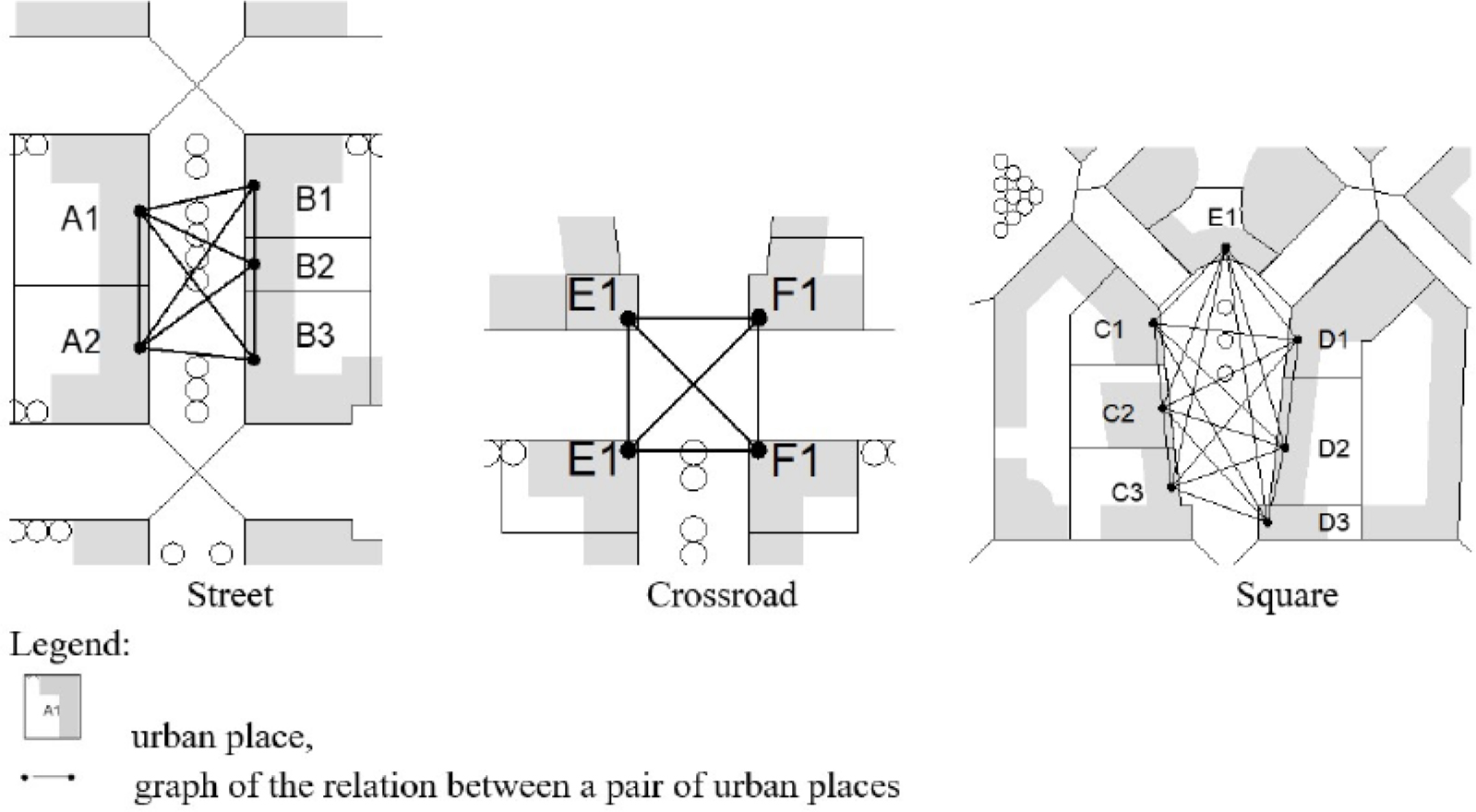
Figure 1.
Neighbourhood relations between urban places within a public space unit
In the engineering approach to urban planning issues, both the description and evaluation of the analysed events in both qualitative and quantitative aspects are required. Especially the latter – a quantitative description – is particularly desirable if the qualitative assessment is not (too) subjective. This is exactly how the assessment of symbiosis and synergy in the urban system should look like. It seems, that at the current level of recognition of the issue and due to the implementation needs in specific projects, all measurements will be very necessary and useful allowing for the comparison of individual urban places and public spaces within the developed area, both in the spatial distribution (states of neighbouring places and spaces at the same time) and in the time distribution (states of the same places and spaces in the existing state and after the proposed and, once the proposals have been implemented, once they have been put into operation). Maps of such comparative comparisons will be very helpful in urban studies. The collection of data on the relations between individual urban places, and thus urban events, will also be a good material for data exchange with specialists in the field of other technical sciences cooperating in urban design, as well as, which is of great importance for the future, with specialists in the field of social and economic sciences, who are increasingly working on the city understood as a network [48].
Symbiosis in urban structures is a condition for synergy – in the conditions of antagonistic or parasitic relations, such positive phenomena as synergy have no chance of occurring. Therefore, in the first place, it is necessary to assess the phenomena of symbiosis in the studied urban structure. In such a measurement, the relations between urban places constituting non-public spaces in the urban structure should be examined [68].
The main street in the city centre is a specific, complex and relatively separated part of the public space of the centre – its characteristic feature is the division into segments. This division results both from its size and connections with neighbouring spaces – generally in terms of moving around the centre. A properly formed and developed main street in the centre is distinguished in the urban structure.
The relations between urban places take place through the public space next to which they are located. Basic relations should be studied between urban places located next to the same unit of public space (influencing each other through one unit of public space), i.e.:
next to the street (or its fragment constituting an urban whole),
at the town square
or
at the corner complex at the junction of street sections, which, although is not an independent form of public space, plays an important role in the assessment of the neighbourhood (Tab. 1.1).
Table 1.
Classification of neighbourhood relations between urban places
| Marking of the Relationships | Description of the Relationships |
|---|---|
| [-/-] | mutually antagonistic |
| [-/+] | parasitic |
| [0/0] | neutral (non-antagonistic) |
| [+/+] | symbiotic |
| [++/++] | hypersymbiotic |
The main city street has a special role and position in the space of the city centre; hence it will be the subject of considerations presented in the further part of the work.
One of the key aspects of the relationship between urban places shown above is the one related to the relationship between their uses or designations. The main street in the city is an area for the most attractive and important uses with strong city-forming capabilities. In European urban thought, the standard of the main urban street has been developed, although it is subject to variability over time in adaptation to overall changes in urban structures. In each city, due to its specificity, the set of such uses may be specific to a given city and different from other cities, but certain rules apply. In the situation of degradation of the space of the centre, on the main street, there are uses that do not have strong city-forming and representative properties and therefore do not comply with this standard. They significantly reduce the conditions for the functioning of those facilities that can best meet the needs and expectations of residents on the main city street. The study of this issue is one of the keys to the overall urban analysis of the main city street, although it is, of course, part of it.
For urban places with, at least, city-wide significance like those adjacent to the main street, it may be appropriate to analyse symbiotic relationships for a larger area, but this only makes sense, if these places are significantly connected through a continuous public space, and their analysis in such an arrangement is justified by significant relationships from the point of view of uses. The main street in the city is such a special space, where the level of symbiosis and synergy between urban places enclosing it is particularly important, and its study is one of the key urban studies. Of course, a full study of the quality of urban structure also requires studies covering other aspects of urban reality and examining the place and role of this street on the scale of the entire city.
Defining the basic division of public spaces of the main street into units should be the first and fundamental step, as all analyses and assessments will be carried out in relation to these units. The designation of public space units is simultaneous with the designation of non-public space areas, which, in turn, is the starting point for analysing the structure of nonpublic spaces, both in terms of the purpose and use, as well as the degree of their publicity. In these analyses, it is important to determine the hierarchical structure of the aggregates into which the basic units of public space are organized. The hierarchical structure of public spaces determines the structure of the designation and use of urban places, but at the same time it is determined by this structure.
The relations that should be analysed and researched should be primarily bilateral – of each urban place with the others in the study area (linked by the indicated unit – a section of public space). In cases justified by studies in the field of the structure of uses and uses, it may be necessary to conduct a study of a more complex relationship between more than two places, but the study should be carried out on a multi-level basis – with aggregation of urban sites at the lower level into complex places, in order to perform the final study between two sets of urban sites. Thus, the relationship between an urban place and a symbiotic relationship or even between two symbiotic relations will be studied.
These strong symbiotic relationships and synergy effects can therefore encompass an area that is more organized around a larger public space than a street or a square. In this case, symbiotic relationships will be studied in relation to urban plots selected based on expected links between their uses. At the same time, these selected uses should be examined in terms of the quality of relations with other uses of urban plots related to the analysed aggregate of public spaces.
The scale of this assessment is crucial for the value of the symbiosis relationship. It seems that the optimal one at the current level of knowledge is the one proposed by John Wood, who introduced a 4-step classification of this relation [2].
For the purposes of urban research, according to the method presented in this paper, a 5-step classification of relations presented below has been developed based on experience [67].
Neighbourhood relations resulting from the different ways of using neighbouring urban places can take the values described above. A neutral (non-antagonistic) relationship [0/0] is one where the neighbouring uses remain in an indifferent relationship, they do not hinder their functioning, but also this neighbourhood does not generate additional benefits for either of them (an industrial store and a notary’s office). In extreme cases, such a neighbourhood can be hypersymbiotic [++/++] which means that the uses complement each other in an exceptionally way, constituting an attractive functional complex (theatre and restaurant) or extremely harmful to each other – mutually antagonistic [-/-] – (restaurant and abandoned ruin). A symbiotic relationship [+/+], on the other hand, is one where the neighbouring uses create mutually better conditions for functioning (the vicinity of specialized industrial stores). A parasitic relation [-/+] of a neighbourhood is one where one of the uses benefits from the situation generated by the neighbouring use but does not itself have added value to such a neighbourhood (an industrial store and a currency exchange office). Of course, such a detailed matrix of neighbourhood relations is individual and particular for each city and its main street, although, as mentioned, general urban planning rules specific to the socio-cultural region apply.
At this point, it should be noted that only the last two meet the postulate of a “win-win” relationship, which has been considered constructive for building a city based on the synergy effect.
The use of the above classification in urban studies and concepts developed according to the method presented here requires that appropriate weights be attached to these relations. The simplest proposal for the division of weights is as follows – Tab. 2.
Table 2.
Weights of neighbourhood relations between urban places
| Types of the Relationship | Marking of Relationships | Weights of Relationship |
|---|---|---|
| mutually antagonistic | [-/-] | -2 |
| parasitic | [-/+] | -1 |
| neutral (non-antagonistic) | [0/0] | 0 |
| symbiotic | [+/+] | 1 |
| hypersymbiotic | [++/++] | 2 |
The weights presented above are selected in the simplest way: neutral relation – has weight [0], extreme relations have weights of absolute value [2], indirect relations – weights of absolute value [1]. However, it is possible to modify them (to increase the readability of the results) for the needs of a specific case – it is necessary – of course – to have one classification and weight table in the area of one project. The aim of defining the weights described above is to enable the preparation of comparative assessments of the level of symbiosis and synergy in individual segments of the main street, so they are dimensionless and assigned by the team performing the study in accordance with the described principles. Entering other absolute values does not affect the final comparison of measurement results for individual segments.
Neighbourhood relations between urban places with assigned relationships weights could be shown as a graph – (Fig. 2.). The graph is representative for one part/segment of the main street.
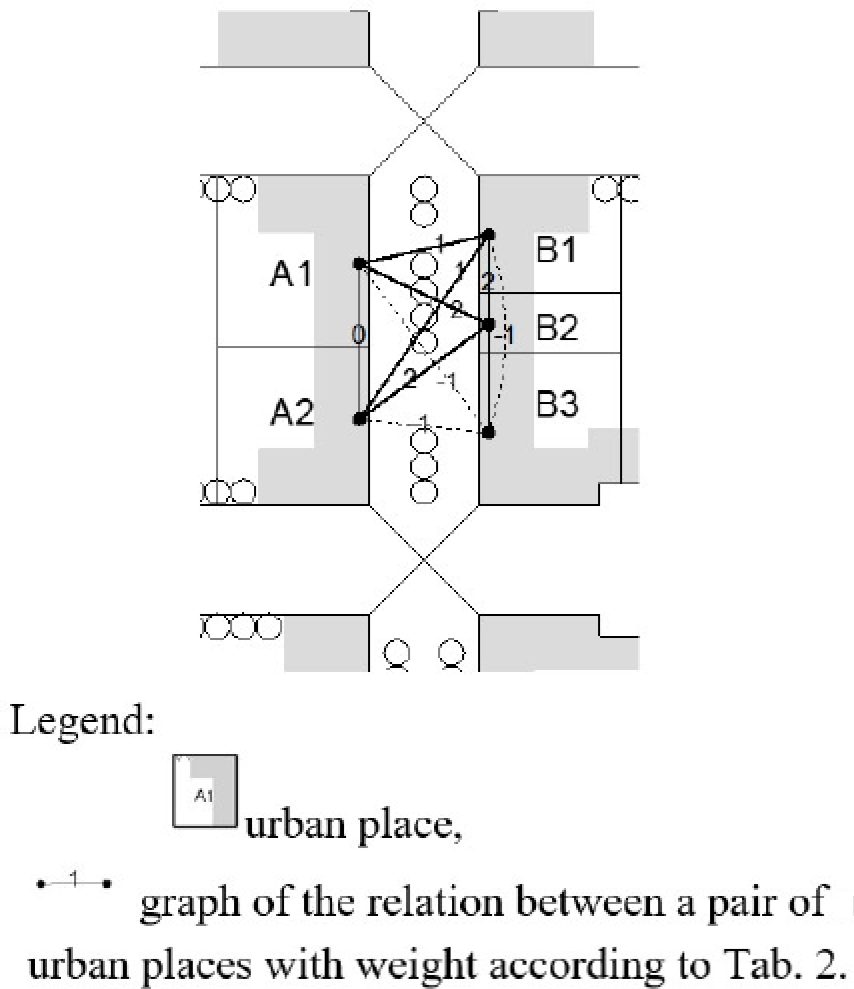
Figure 2.
Neighbourhood relations between urban places with assigned relationships weights
To attempt to evaluate neighbourhood relations, it is necessary to define a set of these relations in accordance with the principles described above and to systematize the results.
Neighbourhood assessments in terms of symbiosis and synergy are possible for a specific part/segment of the urban structure of the main street in the following steps described below.
It should be noted, however, that due to the uniqueness and uniqueness of each of the urban themes, the presented proposal uses generalized symbols for types of development.
The procedure described below is presented based on abstract and symbolic data. This method was adopted to make the rules of the proposed method clearer. The sequence of proposed activities to build a database for the assessment of the level of symbiosis of relations between the neighbourhood of urban places organized around a previously separated unit of public space is as follows:[67].
The general scheme of the procedure is planned as follows:
Step 1
– Construction of a table with the types of uses of non-public plots occurring in the study area
Step 2
Step 3
Step 4
– Building a table for valorisation of neighbourhood relations in a specific developed area (Tab. 6), based on the assessment table (weights) of neighbourhood relations (Tab. 5), which will be the starting point for the assessment of both neighbourhood and diversity in relation to the analysed area.
Step 5
– Calculation of values characteristic for the level of symbiosis and synergy for each part/segment of the main street according to the adopted calculation methodologies
Step 6
– Development of maps of the distribution of the level of symbiosis and synergy in the main street space for the existing state and after the change.
The detailed examination procedure is as follows:
Step 1
– Construction of a table with the types of uses of non-public plots occurring in the study area (Tab. 3.)
Step 2
– Building a table of types of relations of the neighbourhood of urban places occurring in the analysed area (Tab.4.) based on the structure record (Fig. 1.) and a table of types of use of urban places (Tab. 3.). The neighbourhood relationship between the pair of urban places is defined by the value of the relationship between uses of each of urban places in that pair.
Step 3
– Building a table of weights of the types of neighbourhood relations, uses of urban areas occurring in the study (Tab. 5) based on the table of types of neighbourhood relations (Tab. 4) and the table of land use in the area of the street section (Tab. 3.).
Each pair of neighbouring uses should be granted with the weight of the type of neighbourhood relationship according to the table of types of relations of the neighbourhood of urban places occurring in the analysed area.
The matrix given above is to be built individually for each city according to general rules described in comments to table “Weights of neighbourhood relations between urban places“ (Tab. 2).
Step 4
– Building a table for valorisation of neighbourhood relations in a specific developed area (Tab. 6), based on the assessment table (weights) of neighbourhood relations (Tab. 5), which will be the starting point for the assessment of both neighbourhood and diversity in relation to the analysed area:
A summary of the number of relations in individual groups and their weights is as follows (Tab. 7.):
The presented procedures are aimed at preparing data for the assessment of a unit of public space in terms of the level of symbiosis by marking and valorising individual relations in its area and their graphic recording showing the locations of their individual weights.
The analytical activities presented above allow for the registration of all neighbourhood relations along with their assessment in the area of the analysed unit of public space. The key for further work is the method of their processing for the assessment of the analysed public space in terms of the level of symbiosis and synergy in order to make comparative comparisons for all units in the analysed urban area.
Step 5
– Calculation of values characteristic for the level of symbiosis and synergy for each part/segment of the main street (existing state) according to the adopted calculation methodologies.
The number of recorded neighbourhood relationships LR within a public space unit, when compared to neighbouring ones, can be a measure of the complexity of that unit. It corresponds, in the graph notation, to the degree of the vertex, which is the urban place.
A measure of the level of symbiosis in the study area PsyM unit can be, expressed as a fraction, the ratio of the sum of neutral, symbiotic and hypersymbiotic relations LRsyM to the sum of all neighbourhood relations LR.
whenA score of 1.00 will indicate the maximum level of symbiosis, that is, the absence of antagonistic or parasitic relationships. A score close to 0.00, on the other hand, indicates a high level of antagonism.
The difference between the level of 1.00 and the level of symbiosis, expressed as a fraction, is a measure of the level of antagonism of the relationship Pant within the unit being studied. In this view, the level of antagonization for an individual with only positive relations and the level of symbiosis for an individual with only negative relations are defined as 0.00.
It can be considered that synergy is a measure of the development of symbiosis relations in the public space unit. The level of synergy PsyN can be determined as the ratio of the number of symbiotic and hypersymbiotic LRsym+ relationships to the sum of positive LRsym+ relationships.
whenThe above measurement seems to be particularly significant for individuals with a very high level of symbiosis – PsyM close to 1.00.
A measure of the level of conflicting neighbourhoods in the area of the studied unit Pant can be expressed as a fraction of the ratio of the sum of the antagonistic and parasitic relations of Lrant to the sum of all neighbourhood relations of LR.
whenA score of 1.00 will mean the maximum level of antagonism, i.e. the absence of neutral and symbiotic relations. A score close to 0,0 on the other hand, indicates a high level of symbiosis between the uses of urban places.
For individuals in which there will be a significant number of substantial antagonistic relationships (PsyM much lower than 1.00), it seems reasonable to consider the negative impact of these relations on the level of synergy. Therefore, it was proposed to measure the moderate level of synergy PMsyN as the difference between the level of synergy PsyN and the level of antagonism of relationship the Pant.
Such a measurement is intended to indicate the negative impact of antagonistic and parasitic relations on the quality of the public space unit.
The aim of the transformation of urban structures should be to intensify the synergy effect by transforming the structure of the purpose and use of urban places. Therefore, a tool is needed to measure the potential of the level of symbiosis as a basis for the development of synergy and synergy itself. Thus, two measures were proposed, named respectively the intensity of symbiosis the IsyM and the intensity of synergy the IsyN. To calculate them, we used not the number of relations LR, but the weights of the relations WR for individual groups of relations. The adoption of such an assumption results directly from the statement that symbiotic and hypersymbiotic relations are of key importance for the level and intensity of both symbiosis and synergy in the studied unit of public space, the more hypersymbiotic relations, the higher the quality of the public space unit.
The measure of symbiosis intensity in the studied unit IsyM is, expressed as a fraction, the ratio of the sum of the weights of neutral, symbiotic and hypersymbiotic relations WRsym to the sum of all positive neighbourhood relations LRsym.
The measure of the intensity of synergy in the studied unit IsyN is, expressed as a fraction, the ratio of the sum of the weights of symbiotic and suprasymbiotic relations WRsym+ to the sum of symbiotic and hypersymbiotic relations and neutral neighbourhoods LRsym+.
In the case of individuals with a high level of antagonistic relationships Pant, it is advisable to investigate the moderate intensity of the synergy Imsyn, as in the case of the moderate level of synergy PMsyN.
Therefore, it is proposed to measure the moderate intensity of synergy IMsyN as the difference between the level of synergy Isyn and the level of antagonization of the relation Iant, when expressed as the absolute value of the calculation result
or as the sum between the level of synergy o Isyn and the level of antagonism of the relation Iant, when expressed as the value of the result of the calculation (a negative number as the result of negative weights)It should be noted that all the measures presented are relative and have been proposed to be used for comparative purposes within a specific project, where the basic assumptions contained in the tables will be consistently applied without changes:
Table 2. “Weighting of the relationship between the proximity of urban sites in the analysed area”,
Table 3. “Table of types of use and use of urban sites in the analysed area”,
Table 5. “Table of weights of the types of relations of the proximity of urban places occurring in the analysed area”.
In particular, the change of weights in Table 1.5 will affect the values of the measures, but it will not change the comparative usefulness of the results obtained. The introduction of a change in weights may be deliberate in order to highlight certain trends in the transformation of neighbourhood relations.
It should be clearly emphasized once again that the measures given above are eminently relative, and the results obtained can only be used in the area of one project, where the matrix of neighbourhood weights is one and consistently applied to all measurements. The proposed weights for individual relationships are also relative. In the case of a project with very similar outcomes, you can consistently change them by scaling up and introducing a nonzero value for the neutral relationship.
For the example of a public space unit presented above, the results of calculating the measures described are as follows:
in terms of the level of symbiosis and synergy (Fig. 3.): in terms of the intensity of symbiosis and synergy (Fig. 4.)
In the presented example, one antagonistic relationship was found. In order to check the usefulness of the proposed measures, the results of a change (e.g. design) consisting in replacing the purpose of an urban plot clearly in conflict with the others with one referring to the existing surroundings were analysed.
Step 6
Step 7
– Recalculation of values characteristic for the level of symbiosis and synergy for each part/segment of the main street (state after change 1) according to the adopted calculation methodologies
A summary of the number of relations in individual groups and their weights is as follows (tab. 14.):
After introducing a „correcting” change to the example unit of public space, the results of calculating the described measures are as follows:
in terms of the level of symbiosis and synergy (Fig. 5)
in terms of the intensity of symbiosis and synergy (Fig. 6.).
As can be seen from the table below (Fig. 7.), the change in the use of one urban place, which was antagonistic with the uses of neighbouring places, resulted in a significant positive change in the analysed indicators.
From the above comparative comparison, it can be concluded that the following are particularly sensitive and significant:
– moderate level of synergy – PMsyN
and
– moderate synergy intensity – IMsyM,
But a full picture of the changes is provided by a set of proposed measures.
The study of the level of symbiosis and synergy, as mentioned above, is justified and useful in relation to the main street of the city broken down into segments that make it up. The main city street fulfils its role as an element of the city centre correctly and for the benefit of the city residents, when its space is coherent and attractive. One of the factors building this cohesion is the high or even level of symbiosis and synergy of use of individual urban areas on the main city street, which is even in individual segments. It is advantageous when the levels of symbiosis and synergy of individual adjacent segments are at a similar and high level.
Step 8
Development of maps of the distribution of the level of symbiosis and synergy in the main street space for the existing state and after the change.
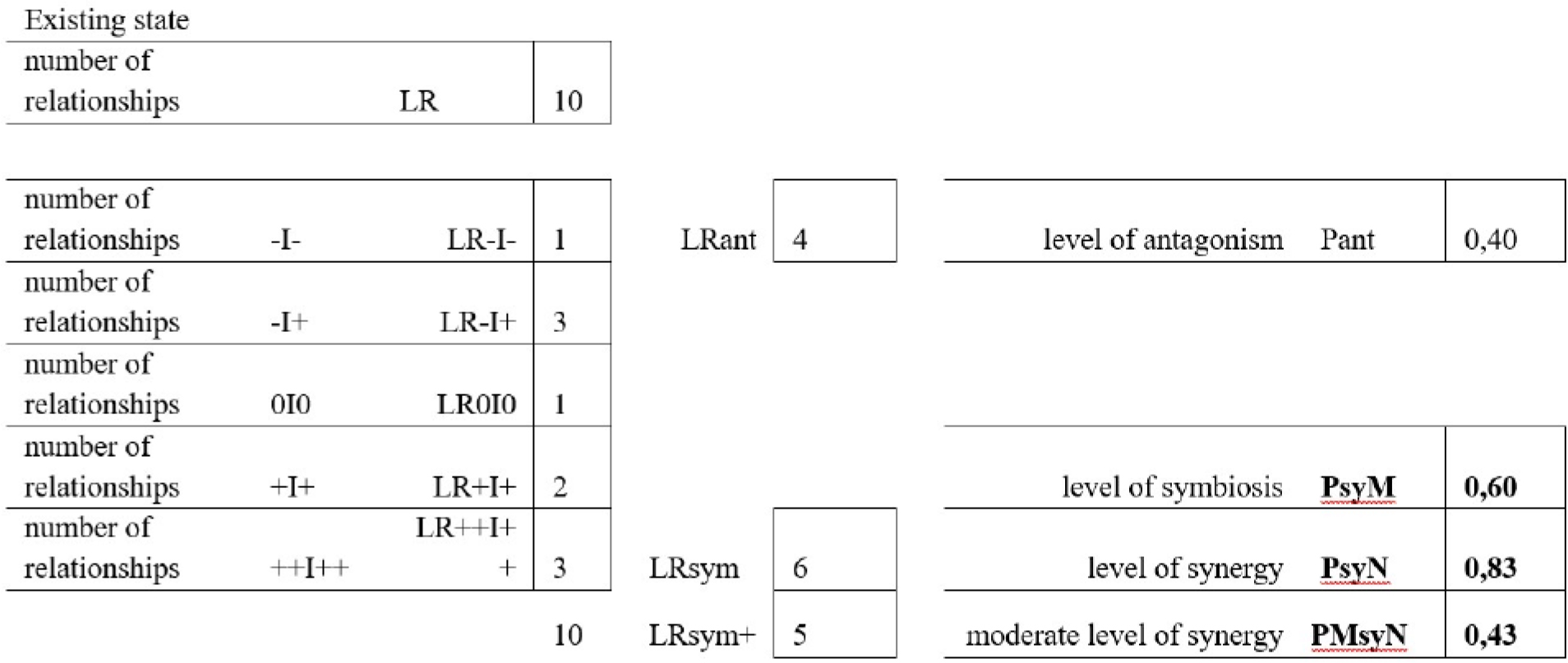
Figure 3.
Measures of the level of symbiosis and synergy occurring in the analysed area in terms of the intensity of symbiosis and synergy
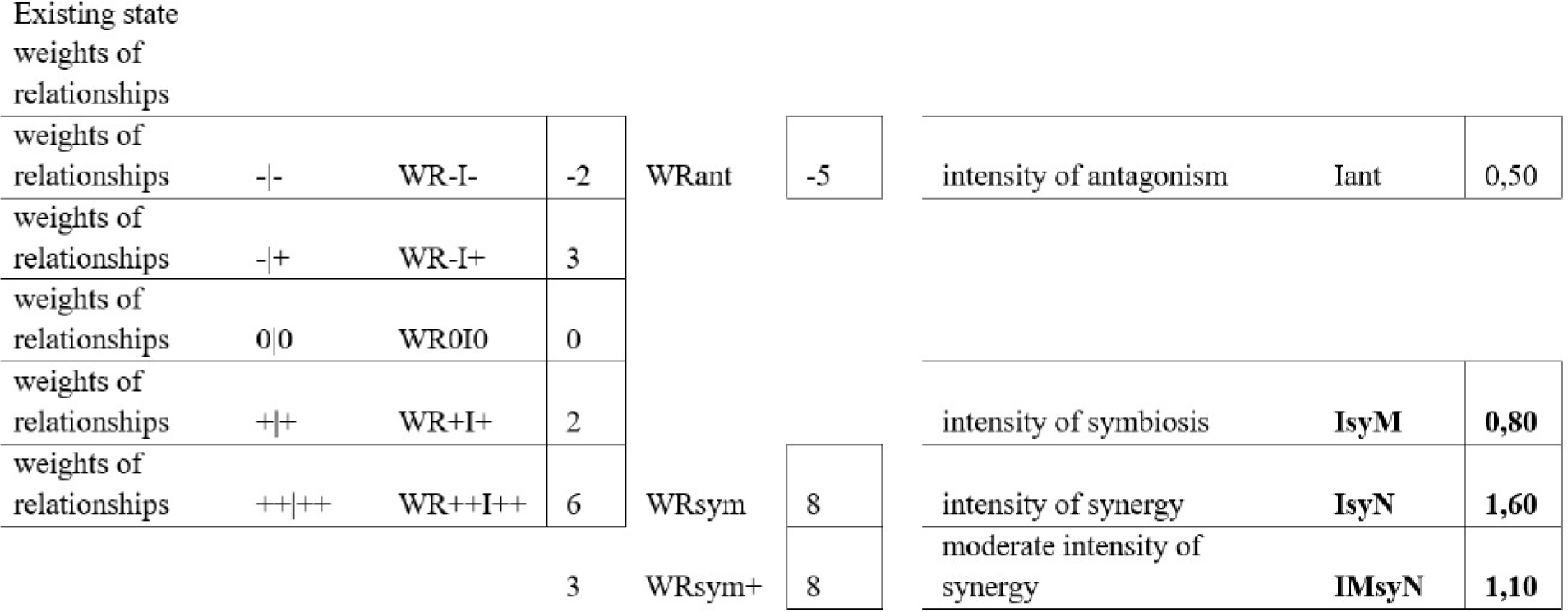
Figure 4.
Measures of the intensity of symbiosis and synergy occurring in the analysed area
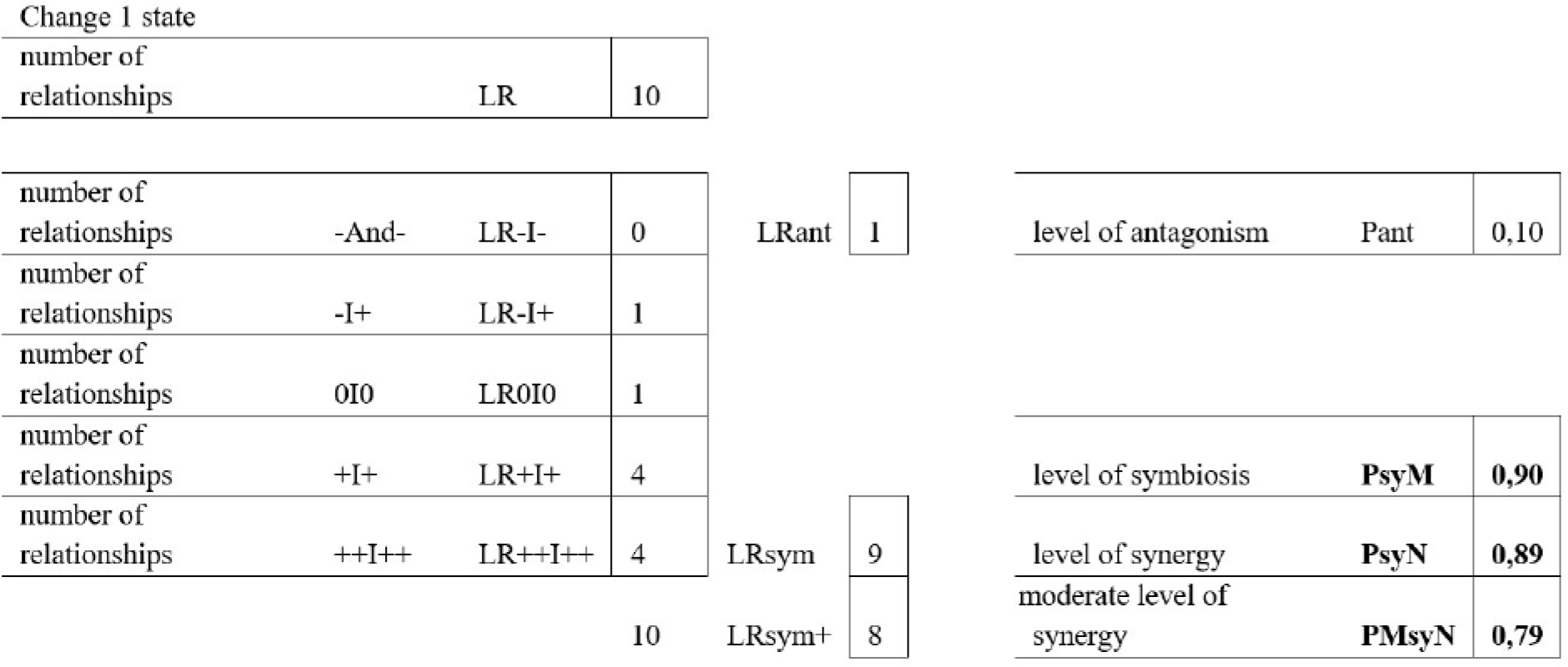
Figure 5.
Measures of the level of symbiosis and synergy occurring in the analysed area after the introduction of change 1
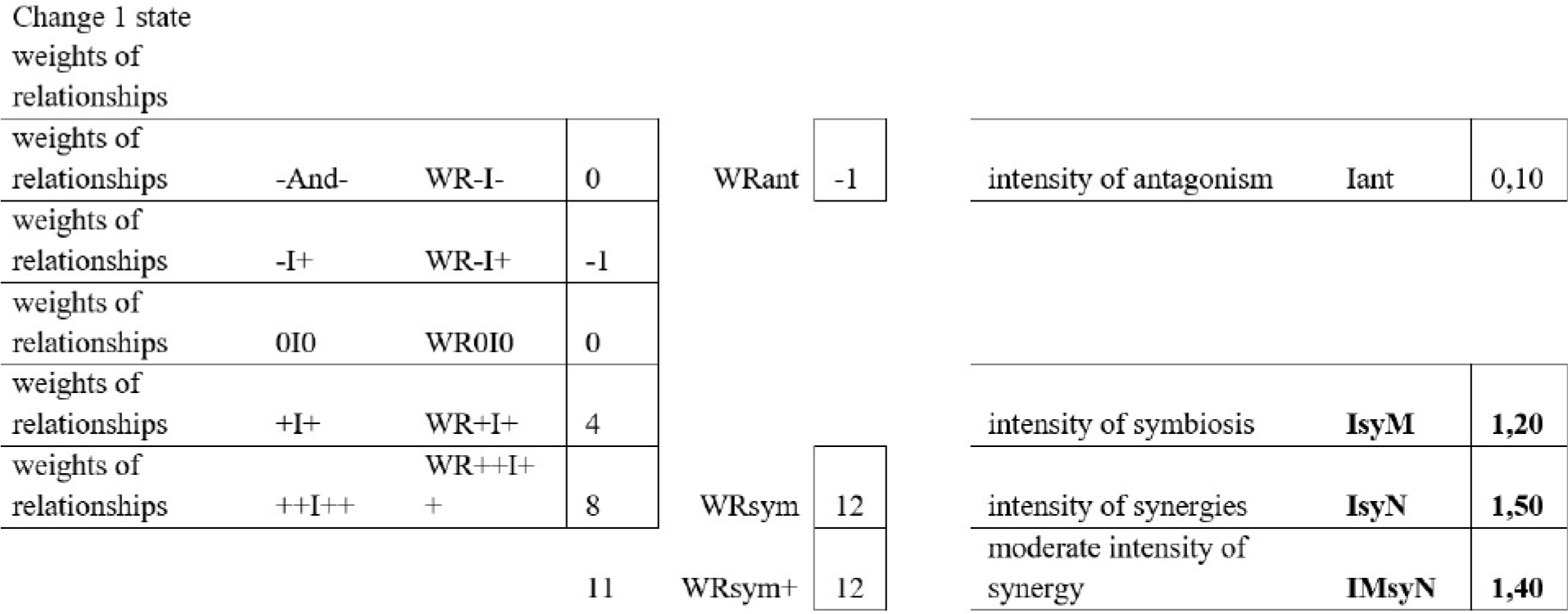
Figure 6.
Measures of intensity of symbiosis and synergy occurring in the analysed area after the introduction of change 1
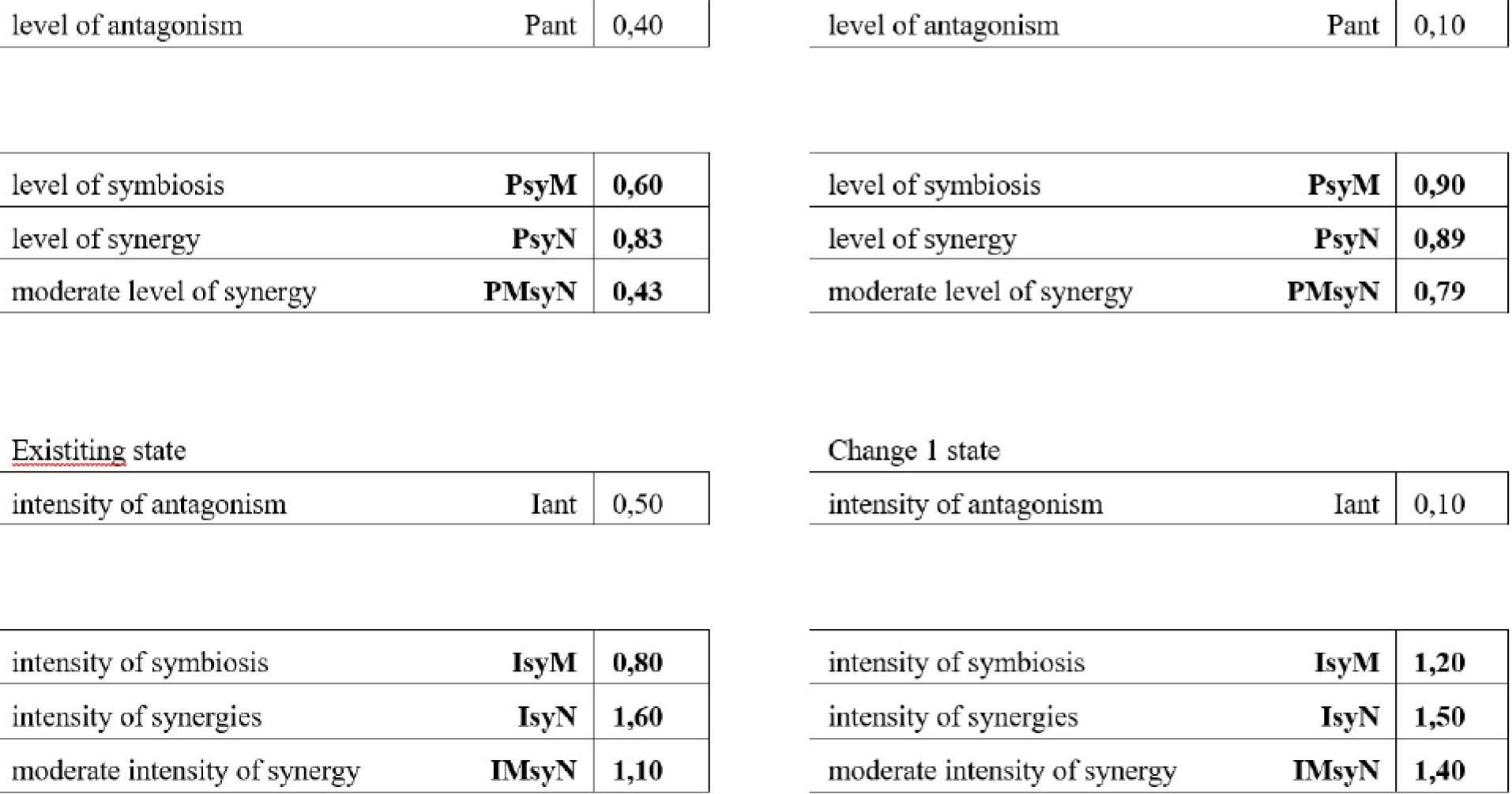
Figure 7.
A comparison of measures of the level and intensity of symbiosis and synergy occurring in the analysed area before and after the introduction of change 1.
Table 3.
Table of types of use and use of urban areas in the analysed area
| Urban Place | Use Types |
|---|---|
| A1 | h |
| A2 | h |
| B1 | u |
| B2 | m |
| B3 | s |
Table 4.
A table of types of relations of the neighbourhood of urban places occurring in the analysed area
| Urban Places Relationships | Uses neighbourhoods |
|---|---|
| A1-A2 | h-h |
| A1-B1 | h-u |
| A1-B2 | h-m |
| A1-B3 | h-s |
| A2-B1 | h-u |
| A2-B2 | h-m |
| A2-B3 | h-s |
| B1-B2 | u-m |
| B2-B3 | m-s |
| B1-B3 | u-s |
Table 5.
A table of weights of types of relations between the neighbourhood of urban places occurring in the analysed area.
| Use of place – neighbourhoods | Weights of the type of neighbourhood relationship |
|---|---|
| h-h | 0 |
| h-u | 1 |
| h-m | 2 |
| h-s | -1 |
| u-m | 2 |
| u-s | -1 |
| m-s | -2 |
Table 6.
A table of weights of the neighbourhood of urban places occurring in the area of the analysed segment of the main street
| Urban Places Relationships | Weights of the type of Neighbourhood |
|---|---|
| A1-A2 | 0 |
| A1-B1 | 1 |
| A1-B2 | 2 |
| A1-B3 | -1 |
| A2-B1 | 1 |
| A2-B2 | 2 |
| A2-B3 | -1 |
| B1-B2 | 2 |
| B2-B3 | -2 |
| B1-B3 | -1 |
Table 7.
Weights of neighbourhood relations between urban places in the analysed segment of the main street
| Types of the Relationship | Relationship markings | Weights of the Relationship | Number of relationships |
|---|---|---|---|
| mutually antagonistic | [-/-] | -2 | 1 |
| parasitic | [-/+] | -1 | 3 |
| indifferent | [0/0] | 0 | 1 |
| symbiotic | [+/+] | 1 | 2 |
| hypersymbiotic | [++/++] | 2 | 3 |
Table 8.
A table of types of use of urban places in the analysed area after the introduction of change 1
| Urban Places | Uses |
|---|---|
| A1 | h |
| A2 | h |
| B1 | u |
| B2 | m |
| B3 | u |
Table 9.
A table of types of relations of the neighbourhood of urban places occurring in the analysed area after the introduction of change 1
| Urban Places Relationships | Uses Neighbourhoods |
|---|---|
| A1-A2 | h-h |
| A1-B1 | h-u |
| A1-B2 | h-m |
| A1-B3 | h-u |
| A2-B1 | h-u |
| A2-B2 | h-m |
| A2-B3 | h-u |
| B1-B2 | u-m |
| B2-B3 | m-u |
| B1-B3 | u-u |
Table 10.
A table of types of use of urban places in the analysed area after the introduction of change 1
| Uses Neighbourhoods | Weights of Neighbourhood Relations |
|---|---|
| h-h | 0 |
| h-u | 1 |
| h-m | 2 |
| h-s | -1 |
| u-m | 2 |
| u-s | -1 |
| m-s | -2 |
| u-u | 0 |
Table 11.
A table of weights of the neighbourhood of urban places occurring in the analysed area after the introduction of change 1
| Urban Places Relationships | Weights of Neighbourhood Relations |
|---|---|
| A1-A2 | 0 |
| A1-B1 | 1 |
| A1-B2 | 2 |
| A1-B3 | 1 |
| A2-B1 | 1 |
| A2-B2 | 2 |
| A2-B3 | 1 |
| B1-B2 | 2 |
| B2-B3 | 2 |
| B1-B3 | 1 |
Table 12.
Weights of the neighbourhood relationship between urban places in the analysed area after the introduction of change 1
| Types of Relationship | Relationship Markings | Weights of Relationships | Number of Relationships |
|---|---|---|---|
| mutually antagonistic | [-/-] | -2 | 0 |
| parasitic | [-/+] | -1 | 1 |
| indifferent | [0/0] | 0 | 1 |
| symbiotic | [+/+] | 1 | 4 |
| hypersymbiotic | [++/++] | 2 | 4 |
The plan of the abstarctional main city street divided into segments is presented on scheme below (Fig. 8). The impact of the proposed changes on the assessment of the quality of sections along the main street in the city centre (abstractional layout) can be presented in comparative graphs (Fig. 9 and Fig. 10.).

Figure 8.
A plan of an abstarctional main city street divided into segments

Figure 9.
A diagram of assessments of sections of public street space – state before change 1

Figure 10.
A diagram of assessments of sections of public street space – state after change 1
In the above comparison, it can be observed that the introduction of mutually complementary and supporting (synergetic) uses results in “calming down“ the variability of the quality of individual sections and a consistent increase in this quality towards the central square (Fig. 10.).
The state of the distribution of assessments of sections of the public space of the main street – before and after the change 1 is presented in comparative graphs (Fig. 11 and Fig. 12.).
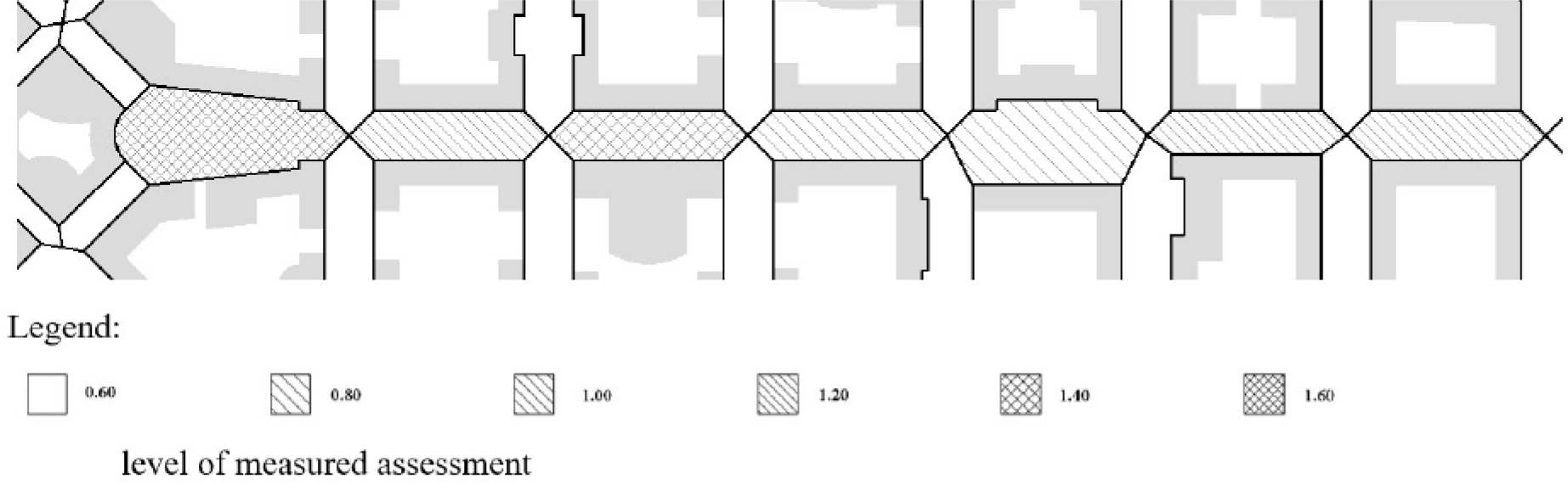
Figure 11.
A map of the distribution of assessments of sections of the public space of the street – existing state – before the change 1
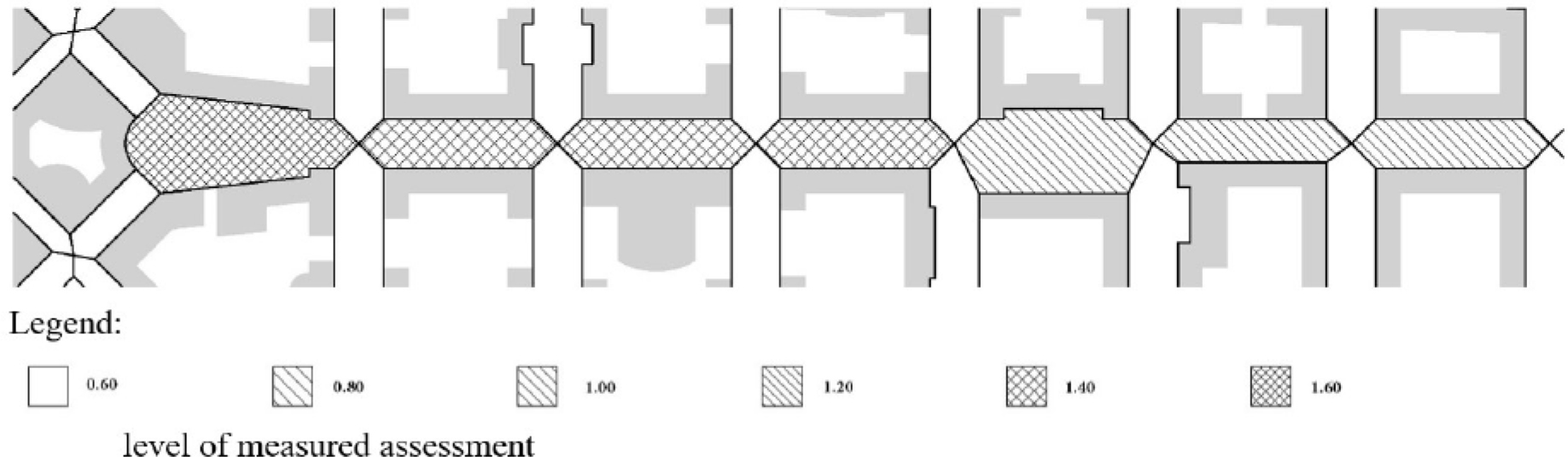
Figure 12.
A map of the distribution of assessments of sections of the public space of the street – state after the change 1.
For the purposes of the study and design of urban planning works, it will be advisable to prepare maps of the spatial distribution of the surveyed measures according to the studied units of public space. One of the recommended options is to use GIS software, which is particularly useful for mapping this type of spatial data.
Symbiotic relationships and the synergy effect are a bit like gravitational forces. Their level and quality depend largely on the distance between urban plots or, more broadly, urban places. The influence of distances between urban places on the measurement of symbiosis and synergy can be overlooked in the analysis within the framework of a street, square or corner section. On the other hand, in the case of studying these relations for larger urban structures (with a larger public space – including also more units of public space) it is necessary to consider the distance factor – distance [50, 69] as one of the weights.
These weights should be selected in inverse proportion to the distance between the designations/uses of urban places remaining in a synergistic relationship, considering the level of the analysed unit of public space in the hierarchical structure of the city being the subject of the analysis.
Due to the specificity and uniqueness of each of the urban planning topics, this study uses generalized symbols for types of development. The current taxonomy of functions in spatial planning and urban planning is completely incompatible with the current situation in cities and the methods of analysing the relationships between them. Therefore, in this paper a more network-based approach is proposed, analysing the relationships between individual uses and uses of urban plots.
7. DISCUSSION
The purpose of creating the proposed method is to obtain a tool for comparing the condition (quality) of public space divided into sections based on a set of uses and uses of urban places adjacent to them.
An important element of the verification of the proposed method was the comparison of the test results for the existing and improved state. The obtained indicators for both states confirmed the emergence of changes in a positive direction. This means, that this method is useful, provided that the relativity of the results obtained is always considered. Therefore, it is not possible to compare the values obtained for different projects, especially when they are obtained based on different assumptions. This method can be fully useful for comparing the quality of sections of public spaces within a single project based on one coherent set of assumptions and covering one municipality.
This method seems to be particularly useful for testing the quality of long city streets, where the desired values will be:
a significant increase in the quality of sections assessed through the prism of symbiosis and synergy of urban use towards the city centre
and
no significant differences in quality for neighbouring sections.
The positive direction of changes is illustrated in the diagrams – Table 1.3 and Table 1.4. The state after the improvement (change 1) is characterized by a lack of dissonances in the assessment and a clear trend of the development quality pattern towards the centre.
The most significant indicators for the status quo seem to be:
– moderate level of synergy – IMsyN
and
– moderate intensity of synergy – IMsyM,
However, it is necessary to always serve this pair.
In the case of analyses for large urban layouts, it will be necessary to develop tools for automated data processing. From the point of view of the effectiveness of urban design works, it is advisable that the technical part does not dominate the conceptual and design part.
As such, this proposal is oriented towards a detailed urban scale: the main urban street or the system of main urban streets, primarily in the downtown and downtown area. On the one hand, it joins the trend of research on the city as a network system, but it goes further, as it does not focus on analysing the morphology of the city as a system of streets and urban blocks, as it is proposed in the main works cited here [57, 58, 59, 50, 51, 70].
Our basic assumption for the proposed method is to add qualitative assessments related to the use of urban spaces along public spaces like main streets to a graph presenting the system of these public spaces on the scale of the city, its city centres or its centre. In this approach, this method is most closely related to the activities organized by Sergio Porta’s team around the research issue of Multiple Centrality Assessment. The closest to the method proposed here are the detailed proposals in the field of urban design methodology proposed by Sergio Porta’s team in chapter 4 of the book “Masterplanning for Change: Designing the Resilient City“ [68, 71].
However, none of the cited works used such detailed and objective methods of examining the quality of public space from the perspective of the use and purpose of urban spaces in terms of emerging symbiotic and synergistic relationships.
8. SUMMARY AND CONCLUSIONS
The obtained results of comparative simulations for an abstract section of public space and related urban spaces bode well for the application of the quantitative and, consequently, qualitative description of the level of synergy and symbiosis in the comparative assessment of the quality of use and use of public space sections, especially in central urban areas. The obtained results indicate that it is expedient and justified to develop the structure of use and designation of urban places using the graph method. We believe that the standardization and quantification of measurements and assessments will allow for the development of data for large areas of the city and the derivation of assessments, forecasts and projects on this basis, including comparative evaluation of variant solutions and selection of the optimal option.
Due to the increasing use of graphs in the study of urban structures, a platform for data exchange is being created, also in digital form, which opens up new opportunities for the exchange of more advanced socio-spatial data, often creating big data sets, between teams working with different approaches to urban issues, i.e. working with different methods, but always working on the city as a complex system of relations. [48].
The results obtained using the Sym_Syn method can be integrated with other data in a situation, where the record of the studied structure will be based on a system of graphs illustrating the layout of public space, which is becoming more and more popular and should become an unambiguous reference system for all specialist studies and design proposals.
It should be noted, however, that due to the relative nature of the proposed measures, the results obtained are also relative and can be used for comparative purposes of assessing the quality of sections of public spaces in terms of the use and purpose of urban spaces in relation to those topics for which the same table of weights of the relationship between the neighbourhood of urban places was used.
The possibility of studying and modelling symbiosis and synergy in urban structures will make it possible to improve the quality of research and, consequently, the design of urban structures, especially in city centres and downtowns, and consequently the quality of urban habitation.
The described analytical and design activities, due to their symbiosis and synergy, are proposed to be called the SyM_SyN method. However, its wider application will require the author’s verification of it on a real example. The recommended choice is the main street in the city, which has been degraded in terms of the use of urban spaces. Such conditions seem to be met by Zwycięstwa Street in Gliwice. It is planned to conduct such an experiment immediately and publish its results.
It is advisable to further develop partial methods of studying urban structures in the most objective way possible, while maintaining the graph notation of the layout of the city’s public spaces as a reference system. This should apply to all research conducted in fields other than urban planning related to urban planning.