
1. INTRODUCTION
Throughout the history of human civilization, commercial function played a special role in the evolution of multifunctional buildings. Trade is an important part of urban life. It acted historically as one of the main drivers of the agglomeration of functions into larger and later architecturally organized formations. From the first urban public commercial spaces to holistically designed shopping complexes, additional activities of human life gravitated to spatially intensive, bustling commercial hubs [1, 2, 3, 4].
Along with the recent trends towards organized poly-functionality in architecture and the fact that larger systemic objects of architectural design are leaning closer to the urban planning scale, which make both functional and hierarchical classifications of such objects mutable, shopping complexes are experiencing their own crisis and reinterpretation rooted in type-specific causes. Such causes primarily center around the active development of e-commerce and increased competition between existing brick-and-mortar structures, which draw the standardization, inflexibility and isolation of many existing solutions into light.
Greater requirement of time investment for visitors of physical commercial centers is balanced by the immediacy of interactions and greater reliability in choosing the exact qualities of goods, and can be supplemented by greater physical experience of being in a pleasant environment and mixing other activities to make up for the time consuming visit. Such factors as immediacy, ambience, convenience and socializing can be a positive or negative influence on the satisfaction of a visit to a brick-and-mortar shopping center [5]. A sizable part of their positive implementation is factored from the complex's architectural qualities, be it spatial organization, context integration or aesthetic detailing. Thus a significant part of the attractiveness of physical experience in a shopping center can be traced to its vessel, architectural object, as a basis, or at least a vital prerequisite for the emergence of its attractive qualities in visitor's perception. Subsequently, it places even greater emphasis on the task of architectural design in “making the place” – crafting an architectural environment for what is effectively a part of urban life.
A characteristic element that distinguishes a multi-functional shopping center from other forms of spatial organization of commercial activity is a connective pedestrian recreational communication space (RCS) [2,4]. Accordingly, its actualization as a tool for creating a comfortable, distinct environment for people along with the strengthening of corresponding public component of shopping centers can be considered one of promising directions for overcoming the consequences of the crisis. Nowadays, spatial formats of commercial complexes continue to diverge. Recreational communication space serves as an important factor in this transformation, emphasizing new qualities relevant in modern conditions. Analyzing the modern transformation of spatial typology of shopping centers is crucial for adapting design practices to the new paradigm that would focus the brick-and-mortar commercial complexes on their important competitive advantage – recreational communication space as a physical place and a frame for non-commercial uses of these buildings.
First, it is important to outline the use of terms in this study. “Public shopping center” and “public commercial complex” are used interchangeably, describing a large multifunctional building or a complex with primarily commercial function and a prominent recreational communication space directing pedestrian movement connecting its parts. “Multifunctional complex” is a wider concept, and its relation with shopping center is discussed in the main part of the study. “Recreational communication space” denotes a purposefully designed transitive pedestrian space connecting the parts of multifunctional complex and capable of incorportating public functions in addition to communication. “Shopping mall” as a term is used to describe a public shopping center with enclosed RCS, primarily of introverted spatial organization. Meanwhile, the “mall” term specifically refers to its, usually covered, recreational communication space. This research draws upon the structural understanding of the spatial organization of commercial centers based on the works of B. Maitland [1], O. Berezko [2], E. Zeidler [3], and previous studies of present author [4]. B. Maitland wrote about evolutionary, morphologic and semantic connections of commercial spaces with urban spaces, specifically highlighting connective pedestrian spaces in modern shopping complexes [1]. This point was further elaborated by O. Berezko in her dissertation work that proposed to transpose the qualities for urban environment evaluation to the shopping center’s environment [2]. E. Zeidler wrote about the part that commercial function and corresponding spaces play in the multi-functional urban fabric, discussing their essential role for energizing urban spaces and urban life [3]. Meanwhile, the dissertation work of present author argued in favor of understanding the connective pedestrian recreational communication space of a shopping center as its structure-forming element, the qualities of which largely define the use and perception of a complex by visitors. Additionally, such a space functioning on a similar logic to an urban one leads to interesting implications about the possibility of using placemaking practices in their design [4].
Prerequisites, circumstances and potential consequences of current crisis, as well as its reflection in theory and practice of the construction of shopping centers are discussed in a number of studies. V. Raimers names the convenience among the primary components of the success of shopping centers, and identifies its loss in the overwrought introverted structure of modern centers as one of the drivers of the present crisis of traditional enclosed shopping malls [6]. O. Fomenko and S. Danylov discussed the decay of “South China Mall” in 2000s as the result of its structure and logic being designed without connection to its context [7]. The works of D. Ferreira [8] and P. Guimaraes [9] speak about the decline of shopping centers in Lisbon, and consider possible ways of their reorganization. The article by F. Moccia contains evidence about the sharp increase in competition and the crisis of large shopping centers in Italy [10]. The study by J. Kunc and F. Krizan notes that universal construction practices of shopping centers transposed to the ground of Eastern Europe countries will eventually lead to similar problems with over-building and the need for change in their structure and logic of use [11]. Accent on public, community, context and atmosphere is proposed as a solution to current crisis in the works by EPA [12] and M. Beyard [13]. The comprehensive comparison of qualities of e-commerce and traditional shopping practices is summarized by X. Zhu [5]. Meanwhile, the study by van den Berg [14] contains evidence that the sense of place contributes positively to a shopping behavior of visitors in physical stores; such sense can be considered along the dimensions of place attachment (factoring in accessibility and comfort), place identity (connected with semantic and aesthetic articulation of place) and place dependence (mainly connected with functional use and socializing). In addition to that, F. Rao argued that the shopping centers in post-Covid and digital era are reorienting their spaces towards “urban experience” instead of a “shopping experience” [15].
The present article aims to identify the prerequisites of the transformation of modern spatial typology of shopping centers in light of current shift of views on their design, and outline the resulting architectural design implications. In doing so, it seeks to verify the hypothesis that recreational communication space plays a prominent part both in evolution and in modern transformation of shopping centers, focusing on its logic of internal and external connections and its relation to the urban fabric as defining qualities of its spatial types.
Methods of the study are based on systemic approach, including analysis and generalization of historic material, theoretic principles and existing studies. Spatial qualities of shopping centers are studied via direct observation when it is possible (for cases in Kharkiv, Ukraine), as well as cartographic and qualitative data analysis using open sources. Direct observation includes on-site visual survey focused on morphology and structure of commercial complexes, as well as the spatial distribution and behavior of visitors. Cartographic data analysis in this case incorporates searching, creating and comparing urban planning and architectural plans and schemes, as well as satellite images describing spatial morphology of shopping centers. Qualitative data analysis is based on feedback of visitors to shopping centers, expressed through online reviews, which allows distinguishing preferences and peculiarities of their perception by public. Illustrations were created with the use of arts and photos in public domain (CC0), from Wikimedia Commons [16] and additional sources [17]. The novelty of work lies in comprehensive highlighting of the part played by recreational communication space in the transformation of spatial typology of shopping centers in the context of their changing relations with urban spaces, as well as discussing its significance for the wider typology of polyfunctional structures. Its relevance is supported by the importance of RCS as a driver of physical experience in present conditions that contributes to the search of new qualities of brick-and-mortar shopping centers in competition with the other formats of commerce.
2. MAIN PART
2.1. Public shopping center as a multifunctional structure
A public shopping center is interpreted in the context of this study as a shopping center with the focus on mixed-use based on public functions, which is characterized by greater integration of its spaces into the life of its community. Its principal element is the recreational communication space (RCS) that defines and embodies these specifics. Said space unites separate functions into a single system with the help of pedestrian movement organized and shaped through its spatial and atmospheric characteristics in a certain way that helps in the realization of the specific center’s concept.
Practically, it can be argued that any sufficiently large multifunctional complex would also become a public center. Any connection of a number of functions requires a medium between them, both in spatial and in temporal sense. Public functions take this part in the cities, as they can both manifest spontaneously in spaces not fully suited to them [18], and be introduced intentionally, with understanding of their role in urban life. In the latter case, it is logical that the public functions of connecting nature would receive a corresponding architectural spatial realization – a recreational communication space. The driving role of a pedestrian movement and visitors’ interest, resembling that of a blood inside blood vessels (RCS) of the architectural complex, may impact the logic and viability of composition of its constituent parts. It is especially apparent in the structure of commercial complexes, where lack of pedestrian movement reaching some parts would result in lower customer attention to shops situated therein, potentially leading to their decline. Interpreting a complex multi-functional architectural formation as a system consisting of its parts in certain interrelations, we can consider RCS as its structure-forming element due to its role in enabling and defining the mode of these interrelations.
Thus, RCS (such as lobbies, atriums, malls) can be understood as a specialized element of public multifunctional complexes in general, connective medium of complex structures. This definition encompasses more than just communications. The configuration and logic of spatial solution of RCS allow it to serve as a driving vessel of multifunctionality that defines character, specifics and forms that it can assume corresponding to the conceptual idea of the architectural complex. No less important is the driving matter of multifunctionality – main functions that bring people to the complex. It may be commerce, work, habitation, study, public and cultural activities, transportation and many others. Still, the role that RCS plays for multifunctional public centers is an important question, not always distinctly realized, despite the fact that it may be considered as a structure-forming element of a complex multifunctional formation and a possible indicator of its specific type.
In the context of characteristic visual features indicating the peculiarities of a building’s type, another interesting question to consider would be the external realization of multifunctionality and flexibility of use in the architectural form of a polyfunctional hybrid structure. In this case, articulation of modularity of its build or accentuation of the more stable parts of its structure may serve as possible universally readable ways of its expression. In particular, this can be achieved through demonstrating and emphasizing its RCS as a carrier of a connecting public function, as it may be understood as a relatively stable element of polyfunctional structure in its integrating quality.
Public shopping centers are important in the general context of the development of polyfunctional architectural formations, as their evolution has formed one of the most known and successful formats of recreational communication space, – the mall, specific traits and peculiarities of which were later actively introduced to spatial organization of architectural buildings and complexes of other types. The development of public shopping centers in the course of 20th century has visibly demonstrated the main problems that multifunctional complexes face in general – the difficulties in defining priorities and hierarchy of their multi-aspect organization, as well as the lack of attention to socio-cultural aspect of their subsequent existence. Of particular importance is the fact that the evolution of recreational communication spaces in public shopping centers continues, presenting new forms of their structural realization. These forms along with the lessons and specific techniques of organization of corresponding spaces can be implemented to the hybrid buildings of wider polyfunctional typology as well. However, the origins of RCS remain important, as the reasons for this element’s emergence and the problems present throughout its evolution define the spatial forms included in the modern typology of shopping centers and the direction of their further development.
2.2. Genesis of spatial structure of shopping centers and their antecedents
E. Zeidler [2] stated that there is no sense in distinguishing separate multifunctional formations before the period of industrial revolution. They appeared and existed as constituent parts of their cities. Understood as such, they were built and used by our civilization for centuries.
At the same time, a retrospective analysis of the development of commercial spaces throughout their history may provide an additional perspective to this point of view. In studying the consequent evolution of architectural objects that eventually led to the formation of modern public shopping centers, it is important to note the dual nature of the development of these predecessor structures. Initial traits may be observed both in the development of separate commercial buildings and in the evolution of larger public commercial urban formations. It is particularly apparent when we consider the genesis of recreational communication spaces, as this element initially had urban origins [1, 4].
An Ancient Greek agora that emerged as a space for public and religious gatherings in front of temples, can serve as an example of a public commercial space shared with urban fabric without significant modifications, apart from those caused by its central location in the logic of the city’s use by its residents. An agora, like the one in Athens or Miletes, was fully situated inside the system of public spaces of the city, playing the part of its important hub element. Adjacent galleries, stoas, served as multifunctional semi-enclosed spaces, often hosting commercial functions alongside civic gatherings, judicial hearings and other activities [19].
Market squares and shopping streets are the most characteristic types of urban commercial formations that highlight the role of connective pedestrian public communication space as it brings together separate commercial establishments. Its spatial morphology may traditionally possess a hub, compact quality (in a square) or a transitive, elongated one (in a street). An active movement inside such a space does not only unite smaller commercial establishments into a single systemic entity, but also promote the emergence of an attractive environment for residents’ social life. Market squares and streets existed as organic elements of urban fabric, the pedestrian activity inherent to them was a natural part of the larger city’s pedestrian structure, their adjacent public and recreation functions being an important constituent of the urban life (Fig. 1). Market quarters or districts included both hubs and transitive, connective parts united into a system with complex organization. As such, they served as spatially and functionally denser fragments of urban fabric in the larger system of a city. Market quarter usually combined enclosed structures, covered spaces and open streets; they housed many different functions aside from just commerce and traditionally served as a space for communication and other kinds of social activities (Fig. 1).
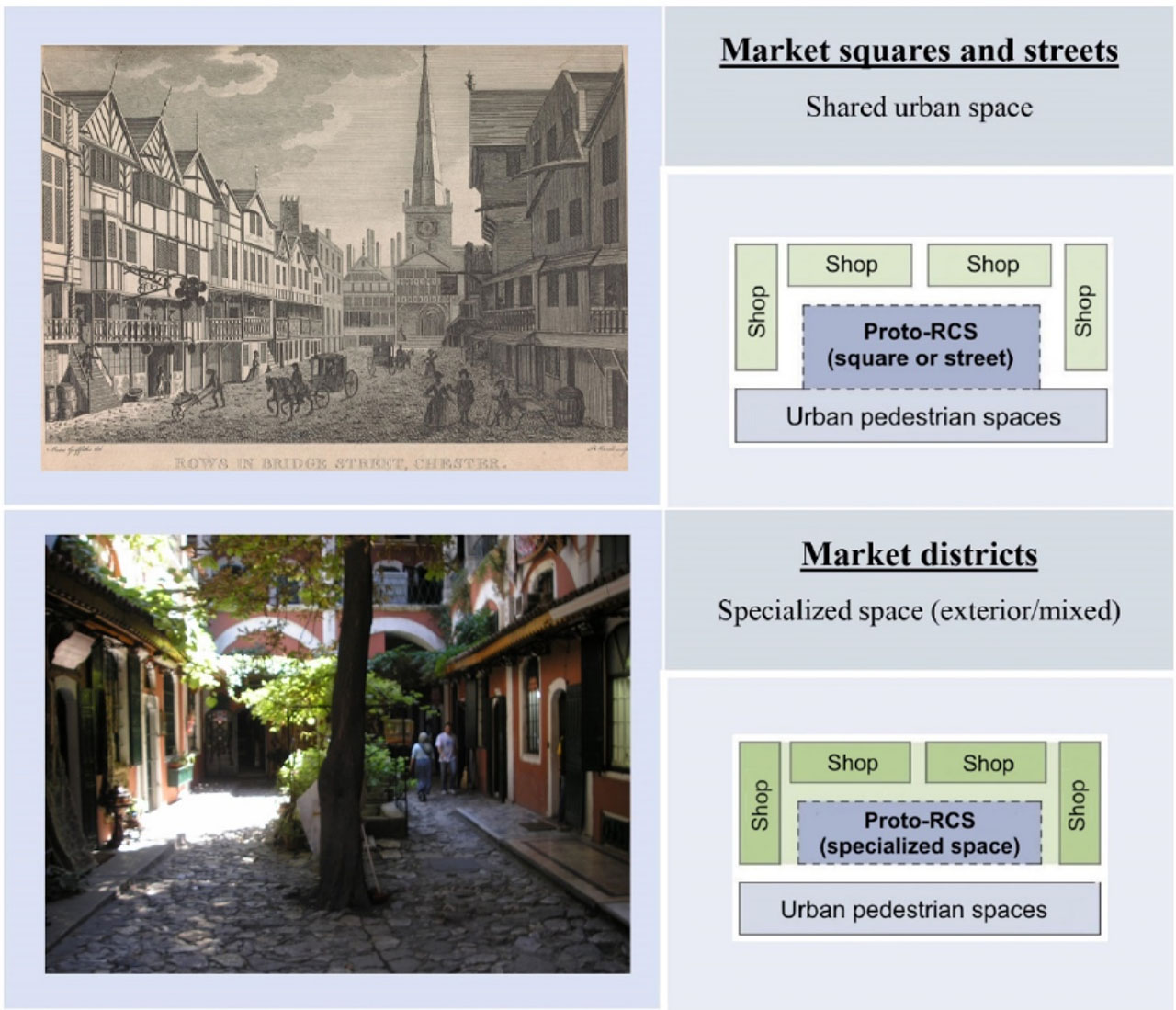
Figure 1.
Spatial structure of market squares, streets and districts. Top illustration – Rows in Bridge Street, Chester, UK, art by P. Mazell, Public domain [16]; bottom illustration – Grand Bazaar in Instabul, Turkey, photo by Gryffindor, Public domain [16]
Starting from the Ancient Roman period of the development of commercial objects, the practice of structural separation of functionally homogenous spaces gained prominence. Covered commercial structures and even large specialized complexes, like Trajan Market, serve as examples of this trend. Purposefully constructed covered trade premises of Late Medieval Europe that came to be known as Cloth Halls (like Sukiennice in Wroclaw or Cloth-Hall in Ypres), were distinguished from the urban fabric as specialized nodes of commercial activity with significantly wider possibilities of controlling the conditions under which said activity occur.
The covering of a shopping area was also a natural step in the countries with hotter climate, which is the reason of covered bazaars gaining prominence in the cities of Levantes and Middle East, as well as North Africa. Grand Bazaar in Istanbul enclosed a number of intersecting commercial passages, structurally similar to streets, under its roof, forming a dedicated spatially dense commercial district in the urban fabric. The dome of Toqi Sarrofon in Bukhara protected the intersection of streets below it from heat, providing favorable conditions for the commercial activity and comfortable being of people inside, visitors of its combined moneylender shops, mosque and adjacent Sarrofon baths. The organized commercial formations of this kind can be considered antecedents for the further intersection of qualities aimed at comfort and urban connectivity in an architectural structure (Fig. 2).
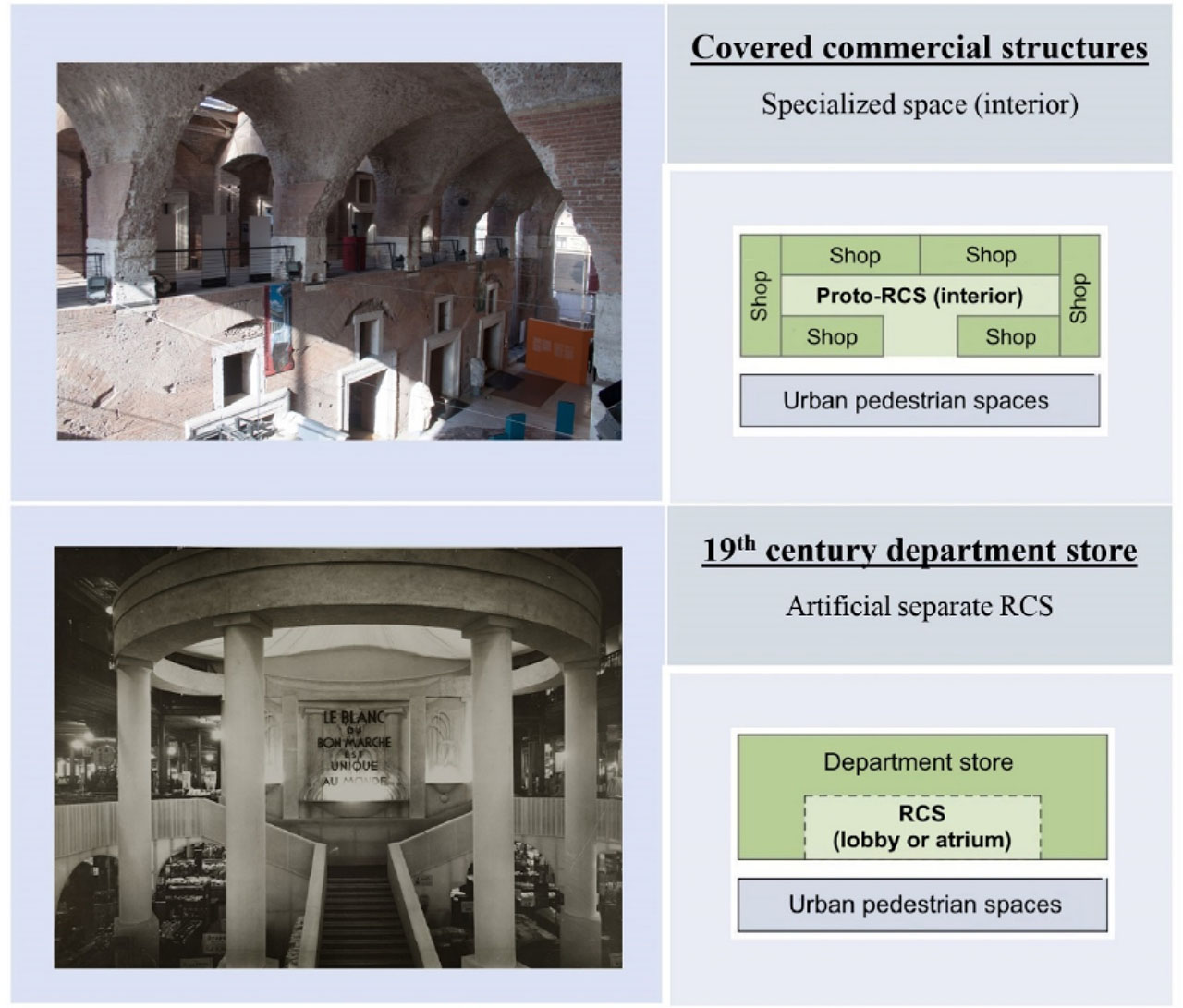
Figure 2.
Spatial structure of covered commercial structures and 19th century department stores. Top illustration – Trajan Market in Rome, Italy, photo by Szilas, Public domain [16]; bottom illustration – “Au Bon Marche” in Paris, France, photo by anonymous author, Public domain [16]
In 19th century the first department stores appeared as enclosed shops of immense area. Their vast, protected, comfortable interior environment served almost exclusively their commercial function. An example of a department store of this kind can be seen in “Au Bon Marche” in Paris, built in 1877. The movement of visitors inside a department store was primarily functional and probably was not considered in urban scale categories. This may be inferred from the fact that its connective pedestrian space did not receive any specific structural prominence by itself aside from its role as a lobby of commercial building (although often a spatially developed one) (Fig. 2).
As we can observe, the basic functional organization of commercial structures is primarily oriented towards providing protection and accessibility of commercial function, and these qualities evolved in the course of their historical development. Meanwhile, commercial spaces in a wider sense were part of an urban fabric from the beginning, and when considered in ensemble with adjacent functions relate to urban planning categories. Market squares, streets and districts evolved as well, their spaces becoming more intensive by the number of connections and uses, while also integrating comfortable qualities on a larger scale. It was the development of the future connective vessel of public shopping centers, but exteriorized, occurring outside – consequent crystallization of recreational communication space from the urban environment. It is in the course of 19th century that these two directions of development fully merged in the structure of a shopping arcade.
A shopping arcade is a holistically designed architectural object with a comfortable, highly organized environment; its interior pedestrian space includes connections on the urban planning level, integrating into the adjacent urban spaces. Here, the essentially urbanistic space of earlier proto-RCS was considered and fully realized as a part of architectural structure.
An example of such commercial space may be observed in the Paschenko-Tryapkin Arcade in Kharkiv (built in 1875; ruined during World War II and subsequently demolished). The pedestrian public recreational communication space of an arcade in the city is not as borrowed from the urban fabric, as it is a planned element that is built into the existing system of pedestrian movement, intentionally filling its gaps; as such, it served as a socially activating, spatially rich fragment in the continuity of urban spaces. While the connective pedestrian space in department stores turned into purely interior element with predominantly commercial function, its variant formed in arcades played the main structure-forming role in a holistically designed complex. In this way, it renewed the public meaning of its earlier urban iterations, this time in the covered structure. It is then we can speak about the emergence of the first fully realized RCS, similar to those used in modern shopping centers as their main structure-forming element, most known presently as a “mall” (Fig. 3).
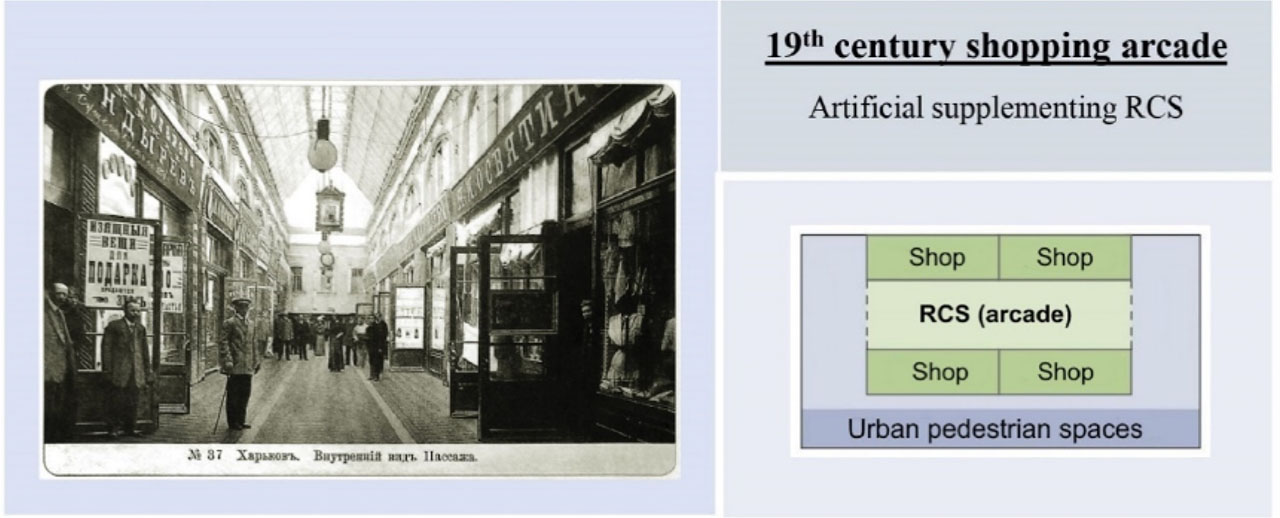
Figure 3.
Spatial structure of 19th century shopping arcades. Illustration – Paschenko-Tryapkin (Old) Arcade in Kharkiv, Ukraine, postcard [17]
Despite the promising nature of this approach in retrospective, the predominance of functionalist views in architectural thought of the first part of 20th century resulted in preference being given to the more organized and controllable realization of separate commercial function in the department stores. At the same time, another, more complex type of organization of commercial spaces gradually took shape that included department stores as part of its structure – a public shopping center, also known as a shopping mall.
The first groupings of stores that actively used the new possibilities of automobile transport for their reach were located in suburban areas and on the outskirts of US cities, where the processes of desurbanization were gaining strength. On the one hand, such a new beginning made it possible to deconstruct and reconstruct the logic of the multifunctional space from scratch, based on the immediate challenges of the present. On the other hand, from the very start, automobile shopping centers assumed the role of public and recreational centers for the residents of the suburbs, which were distanced from the old city centers, but felt the need for their own, similar urban spaces.
Thus, the combination of various functions other than commerce became an important part of the development of suburban shopping centers from the very beginning. Accordingly, it led to the emergence of a relevant new form of connecting space. Its initial implementation was a morphological necessity – pedestrian traffic between a group of spatially separated functions required a distinct and convenient place for its passage. Presumably, such a space appeared as a path from the parking lot to a large department store, around which additional stores, attracted by the favorable location, were grouped. In accordance with the aspirations of the residents of suburbs to have their own “city center”, this pedestrian space received advanced landscaping and began to be designed like an urban space. Additional public functions opened onto it, while its parts were used for social activities, recreation and public events.
RCS acted as an important constituent of a suburban shopping center by organizing pedestrian movement inside and ensuring the accessibility of the rest of the spatial components of its functional program – initially. However, with the active development of this new promising type and widening of the array of uses that it encompasses, RCS gained new traits aimed at realizing particular qualities connected to the location and general concept of different complexes. In light of that, architectural spatial qualities of RCS can be considered as an indicator of different types of public shopping centers, while its organization at the design stage defines the basic logic of connection and use of different parts of the complex. Active changes to this element, meanwhile, can indicate the transformation of spatial typology of shopping centers, emergence of new qualities or the search for new types of these structures. Let us consider these differences and peculiarities in the organization of RCS on a number of modern cases.
2.3. Modern transformation of the spatial typology of shopping centers
When considering the modern typology of public shopping center and its transformation, it is useful to employ the classification describing spatial organization differences of their RCS as a base. A number of articles is dedicated to the classification of shopping centers in their modern interpretation and elaborates on the examples of specific types. Among them, F. Rao studied the spatial morphology transformation of shopping centers as it stems from three retail types of main street, power center and suburban mall, forming synergies between them, while lifestyle center is mentioned as the fourth spatial alternative [20]. L. Dolega with co-authors proposed a flexible multi-factor classification of shopping spaces based on spatial composition, size and function, as well as product diversity and economic health [21]; of these factors, the first two clearly relate to architectural spatial design of commercial complexes. D. Herman in his essay in “The Harvard Design School Guide to Shopping / Harvard Design School Project on the City 2” distinguished two main spatial types of shopping malls as a “dumbbell” and a “cluster” type, noting that most complexes combine the qualities of both [22]. S. Deb proposed four main types of shopping centers by their morphology, these being “cartesian” (grid-based), “dumbbell” (linear axial), “tree” (branching axial) and a mixed type [23]. Meanwhile, O. Berezko distinguished the recreational communication space (denoted in the study as “public space”) into linear, court and mixed type by their configuration [24]. Previous work by present author considered various classification methods of shopping center typology; it was then proposed to update the classification discussed by B. Maitland for further use [25], as it is suitable for highlighting the underlying logic of spatial organization of particular types.
First significant examples of shopping centers had formed on suburban territories, which became reflected in their structure. They are primarily characterized by their enclosed, introverted organization, with limited impact of external connections, as embodied in the spatial confuguration of their RCS. Described qualities serve as a base for distinction of an introverted shopping center type [25]. The shopping is a primary driver of multifunctionality for it, while the mixed use and entertainment primarily serve to improve its efficiency in the functional logic of the complex by ensuring the work of enclosed system of movement inside, reinforcing and accentuating its parts as needed. RCS of such a complex is often designed with the goal of creating and strengthening the contrast between indoor and outdoor environment through its intensity of use and peculiarity of detailing (Fig. 4). Interesting to note is that special attention in visitors’ reviews on this type is given to additional ways of energizing activity inside, like social functions, active recreation, entertainment etc [26]. It may reflect the conceptual need for the formation of a full-scale separate hub of public life in the interior spaces of introverted shopping centers, initially intended to replace traditional urban spaces for suburbs. Examples of the type may be observed in “Mall of America” in Bloomington, USA or “Karavan” and “Daffi” shopping centers in Kharkiv, Ukraine.
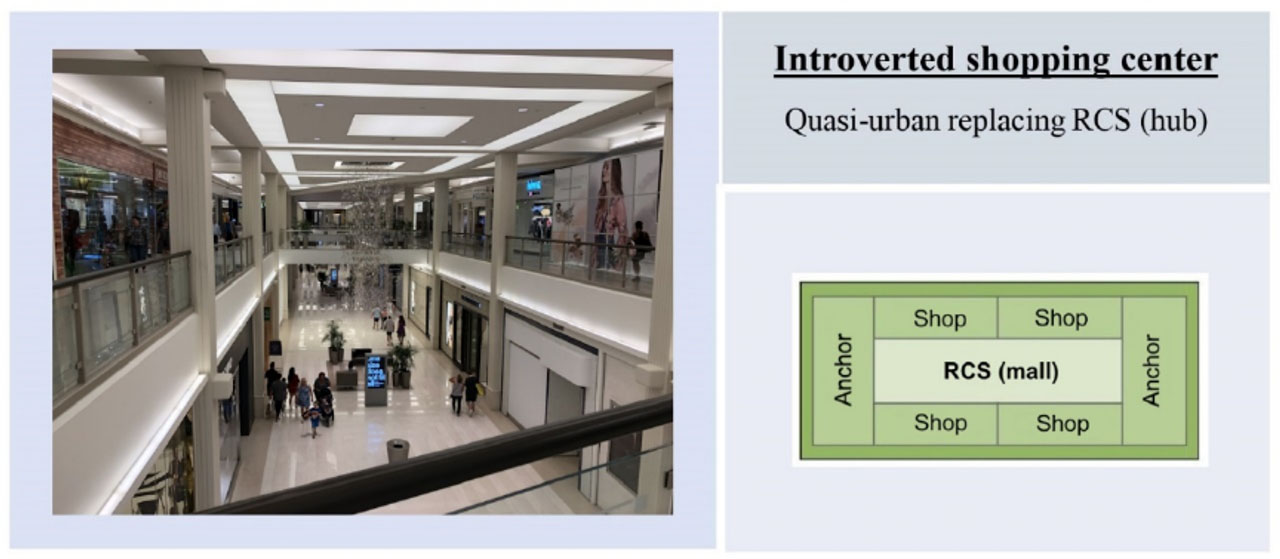
Figure 4.
Spatial structure of an introverted shopping center. Illustration – “Mall of America” in Bloomington, USA, photo by Thomson200, Public domain [16]
Eventually, the active construction of public shopping centers in cities (as opposed to the suburban situation of their genesis) has led to the modification of their architectural spatial organization towards adaptation to urban conditions, therefore crystallizing a new type. An integrated shopping center (similar in structure to a shopping arcade, as remarked by B. Maitland [1]) connects existing public spaces in its immediate surroundings, supporting and enriching the structure of the resulting complex system of urban fabric due to its crucial placement and orientation of RCS towards external connections. The size of an integrated shopping center may be large; however, due to its different logic of use, it also serves as a supporting element in the larger system of an architectural mega-structure, urban district or a city as a whole. In these cases, reviews by visitors primarily highlight the specific qualities of a public shopping center through which it can be useful in supporting a larger system – most often, its comfort, convenience, providing communications and additional services lacking in the urban area around it. RCS of such a complex is usually of a transitive, integrated character; more open, it has a larger number of outside connections and does not necessarily aim to create a visual contrast with its surroundings. It serves not as an end destination of a path, but its organized conduit in a complex system of urban life and in this quality becomes an integrating tool for its design (Fig. 5). An example of an earlier integrated shopping center of larger size may be seen in “Toronto Eaton Centre” in Canada, modern ones can be observed in “Cabot Circus” in Bristol, UK or “Liverpool One” in Liverpool, UK, while “Ave Plaza” in Kharkiv, Ukraine can serve as a smaller example of the type.
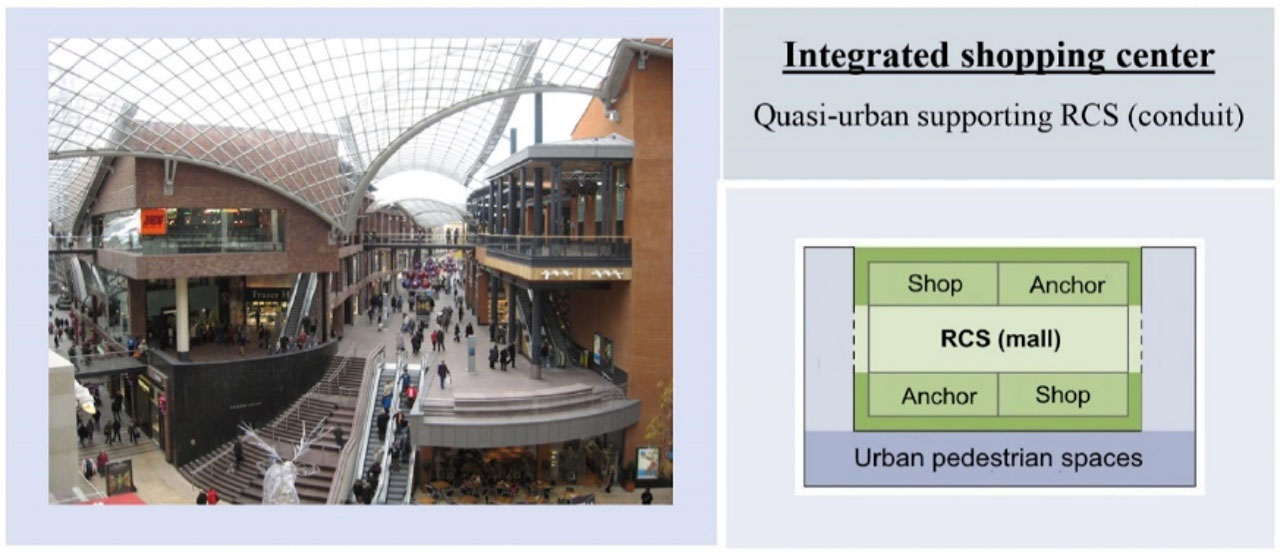
Figure 5.
Spatial structure of an integrated shopping center. Illustration – “Cabot Circus” in Bristol, UK, photo by Jongleur100, Public domain [16]
Shopping centers of the thematic type emerged in 1960–1970s; however, they warrant additional attention in connection with the crisis of traditional approaches and solutions of shopping complexes in 2000–2010s. Under thematic shopping centers, lifestyle centers, festival malls, outlet villages, retail parks and many other subtypes of related spatial organization may be grouped. Such a type of organization of multifunctional public commercial formations is characterized by an articulated attention to architectural and spatial detailing, as well as to aesthetic and semantic aspect of the resulting spaces in general. This observation is further reinforced by visitors’ reviews on the buildings of the type that universally favor the aesthetic qualities of a complex, while maintaining a high interest in energization of activities inside, but exhibit lower attention to qualities connected to basic convenience when compared to the introverted and integrated shopping centers [26]. The spatial logic of RCS of a thematic shopping center is drawing attention to visually expressive spaces and maintaining activity inside with the use of additional non-commercial functions, often including cultural and educational activities along with the more common socializing, recreation and active entertainment. This accentuation of public and cultural functions, as well as an increased attention to architectural spatial qualities of environment make thematic shopping center a promising type in the context of the present shift of perspective on the shopping center design. It also makes its logic of connecting multiple functions into a singular complex via semantically charged RCS a potentially useful tool for designing polyfunctional hybrid formations of a wider type.
Based on a structured approach to human perception of urban environment (like the one presented by K. Lynch [27] or discussed in connection to commercial centers by Z. Tan [28]) and utilizing characteristic archetypal elements, such a tool can help construct a hierarchic and meaningful space both for easier navigation and for facilitating its realization as an integral part of urban life. Thus, it can be argued that the architectural composition of thematic type is primarily based on semantic spatial modeling of a quasi-urban network of spaces, creating a “mallscape” of sorts (Fig. 6). “Ghirardelli Square” in San-Francisco, USA may serve as an earlier example of a thematic shopping center, location- and context-specific in its commercial specialization (trading in chocolate due to it being based on the old buildings of confectionery factory), while “Coal Drops Yard” in London, UK is a smaller case, basing its expressiveness on the architectural memory of the place. “Nikolskyi” in Kharkiv, Ukraine presents a complicated case, as besides having a strong thematic component to its appeal, its spatial structure is dominated by functional qualities of an introverted type, which may not be the best solution for its prominent location in the city’s historical center.
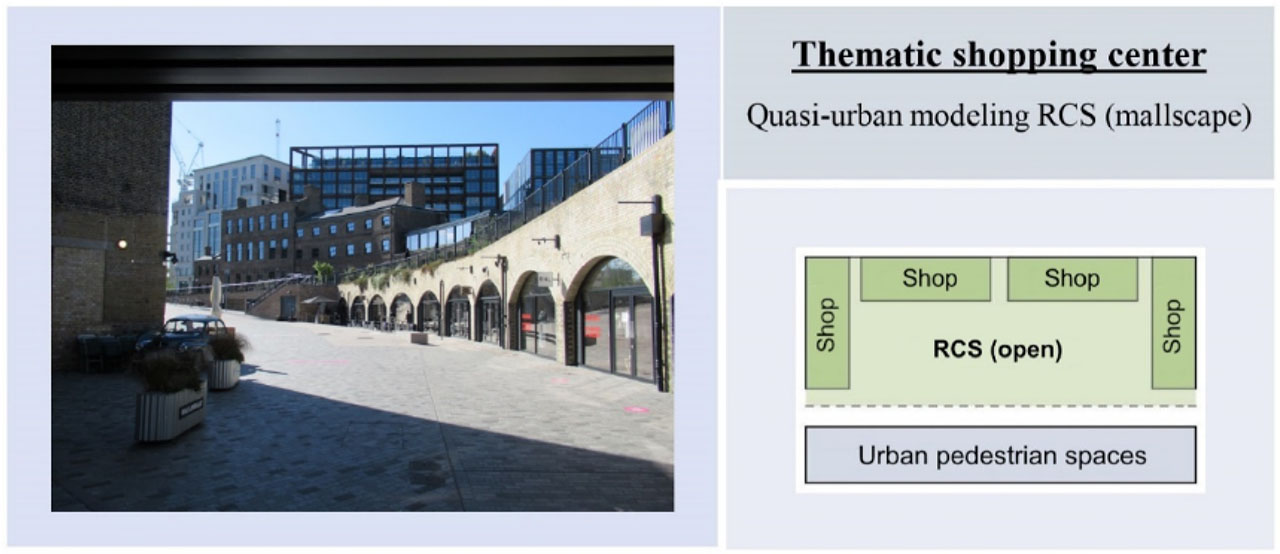
Figure 6.
Spatial structure of a thematic shopping center. Illustration – “Coal Drops Yard” in London, UK, photo by Andy Scott, Public domain [16]
It can be observed that the history of development of larger urban public commercial formations is reflected in the spatial variety of modern public shopping centers (Fig. 7). Looking back at the antecedents of shopping malls, two main lines of their influence on the modern transformation of spatial typology of these architectural formations can be discerned – functional and urbanistic. The development of interior commercial spaces led to the emphasizing of qualities aimed at creating a comfortable environment for commercial and associated activities – functional control of pedestrian movement and environmental conditions that is fully realized in introverted spatial schemes. Meanwhile, the legacy of urban influences on the spatial structure of shopping centers can be further separated into them being suited to work as part of a larger system (emphasizing situational conditionality of their solutions) and the conscious semantic crafting of an urban or quasi-urban narrative in their design (working with context, mimicking or re-modeling a city in themselves).
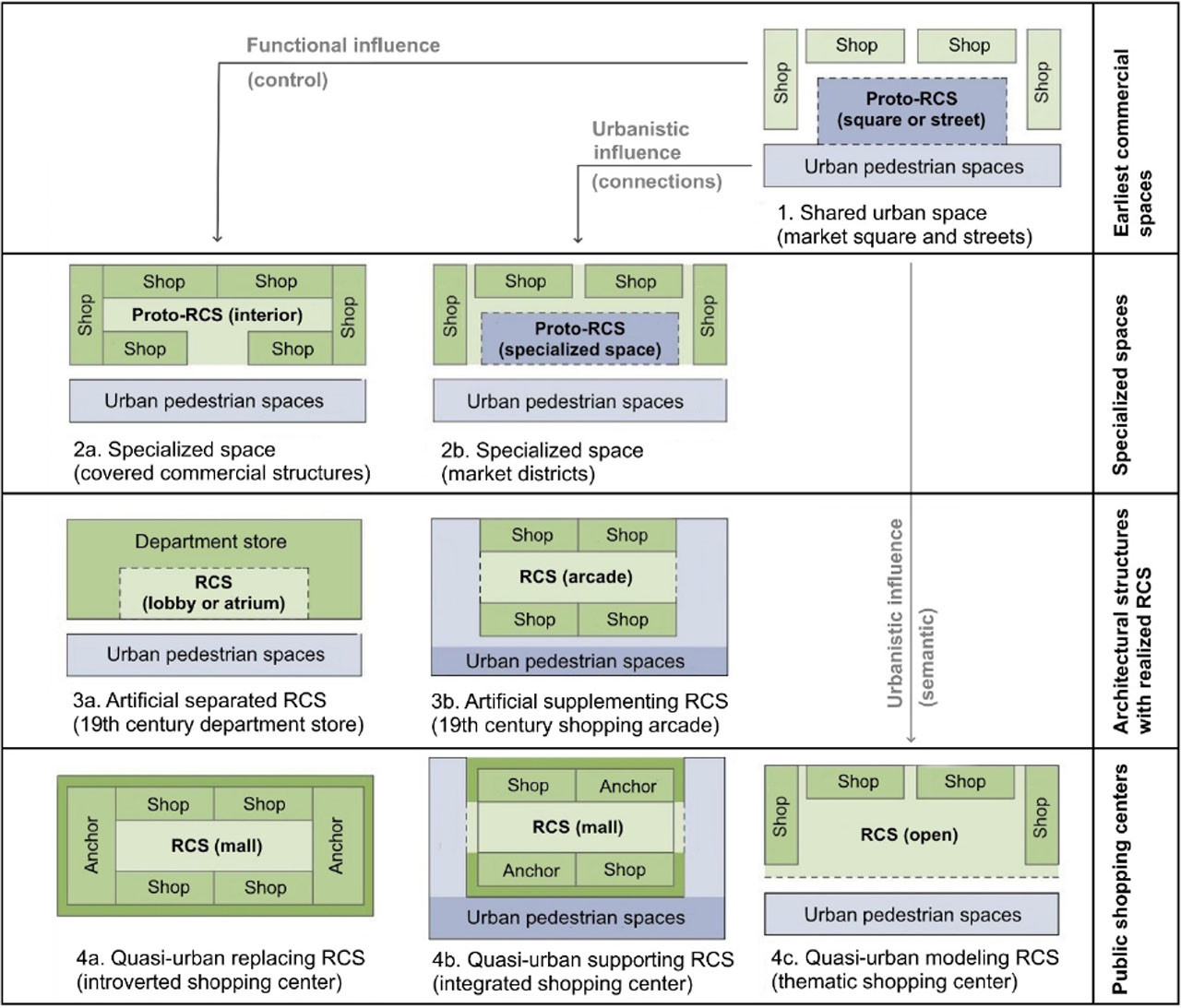
Figure 7.
Transformation of recreational communication space of public shopping centers and their antecedents. Own work
Thus, the prerequisite influences and causes for the emergence of introverted, integrated and thematic spatial schemes can be distinguished. Each is characterized by a corresponding type of RCS with different qualities (Fig. 8). The aforementioned distinction is considered important by the author in light of the modern spatial transformation of shopping centers because it highlights different RCS logic priorities that eventually result in different spatial types of these buildings. It is useful to distinguish between introverted and thematic types, as an introverted shopping center may have strong thematic influences, but its RCS-hub primarily focuses on control and separation of pedestrian movement within its structure, following the functionalist tradition in this regard. Meanwhile, thematic shopping center emphasizes uniqueness and atmosphere of its RCS-mallscape, building on context and permeating semantic narratives without focus on separation. By distinguishing integrated and thematic types, RCS-conduit from RCS-mallscape, different shopping center design goals can be articulated, namely providing support for a larger system and semantic modeling of a quasi-urban space.
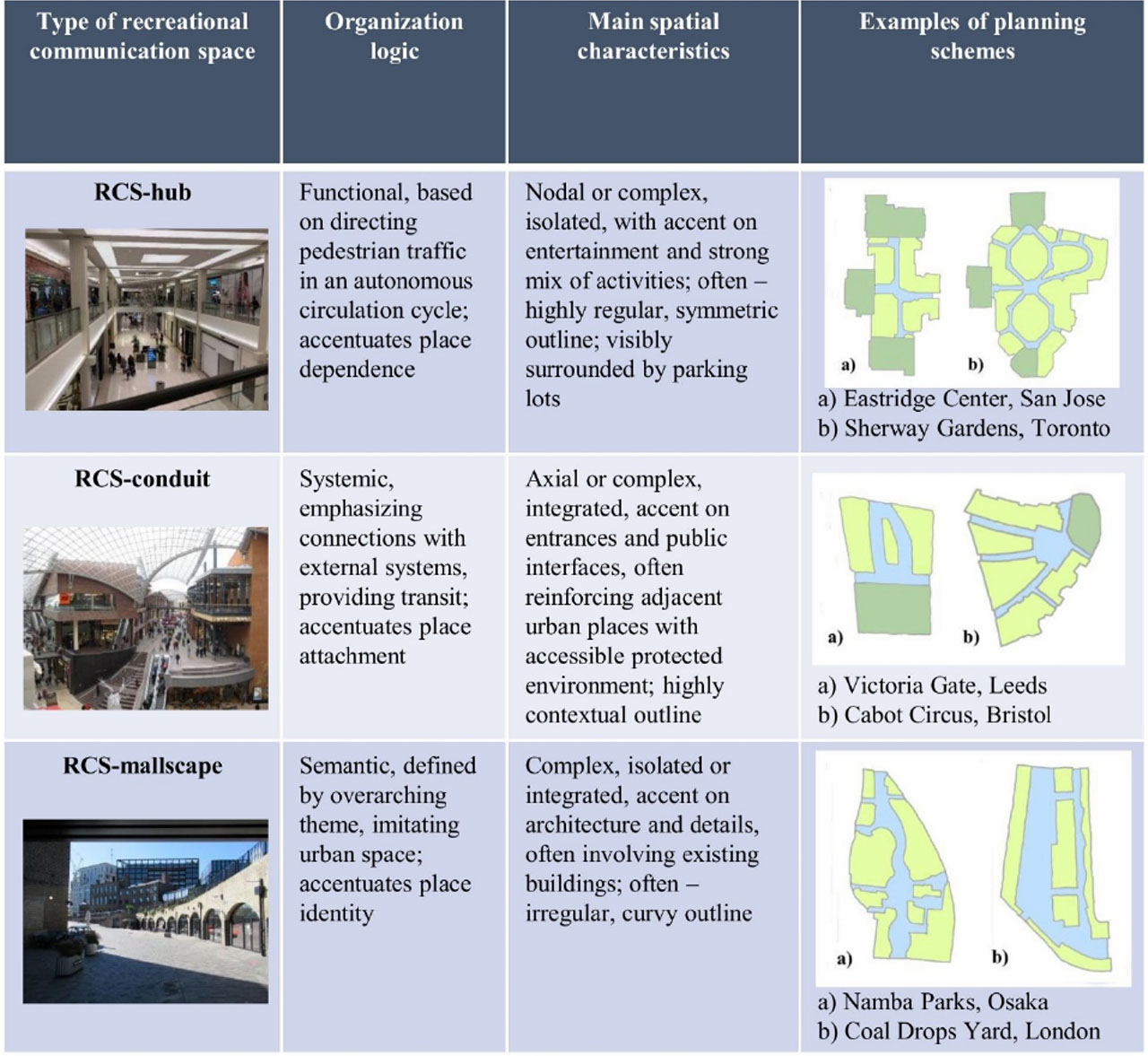
Figure 8.
Three types of recreational communication spaces by their primary logic of spatial organization (blue color on the schemes denotes RCS, light green – shops and additional functions, dark green – department stores as anchors). Illustrations, top to bottom – “Mall of America” in Bloomington, USA, photo by Thomson200, Public domain [16]; “Cabot Circus” in Bristol, UK, photo by Jongleur100, Public domain [16]; “Coal Drops Yard” in London, UK, photo by Andy Scott, Public domain [16]; planning schemes – own work
Such tri-point distinction may cause a number of liminal examples to blur the classification, as borders between introverted and integrated shopping centers are more naturally apparent, than between each of them and thematic. However, the distinguishing factor in identifying the third type is the driving force behind its structure – if the focus on the semantic modeling of quasi-urban space factors over functional movement control or system support in its spatial organization (while all three are usually present in modern solutions), the public shopping center may be considered a thematic one. “Ghirardelli Square” in San Francisco, “Namba Parks” in Osaka, and “Coal Drops Yard” in London can serve as examples of thematic centers by such distinction, illustrating the concept in different decades of public shopping center's history. Meanwhile, “West Edmonton Mall” in Edmonton, Canada or “Nikolskyi” in Kharkiv, Ukraine are still primarily introverted centers, albeit with a stronger role of their overarching theme.
In the same vein, “Cabot Circus” in Bristol, UK or “Victoria Gate” in Leeds, UK are integrated centers. This distinction is reflected in the perception of shopping center's attractive qualities as expressed in visitor's reviews, with different perceived priorities corresponding to three different types [26]. It also maps to a “sense of place” in the context of shopping centers as outlined by van den Berg [14], with perception of place attachment (accessibility and comfort), place dependence (functional use and socializing) and place identity (semantic and aesthetic articulation of place) approximately corresponding to the qualities resulting from the influences mentioned above. While all three are present and important to different degrees, effect of place attachment would be more in line with qualities of integrated shopping centers, place dependence would resonate with introverted solutions, while place identity is definitely linked to the attractive qualities of thematic shopping centers.
Modern transformation of architectural morphology of shopping centers highlights the continuing divergence of spatial formats suitable for their different roles in contemporary situations, further emphasizing the introverted, integrated and thematic spatial schemes. The emergence of “destination malls”, commercial complexes of a significant size with prominent role of entertainment functions, further develops RCS as autonomous hub of activities with a distinct and protected environment. Relatively smaller malls are often designed as part of larger multifunctional complexes (hotels, transport hubs and renovated urban districts in particular) to reinforce the resulting system with their accessible RCS of a conduit type and a convenient trade. Meanwhile, lifestyle centers are enjoying increased attention of developers due to the focus of their RCS-mallscape on unique architectural environment and physical experience, while continuing to be an object of critisism for the deceptively quasi-public nature of their spaces [20].
Another prominent aspect of the modern spatial transformation of shopping centers is connected with the procedures known as “demalling”. They are employed in modern architectural practice as an answer to the problem of “dead malls”, aiming at reconstructing their spatial and functional structure for a more viable use [8]. Design process there is often centered on RCS, opening and adjusting it to work with different functions, but still using it as a basis for the repurposed functional scheme. In fact, some of the processes known under “demalling” specifically focus on transforming the RCS of a hub type into a conduit or a mallscape type. Furthermore, it can be argued that in light of the current shift of perpective in the construction of public shopping centers, caused by the advent of e-commerce, the type-specific architectural tools of thematic shopping centers become even more relevant. As a large part of particular appeal of a traditional physical commercial complex is connected to the experience of visit, aesthetic detailing and overall semantic narrative of RCS provide its atmospherics and character; in the context of forming the sense of place, it creates its unique identity.
An aesthetically and semantically organized RCS-mallscape is a complex object for design, as ideally it should represent not a replica, but a particular mode of existing of an urban fabric in its latest morphological transformation. The problems of private ownership of such a quasi-public space, its existing social control and filtering, as highlighted by a number of authors [29, 30], remain. However, the architectural design of its structure has a genetically conditioned model in its relationship with urban fabric, and often strived to recreate it. The semantic structuring of recreational communication space can be considered as the next, potentially constructive step in this direction and in this quality deserves additional attention as a factor for its further transformation. Such semantic dimension of design ranges from the simple echoing of overarching theme on decoration and detailing, to assigning different but systemically connected (and readable) meanings to different zones and locations of the spatial structure of RCS, to designing the viewscapes and routes through it as part of a quasi-urban experience (which benefits both atmospherics and navigation inside shopping center). Adjacent to that are tools for controlling and articulating the perceived scale of its artificial, but semi-urban environment. The evaluation of specific architectural techniques suitable for these goals may warrant further, more focused study.
3. CONCLUSIONS
Recreational communication space serve as the primary structure-forming element of a public shopping center understood as a system. It ensures the connection of constituent parts of a complex, and defines the peculiarities and intensity of said connections. The development of recreational communication spaces, visibly demonstrated throughout the history of commercial buildings, points to their structural relation to urban spaces. It also highlights the conflicts of functionalism and contextuality, control and situational conditionality as factors at the base of the genesis of modern public shopping centers. This conflict later became reflected in the spatial variation of shopping center types. As a prerequisite factor for the modern transformation of spatial typology of shopping centers, its influence is observed in the changes that recreational communication spaces of these buildings underwent.
Structurally, a recreational communication space can serve as an indicator of a type in the spatial typology of public shopping centers. RCS defines the mode of connection of constituent parts of a larger whole, and the mode of connection primarily defines the spatial organization, as a structure to the system. That is why in the course of designing a public shopping center it is prudent to utilize RCS as the structure-forming basis in architectural composition process, as the configuration and spatial features of RCS define both functional and aesthetic connections in the complex system of a designed object. As such, RCS may be understood as a key element in the spatial typology of shopping centers. Due to morphologic similarities and common formation logic with a wider set of poly-functional structures, a comparable role of this structural element in their spatial organization may also be inferred.
The prerequisites of modern transformation of spatial typology of shopping centers highlight three directions of its development, resulting in particular spatial organization of corresponding RCS. Recreational communication space can form a spatially distinct hub-like structure, generally related to introverted shopping center scheme and based primarily on functional logic in its design. RCS-hub is organized as the end destination, involving and cycling pedestrian movement inside of it. Such a space has a nodal composition and requires a particular focus on mutual energization and synergy of activities within. Alternatively, RCS can serve as a conduit of urban life and activity for a larger system that incorporates integrated shopping center scheme in its structure; in this case, its spatial organization is designed with a focus on systemic approach and particular attention to the logic and placement of its connections. RCS-conduit is usually of transit nature, often of axial composition, allowing visitors to permeate adjacent pedestrian spaces inside and outside, and easily pass between different entrances. It may require additional reinforcement of its comfortable qualities, like protection from adverse weather conditions and availability of free accessible WCs. Finally, RCS can be organized into a spatially complex mallscape with the guiding role of aesthetic and semantic factors in its design, an approach characteristic for thematic shopping centers. RCS-mallscape is a complex network of spaces differentiated by their semantic contents, aimed at modeling urban space in its perception by visitors, often involving the use of historic buildings and situational context. It usually includes mixed open and enclosed spaces, mimicking the spatial complexity of urban fabric. An associated design approach is particularly relevant in light of the modern shift of views on traditional shopping centers. Having to compete with e-commerce, bricks-and-mortar complexes have to rely on their distinct advantage of physical environment and experience of a visit associated with it, which may be effectively articulated by the purposeful semantic design and spatial qualities of their recreational communication spaces.
ACKNOWLEDGEMENTS
This study is carried out as a part of larger research topic “Prerequisites of Transformation of Modern Typology of Buildings and Structures” of the Department of Architecture of Buildings and Structures of O.M. Beketov National University of Urban Economy in Kharkiv.