
1. INTRODUCTION
The main pollutants emitted to the atmosphere as a result of anthropogenic human activity include: sulfur dioxide, nitrogen oxides, dust, volatile organic compounds (VOCs), persistent organic pollutants (POPs), heavy metals, greenhouse gases and odours. The enormous impact of air quality on the environment, but above all on human health and life, is the reason why it is so important to constantly monitor air quality and strive to minimize pollution and improve air quality. Epidemiological studies show that negative health effects in humans occur not only in the case of exposure to increased mass concentrations of various fractions of atmospheric dust, but also result from its chemical, physical and biological properties [1-2]. The incidence of asthma and chronic obstructive pulmonary disease (COPD) as well as increased exacerbation of these diseases is correlated with an increased concentration of harmful substances in the atmosphere, which implies a significant share of air pollution in the course of obstructive pulmonary diseases [3]. It is believed that children's bodies are more exposed to pollution than adults. This is because organisms in the growing phase are more susceptible to damage than organisms that are already developed. Moreover, children inhale more air in relation to their body weight than adults, and they also display greater physical activity, which in turn translates into greater exposure to air pollutants [4].
Research results prove the huge impact of broadly understood air pollution on the biological condition, the regularity of growth and development processes, and the general psychophysical condition of people at all stages of ontogenesis, up to the quality and length of life. Environmental factors in each phase of ontogenetic development modify all aspects of the psychophysical condition. Organisms in the prenatal period of progressive development are particularly sensitive to environmental factors, when air pollution causes: 1/ fetal hypoxia (hypoxia), reducing birth weight, and 2/ through epiegenetic activities, it will change genetically programmed developmental pathways. For example, the diversity of the living environment in Poland determines up to 8 cm difference in the final body height of young men [5].
Exposure to air pollutants is highly dependent on their concentration. According to a report by the World Health Organization, nine out of ten people breathe polluted air, and this causes around seven million deaths worldwide each year. The current state of air quality in Poland is mainly caused by the so-called low emissions, mainly from the household and municipal sectors. The factors that negatively affect air quality, especially in the case of low-emission sources, include unfavourable meteorological conditions, such as: weak wind, low air temperature or fog. However, high wind speeds and heavy rainfall result in a significant reduction in the level of pollutant concentrations. The problem contributing to poor air quality in Poland is the use of outdated motor vehicles, especially those with diesel engines, which are important sources, e.g. of dust emissions. The exceedance of air quality standards for dusts PM10 and PM2.5 is caused not only by their emission, but also by their gaseous precursors commonly emitted into the atmosphere, e.g. SO2, NOX, and hydrocarbons.
Air protection is one of the priority directions of Poland's policy. Considering the improvement in air quality, the need to replace coal with other energy carriers becomes more and more clearly visible. This problem affects all countries where energy policy is based on coal, such as China, India and North America. The key activities in the field of air protection include the reduction of air pollutant emissions, allowing for the improvement of its quality and compliance with the air quality standards in force in Polish law.
At the end of 2018, the Silesian University of Technology in Poland acquired a mobile laboratory built on the Ford Transit chassis, and the obtained measurement results are used in the area of low emissions forecasting and serve as a tool to fight smog. The mobile air pollution emission laboratory is equipped with: SO2 – T100/Teledyne API analyzer, NOX – T200/Teledyne API analyzer, suspended dust meter PM10/PM2.5 BAM1020, WS 500 Lufft meteo set, Envimet intake Services, Envimet Services calibration system, Envimet Services datalogger with a display and Envimet Services power system. The laboratory allows to measure the concentration of:
SO2 – continuous automatic measurement using the fluorescence method in accordance with PN-EN 14212: 2013-02/AC:2014-06E (PN-EN 14212:2013-02/AC:2014-06E Ambient air quality – Standard method for the measurement of the concentration of sulfur dioxide by ultraviolet fluorescence [6]);
NOx – continuous automatic measurement using the chemiluminescence method in accordance with PNEN 14211:2013-02 (PN-EN 14211:2013-02 Ambient air quality-Standard method for the measurement of the concentration of nitrogen dioxide and nitrogen monoxide by chemiluminescence [7]);
PM10 – continuous automatic measurement with the method for which equivalence with the reference method has been demonstrated according to PN-EN 12341:2014-07 (PN-EN 12341:2014-07 Ambient air - Standard gravimetric measurement method for the determination of PM10 or PM2.5 mass concentration of suspended particulate matter [8]);
PM2.5 – continuous automatic measurement with the method for which equivalence with the reference method has been demonstrated according to PN-EN 12341:2014-07 (PN-EN 12341:2014-07 Ambient air - Standard gravimetric measurement method for the determination of PM10 or PM2.5 mass concentration of suspended particulate matter [8]).
Owing to the co-financing granted by the Voivodship Fund for Environmental Protection and Water Management in Katowice and by the Silesian University of Technology in Poland, the launched mobile laboratory allows to carry out measurements of air pollution concentrations in the vicinity of selected emission sources, e.g. energy facilities, municipal sources, or sources of fugitive emissions. It allows to supplement and expand the spectrum of information on air quality in places not covered by systematic monitoring. Therefore, the use of the simple additive weighting method in the assessment process of air pollution may be of particular importance in interdisciplinary research on public health and its determinants.
2. SIMPLE ADDITIVE WEIGHTING (SAW) – DESCRIPTION OF THE METHOD
Monitoring the phenomenon of smog, which generates high concentrations of substances in the air, hazardous to human life and health, is one of the platforms of broadly understood pro-ecological activities. In recent years, in the processing of large amounts of data and information describing the extent of air pollution, the so-called synthetic measures have become more and more important. They are determined on the basis of multivariate statistical methods, and although these methods differ in the approach to the criteria which are taken into account (setting correlation thresholds, unifying the field of compared criteria), by their application, we can replace the entire set of features describing the object with one aggregated variable.
The Simple Additive Weighting (SAW) method belongs to the group of single criteria synthesis methods, which rank the examined objects on the basis of a linear combination of the weight vector W [k×1] and the decision matrix D [m×k] (m – object, k – criterion) [9, 10, 11, 12, 13, 14, 15, 16, 17, 18, 19, 20, 21, 22, 23, 24, 25, 26]. The weight vector W can be filled arbitrarily (subjective weights) or using mathematical methods (objective weights), and regardless of the determination method of the weights of the values of the coefficients defining the degree of influence of the k-th criterion on the final decision, it should be within the range 〈0;1 〉. The SAW method requires the determination of the nature of each of the criteria: cost criterion or qualitative criterion (in the case of the first one, it is desirable to minimize the obtained values, and in the case of the second one – to maximize the obtained values). In turn, the decision matrix D consists of real numbers dij corresponding to the numerical value adopted by a given criterion for the selected object. In order to ensure the comparability of the values obtained by the objects under criterion k, the decision matrix D should be linearly re-scaled [27]:
in the case of the so-called cost criterion:
in the case of the so-called qualitative criterion:
3. RESULTS OF THE RESEARCH
As part of the article, the measurements results of the concentration of PM10 [μg/m3] and PM2.5 [μg/m3] as well as the concentrations of SO2 [μg/m3], NO [μg/m3], NO2 [μg/m3] and NOx [μg/m3] were used. They were made in the so-called “winter period” of the year 2020, i.e. from 1/01/2020 to 31/03/2020 and from 01/10/2020 to 31/12/2020 on the campus of the Silesian University of Technology in Poland (sampling point PP (Fig. 1): Gliwice, Konarskiego 20B, 50.292934N, 18.682164E).
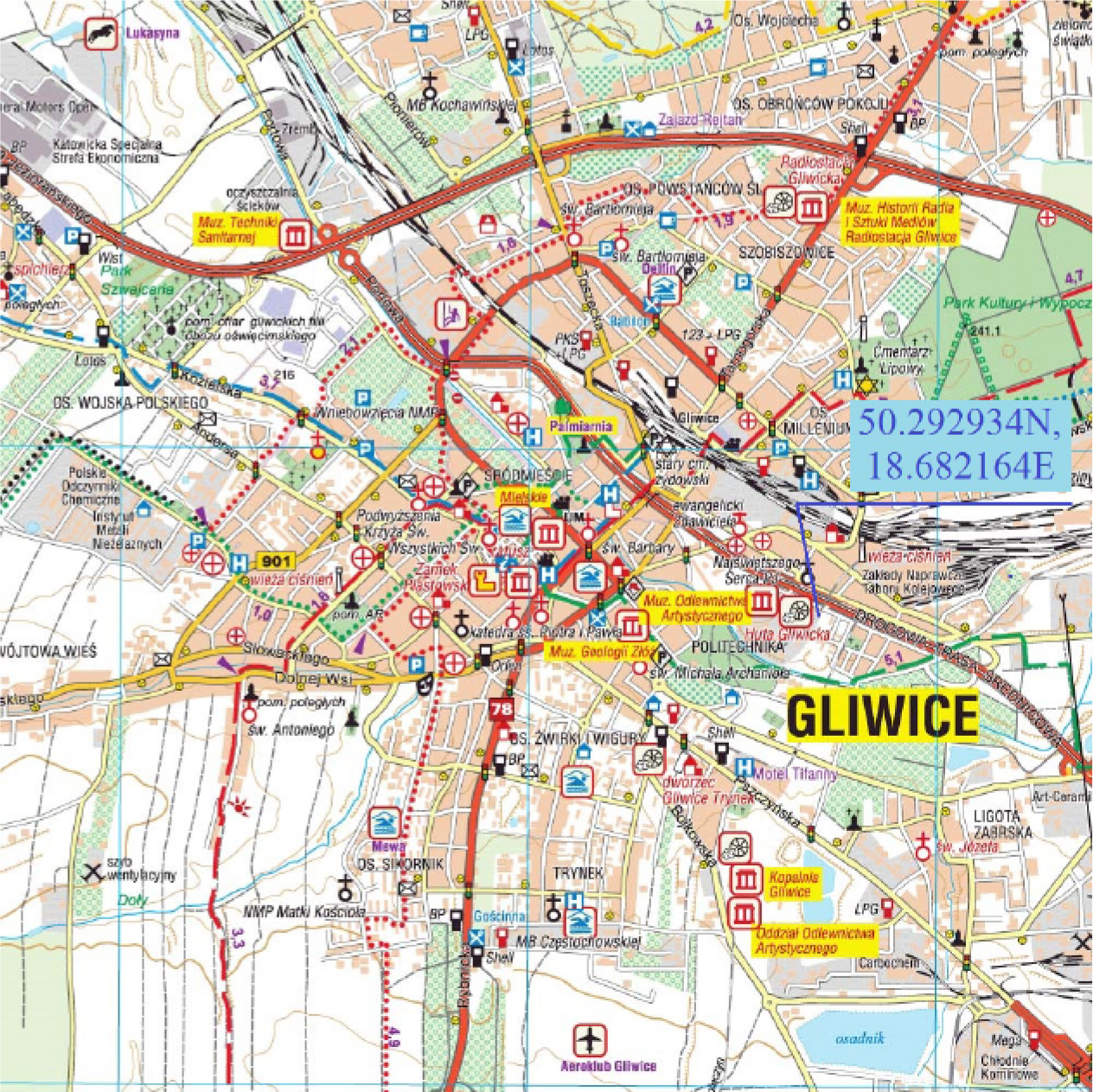
Figure 1.
Location of the measurement point (50.292934N, 18.682164E) [28]
The distance of the sampling point from the nearest building development was about 12 m, and it was greater than the distance required for the place of air sampling [29]. The following communication routes are located in the vicinity of PP:
from the north-east, at a distance of approximately 500 m – road DW902,
in the north-west direction at a distance of about 450 m – road DW901,
towards the west, at a distance of approximately 600 m – road DK78.
In addition, to the north, at a distance of about 600 m, there is a well-developed railway infrastructure (Gliwice railway station).
In the immediate vicinity of the PP, there is a typical urban development including public utility buildings, a shopping centre and multi-family residential buildings.
The compilation of the measured values of the above-mentioned substances is presented in Table 1. The ranges of variability of the measured parameters are presented in Table 2.
Table 1.
Compilation of the concentration of PM10 [μg/m3] and PM2.5 [μg/m3] and the content of SO2 [μg/m3], NO [μg/m3], NO2 [μg/m3] and NOx [μg/m3] in the “winter period” of the year 2020
| Measurement date | PM10 [μg/m3] | PM2.5 [μg/m3] | SO2 [μg/m3] | NO [μg/m3] | NO2 [μg/m3] | NOX [μg/m3] |
|---|---|---|---|---|---|---|
| 1/01/2020 | 40.462 | 28.323 | 25.478 | 3.275 | 8.706 | 13.715 |
| 2/01/2020 | 124.902 | 87.432 | 41.503 | 38.821 | 27.195 | 86.583 |
| 3/01/2020 | 107.254 | 75.078 | 32.006 | 26.421 | 14.956 | 55.371 |
| … | … | … | … | … | … | … |
| 29/03/2020 | 55.676 | 38.973 | 7.273 | 2.754 | 14.338 | 18.552 |
| 30/03/2020 | 20.938 | 14.656 | 6.421 | 3.986 | 15.239 | 21.336 |
| 31/03/2020 | 39.466 | 27.626 | 8.923 | 5.641 | 20.317 | 28.951 |
| 1/10/2020 | 18.258 | 12.781 | 22.049 | 14.453 | 19.972 | 42.070 |
| 2/10/2020 | 26.515 | 18.560 | 21.959 | 9.113 | 21.565 | 35.493 |
| 3/10/2020 | 24.387 | 17.071 | 22.209 | 1.164 | 7.612 | 9.392 |
| … | … | … | … | … | … | … |
| 29/12/2020 | 43.747 | 30.623 | 19.279 | 13.790 | 24.309 | 45.409 |
| 30/12/2020 | 39.855 | 27.899 | 18.920 | 41.474 | 45.820 | 109.232 |
| 31/12/2020 | 54.991 | 38.493 | 37.079 | 13.620 | 34.108 | 54.943 |
Table 2.
The ranges of variability of the measured parameters
| Measurement date | PM10 [μg/m3] | PM2.5 [μg/m3] | SO2 [μg/m3] | NO [μg/m3] | NO2 [μg/m3] | NOX [μg/m3] |
|---|---|---|---|---|---|---|
| max | 174.146 | 121.902 | 41.503 | 112.511 | 45.820 | 216.371 |
| min | 7.403 | 5.182 | 5.552 | 0.959 | 5.935 | 7.406 |
Additionally, the following were also measured: air temperature, air humidity, air pressure, as well as wind speed and direction (Table 3).
Table 3.
Measured values of air temperature, air humidity and air pressure, wind speed and direction
| Measurement date | Air temperature [°C] | Air humidity [%] | Air pressure [hPa] | Wind speed [m/s] | Wind direction [°] |
|---|---|---|---|---|---|
| 1/01/2020 | 2.626 | 77.801 | 1005.725 | 1.203 | 208.410 |
| 2/01/2020 | −0.240 | 74.948 | 1003.083 | 0.514 | 151.699 |
| 3/01/2020 | 0.998 | 73.279 | 996.589 | 0.954 | 128.822 |
| … | … | … | … | … | … |
| 29/03/2020 | 4.583 | 72.266 | 988.835 | 3.349 | 340.415 |
| 30/03/2020 | 0.262 | 59.337 | 996.989 | 2.493 | 270.373 |
| 31/03/2020 | 0.566 | 65.272 | 999.125 | 1.642 | 272.971 |
| 1/10/2020 | 12.491 | 95.095 | 979.778 | 0.995 | 89.145 |
| 2/10/2020 | 14.304 | 86.464 | 979.089 | 0.946 | 173.747 |
| 3/10/2020 | 19.404 | 65.669 | 975.675 | 2.524 | 179.362 |
| … | … | … | … | … | … |
| 29/12/2020 | 4.897 | 78.060 | 968.197 | 1.015 | 148.936 |
| 30/12/2020 | 3.773 | 92.317 | 978.256 | 0.646 | 193.396 |
| 31/12/2020 | −0.311 | 97.963 | 983.239 | 1.055 | 171.390 |
The scaled decision matrix V is presented in Table 4.
The weight of features (parameters) wj were determined on the basis of a survey of experts' opinions. The compiled list of weights of the features (parameters) wj is presented in Table 5.
Table 4.
Scaled decision matrix V
| Measurement date | j = 1 | j = 2 | j = 3 | j = 4 | j = 5 | j = 6 |
|---|---|---|---|---|---|---|
| 1/01/2020 | 0.802 | 0.802 | 0.446 | 0.979 | 0.931 | 0.970 |
| 2/01/2020 | 0.295 | 0.295 | 0.000 | 0.661 | 0.467 | 0.621 |
| 3/01/2020 | 0.401 | 0.401 | 0.264 | 0.772 | 0.774 | 0.770 |
| … | … | … | … | … | … | … |
| 29/03/2020 | 0.710 | 0.710 | 0.952 | 0.984 | 0.789 | 0.947 |
| 30/03/2020 | 0.919 | 0.919 | 0.976 | 0.973 | 0.767 | 0.933 |
| 31/03/2020 | 0.808 | 0.808 | 0.906 | 0.958 | 0.639 | 0.897 |
| 1/10/2020 | 0.935 | 0.935 | 0.541 | 0.879 | 0.648 | 0.834 |
| 2/10/2020 | 0.885 | 0.885 | 0.544 | 0.927 | 0.608 | 0.866 |
| 3/10/2020 | 0.898 | 0.898 | 0.537 | 0.998 | 0.958 | 0.990 |
| … | … | … | … | … | … | … |
| 29/12/2020 | 0.782 | 0.782 | 0.618 | 0.885 | 0.539 | 0.818 |
| 30/12/2020 | 0.805 | 0.805 | 0.628 | 0.637 | 0.000 | 0.513 |
| 31/12/2020 | 0.715 | 0.715 | 0.123 | 0.887 | 0.294 | 0.773 |
Table 5.
Weights of features (parameters) wj used in the example
| wj | |||||
|---|---|---|---|---|---|
| j = 1 | j = 2 | j = 3 | j = 4 | j = 5 | j = 6 |
| 0.163 | 0.163 | 0.121 | 0.286 | 0.095 | 0.173 |
The ranking vector R [m×1] is presented in Table 6.
Table 6.
Ranking vector R [m×1]
| “Object” | Rank (synthetic value) | Ranking place |
|---|---|---|
| 22/11/2020 | 0.976 | 1 |
| 25/12/2020 | 0.964 | 2 |
| 22/03/2020 | 0.956 | 3 |
| 11/02/2020 | 0.952 | 4 |
| 12/02/2020 | 0.945 | 5 |
| 02/02/2020 | 0.944 | 6 |
| 21/03/2020 | 0.941 | 7 |
| 12/03/2020 | 0.940 | 8 |
| 11/03/2020 | 0.938 | 9 |
| 18/10/2020 | 0.934 | 10 |
| … | … | … |
| 03/12/2020 | 0.586 | 159 |
| 18/03/2020 | 0.578 | 160 |
| 01/12/2020 | 0.573 | 161 |
| 11/12/2020 | 0.509 | 162 |
| 02/12/2020 | 0.455 | 163 |
| 02/01/2020 | 0.437 | 164 |
| 05/03/2020 | 0.433 | 165 |
| 09/11/2020 | 0.409 | 166 |
| 16/01/2020 | 0.300 | 167 |
| 17/01/2020 | 0.064 | 168 |
Partial rankings of “objects” according to concentration of dusts: PM10 and PM2.5 and chemical compounds: SO2, NO, NO2 and NOX are presented in Tables 7–8.
Table 7.
Partial rankings of “objects” in terms of measurement results of the concentrations of dusts: PM10 and PM2.5
| Place in ranking | „Object” | Concentration of dust PM10 | Place in ranking | „Object” | Concentration of dust PM2.5 |
|---|---|---|---|---|---|
| 1 | 14/10/2020 | 7.403 | 1 | 14/10/2020 | 5.182 |
| 2 | 23/02/2020 | 10.552 | 2 | 23/02/2020 | 7.386 |
| 3 | 11/03/2020 | 11.191 | 3 | 11/03/2020 | 7.834 |
| 4 | 12/03/2020 | 11.752 | 4 | 12/03/2020 | 8.226 |
| … | … | … | … | … | … |
| 166 | 16/01/2020 | 113.446 | 166 | 16/01/2020 | 79.413 |
| 167 | 02/01/2020 | 124.902 | 167 | 02/01/2020 | 87.432 |
| 168 | 17/01/2020 | 174.146 | 168 | 17/01/2020 | 121.902 |
Table 8.
Partial rankings of “objects” in terms of measurement results of the concentrations of chemical compounds: SO2, NO, NO2 and NOx
| Place in ranking | “Object” | Concentration of dust PM10 | Place in ranking | „Object” | Concentration of dust PM2.5 |
|---|---|---|---|---|---|
| 1 | 21/03/2020 | 5.552 | 1 | 22/11/2020 | 0.959 |
| 2 | 22/03/2020 | 5.876 | 2 | 26/12/2020 | 1.051 |
| 3 | 18/02/2020 | 5.926 | 3 | 03/10/2020 | 1.164 |
| 4 | 12/03/2020 | 6.141 | 4 | 25/12/2020 | 1.351 |
| … | … | … | … | … | … |
| 166 | 31/12/2020 | 37.079 | 166 | 09/11/2020 | 64.873 |
| 167 | 14/01/2020 | 38.031 | 167 | 16/01/2020 | 96.890 |
| 168 | 02/01/2020 | 41.503 | 168 | 17/01/2020 | 112.511 |
| Place in ranking | “Object” | Concentration of NO2 | Place in ranking | “Object” | Concentration of NOx |
| 1 | 22/11/2020 | 5.935 | 1 | 22/11/2020 | 7.406 |
| 2 | 18/10/2020 | 6.790 | 2 | 25/12/2020 | 9.094 |
| 3 | 25/12/2020 | 7.028 | 3 | 18/10/2020 | 9.249 |
| 4 | 03/10/2020 | 7.612 | 4 | 03/10/2020 | 9.392 |
| … | … | … | … | … | … |
| 166 | 27/03/2020 | 42.210 | 166 | 05/03/2020 | 129.471 |
| 167 | 17/01/2020 | 44.248 | 167 | 16/01/2020 | 183.417 |
| 168 | 30/12/2020 | 45.820 | 168 | 17/01/2020 | 216.371 |
4. CONCLUSIONS
The method of Simple Additive Weighting (SAW) used in the article belongs to the group of single criteria synthesis methods which creates a ranking of the examined objects on the basis of a linear combination of the weight vector W [k×1] and the decision matrix D [m×k] (m – object, k – criterion). Since the adopted criteria/measurement results of the concentration of dusts PM10 and PM2.5 as well as gaseous pollutants: SO2, NO, NO2 and NOX involved in this paper only one measuring point (r = s), in order to define the “objects”, an additional parameter (feature) was introduced which is the time (time moments/date) of taking the measurements (sampling). Thus, the subject of the assessment involved “objects” described by the above-mentioned criteria in the successive days of the so-called “winter period” of the year 2020, i.e. on the successive days from 01/01/2020 to 31/03/2020 and from 01/10/2020 to 31/12/2020. The measurement results were used to build the decision matrix D [167×6], and all criteria had the nature of cost criteria.
In terms of the aggregated values of R, the most favourable air quality conditions were reported successively as follows:
22/11/2020 (R = 0.976): the “object” was in the first places three times in the partial rankings (in terms of the concentration level of NO (0.959 [μg/m3]), NO2 (5.935 [μg/m3]) and NOX (7.406 [μg/m3]), but it also took the 13th place in terms of dust concentration level (the concentration of PM10 dust content was 14.961 [μg/m3], and the concentration of PM2.5 – 10.473 [μg/m3]) and merely the 29th place – in terms of SO2 concentration level (8.364 [μg/m3]).
25/12/2020 (R = 0.964): the “object” did not ever come first in the partial rankings: in terms of dust concentration level (PM10 dust concentration was 12.54 [μg/m3], and the concentration of PM2.5 – 8.778 [μg/m3]), it took the 5th places, in terms of the concentration level of NO (1.351 [μg/m3]), NO2 (7.028 [μg/m3]) and NOX (9.094 [μg/m3]) – it took the 4th, 3rd and 2nd place, respectively. Also on that day high concentration of SO2 was recorded (11.654 [μg/m3), which meant that in the partial ranking the “object” took only 64th place.
22/03/2020 and even despite the fact that this “object” was never placed first in the partial rankings. Due to the high level of dust concentration (the concentration of the content of dust PM10 was 23.151 [μg/m3], and the concentration of the content of dust PM2.5 – 16.206 [μg/m3]), this “object” took only the 43rd place. However, in terms of the concentration level of SO2(5.876 [μg/m3), NO (1.844 [μg/m3]), NO2 (8.537 [μg/m3]) and NOX (11.355 [μg/m3]) the “object” took respectively the 2nd, 8th, 7th and 5th place in partial rankings.
With respect to the aggregated values R, the least favourable air quality conditions were reported accordingly on 17/01/2020 (R = 0.064), 16/01/2020 (R = 0.300) and 9/11/2020 (R = 0.409). On 17/01/2020, the highest concentration of dust PM10 and PM2.5 was reported (respectively 174.146 [μg/m3] and 121.902 [μg/m3]), and that of nitrogen oxides: NO (112.511 [μg/m3) and NOX (216.371 [μg/m3]), and on 16.01.2020 in the case of as many as four criteria (concentration of dust PM10 and PM2.5) and nitrogen oxides (NO and NOX), the reported results placed the “object” among the three most “polluted” days in the entire “winter period” in 2020.
By comparing the measurement results of the concentrations of harmful substances in the atmosphere with the observation results of atmospheric conditions (direction and speed of wind, temperature, pressure and humidity of air, etc.), it is possible to determine the level of correlation relationships between the above-mentioned elements. For example, using the Pearson linear correlation coefficient (rxy), we can state that in the “winter period” of 2020, the correlation relationship (a measure of the strength of the linear relationship) between the concentration level of dusts PM10 and PM2.5 and air temperature is low but clearly negative (rxy = −0.393). Also, a low negative but clear correlation occurs in the case of the dependencies between the concentration level of dust PM10 and PM2.5 and air pressure (rxy = −0.246), and between the concentrations of nitrogen oxides: NO, NO2 and NOX and air speed (rxy values are in the range – 0.229÷0.265). The above results can be used for the estimation of the risk of air pollution hazards, for mapping areas with a similar level of risk and for taking preventive action in the case of “objects” with “similar characteristics”. However, it should be remembered that due to the introduced restrictions caused by the SARS-CoV-2 virus (from mid-March 2020, the work was done in the remote mode), the intensity of road traffic, and hence the intensity of traffic in the parking lot of the Silesian University of Technology in Poland (sampling sites) was smaller than that during the time of normal economic functioning, so it does not properly reflect the pollution of the atmosphere. According to the General Directorate for National Roads and Motorways, based on the analysis of data obtained from 32 measuring stations equipped with the via Toll system, the average vehicle traffic from March 9 to May 17, 2020, amounted to approximately 16,500,000 vehicles per day, while in the same period in 2019, it was 25,300,000 vehicles, which is a decrease by approximately 35%. In the future, the author plans to use the above-mentioned method for the analysis of measurement results of air pollution recorded at various points located throughout the entire Silesian agglomeration, which will allow to better identify the concentration level of selected air pollutants in the vicinity of various emission sources and in places away from already existing monitoring stations.
ACKNOWLEDGEMENTS
This work was supported by the Faculty of Energy and Environmental Engineering, Silesian University of Technology (statutory research).