
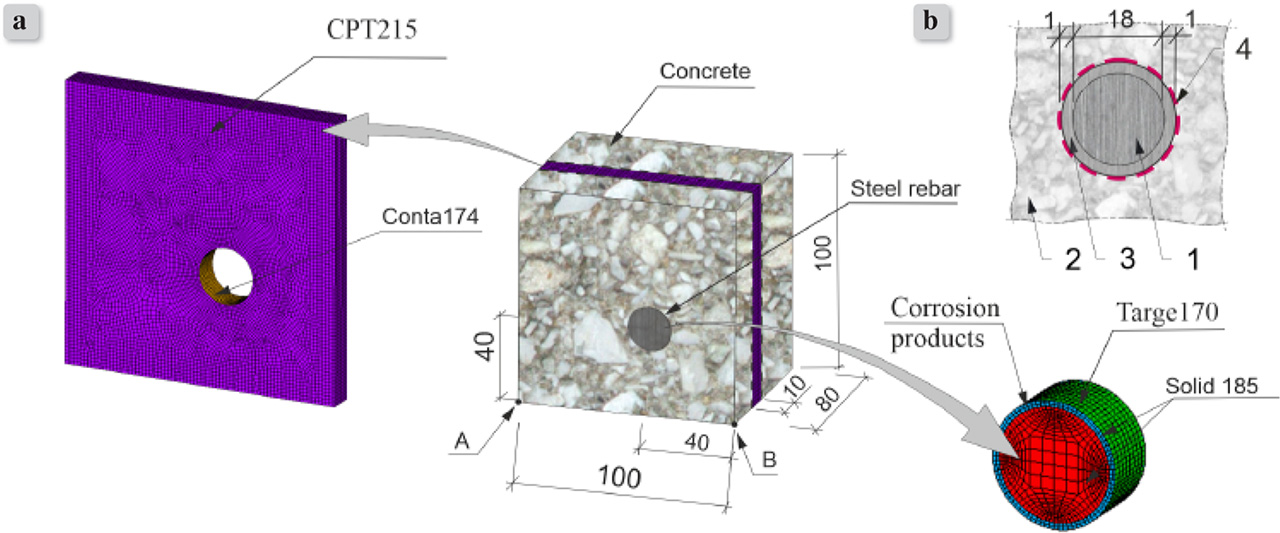
Figure 1.
Model of the test element subject to accelerated reinforcement corrosion: a) FEM model; b) steel-concrete contact zone model, description in the text
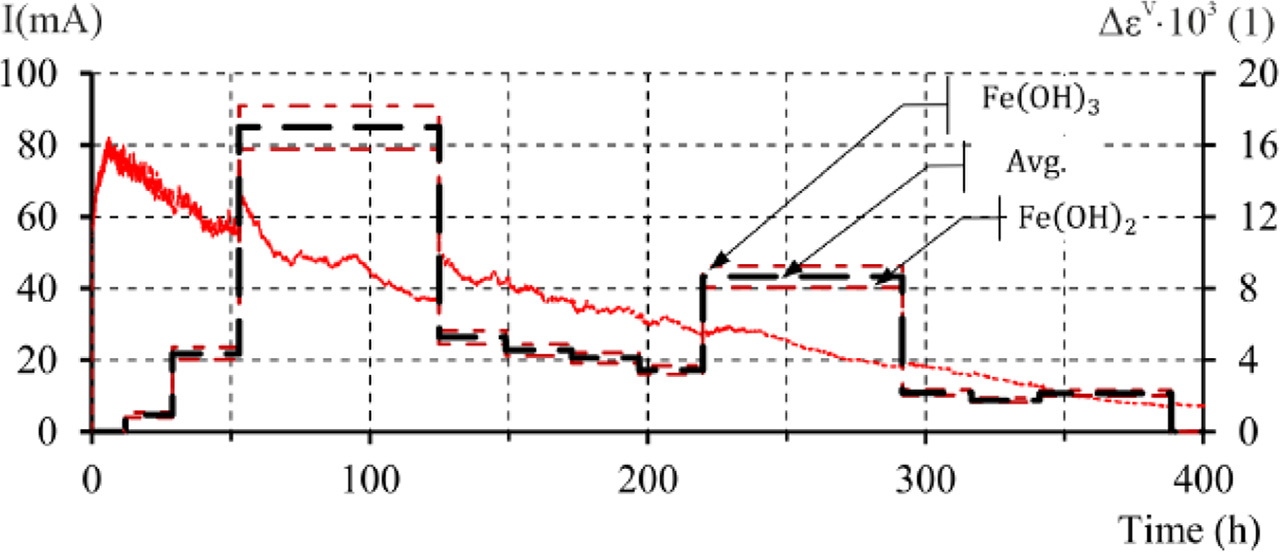
Figure 2.
Functions of the intensity of the current and equivalent increments of volumetric strains in the plane perpendicular to the reinforcing bar axis, Δɛ (description in the text)
Table 1.
Initial elastic and strength material parameters of concrete
| Description | Value |
|---|---|
| Modulus of elasticity, E (GPa) | 38.28 |
| Poisson’s ratio, ν (−) | 0.2 |
| Uniaxial tensile strength, ft (MPa) | 3.99 |
| Uniaxial compressive strength, fc (MPa) | 56.4 |
| Biaxial compressive strength, fbc=1.15 fc (MPa) | 64.86 |
Table 2.
Initial elastic and strength material parameters of steel
| Description | Value |
|---|---|
| Modulus of elasticity, Es (GPa) | 200 |
| Poisson’s ratio, νs (1) | 0.3 |
| Yield strength, fy (MPa) | 235 |
Table 3.
Inelastic parameters of the MW model with HSD2 [21]
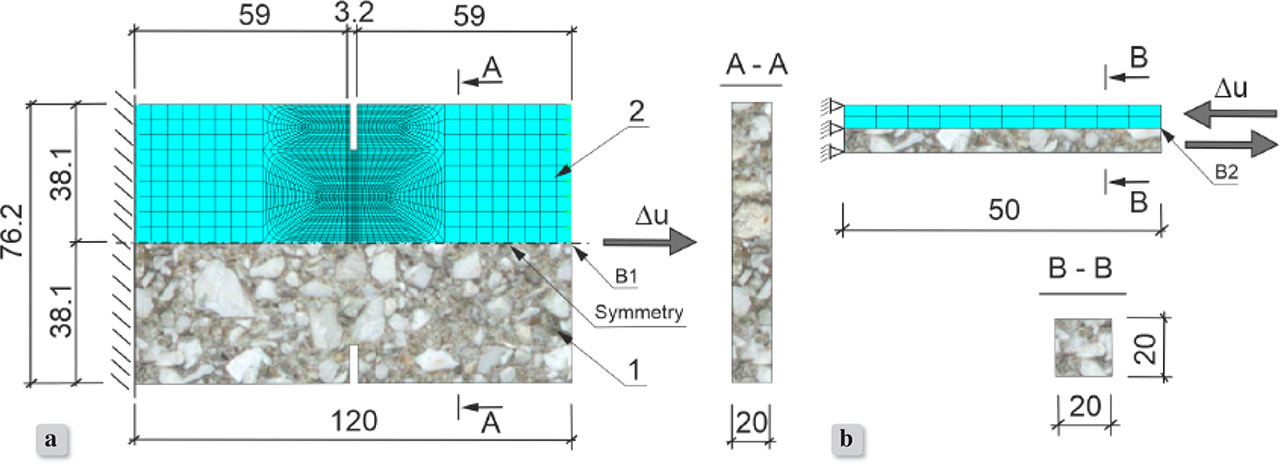
Figure 3.
Test model: a) notched tensile sample and b) cyclically compressed sample
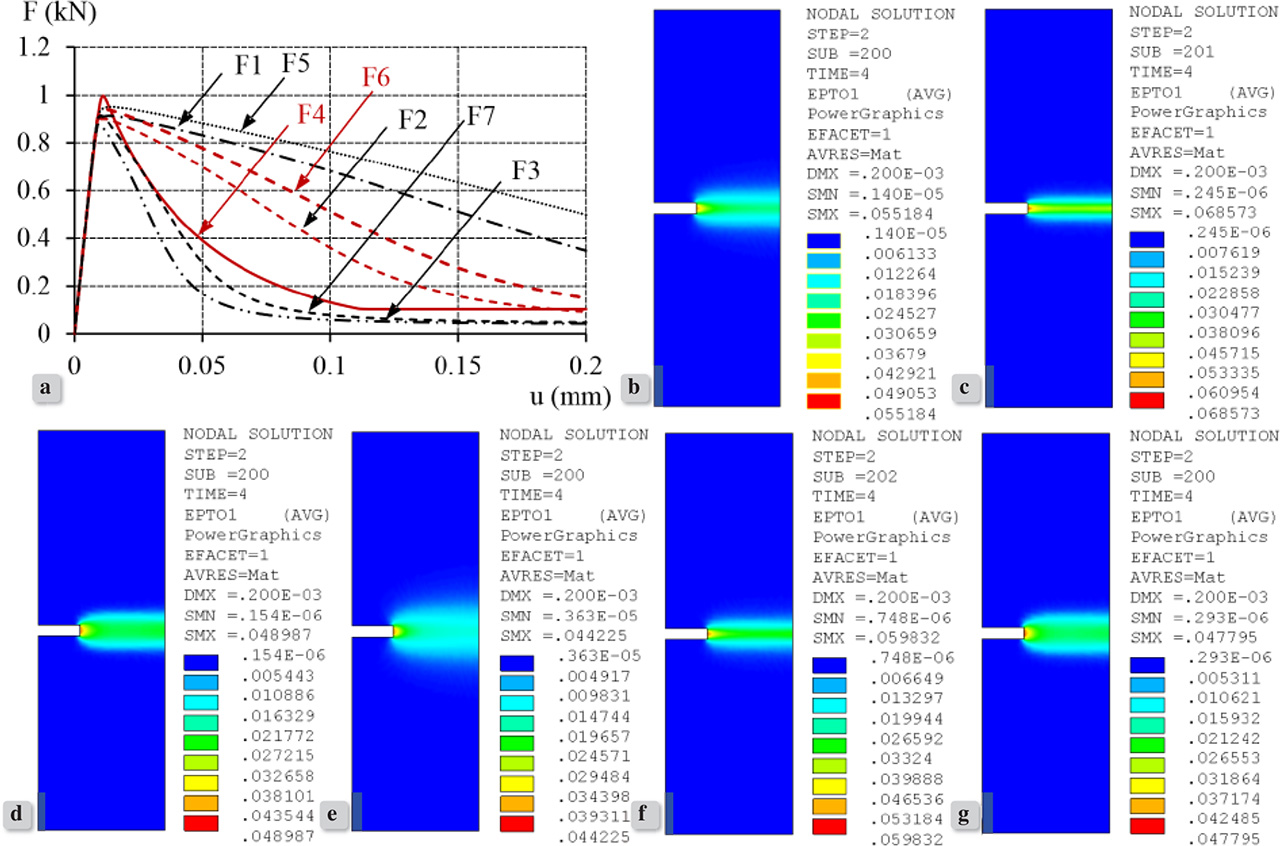
Figure 4.
Response of the system and maps of principal tensile strains ɛ1 (model EDM, variables c, β): a) response of the system; b) c = 5 mm2, β = 50; c) c = 5 mm2, β = 100; d) c = 5 mm2, β= 300, e) c = 8 mm2, β= 50; f) c = 8 mm2, β = 100; g) c = 8 mm2, β= 300
Table 4.
The material parameters of the CDPM model assumed in the cyclic compression test to determine the values D, βc, γc0, [30]
| Description of the variable | Value |
|---|---|
| Abscissa of the intersection point between the compression cap and the Drucker-Prager yield function, (MPa) | −50 |
| The ratio between the major and minor axes of the cap, R (−) | 2 |
| Tension cap hardening constant, RT (−) | 1 |
| Tension damage thresholds, γt0 · 105 (−) | 9.38 |
| Nonlocal interaction range parameter, c (−) | 10 |
| Over-nonlocal averaging parameter, m (−) | 2.5 |
| Tension damage evolution constant, | |
| Hardening material constant, D* (MPa) | 10000 |
| Compression damage thresholds, | 0.0001 |
| Compression damage evolution constant, | 1000 |
Table 5.
Variable material parameters of the CDPM model assumed for the cyclic compression test to determine the value D, βc, γc0, [30]
| Description | M1 | M2 | M3 | M4 | M5 | M6 | M7 | M8 |
|---|---|---|---|---|---|---|---|---|
| D/D* | 4 | 4 | 4 | 1 | 8 | 1 | 1 | 1 |
| 1 | 1 | 1 | 1 | 1 | 0.7 | 1 | 1.3 | |
| 1 | 2 | 3 | 2 | 2 | 2 | 2 | 2 | |
| 1 | 2 | 3 | 2 | 2 | 1.33 | 1.33 | 1.33 |
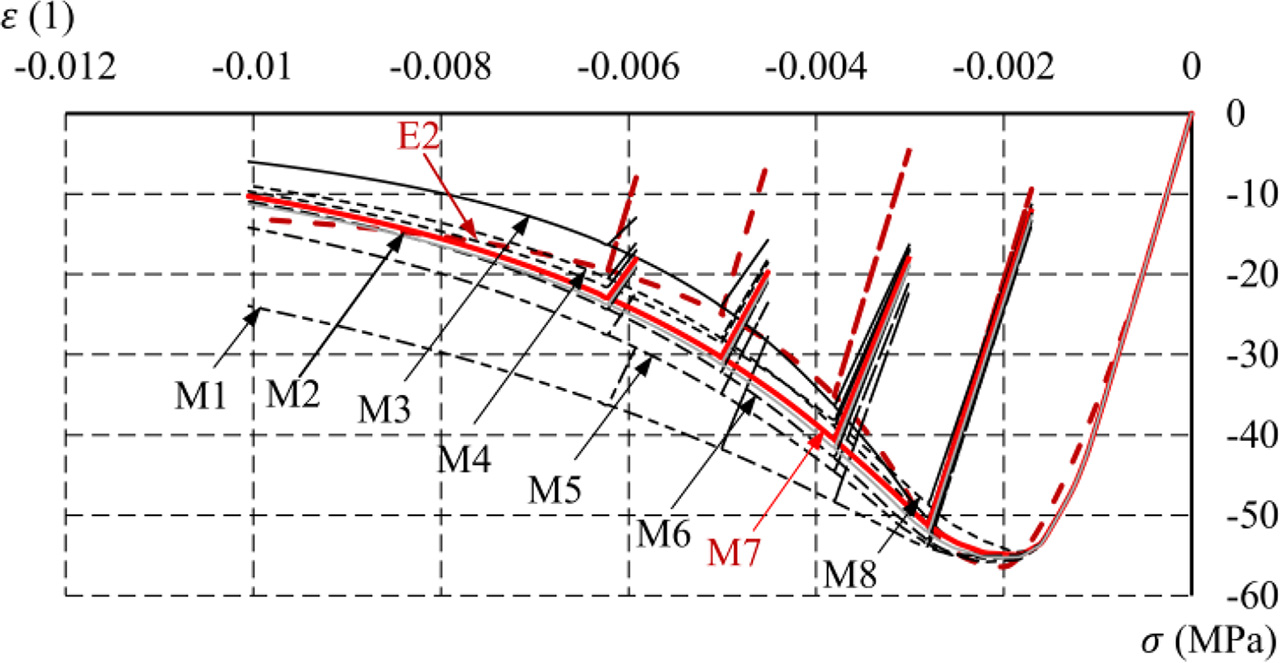
Figure 5.
Change of the σ-ɛ relationship in a cyclically compressed and tensiled sample (description in the text)
Table 6.
Variable material parameters of the CDPM model assumed for the tensile test to determine the values βt and c [30]
| Description | N1 | N2 | N3 | N4 |
|---|---|---|---|---|
| βt | 2000 | 2000 | 2000 | 3000 |
| c (mm2) | 12 | 8 | 5 | 5 |
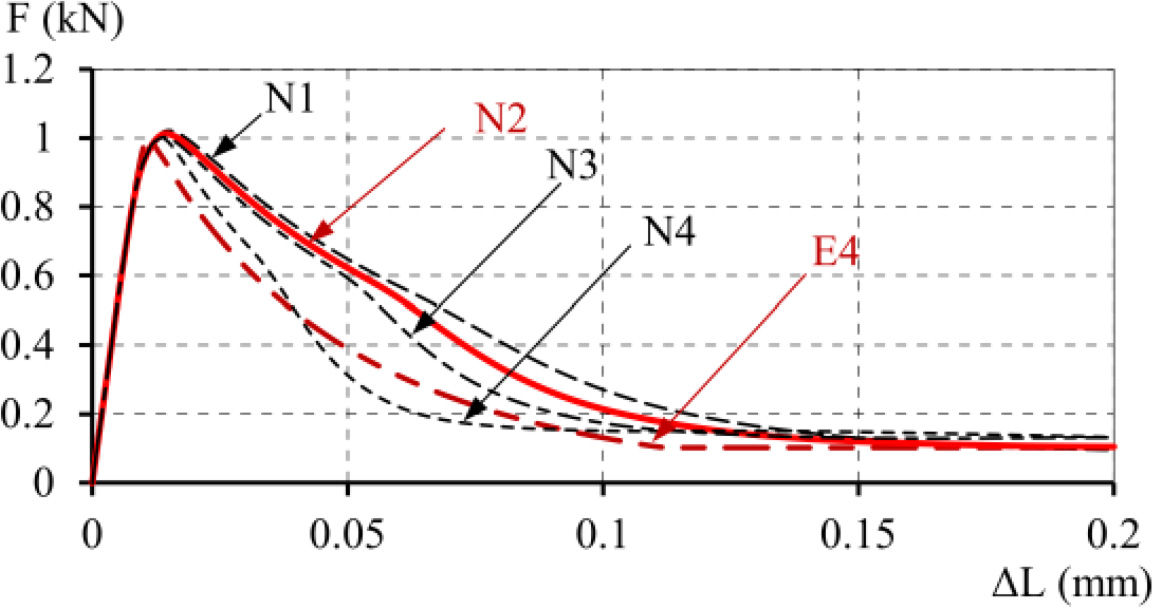
Figure 6.
Relationship between the force and displacement of the system with a variable value of the βt parameter and the gradient parameter c (description in the text)
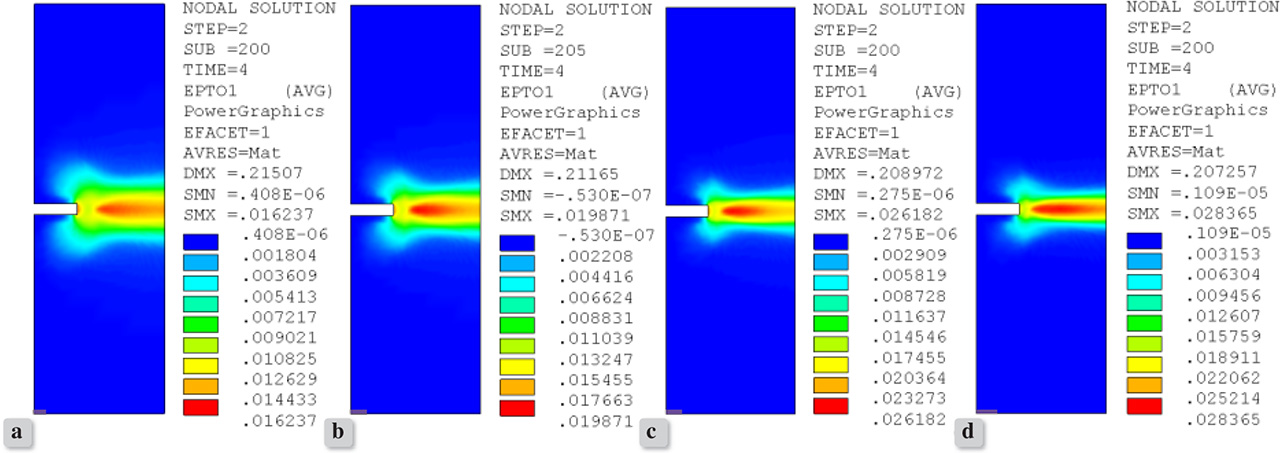
Figure 7.
Maps of the main tensile strains ɛ1 of the notched element (CDPM model, variable parameters βt and c): a) N1, βt = 2000, c = 12; b) N2, βt = 2000, c = 8; c) N3, βt = 2000, c = 5; d) N4, βt = 3000, c =5
Table 7.
Contact model parameters: bonded, no separation with sliding, CZM, standard
| Parameter | Value | |||
|---|---|---|---|---|
| Coefficient of friction, μ (1) | 1.0 | 0.2 | 0.2 | 0.2 |
| Cohesion coefficient, ch(MPa) | 0.0 | 0.375 | 0.375 | 0.375 |
| Normal contact stiffness, | 1.0 | 1.0 | 1.0 | 1.0 |
| Tangent contact stiffness, | 1.0 | 2.0 | 5.0 | 5.0 |
| Maximum allowable shear stress, τmax (MPa) | 1E20 | 18.77 | 18.77 | 18.77 |
| Contact Type | B | NSS | CZM | S |
Table 8.
Supplementary parameters of the cohesive model (CZM)
| Parameter | Value |
|---|---|
| Maximum normal contact stress, σmax (MPa) | 3.99 |
| Critical crack energy in the normal direction, Gcn (N/m) | 151 |
| Maximum tangential contact stress, τt,max (MPa) | 2.26 |
| Critical fracture energy in the tangential direction, Gct (N/m) | 113 |
| Artificial damping parameter, η (1) | 0.0001 |
Table 9.
List of materials and contact models analysed in the paper, along with denotations
| Contact Type | MW with HSD2 | EDM | CDPM |
|---|---|---|---|
| B | M1 | E1 | C1 |
| NSS | M2 | E2 | C2 |
| S | M3 | E3 | C3 |
| CZM | M4 | E4 | C4 |
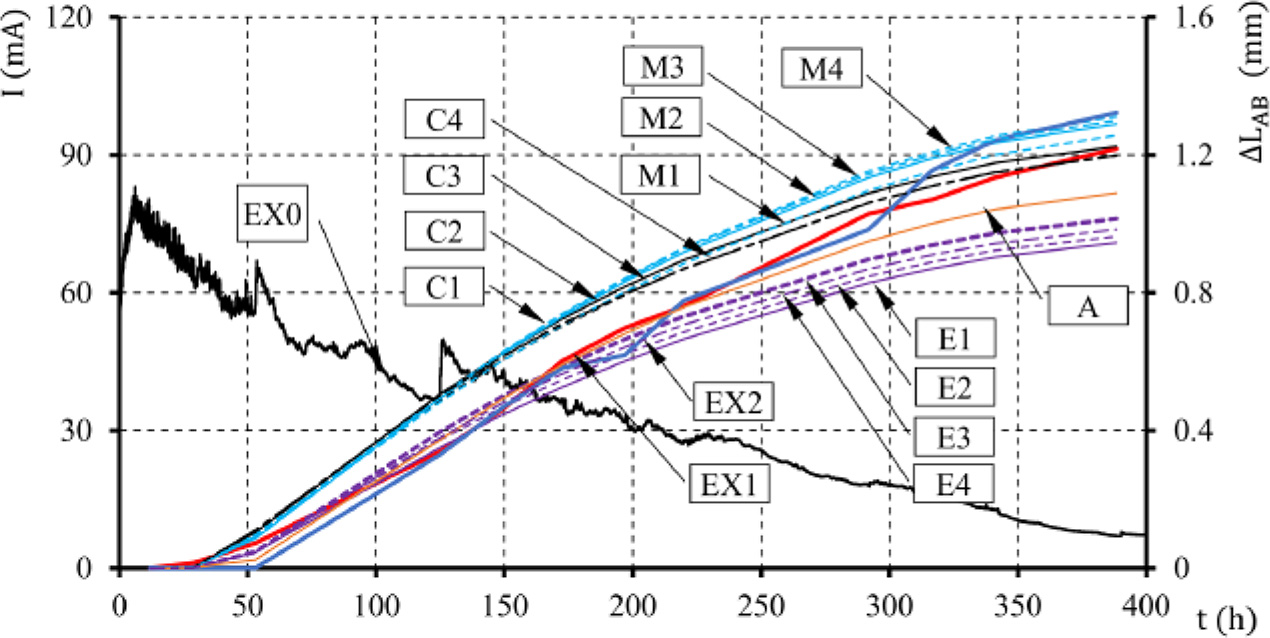
Figure 8.
The evolution of changes in the elongation of the edges of elements of reinforced concrete samples ΔLAB as a result of reinforcement corrosion/calculation model (cf. Fig. 1)
Table 10.
Comparison of the calculation results and the percentage deviation from the results obtained for the MW model with HSD2
| Model | LAB (mm) | |ΔAB|(mm) | |
|---|---|---|---|
| EX1 | 101.22 | - | - |
| EDM E1 | 100.94 | 0.27 | 29 |
| EDM E2 | 100.96 | 0.25 | 26 |
| EDM E3 | 101.01 | 0.20 | 20 |
| EDM E4 | 100.98 | 0.23 | 24 |
| CDPM C1 | 101.22 | 0.01 | 1 |
| CDPM C2 | 101.20 | 0.02 | 2 |
| CDPM C3 | 101.20 | 0.02 | 2 |
| CDPM C4 | 101.20 | 0.02 | 2 |
| MW M1 | 101.29 | 0.07 | 6 |
| MW M2 | 101.26 | 0.04 | 3 |
| MW M3 | 101.31 | 0.09 | 7 |
| MW M4 | 101.30 | 0.08 | 6 |
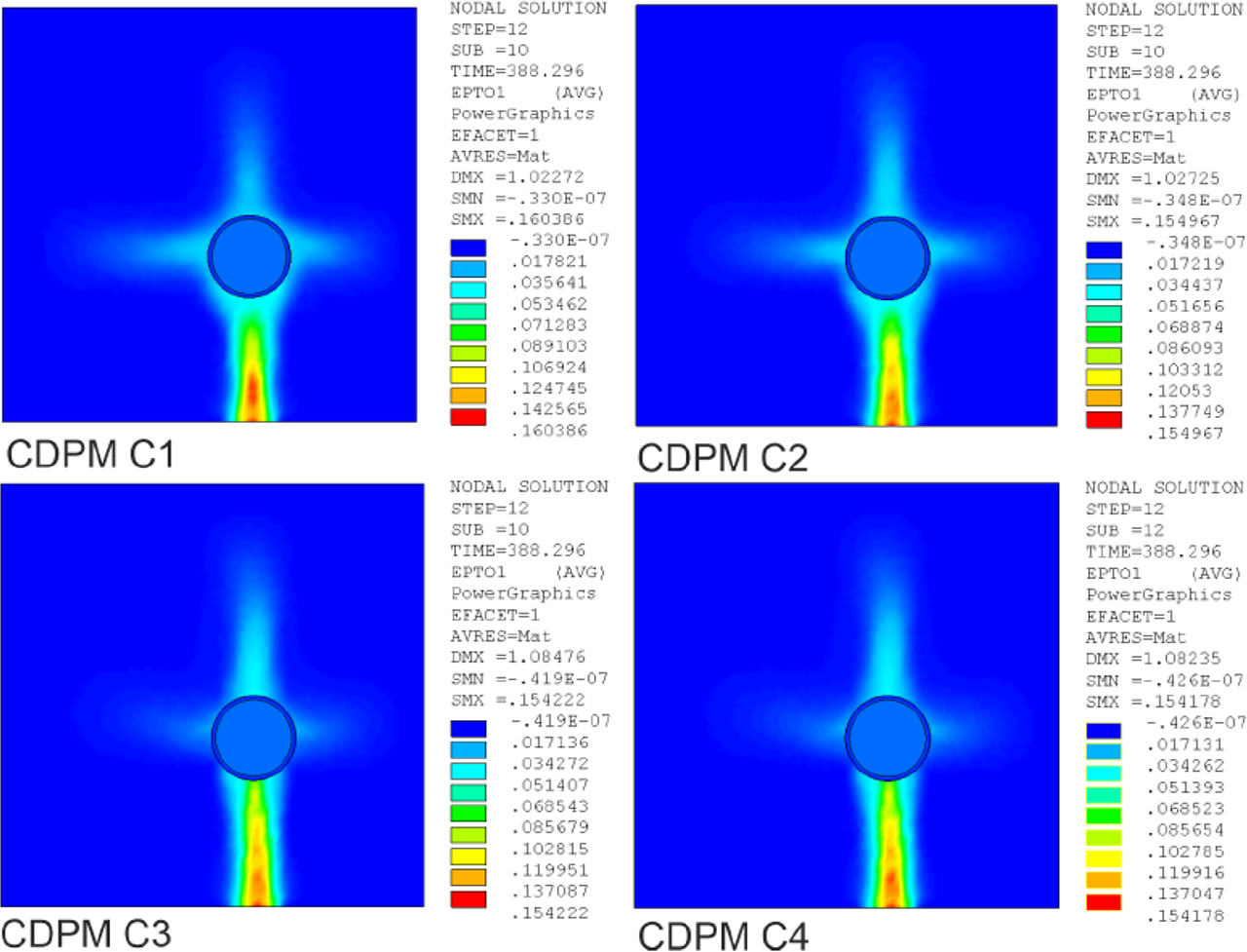
Figure 9.
Maps of total and principal strains, ɛ1, with the CDPM gradient model, time t=388 h
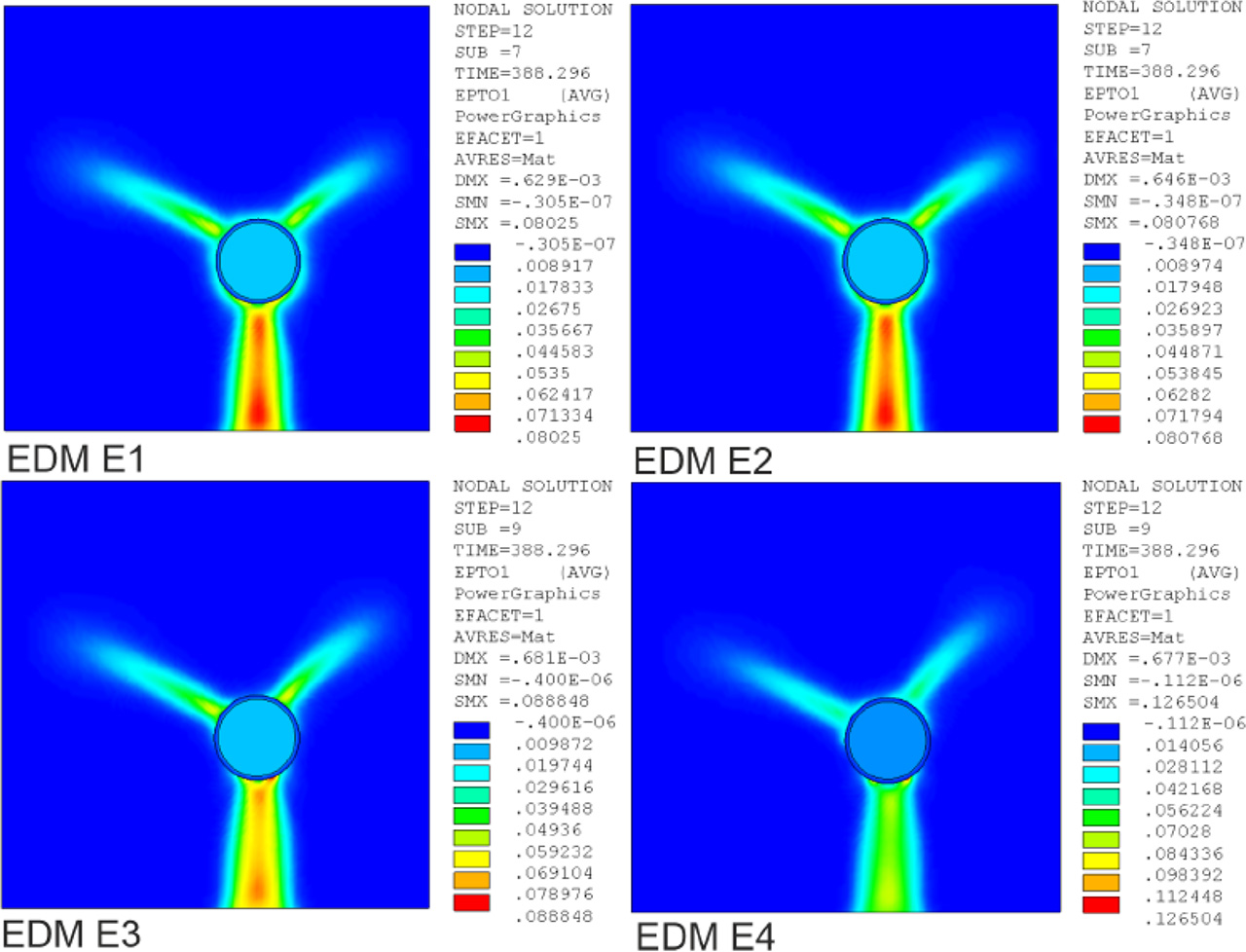
Figure 10.
Maps of total and principal strains, ɛ1, with the EDM gradient model, time t=388 h
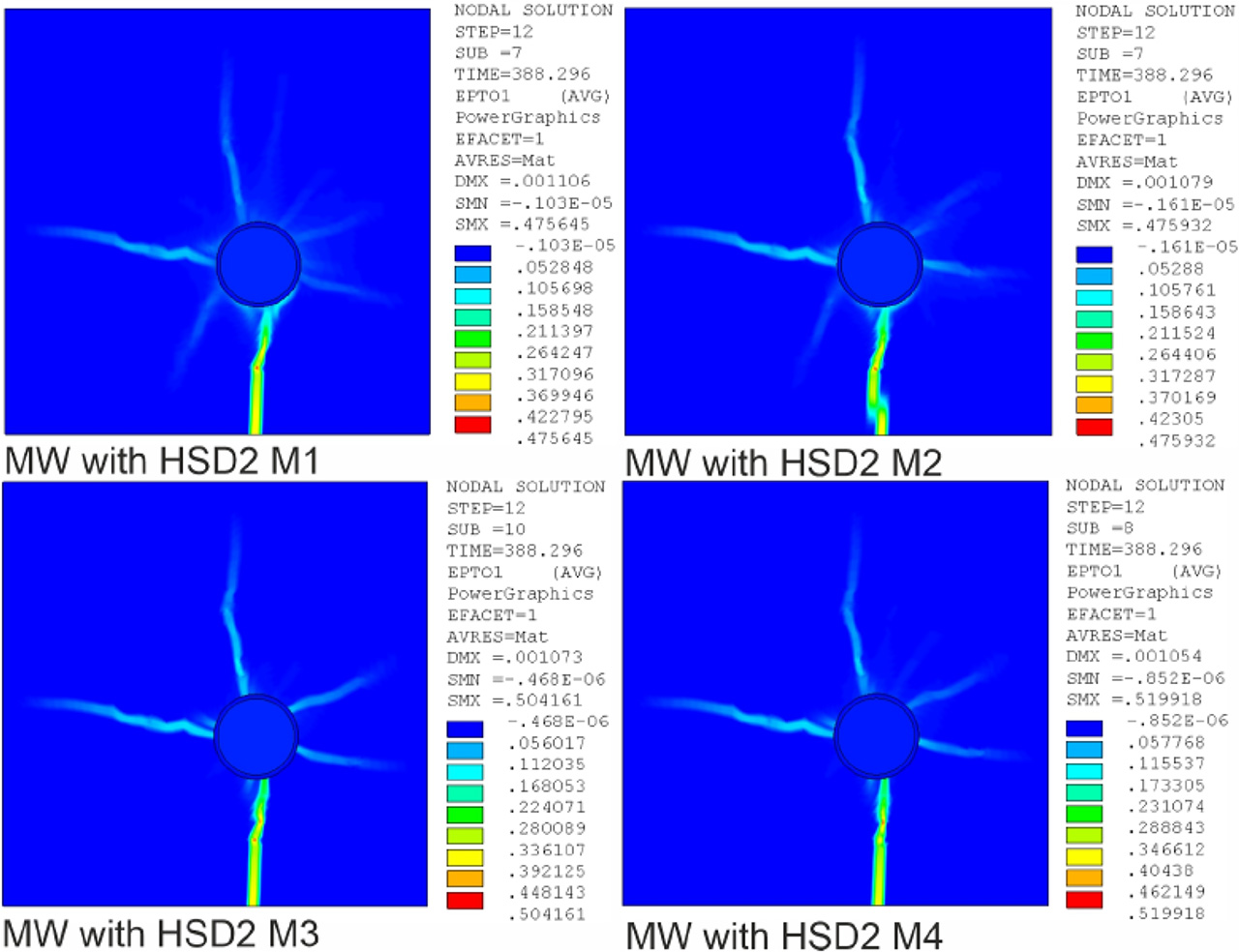
Figure 11.
Maps of the total and principal strains, ɛ1, model MW with HSD2, time t=388 h