
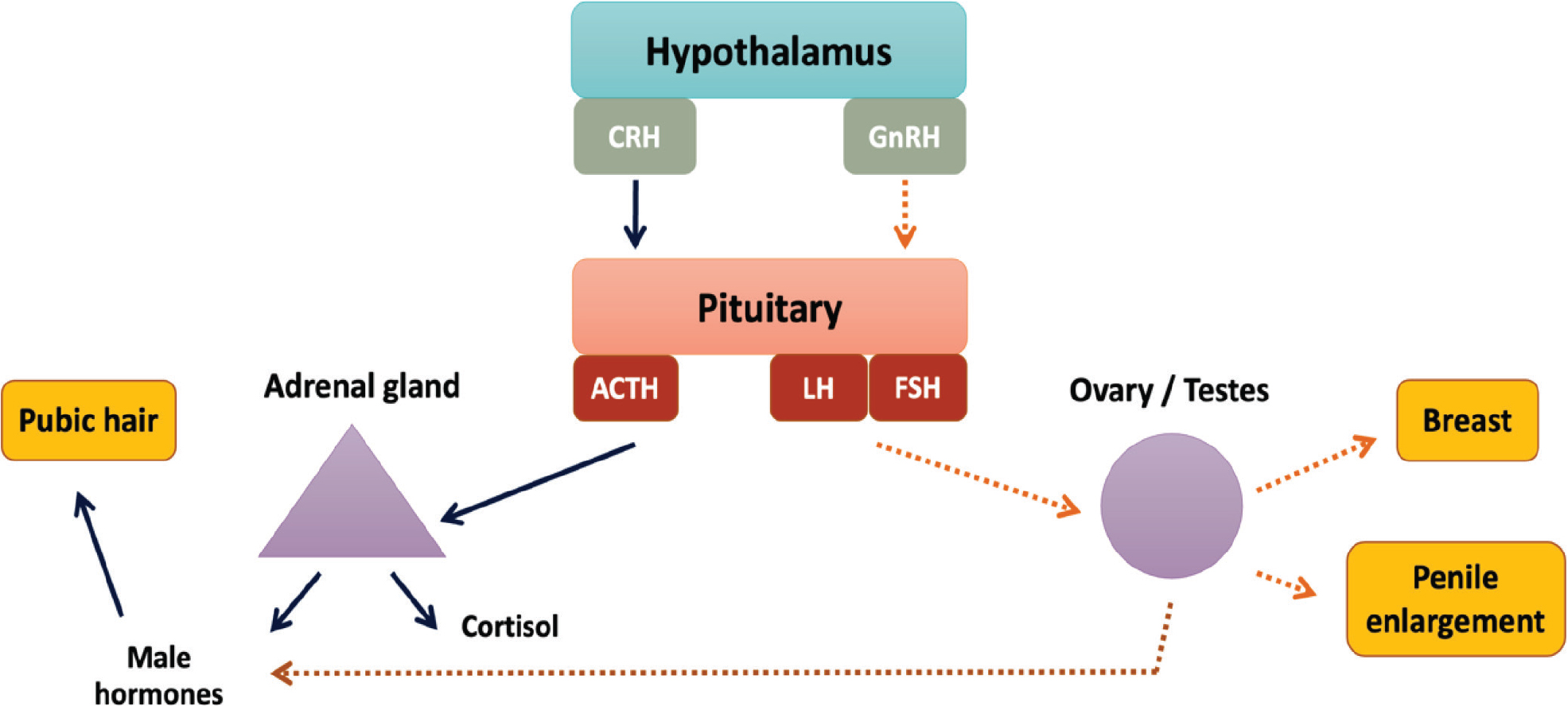
Figure 1.
Development of the HPA and HPG axes during adolescence. ACTH, adrenocorticotropic hormone; CRH, corticotrophin-releasing hormone; FSH, follicular stimulating hormone; GnRH, gonadotropin-releasing hormone; HPA, hypothalamic–pituitary–adrenal; HPG, hypothalamic–pituitary–gonadal; LH, luteinizing hormone.
Table 1.
Tanner classification of breast development in girls [6]
| Tanner | Characteristics |
|---|---|
| 1 | Prepubertal: elevation of papilla only |
| 2 | Breast bud stage: elevation of breast and papilla as a small mound. Enlargement of areola diameter |
| 3 | Further enlargement and elevation of breast and areola, with no separation of their contours |
| 4 | Projection of areola and papilla to form a secondary mound above the level of the breast |
| 5 | Mature stage: projection of papilla only, due to recession of the general contour of the breast |
Table 2.
Tanner classification of pubic hair in girls
| Tanner | Characteristics |
|---|---|
| 1 | Prepubertal |
| 2 | Sparse growth of long, slightly pigmented downy hair, straight or slightly curled, chiefly along labia |
| 3 | Considerably darker, coarser, and more curled. The hair spreads sparsely over the junction of the pubes |
| 4 | Hair now adult in type, but area covered is still considerably smaller than in the adult. No spread to the medial surface of the thighs |
| 5 | Adult in quality and type with distribution of the horizontal (or classically “feminine”) pattern. Spread to medial surface of thighs but not up linea alba or elsewhere above the base of the inverse triangle (spread up linea alba occurs late and is rated as stage VI) |
Table 3.
Tanner classification of genital development in boys [7]
| Tanner | Characteristics |
|---|---|
| 1 | Prepubertal |
| 2 | Enlargement of scrotum and testes. Skin of scrotum reddens and changes in texture |
| 3 | Enlargement of penis, which occurs at first mainly in length. Further growth of testes and scrotum |
| 4 | Increased size of penis with growth in breadth and development of glans. Testes and scrotum larger; scrotal skin darkened |
| 5 | Genitalia adult in size and shape |
Table 4.
Tanner classification of pubic hair in boys
| Tanner | Characteristics |
|---|---|
| 1 | Prepubertal |
| 2 | Sparse growth of long, slightly pigmented downy hair, straight or slightly curled, chiefly at the base of the penis |
| 3 | Considerably darker, coarser, and more curled. The hair spreads sparsely over the junction of the pubes |
| 4 | Hair now adult in type, but area covered is still considerably smaller than in the adult. No spread to the medial surface of the thighs |
| 5 | Adult in quality and type with distribution of the horizontal (or classically “feminine”) pattern. Spread to medial surface of thighs but not up the linea alba or elsewhere above the base of the inverse triangle (spread up linea alba occurs late and is rated as stage VI) |
Table 5.
Physical examination of precocious puberty
| Physical examination | Details | Reasons |
|---|---|---|
| Breast | According to Tanner staging | Assess breast development |
| Testes | Evaluate size using Prader orchidometer | Assess testicular development to differentiate causes |
| Penis | According to Tanner staging | Assess penile development |
| Clitoris | Measure length in centimeters | Assess clitoral development, especially in heterosexual precocity cases |
| Pubic hair | According to Tanner staging | Assess pubic hair development |
| Vulvar mucosa | Color of mucosa | Assess vulvar mucosa appearance which reflect estrogenic effect |
| Rash | Check for café-au-lait spots (irregular border) | Consider McCune Albright syndrome |
| Visual field | Assess vision | Pituitary gland tumors may affect vision |
| Abdominal mass | Palpate abdominal area | Detect abdominal tumors capable of hormone production |
| Dysmorphic features | All dysmorphic features should be observed and recorded | Pallister–Hall syndrome, William syndrome, Temple syndrome are the examples of syndrome associated with precocious puberty |
Table 6.
Etiology of CPP [18]
| System | Diseases |
|---|---|
| CNS lesions | Congenital |
| – Hypothalamic hamartoma – Suprasellar arachnoid cysts – Hydrocephalus – Glioma or neurofibromatosis type 1 – Tuberous sclerosis – Septo-optic dysplasia – Chiari malformations and myelomeningocele Acquired – Tumors: astrocytoma, ependymoma, pinealoma, hypothalamic or optic glioma – Post-insults (perinatal, infection, trauma, radiotherapy) – Granulomatous disease – Cerebral palsy | |
| No CNS lesions | – Idiopathic – Endocrine disruptors – Genetic changes: gain-of-function mutations in the genes encoding KISS1 and KISS1R: formerly called GPR54: G-protein coupled receptor, loss-of-function mutation in MKRN3 and DLK1 – Early exposure to sex steroids (secondary CPP) |
Table 7.
Etiology of PPP [19]
| System | Diseases |
|---|---|
| Boys | –Beta-HCG secreting tumor (CNS/outside CNS) – Androgen secretion by adrenal glands and testes –CAH – Virilizing adrenal neoplasm – Leydig cell tumor – Familial testotoxicosis |
| Girls | – Ovarian cyst – Estrogen secreting ovarian or adrenal glands |
| Both sex | – MAS (PPP, irregular border café au lait spot & fibrous dysplasia) – Hypothyroidism – Exogenous sex steroid |
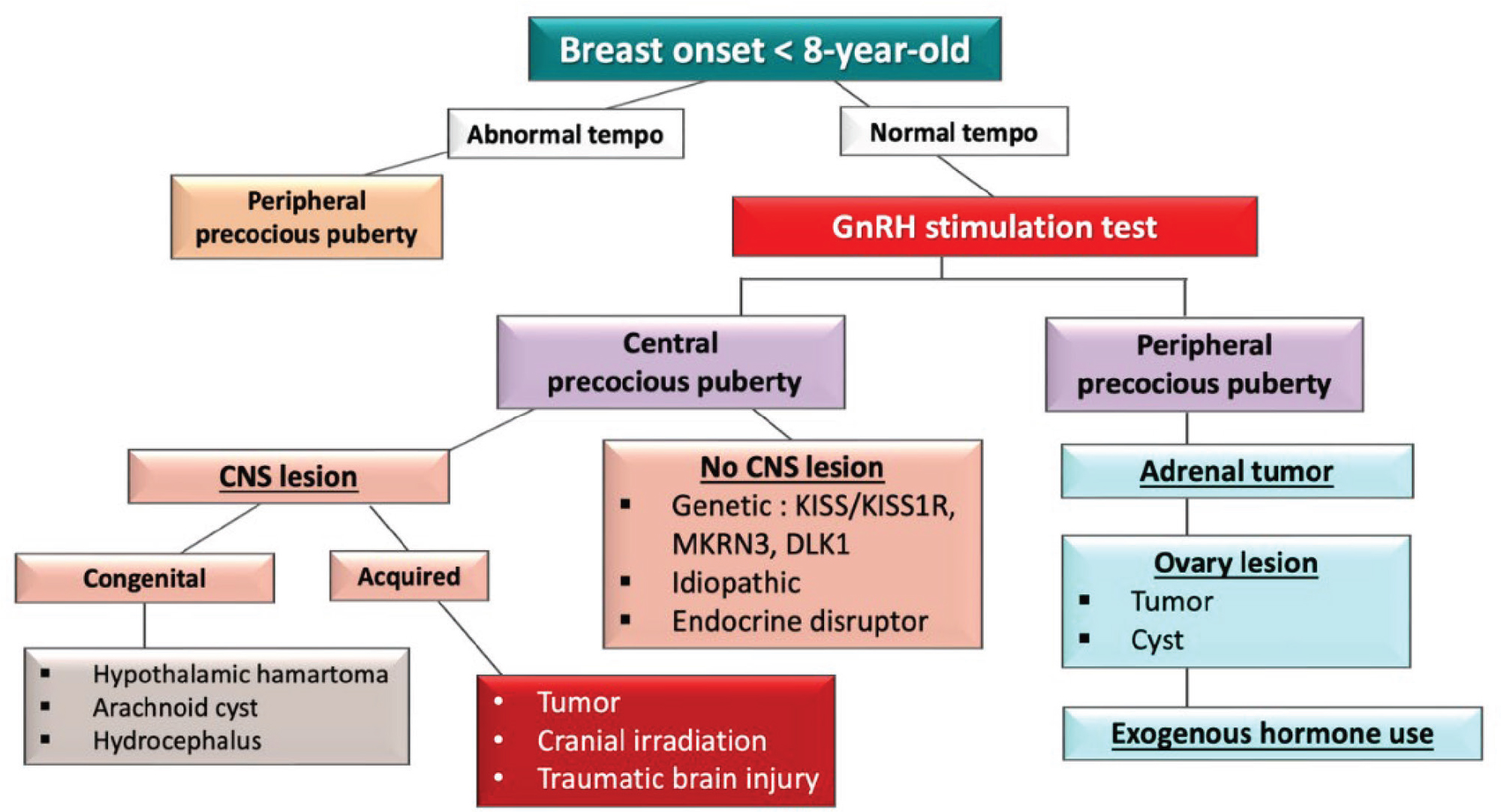
Figure 2.
Diagnostic guidelines for precocious puberty in girls (MAS). CNS, central nervous system; DLK1, delta-like homolog 1; GnRH, gonadotropin-releasing hormone; KISS1, kisspeptin; KISS1R, kisspeptin receptor; MAS, McCune-Albright syndrome; MKRN3, makorin ring finger 3.
Table 8.
Genetic mutation in CPP
| Gene | Protein | Diseases |
|---|---|---|
| MKRN3 [20] | MKRN3 | Suppression of GnRH secretion |
| KISS1 | KISS1 | Disruption of puberty regulation |
| KISS1R [21] | KISS1 receptor | Impair response to KISS1 signaling |
| DLK1 [5] | DLK1 | Imprinting disorder affecting pubertal timing |
| LIN28B | Lin 28 Homolog B | Unknown, homolog of Caenorhabditis elegans protein may play in GnRH secretion |
| NPYR1 | NPYR1 | Inhibitory effect on GnRH pulse activity |
| TAC3 [22] | Neurokinin B | Play role in GnRH release |
| TACR3 | Neurokinin B receptor | Neurokinin receptors, which is G protein-coupled receptor that bind to neurokinin B may play a role in GnRH release. |
| GABRA1 [23] | Gamma amino butyric acid A1 receptor α-1 subunit | GABA-A receptor α-1 subunit that binds to GABA may inhibit GnRH release. |
1 CPP, central precocious puberty; DLK1, delta-like homolog 1; GABA, gamma-aminobutyric acid; GABRA1, gamma-aminobutyric acid receptor subunit alpha 1; GnRH, gonadotropin-releasing hormone; KISS1, kisspeptin; KISS1R, kisspeptin receptor; LIN28B, lin-28 homolog B; MKRN3, makorin ring finger protein 3; NPYR1, neuropeptide Y; TAC3, tachykinin 3; TACR3, tachykinin receptor 3.
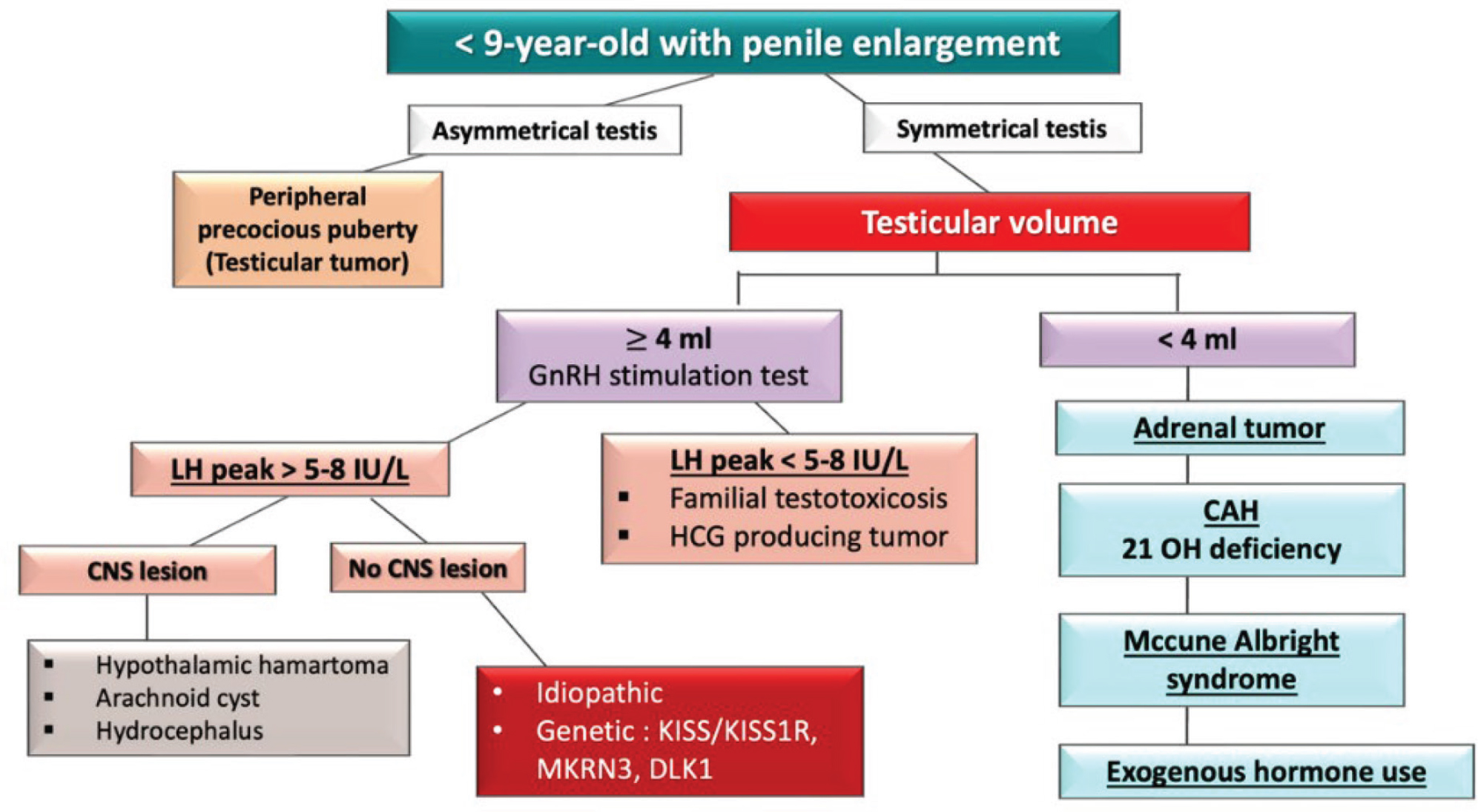
Figure 3.
Diagnostic guidelines for precocious puberty in boys. CAH, congenital adrenal hyperplasia; CNS, central nervous system; DLK1, delta-like homolog 1; GnRH, gonadotropin-releasing hormone; KISS1, kisspeptin; KISS1R, kisspeptin receptor; LH, luteinizing hormone; MKRN3, makorin ring finger 3.